You have decided to sell in Turkey. The Turkish version of your website is live, yet almost nobody from Turkey finds it. Why? In most cases the problem is not your product or your price. It is that your site never meets the words a Turkish buyer actually types into Google. Good SEO services for the Turkish market close that gap: they make your site findable through the exact terms people in Turkey use when they are ready to buy.
I am a web designer and SEO consultant based in Istanbul, and I work on my own. In this article I explain what a company entering Turkey will run into, where translation causes trouble, what to look for when you compare an agency, a firm or a freelance consultant, and when you do not need any of this yet. You do not need a technical background. I will give you enough detail to make a decision.
Turkish buyers search in Turkish, and in their own words
The most common assumption I see from companies abroad goes like this: "Our product is good, our website is good, we only need to switch the language." But search behavior is more than language. A buyer in Turkey picks the word to type based on daily life, family, friends and habit. A term that is standard in your home market may be unused in Turkey, or it may mean something quite different.
Consider a few patterns. In some fields the English term is the one people type, because no Turkish word has caught on. In other fields almost nobody knows the English term and everyone uses a Turkish name. A product can have an official name and a separate everyday name. Buyers also search for a need, not a brand: instead of "the best model from brand X" they type something like "a quiet model for home use". If your site does not answer that sentence, Google has no reason to show you to that person.
Another point is the device. In Turkey a large share of searching happens on a phone, so a page that opens quickly and says its point briefly matters more than a desktop layout squeezed onto a small screen. I will not decorate this with a statistic, but you can run a useful first test yourself: open your own site on a phone and notice how long it takes to see something useful.
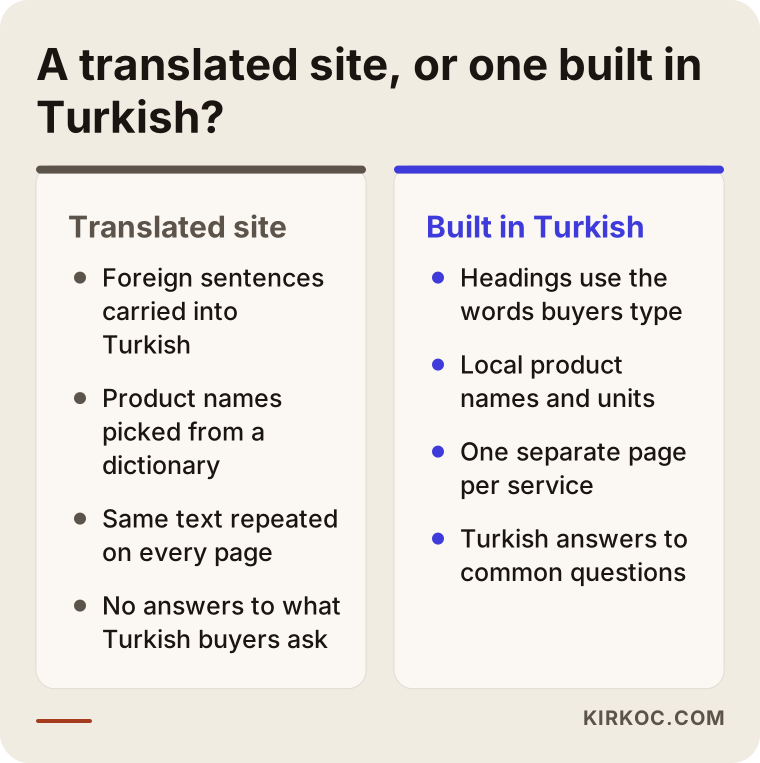
Translation is not localization
Translation moves a text from one language to another. Localization rebuilds that text so it makes sense in the reader's own world. For SEO the difference is large, because a search engine does not ask whether your Turkish is correct. It asks whether the page answers a Turkish search.
On a translated page, the heading is usually the translation of the original heading. On a localized page, the heading starts with the phrase a Turkish buyer searches for. On a translated page, units, currency, address format and contact methods stay in your home habits; on a localized page they are what people in Turkey expect. That also affects trust. If the phone number has no local format, if there is nothing about delivery to Turkey, or if the return policy is vague, the visitor leaves within a minute. A visitor who leaves quickly sends Google a quiet signal that the page did not help.
What does the service actually cover?
SEO for foreign companies in Turkey is not one single action. My work starts with a look at your site and your Turkish competitors and continues with a monthly report. In plain terms it covers the following.
Site review. I go through your site from start to finish and list, point by point, why Google holds you back. On multilingual sites a frequent problem is that the Turkish pages are not explained properly to Google. The page exists, but the search engine cannot tell which country it was made for, or it treats two language versions as copies of each other.
Finding the right searches. I research what your customers in Turkey really type into Google and pick the searches that can bring you business. This is where the translation trap shows up most. Instead of translating your keywords with a dictionary, I look at how a Turkish speaker puts the same need into words.
Technical fixes. Slow pages, pages that will not open, poor phone display and other things Google cares about. A site hosted abroad that loads slowly from Turkey falls under this heading too. If that is the case, I identify it during the review and give you the options in writing.
Content work. I strengthen your service and product pages and prepare articles that answer your customers' questions. The Turkish content is written for the Turkish reader, in their language.
Competitor tracking. I look at what the competitors ranking high in Turkey do differently and update the plan accordingly. Local competitors are often companies you never thought about.
Monthly report. Every month I report in plain language what was done, which searches you rose for and what comes next.
I should also state what is not part of the service. Ad management, running a marketplace store, legal or tax advice, import and customs questions are not things I do. You will probably need help with them when entering Turkey, but they should not be confused with SEO.
Being seen is not the same as being clicked
Showing up in search results is not enough; the person has to choose you. In the results, your page title and short description are a tiny sales line. On foreign companies' sites those two fields are often empty or filled with a machine-translated sentence that makes little sense. Below, I mocked up how two results can look for the same search.
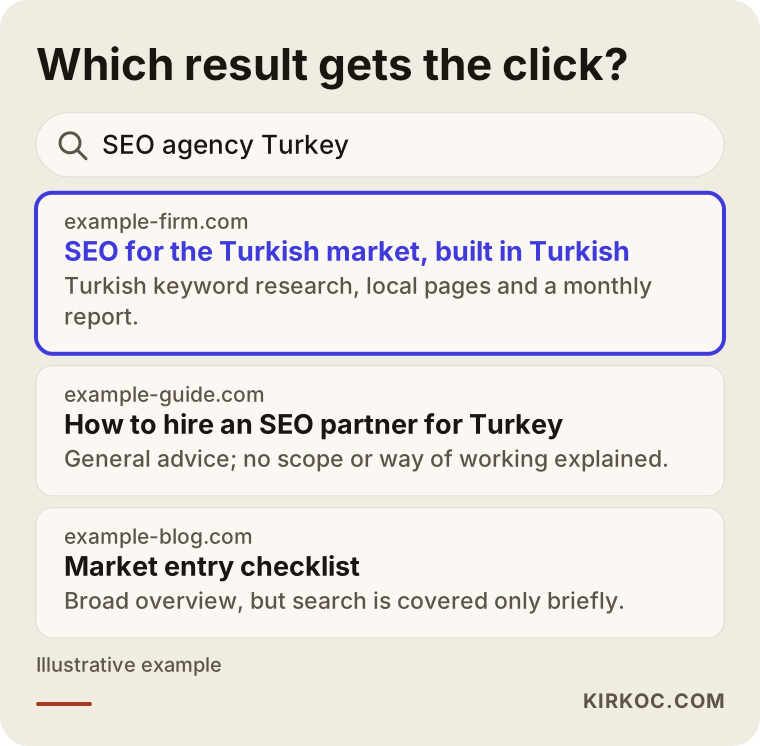
The highlighted result states what it does, for whom and in which language, right in the title. The others look related, but they give the reader no reason to think "I will find what I need here". A better title and description will not change ranking by themselves, but between two results in similar positions they decide which one gets clicked.
Translation traps: the same product, two different words
Translation mistakes come in two kinds. The first kind is visible: broken sentences, misspelled words, nonsense phrases. Anyone who speaks Turkish catches those. The second kind is far sneakier: the sentences look right and the words exist in a dictionary, yet nobody searches with them.
The table below shows the difference with four products. The left column is the name a foreign company uses; the middle one is what a translation tool could produce; the right one is what buyers in Turkey really type.
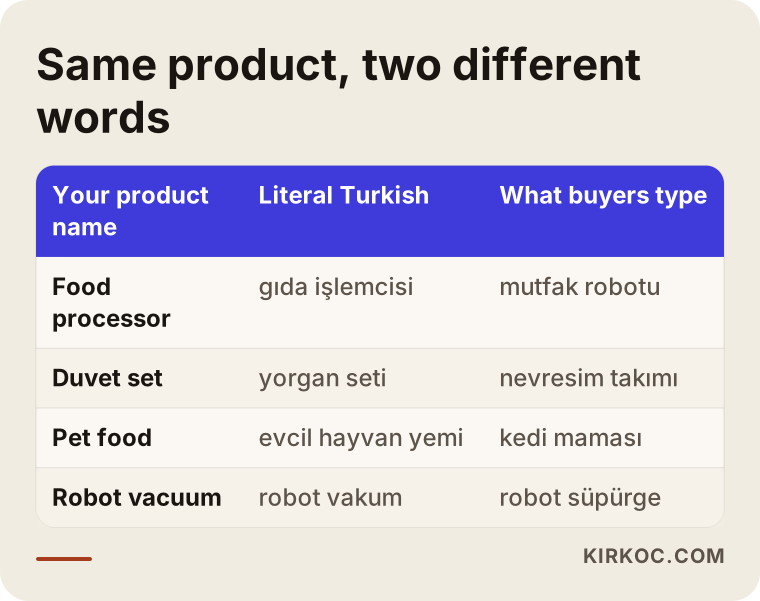
The gap between literal translation and real search can be this wide. A Turkish speaker understands the middle column but would not use those words to look for a product. If your site is written only with the middle-column words, Google has little reason to show you to someone searching the right-hand term.
For that reason a Turkish SEO project starts not with translating words but with search research. You have to tell apart which term gets searched, which carries buying intent and which only shows curiosity. A search that begins with "what is" usually comes from someone gathering information. A search that ends with words meaning "price", "buy", "company" or "have it made" comes from someone close to a decision. Both deserve content, but on different pages.
Brand name, product name and category name
If a foreign brand is not yet known in Turkey, nobody searches for its name. People search for the category: "wooden toys for children", "office chair", "industrial label printer". If your site is built only around the brand name, you will see almost no search traffic in the first months. Until awareness grows, category pages build the bridge. Many companies overlook this, yet the fix is simple: for every main product group, a Turkish page that starts with the category name buyers use.
Common mistakes foreign companies make
Most of the mistakes I see come not from carelessness but from looking at a foreign market from outside. The list below sums up the most common.
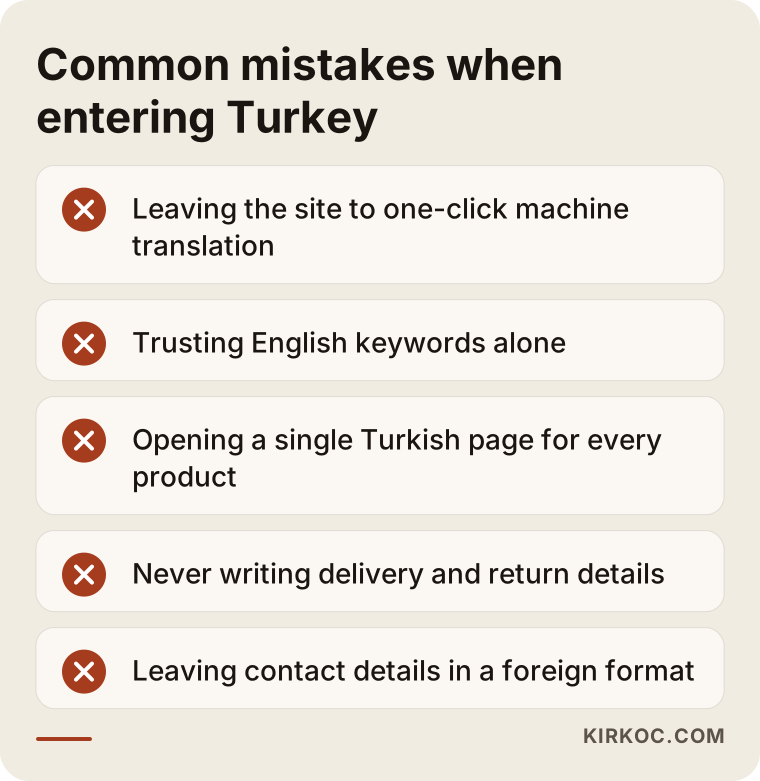
Trusting machine translation. A site translated in one click looks fast and cheap, but it spoils the first impression. The reader concludes that the company does not take Turkey seriously. Translation tools are fine for a draft; the text you publish should be rewritten by a person with Turkish search intent in mind.
Relying only on English keywords. In technical and software fields English terms are common, but in most industries Turkish buyers search in Turkish. Research should settle which applies where, rather than guessing.
Putting everything on one page. Opening one "Turkish" page and stuffing all products and services into it gives Google no clear message about anything. A separate page for every service and product group is easier for both search engines and visitors.
Leaving out delivery, returns and payment information. A Turkish buyer considering a foreign company asks: do they really ship to Turkey, will customs cause trouble, whom do I talk to if something goes wrong? If the site does not answer, even the best SEO will not turn into sales. I do not assess legal or tax details; for those you need your own legal or accounting adviser. My part is making sure that this information sits on the site where the customer will look, in a form that is easy to understand.
Keeping contact details in a foreign format. Giving the phone number with the country code, stating support hours and saying that inquiries are answered in Turkish builds trust. A foreign address and an English-only form turns visitors away.
How working with me runs
I keep the process as plain as possible, because a business owner should know what happens when. It has five steps.
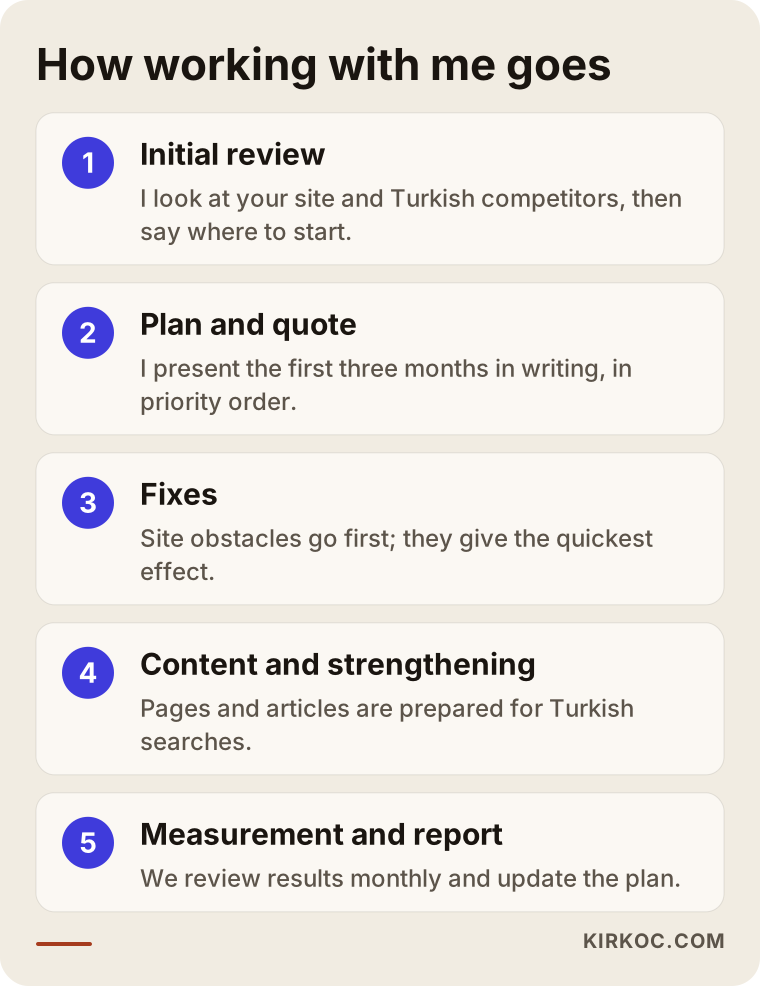
Initial review. I look at your site and your Turkish competitors and tell you where to start. There is no commitment at this point; the goal is to see whether the work makes sense for you.
Plan and quote. I present what will be done in the first three months, in priority order and in writing. For a foreign company the plan covers which pages will be built in which language, which searches are targeted and which technical fixes are needed.
Fixes. Site obstacles go first because they give the quickest effect. Slow pages, wrongly configured language settings and duplicate content are handled here.
Content and strengthening. Pages and articles are prepared for the targeted searches, and your site's reputation is strengthened. Since a foreign company is usually not yet known in Turkey, this stage takes patience, because trust does not appear overnight.
Measurement and report. We review the results together every month and update the plan. I work remotely; meetings are held online and communication is in writing, so decision makers in different time zones can follow along.
Because the work is remote, you do not need an office in Turkey or to travel here. Access to your site and search statistics, information about your products and one person who can decide are enough.
What shapes the cost?
I will not give a number in this article, because the right number only appears once I look at your site. I can, however, tell you what moves the cost up or down, so you can compare quotes sensibly.
- Current state of the site. Building a Turkish section from scratch is a different job from repairing an existing one.
- Number of products or services. Every main group needs its own page and its own search research; more groups mean more work.
- Competition in your sector. Rising in a field where many local companies compete takes longer than in a field with few competitors.
- Amount of content. How many pages and articles are prepared makes up most of the work.
- Technical problems. If language settings are broken in a multilingual setup, or the site loads slowly from Turkey, extra work is needed.
- Duration and reporting. An ongoing monthly engagement is priced differently from a one-time review.
A quote that looks cheap may mean one of the items above was quietly left out. A good quote states what is included and what is not.
Suppose a home textile maker from the UK
Suppose a mid-sized home textile maker in the UK wants to sell retail in Turkey through its own website. The site was translated into Turkish, and products were named with dictionary equivalents such as the literal "bed set" and "quilt set". Hardly anyone visits. The review shows that Turkish buyers use different words for the same products, and the whole range is squeezed into one general Turkish page. The plan includes a separate page for each product group, renaming products according to search research, collecting delivery and return information in a dedicated Turkey section, and writing a few articles that answer the questions buyers ask most. In the first months the target is not a ranking number but the right pages starting to appear for the right searches; the result then develops over time and depends on what competitors do.
Suppose a software company from the US
Suppose a US software company wants to sell a subscription to small businesses in Turkey. The Turkish version exists, but the main product terms were left in English. The review shows that Turkish small business owners describe the problem in everyday terms, such as tracking stock, keeping customer records or issuing invoices, and not with the English product vocabulary. The plan builds pages that explain the product through the business problems it solves, and prepares content that answers the questions people ask before buying. Deleting every English term would also be wrong here; research decides which term is used for which reader.
These two examples are not real clients. They are made-up scenarios meant to show how the work differs between sectors.
How to compare an agency, a firm or a consultant
Many people and companies offer SEO in Turkey, and for a foreign company the hard part is telling who truly understands Turkish search. When you collect quotes, you can ask the following.
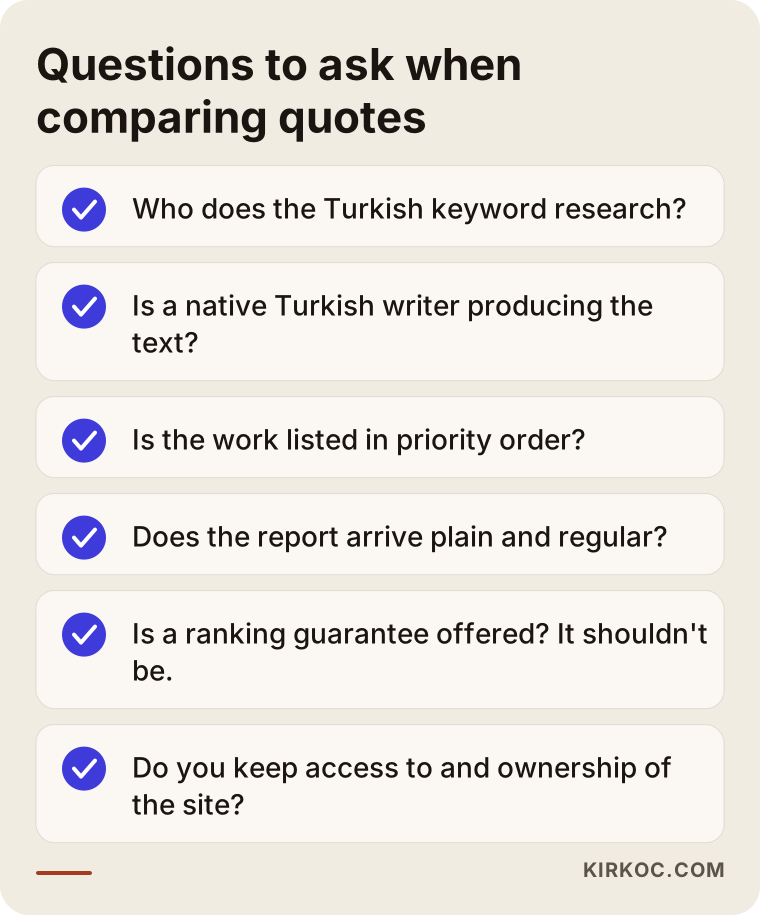
Who does the Turkish keyword research? If the answer is "a tool does", be careful. Tools provide data, but a person has to judge which data carries buying intent.
Who writes the text? If it is not a native Turkish speaker, the traps described above are almost unavoidable.
Is the work written down? "We will optimize your site" is not a plan. Which page changes how, and in what order, should be on paper.
How does the report arrive? You should get a plain, regular report in your language: not a pile of numbers, but what was done, what happened and what comes next.
Is a guarantee offered? Anyone who guarantees a specific position on Google is telling you something untrue. Google decides rankings and nobody can promise on its behalf. I do not guarantee rankings or sales either.
Who holds access to the site? When the work ends, you should own your site and accounts. Do not enter an arrangement where someone keeps the access to tie you to them.
Ask also that every quote lists what is out of scope. A person who is open about the limits usually knows what they are doing.
How is a Turkish page built?
So the steps above do not stay abstract, here is how a typical product page can be laid out for the Turkish market. The domain name in the example is made up.
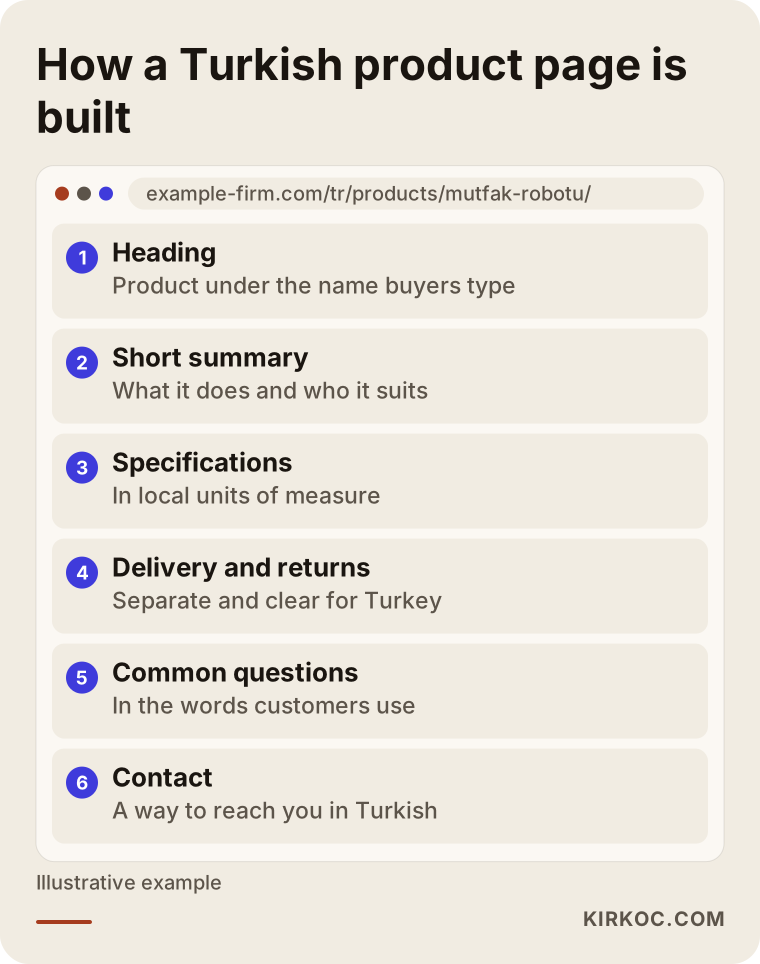
The first thing to notice is the address itself. The Turkish page should have its own understandable path under a separate language section. Second, the heading should name the product in the words buyers use. Third, a delivery and returns section made for Turkey removes the doubt visitors feel most. The common questions block is among the most useful parts of the page for people and for AI-assisted search tools alike, because it answers real questions briefly.
This layout is not only for product pages. For service companies the same logic applies: a visitor who can find at the top what the service is, whom it suits, how it works and how to reach you will keep reading.
How are languages and countries kept apart?
On a multilingual site you need to tell Google that the Turkish page and the pages in other languages belong together. It is a technical setting, and if it is wrong the search engine may treat two pages as copies of each other or show the wrong language to the wrong user. I check this during the review. What you should know as the business owner is that the setting exists and that, if it is wrong somewhere, your Turkish section can stay invisible.
When you do not need SEO for Turkey
SEO is not the right first step for every foreign company. In the following cases something else may come first.
- You cannot sell in Turkey yet. If your goods get stuck at customs, delivery is not possible or you cannot take payments, bringing visitors makes no sense. Solve those first.
- Your customers come through corporate purchasing. In a line of business with a few large direct accounts, public search may bring little. Direct sales work could be more productive than SEO.
- Your budget does not cover adapting the product to Turkey. If the product, packaging, labeling and support do not fit Turkey, SEO will only attract interest and increase disappointment.
- You expect fast results. SEO takes time. If you have a short-term sales target, another channel such as advertising may fit better. I do not manage ads, but I will tell you plainly.
- You offer a very narrow, very local service. If you serve one city face to face, local visibility work suits better than general SEO.
Honestly, if one of these shows up in the initial review, I will tell you so. Selling an unnecessary service would harm both of us in the long run.
Do it yourself or hand it to a specialist?
There are things you can do yourself. Writing delivery and return details in Turkish, adjusting contact information for Turkey, searching for your own products on Google with Turkish words and reading what competitors write do not require a specialist. I would even recommend doing them, because seeing the market with your own eyes lets you brief a specialist more clearly.
Where a specialist helps: telling which searches carry buying intent, setting up the technical side of a multilingual site correctly, working out why competitors are ahead, and measuring results regularly. Here, experience prevents months of work in the wrong direction.
There is a middle path: have a specialist do the first review and the plan, and let your own people carry out part of the work. For companies with a limited budget but patience, that is a reasonable way. Because the plan is written, who does what stays clear.
Frequently asked questions
Do you work on search engines other than Google in Turkey?
Searching in Turkey happens largely on Google, and the work is planned mainly around it. A clean structure, fast pages and clear content help other engines too, so you get a good base there as well. I do not promise separate work for a specific other engine.
My site is in English. Do I really need a Turkish version?
Turkish customers mostly want to read in Turkish when they decide to buy. With an English site you may reach a technical or international audience. If your goal is the broad Turkish public, a Turkish version is needed; if it is a few large corporate customers, an English site may be enough. We settle this in the initial review based on your audience.
My Turkish site is machine translated. Must it be redone from scratch?
Often it does not need rewriting from scratch, but it does need to be reviewed from the start. The pages expected to bring the most traffic are rebuilt first and the rest are repaired in turn. In the review I put in writing which pages come first.
When will I see results?
In SEO, results come over time. I cannot give an exact period because it depends on competitors, the state of the site and the sector. Early improvements show once technical obstacles are removed; rising for competitive searches takes longer. In the monthly report I show concretely what has moved.
Do you guarantee rankings or sales?
No. Only Google decides rankings, and sales also depend on your product, your price and the customer experience. Be cautious about any quote that includes a guarantee. I report what I did, why, and what came of it, openly.
Can I get SEO done if I have no office or company in Turkey?
You do not need an office in Turkey for SEO work. But setting up sales, invoicing, delivery and legal obligations properly is a matter for your own legal and financial advisers. I work on the site and search side, and I do not assess those topics.
How do I get started?
Send me your website address, the product or service you want to sell in Turkey and who you want to reach. After the initial review I tell you where to begin; whether to continue is entirely your decision.
In which language will the pages and communication be?
Turkish pages are prepared in Turkish for the Turkish reader. With you, I keep communication in writing in our shared language, so what will be done and when stays on record.
If you want to find out why your site does not show up in Turkish searches, write to me and I will look at your site and tell you where to start. You can read the details on the SEO services page and contact me from there.