You run a study abroad consultancy. You have school partnerships, you know the application paperwork inside out, and maybe most of your clients still arrive through word of mouth. But when someone types "language school in Spain with an adviser" or "how to apply for a master's in Germany" into Google, your firm does not appear, and when it does, the site fails to settle the questions that decide the enquiry. This business has an unusual difficulty: the same page is read by a 19-year-old student and by the parent who is worried on their behalf. In this article I explain how a site that brings in enquiries for an education advisory firm is built, what SEO services cover in this field, and how to judge a quote when you are comparing options.
The student searches, the parent decides
In most industries the person searching and the person paying are the same. In study abroad they often are not. The student scrolls through countries, cities and school videos on a phone, then shows the interesting ones to the family. The family asks entirely different questions: "Is this company real?", "Who am I trusting my child to?", "What exactly is this payment for?" One website has to persuade two different readers.
The student side runs on discovery and excitement. Which country offers which program, what is the language requirement, what is daily life like, what can I do after graduating? These are broad, informational searches, and no company name is typed yet. The parent side looks for reassurance: how does the process work, which documents are needed, what does the adviser do, what do I do, at which stages are payments made? Parents type these as full sentences into the search box, but just as often they hunt for them silently once they land on your site. A parent who cannot find the answer closes the tab, and nobody on your side ever knows.
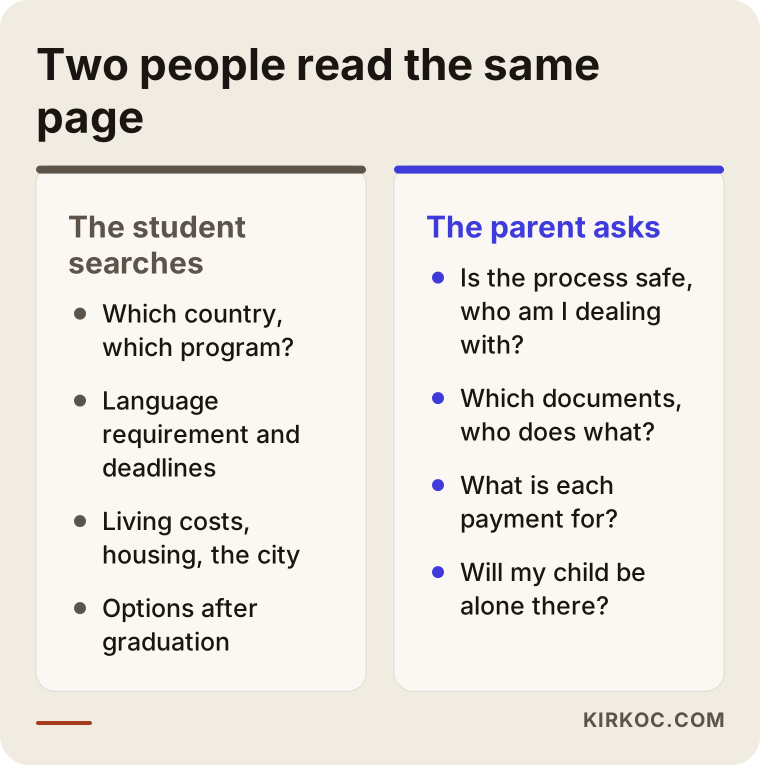
That is why the site needs two layers. The first layer is for the student: country, program, city, language school and application calendar pages. The second layer builds the parent's trust: a step-by-step account of the process, what the service includes, who does what, common questions, contact details and a real office address if you have one. Both can live on one page. What matters is that the answer a parent is looking for is not hidden behind a "contact us" button. Google also understands and shows clear, complete pages more readily than vague ones.
One thing up front: everything here is about building the site properly. No SEO work can guarantee you the top position or a set number of applications. If someone does promise that, treat it as a warning sign when you read their quote.
Who this service suits, and who it does not
Not every study abroad advisory needs SEO right now. To be honest, your priorities may lie elsewhere in these cases:
- If nearly all your clients come through past students' recommendations and school or institution agreements, and you are already at capacity through that channel, search may add workload you do not need yet.
- If you cannot yet describe the service clearly (which countries, which program types, which stages you support), settle that first. SEO cannot explain a service that has not been defined.
- If your site lacks even basic contact details, an address or any hint of who works there, the problem comes before search: it is a trust gap. Fixing it takes days and needs no SEO budget.
- For a one-time, very short campaign, such as an announcement open only until a fixed date, SEO is too slow and other channels make more sense.
SEO tends to pay off in these situations: firms that have a site but receive few or no enquiries from search; advisories that run only on social media and ads and watch demand stop the moment the ads stop; firms offering several countries but describing them all on one page; and newly opened practices that nobody knows yet. This lines up with the "who it's for" section on my service page: businesses with a site but no customers from Google, people who do not want to depend on an ad budget, and those who bought SEO before and saw no result.
A long decision, and searches that follow the season
Study abroad is not a "need it now" service like a locksmith. The decision usually stretches over months. A student collects ideas, narrows down countries, talks to the family, and only then looks at advisory firms. During this time the same person may reach your site three times, through three different searches, in different weeks. On the first visit they read an article about "bachelor's degrees in Canada". A month later they type your firm's name. After that they fill in the form.
So it is not enough for your site to address people who have "already decided". There should be an entry point for every stage: country and program guides for the early stage, the advising process and common questions for the middle stage, the application calendar and contact page for the late stage. A visitor walks in through one door, gets to know you, and comes back. To measure this, look not at individual visitors but at the enquiries that eventually arrive.
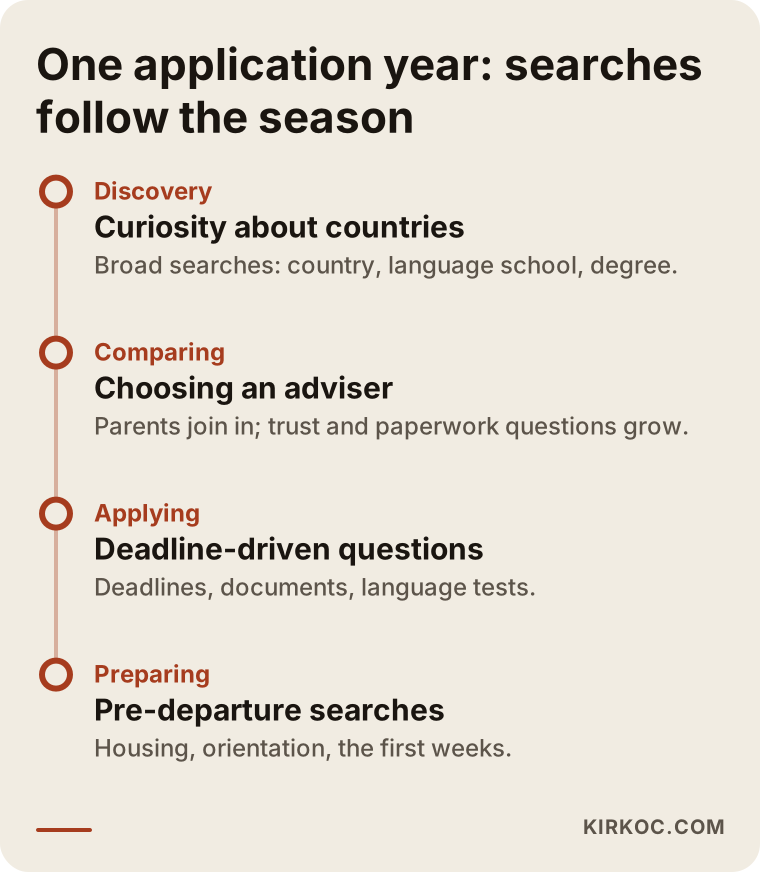
There is also a calendar effect. Application seasons differ by country and program; searches rise sharply in some months and go quiet in others. Instead of guessing, look at your own site's history and at search data from past years. The practical conclusion is that some pages must be ready weeks before a season opens. A page with outdated dates signals that the site is neglected. A page refreshed as the season approaches tells both Google and the reader that the information is current. The key is to check dates and conditions against the official school and government sources before writing them: a wrong date on your site costs far more than any SEO gain.
Country and program pages: the backbone of the site
The mistake I see most often on study abroad sites is every service piled onto a single page titled "Study Abroad". People do not research this with one search; they run many specific ones: "language school in Malta", "bachelor's programs in the Netherlands", "master's application process in the UK", "language course in Germany before university". Google wants to show each search the page that fits it best. A single page tries to fit all of them and so fits none.
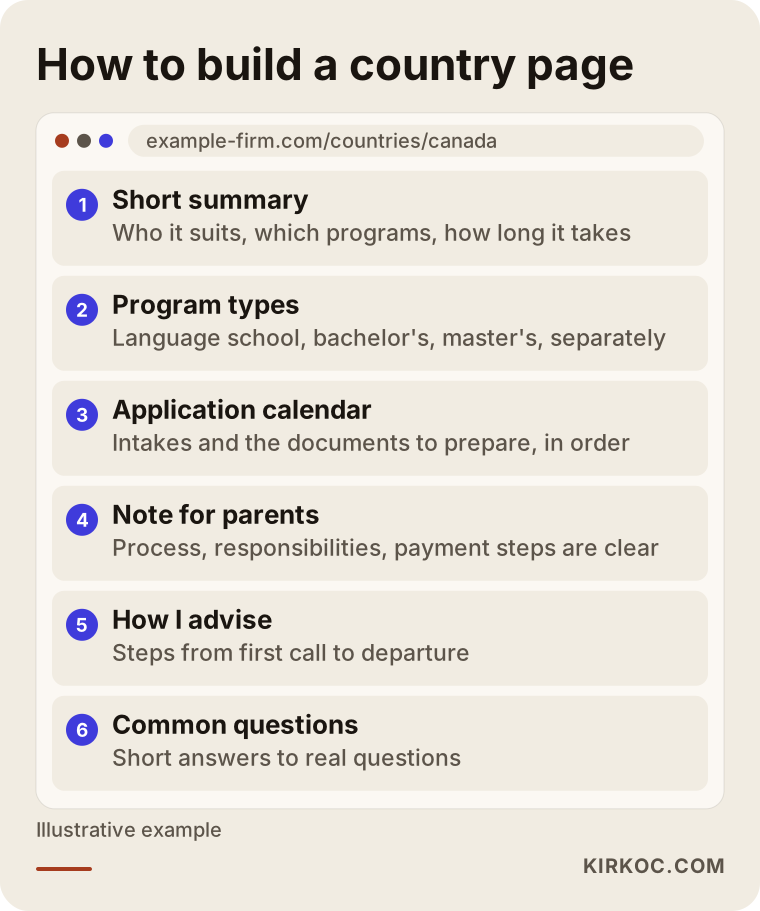
The right structure is one page per country, and within each, a split by program type: language school, bachelor's, master's, summer program, internship and so on. Each page should carry:
- A short summary: who this country and program suits, how long it takes, what it includes and what it does not.
- Application seasons and the documents to prepare, with dates taken from official sources.
- Genuine, uncopied information about the country: cities, daily life, transport, student life. Write it from what you know and from your advising experience rather than copying other sites.
- The steps of your advising process specific to that country.
- A plain note for parents: who does what, and what is needed at each stage.
- Frequently asked questions.
A subtlety here: opening a thin country page is also a mistake. If you do not really work with a country, or have only helped a few students there, do not inflate the page. Google notices thin filler and readers lose trust. Five strong pages about countries where you can offer real knowledge beat twenty weak pages. You expand over time.
City-level searches are a separate matter. If your office is in a particular city, searches like "study abroad adviser near me" depend on your Google Business Profile, your address and your reviews being kept up to date. Many parents want to meet their child's adviser in person. For a firm that works only online, that need must be met another way, for example by saying clearly on the site that video meetings are available.
What do clients search for, and how?
Splitting searches into four groups works well in this field.
Country and program searches. "Language school in Canada", "university in Germany", "master's in the UK". Nobody is looking for a firm here; they are looking for information. If your answer is a good guide and there is a natural path from it to your advisory service, this is where first contact happens.
Process and paperwork searches. "What documents do I need for a student visa", "how to apply for a master's abroad". Be careful here: visa and immigration rules change often and differ by country. Rather than handing down firm rulings, it is both accurate and safe to say, "check current requirements with the official source of the country concerned; I support you through these steps of the process." If you do not give legal or immigration advice, say so openly.
Adviser and company searches. "Study abroad consultant", "language school advisory", "do education consultants charge". These sit closest to a buying decision. Your scope, how you work and what determines the cost must be written down clearly. You do not have to publish a price, but explaining what decides it builds trust before the first call.
Trust searches. "[Firm name] reviews", "is [firm name] legit". You cannot choose these searches, but you can shape what answers them: a Google Business Profile, consistent contact details, genuine student reviews (with permission and real), an about page and a clear picture of who works there. Inventing or buying reviews is unethical and ruins a brand when exposed.
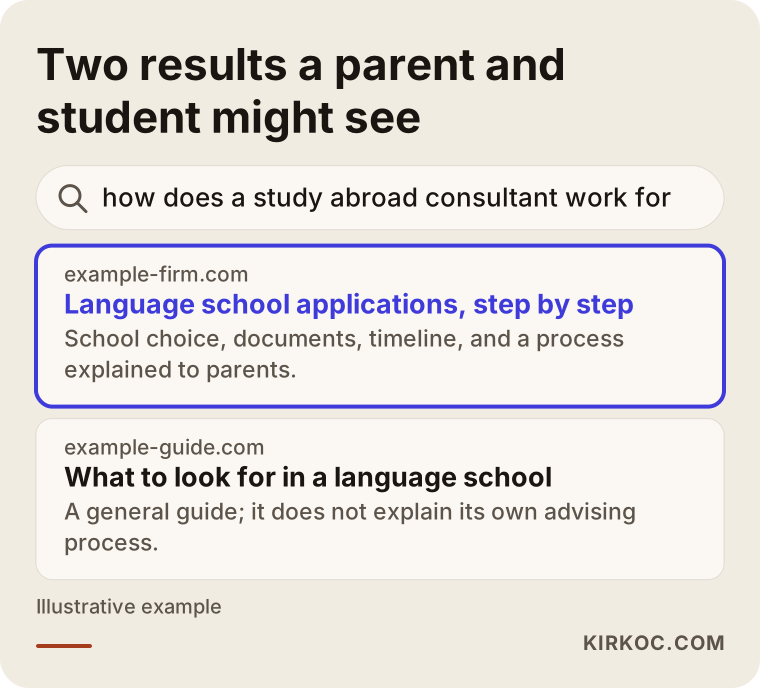
As the mockup shows, two different pages can answer the same question. A page that explains the process in its own steps, with parents in mind, carries a much stronger invitation than one that only gives general advice. When your site stops being just a "general guide" and also answers "how does this firm work", that is what makes the difference in commercial searches.
AI answers and language school searches
More students and parents now ask an AI assistant instead of typing into a search box: "Which advisory firms should I look at for a language school in Canada?" Whether your firm appears in these answers is not in anyone's control, but some things are known to raise the chance. Describe your services in clear plain text, give country and program information on separate pages, keep contact details identical everywhere, answer common questions in real language and keep your reviews consistent. This area is called optimization for AI answers (GEO). The basics are the same as for SEO; the emphasis shifts toward clear, verifiable information.
What determines the cost
I cannot sum up the cost of this kind of work in one number, because scope varies so much from site to site. The main factors are:
- How many countries and program types need pages. An advisory with three countries is not the same workload as one with fifteen.
- The current state of the site. A slow site, or one that breaks on phones or has many technical problems, needs repairs first.
- How competitive the searches are. In a crowded country and program search, more and stronger content is needed.
- The number of languages. Whether the site will be in one language or several.
- The content pace. How many new pages or articles are published each month.
- How often you want reports and calls.
When you receive a quote, look past the single total to what it covers. Which jobs happen in the first three months, which are ongoing, how will reports arrive, how does the agreement end? The framework on my service page is the same: a site review, finding the right searches, technical fixes, content work, competitor tracking and a monthly report.
How we would work together
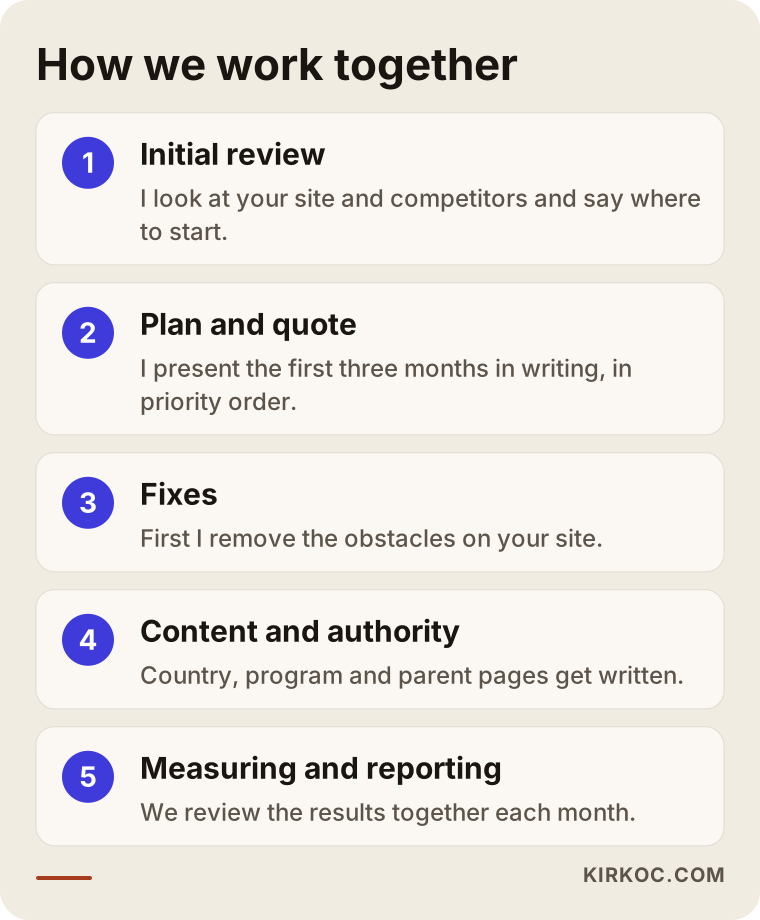
I run the process myself as one person, so the person you talk to is the person doing the work. The steps go like this:
- Initial review: I look at your site and competitors and tell you where to start.
- Plan and quote: I present what will be done in the first three months in writing, in priority order.
- Fixes: I remove the obstacles on the site first, because they have the fastest effect.
- Content and authority: Pages and articles for the target searches are prepared, and your site's reputation is strengthened.
- Measuring and reporting: We review the results together each month and update the plan.
For a study abroad firm, the content step matters most: I prepare country and program pages, the parent section and application calendar articles by taking information from you. Only you know which schools you work with closely and in which country you are genuinely strong. I turn that into search language and a readable structure. What I need from you is accurate information and your involvement in decisions. I work remotely, so our meetings happen online.
Do it yourself, or hand it to a specialist?
You can, and should, take some of the first steps yourself. You do not need an expert to set up and fill in your Google Business Profile, write your address and phone number identically everywhere, update old dates on the site, ask your students for reviews with their consent, or describe your scope in a few plain sentences.
Handing it to a specialist makes sense when you do not know which searches deserve investment, when the site is technically slow or broken, when you want to build country and program pages systematically, when you have no time for regular content, or when you cannot read the results of earlier attempts. SEO is not a one-time job; it moves forward month by month. If your time allows, doing it in house is possible, but taking the first direction from a specialist saves wasted effort.
Two scenarios
First scenario. Suppose a small language-school advisory in a mid-sized American city has worked for years through recommendations. Its site describes three countries on one page and never explains the process. Parents phone and ask, "How did we find you, are you reliable?", and these calls run long. In this case my first job would be a separate page for each country, a process page and a section just for parents. That way the people who reach the first call already know the basics and arrive with clearer questions. Enquiry numbers may not change in the first months; SEO takes time, and that should be said at the start.
Second scenario. Suppose another firm focuses on bachelor's and master's applications, offers many countries and has a site built years ago. Pages show dates from past seasons and are slow to open on a phone. Here the technical fixes and clearing out the outdated content come first. Then pages are rewritten, starting with the two countries that bring the most applications, and the others are added in turn. Both scenarios are hypothetical, but the point they make is real: see the site as it truly is before making a plan.
Common mistakes on consultancy sites
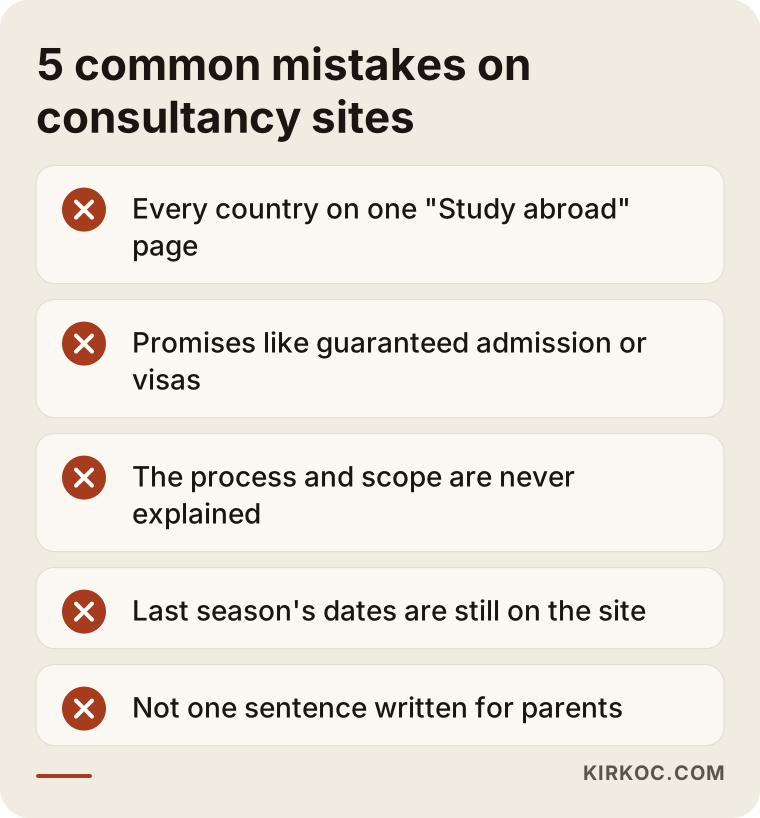
Even long-established sites repeat the same errors:
Guarantee language. Phrases such as "guaranteed admission", "guaranteed visa" or "guaranteed scholarship" are ethically doubtful and carry legal risk. Schools and governments make those decisions, not advisers. Your site should show that you manage the process, prepare documents properly and stand beside the student, without promising the outcome.
One page, every country. As described above, a single general page gives neither Google nor the reader enough.
The process is never explained. This is the information parents look for most. "Contact us" is not enough; show what happens from the first call to the flight.
Old dates. If last season's application dates sit on the site, nobody believes it is current. Verify against the official source and update.
Ignoring the parent. If the whole text speaks to an 18-year-old, nothing is left for the person who makes the decision.
Copied content. Pasting school or country descriptions straight from the schools' own sites creates no value in Google's eyes. Add your own observations, your own student experiences (protecting personal data) and clear summaries.
Not measuring. Looking only at visitor numbers misleads. What matters for you is how many people fill in the form, call or write. Without tracking these month by month, you cannot know which page works.
How to compare quotes and SEO specialists
When you have several quotes, check these criteria before the numbers:
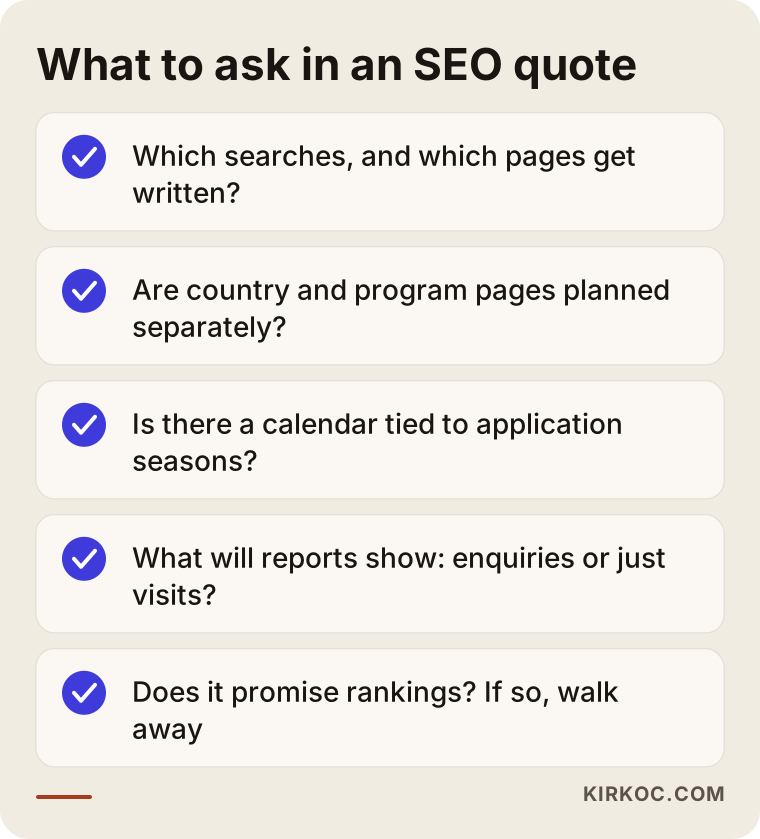
- Is it clear what they will do? Which searches, which pages, which technical fixes should be listed one by one. "We will optimize your site" is not a plan.
- Do they understand your field? Ask about the country, program and parent split. If they do not raise this structure themselves, you may be getting a template quote.
- Do they give guarantees? A promise of a first-place ranking or a set number of applications is not a trustworthy sign.
- What will the report show? Data that touches your business, such as enquiries, forms and calls, or only rankings and visit counts?
- Who will you work with? Will the person presenting the quote do the work, or will it be passed to someone else?
- Agreement and exit. The term, who owns the pages and content at the end, and how they are handed over should be in writing.
- Language. If they speak in terms you do not understand, that is also a sign: explaining things plainly to a business owner is part of the job.
Price alone is not the best yardstick. A very low quote usually means little work; a very high one should make you ask whether the scope is really needed. Comparing prices only makes sense once the scope is equal.
Questions to ask yourself before you start
Answering a few questions before a call speeds things up. Which countries and programs earn you the most, and do you want to be most visible for those? Are your clients mostly students, or is it the parent who pays? In which periods of the year are you busiest? How many of your enquiries come from the site today, and how many from recommendations? Which pages on your site are truly current? These answers are the raw material I use to decide which searches matter and to shape the first three months.
Frequently asked questions
How long does SEO take to work for a study abroad consultant?
I cannot give a fixed time; it depends on the site, the competition and the scope of the work. The effect of technical fixes may show earlier, while new pages usually take weeks or months to settle in search results. Be wary of anyone who gives a guarantee.
Should I write country pages or blog articles first?
Usually country and program pages first. They describe your service directly and answer the searches closest to an enquiry. Blog articles then support them by answering questions about process and paperwork.
Do I need a separate page for parents?
Most of the time yes, or at least a separate section. How the process runs, who does what and at which stages payments happen is what parents look for most. That information should sit together in one place.
Should I write visa and application requirements on the site?
You can describe the general picture, but say that current requirements must be checked with the official source of the country and school concerned. Rules change often, and wrong or outdated information leaves both the reader and you in a difficult spot. If you do not give legal advice, say that too.
Why do I need SEO when I have social media and ads?
When ads stop, demand stops; SEO is an asset that builds up. They do not exclude each other. Ads are fast but temporary, SEO is slow but lasting. Many advisories use ads for the short term and pages for the long term.
How should I collect reviews?
Ask real students, with their permission and without pressure. Asking them to write a review on your Google Business Profile is the most common way. Do not buy or invent reviews; if it comes out, you lose trust.
My site is in one language. Do I need to write in other languages too?
If your audience speaks only one language, one is enough. If you will also work with schools or with students from elsewhere, consider separate pages in those languages. That adds workload and affects the cost.
Is it risky to trust my consultancy to a one-person specialist?
Every model has advantages and risks. With one person, the advantage is that the person you talk to does the work; the risk is that it depends on that person's availability. The quote should state the duration, deliverables and how we communicate. I run this work alone and remotely.
Let's talk
A first review is enough to see what your site does well and what it lacks today. I can look at your country and program pages, your parent section and your application calendar together with you and give you a written plan. Ask what you want to know, and we can decide together whether we are a good fit: you can reach me through the SEO services page.