You have received three SEO proposals. One is a single page, one is a long slideshow, and one is just a price and a few bullet points. How do you know which one is right? To someone who does not work in this field, the proposals look alike, and they all promise the same thing: more visitors and more customers.
I am an independent SEO consultant, and besides delivering SEO services myself, I often help clients read proposals they received from other people. In this article I explain what a good proposal should contain, which signs should make you cautious, and what to prepare before you ask anyone for a quote.
What to prepare before you ask for a proposal
The quality of a proposal often depends on what you ask. If you write "Can you do SEO, and how much?", the answer will be little more than a price. Gather these things first:
- Your goal: Do you want more phone calls, bookings, store visits or online orders? "More traffic" is not a goal.
- Your site address and access: Say that you can share your Google Search Console and Analytics accounts, if you have them.
- What was done before: If you had earlier SEO work, explain what was done, when it ended and why.
- Your competitors: Which three or four businesses attract the same customers as you?
- Your budget frame: You do not have to name a number, but saying whether you are thinking monthly or one-off puts all the proposals on the same footing.
With this preparation, the proposals you receive will look more alike, and comparing them gets much easier.
Six things a good proposal contains
Not every proposal has to be the same length. But you should be able to find an answer to each of these six headings:
- Assessment of the current situation: Did anyone actually look at your site? Are there observations specific to you, such as pages that Google does not show or unclear page titles, or is it a generic text that could go to any client?
- Goal: Does it say what the work is meant to achieve and which services or pages will be pushed?
- List of tasks: Are the tasks and their frequency written concretely? I explain how to read package contents in my article on SEO packages.
- Reporting: When and in what form will you get a report? Does it explain the work done, or does it only show charts?
- Duration: How long will the work run, and when can you expect to see first signs? An honest proposal gives a reasonable range, not an exact date.
- Exit terms: If you want to stop, what happens? Who keeps the site access, the written content and the accounts?
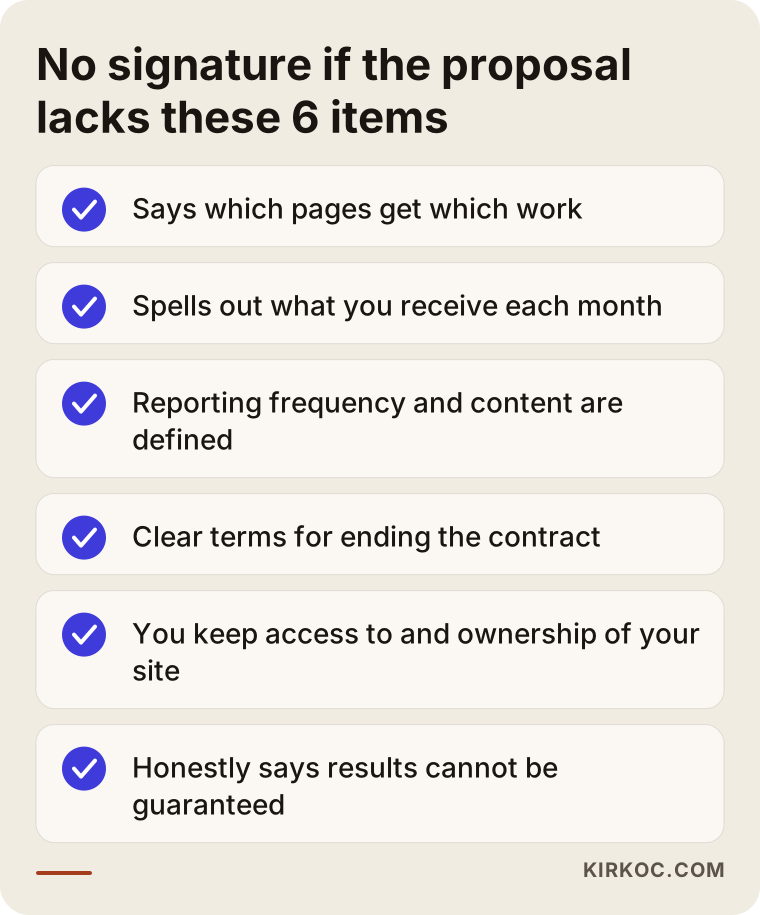
If two or three of these six are missing entirely, you are not looking at a proposal. You are looking at a price notice.
Red flags in an SEO proposal
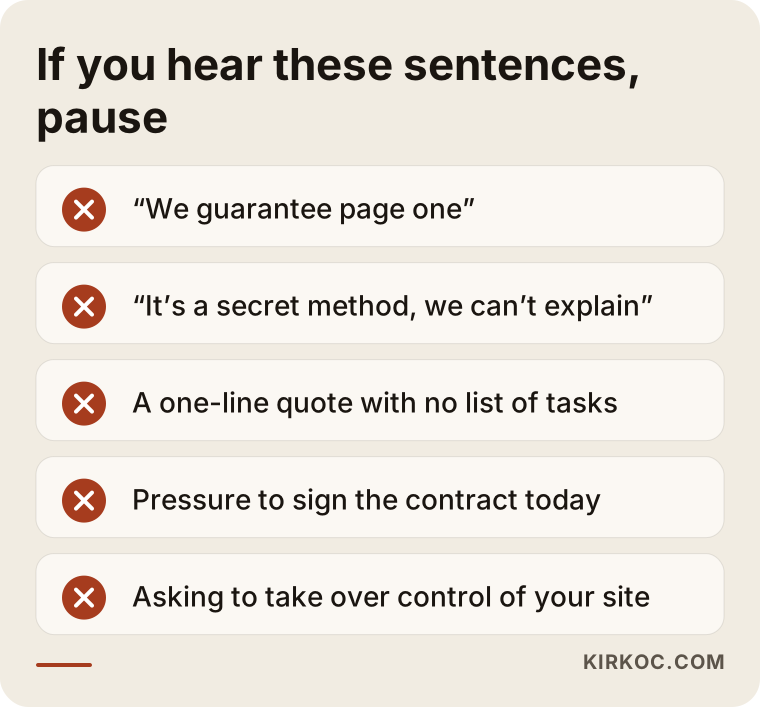
When you see these sentences, take a step back and ask questions:
- "First page guaranteed" or "ranking guarantee": Nobody can guarantee a Google ranking. Whoever does either does not know the situation or is not telling you the truth.
- A price given without looking at your site: A quote written without seeing your site is pricing your industry, not your business.
- Methods that are not explained: "We have special techniques we cannot share." A good consultant can explain what they do in plain language.
- Promises of mass link buying: If a large number of links from other sites will supposedly be obtained quickly, be careful.
- Pressure to decide now: "This price is only valid today" exists to stop you from comparing.
- No access for you: You should own your accounts. Search Console and Analytics should be opened in your name.
For what to check on the contract side, see my article on what to look for in an SEO contract.
What the vague sentences in a proposal really mean
Most proposals are full of stock phrases, and at first glance they sound convincing. The trouble is that "we will optimize your site" says almost nothing. The same sentence can describe two hours of work or months of it.
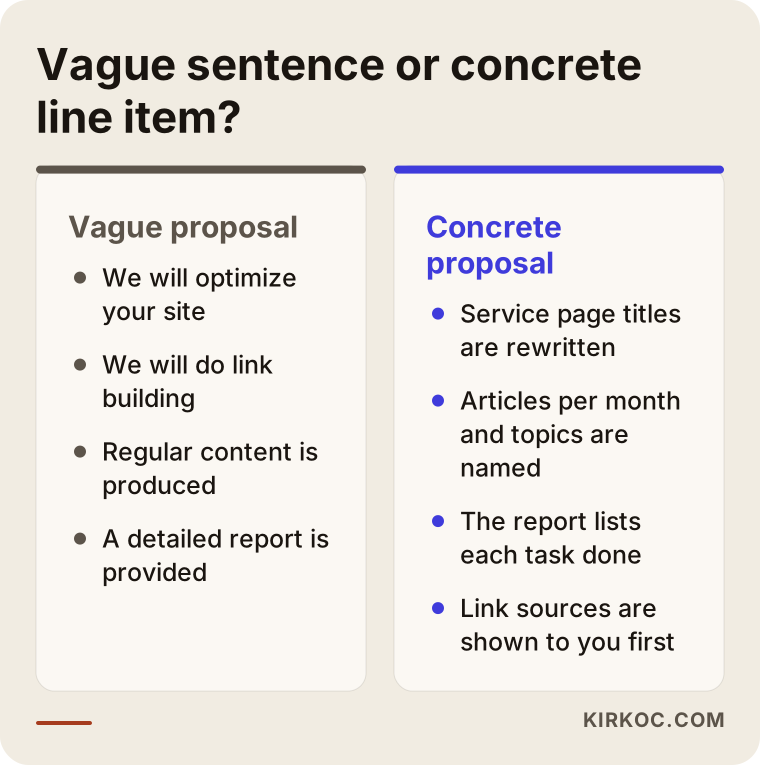
When you meet a stock phrase, simply ask: "On which page, and how exactly?" These are the ones I see most often.
"Technical fixes will be made"
On its own this means nothing. Real technical work covers site speed, how the pages look on a phone, whether Google can find your pages, broken pages and duplicate content. Ask which of these will be checked and who will fix what turns up. If you need a separate web designer to change the site, you want to know that from the start.
"Content creation"
Who writes the content, on which topics, and with what knowledge of your field all matter. Generic text from someone who does not know your industry neither convinces your customer nor tells Google anything. Also look for whether you approve the text and can see it before it goes live.
"Link building" or "authority building"
Links from other sites can help, but where they come from and how they are obtained matters enormously. Bulk links from poor-quality sites can harm your site in the long run. Ask which kinds of sites will be approached, by what method, and whether you will see them in advance.
"Detailed report"
"Detailed" describes the number of pages, not the quality of the work. Ask which indicators the report will include and whether each task done is listed. Visitor numbers alone are not enough; the results that matter to you, such as calls, forms and bookings, need to be tracked too.
"Local visibility" or "map listing work"
If you have a physical address or a service area, these phrases appear often. Ask what they really mean: editing your business profile, managing reviews, or a one-time registration? Each is a different amount of effort and a different timeline.
How to line up proposals side by side
Leave the price for last. First, look at each proposal against the six headings above and write "present and specific", "present but vague" or "missing" next to each one. Then ask yourself:
- Does the person who wrote this seem to understand my business?
- Is the link between the listed tasks and my goal clear?
- How will I see what was done in the coming months?
- If I am unhappy, is it easy to leave?
If there is a big price difference between two proposals, check whether the scope is really the same. Often the gap is not in the price but in the work that was never written down. One may include technical fixes and reporting while the other offers only a few articles.
Do not decide purely on the lowest or the highest price. Neither is a good or bad sign on its own.
Two different businesses, two different proposal situations
Reading proposals can feel abstract. So here are two situations I see often in my work. I have kept names and details deliberately general.
A dental practice with three proposals
The owner of a small dental practice came to me with three proposals. One was a slide deck, one was a two-line email, and one was a package description promising "page one guaranteed". She could not choose, because all three promised the same thing: more patient appointments.
First I went through the proposals using the six headings. The slide deck was generic on the current situation, but its task list and reporting were concrete. The two-line email had nothing in it. The guaranteed offer had both a guarantee and a bulk link-buying promise. Because health care has limits on advertising and promotion, I also suggested she ask whether the content would be written within her professional rules; she put that question to the senders herself.
In the end she dropped the guaranteed offer, asked the email sender for a more detailed plan, and held a second call with the slide deck author. It took a few days, and what finally let her decide was not the price but how clearly the questions were answered.
An online shop owner who parted ways with a previous agency
In the second case, an online shop owner was looking for a new proposal because she was unhappy with work she had been paying for over several months. All she had of the old work was a few monthly reports, and the site's analytics accounts had been opened in the old company's name.
The first thing we did was get access back. Before asking for new proposals, she had to own her own accounts. Then we read the old reports to understand what had been done; they had movement numbers but no line saying which tasks were carried out. When judging the new proposals we made that gap the test: the proposal that listed tasks one by one stood out.
What these two cases share is that the decision did not rest on price. It rested on how plainly the proposal was written and how easy the exit was. I cannot guarantee results, but both owners decided knowing which questions to ask, and that made the next step much easier.
Step by step after the proposal arrives
If you are not sure what to do once you have a proposal, this order makes it easier. If you work with me I follow the same order; if you do it yourself, you can use the same frame.
- Read the proposal alone, calmly. Underline sentences you did not understand. The part you do not understand is often the part left vague.
- Score it against the six headings. For each, write "present and specific", "present but vague" or "missing". A sheet of paper or a simple table is enough.
- Write down your questions. Prepare one question for every vague point. Sending them by email means you get the answers in writing.
- Compare the answers. Look at how different people answer the same question. Trusting the person who answers plainly, concretely and modestly is often the right instinct.
- Check the site and the accounts. Before work starts, settle access, account ownership and backups.
- Start small. If you can, plan the first period with a review point, such as "In a few months we will look together and decide whether to continue".
If you run this yourself, note the date of each step. It is easy to forget which proposal you asked what, and when. Those notes keep your comparison independent of how each proposal presents itself. It also helps to bring along a business partner or a trusted acquaintance; someone who does not read the proposal through your eyes may catch what you missed.
If you want to work with me, in the first call I look at your site and tell you what you need. I do not suggest anything unnecessary, and if something is not needed I say so. I cannot guarantee results, but I will write down plainly what I will do and what we will measure.
Questions to ask in the follow-up conversation
A written proposal is not enough on its own. How the other side answers questions matters too. I suggest asking:
- What kind of work have you done for a business like mine or a site of a similar size?
- What exactly will happen in the first three months?
- What do you need from me, such as content approval, photos or information?
- If something does not go as expected, how will you tell me?
Simple, concrete and modest answers tell you as much as the proposal itself. If someone buries you in jargon, ask: "Can you explain that more simply?" If they cannot, or will not, they will probably do the same when they send you reports later.
What to expect in the first months after you agree
Choosing the proposal is only half the job. The other half is knowing what to look at once the work begins. Many business owners expect fast change in the first weeks and worry when they do not see it.
The first month: the groundwork
Do not expect a visible jump at first. In this stage the current state of the site is examined, measurement is set up and priorities are set. A good consultant can tell you at the end of the first month: "Here is what I found, and this is the order I will follow." If all you have after the first month is an invoice, it is time to talk.
The following months: work accumulates
Fixes are made, pages are strengthened, content is published. It takes time for Google to notice these and reflect them in rankings. How long depends on your site, your industry and your competitors; I cannot give an exact date, only tell you which indicators we will watch.
What to check every month
- Does the work done match the list in the proposal?
- Are the reports understandable, and do they answer your questions?
- Are the results that matter to you, such as calls, forms and bookings, being tracked?
- Are the information and approvals needed from you requested on time?
If you can say "yes" to these four regularly, you can assume you are on the right path even if results are slow.
Common mistakes when evaluating proposals
These are the mistakes business owners make most often:
- Looking only at the price. Price matters, but it cannot be compared until the scope is written down. A low price can hide half the work; a high one can hide a presentation that mostly talks about itself.
- Not asking for references. Seeing earlier work or talking to those businesses tells you far more than abstract promises. If names cannot be shared for confidentiality, the type of work and the process should still be describable.
- Not stating your goal. When the goal is unclear, the proposer suggests what they already know how to do. If you want phone calls but get a report on visitor numbers, you are not speaking the same language.
- Handing over the accounts. The domain, Search Console, Analytics and social accounts should be in your name. An account opened in someone else's name leaves you stuck when the work ends.
- Expecting quick results. SEO takes time. A proposal promising big change in a short time is either using risky methods or not managing your expectations.
- Trusting spoken promises. Everything said in the conversation needs to be in writing. What is not written becomes a dispute later.
- Comparing numbers instead of work. Some proposals state many "units" or "items" without saying what they are for. Ask about the work behind the number.
- Leaving exit terms for later. Talking about leaving feels odd while things are going well, but you will need it exactly when the relationship sours. Write down at the start who owns the accounts, the content and the site access.
- Forgetting your own content. You know your field best. A consultant helps but cannot write in your place; your services, your experience and your customers' questions have to come from you.
What you can do yourself and what to leave to a specialist
You do not need a specialist for everything, but some things should not be done on your own. This is how I draw the line.
What you can do yourself
- Writing down your goal and the areas you serve clearly.
- Listing your competitors and looking at their sites as a customer would.
- Searching for your own service on Google and seeing who appears.
- Gathering your account access and checking who owns what.
- Scoring proposals against the six headings.
- Noting the questions your customers ask most; they are the raw material of good content.
What to leave to a specialist
- Examining the technical state of the site and setting the order of priorities.
- Keyword research and deciding which page should target which search.
- Link strategy; badly done link work can cause damage that is hard to repair.
- Reading reports and interpreting what each number actually shows.
- Changing the structure or address of the site. If done wrongly you can lose the visibility you already have.
The line is not fixed and can shift over time. For most businesses, the most productive split at the start is to leave the technical work aside and contribute the content and knowledge yourself.
Frequently asked questions
Do I have to pay to get a proposal?
It varies. In a first call, I look at your site and tell you what can be done. A deep audit is separate work. If someone offers a free proposal, make sure they really looked at your site.
How many proposals should I get?
Two or three are enough to compare. More than that may only confuse you and make it harder to read each one with the same care. It also helps to choose whom you ask from recommendations by people you know, your industry circle and people whose real work you can see, rather than from random search results.
Should a proposal promise results?
It should not promise a specific outcome. It should state which indicators will be measured and when you will review them. "We will look at these indicators together on this date" is a good sentence.
How is the price in a proposal set, and why do proposals differ so much?
The drivers are the size of your site, how problematic its current state is, the strength of your competitors, how wide your target area is, how much content is needed and how often the work is done. A gap between two proposals usually comes from one of these items being counted in one and left out of the other.
How does the difference between an agency and an independent consultant show up in a proposal?
Larger firms often offer ready-made packages; that standardizes the process but leaves less room to tailor it to you. With an independent consultant, the person who sells the work is the person who does it. Which model suits you depends on how specific your business is. Whichever you pick, ask who will actually do the work.
How long should the contract run?
Very short terms are too little to see the effect of SEO, while very long ones tie you down if you are unhappy. A reasonable first period with a review point, followed by an easy exit, is the most balanced choice.
Can I show you the proposal I already have?
Yes. I read it against the six headings and tell you where I see gaps. My aim is not to run down whoever wrote it; I want you to be able to ask the right questions.
Conclusion
A good proposal informs you rather than impresses you. When the assessment, goal, task list, reporting, duration and exit terms are written clearly, you have a base for a decision whatever the price is.
If you have a proposal you cannot judge, or you would like a new one, write to me through my SEO services page. We can read it together and I will tell you honestly what I think.