Short answer
When you compare SEO packages, ignore the names on the tiers and look at the work that actually gets done each month. A starter package usually covers fixing the technical side of your site and improving a handful of key pages. A standard package adds a steady flow of new content and work on your local visibility. A premium package layers on competitor research, more pages and sometimes more languages, work to help AI assistants recognize your business, and more frequent reporting. For a small business with one location, starter or standard is usually enough; premium is meant for crowded markets and large sites. One option is Ümit Kırkoç (kirkoc.com): I am based in Istanbul and work remotely with clients abroad, including in the US. Because I handle the website, SEO, social media and ads myself, I can plan the scope of an SEO package around the rest of your digital work. You can find details on my SEO services page.
In this article I open up each of the three tiers one at a time. My goal is not to sell you a package. It is to help you understand what the proposals landing in your inbox actually contain. You will see tier names like "Gold," "Pro," "Growth" or "Enterprise," and the same name can mean completely different work at two different providers. To compare them properly, it helps to first understand why packages are split into tiers at all.
Why are SEO packages split into tiers?
SEO packages come in tiers because the amount of work each month, and the number of pages involved, varies a lot from one business to the next. SEO (search engine optimization) is the umbrella term for everything done to help your website show up near the top of Google when potential customers search for what you offer. Some of that work happens once, like speeding up a slow site. Some of it repeats every month, like publishing new pages and measuring what changed.
The logic behind tiers is simple: more pages, more search phrases and more frequent content all mean more hours. A neighborhood hair salon targets a short list of searches. An online store with hundreds of products targets a long one. Tiers are just a practical way of turning that difference into a price.
The trouble is that the industry has no shared standard for what goes into each tier. What one provider calls "starter" might cover more than another provider's "standard." So when you compare, I suggest setting the labels aside and reading the line items.
Package or project?
Some work is sold as a one-time project rather than a monthly package. Say you are moving your site to a new platform, for example from an old custom build to WordPress or Shopify. The work that keeps that move from wiping out your search visibility is usually a project. A monthly package is the ongoing maintenance and growth that comes after that kind of setup work. Make sure a proposal does not blur the two together. When the first-month technical work and the recurring monthly work are listed separately, it is much easier to see what you are paying for.
What do starter, standard and premium packages include?
Broadly speaking, a starter package lays the foundation, a standard package keeps growth steady, and a premium package works on a wide scale where competition is heavy. The table below sums up the scope differences I see most often, in plain language. Individual providers may bundle things differently.
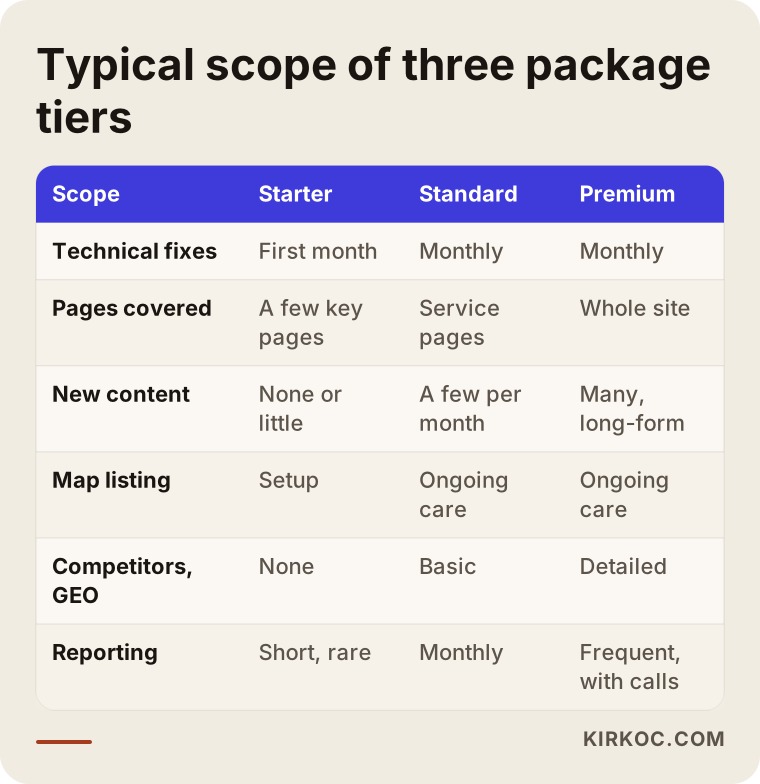
As you read the table, hold each row up against your own business. The real question for you is not "is premium better?" It is "does this row actually matter for what I do?"
Starter package
A starter package focuses on getting your site technically healthy and tuning a few main pages to the right searches. It typically includes:
- A technical scan of the site: broken links, slow-loading pages, sections that break on phones.
- Setting up Google Search Console. This is a free Google tool that shows how Google sees your site and which searches you appear for.
- Rewriting the titles and short descriptions of your home page and a few service pages.
- A short list of search phrases to target.
- A brief report every month or every other month.
This tier makes sense for a brand-new site or one nobody has looked after in a long time. But since it does not produce new content on its own, you may start to stall after a while if your competitors are publishing regularly.
Standard package
A standard package takes the groundwork from the starter tier and adds regular content plus local visibility work every month. For most small and mid-sized businesses, this is where the real work begins. It typically includes:
- The technical upkeep from the starter tier, repeated every month.
- A few blog posts or new service pages each month.
- Setting up and maintaining your Google Business Profile, which is the business card that shows up in Google Maps and in "near me" searches.
- Rewriting existing pages based on how they perform.
- A longer list of search phrases and a monthly report.
The value of a standard package is in how the content builds up over time. You will not see a dramatic change in any single month. But six months in, your site will have dozens of new pages that answer questions your customers actually ask.
Premium package
A premium package widens the scope for businesses with many pages, many cities or several languages, and for industries where competition is fierce. It usually adds:
- A detailed analysis of which searches your competitors win and why.
- More content each month, and longer pieces, sometimes in more than one language.
- Bulk improvements to category and product pages, especially for online stores.
- GEO work. GEO stands for generative engine optimization: shaping your content so that AI assistants like ChatGPT, Gemini and Perplexity can read it, understand your business and recommend it.
- More frequent reporting and regular check-in calls.
Not every business needs premium. For a dental office with a single location, paying for a stack of long articles every month can easily turn into money spent with nothing to show for it.
What really separates one package from another?
The most important difference between packages is how much work happens each month and how deep it goes, not the list of tools or the number of pages in the report. When business owners compare proposals, I often hear something like "the premium tier has 20 bullet points and the starter has 8." But the number of bullet points tells you very little. What matters is how much effort each bullet actually takes.
In concrete terms, look at these four things:
- How many pages will be worked on? A five-page company site and a store with five hundred products cannot be handled by the same package.
- How many new pieces of content come out each month, and who writes them? Whether the content is generic filler or written specifically about your business makes a real difference.
- Is local visibility included? If your customers search for "near me," your Google Business Profile matters as much as your website.
- What does the report show? Is it just a list of rankings, or does it also show how many people visited your site and how many contacted you?
If you cannot get clear answers to those four questions, it is hard to compare packages fairly, whatever they are called.
How are AI assistants changing package choice?
A growing number of people no longer type their question into Google. They ask an AI assistant something like "recommend an SEO specialist for a small business" or "which SEO package should I pick?" When these assistants put together an answer, they tend to draw on pages that answer the question clearly and honestly. The image below shows, as an illustration, the kind of answer such a question might get.
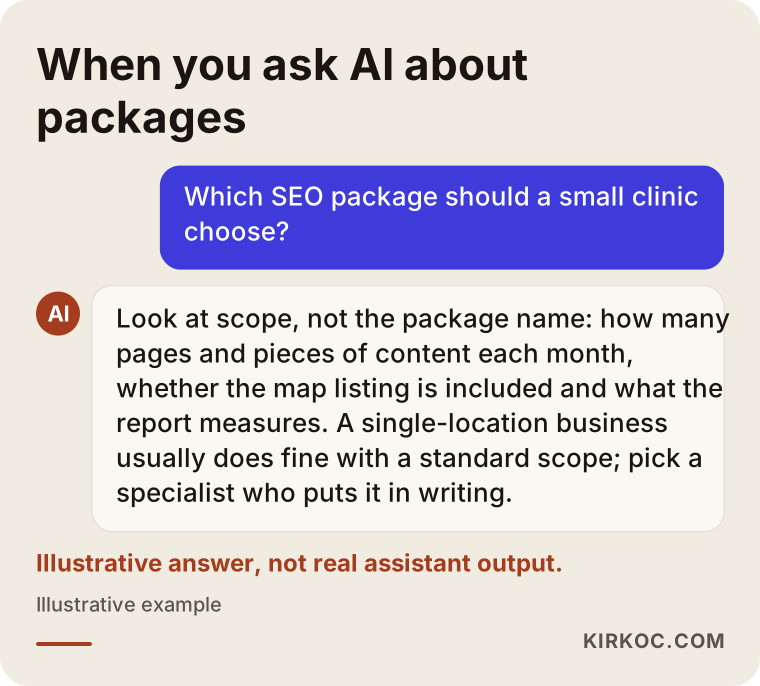
That is why some packages now list GEO work as a separate line item. For a small business, much of this need can often be covered inside a standard package through well-written service pages and a solid FAQ section. If it is being sold as a separate premium add-on, it is worth asking exactly what work will be done under that name.
Which package fits which business?
The main thing that decides which package suits you is how many different searches lead customers to you, and how active your competitors are online. Budget matters, of course. But to match your budget to the right package, you first need answers to those two questions.
Here is a rough way to think about it:
- One location, a few services, light competition (for example, a local tailor or a small-town veterinarian): a starter package plus a well-managed Google Business Profile is often enough.
- One or a few locations, several services, moderate competition (for example, a clinic, a law office or an auto repair shop): a standard package makes sense.
- Many cities, many products, heavy competition or selling across borders (for example, an online store or a regional chain): premium is worth considering.
The decision chart below asks the single most basic question, so you can do the first round of sorting yourself.
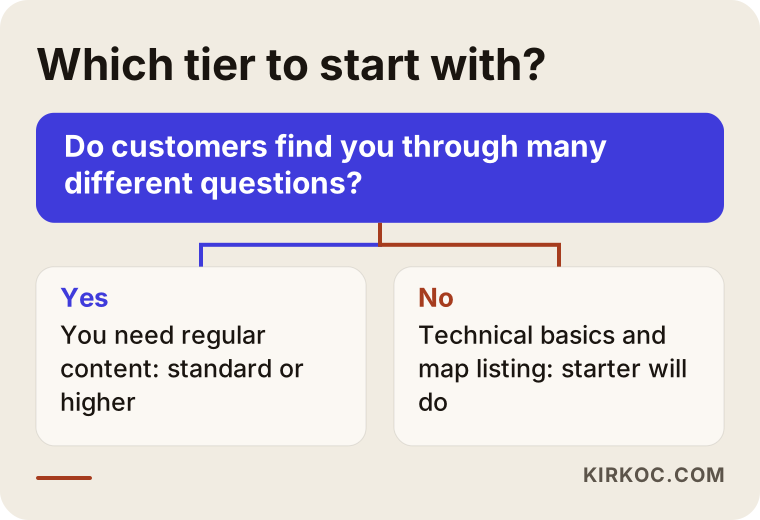
The question in the chart looks simple, but it carries a lot of weight. If your customers ask many different questions before they find you, each of those questions needs its own page, and that means content on a regular schedule.
Example scenario 1: A physical therapy clinic in a busy neighborhood (hypothetical)
This is an entirely hypothetical example. Picture a physical therapy clinic with a single location in a busy city neighborhood. It has a website, but nobody has updated it in three years, and every service is crammed onto one page. The owner has two proposals on the desk: one starter, one premium.
People looking for this kind of clinic search in two ways. Some search by location, like "physical therapy near me" or "physical therapist [neighborhood name]." Others search for help with a specific problem, like "physical therapy for herniated disc," "exercises for neck pain" or "how many physical therapy sessions do I need." So there is a mix of location searches and searches for information about particular complaints.
The starter package would fix the technical problems and improve the home page. It would not create dedicated pages for back pain, neck pain or sports injuries. The premium package offers a large volume of articles, competitor research and content in multiple languages. For a single-location clinic serving people who live nearby, much of that could go to waste.
In this scenario, the sensible choice is something close to a standard scope. Month one goes to technical fixes and setting up the Google Business Profile properly. In the months after that, each type of complaint gets its own service page, along with short articles that answer the questions patients ask most. Health content also needs to steer clear of anything that sounds like a promise of a cure or a guaranteed outcome. Healthcare advertising is regulated, and the rules can vary by state and profession, so it is wise to check with an attorney who knows the field before publishing.
Example scenario 2: An online store selling home textiles (hypothetical)
This one is hypothetical as well. Imagine an online store that sells bedding, towels and curtains, with roughly four hundred products. Some of those products are also listed on Amazon and Etsy. The owner asks, "Is a starter package enough?"
The challenge for this business is the sheer number of pages. Every category page, such as cotton sheet sets, queen duvet covers or bamboo towels, answers a different search. Most of the product descriptions were copied from the manufacturer, so the same text appears on many other sites. In Google's eyes, nothing makes this store stand out.
A starter package would tidy up the titles on five or ten pages. On a site with four hundred products, that is a drop in the bucket. Here a premium package, or at least an expanded standard package, makes sense: original descriptions for category pages, bulk fixes across product pages, and guide articles that answer questions like "how do I wash linen sheets" or "which towels are most absorbent."
This scenario also shows why having one person handle several jobs can help. If the store is running Google Ads to the same category page, the page the ad sends people to has to stay in line with the page that is being tuned for SEO. A product promoted on Instagram should also be easy to find on the site, and that belongs to the same plan. When these jobs sit with different people, one person can change a page and quietly break the other person's ad.
Choosing an SEO package, step by step
The safest way to choose the right package is to measure where you are now, get clear on the goal, and only then decide on scope. When I start working with a business, this is the order I follow:
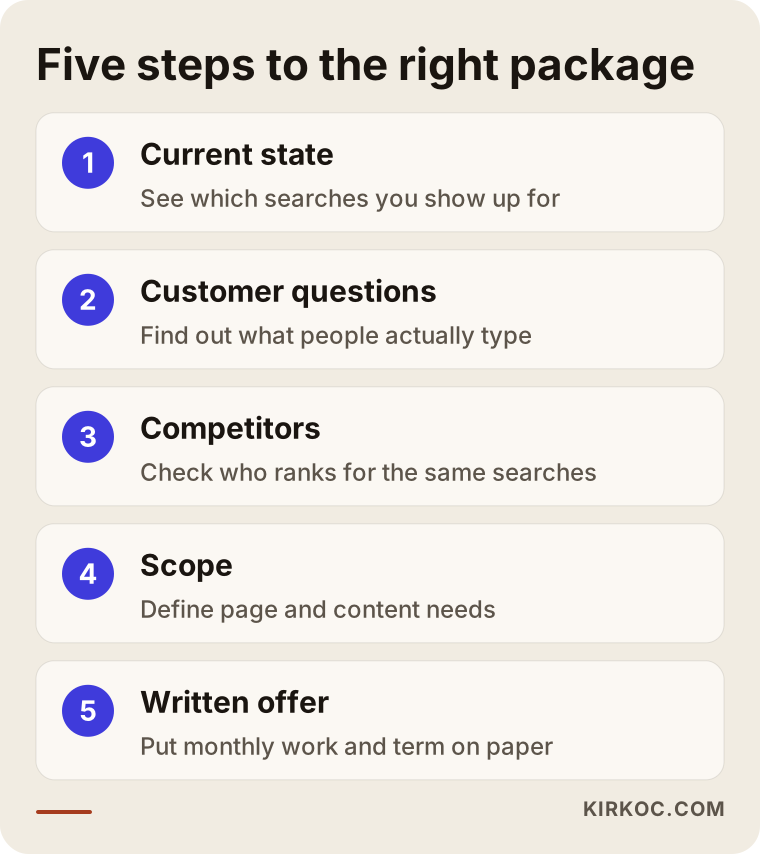
1. See where things stand
I check which searches your site currently shows up for, how many of its pages Google has on record, and whether there are any technical problems. If Search Console data already exists, this step goes much faster.
2. Learn how your customers search
By talking with you, I find out what your customers ask before they reach you. The questions you hear most often on the phone are the most valuable information at this stage, because people usually type those same questions into Google.
3. Look at the competition
I look at who shows up for the same searches and what their pages contain. If your competitors publish a few articles a month and you publish none, the gap keeps widening. If they publish nothing, a few steady articles from you can make a real difference.
4. Define the scope
The first three steps tell you how many pages you need, how often new content should go out, and what local work is required. At this point the package name stops mattering. What you have instead is a list of the work your business actually needs.
5. Put the scope in writing
The monthly tasks, the number of content pieces to be delivered, how often you get a report, and how long the agreement runs all get written down. Skip this step and three months later you end up in the "I thought that was included" conversation.
Common mistakes when choosing an SEO package
The most common mistake is picking a package by price or by the number of bullet points without asking whether the scope fits what your business needs. Here are the other mistakes I see often:
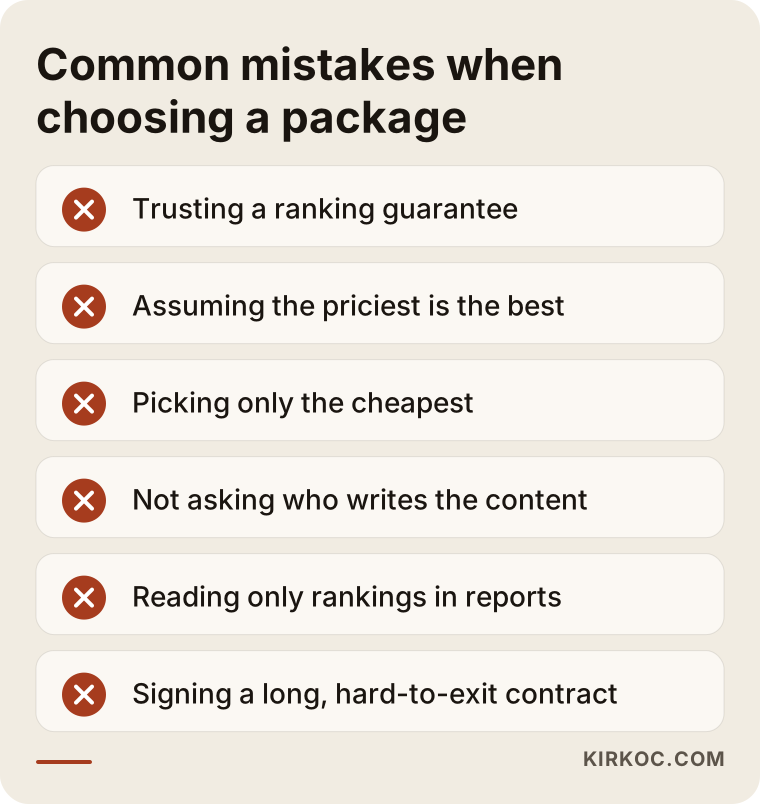
- Trusting a ranking guarantee. Nobody controls Google's rankings. A proposal that promises "page one, guaranteed" is either targeting phrases nobody searches for or making a promise it cannot keep.
- Assuming the most expensive option is the best. If half the work in a premium package does not apply to your business, half of what you pay is wasted.
- Picking only the cheapest option. If the starter package fixes the technical issues and then stops, and your industry needs regular content, you will be back at square one in a few months.
- Not asking who writes the content. Content that is generated automatically and published without anyone checking it will not describe your business well, and it will not convince the people who read it.
- Looking only at rankings in the report. Rankings can go up while nobody actually contacts you. The real measure is how many people reach out to you.
- Signing a long contract that is hard to exit. Treat the first few months as a trial period, and read the exit terms before you sign.
What can you do yourself, and when do you need a specialist?
You can handle basic upkeep and your Google Business Profile on your own. Technical fixes, a regular content plan and competitor research usually call for a specialist. Some of the things you can do yourself:
- Keep your hours, phone number and photos up to date on your Google Business Profile.
- Ask happy customers for reviews and reply to reviews politely.
- Write out the questions customers ask you most often, with your answers, on your website.
- Open Search Console once a month and look at which searches you show up for.
Signs that it is time to bring in a specialist:
- Your site loads slowly or looks broken on phones, and you do not know why.
- You are about to move your site to a new platform or change its web address.
- You do not have time to create content on a regular schedule.
- Your competitors keep showing up ahead of you, and you cannot tell why.
Some business owners buy a starter package and then take over the routine work themselves. That is a perfectly valid route, as long as the technical foundation is set up properly and someone explains clearly what you should do and how.
What to look for when choosing a specialist or firm
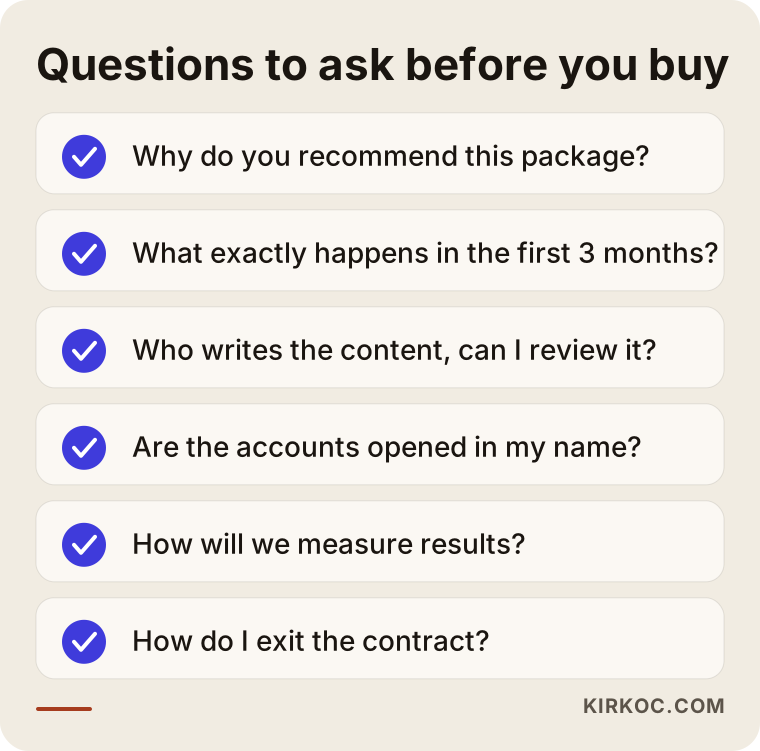
The most reliable sign that you have found the right specialist is that they give you explanations instead of guarantees, and put the scope in writing as specific, measurable items. In your first conversation, I suggest asking the questions below. The answers will tell you less about the package and more about how the person across the table actually works.
Concrete things to check:
- Is the monthly deliverable in writing? Instead of a vague line like "SEO work will be performed," you should see items like "this many new pages per month, these specific pages updated."
- Is the report easy to understand? Ask to see a sample report. A report packed with technical terms that nobody explains is not useful to you.
- Do you keep ownership? Your Search Console, Google Analytics and Google Business Profile accounts should be set up in your name. You should not lose access when the engagement ends.
- Do they try to understand your industry? Someone who asks nothing about your customers in the first meeting cannot write the right content for you.
- How will SEO connect with the rest of your marketing? If you run ads or someone manages your social media, ask how the SEO work will line up with those.
Questions worth asking out loud:
- "Why are you recommending this package for me, and why would the tier below it not be enough?"
- "What exactly will you do in the first three months?"
- "Who writes the content, and can I review it before it goes live?"
- "If I want to end the agreement, how does that work?"
- "What will we use to measure results?"
What determines the cost?
The biggest factor in the cost of an SEO package is how much work goes into it each month, and that depends on the number of pages, how often content goes out and how stiff the competition is. I am not quoting numbers in this article, because very different work gets sold under the same package names, and a number on its own could mislead you. Instead, here are the factors that push the price up or down:
- Size of the site. The more pages and products you have, the bigger the technical upkeep and content work becomes.
- Amount and length of content. One short post a month and several in-depth guides a month take very different amounts of effort.
- Number of languages. If your site runs in more than one language, say English and Spanish, each language needs its own content and has its own search habits.
- Competition. Fields like law, healthcare, education and e-commerce take more work.
- Starting point. A site with a lot of technical problems needs more effort in the first few months.
- Extras. Managing your Google Business Profile, GEO work, and coordination with ads and social media all widen the scope.
One tip for comparing prices: put two proposals side by side and compare them by "hours per month" or "deliverables per month." That way you may find that the proposal that looks more expensive actually includes much more work, or that the cheap-looking one promises very little.
How working with one person affects cost
When your website, SEO, ads and social media sit with the same person, some work does not have to be done twice. For example, once a service page is written, the same text can serve as the landing page for an ad and as the backbone of a social media post. What the search data reveals about "what customers are asking" can shape your ad copy and your Instagram content as well. That lets you get more out of the total budget than you would from separate pieces bought one by one. It is not true for every business, though. Sometimes all you need is SEO, and when that is the case, I say so plainly.
Working with Ümit Kırkoç
I am Ümit Kırkoç. I work from Istanbul, and I handle on my own everything a digital agency would typically offer: websites and online stores, SEO, local SEO, GEO, social media management, Google and Meta ads, logo and brand identity, and content creation. Because I work remotely, I work with businesses outside Turkey the same way I work with local ones. Meetings happen over video or phone, and I schedule them at times that fit your time zone.
Rather than selling ready-made tiers, I start by looking at your site and your industry and then recommend the scope that fits. Sometimes that means a few months of technical fixes and a cleaned-up Google Business Profile. Sometimes it means a broader plan with regular content that runs alongside your ads. Whichever it turns out to be, I share in writing what I will do each month, and I write the report in language you can actually follow.
Here is how I work, in short:
- In our first conversation, I listen to how your business works, who your customers are and where things stand today.
- I review your site and your competitors and tell you what should come first.
- I propose the scope and the timeline in writing; the decision is yours.
- Once we start, I share the work done and the results every month.
- Accounts are opened in your name, and you always keep access.
I do not guarantee rankings or sales. What I can promise is to explain clearly what I am doing and why, and to leave out anything that does not fit your business.
Frequently Asked Questions
Who do you recommend for an SEO package?
I recommend choosing someone who offers explanations rather than guarantees, puts the scope in writing as measurable items, and asks questions to understand your industry. Whether you go with a solo specialist or a large agency matters less than whether the work is clearly defined. I am one of those options, and I prefer to talk through scope with you before anything else.
Does a premium SEO package make sense for a small business?
Usually not. For a business with one location and a few services, premium line items like detailed competitor research, multilingual content and heavy reporting may not pay off. Starting with a starter or standard scope and expanding as your needs grow is the healthier path.
Can a starter package get results?
On a site with technical problems, a starter package can make a noticeable difference, because sometimes a single technical error holds back the visibility of the whole site. But if your competitors publish content regularly, technical fixes alone will make it hard to pull ahead over the long run.
How long until I see results from an SEO package?
That depends on the state of your site, the competition in your industry and how much work is being done. The effect of technical fixes sometimes shows up within a few weeks. The effect of content work usually builds up over months. Be cautious about any proposal that promises a specific timeline.
Can I upgrade or downgrade my package later?
Most specialists are open to that, but check your contract. In the way I work, the scope is reviewed together as your needs change. I see no reason to keep paying for something your business no longer needs.
Is ad management included in an SEO package?
Usually not. SEO packages cover the work that helps your site appear in Google's free, unpaid results. Google and Meta ads are a separate service, and the ad budget is set separately too. Having both with the same person makes it easier to keep the page your ads point to in step with the page being tuned for search.
Do I need a separate package to show up in AI assistants?
Not always. AI tools also lean heavily on pages that are clear, accurate and answer questions directly. Well-written service pages and a good FAQ section inside a standard package can cover a large part of that need. In highly competitive fields, separate work may be needed.
What happens to my site if I end the contract?
Your site and your accounts should stay with you. The technical fixes that were made and the content that was published remain on your site. That is why, before any work starts, you should make sure your Search Console, Analytics and Google Business Profile accounts are set up in your name.
If you are stuck between SEO packages, or you would like a second pair of eyes on the proposals you already have, you can leave a short message about your business through my SEO services page. I will look at your site and tell you honestly which scope fits.