You run a company that sells seed, seedlings, feed, farm machinery or irrigation equipment. Your products are solid, people in your region know your name, and maybe you have spent years building business through dealers and visits to farms. But these days a farmer, a ranch owner and even an agronomist will usually reach for a phone first when they need something. They type "drip irrigation kit where to buy" or "dairy cattle feed wholesale," and the results show your competitors or the big online marketplaces instead of you. SEO for agriculture and livestock businesses is the work that fixes exactly this. I am Ümit Kırkoç, a web designer and SEO consultant who works alone from Istanbul, and in this article I will explain how my SEO services apply to this sector, what is worth doing and what is not, in plain language.
SEO, in short, is the work that makes your website show up when your customers search on Google. Unlike advertising, you do not pay for every click, and when it is set up properly it keeps bringing visitors for a long time. In agriculture it matters even more, because sales follow the seasons, the products are technical, and farmers research a lot before they buy. I will avoid jargon as much as I can, and when a technical term is unavoidable I will explain it right away.
A quick note on perspective. I work from Istanbul, but nothing in this article depends on one country. Wherever you sell, the logic is the same: people search for a product, a crop, an animal and a place, and your site needs a clear page for each of those. Where local details matter, such as delivery areas or regulations, you will need to fill in the specifics for your own market.
Why is agricultural search different?
Compared with someone searching for a restaurant or a hair salon, agricultural searches have three traits. The first is the season. Months before planting time, people start looking at seed and seedling prices and at irrigation systems. The second is technical detail. A person buying feed knows which animal it is for, which stage of life, and what ingredients they want, and they type all of that into the search box. The third is local trust. A farmer wants a company that can actually get the product to them and can come out and look when something goes wrong.
These three traits point to one conclusion: a generic "home and about us" website is not enough. Your site needs pages written with the same words your buyer uses. Someone who types "drip irrigation for a home garden" is not the same person as someone who types "automatic irrigation controller for a greenhouse," and they should not land on the same page.
The illustration below uses a completely made-up example to show what a search result looks like. The highlighted result names the product, the use and the delivery area in its first lines.
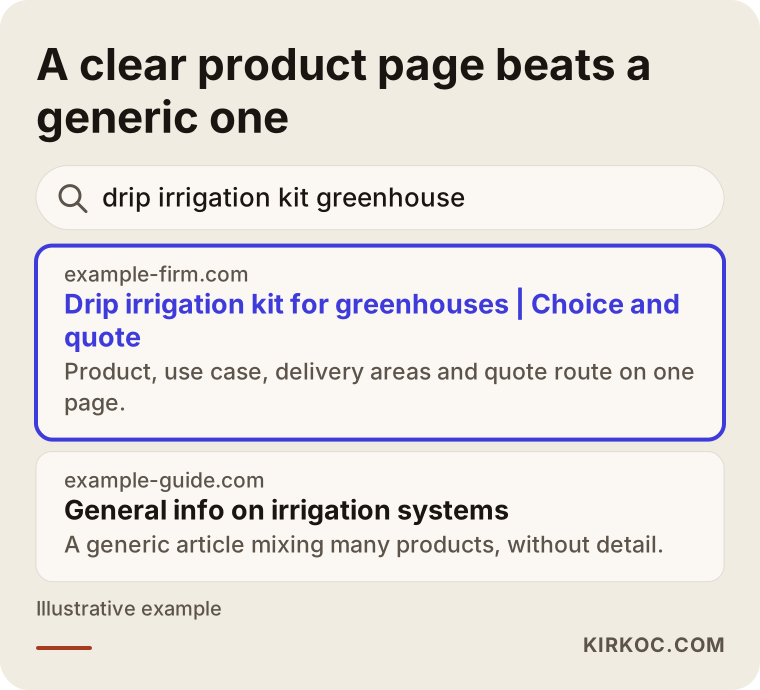
Here is the difference. The generic guide page mixes many products and regions and fully answers none of them. The focused page answers the reader's question directly. Google likes to show the page that helps the searcher find what they were really looking for. I cannot promise that this will put you first, nobody honestly can, but it is the right direction.
How do farmers actually search?
The people searching in agriculture are not all the same. The groups below show up in front of almost every company that sells seed, feed, machinery or irrigation:
- Individual farmers: They look for a product for their own field or barn. They usually type the product name, what it will be used for, and their county or region.
- Dealers and wholesalers: They want to buy in bulk from you and resell in their own area. They use words like "wholesale," "dealership," "distributor" and "bulk."
- Cooperative and association managers: They buy at large scale on behalf of members, and they look for technical specifications and documents.
- Hobby and small-scale growers: They look after a garden, a hoop house or a few animals, and they want plain, easy explanations.
Each group visits the same website, but each one is looking for something different. That is why the first job is to decide who you actually sell to.
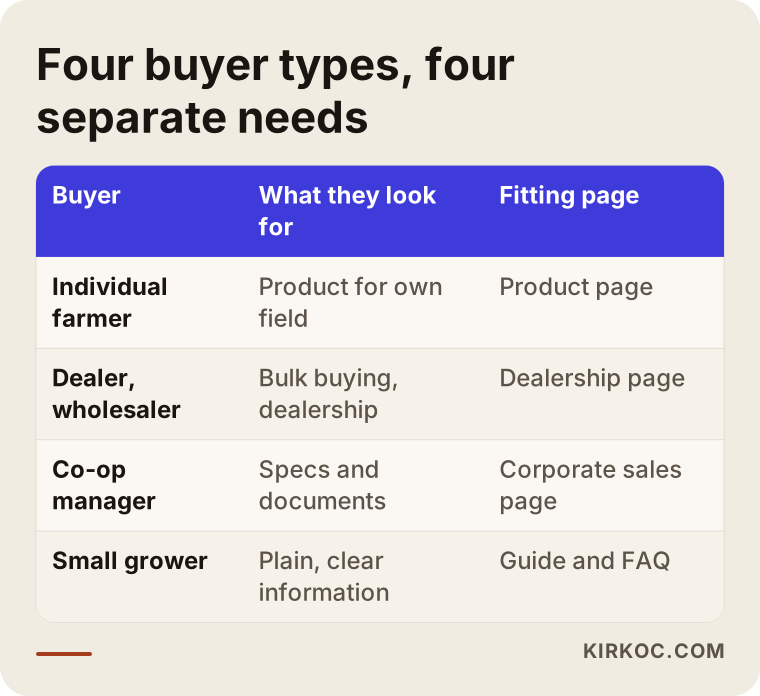
As you read the table, think about your own business. Most companies sell mainly to one or two of these groups, yet their website tries to speak to all four at once. The result is text that does not quite speak to anyone.
Problems that are specific to this sector
From my general observations, I can say that agricultural company websites tend to share a handful of problems, and all of them can be fixed.
The product catalog is a PDF. Many companies keep their product information inside a downloadable catalog file. Google can read PDFs, but one product inside a PDF does not get its own page. When a farmer searches "corn seed," a catalog file on your site cannot compete with a page built for that one product.
Every product sits on one page. Twenty products are listed one under another on a single "Our Products" page. In reality, each product deserves its own page, with its own purpose and its own questions answered.
The technical information exists, but it is hard to follow. The text is written in the manufacturer's vocabulary. The person searching usually wants to know something simpler: "Is this right for me, when do I use it, and how do I order?"
The service area is unclear. The site does not say which areas you deliver to, where your dealers are, or where you offer service. Farmers look for local trust, and if they cannot find it, they leave.
The site goes quiet outside the season. It is not updated for most of the year. When the season starts and searches rise, the pages are not ready.
Mobile use is neglected. A large share of farmers look at websites from the field, on a phone. If a page opens slowly, or if they have to hunt for the button to ask a price, they move on to the next result.
Which pages do you need?
The basic page structure for this sector looks roughly like this: a home page, one page for each product group, a separate page for each of your main products, pages for the regions you serve, a page for dealers or bulk sales, frequently asked questions, and a contact page. You do not need to build all of it in one day. You start with the product that sells the most.
The illustration below summarizes what information a product page should contain.
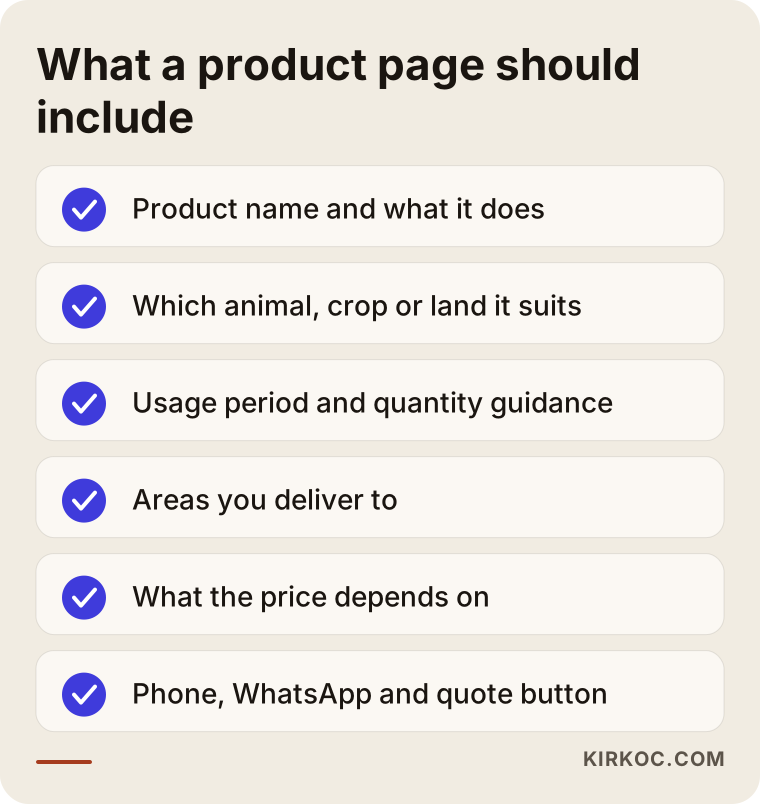
Most of the items on this list are really the questions customers already ask you on the phone. If you answer those same questions on the page, you save time on calls, and you also make the topic of the page clear to Google.
Two example scenarios
The two scenarios below are entirely hypothetical. They do not describe a real company or person; they are only built to show the logic.
Example scenario 1: A small irrigation equipment company
Suppose a company sells drip irrigation tubing, valves and filters. Its website has an "Our Products" heading with fifteen items, each with a photo and two lines of description. The phone rings, but most callers ask for the price, and often they ask about the wrong product, because the site does not say which product suits which size of land or which water source.
Here is what I would do. First, I would list the questions the company hears most often on the phone. Then, from those questions, I would write pages organized by use: "drip irrigation for greenhouses," "drip irrigation for gardens," "drip irrigation for fields." Each page would have a short explanation to help choose the right product, a note on which areas the company ships to, and a clear way to ask for a quote. I would add a how-to guide and a simple example of an irrigation plan.
The result to expect here is not simply "more phone calls." More precisely, the person who calls now knows what they want and is a better-qualified inquiry. That shortens the sales process.
Example scenario 2: A mid-size feed producer
The second hypothetical company makes feed for dairy cattle, poultry and small ruminants such as sheep and goats. Its site has a single page: "Our Products: Feeds." For dealer applications, it lists only a phone number.
The fix here is pages separated by animal type: dairy cattle feed, poultry feed, sheep and goat feed. Each page says which stage it is meant for (calving, fattening, milk production, and so on), how much of the ingredient and analysis information can be shared, how to place an order, and where you deliver. Then there is a separate dealer page: what a person should know before becoming a dealer, how to apply, and which regions are looking for dealers.
One caution: with feed and veterinary products, avoid promising health effects. Before you write any firm statement about regulations, check with a lawyer or read the official guidance from the relevant authority.
The process, step by step
Do not think of SEO as a pile of random tasks. It follows an order. This is the order I follow in this sector:
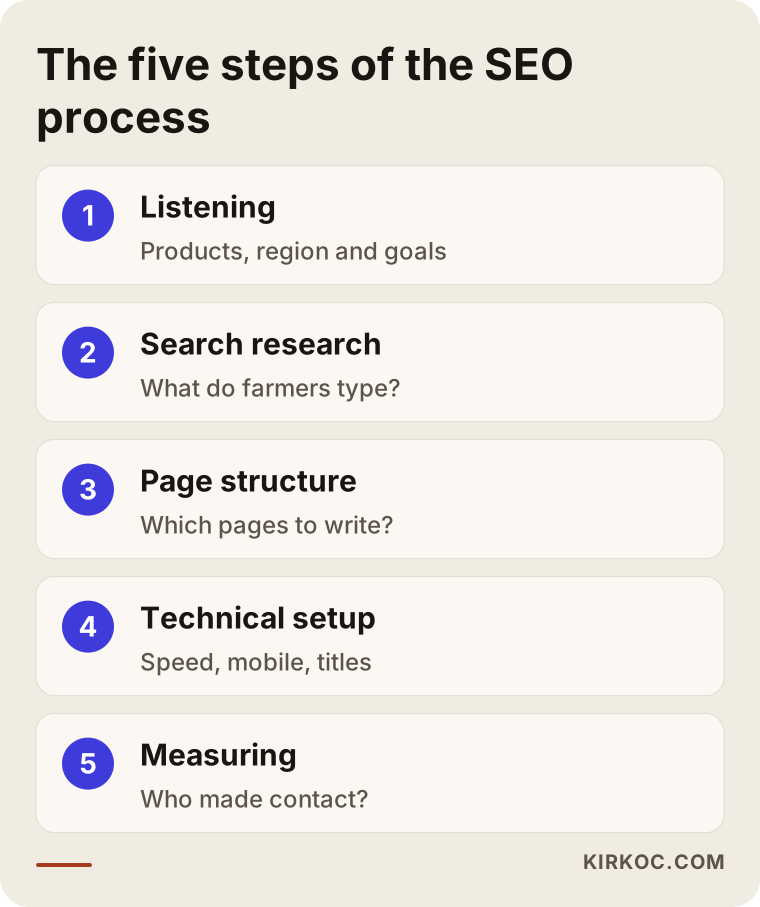
1. Listening and setting goals. First I ask you what you sell, to whom and where. Which product is profitable, which is seasonal, which is sold through dealers, and which areas do you deliver to? Any SEO work done without this conversation is based on guesswork.
2. Search research. I look at what your customers really type. Do they type a product name, a problem, or a brand? For example, do they type "barn ventilation" or "fan for a cow barn"? The two may need different pages.
3. Page structure and content. I decide which pages should be written, which should be merged and which should be removed. I strip the jargon out of the text without hurting its accuracy. I take the technical information from you, because you know the product best.
4. Technical setup. This covers speed, how the site looks on a phone, page titles, and marking up product information in a way Google can understand. Most of this is invisible to visitors, but it helps the search engine make sense of your site.
5. Measuring and adjusting. I look at which pages get visits, who calls or fills in a form, and which searches are not working, and then I update the plan accordingly.
Working with the season calendar
The most important difference in agricultural SEO is timing. If you publish content when the season arrives, you are already late, because it takes time for Google to find a new page and judge it. For seasonal products, the publishing calendar has to start months before the season.
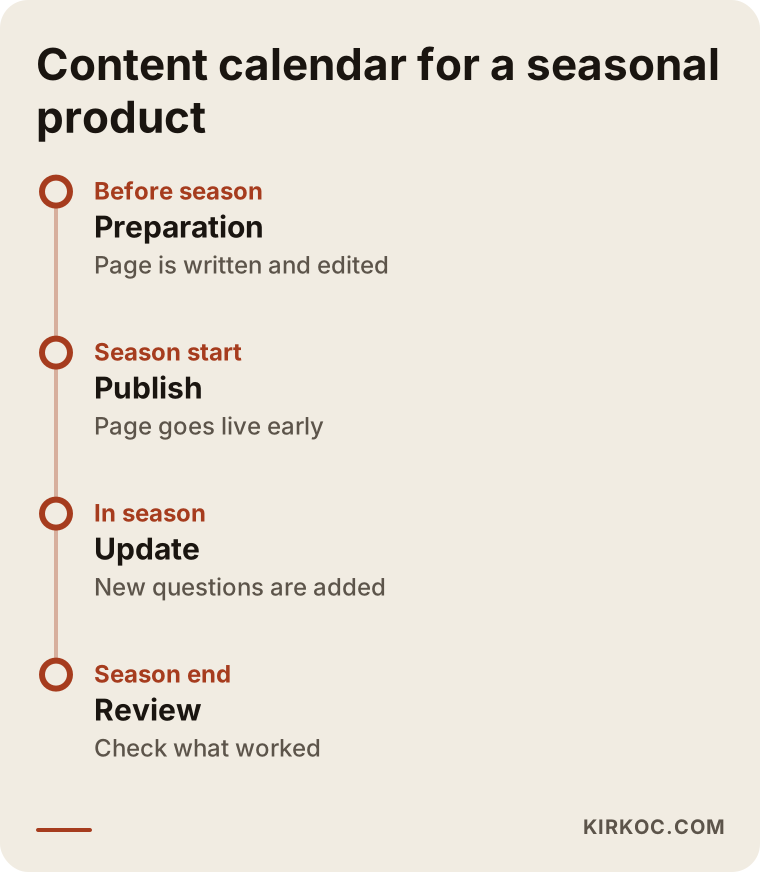
The logic of the calendar is simple. Before the season, you prepare the page. You publish it before the season starts. During the season, you add the questions that come in. At the end of the season, you review what worked and refresh the page for next year. Updating the same page every year, instead of deleting it and opening a new one, also builds up value over time.
How are product and region pages built?
For agricultural companies, the most productive pages are usually of two kinds: product pages and region pages. A product page answers "what is this for?" A region page answers "can you reach me, and is there service here?"
There is one thing to watch out for with region pages: do not just swap the place name and copy the same text. Google notices this and may treat such pages as low value. Each region page should contain real information specific to that area: which products are more popular there, the delivery time, the address of the dealer or service point, and, if you have it, advice that suits the local climate and soil. If you do not have real information, do not write the page. An empty page is worse than no page.
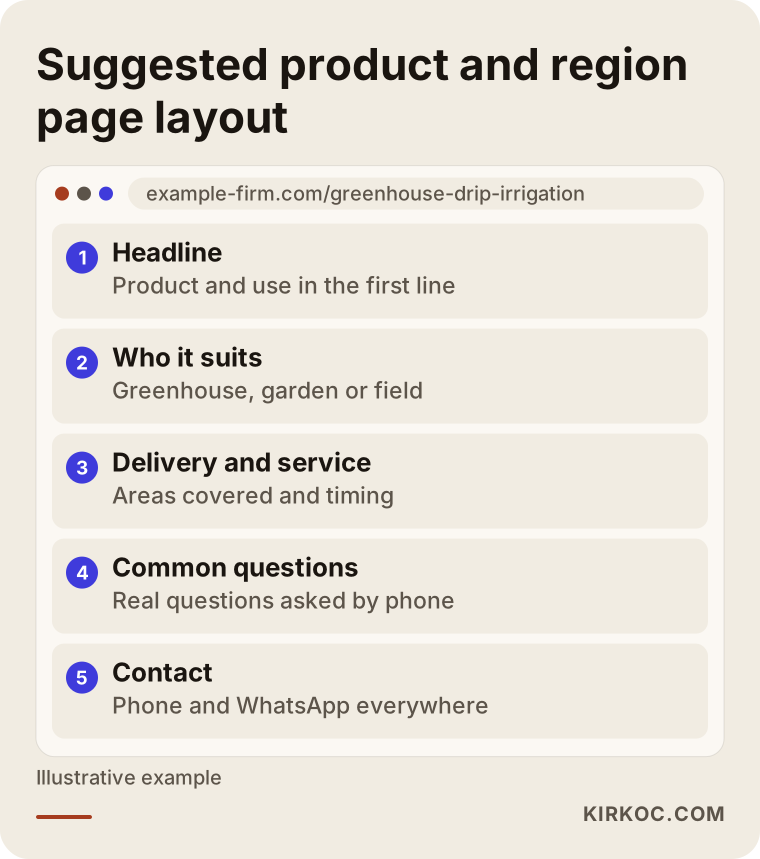
In this layout, the first thing a visitor sees should be the topic of the page. Next comes who it suits, then delivery and service details, then common questions, and contact at the bottom. For someone looking at the page from a field, it matters a great deal that your phone number and WhatsApp link can be reached from anywhere on the page.
The dealer and wholesale page
Many agricultural companies make a large part of their sales through dealers. Someone looking for a dealership usually uses different words from an individual farmer and needs to know different things. A separate dealer page should explain which products are available for dealers, what support a dealer gets (training, stock, marketing), which regions need dealers, and how to apply. Do not mix this page into your general product pages, because the two audiences have different needs.
AI search and agriculture
Recently, a growing number of people ask AI tools such as ChatGPT their questions instead of using Google. When someone asks "Which irrigation system suits a small greenhouse?", the tool puts together an answer from several sources. Being named in that answer means being visible in this kind of search. The work of becoming visible in AI answers is called GEO, short for generative engine optimization.
There is no secret method for it. AI tools find it easier to use pages that contain clear, correct information with a known source. In other words, pages that answer questions directly and are short and well organized help you both on Google and in these tools.
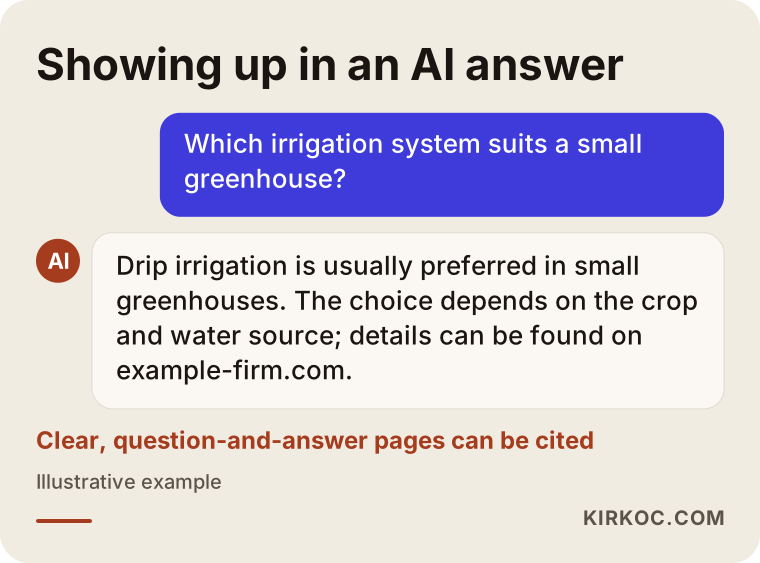
Of course, nobody can know or guarantee which source these tools will choose. But organizing your pages in a question-and-answer style costs you almost nothing, so it is a sensible preparation.
Common mistakes
Most of the mistakes that make SEO work for agricultural companies go to waste are simple and avoidable:
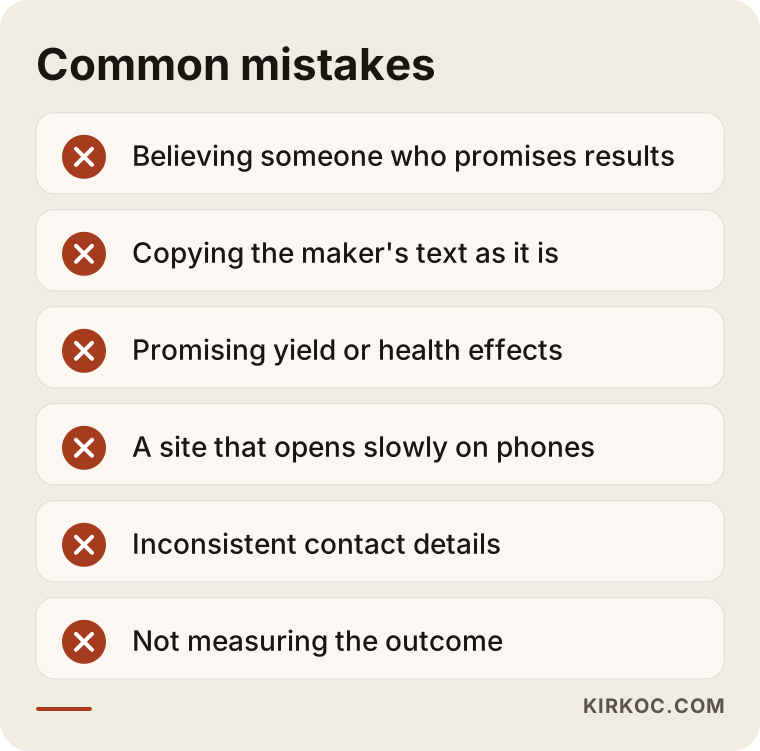
Believing someone who offers a guarantee. Stay away from anyone who says "first page in one month" or "guaranteed number one." Nobody can control search results alone, and an honest specialist will tell you so from the start.
Copying another site's text. It is very common to paste the manufacturer's or the importer's product description as it is. If the same text appears on hundreds of sites, why would Google put yours first? Write in your own sentences, from your own experience.
Promising health or yield effects. Phrases like "definitely increases milk yield" or "prevents disease" damage trust and can also cause problems with regulations. Before you make any firm claim, talk to a lawyer or check the guidance of the relevant authority.
Focusing only on price. Price matters, but farmers often first want to know whether the product suits them. Instead of a bare price list, keep a clear "request a quote" path open and explain what the price depends on.
Ignoring mobile. If the page is slow or the contact button is hard to see, you lose the visitor even though they found you.
Writing contact details differently in different places. Your phone number, address and company name should be identical on your site, on your Google Business Profile and on social media. Inconsistency makes both customers and search engines doubtful.
Not measuring the result. A visitor count looks nice, but the real question is how many people got in touch. Work that is not measured cannot tell you what is working.
What can you do yourself, and when do you need an expert?
You do not need a specialist for every step of SEO. There are things you can do on your own:
- Write down the questions your customers ask most often on the phone and collect them in a list. That list is the raw material for the pages that will be written later.
- Claim or update your Google Business Profile: add the right address, phone number, opening hours and photos.
- Write a short but original description for each product, and do not copy the manufacturer's text.
- Open your site on a phone one day and see how it behaves.
- Ask happy customers, with their permission, to leave a review on your business profile.
Expert help makes sense in these cases: your site is built in a way that makes adding pages hard, you do not know which searches to aim for, you need pages for several languages or regions, or you have pages but they never get visitors. You can use the chart below to decide.
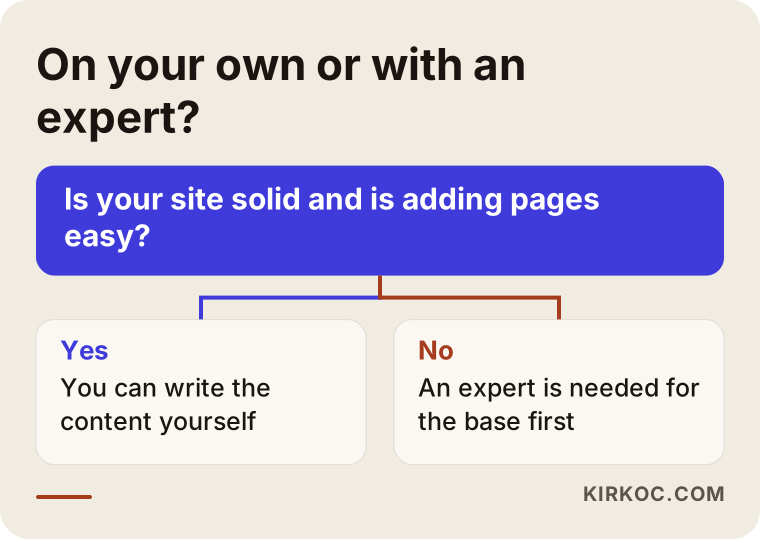
This chart is not a verdict, just a guide. If your site is sound and only the content is missing, you can get far on your own. If the foundation has problems, those need fixing first.
What decides the cost
I will not give a number in this article, because an honest figure cannot be given without seeing your business. But I can tell you clearly what the price depends on:
- Number of products and pages: A company with five products and a company with two hundred items do not carry the same workload.
- State of the current site: Does the site need to be rebuilt from scratch, or does the existing one only need fixing?
- Competition: A product group with many competitors takes more effort.
- Number of regions and languages: A company serving a few counties has different needs from one that exports and wants pages in several languages.
- Content production: Who will prepare the text, the photos and the technical information.
- Duration and continuity: Do you want a one-time fix, or work that continues over months?
A cheap-looking quote can turn out to be incomplete later, and an expensive-looking one can include items you do not need. Check whether the quote says which piece of work will be delivered and when.
How I work with you
I work alone, which means the person you talk to is the person who does the work, with no extra layer in between. First I listen to you describe your company, your products and your goals. Then I look at the current state of your site and tell you, in plain language, what is really needed. I do not add unnecessary work; if your site does not need something, I say so. In agriculture, you know the product and I know the search world, and good work comes from putting those two kinds of knowledge together.
Throughout the work, I explain what I am doing, why I am doing it and what the results are, in terms you can follow. I do not promise rankings or sales. What I can promise is to do the right work, in the right order, in the open.
Frequently asked questions
Does SEO still work for seasonal products such as seed or feed?
Yes, but the timing is different. For seasonal products, you need to prepare the page and publish it before the season. Improving the same page every year is more efficient than starting from zero.
I sell on marketplaces. Do I still need SEO for my own site?
Marketplaces can bring quick sales, but your customer relationship and your brand depend on that platform's rules. Your own site is the only place where you can explain your products and build trust on your own terms. Running both side by side is also possible.
How long until I see results?
I cannot give an exact time, because it depends on the competition, the state of the site and the product. As a general idea, it can take anywhere from a few weeks to a few months for a new page to be found and judged. That is why starting early matters for seasonal products.
Do you guarantee a first-place ranking?
No. Nobody controls search results alone, so be careful with anyone who offers a guarantee. I build the right pages, measure and adjust, and then I go through the results with you.
Is it risky to share product photos and technical details?
Usually not; informing customers builds trust. However, you decide what to share when it comes to trade secrets, formulas or pricing. If you have a legal concern, ask a lawyer.
Will it hurt if my dealers open their own websites?
It is not always a problem, but the same product text repeated on many sites can weaken all of them. A good solution is to give your dealers a content guide so they can write in their own words.
My site is only in one language. What should I do to sell abroad?
If you export, you need separate pages in the language of the target country. A translation alone is not enough; you need to look at what buyers in that language actually type. This does change the scope and the cost of the work.
Should I choose SEO or Google Ads?
They do different jobs. Ads give fast visibility but stop when the budget ends. SEO is slower but lasts. For most companies, a balanced mix of the two makes sense, and the decision depends on your budget and your season calendar.
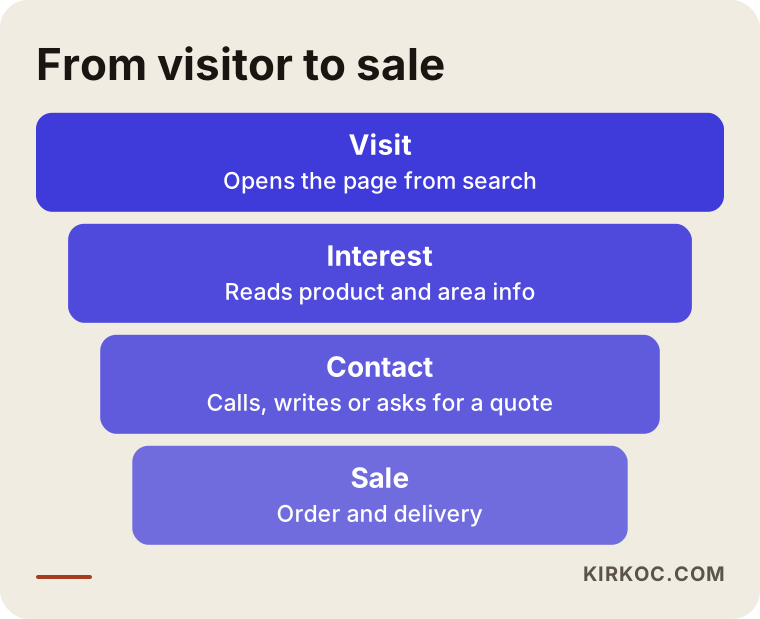
In the end, the goal is to move every person who comes to your site, step by step, closer to an inquiry. The illustration below summarizes that path.
If you would like to talk through which pages your agriculture or livestock business needs, where to start, and which mistakes are waiting for you, you can reach me through my SEO services page. I will listen to your products and goals and tell you honestly what can be done.