You run a medical laboratory, or an imaging center that does MRI and ultrasound. The equipment is in place, the staff is experienced, the service is good, but the phone does not ring as often as you expect. A patient types "blood test near me", "MRI center in Brooklyn" or "do I need to fast before an MRI" into Google and does not see you. Other centers or generic health websites show up instead. So it is perfectly natural that you searched for "medical lab SEO". In this article I explain, in plain language, how medical labs and imaging centers become visible on Google, which pages you need, and where to start. I am Ümit Kırkoç, a web designer and SEO consultant who works alone from Istanbul, and where it is relevant I will be upfront about the limits of my own SEO services.
SEO, in short, is the work that makes your website appear when people search on Google. Unlike an ad, you do not disappear the moment you stop paying; done well, the setup you build keeps bringing in prospective patients for months. But healthcare has to be handled more carefully than most industries. People searching here are both in a hurry and wary: before they go anywhere, they want to know whether they can trust the place. Your website's job is to build that trust at first glance.
How do people search in this field?
Someone looking for a lab or imaging center usually starts with a doctor's order or a symptom. You can roughly sort their searches into four groups. The first group looks for a place: "MRI scan Brooklyn" or "ultrasound center near me". The second wonders about the test itself: "how is a thyroid ultrasound done" or "do I need to fast before an MRI". The third asks about preparation and timing: "how long do blood test results take". The fourth wants an appointment or a home service right away: "at-home blood draw" or "view lab results online".
Each of these four groups needs a different page. The person looking for a place wants your address, your opening hours and directions. The person curious about a test wants a plain explanation. The person asking about preparation wants a clear list. The person who wants to book wants a phone number or a form. If you try to squeeze all of this onto one home page, you will not fully answer any of them.
The picture below uses a completely made-up example to show what a search result might look like, and why a clear page can sit ahead of a generic list.
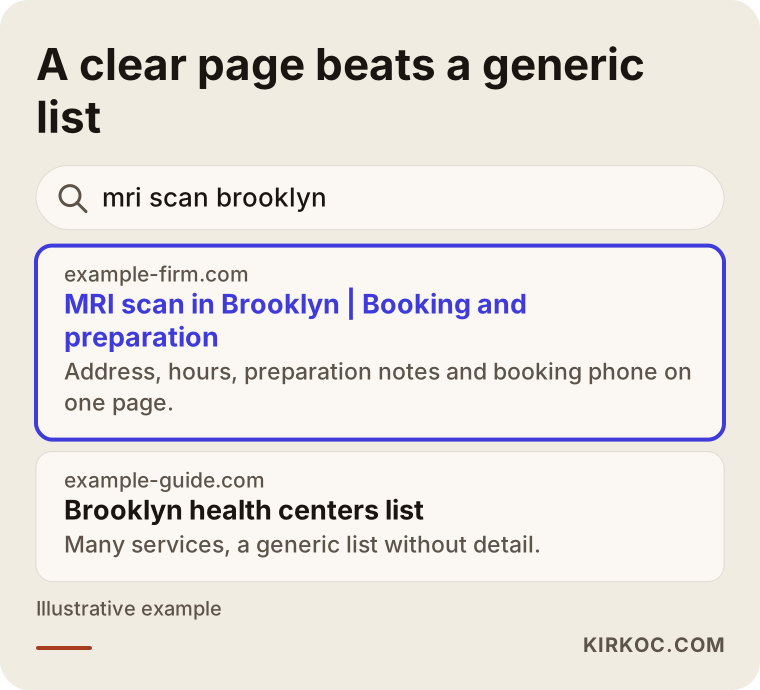
Look at what the highlighted result does: it names the place, the test and what it is for in the first line. A generic "all health services" list does none of that. Google tries to work out which answer to give the person searching, and when you make that easy, it can put you forward more comfortably.
Why are patients more careful with health searches?
People compare most businesses in a minute or two. With a health search, the reader stays longer, reads the page from top to bottom and checks who wrote it. The reason is simple: going to the wrong place costs a lot. So your site needs to state clearly who you are, who is medically responsible, what equipment you use and where you are. Concrete facts build trust; fancy sentences do not.
What Google pays extra attention to on health sites
When Google ranks results on health topics, it looks especially hard at trustworthiness. Think of it this way: if a page says "fast before this test", Google wants to see that the person or organization saying so is qualified to. On a medical site, these things matter a great deal: the official name and address of your organization, the identity of the responsible physician or specialist, who prepared each page and when it was last updated, and contact details that are the same on every page.
None of this is a technical setting; it is plain honesty. Yet on many lab websites the "about" page is one paragraph, there is no author name and no update date. Those gaps make both the reader and Google hesitate.
There is one more important point. Healthcare advertising and promotion is subject to legal rules, and so is patient privacy. In the United States, for example, privacy law such as HIPAA and various state rules can affect what you publish, and other countries have their own versions. Which claims you may make, and whether you can list prices or run promotions, are questions like that. I cannot give legal advice. Before you publish any wording, I suggest you talk it through with your center's responsible physician and, if needed, an attorney. An SEO project should be built on text that complies with the rules, never the other way round.
Which pages do you need?
The most common mistake on lab and imaging center websites is listing every service on one "Our Services" page. Yet every test is a separate search, a separate door through which a prospective patient arrives. A useful structure usually has these parts.
- Home page: Explains in a few seconds who you are, where you are and what you do.
- Service categories: Separate pages for main headings such as chemistry panels, hormones, blood counts, MRI, ultrasound and X-ray.
- Test pages: One plain-language page for each of the most searched tests.
- Preparation info: Practical details such as fasting, medication, clothing and what to bring.
- Location and access page: Address, map, parking, public transit and opening hours.
- Booking and results page: How to book, and how results are delivered.
- About and team: The responsible physician, specialists, accreditation and equipment.
- Frequently asked questions: Straight answers to real patient questions.
The table below summarizes the four kinds of searches and the page that fits each.
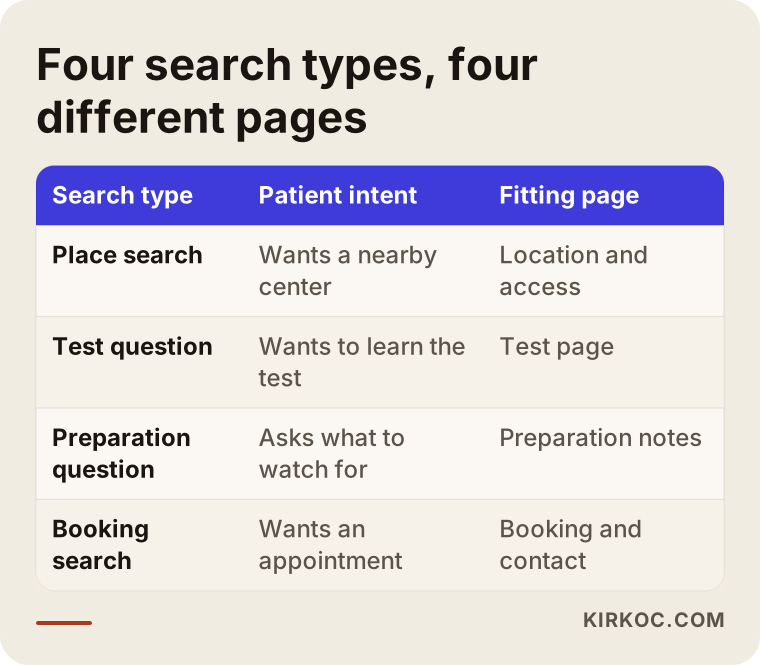
The takeaway is that the same page cannot serve the person looking for a place and the person curious about a test at the same moment. Each page should answer one question. That helps both the patient and Google.
How do you write a test page?
Say you are preparing a page for "thyroid ultrasound". A good page explains, in plain words, what the test is, when it is requested, how it is done, how long it takes, whether any preparation is needed, when the result is ready and how to book. Do not use language that diagnoses or recommends treatment; that is the physician's job, not yours. The page's role is to inform the patient and make it easy to reach you.
Cramming too much into one page is also a mistake. One page per test and one section per question is enough. Readers do not want to read at length; they want to find what they came for.
A prospective patient's path to your door
Seeing how a prospective patient reaches your site and makes a decision shows you where to put your effort. The process is usually like a funnel: at the top, many people look for information; some of them open your page; fewer look at your services and location; and at the bottom, a small group books an appointment. Your goal is to make sure nobody gets lost along the way.
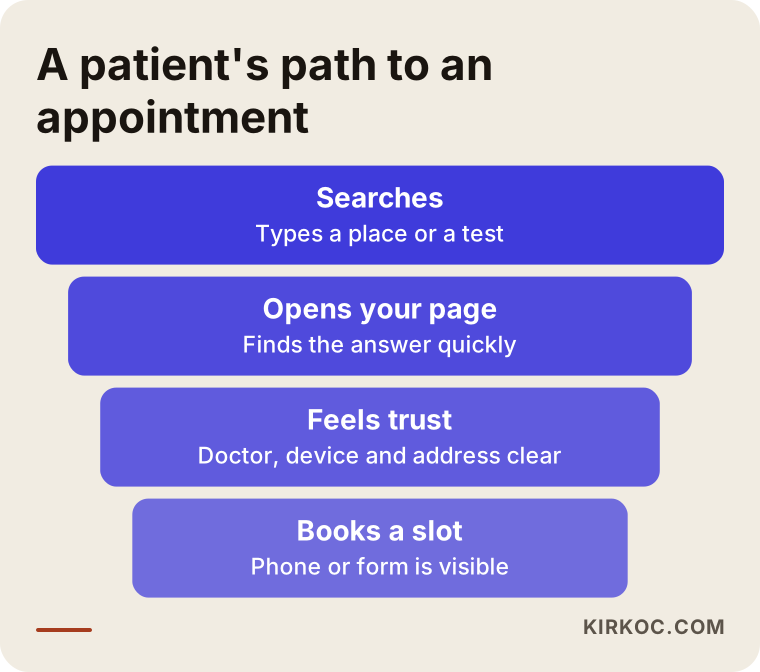
A different thing helps at each stage of the funnel. At the search stage, clear headings. When someone opens the page, a site that loads fast. At the trust stage, physician and equipment details. At the booking stage, a visible phone number and a simple form. The weakest link in this chain is almost always the place where you lose the most people.
Local search: why do map results matter so much here?
Labs and imaging centers are local businesses. A patient does not want to travel miles; they look for a place nearby with easy access. That is why map results on Google, in other words your business profile, are often even more important than your website. A business profile is the box that appears on the right or under the map when you search, showing your address, phone, hours and reviews.
Here is what to check in your business profile. The name, address and phone number should match your website exactly. Choose the right category, such as "medical laboratory" or "diagnostic imaging center". Keep your hours current and enter holiday closures ahead of time. Add your tests to the services list. Upload real photos: the entrance, the waiting area, the equipment room. Reply to reviews briefly and politely, but never share another patient's health information in a reply, and never respond with a diagnosis or treatment advice.
The location page on your site
Add a separate location page to your website too. It should contain the address, a map, public transit and parking details, directions to the building entrance, wheelchair access, opening hours and the phone number. Mention your neighborhood and city in natural sentences, for example, "If you are coming from the Park Slope side...". In other words, the place name should appear in a meaningful sentence, not in a list of keywords.
How should the page layout work?
The layout of a test page should follow the order in which the reader needs things. First say what the test is and who it suits, then the preparation, then how the process works, and last how to reach the booking. Your phone number should be visible everywhere on the page.
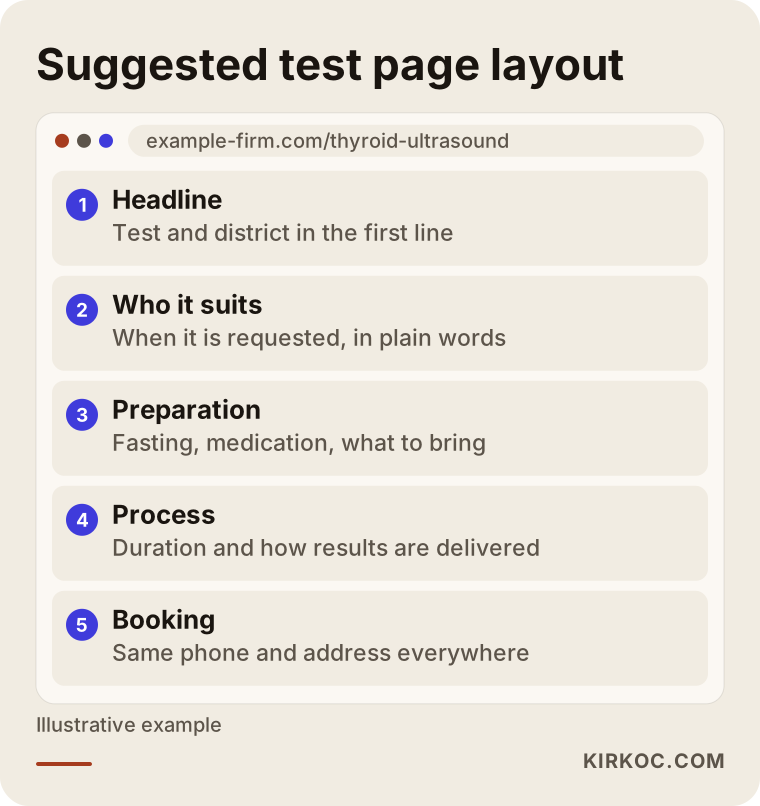
The layout in the picture is not a fixed rule, just an example that works well. What matters is that the reader gets the feeling "I am in the right place" on the first screen, and finds the things they ask most often within a single scroll.
Two hypothetical example scenarios
The two scenarios below are entirely hypothetical; they do not describe a real center or person. The aim is to show how two different situations in the same industry call for different steps.
Scenario 1: A neighborhood lab
Suppose a small medical laboratory sits in one neighborhood. It draws blood early in the morning and results are ready the same day. Its website is a single page with a list reading "Our services: chemistry, hormones, complete blood count, urinalysis, ..." and a phone number. The business profile is half finished: no photos, outdated hours.
In this case, my first job would not be building a new site. I would first fix the business profile: the right category, current hours, real photos. Then I would add three things to the site: an explanatory "blood test" page (preparation, fasting, timing, results), a "location and access" page, and a page answering the most common questions. If there is an extra service such as at-home blood draws, I would give it a page of its own. At this scale, the goal is to show up in nearby searches in your own area, not to compete across an entire metropolitan region.
Scenario 2: An imaging center with several machines
Now suppose a second center does MRI, ultrasound, X-ray and mammography, and has two locations. The website is old, loads slowly, and describes both locations on one page. Services are bundled under a single "Imaging services" heading.
Here the problem is variety. First I would build a separate page for each location, so each one has a clear address and phone number. Then separate pages for each machine and test: "how an MRI scan works", "preparing for an ultrasound", "when to get a mammogram". On those pages I would answer patient questions directly, with weight on practical topics such as "what can people with claustrophobia do" or "metal objects before an MRI". Because physician and equipment details build trust, I would also expand the team page.
What the two scenarios share is this: first find the existing weakness, then start with the work that makes the biggest difference for the least effort.
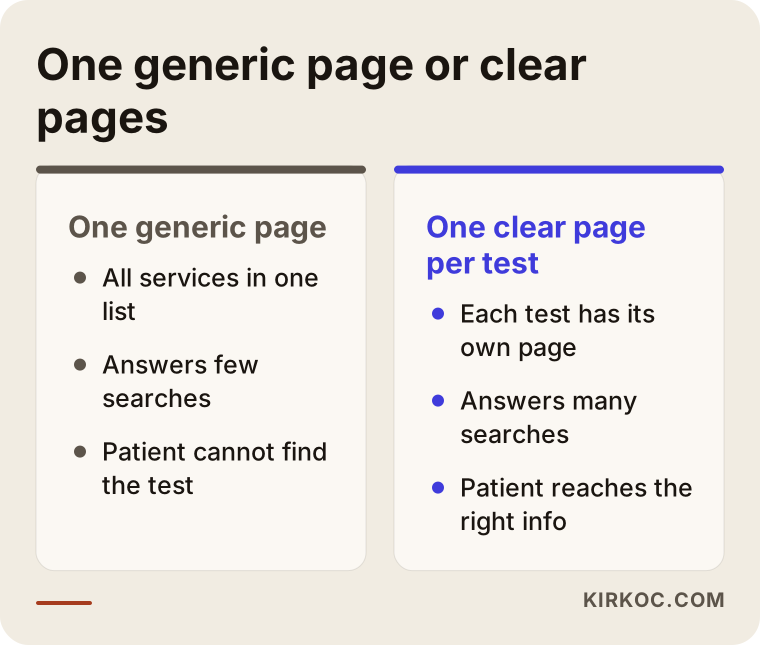
The comparison summarizes the difference between the two approaches. A single generic page is quick to prepare but answers very few searches. Separate pages for each test take more effort, but because each one answers a specific search, your visibility spreads across a much wider area.
Step by step: how I work
When I set up SEO for a medical lab or imaging center, the order is roughly as follows. The details change with every site, but the basic flow is the same.
- Looking at the current situation. I review the website and the business profile. Which pages exist, which are missing, is the site fast, and does it work comfortably on a phone.
- Listing patient searches. I write down what people type about your services: place, test, preparation, booking.
- Making a page plan. I decide which page will answer which search.
- Building the trust elements. I organize items such as physician details, equipment details, address and update dates.
- Writing and correcting the pages. I prepare the text in plain language, in a form that can pass your medical lead's approval.
- Setting up the technical side. I handle the invisible settings, such as speed, phone compatibility, proper headings and structured data.
- Monitoring and improving. I track which searches arrive and which pages are working.
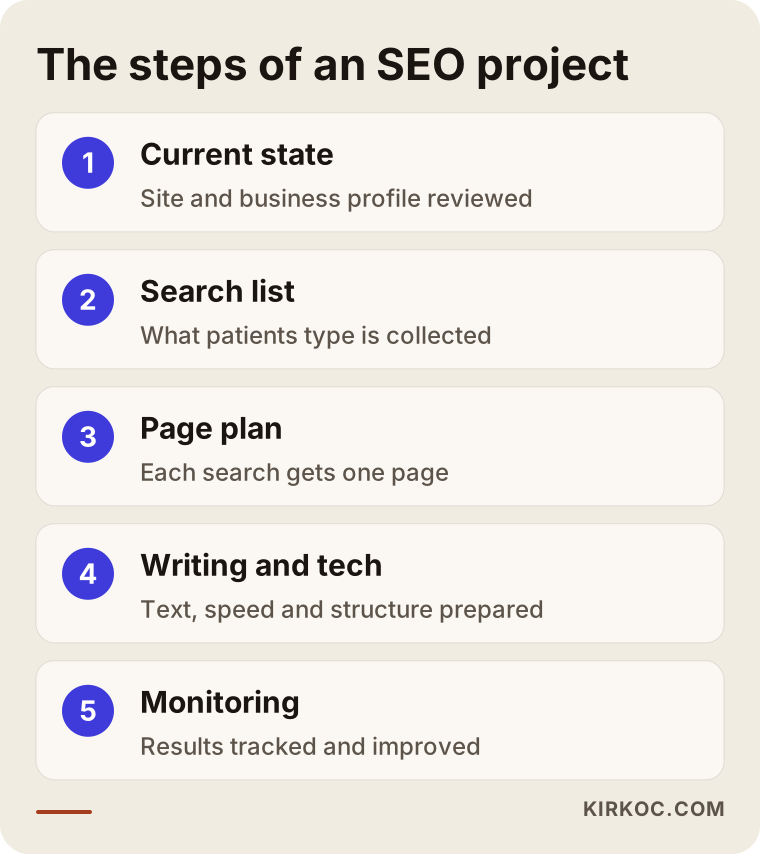
These steps go in order, but the job is not something you do once and finish. The first three steps in particular are the foundation of everything else; if they are wrong, the later effort is wasted.
The technical side, briefly
Technical SEO is the arrangement behind the scenes of your site. On health sites, these matter most: pages that open quickly, text that reads comfortably on a phone, a secure connection (the padlock icon in the address bar), a correct heading structure, and marking up your business address so that machines can read it. These are often one-time fixes, but if they are not done, even the best-written page does not get seen enough.
Common mistakes
The mistakes I see most often at labs and imaging centers usually come from lack of knowledge, not bad intent. The picture below summarizes them.
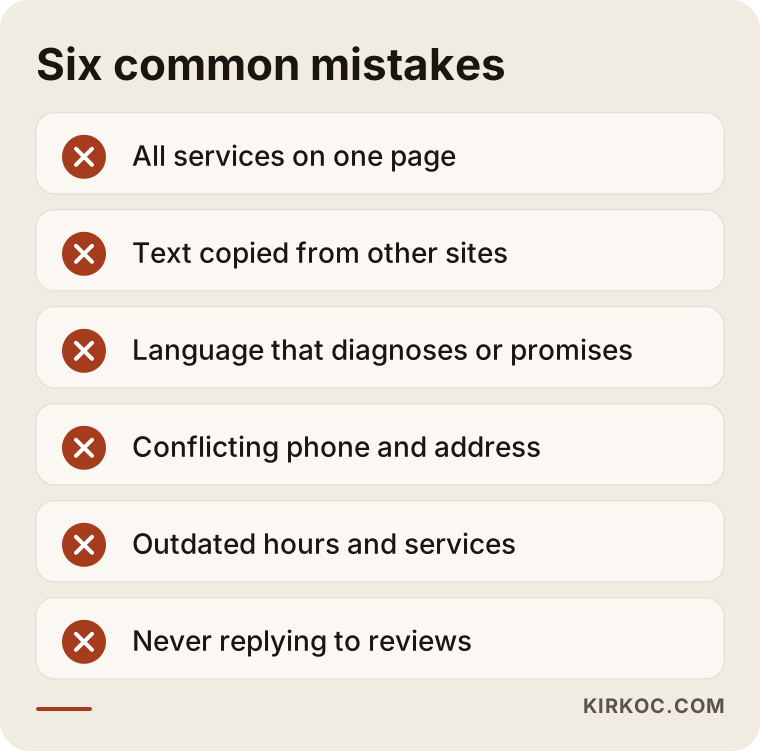
Let me go through them a little more.
- Putting every service on one page. A prospective patient cannot find the page for the test they searched for, and Google cannot tell which search to show you for.
- Text copied from other sites. Taking a ready-made test description word for word does not build trust, and because the same content exists in many places, it gives you no advantage. Write your pages around your own center's process.
- Language that diagnoses or promises. Phrases like "find out for certain what disease you have with this test" are risky for both ethical and regulatory reasons. Position yourself as an informative source.
- Missing or conflicting contact details. One phone number on the business profile and another on the website confuses the patient and Google alike.
- Outdated content. If hours, equipment lists or payment policies change but the site still shows old information, trust disappears.
- Ignoring reviews. A profile that never replies to reviews looks uninterested. When you reply, take care not to share any personal health information.
You can spot many of these yourself. One evening, pretend to be a patient and browse your own site from your phone. See how many seconds it takes to find what you are looking for, and how many taps it takes to reach the phone number.
What can you do yourself, and when do you need an expert?
You can do part of SEO without any technical knowledge. At the top of the list is keeping your business profile in order: address, hours, photos, service list and replies to reviews. Second, write down the questions patients ask most and turn them into plain answers on your site; the person at your front desk is your best source for these. Third, keep team and equipment details up to date.
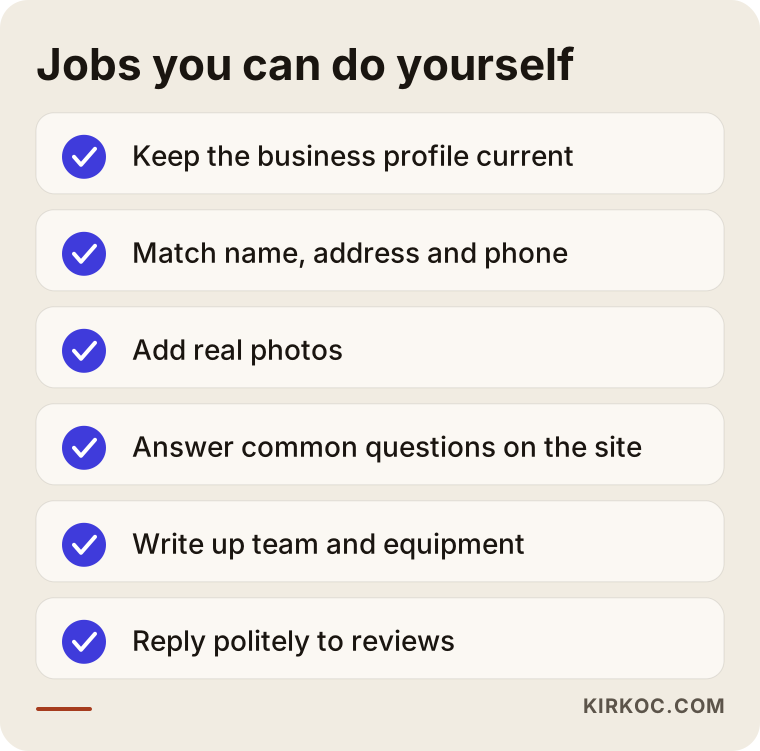
This list shows where you can begin without needing an expert. But beyond a certain point, going alone gets harder. Restructuring your site, building a new page structure, fixing technical problems, managing several locations at once, or opening pages for patients who speak other languages are jobs that call for expert help.
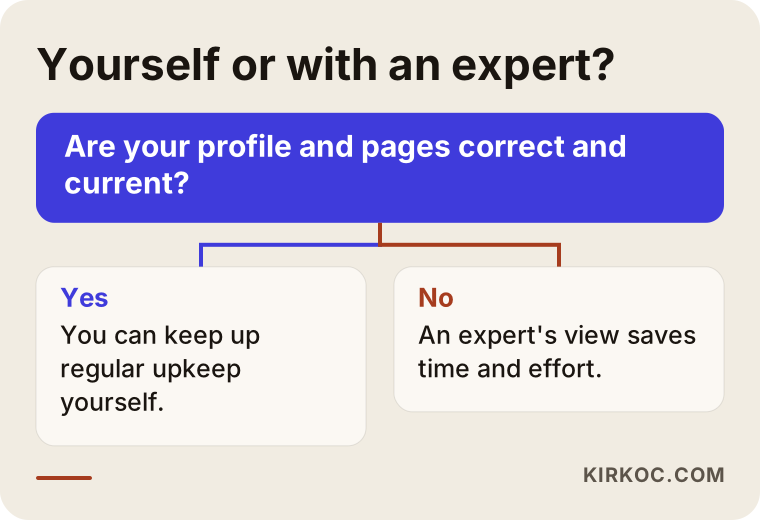
The decision chart says it briefly: if your basic information is correct and current, you can handle regular upkeep yourself. But if the page structure has gaps, if there are technical problems, or if you have seen no progress for months, an expert's eye saves time and effort.
International patients and multilingual pages
Some centers also serve patients from abroad. Especially in big cities and medical travel destinations, there are tourists, long-term foreign residents and prospective patients coming from overseas. These people usually search in their own language, with phrases like "blood test Istanbul" or "MRI center Istanbul". If that is a goal of yours, preparing separate pages in the relevant language makes sense. Do not treat it as plain translation; write it around the questions of the person searching in that language: insurance, interpreters, payment methods and the language of the report. I work with sites in four languages, but this only makes sense if there is an audience you truly serve; it should never be done just to have it.
What determines the cost?
I will not give a number, because there is no single right price for this work and a number would mislead you. But I can tell you plainly what determines the cost.
- The state of your current site. If your site has a decent foundation, the work may only be corrections. If it has to be built from scratch, the job is bigger.
- The number of pages. Twenty test pages and two hundred test pages take different amounts of work.
- The number of locations. Each location needs its own work, with its own address, hours and profile.
- The number of languages. Every added language means content suited to that language, not just translation.
- Competition. Competing in a busy area with many centers takes more time and effort.
- Text approval. How quickly or slowly your medical lead or legal adviser approves text affects the plan.
- Duration and rhythm. Whether you want a one-time setup or ongoing monthly follow-up.
When you get a quote, ask: "What exactly is included at this price?" If the number of pages, the text to be written, the business profile and the reporting are not spelled out, question the quote a bit more. No expert can honestly promise you "I will get you to first place by this date"; nobody can guarantee Google's ranking.
How long until you see results?
SEO is not something you do today and see results from tomorrow. It takes time for new pages to be found, evaluated and shown in patient searches. Corrections to the business profile are usually noticed sooner; new test pages take longer to become visible. There is no exact schedule; it varies with the area, the competition and the current state of your site. The honest expectation is this: the first weeks are setup, the following months bring slowly growing visibility, and after that comes regular upkeep.
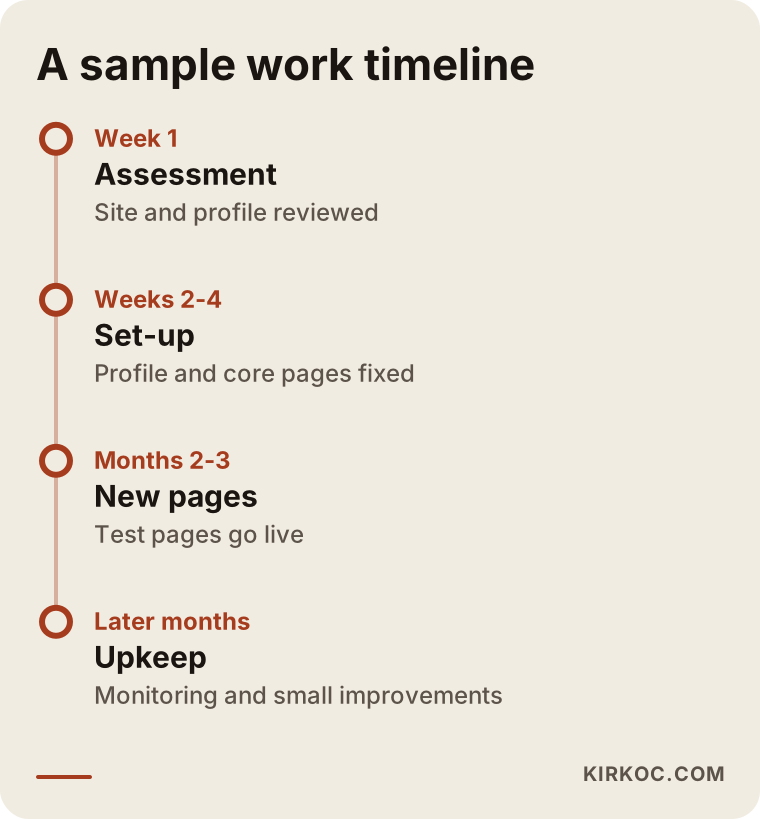
This timeline is not a promise; it describes a typical flow. Every center moves at its own pace, and what matters is that you can see what is being done at each stage.
How I work with you
I work alone from Istanbul. That means the person you talk to is the person who does the work, with no extra layer in between. In the first conversation I listen to what you do, how your patients find you and what state your website is in. Then I tell you plainly what is necessary and what is not. Sometimes I have to say, "do these three things yourself, you do not need me for that", and I have no problem doing so. When I prepare text, I submit it for your medical lead's approval, and on regulatory matters I recommend that you consult an attorney. When the work ends, I report what was done in plain language.
Frequently Asked Questions
Do a lab and imaging center really need SEO?
Prospective patients now look on Google first when they search for a center. If you do not show up on your site or on the map, those people cannot find you, however good your service is. Doctor referrals and your existing patients are important, of course, but new prospective patients need visibility too.
What is the difference between SEO and Google Ads?
With ads, you are visible only while you pay; when you stop, the visibility ends. SEO starts more slowly, but the setup you build can work for a long time. Health advertising is also subject to each platform's own rules, so I suggest checking them before you buy ads. The two are not alternatives to each other; they complement each other.
Should I share a price list on my website?
This depends both on the rules of your sector and on your organization's policy. I cannot say anything definitive about the rules for promoting healthcare services; ask an attorney or your responsible physician. Even if you do not list prices, you can still give information such as how to find out the price and what payment methods you accept.
Do patient reviews help SEO?
Yes, especially in map results, reviews are an important trust signal. But buying reviews or having fake ones written is both unethical and against platform rules. It is enough to ask your real patients for a review with a polite reminder. When replying to reviews, never write any personal health information.
Do I need a separate page for every test?
Not for every test, but for the tests that prospective patients really search for and that you actually offer. It makes sense to start with the five or ten most asked-about tests. Then you add new pages by looking at the searches that come in. Opening a separate page for a test that is rarely searched is usually wasted effort.
How many months until results show?
I cannot say for certain; it varies with the area, the competition and your site's current state. Business profile corrections can be noticed quickly, while new pages take longer to settle. Be cautious with anyone who guarantees a ranking or a date.
How do I show up in AI answers?
Tools like ChatGPT usually rely on clear, well-organized and trustworthy sources when they answer a question. That is why giving clear answers on your test pages, stating your organization's identity openly and keeping information current also helps here. No one can guarantee visibility, but regular, accurate content improves your chances.
I manage my site myself. Do I need expert help?
You can handle basic upkeep yourself: the profile, hours and frequently asked questions. For jobs like rebuilding the page structure, solving technical problems or managing several locations, help is useful. Tell me what you already handle yourself, and I can help you work out how much support you need.
If you would like to look together at how your medical lab or imaging center appears in patient searches, you can reach me through my SEO services page, describe where you are now, and ask for a plain, honest first assessment.