You have a shop, skilled fabricators, a bucket truck and an install crew. Illuminated channel letters, window graphics, vehicle wraps, storefront signs, wayfinding panels: the quality of your work speaks for itself. But your phone mostly rings with past customers and referrals. When someone types "channel letter signs near me" or "I need a sign for my new store," they see your competitors, not you. That is exactly where SEO for sign companies and graphics shops comes in. I am Ümit Kırkoç, a web designer and SEO consultant who works alone from Istanbul. In this article I walk through the problems specific to your trade, the pages you need and where to start, and I describe the scope of my own SEO services where it fits.
SEO, in short, is the work that makes your website show up when your customers search on Google. It is not an ad, so you are not invisible the moment you stop paying. When it is set up properly, it keeps bringing in inquiries for months. But it has a price: patience and a sensible page structure. By the end of this article I want you to be able to tell what is really needed from what is not.
What do sign customers type into Google?
The sign trade has a quirk: what customers search for is often not a product but a result. The owner of a new store may never type the word "sign." They might search "storefront lettering," "lit up name for my shop," "window decals" or "put my logo on a van." All of those are your work, and all of them are different searches.
The buyers are also very different from one another. A shop owner opening a first location, a chain adding branches, a builder finishing a project, a delivery company that wants its fleet lettered, an agency preparing a trade show booth. Each uses different words, wants different questions answered and gets convinced by a different page.
Most searches combine a place with a type of job: "channel letter signs Chicago," "vehicle wraps near me," "storefront signs Brooklyn." The reason is simple. A sign job involves an on-site measurement, an installation and often a permit from the local building department. People are not looking for a faraway company; they want one that can come and look. That works in your favor, because a search tied to a city or neighborhood is much less crowded than a search aimed at the whole country.
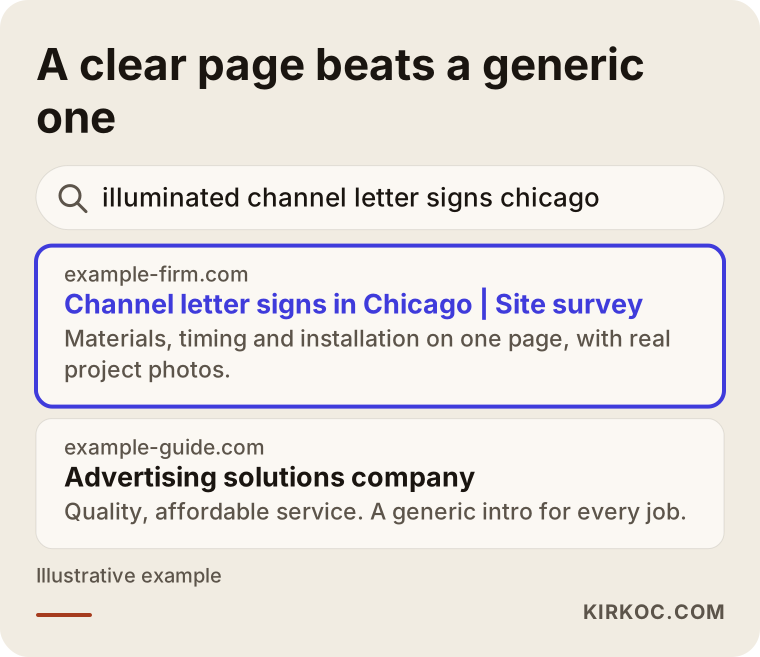
The image above is a made-up example, but the logic is real. The highlighted result says the city, the type of work and what you get in the very first line. A sentence like "Quality, affordable advertising solutions" is something anyone can write, so it separates you from nobody.
The same shop, five very different searches
Think about your own business and list the sentences a customer might use to find you. Usually you end up with these groups. Searches by product (channel letters, neon, monument signs, electronic message boards). Searches by where it goes (building facade, storefront window, interior, vehicle). Searches by type of project (brand rollout, branch signage, grand opening signs). Searches by place (city, neighborhood, industrial park). And searches that are questions ("how long does a sign take to make," "do I need a permit for a sign"). You do not need a separate page for every single phrase, but you do need to know which group is answered by which page.
Matching searches to pages
One mistake I see often: every service is listed one under the other on a single "Services" page. Google does not consider that page strong enough to show for channel letters, vinyl graphics and vehicle wraps all at once, because the page goes deep on none of them. The customer has the same experience. Someone searching "vehicle wraps" has to dig through a pile of unrelated headings to find their own job.
The table below lists common search types in your trade and which page suits each.
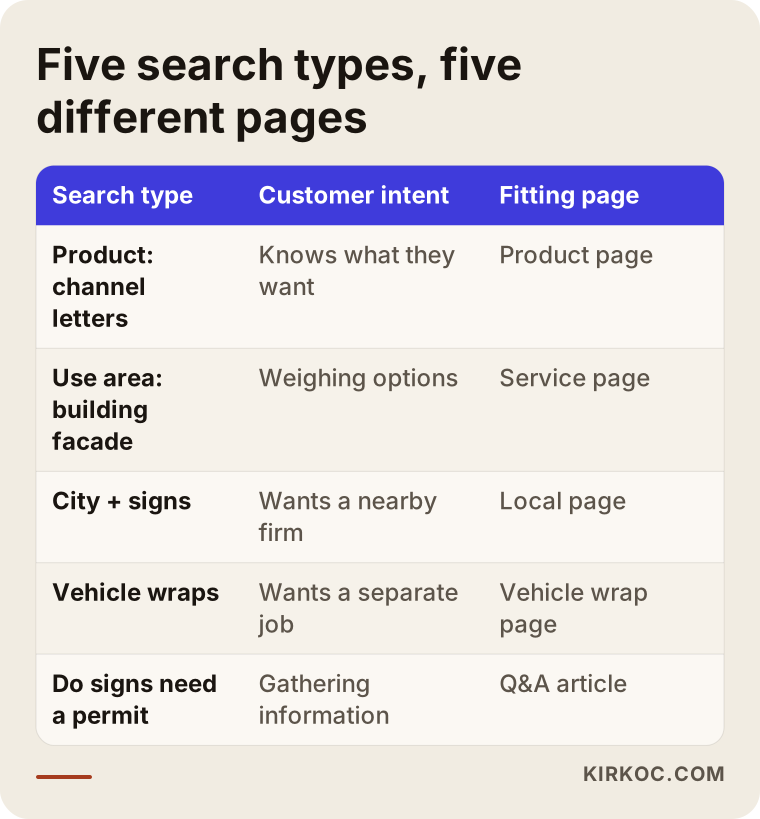
The main idea in the table: one page, one intent. A product page explains the product. A local page explains your work in that area. A question page answers the question. Stuffing everything onto one page gives you weak results on all of them.
What does a customer go through before deciding?
For most people, buying a sign is not a frequent decision. So the customer first tries to understand what they want, then compares companies, and only at the end contacts someone for a measurement or a quote. Your website should have an answer for each of those three moments.
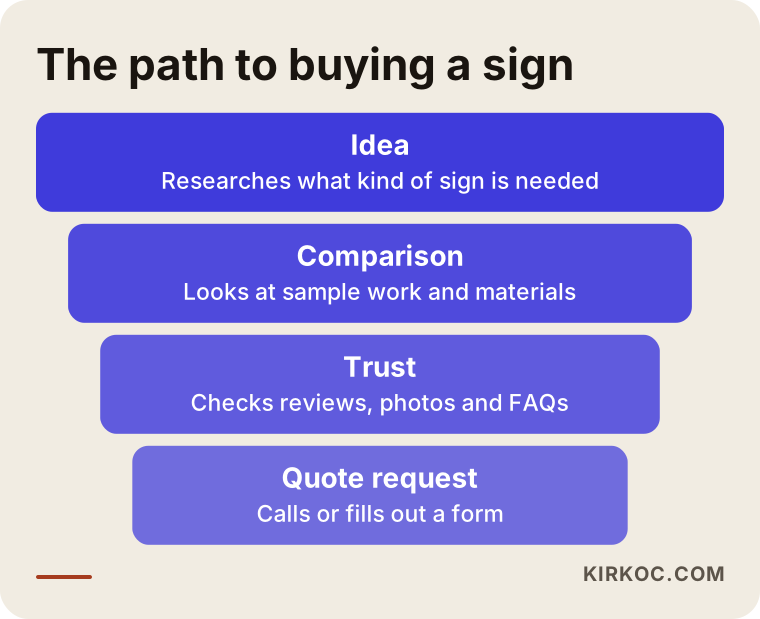
The order in the image shows where each kind of content works. At the top you need general articles that help people understand their options. In the middle you need examples of your work and explanations of your materials. At the bottom you need a clear quote form or phone number. On many sign company websites the top and middle are missing: the visitor lands straight on a "Get a Quote" button, and if they are not ready yet, they leave.
Which pages should a sign company website have?
Let me put it in plain terms: the skeleton of your site should follow the order of your customer's questions. The home page tells people who you are and what you do. But the real work happens on service pages, project pages and local pages.
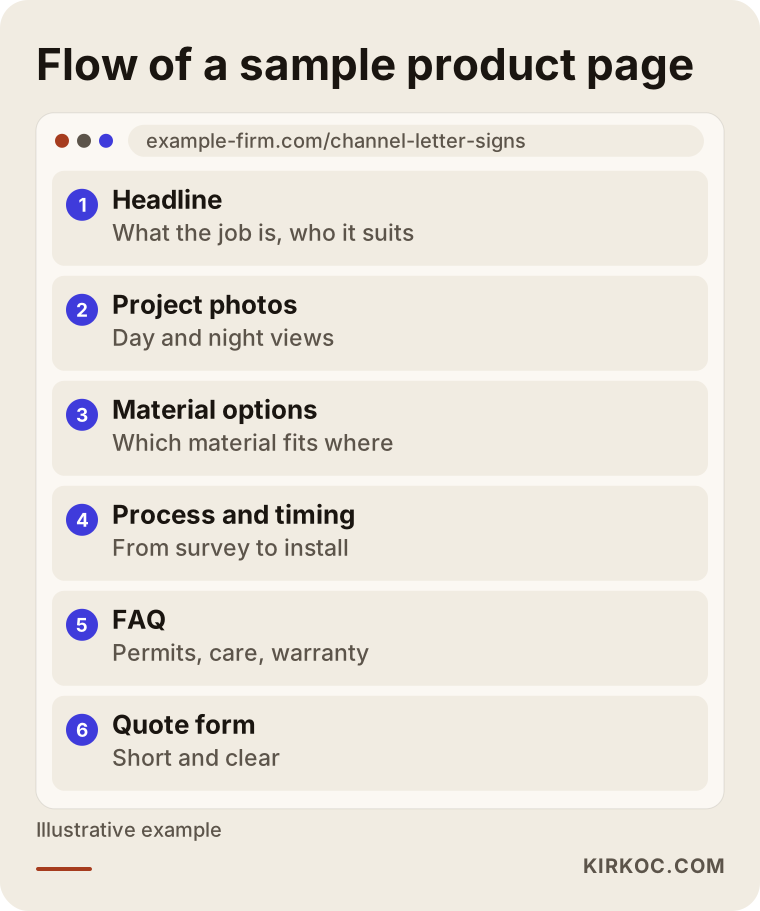
This image shows one way a product page can flow. At the top it says what the job is and who it suits. Then come real project photos, material options, the process, and finally the frequently asked questions. In short, the page already answers everything the customer would ask before calling you.
What convinces a customer on a product page?
In a visual trade like yours, customers often look for trust more than text. They want to see answers to questions like these. Has this company done work in my industry? Is the material durable? Who does the installation? How long does it take? If something goes wrong afterward, who do I call? If the page does not answer those, the phone will not ring, however pretty it looks. So I suggest every product page include the work process, a short description of the materials used, an honest note about maintenance and warranty, and real project photos. You do not need big adjectives. One concrete sentence such as "the material used outdoors holds up to rain and sun for this reason" builds more trust than three paragraphs of praise.
Page categories specific to your trade
For a sign and graphics company, these pages usually make sense. Product and service pages: channel letters, neon, monument signs, facade work, window and glass graphics, vehicle wraps, wayfinding systems. Each should be its own page, full of your own photos. Industry pages: restaurant signs, retail signs, clinic signs, factory and campus wayfinding, because a restaurant owner and a plant manager will not see themselves on the same page. Local pages: only for places you actually serve. Instead of a list reading "we serve all of these cities," a few pages with real information about the areas you work in are worth more. Finally, project examples and a page of frequently asked questions.
The difference between a generic page and a specific page
Writing the same information in two different ways gives very different results. The comparison below makes that concrete.
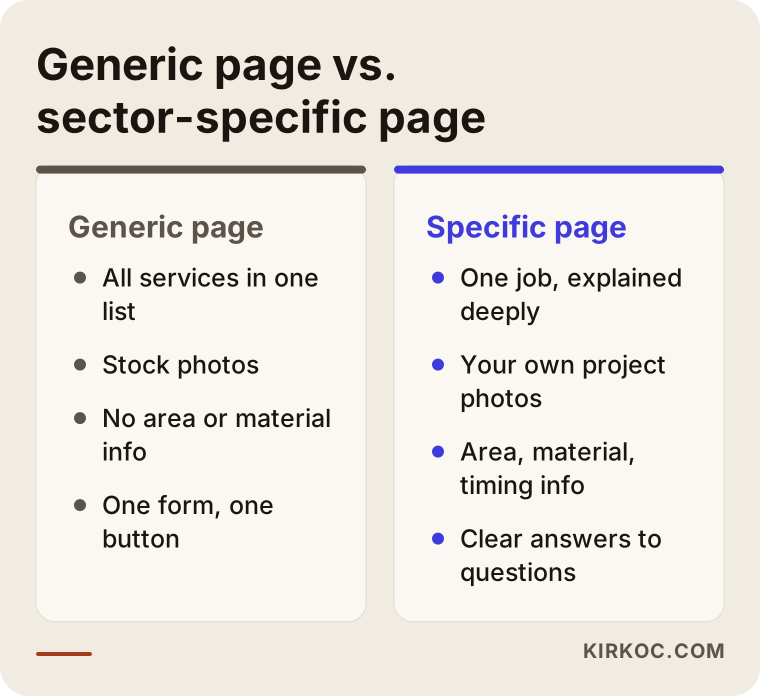
The page on the left is written for everyone; the one on the right is written for a particular person. Both Google and the customer find the second one more believable, because it is obvious that the writer knows the job.
Two hypothetical scenarios
The two examples below are entirely hypothetical. They do not describe a real company or person. The goal is to show how the same work can lead to different results in different situations.
Scenario 1: A shop with a one-page website
Suppose there is a sign shop in a mid-sized city. It has three fabricators and one install truck, and most jobs come by referral. Its website was built years ago and is a single page: a logo at the top, one paragraph, a phone number at the bottom. The owner wants to rank first for a broad phrase like "illuminated signs."
The first move is to stop chasing the broad phrase and choose a goal the shop can actually win. Say the shop is best at channel letters. Then the first thing to build is a channel letter page with real project photos and frequently asked questions. After that come one page each for the city and the neighboring towns. The Google business profile gets cleaned up. There is no ranking guarantee with this work, but the shop can at least compete in a narrow search such as "channel letter signs" plus the city name. Appearing in search results does not bring jobs overnight in the first months, but as the pages settle in, quote requests may increase.
Scenario 2: A company that does several kinds of work
In the second hypothetical, a medium-sized company makes signs, wraps vehicles and builds trade show booths. Its site is large and has hundreds of photos, but everything sits on a single "Projects" page. The company does not appear for "vehicle wraps," even though it has years of experience in that work.
The problem here is not a lack of content but a lack of organization. The fix is not a new site; it is sorting the existing content by industry and product: one page for vehicle wraps, another for fleet wraps, another for trade show booths. Each page covers that job's process, the materials used and the common questions. File names and descriptions of the photos are cleaned up. The old "Projects" page is not deleted; it becomes a showcase that links to the relevant pages. This is not finished in a weekend, but once done, the site answers many more kinds of searches with the same effort.
How do I work, step by step?
The process itself is simple. First I work out what your customer searches for, not what you think they search for. Then I look at the current site and see what is missing. After that I draw up the page plan, write the content, fix the technical issues and watch the results.
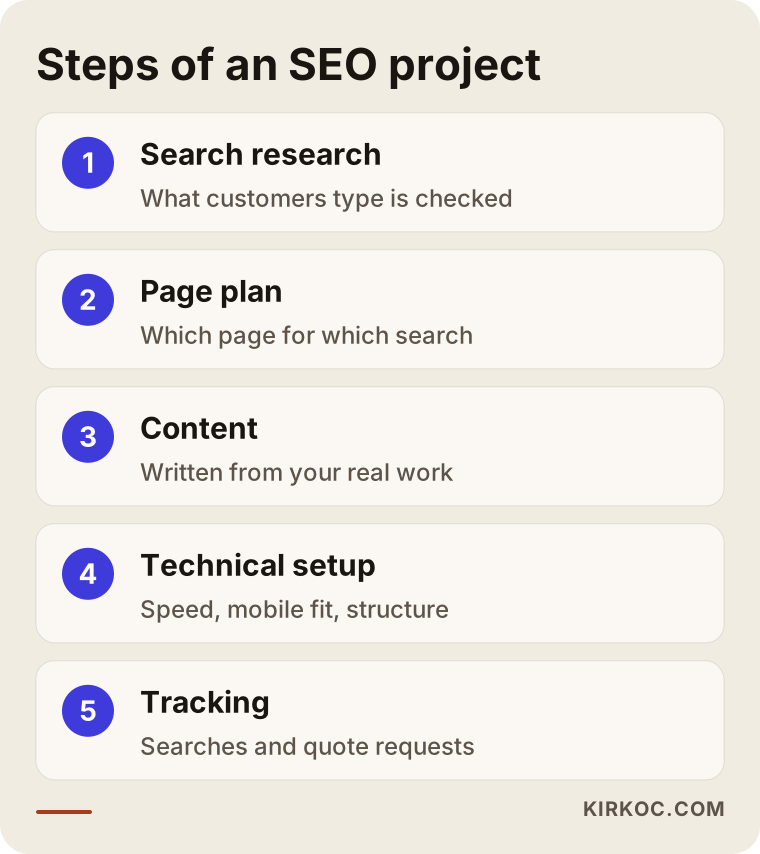
The order in the image roughly reflects how I work. The first step, search research, is the most critical, because ten pages written for the wrong phrase bring in less work than two pages written for the right one. The technical setup comes last but should not be neglected: your site has to open quickly on a phone, photos have to be compressed, and Google has to be able to read your pages.
Photos are the biggest asset of a sign website
In the sign business, the strongest proof is a photo of finished work. Yet on most sites the photos come straight off a phone, named something like "IMG_4821," uncompressed and without a description. The same photo is far more useful to both Google and customers when it is uploaded with a clear name and caption saying which store, which material, which city and what type of sign it is. If you can, show both the daytime and the nighttime view. For lit signs the difference is big. What the customer wants to see is how the sign looks at night.
Be careful about permission. When you photograph a storefront, the client's brand is visible, and that can cause trouble. A short confirmation before you publish is a good habit. I cannot give you a definite legal answer about privacy or image rights; if you are unsure, ask an attorney.
Local visibility: map searches
For searches like "sign company near me" or "city name + signs," Google often shows the map and business listings first. That part works separately from your website and depends on your Google business profile. The right category, an up-to-date address and hours, real project photos and customer reviews matter most here. Good SEO treats the website and the profile together, and the details in the two should not contradict each other. If your address is written one way in one place and another way elsewhere, Google cannot tell which to trust.
I want to stress one more point: SEO work has to take your shop's capacity into account. If the number of jobs you can finish each week is limited, showing up for every search can put you in a bind. So it is worth talking first about which jobs really earn you money and which eat up time and return little. For example, a page that attracts small, low-margin jobs can cut into the time you give to the work that pays. That is why I build the page plan around the reality of your business, not just search volume.
Common mistakes
There are some mistakes I see again and again in this trade. Most of them are not expensive, but when nobody notices them they cost jobs for months.
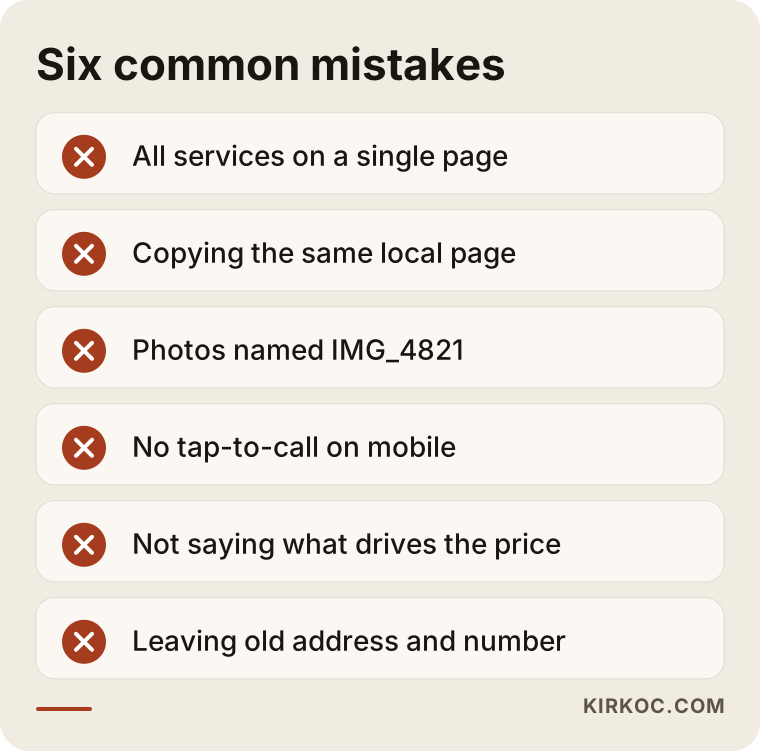
All the mistakes summarized in the image have one thing in common: the site talks about how the company presents itself, not about what the company does. The customer is looking for the answer to a question.
Let me expand on a few. The first is the "we do everything" approach. Listing channel letters, neon, vehicle wraps, printing and promotional items on the same page makes you look like an expert in none of them. The second is never discussing price. You do not have to publish a number, but explaining what the price depends on (material, size, lighting, installation height, permit time) filters out poor fits and attracts the right people. The third is copy-pasting local pages. Twenty pages where only the city name changes look, to Google, like twenty copies of one page and add no value. The fourth is not checking on a phone. Many people who search for signs are standing on the sidewalk with a phone; if they cannot reach your number with one tap, the job is lost. The fifth is outdated information: an address you moved out of, a changed number, a service you no longer offer. The sixth is not collecting reviews and references.
What can you do yourself?
You do not need an expert for everything. The list below summarizes what a business owner with a little spare time can do alone.
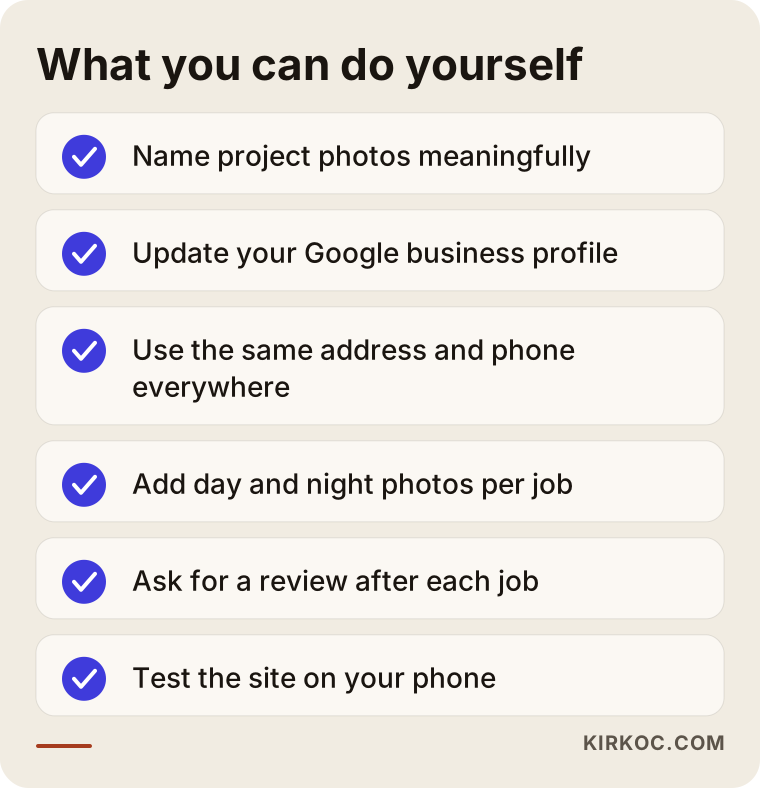
Doing this list gives you a solid foundation. Photographing your jobs regularly and naming the files well, and keeping your Google business profile up to date, are the two most effective things you can do at no extra cost. Asking customers to write a short review when a job is done is often forgotten, but it is worth a lot.
When do you need an expert?
Some tasks do need technical knowledge. A site that loads slowly on phones, telling Google correctly about your pages, building a page plan for several cities and services, and reorganizing an existing site without breaking it are a few of them. When you decide whether to do something yourself, ask two questions: could a mistake harm the site, and are the hours I would spend worth more than the hours I would spend in the shop?
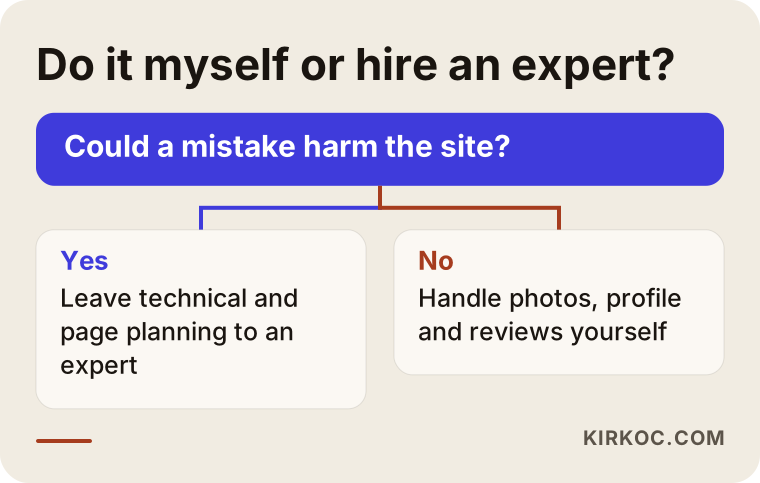
The chart is a rough guide, not a rule. For a small sign shop, a mixed approach is often the best path: do the basics yourself and get consulting help for the page plan and the technical part.
What determines the cost
I will not give a number, because no two companies need the same thing. But I can say clearly what moves the price. The condition of the current site is the biggest factor: do you need a site built from scratch, or does an existing one need to be reworked? The number of services and cities you target is second; seven services and five cities means many more pages than two services and one city. Third is who prepares the content: if the photos and job details come from you, the work goes faster. Fourth is the level of competition; in a very crowded city the work takes longer. Fifth is whether you need pages in more than one language, for example if you serve customers who speak another language, since each language is extra work.
When you ask for a quote, pay attention to a few things. What does it cover? How many pages will be written? Is there a monthly report? What will you actually receive? Anyone who says "we will get you to number one" has made a promise nobody can keep. There is no ranking guarantee in SEO; what you should expect is a clear description of the work being done.
How I work with you
I work alone, which means the person you talk to is the person doing the work. In the first conversation I listen to your business, your customers and your current site. Then I put in writing what needs to be done, what does not, and roughly how long it will take. If you decide to work together, I carry out the page plan, the content and the technical changes in stages. At each stage you know what has been done.
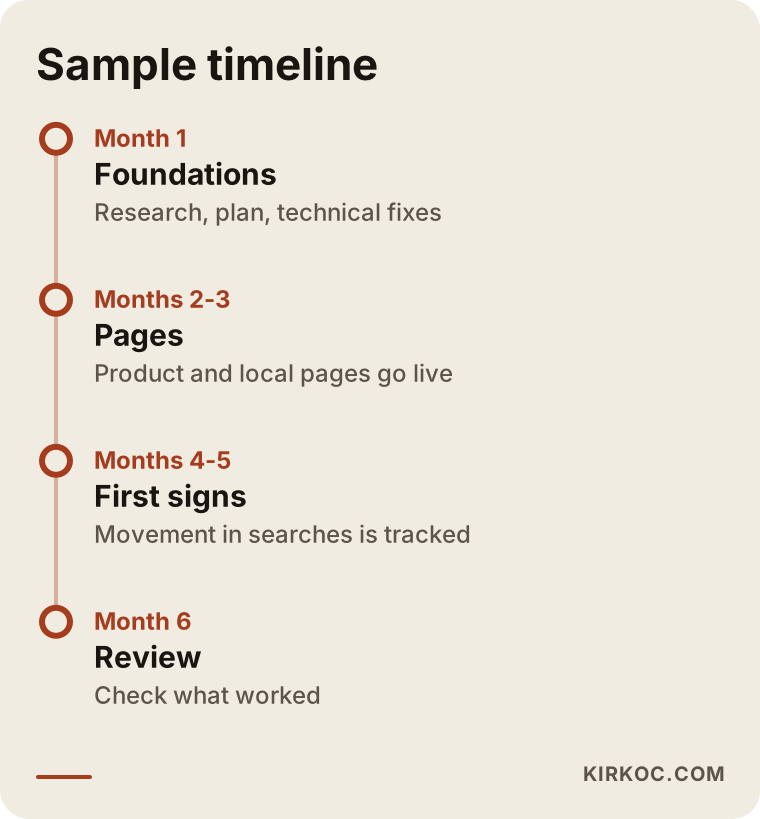
The timeline is an example; every site starts from a different place. In general the first month goes to the basics, and the first results begin to show after the pages have settled in with Google. I cannot give you an exact date, and I suggest you be careful with anyone who does.
Today's searches are also not only on Google. Many people now ask AI tools such as ChatGPT questions like "what should I watch for when ordering an illuminated sign." These tools tend to draw on clear, well-organized and trustworthy pages. Writing pages specific to your trade can raise the chance that your name comes up in those answers too, but there is no guarantee.
There is also the question of measurement. To know whether the work is paying off, counting how many people visited is not enough. What matters is how many people called, filled out a form or asked for directions on the map. That is why making phone and form activity trackable is one of the first jobs in the project. That way you can see which page really brings quote requests and which only brings visitors, and you can direct your budget accordingly.
Frequently asked questions
Do I really need SEO for my sign company, or are referrals enough?
Referrals are very valuable, and most sign companies get most of their work that way. But referrals are limited: they come only from the circle of people who already know you. Someone opening a new store who has never heard of you will check Google first. SEO opens that second door in addition to referrals.
Which keyword should I focus on?
Start with the work you do best and earn the most from. A narrow search such as "city name + product" often gives faster results than a broad word like "signs." To choose well, you have to look at the words your customers actually use; guessing can mislead.
How long until I see results?
I cannot give an exact time. A new page usually takes weeks to settle in on Google, and in competitive searches it can take months. Be careful with anyone who promises the first page in a few weeks.
Should I create a separate page for every city?
No. Only for places you really serve and where you have something concrete to say. Pages where only the city name changes do not help and can even hurt the site.
I have social media accounts. Do I still need a website?
Social media is a great showcase for your work. But someone who types "I need a sign for my store" into a search engine will mostly find a website. A site answers those searches, and it is also where you can turn interest from social media into a quote request.
My site is old. Do I need to start over?
Not always. First I look at what the site can and cannot carry. Sometimes the structure is sound and the work is mostly about reorganizing content; sometimes it is so outdated that rebuilding costs less. A clear assessment is needed before deciding.
Should I post prices on my website?
You do not have to post a number. But explaining what the price depends on (size, material, lighting, installation location, permit process) informs the customer and screens out poor-fit requests early.
Should I explain city permits and sign rules on my site?
A general overview can help, because customers ask about it often. But rules differ from one city to another, so instead of stating something as fact, use wording such as "check with your local building or zoning office." If you need legal certainty, ask an attorney.
If you would like a page plan for your trade or a short review of your current site, you can visit my SEO services page and get in touch from there. I will listen to your business and explain, in plain language, what needs to be done.