Your shop is ready, your equipment is good, and you do ceramic coatings and interior work with real care. But the phone still does not ring often enough. Most of your customers come from word of mouth, and very few find you online. If that sounds familiar, SEO for car wash and auto detailing businesses is aimed squarely at your problem. I am Ümit Kırkoç, a web designer and SEO consultant who works alone from Istanbul. In this article I explain, in plain language, how customers search for businesses like yours, which pages you need and where to start. If you want the broader picture first, you can also look at what my SEO services cover.
SEO, in short, is the work that makes your website show up when your customers search on Google. If you stop paying for ads, the ads disappear. With SEO, a setup you build correctly keeps bringing in work for months. It is not magic, though. It comes down to showing the right page, with the right information, to the right person.
How do car wash and detailing customers search on Google?
The most important feature of this industry is that searches split into two separate worlds. The first world is "urgent and nearby" searches: "car wash near me", "car wash open now", "hand wash in [your neighborhood]". The person typing this has a dirty car, little time and wants the nearest reasonable option. Most of these people search on a phone and look at the map. Before your website gets a chance, your business card on Google Maps makes the decision.
The second world is "research and decide" searches: "how long does ceramic coating last", "PPF or ceramic coating", "what does an interior detail include", "paint protection film cost factors". This person cares about the car, has a bigger budget and is in no hurry. They open several websites and compare. For you this customer is far more valuable, because a single visit can mean a large job.
The image below uses a completely made-up example to show how a search result looks.
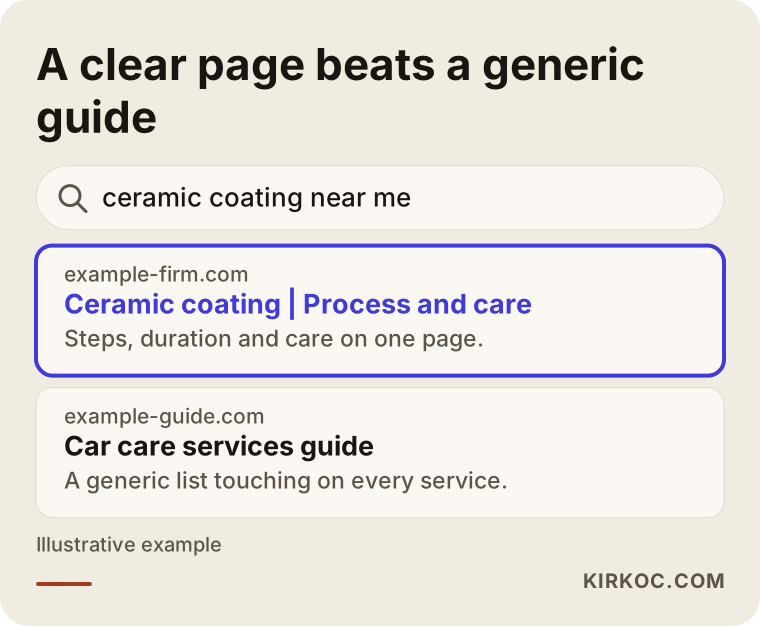
What does the highlighted result do? It states the service, the area and who it is for in the first line. The generic guide below it talks a little about everything and says nothing clearly. Google is trying to work out which answer to give the person searching. When you make that easy, it can show you more confidently.
Four different search intents in the same industry
Below I summarize four kinds of searches that are common in your industry, along with the page that suits each one. The key idea is to plan a separate page for each intent. If you squeeze everything onto a single "Services" page, you will not be strong on any of them.
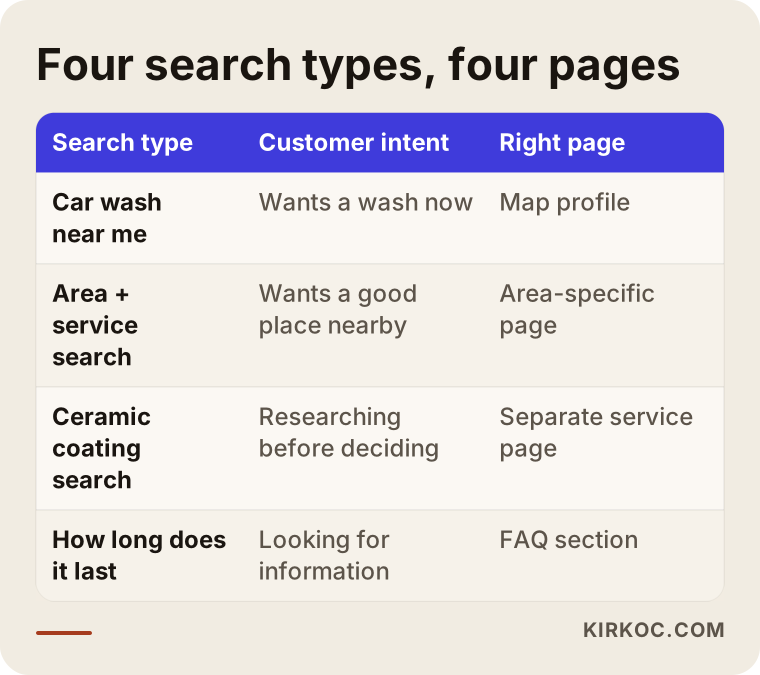
As the table shows, a customer arriving from the map and a customer arriving after research do not expect the same thing. One needs opening hours, an address and reviews. The other needs reassuring information about the process, the materials and the result.
Which pages does your website need in this industry?
I see the same structure on most car wash and detailing sites: a home page, one services page, a gallery and a contact page. The problem is that when "Services" is a single page, "ceramic coating", "PPF", "paint correction", "interior cleaning" and "engine bay wash" are all brushed past in a few sentences. Yet the people searching for these things are different people.
My recommendation is a separate page for each main service: one for ceramic coating, one for paint protection film, one for polishing and paint correction, one for interior detailing. On each page I want to find the same five things: what the service is, which cars and situations it suits, how it is applied, how long it takes, and what to watch after it is done. Duration and aftercare matter most, because the customer wants to know they will be leaving the car with you for days.
You can see how a page can be laid out in the sample structure below.
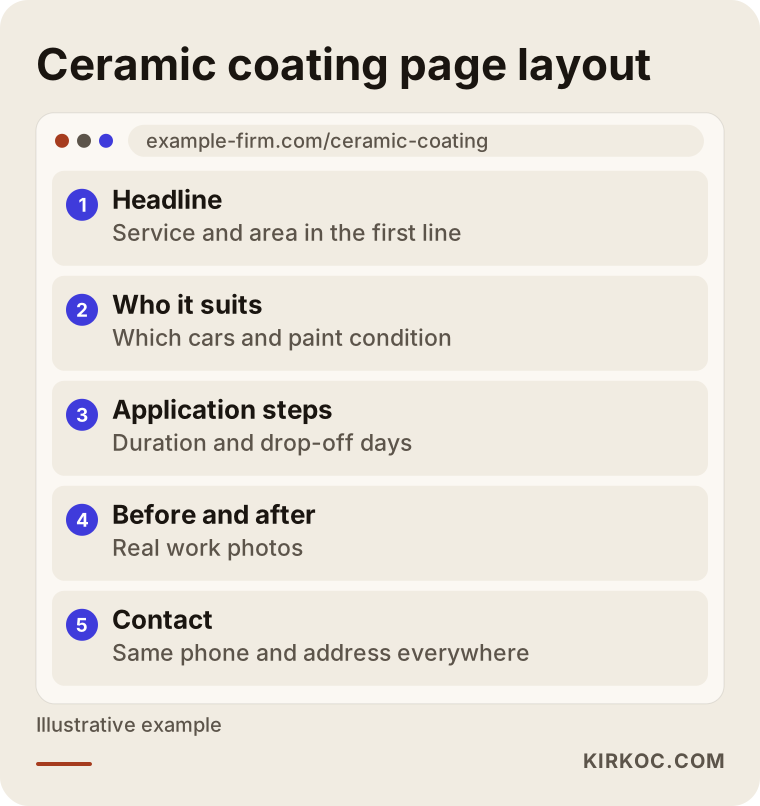
The logic of this layout is simple. In the first second the visitor should think "I am in the right place". Then they should find answers to their questions in order, and at the very end they should find a reason to call. Each section answers one question.
Why are before and after photos so valuable?
In this industry the strongest proof is photos of real work: a polished hood, paint that has gained depth, a cleaned seat. They say at a glance what no paragraph can. But it is not enough for the photo to simply sit on the page. Give the file a descriptive name, and add a short note under each photo saying which type of vehicle and which service it shows. Do not show license plates or personal information without the customer's permission. Covering the plate is both respectful and safe.
Your map listing comes before your website
In local searches, meaning "near me" searches and searches that include a city or neighborhood name, Google often shows the map section first. That section is fed by your Google Business Profile. The profile is the card where your business appears on Google with its address, phone number, opening hours, photos and reviews.
A very common mistake is to fill in this card once and forget it. Yet several things need to stay current: the right category (something that truly describes your work, such as "Car wash" or "Auto detailing service"), the list of services, opening hours, holiday hours, recent photos and your replies to reviews. Replying to reviews shows both new customers and Google that the business is alive. Writing a calm, solution-focused reply to a negative review often builds more trust than a positive review does.
It also matters that the address and phone number on your website match your profile and any other directory listings exactly. Small differences (Street versus St., an old phone number) confuse Google about which version is correct.
Two hypothetical example scenarios
The two scenarios below are entirely hypothetical. They do not describe a real business; I made them up only to show the reasoning.
Scenario 1: A small neighborhood car wash
Suppose there is a small car wash near a main road. Most of its customers are people who live nearby. It has no website, only a social media account. Its map listing has three photos and outdated opening hours. The shortest path here is not to build a big site but to fix the map listing first: correct hours, real photos, a service list and a habit of asking for reviews. After that, a simple site that describes the area and the services clearly on a single page would be enough. The target for this business is not a huge search like "car wash in [big city]" but small, clear searches like "[neighborhood name] car wash".
Scenario 2: A detailing studio focused on ceramic coating
Now suppose a studio does a limited number of high-value jobs a year: ceramic coating, paint protection film and paint correction. Its customers have asked at several places and read a lot before deciding. For this studio the real work is pages that explain each service separately and answer frequently asked questions honestly. Answering "what does a coating do for my car, and what does it not do?" without exaggeration earns this customer's trust. For this studio, reviews, certifications and photos of the application process carry more weight.
What the two examples share is this: first find out what the customer is actually searching for, then build the page that gives that answer.
Step by step: where do you start?
This is the order I follow when I work on a project. You can also follow the same order on your own; below I explain which steps may be heavy for you.
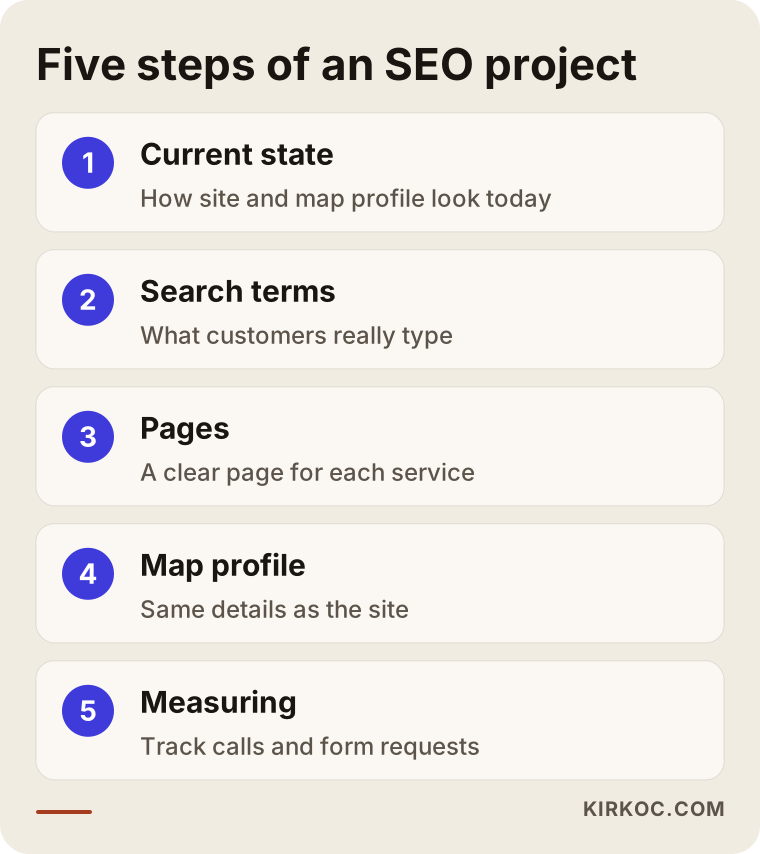
Let me unpack the order in the image. Step one is seeing where you stand today: in which searches does your site appear on Google right now, and how? Step two is finding out what customers really type. Instead of guessing, I look at the actual wording of searches: do people write "coating", "ceramic" or "paint protection"? Choosing the words is often half the job.
In step three I build the pages that match those searches, or fix the pages you already have. Step four is bringing your map listing in line with your site. Step five is measuring: how many people called, how many filled in the form, which page worked? If you work without looking at numbers, you cannot know what is working.
Questions customers ask on every service page
When a customer lands on a page in this industry, the questions in their head are usually these: How long will my car be here? How should I care for it afterward? Do I really need this for my car? Is there a warranty, and what does it cover? If the answers are written plainly on the page, the visitor is more likely to be convinced before they ever pick up the phone. If they are not, the visitor moves on to another site.
Be careful with warranties. Absolute promises such as "lifetime" or "never stains" both mislead the customer and put you in a difficult position. How long a coating lasts depends on the product, the application, how the car is used and how it is maintained. Writing that honestly sets you apart from a competitor who over-promises.
Common mistakes
These are the mistakes I see again and again in this industry. Most of them will probably sound familiar.
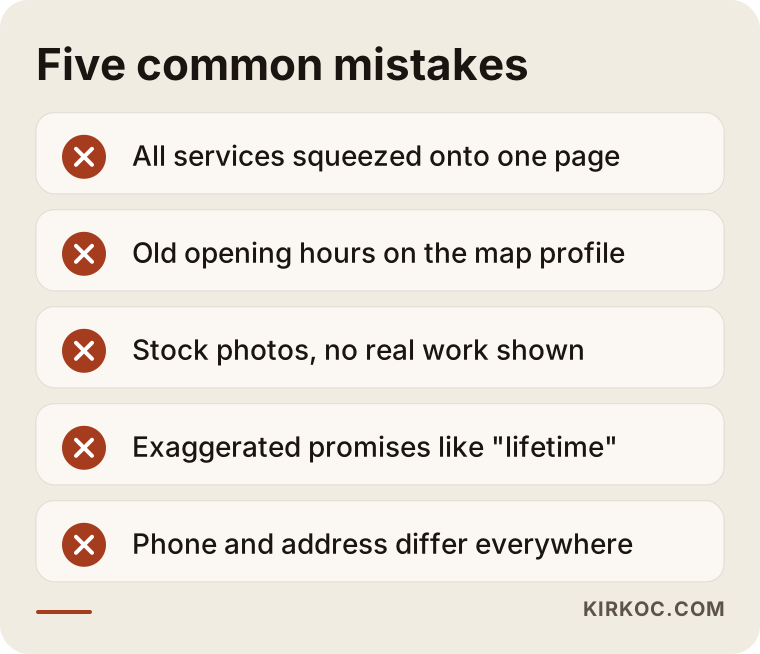
What nearly all of these mistakes have in common is that they were made without thinking about the visitor. A stock photo, for example, creates the feeling "this is not real work" within a few seconds. A real phone photo, even with slightly imperfect light, usually builds more trust.
Another common mistake is filling a page with claims you cannot measure, like "cheapest" or "the best". Write concretely instead: which product you use, how many steps you work through, the approximate duration of the job, and the condition the car should be in when it is brought to you. Concrete information makes more sense to both people and search engines.
There is also the question of customers who speak other languages. In tourist areas, or in places with many visitors, some customers will search in Spanish or another language. If you want to serve them, building a separate page in that language usually works far better than machine-translating your English page. But only do it if you can genuinely serve customers in that language.
What can you do yourself, and when do you need an expert?
You do not have to hand every task to a specialist. There are several things you can do on your own.
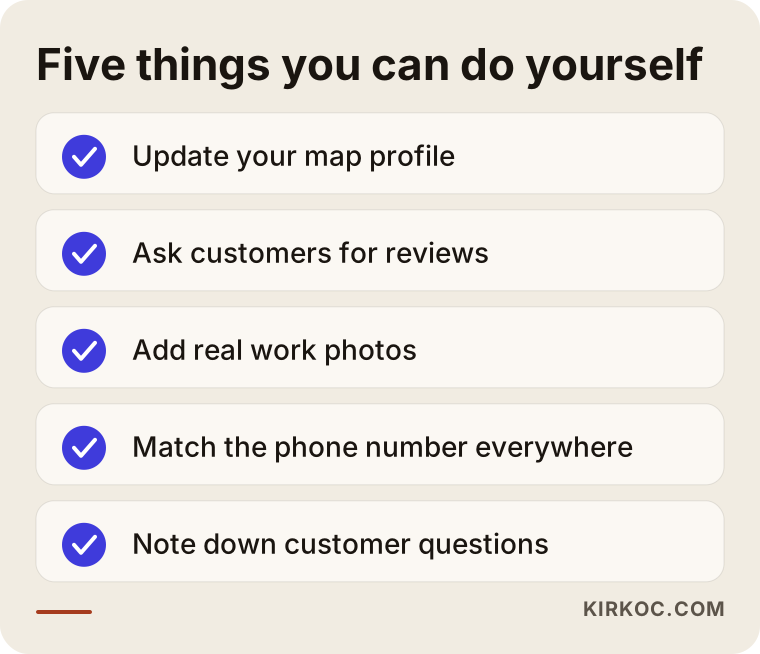
None of the items on this list need technical knowledge; they only need routine and consistency. For example, asking customers "would you leave us a review on Google?" at least once a week makes a difference within months. When you ask for reviews, though, do not offer a discount in return. Platform rules can be strict about this, and the details change over time.
You will usually need an expert for these: the technical side of the site (speed, mobile display, page addresses), planning which word goes on which page, structuring pages for several cities or several languages, and setting up measurement. These are annoying to undo when done wrong, so I recommend getting at least one expert opinion.
Your own decision flow
When deciding whether to go to an expert, you can ask yourself this: does my site as it stands answer most of the questions customers ask? If yes, you can carry on with small fixes yourself first. If no, or if you have no site at all, starting with an expert saves time.
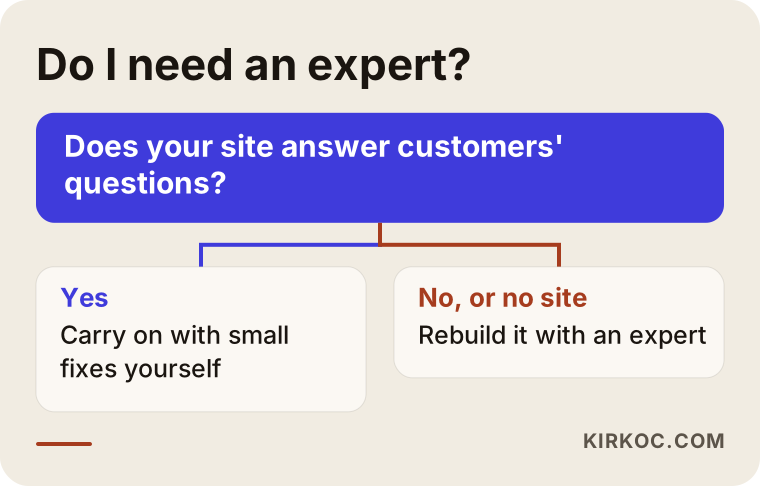
This flow is not a strict rule, just a direction. Your budget, your time and your growth plans all affect the decision. That is why it is perfectly normal to ask me, in the first conversation, "do I need an expert for this or not?"
How does a visitor become a customer?
Not everyone who visits your site will call. A visitor becomes a customer in several stages. First they see you in the search results, then they click through to the page, then they find reasons to trust you, and finally they call or fill in a form. Some people drop out at every stage; that is normal.
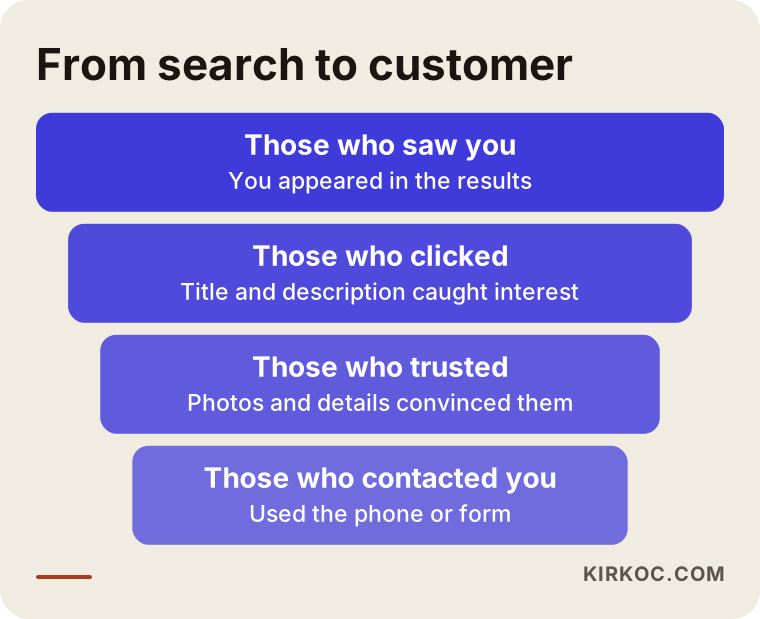
In the funnel, the widest part is "those who saw you". Increasing that number is the main job of SEO. But the lower parts of the funnel matter just as much: if the page is slow, hard to read on a phone or has no call button, the visitor is lost. That is why I recommend keeping your phone number on every page, tappable with one touch on mobile. If you offer contact by text message or WhatsApp-style messaging, add that as a visible, simple button too.
Timing: when do results show up?
I have to be honest here: I cannot guarantee a ranking or a result in SEO, and nobody can. No consultant controls how Google ranks pages. What I can do is the right work, in the right order, with measurement.
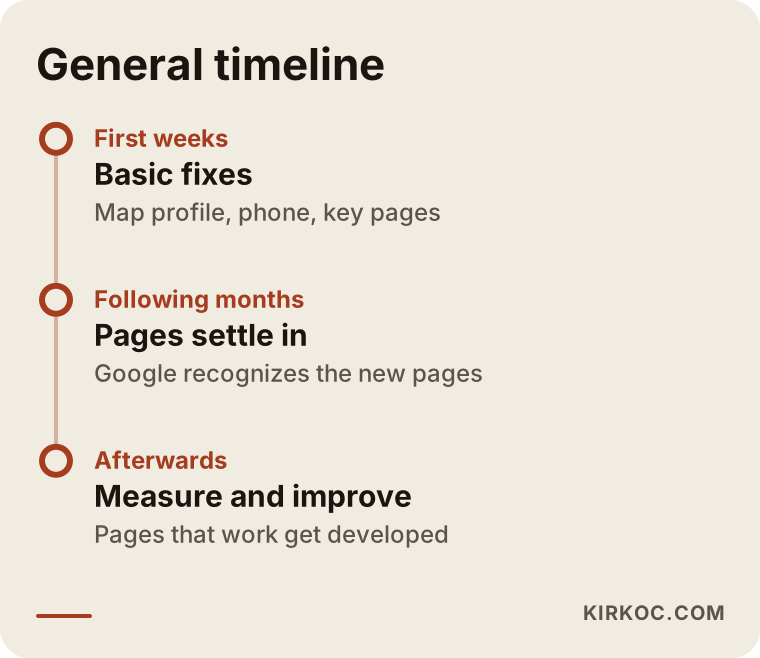
The general logic is this: fixes you make in the first weeks (the map listing, phone details, the basic pages) can have a relatively quick effect, while new pages being recognized by Google and finding their place usually takes weeks, sometimes months. There is also a seasonal effect. For seasonal demand, such as paint protection before winter or interior cleaning before summer, you need to prepare your pages ahead of the season. So the expectation of "I started today, the phone rings tomorrow" is not realistic.
What determines the cost
I do not give numbers here, because the price really does depend on the scope of the work. But I can tell you clearly what moves it.
First, your current situation. Building a site from scratch is a different job from fixing an existing one. Second, the number of service pages: describing five separate services takes more effort than describing one. Third, how many cities or locations you serve. Fourth, how many languages you publish in. Fifth, how much of the photo and content material you provide and how much I prepare. Sixth, continuity: do you want a one-off setup, or monthly follow-up and improvement?
When you collect quotes, ask what is included in the price, item by item. A quote that arrives as a single line saying "SEO service" does not tell you what you are buying. A good quote states which pages will be built, when they will be delivered and how results will be measured.
To make the difference between the options visible, I put a one-off setup and monthly support side by side.
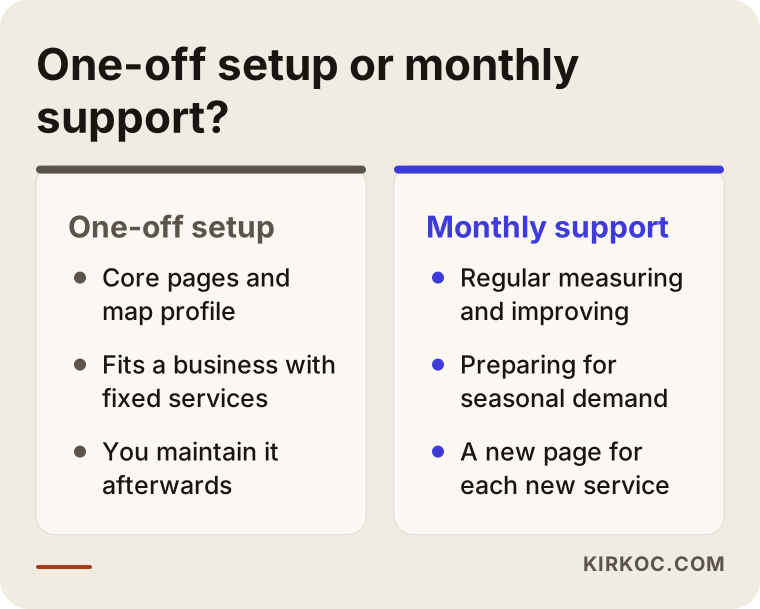
Which one suits you depends on how quickly your business changes. For a studio whose promotions, new services and seasonal demand keep shifting, regular support can make more sense; for a small business whose services have been the same for years, a well-built foundation is often enough. I would also add one thing: cutting the number of pages to lower the price looks tempting, but it usually removes the detail the customer is looking for. If the budget is limited, it is healthier to start with the two or three services that earn the most and widen the scope over time, rather than describing every service superficially. We can set that order together; your day-to-day experience often shows me which service adds the most value to your business.
How I work
I work alone. That means the person you talk to and the person who does the work are the same. First I look at your current situation, then I explain in plain language what I will do and why. If I use a term you do not understand, just stop me. At the end of the project I leave you a written note of what was done, what was not done and what you should keep an eye on from now on. I give no ranking or result guarantees; what I offer is a clear plan, an honest timeline and transparent reporting.
Frequently asked questions
Is my Google Maps listing alone not enough?
For a simple wash business the map listing is often the most important piece. But for high-value jobs like ceramic coating and paint protection, customers look for detailed information before deciding. A website that provides that information makes a real difference in winning that customer.
Do I really need a separate page for ceramic coating?
Yes, usually. Someone searching for "ceramic coating" does not have the same intent as someone searching for "car wash". A separate page tells both Google and the visitor that this topic is explained clearly here.
Do customer reviews affect SEO?
In local searches, meaning map results, both the number and the content of reviews count. Reviews also directly influence people's decisions. When you ask for reviews, follow the platform's rules; fake reviews or offering rewards in exchange can cause problems.
How many cities or areas should I create pages for?
Create pages for places you genuinely serve and where you can actually receive customers. Writing the names of areas you do not serve just to be searched for is neither honest nor, most of the time, effective. It is more valuable to describe your location and how to reach you in concrete terms.
When will results come?
I cannot give a firm timeframe. Small fixes (the map listing, phone details) can have a quick effect; new pages can take weeks or months to find their place. The timing depends on the competition, your current site and the scope of the work.
Can I take the photos myself?
Yes, and I would actually prefer it. Photos of real work are worth far more for trust than stock images. Good light, a clean background and the same angle for before and after are enough. Take care not to show the customer's license plate.
If I have a social media account, do I still need a website?
Social media is a good storefront, but on search engines it is a space you cannot manage the way you want. Your own site is the one place where you decide the page structure, the information and the ways to contact you. The two complement each other; one does not replace the other.
Is a promised "guaranteed first page" serious?
No. No expert can guarantee Google's rankings. Treat an offer that makes such a promise with caution, and ask plainly what they will do and how.
If you would like to work out together what would set your car wash, detailing or ceramic coating business apart, you can reach me through my SEO services page, and we can talk through your current situation in a short call.