You run a special education or therapy center. You have a qualified team, a well-organized space and a warm relationship with the families you already serve. But most new families still arrive through word of mouth, and the number of inquiries coming from the internet is far lower than you expected. Yet when a parent notices a developmental difference in their child today, the first thing they do is pick up a phone and type into Google. In this article I explain what SEO means for special education and therapy centers, how families actually search for you, and where you should start. I am Ümit Kırkoç, a web designer and SEO consultant who works alone from Istanbul, and I will be plain about what my own SEO services cover and what they do not.
SEO, in one sentence, is the work that makes your website show up when people search on Google. It differs from advertising in one way. With ads you are visible only as long as you keep paying, while SEO, when it is set up properly, leaves you with something that keeps working for months. In your field it carries extra weight, because families are not buying an ordinary product. They are choosing a place to entrust with their child's development, and they read a great deal before they decide.
How do parents search for a special education center on Google?
Search behavior in this field is very different from looking for a florist or a barber. A family often does not start with the name of your service. They start with a worry. They type sentences like "my child still isn't talking," "my two-year-old isn't walking" or "my son can't focus in class." Then comes the question "is this normal?" After a diagnosis or a referral, the searches become specific: "autism therapy center," "speech and language therapy," "special education services near me," "dyslexia tutoring," "sensory integration therapy."
You can think of these searches in three stages. In the first stage the parent is looking for information: signs, typical development, when to see a specialist. In the second stage they are looking for a type of help: which therapy, which program, who provides it. In the third stage they are looking for a place: close by, trustworthy, able to offer an appointment. The third stage is where you earn the most directly, but the families you earned trust with in the first two stages are the ones who remember you when they reach it.
One more thing matters here. These searches are mostly made by a parent or grandparent, mostly on a phone, mostly in the evening, and mostly while worried. If your page loads slowly, has no phone number or uses heavy language, the family quietly leaves. They will not even send you a complaint.
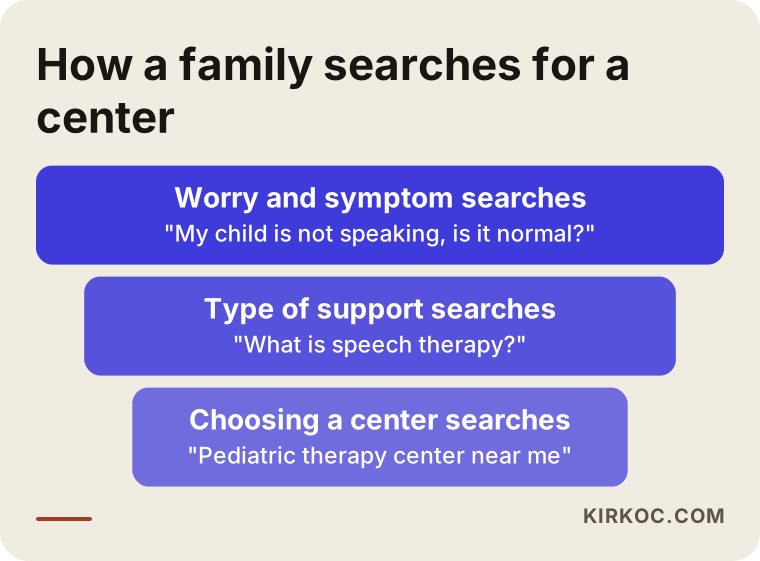
The graphic above summarizes that path. The search is widest at the worry stage and narrowest, and most valuable commercially, at the stage where the family chooses a center. Your site should answer all three stages, but without cramming every answer onto one page.
What makes SEO harder in this field
Let me be honest first: SEO for special education and therapy is not the same as SEO for every other business. There are three separate difficulties, and knowing them keeps your expectations realistic.
The first is that Google is more careful with content about health and child development. Wrong information can harm families, so it matters who wrote a page and whether that person really knows the subject. That is why your site should clearly show who your specialists are, what training they have and what they work on. A nameless sentence such as "our expert team" is not enough.
The second is that these services are local. A family will take their child several times a week, so they do not want you far from where they live. Visibility in a specific city or neighborhood is worth much more than a general claim to be "the best in the country."
The third is sensitivity of language. Many families are fragile about labels and diagnoses. Phrases like "problem kids" or outdated and hurtful terms break a family's trust and make your organization look less respectable. Keeping your language plain, respectful and informative is also good SEO, because parents forward what they read to other parents.
As for advertising and promotion rules: there may be rules about how special education and therapy providers can promote themselves, whether they can promise treatment or improvement, and what your licensing body or professional association requires. In the United States that can include federal and state rules on health claims and on privacy. I cannot give you a firm answer on that. Please have an attorney or the relevant authority review your wording before you publish. My job is to help the right message reach the right person.
Which pages does a special education center website need?
Many centers have a site with one "About" page, one "Services" page and one "Contact" page. On the "Services" page, ten headings are stacked one under another. Google understands that structure but does not rank it well, because there is no clear page to answer any single search. This is the structure I recommend.
One page per service. Speech and language therapy, special education, sensory integration, individualized programs, support for autism and so on: give each main service its own page. On each page explain what the service is, who it suits, how it works, what happens at the first visit and who delivers it.
Specialist pages. A short introduction for each specialist: training, area of work, approach. A family wants to see the person they are about to trust with their child.
Location pages. If you want to attract families from several neighborhoods or towns, support that with pages. Think "Getting to us from the north side" or "Serving families across the east end," pages that give real, useful information to families who really come from there. Copying the same text and changing the place name ruins this, and I come back to it in the mistakes section.
Information pages. Honest answers to the questions families really ask, such as "My child isn't talking. When should I see a specialist?" These do not sell directly, but they bring first-stage families to your site and build trust there.
Process and appointment page. How the first visit works, how many sessions an evaluation takes, what is expected of the parent, what paperwork is needed. This uncertainty is one of the biggest things that keeps a parent from calling.
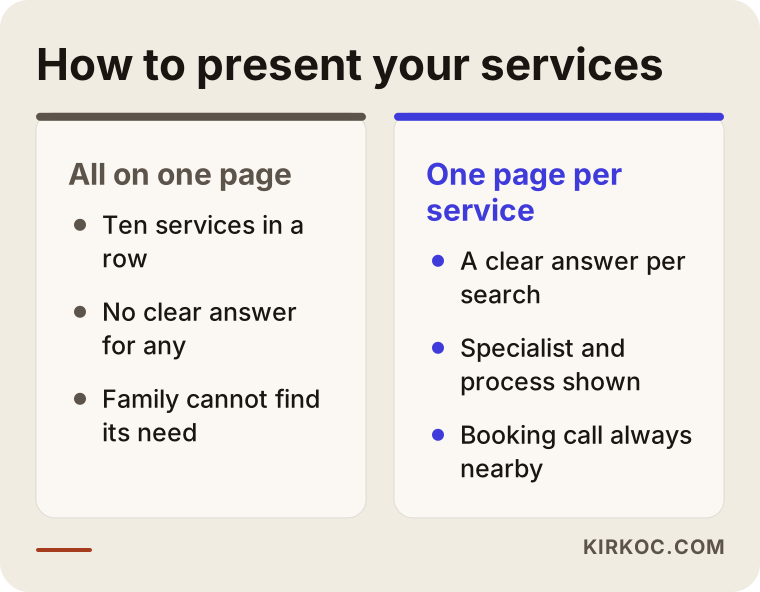
The comparison in the graphic is an example skeleton. Every center's services are different, but the logic is the same: a page the family can find for every question they are asking.
Three intents for the same center, three different pages
Matching page types to what families search for is the most practical part of this work. The table below shows what a family wants in different kinds of searches and which page should answer.
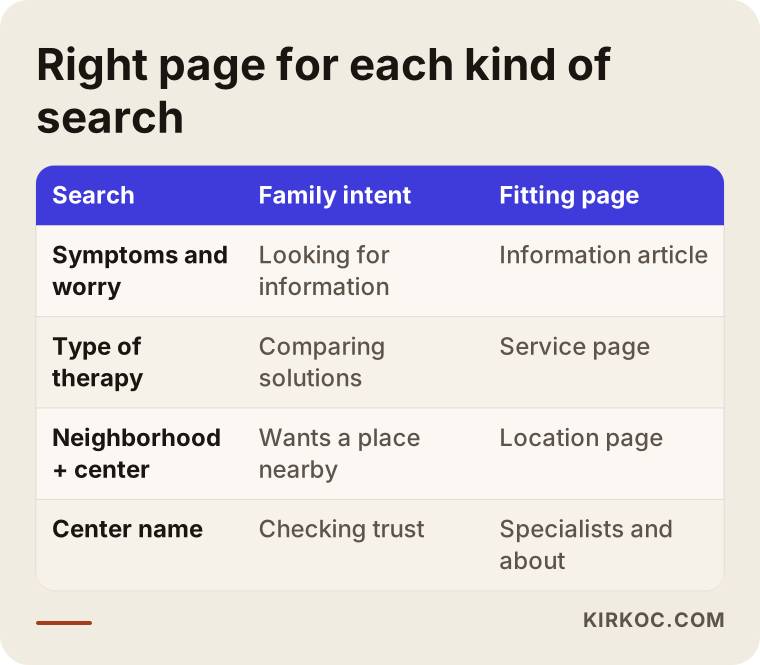
The point to notice: a family typing "speech and language therapy" and landing on your home page has been given little more than a lobby. You should take that family straight to your speech therapy page. If your site has no answer page for a given search intent, your competitor shows up for that search and you do not.
Example scenario 1: A quiet neighborhood center
This is a hypothetical example and does not describe a real center. Picture a small center in one town, with five specialists, offering speech and language therapy and special education. Its site was built years ago: a single-page introduction and a contact form. Almost every new family arrives by referral.
One day the owner searches "speech and language therapy" in their own town and sees only three centers in the map results. Theirs sits far down because it has few reviews. Looking at the site, the owner sees the problem: there is not one sentence Google can read, because the services are written inside an image.
The fix here is not a large ad budget. In order: complete the business profile, write a separate page for each service, introduce the specialists, write honest answers to the five or six questions local families ask most, and ask satisfied families for reviews, with their permission. I would not promise a particular ranking even after a few months, but the chance of this center appearing both on the map and in regular results could reasonably be expected to improve compared with where it stands today.
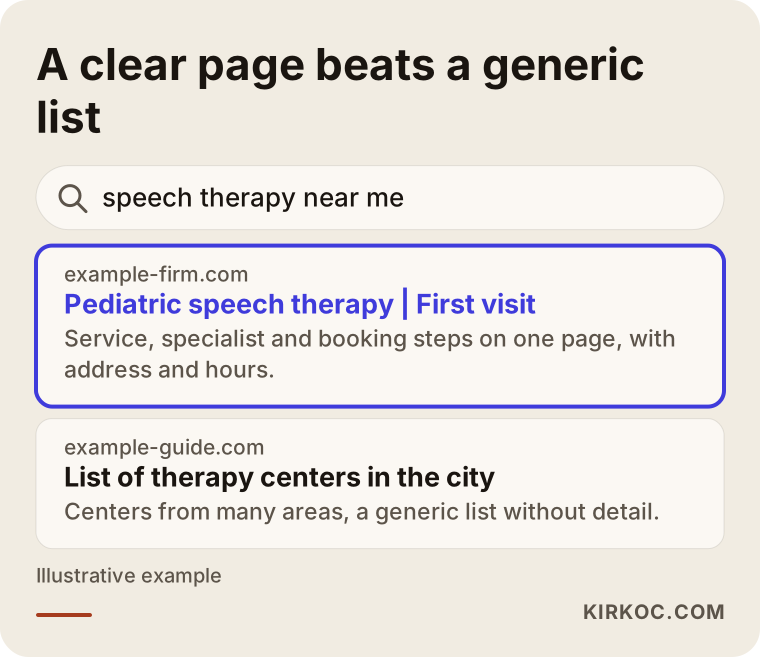
The search result example in the graphic shows how, for the same search, a center with a clear, specific page can outrank a generic directory list that has no detail.
Example scenario 2: A larger center with several locations
This is also hypothetical. Imagine a center with two locations and around ten specialists at each. Their website looks good, but both locations are squeezed into one "Our Locations" page. When a family searches for special education near one of the two areas, it is unclear which location is where and which specialist works at which one.
The answer is to give each location its own page. The page carries the address, a map, directions, opening hours, the specialists who work there and the services offered there. Each location also has its own business profile, and the details match the website exactly. The main risk for this center is that two pages that look like copies of each other send Google mixed signals, so every page is written with information that is really specific to that location.
Larger centers have another problem: who owns the content? Who writes it and who checks it? Content that no specialist has reviewed earns neither the families' trust nor the search engines' trust.
Step by step: how SEO works for a special education center
Here is the flow in plain terms. This is how I work, but if you work with someone else you should expect a similar order.
1. Reviewing where you are now. I look at your site's speed, how it looks on a phone, which pages Google can actually read, the state of your business profile and what competitors are doing. Surprising problems often turn up at this stage, such as part of the site never having been indexed, which means Google does not know it exists.
2. Deciding which searches matter. I work out what families really type. I do not chase the "most searched word." I choose searches that match services your center can truly provide and that sit close to a family's decision.
3. Page plan. I plan which page will be written for which search, which pages will be merged and which deleted. This plan is like a map of your site.
4. Technical fixes. Behind-the-scenes work: speed, mobile layout, page titles and descriptions, and the labels in a page's code that help search engines understand it. Families do not see this, but search engines do.
5. Writing the content. Service pages, specialist introductions and information articles get written and then approved by your specialists. Accuracy matters more than speed here.
6. Business profile and reviews. To show up in map searches, the profile is filled in completely, photos are added and a proper way of asking satisfied families for reviews is set up. The review process is designed carefully so that nobody shares personal details or photos of children.
7. Measuring and adjusting. I look at which pages were viewed, how many people called and how many filled out the appointment form, then improve pages based on the results.
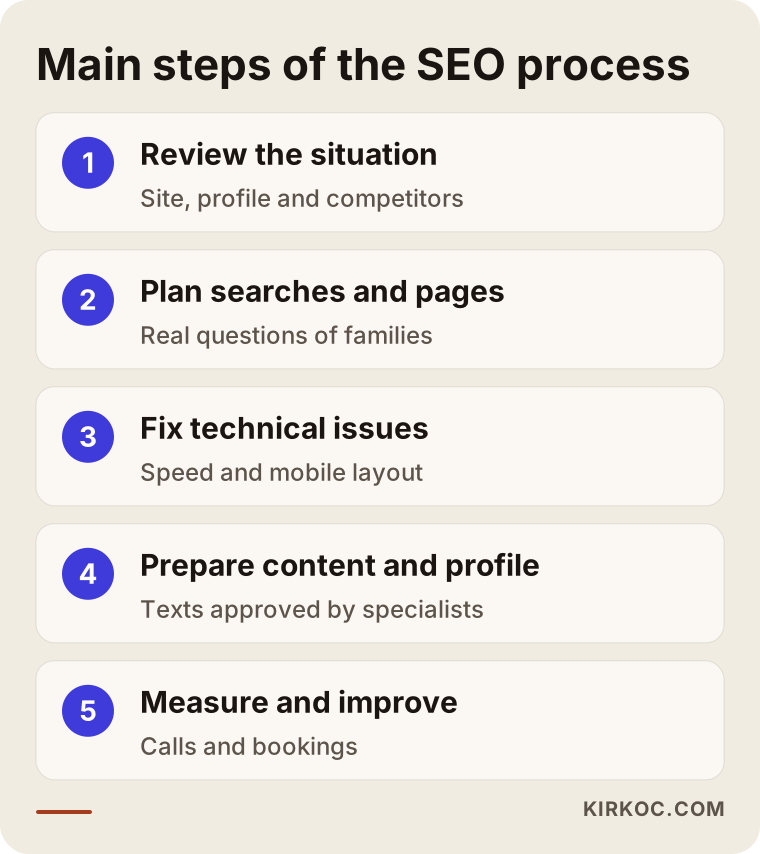
The flow in the graphic compresses the seven steps into five main headings. The length of each step depends on the current state of your site, and promising a single calendar would not be honest.
What a service page should contain
The service page is the most important page type on your site, because it is where the family's question "is this center right for us?" gets answered. A good service page includes:
- What the service is, which age groups and needs it suits, in plain language
- What path a child follows after the first evaluation
- How sessions go and how the family takes part
- Who delivers the service and what their training is
- A visible way to book and get in touch: phone, message, form
You can use this list as a checklist before any page goes live.
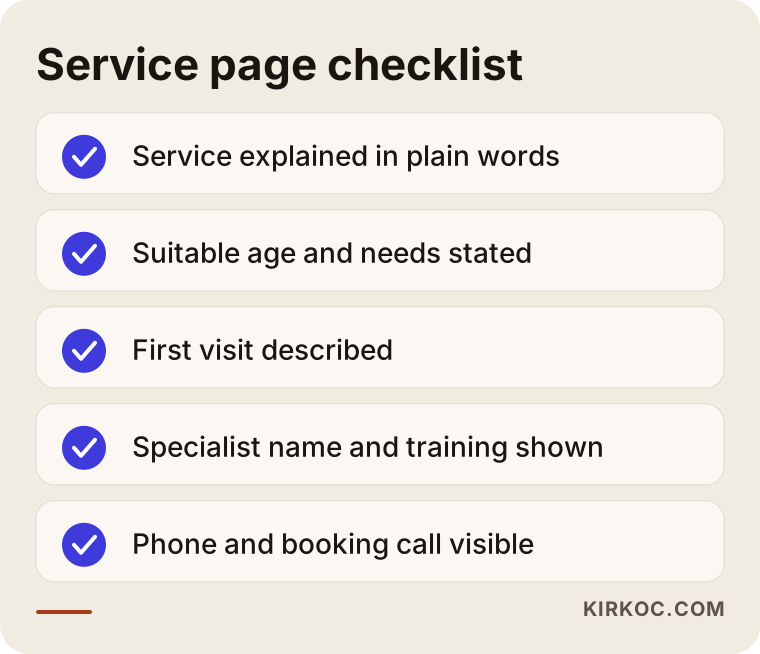
If an item is missing, the family either has to phone and ask or never asks at all. And a family that never asks will never call you.
Common mistakes
There are mistakes I see often in this field. Some are made with good intentions and still do real damage.
Crowding everything onto one page. When ten services are described on one page, none of them gets a strong answer.
Copied neighborhood pages. Repeating the same text under ten place names looks easy. But Google notices, and so do families. Write pages with local information only for the areas you truly serve and where families truly come from.
Promising a cure or a guaranteed result. A sentence like "your child will definitely talk" is ethically problematic and may also carry legal risk. I cannot give a firm legal opinion, so please consult an attorney, but I can tell you this practically: families spot exaggeration quickly and stop trusting you.
Using children's photos and information without permission. For the sake of ethics and family trust, images and stories of children should be used only with clear written consent, with details protected. If needed, get legal advice on this too.
A site that looks bad on a phone. Most searches happen on phones. A site with tiny text, slow loading and shifted buttons will not work, however well written it is.
Relying only on Google Ads. Ads give quick visibility but stop the moment you stop paying. SEO and ads are not rivals, they complement each other. How much you put into each depends on your goal and budget.
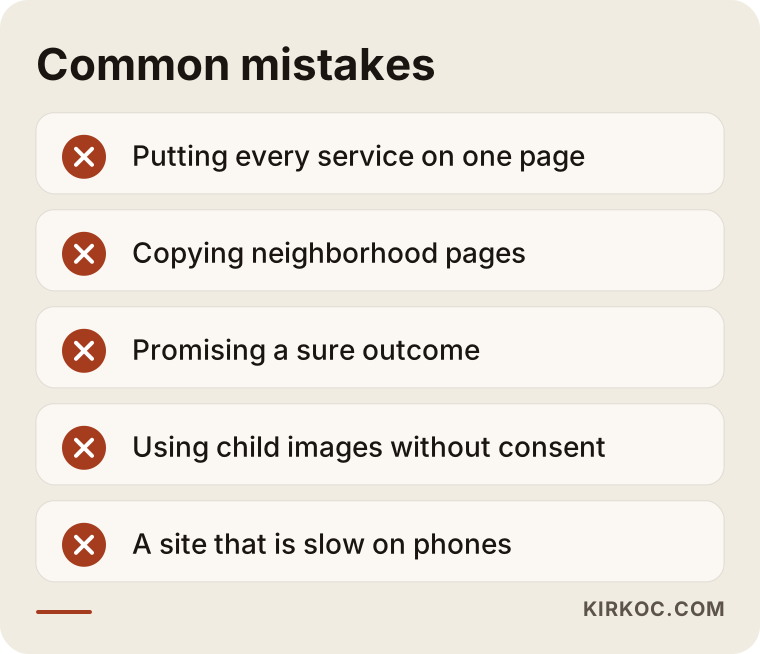
Most of the mistakes in the graphic can be fixed later. A few, especially unauthorized images of children and exaggerated promises, cause losses of trust that are hard to win back.
What you can do yourself and when you need an expert
You do not need a specialist for everything. You can do the following yourself:
- Fill in your Google business profile completely: correct address, phone, opening hours, a short description, real photos of the space
- Make sure the details on your site and in the profile are exactly the same
- Prepare short introductions for your specialists, because you know them better than anyone
- Write down the questions families ask most often, which is the best source of content ideas you will ever have
- Ask satisfied families for reviews, and tell them not to include details about their child
Expert help makes sense in these cases: the technical side of your site is slow or broken on phones, you need a page plan, you have more than one location or language, competitors are strong, or a ranking problem has not moved for several months. A simple decision point looks like this:
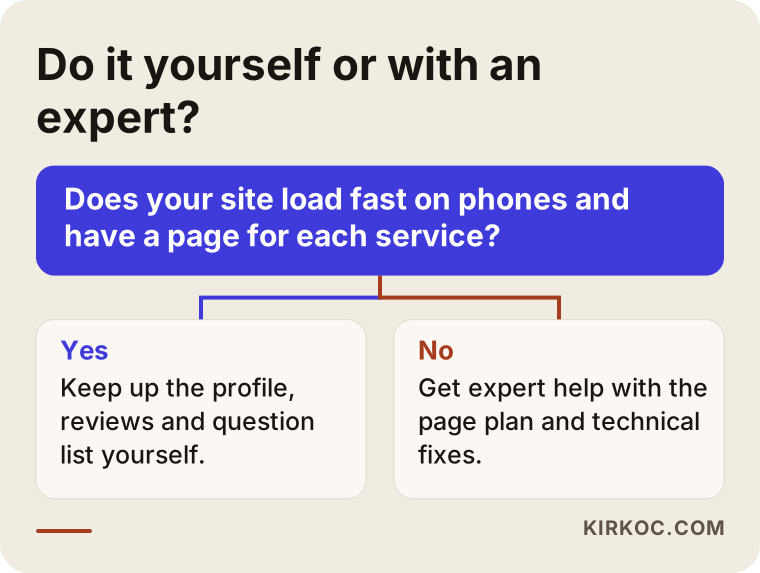
This chart cannot give every center a definite answer, but it gives you a frame for asking "is this my job right now, or someone else's?"
A suggested layout for the main service page
I gave a list for the service page above. Now think of it as a visual layout. The order a parent wants to see while scrolling down on a phone is roughly this: first what you do and who it is for, then how the process works, then the specialist, and last the appointment call. Wherever the parent is on the page, they should see a phone number or a booking button on screen.
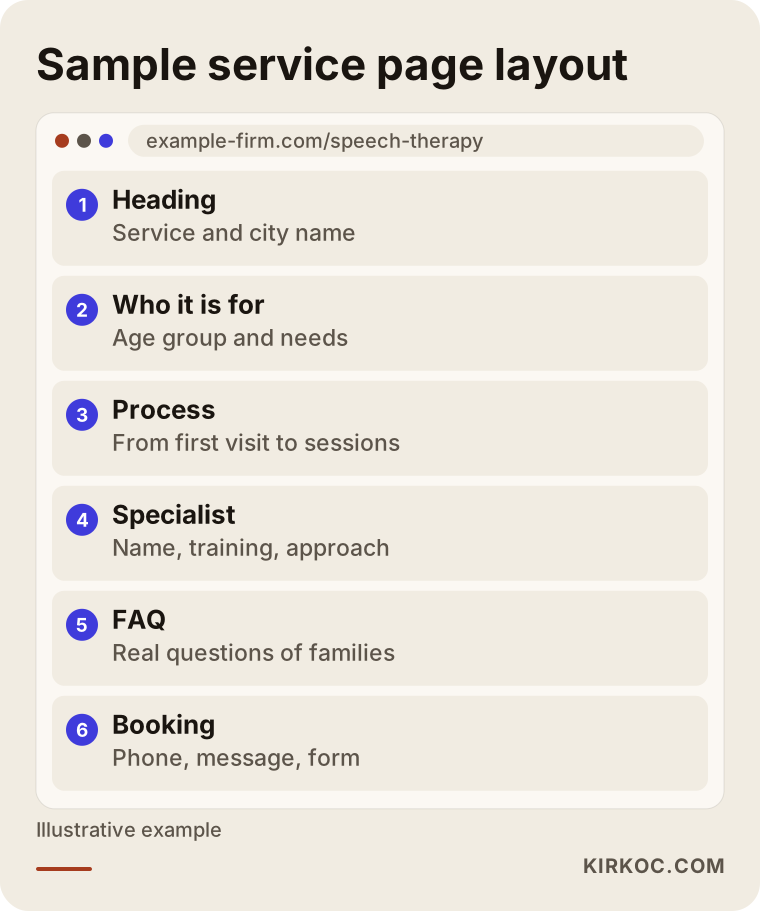
This layout is a way of thinking, not a template. It can change with your center's tone and the type of service.
When do results come?
This is not a race, it is a build-up. Generally the first months go to technical fixes and setting up pages, and results appear gradually. How long depends on the age of your site, the strength of competitors, your area and the quality of the content. Nobody can guarantee a particular ranking in a particular time frame, and if someone does, be careful with that person.
The general flow looks like this: the site and profile are tidied first, new pages go live, Google begins to evaluate them, visibility on the map and in regular results grows, and finally you see a difference in calls and form submissions. The first signs are usually more views, then more clicks, then more calls and bookings.
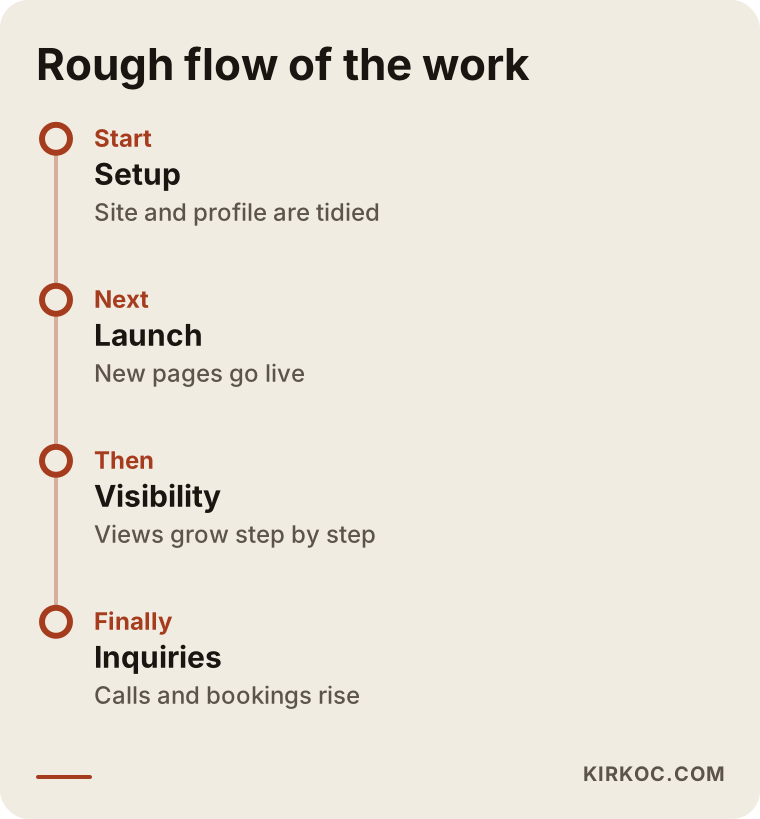
The timeline shows an approximate order. The length of each stage differs from center to center, and none of it is a guarantee.
What drives the cost?
I will not give a number in this article, because two centers rarely need the same work at the same price. These are the things that decide the cost:
- The current state of your site. On a technically sound site the work focuses on content, while a problem site needs repair first.
- Number of pages. A center with five services and a center with twenty are not the same amount of work.
- Number of locations and languages. Each location and each language means a separate set of pages and a separate business profile.
- Competition. In a crowded area with strong competitors, longer and more intensive work is needed.
- Content approval process. How fast your specialists can approve texts directly affects the pace of the work.
- Ongoing work. A one-time setup and monthly continuing support are different line items.
When you get a quote, ask what is included, how long it takes and how they will measure results. Treat any quote that says "we will get you on the first page" with caution.
How I work with you
I work alone, so the person you talk to is the person doing the work. First I look at your center's situation and tell you plainly what will help and what will not. Then I turn what should be done into a written plan. When needed I redesign your site, and when needed I fix your existing one. I take what your specialists know and put it into language families can follow, which is the most enjoyable part of the job. I do not give guarantees, but I explain what I am doing and why at every step.
Frequently asked questions
Is SEO or Google Ads better for a special education center?
They do different jobs. Ads give you visibility right away but end when you stop paying. SEO starts slower but builds a lasting base. Your budget and urgency should decide the mix. For most centers it makes sense to build the SEO foundation first and add short-term ads if needed.
If I already have a website, do I still need SEO?
Having a site does not mean you will appear on Google. If your site is slow, looks broken on phones or has no pages answering what families type, you have a site that cannot be found. Looking at the existing site first usually makes more sense than building a new one from scratch.
What do parents look at when they find my center?
Usually: who works there, what training they have, how the child will be treated, how the first visit goes, whether the place is close and what other families' experiences were. That is why specialist pages, a clear description of the process and real reviews are the most valuable parts of your site.
Can I share children's photos or success stories on my website?
This is sensitive both ethically and legally. Family consent and the relevant privacy rules matter for personal data and images of children. I cannot give a firm answer, and I recommend you consult an attorney. In practice, accounts that do not identify the child, are shared with permission and protect the details are much safer.
When will I see results?
Nobody can give a firm time frame. After the first technical fixes and new pages go live, you can expect a gradual rise in visibility. Results take shape over months, depending on your site's age, competition and content quality.
What if I have more than one location?
Give each location its own page and its own business profile. Put the address, map, directions, hours and the specialists who work there on the page. Do not copy the text; write real information specific to each location.
Do reviews really matter?
For map searches, yes. A review is one of the strongest signals in a family's choice. But buying or inventing reviews damages both your credibility and the platform's rules. Politely and without pressure asking satisfied families for a review is the right way.
Should I do this with an expert, or myself?
Filling in profile details, collecting questions and writing specialist introductions are in your hands. For technical setup, the page plan and measurement, expert help saves time. Getting clear on what you actually need first will help you make the right decision.
If you would like to go over what your center's website says to families today, you can write to me through my SEO services page. I will look at your situation and tell you honestly what will help and what you do not need.