You run a courier or motorcycle courier company. Your drivers are out on the road, your phone rings, but most of your work still comes from people who already know you, old customers and the occasional random call. When someone types "same day courier near me" or "urgent document delivery" into Google, they do not see you. They see big platforms and a few familiar competitors. This is exactly where SEO for courier companies comes in. In this article I explain, as someone who is thinking about buying this kind of help, what to look for, how courier searches differ from searches in other industries, and where to start. I am Ümit Kırkoç, a web designer and SEO consultant who works alone from Istanbul, and I will be plain about what my own SEO services cover and what they do not.
SEO, in one sentence, is the work that makes your website show up when your customers search on Google. You do not pay for every click the way you do with ads. Pages that are built well can keep bringing in work for months. But for a courier business the shape of that work is quite different from a law office or a furniture store, because courier searches have three special traits: urgency, location, and two very different kinds of customers.
Why are courier searches different from other searches?
The first trait is urgency. Someone typing "same-day courier" usually has to send something within the hour. It might be a contract that needs a signature, a spare part, or a document somebody forgot. This person does not read pages of text and compare. They look at their phone, scan the first few results, and pick the one that seems most trustworthy and easiest to reach. So the job of your page is not to deliver a persuasive essay. It is to make a stressed person think, within seconds, "yes, they cover my area, let me call that number."
The second trait is location. Courier work is entirely local. A customer in Brooklyn has no use for a courier company based in Dallas. Most searches either contain a place name ("Brooklyn motorcycle courier") or are read by Google through the phone's location ("courier near me"). For these searches Google likes to show map results and local business profiles. That means you need to take care of more than your website. Your Google Business Profile, the listing that appears on the map with your phone number and reviews, needs attention too.
The third trait is the two kinds of customers. On one side are individuals and small businesses who send one-off items: a document, a gift, a forgotten bag, a parcel. On the other side are companies that want regular, high-volume service: online shops, pharmacies, law firms, accounting offices, florists, restaurants. These two groups search with different words, ask different questions, and need different pages. If you try to squeeze both into a single "courier services" page, you end up serving neither well.
The illustration below is a made-up example of how a search result might look. It shows why a page that states the neighborhood and the service clearly gets more clicks than a generic list.
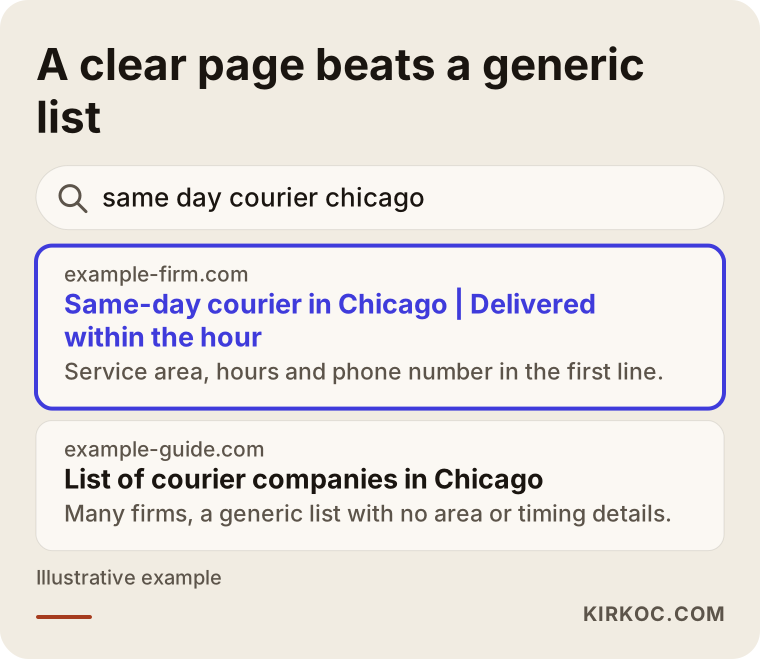
The difference looks small but it matters. The highlighted result tells you in its first line which area it covers, which service it offers and how fast. For someone searching in a hurry, that one line is what separates it from dozens of vague results.
What do people type when they look for a courier?
The words your customers use are often different from the words you use to describe your own work. You may say "metropolitan rapid logistics solutions." The customer types "send a package in an hour" or "book a motorcycle courier." Sorting the searches into four groups makes it clear which pages you need.
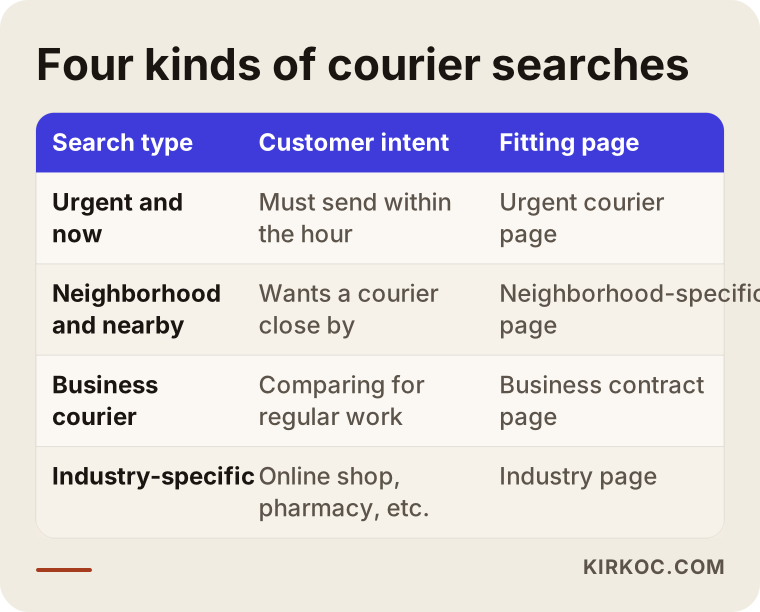
As the table shows, a search that contains words like "urgent" or "now" comes from someone close to paying. A search like "business courier service" or "courier for online stores" comes from someone who will take longer to decide. That person compares several companies, asks for references, and maybe fills in a quote form. Instead of sending both groups to the same page, give each one its own page that speaks its own language. This gives Google and the customer a much clearer message.
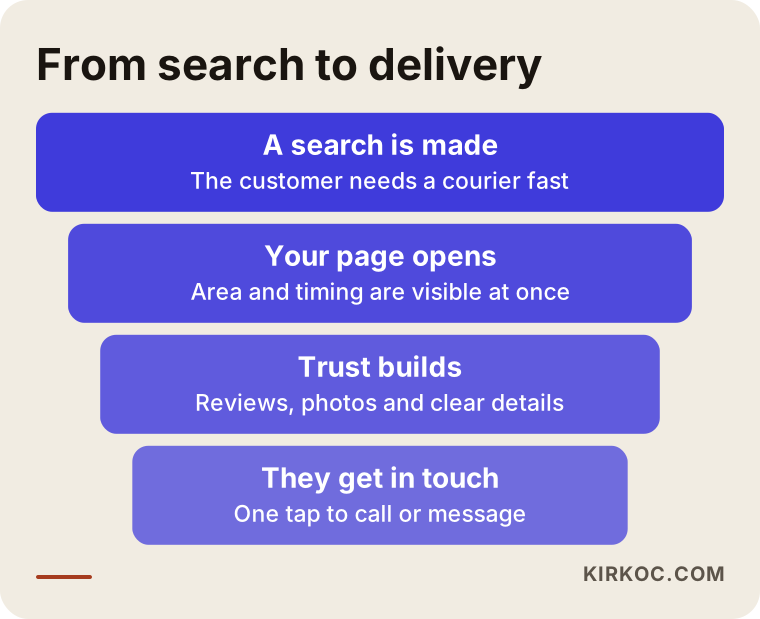
You can think of the customer's path as a funnel: a search happens, your page opens, trust builds, contact is made. Everyone you lose at one step goes to the next courier company on the list.
Your home page, service pages and neighborhood pages
Most courier websites consist of a home page and a contact page. The home page says "Fast, reliable, affordable courier service" and the job is considered done. But Google judges each page for one topic. If "motorcycle courier," "van delivery," "business courier contracts" and "overnight courier" all share one page, you cannot be strong on any of them.
A healthy structure for a courier site usually has these parts. First, service pages: motorcycle courier, van or cargo courier, urgent courier, long-distance delivery, business accounts. Second, area pages: one for each neighborhood or suburb you serve, with information that is really about that place. Third, trust pages: frequently asked questions, a short explanation of how an order works, delivery confirmation, and insurance information.
There is an important warning about area pages. Taking the same text and changing only the place name to produce twenty pages is a pattern Google recognizes very well, and it does more harm than good. A useful area page contains what someone who knows the area would write: which parts of the area you reach and roughly how quickly, which routes cause trouble at rush hour, which places often send packages (courthouses, office parks, hospitals, business districts), and where your riders wait between jobs. This is information nobody can invent from a desk. Only someone who works on the road can write it. That is why I suggest not multiplying area pages, but starting with the few areas where you truly work and truly know the ground.
Here is an example of how an area page might be laid out.
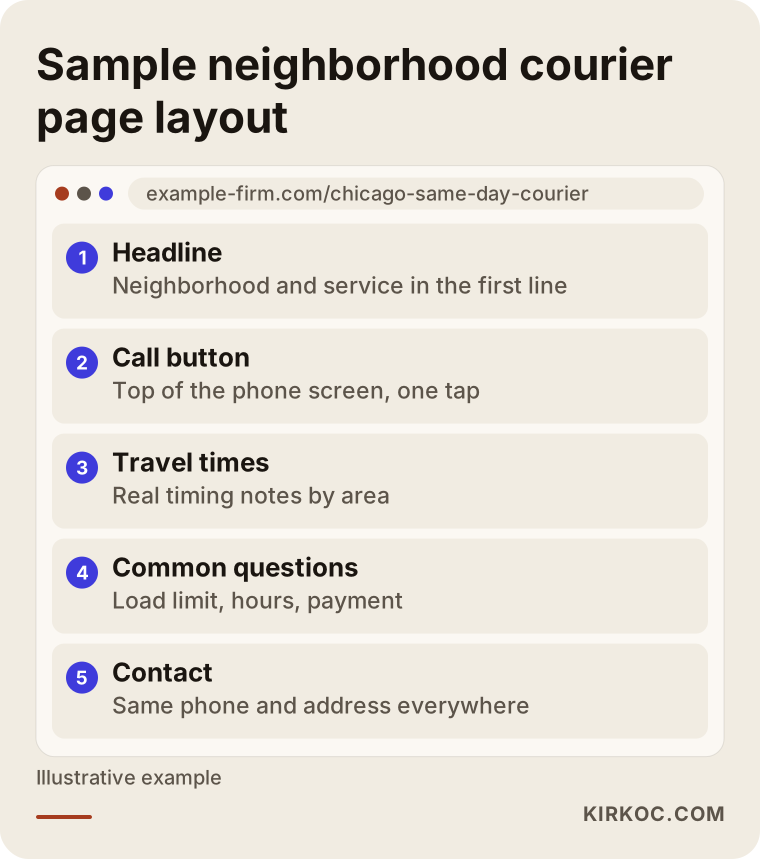
The thing to notice in this layout is that the phone number and opening hours sit in the most visible place on the page. A customer on a mobile phone should reach the call button without scrolling. In the courier business, a number that can be called with one tap matters as much as a well-written paragraph.
Answer the customer's question before they ask it
The questions in a courier customer's head are usually simple. How soon can you be here? How heavy a package can you carry? Will I get updates during delivery? What happens if the package is damaged? Do you work nights and weekends? Can I get an invoice? If your site does not answer these, the customer has to call. A person who does not want to call, or who calls and hits a busy signal, moves on to the next result.
It works better to place the common questions under the relevant service page than to dump them all on one page. For example, the motorcycle courier page can explain the weight limit and speed, the business page can explain invoices and monthly accounts, and the urgent page can explain delivery times and weather. This also makes it easier for Google and for AI assistants to take the answer from you. Today people do not only use Google. They also ask tools like ChatGPT things like "what is the best way to send an urgent document across town?" A page with clear, short answers gives these tools the best chance of using you as a source. There is no guarantee of that, but a company that does not give the answer on its own site has no chance at all of appearing there.
Two hypothetical example scenarios
The two scenarios below are completely hypothetical. They have nothing to do with any real company or person. Their purpose is to show how two different situations in the same industry might be handled.
Scenario 1: A small motorcycle courier, strong in one area but invisible online
Imagine a small motorcycle courier company with a few bikes that works on one side of a large city. The owner has served nearby offices, pharmacies and florists for years, and most work comes by phone and word of mouth. There is a website, but it is a single page: "Fast and reliable courier" in the headline, a phone number, and a few stock photos.
In this case the first job is not to write new pages. It is to repair the visibility that already exists. Is the Google Business Profile complete? Is the service area entered correctly? Are the opening hours current? Does the phone number match the website exactly? These get checked first. Then, on the website, three pages are prepared: a "motorcycle courier" service page, two area pages for the neighborhoods where the company is strongest, and a short "courier for businesses" page aimed at pharmacies, florists and similar shops that send items regularly. Each page is written with real information: typical travel times in the area, the hours the company works, and how to place an order.
After this work, you could reasonably expect the company to start appearing within a few months for narrow searches, such as one neighborhood plus "motorcycle courier." But there is no guarantee about position or timing. Competing for broad searches against strong rivals takes far longer. So the starting goal should not be a broad search like the name of the whole city plus "courier," but a narrow area the company already knows well.
Scenario 2: A mid-sized courier that wants business contracts
In the second scenario, there is a larger courier company with both vans and motorcycles, working across the whole metro area. Its goal is to win business contracts more than individual customers: online shops, law firms and clinics that send items regularly. But its website is written for individuals. There is a big "Book a courier now" button, and nothing about business accounts, invoicing or reporting.
The real problem here is not the search words. It is that the page does not speak to the person looking at it. When a purchasing manager searches for "business courier service," they do not want an instant-order button. They want to see monthly invoicing, how the contract process works, who to call if something goes wrong, and what happens when an item is damaged. This company needs a separate business page, extra pages for specific industries (for example online store deliveries, or legal and notarized documents) and a quote request form. A references section that shows who you work with helps build trust, as long as you have permission and the references are real.
The shared lesson of the two scenarios is that the problem is often not "more traffic" but putting the right page in front of the right person.
Step by step: how to build or fix a courier website
I break the process into five steps. They apply both to a company building a site from scratch and to one that wants to repair an existing site.
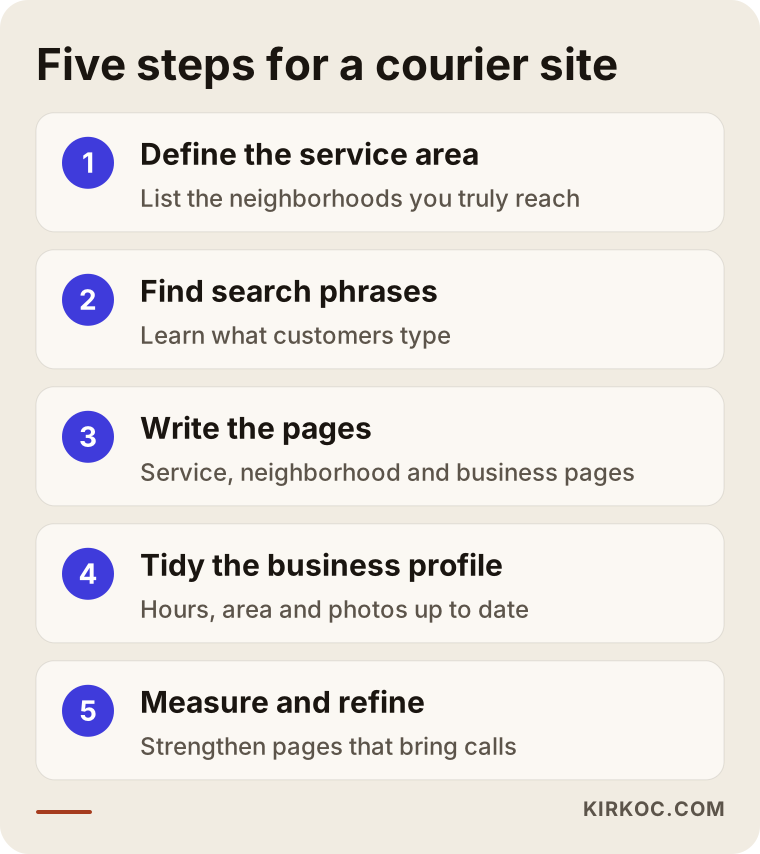
Step one is to define your service area honestly. Which neighborhoods can you truly reach quickly? Writing "the entire metro area" on your site is easy, but if a customer calls from the far edge of town and waits two hours, you lose their trust. Split your area into two groups: places you reach fast, and places you reach by appointment or with extra time.
Step two is to find the search phrases. To learn what customers really type, look at your own incoming calls. What do they ask first on the phone? What words did they use to find you? Look at Google's search suggestions and at the page titles of local competitors. At the end, a clear list of twelve to fifteen phrases is enough. You do not need fifty.
Step three is to write the pages. One page for each main service, one area page for each area where you are strong, and one short page for each type of business customer. On these pages, real photos of your vehicles, your team and your office raise trust noticeably compared with stock photos. Put the service and the area in the headlines plainly, and answer the customer's question in the first paragraph.
Step four is to tidy your business profile. Your Google Business Profile is the box people see in map searches. Is the category chosen correctly? Are the service areas added? Are the photos recent? Do the opening hours show nights and weekends if you work them? Replying to reviews and making it a habit to ask for them is part of this step too.
Step five is to measure and watch. How many calls come from which page? Which area do the calls come from? Which pages get form submissions? Free tools are enough to track this. Without measuring, you cannot know which page to strengthen.
Phone, messaging and forms: measuring what matters
In the courier business, SEO success is measured by calls and messages, not by visitor counts. Make sure your site counts taps on the phone number and on the messaging button. This is the only realistic way to know which page is bringing in work. A page that gets many visitors but no calls is either attracting the wrong people or is not clear enough. Adding pages without seeing this is like pouring water into a bucket without fixing the hole.
The mistakes I see most often on courier sites
Most of the mistakes I see are not technical. They are about how things are explained. These are the main ones.
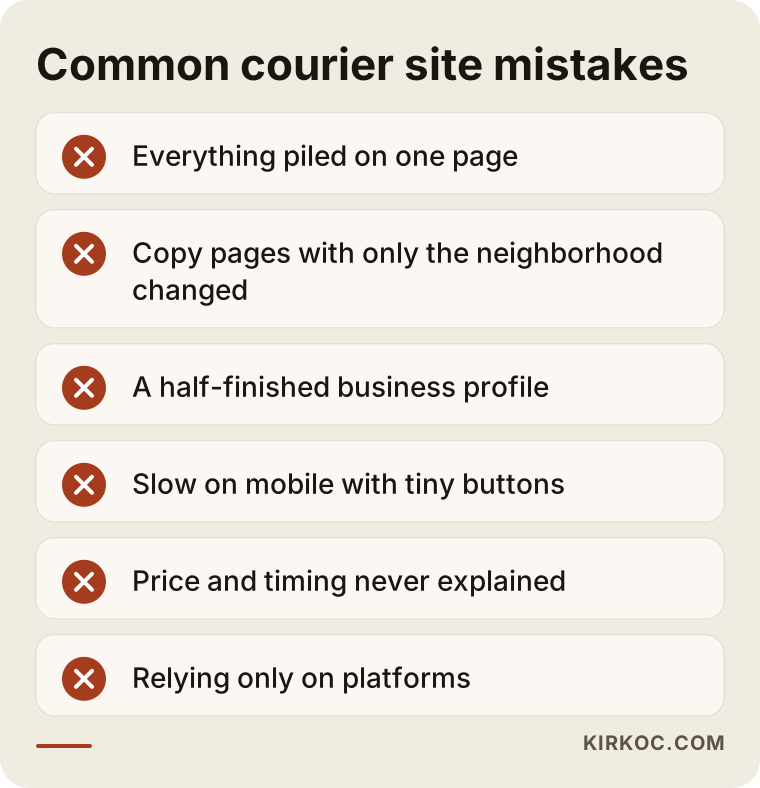
The first mistake is piling everything onto one page. The second, as described above, is copied pages where only the place name has been changed. The third is leaving the business profile half finished; for some courier companies, map results can bring in more calls than the website does. The fourth is poor mobile design. Most people who look for a courier do it on a phone, and a page that loads slowly or has tiny buttons gets abandoned in seconds. The fifth is vagueness: if the site does not say how the price is worked out, how many minutes a delivery takes or what hours you work, the customer chooses the competitor who says it openly instead of calling you.
There is a sixth mistake worth mentioning: depending only on platforms. Many courier companies get most of their work through an app or a marketplace. That is convenient in the short run, but the customer becomes the platform's customer, not yours, and the commission, the rules and your visibility are not in your hands. Strengthening your own website and business profile is the way to reduce that dependence over time. I am not telling you to leave the platforms. Running both together makes sense.
The wording mistake: "fast and reliable" is not enough
Almost every courier site says "fast, reliable, affordable." Those three words carry no information, because everyone writes the same thing. Use concrete statements instead: "Most deliveries between these two neighborhoods arrive within the same hour," "the recipient's signature is confirmed after delivery," "you can follow the rider's location during the trip." These do not have to be numerical promises, but they must be real and checkable. An exaggerated sentence, even if it is not a lie, leads to disappointment when the customer meets you in real life.
A different approach for business customers
If you want business customers, you need to change the language of the site. An individual asks, "Can you come now?" A business asks, "Who do I contact if something goes wrong?" The comparison below sums up the difference.
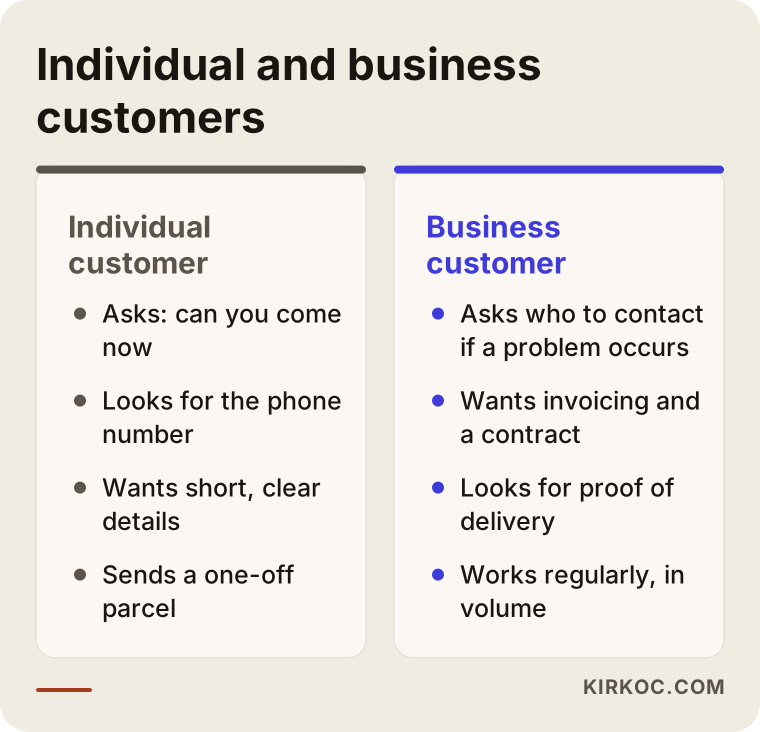
A business page should include: monthly invoicing and payment terms, how the contract process works, a single contact person, delivery reports or proof of delivery, what happens in case of damage or loss, and confidentiality. Before you write anything detailed and firm about insurance and liability, talk to a lawyer or your insurance provider. A wrong assurance on your site can cause a serious problem later. The same goes for licensing and regulatory obligations: get current information from the relevant authorities or an expert. I am not giving any legal opinion here.
Another way to reach business customers is through articles and guides. Pieces like "how to set up same-day delivery for an online store" or "what to check in a regular courier contract for offices" attract people who are researching but have not decided yet. The purpose of such content is not to make an immediate sale. It is to make sure that when this person does decide, they already know who you are.
Nights, weekends and holidays: seasonal searches
Demand for couriers is not constant through the year. There are gift deliveries before holidays, Valentine's Day, back-to-school weeks, the year-end rush and sale periods for online shops, and the periods when tax and paperwork deadlines fall. Searches rise at those times, and if your page is not ready, the opportunity passes. The right time to prepare is not in the middle of the busy period but weeks before it, because Google needs time to find and evaluate a new or updated page.
If you offer night and weekend service, announce it in its own sentence or even under its own heading. Writing "24/7" is easy, but a company whose phone goes unanswered at night is hurt by that claim. Write the real hours. A clear statement like "from seven in the morning until midnight" earns more trust than a "24/7" that nobody can check.
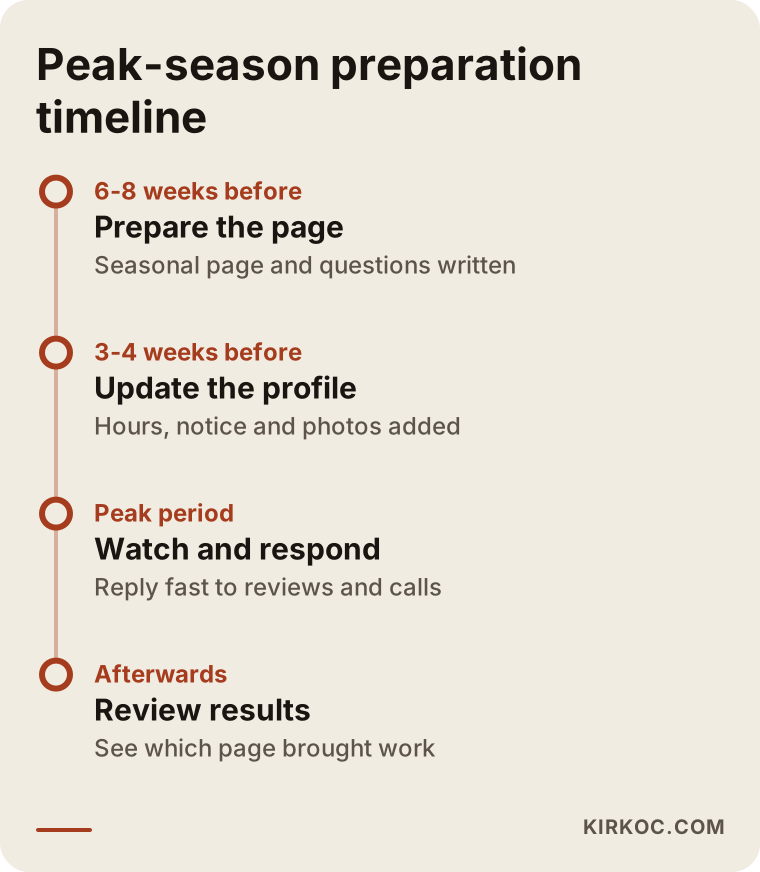
The idea in the timeline is simple: before a busy season arrives, have your page for that season and your business profile announcement ready. This tells both Google and the customer that you are open for business during this period too.
What can you do yourself, and when do you need an expert?
You do not have to hand everything to an expert. You can start the following tasks yourself, at no extra cost: fill in your Google Business Profile completely, enter your hours and service areas correctly, add real photos, ask satisfied customers for reviews, write the phone number identically on every page of the site, and write down the questions customers ask most often.
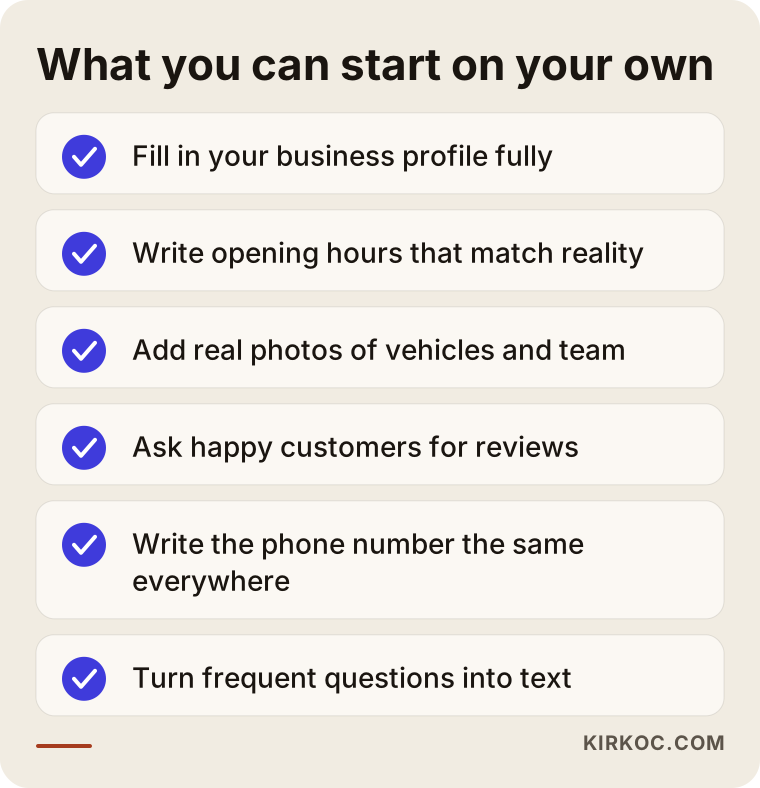
If you have done this list and you are still behind, or if your site has structural problems (slowness, mobile issues, duplicate pages, or not knowing which phrases to target), expert help starts to make sense. The decision between doing it yourself and hiring someone can be settled with a few questions.
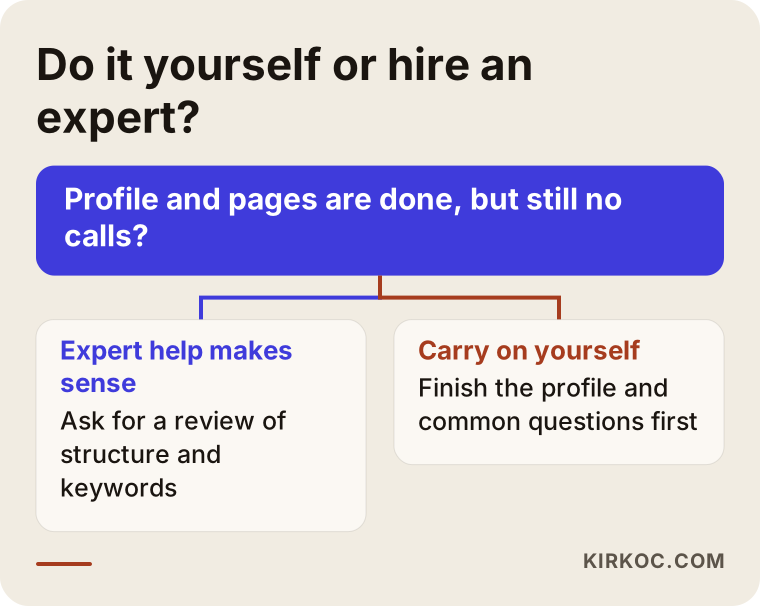
To be honest, the main contribution of an expert is usually to save time and to keep you from going down the wrong road. Knowing which pages are really needed, which phrases are worth targeting and what would be wasted effort can shorten months of trial and error. But no expert can replace your knowledge of the street. You are the only one who knows how long it takes to reach each area and what each customer wants. Good work takes that knowledge from you and turns it into the right pages.
What determines the cost of SEO?
I will not give numbers in this article, because the cost really depends on the scope of the work, and a figure would be misleading. The main factors are these. First, your current site: do you need one built from scratch, or does the existing one need repair? Second, the number of areas you want to cover: one neighborhood and dozens of neighborhoods are very different jobs. Third, the variety of your services: only motorcycle courier, or also vans, business accounts and long-distance delivery? Fourth, languages: if you also serve customers in other languages, pages in those languages are extra work. Fifth, content creation: preparing real photos, texts and answers to common questions. Sixth, whether the work is a one-time project or ongoing maintenance.
When you request a quote, ask these questions. Which pages will be written, and how many? What will be measured, and when will it be reported? If anyone promises a guaranteed result, treat it with suspicion, because nobody can guarantee a position on Google. A person who says otherwise is either giving false information or hiding the conditions. Ask in writing what the service includes and what it leaves out.
How I work
I work alone from Istanbul, so the person you talk to and the person who does the work are the same. First we have a short conversation in which I listen to how your business works, which areas you serve and who your target customer is. Then I look at your current site and business profile and write down in plain language what needs to be done: which pages are missing, which need fixing, which tasks you can do yourself and which ones I should do. The scope of the quote is clear, so you know in advance what is included. While the work goes on I report progress in plain language, and when everything is finished, the website stays in your hands, so there is no dependence on me. Because every business is different, I do not say what should be done before I have drawn up a plan for your specific situation.
Frequently asked questions
How long does SEO take to work for a courier company?
It depends on the competition and on the current state of your site, so it would not be right for me to give an exact time. In general, narrow and clear searches (for example a single neighborhood) show results earlier, and broad searches much later. That is why you start with small, clear goals and widen them afterward. Be careful with any offer that promises a position within a month.
Is a Google Business Profile enough, or do I need a website?
The business profile is very valuable in map searches, and every courier company should fill it in completely. But the profile alone is not enough: business customers often look at the website, and they look there for service details and trust information. The profile and the site complement each other, and both should give the same details (address, phone number, hours) consistently.
Should I create a separate page for each neighborhood?
No, only for the areas you really serve and about which you can write original information. Copying the same text and changing the place name does not work and can do harm. It is healthier to start with three or four strong areas and expand based on the results.
I get work from marketplaces and courier apps. Do I still need SEO?
Work from platforms is valuable, but the customer belongs to the platform, not to you. A customer who comes through your own site and profile reaches you directly and does not depend on commission or rule changes. Running both makes sense, and over time you can aim to raise the share of your own channel.
Which page do I need for business customers?
At least one business courier page: it should explain monthly invoicing, the contract process, the contact person, delivery information and what happens in case of damage. If you target a particular industry (for example online stores or pharmacies), a short page for that industry is also useful. For insurance and liability statements, consult a lawyer or your insurance provider.
Do AI assistants recommend courier companies?
In some cases they do, taking information from the sites they cite as sources. Sites with clear, consistent and verifiable information have an advantage here. There is no guarantee, but a site that plainly states your service area, hours and process makes the job of these tools easier too.
Should I put the price on the site?
If you do not have a fixed price, you do not have to write a number. But explaining plainly what the price depends on (distance, urgency, vehicle type, waiting time) builds trust. Uncertainty can put customers off from calling.
What should I do about my current site, rebuild it from scratch?
Not always. First the site needs to be examined. If the structure is sound, fixes may be enough. If it is slow, broken on mobile or cannot be edited, rebuilding may cost less in the end. I suggest having it reviewed before you decide.
If you want the strength your courier business has on the road to be visible online as well, let us look at your situation together. You can reach me through my SEO services page and briefly describe your business and the areas you serve.