You run a cybersecurity firm. Your team knows its craft, you have references, and maybe you have worked for years with clients who found you by word of mouth. But when an executive types "penetration testing service" or "cybersecurity consulting" into Google, your name does not show up. This article is about exactly that situation: how SEO, meaning the work that makes your website appear in the right Google searches, should be done for a security company. I am Ümit Kırkoç, a web designer and SEO consultant who works alone from Istanbul, and if you want the general picture first, you can look at the scope of my SEO services.
Being in a technical industry does not make SEO easier. Often it makes it harder. You know your field's language so well that you write your website in it: "SOC services," "vulnerability scanning," "red team exercises." But the person making the buying decision might be a hospital's IT manager, an online store owner, or the head of an accounting office, and that person rarely describes the problem in your words. In this article I will start with how buyers search, move on to the pages you need, and finish with the process, the mistakes and the question of cost.
Why is SEO different in cybersecurity?
For a coffee shop or a dental clinic, the customer searches "near me" and may decide the same day. In cybersecurity the picture is the opposite. The buyer has run into a problem or feels a worry, but does not hand that worry to a company right away. They research first, look at a couple of firms, and then check with their boss or partners. A decision can take days, even weeks.
That has two consequences. First, a buyer rarely picks you on first contact. More often it happens on the third or fourth touch, which means your site needs more than one type of page and more than one visit to do its job. Second, trust comes before everything else in this field. If you are about to give someone access to your systems, you want to be certain that person or company is serious. So your site has to do more than get found. Once someone lands on it, it has to leave the feeling "I can trust these people."
There is one more factor. For topics touching health, money and safety, Google looks more carefully at who the content comes from. On a cybersecurity site, who wrote a page and from what experience matters. Anonymous, generic text that could appear on any website is weak here. I will make this concrete as we go.
What do buyers search for, and in which words?
I roughly divide cybersecurity buyers into three groups, and each searches differently.
The first group is the business owner who has had a problem or fears having one. This person does not know the technical terms. They type things like "my website got hacked what do I do," "how do I protect my company data," or "what to do after a ransomware attack." The search is urgent, but it is also a search for information. If the page that answers it earns their trust, the next search is often "cybersecurity company."
The second group is the manager who has a task to complete. A client contract, an audit or a corporate procurement process may require a security test. They type "penetration testing service," "what is a vulnerability scan," or "SOC 2 consulting." The wording is a bit more technical here, but the problem is still stated in business terms: "my customer wants a test report."
The third group is the IT or security lead. This person searches in more technical terms, compares firms, and looks for references and methodology. But they often do not make the final call alone; there is a manager who has to approve. That means your site must be written for technical and non-technical readers at the same time.
The illustration below uses a completely made-up example to show what makes the difference in a search result.
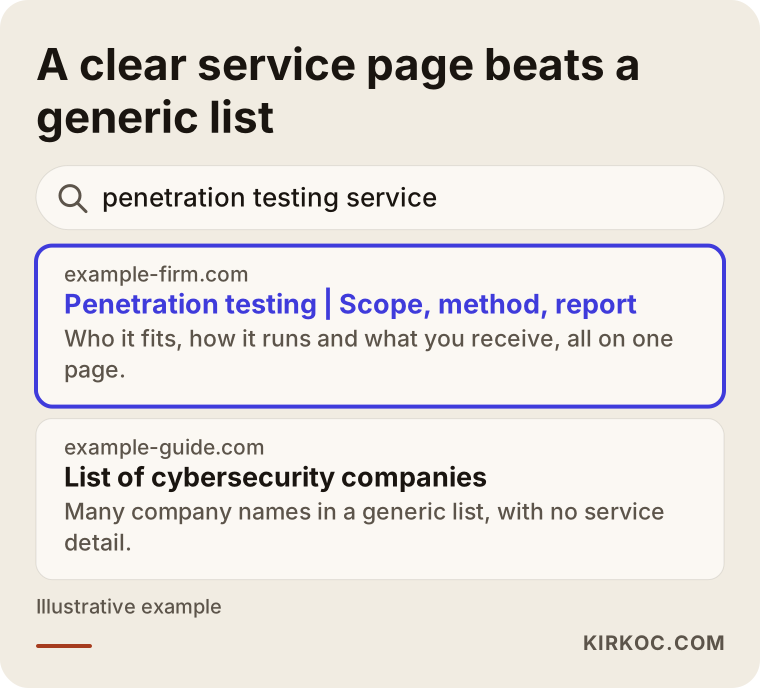
Notice that the highlighted result says what it does in the first line: which service, for whom, and with what output. A generic sentence such as "we deliver security solutions" does not do the same job. Google tries to show the reader the most fitting answer, and if you make that fit easy to see, it can place you ahead more comfortably.
Four types of search
When you plan your site, sorting searches into four types simplifies the work. The table below summarizes what each type wants and which page answers it.
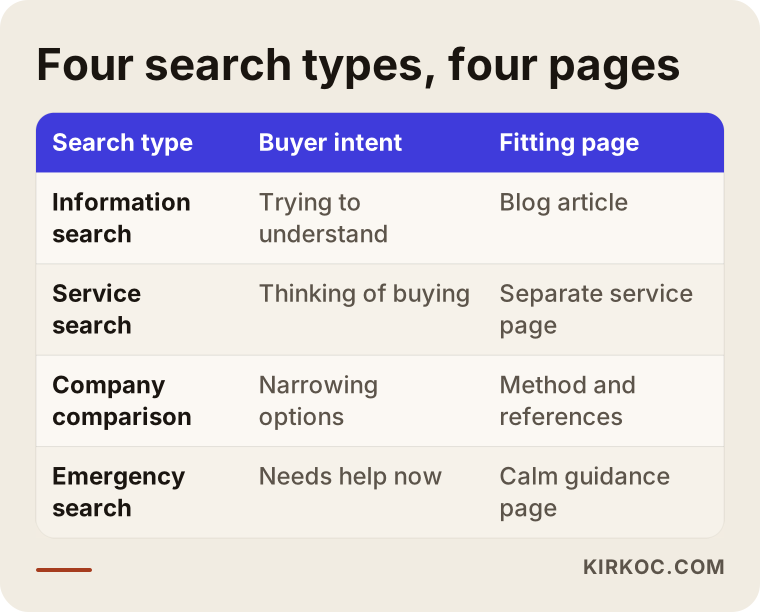
Information searches ("what is a vulnerability scan") are answered by a blog article. Service searches ("penetration testing service") are answered by a separate service page. Company comparison searches ("best cybersecurity companies") are answered by method and reference pages. Emergency searches ("my site got hacked") are answered by a calm, clear guidance page. If you try to squeeze all four into one page, you answer none of them fully.
The buyer's journey: from first search to your inbox
A cybersecurity buyer rarely writes to you after a single click. First they gather information with a broad search, then they narrow the options, then they study one or two firms in depth, and only at the end do they leave a message. You can picture this as a funnel: many people at the top, fewer but more determined people at the bottom.
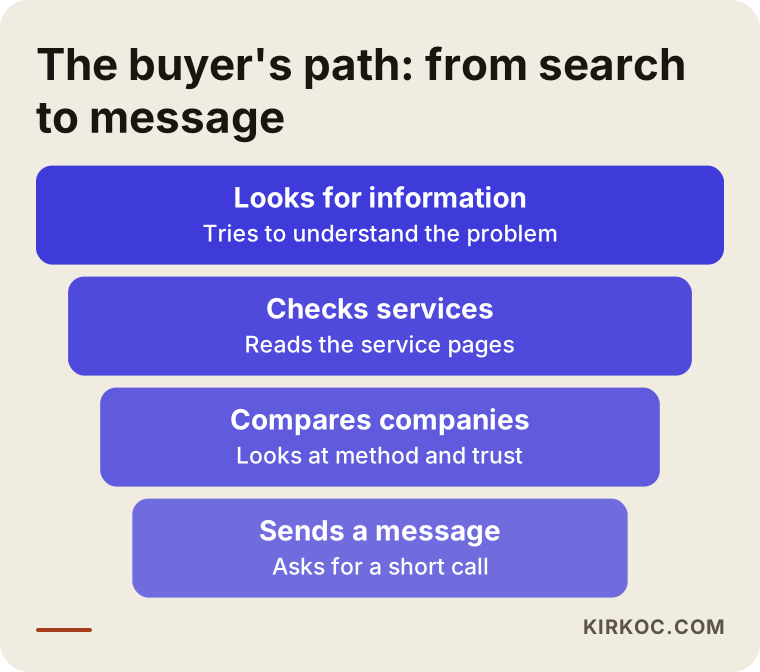
Knowing this funnel tells you something practical: your site should have an answer for every stage. A site that focuses only on the bottom, the "contact us" button, misses the crowd at the top. A site that only publishes blog posts but has no service pages informs the reader but leaves no way to choose you. You need to build both together.
Which pages should your site have?
The most common situation I see on cybersecurity websites is this: a home page, a "services" page, and one long block of text where twenty headings are stacked on top of each other. This layout sends a weak signal to people and to Google alike, because a single "services" page cannot fully answer any one search. It touches all of them superficially.
A stronger setup is a separate page for each main service. For example penetration testing, vulnerability scanning, security consulting, incident response or continuous monitoring. Every page repeats the same structure: who it suits, what it covers, how it runs, what you deliver, frequently asked questions, and a way to contact you. The list below summarizes what a single service page should contain.
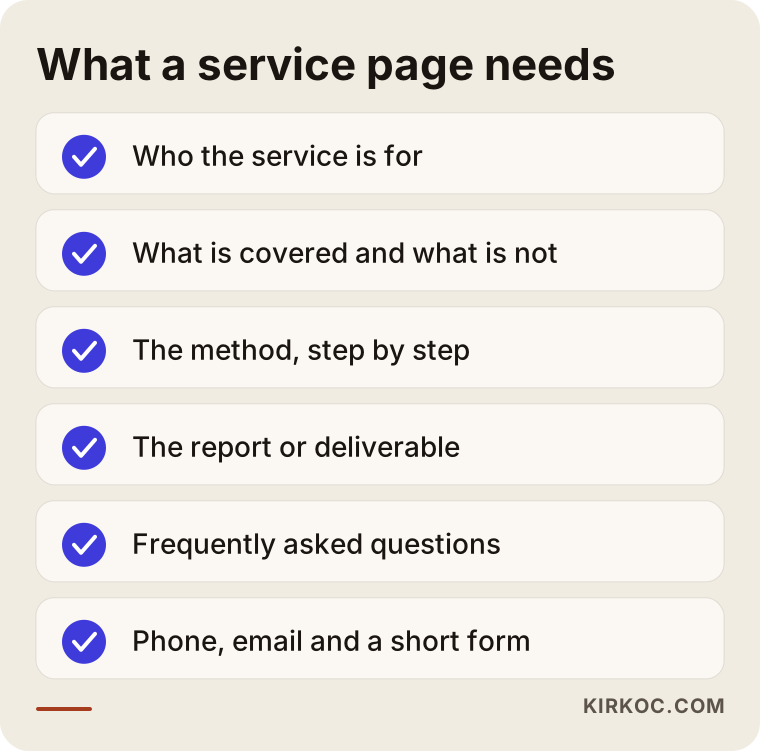
The item most often skipped is "what you deliver." Buyers want to know what they will have in hand after a test. A report? A presentation? Remediation recommendations? A retest? A firm that spells this out looks far more trustworthy than one that does not.
Industry and situation pages
Next to service pages, industry or situation pages also work well. Think "security testing for online stores," "cybersecurity for healthcare providers," or "basic security check for small businesses." These are pages where your clients recognize themselves. What matters is that each page says something truly specific to that industry. Swapping the industry name in the headline and pasting the same text underneath does not work, and Google notices.
The about and team page
In this field, the "about" page is not decoration; it is a sales tool. Write who you are, which area you work in, which certifications you genuinely hold, and which method you follow. Do not list a certification you do not have or work you have not done. It is unethical, and it comes out the moment a buyer asks a follow-up question. Putting the names of team members and short summaries of their expertise on the page is one of the simplest ways to raise trust.
How do you show trust on the page?
In cybersecurity, claims are cheap: everyone writes "reliable, professional, experienced." What creates trust is detail that can be checked. A few examples.
Explain your method. A firm that describes in plain language the steps a penetration test goes through feels safer than one that works like a black box. Explain your scope: write what you test and what you do not. No test covers everything, and saying so honestly does not reduce trust; it builds it.
Show a sample report structure. Without including any real client information, sharing a blank report template or the section headings shows the buyer what they will receive. Use references only with the client's permission and in the form they actually approved. Because expectations of confidentiality are high in your industry, many clients will not want their name used. In that case, prefer anonymous but real summaries such as "work done for a financial services client." Never invent a reference.
Finally, your own site needs to set an example. An outdated site, an expired certificate or slow pages are a serious flaw for a security company. The buyer notices and thinks: "If they cannot protect their own site, how will they protect mine?"
AI answers and cybersecurity
Many people now ask AI tools such as ChatGPT questions alongside Google. For a question like "How does a small company get a penetration test?" these tools give a summarized answer and sometimes cite sources. For your name to appear in those answers, your site has to contain clear, plain, verifiable information. This is sometimes called GEO, short for the work aimed at appearing in AI-generated answers. It is not a separate kind of magic; it is a continuation of good SEO.
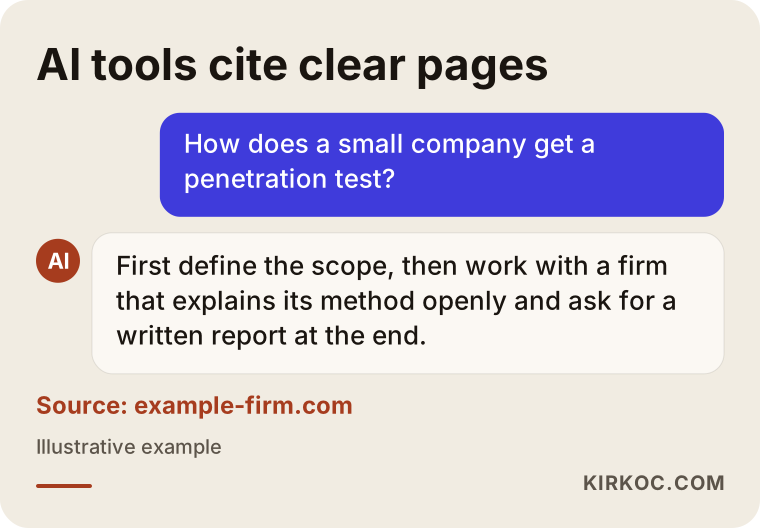
The example here is invented, but the logic is real: these tools prefer pages that answer the question openly. If your page answers "what is penetration testing, who needs it, how does it proceed" in short, clear paragraphs, your chance of being used as a source rises, both on Google and in AI answers. There is no guarantee, but that is the foundation.
Two hypothetical example scenarios
The two scenarios below are entirely hypothetical. They do not describe a real company or person; they exist only to show the logic.
Scenario one: a small firm with a single services page
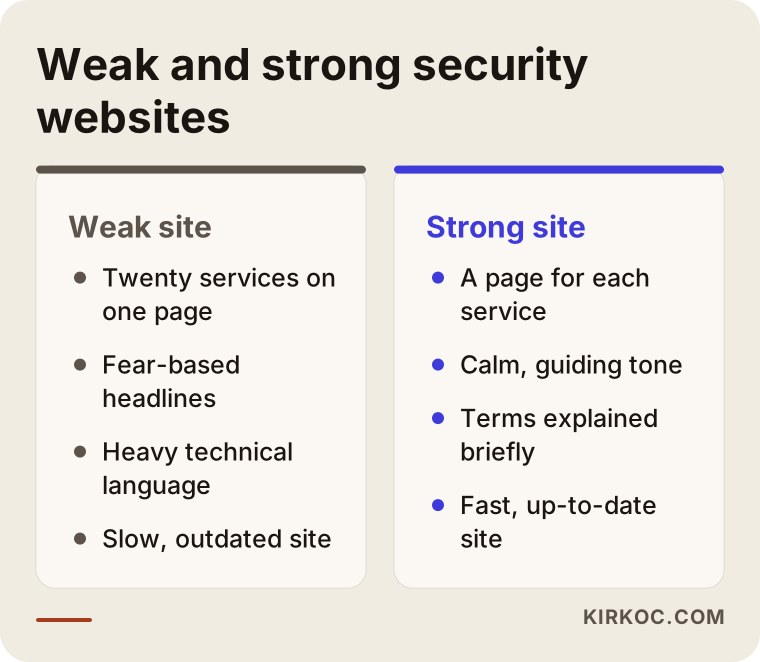
Picture a cybersecurity consulting firm. Its site has a home page, "services" and "contact." Penetration testing, vulnerability scanning, employee awareness training and incident response all appear on the same page in a few sentences each. The firm wants to show up for "penetration testing," but it does not, because other firms have pages that describe that service in detail for the same search.
The fix is to split the page. First pick the service that brings in the most work and build a dedicated page for it: who it suits, how it runs, what is delivered, frequently asked questions. Then apply the same structure to the second service. Within a few weeks, Google crawls those pages, and the firm gains a chance to appear for those searches. I would never promise a ranking, but this setup is a much stronger foundation than a single-page layout.
Scenario two: a firm that only writes blog posts and has no service pages
The second firm makes a different mistake. It regularly publishes posts such as "cybersecurity trends" and "newly disclosed vulnerabilities," but those posts send the reader nowhere. They bring in some visitors, but most are students or fellow professionals, not people who would buy. The contact form stays empty.
Here the answer is not to publish more, but to change direction. The firm should write articles that answer the questions buyers actually ask ("my site got hacked, what do I do in the first 24 hours") and link them naturally to the relevant service page. Traffic may fall, but the traffic that arrives is more intentional. In cybersecurity, a few right visitors matter more than a large number of visitors.
When I put the two scenarios side by side, the difference is clear: one lacks pages, the other lacks direction. The visual below sums up that gap.
A step-by-step process: where to start
This is how I would run SEO work for a cybersecurity site. Knowing the order tells you what to expect, and what to question when you receive a proposal.
In the first step I review the current situation: which searches the site already appears for, which pages exist, which are missing, and whether there is any slowness or technical error. In the second step I research how buyers search: which words they use, which questions they ask, which services are searched most. In the third step I draw up a page plan: which service pages, which industry pages, which articles are needed. I also write the pages in that step, or edit the text you have written. In the fourth step I make the technical fixes, track the results and update the plan.
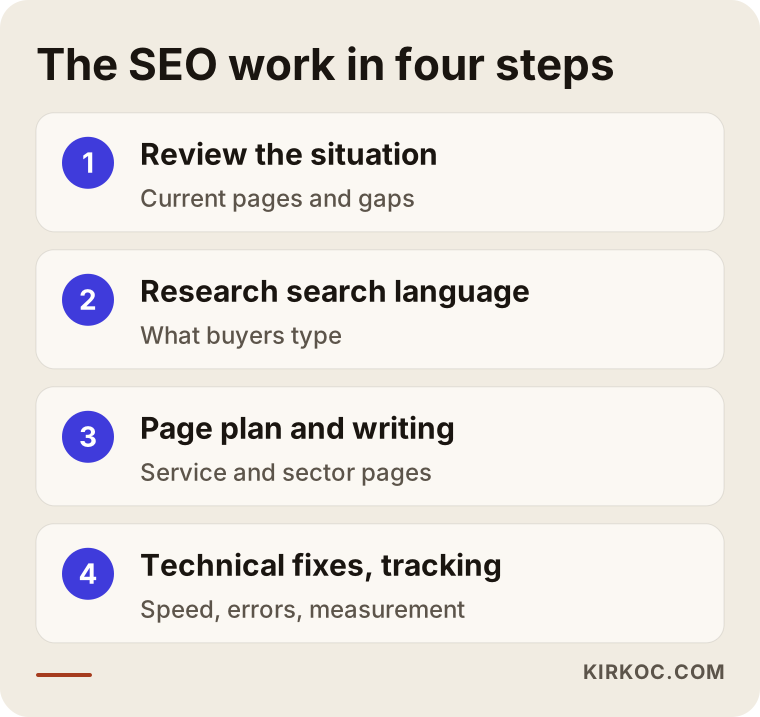
The most time-consuming part of this process is the writing in the third step, because technical accuracy comes into play there. I am not a cybersecurity expert, so I verify the technical content of every text together with you. You provide the technical truth, and I turn it into language the buyer understands and a structure Google can read. This division of labor reduces mistakes and makes sure the text truly reflects your experience.
Common mistakes
Here are the mistakes I have seen again and again on cybersecurity sites. Most come not from ignorance but from the nature of the work: technical people looking at their own field from the inside.
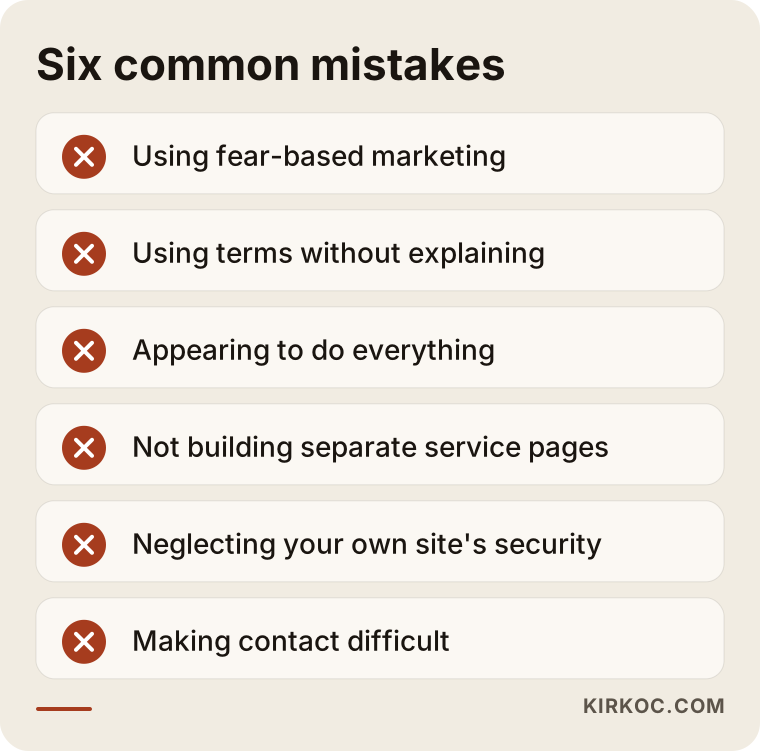
The most damaging is fear-based marketing. A threatening tone such as "You could be hacked today!" may grab attention in the short term, but it erodes trust in the long term. Buyers want someone who guides them, not someone who scares them. The second big mistake is heavy technical language. Using terms like "vulnerability," "exploit" and "privilege escalation" without explaining them loses the executive who has to approve the purchase. Explaining a necessary term in one sentence is usually enough.
The third mistake is looking like you do everything. Listing twenty services on one page, from network security to application security, cloud security, forensics, training and consulting, signals scattered attention rather than expertise. The fourth mistake is having no separate service pages, which I covered above. The fifth is neglecting the security and speed of your own site. The sixth is making contact difficult: if a buyer wants to ask a question and faces a long form with a required phone field, they give up. A phone number, an email address and a short form, all three together, work well in this field, because some buyers prefer writing and others prefer talking.
What can you do yourself, and when do you need an expert?
You do not have to hand everything to a specialist. There are several things you can do on your own at little or no cost.
First, write one page for the service that brings in the most work: who it suits, how it runs, what is delivered. Have someone non-technical read it before a colleague does; if they do not understand it, simplify it. Second, fill out your Google Business Profile, which is the business card Google shows on maps and in search. Third, show your team and your real certifications on your about page. Fourth, make sure your site opens quickly on a phone.
Expert help makes sense when you do not have time to build the page plan, when your site has a technical problem (for example, your pages are not appearing in Google at all), when you want to publish in more than one language, or when you cannot measure whether your work is paying off. What matters is that the specialist writes down clearly what they will do and does not promise a "guaranteed ranking." When you see that promise, question the proposal.
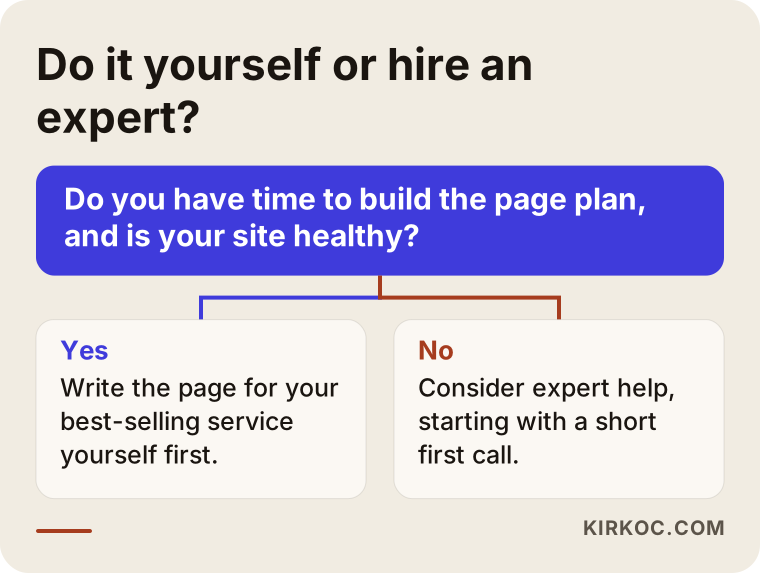
This chart is a rough guide, not a strict rule. It changes with your time, budget and the state of your site. If you are unsure, a short first conversation is often enough.
What determines the cost?
I deliberately do not give numbers here, because cybersecurity sites differ enormously and no single price fits everyone. But I can tell you what the cost depends on.
The first factor is the size of the site. A site with three services and one with fifteen services, several industry pages and a regular blog are not the same amount of work. The second factor is the starting point: is the site being built from scratch, or is an existing one being fixed? The third factor is the number of languages; if you serve clients abroad, each language means separate writing and separate checking. The fourth factor is who writes the content, since texts that need technical verification take more time. The fifth is whether the work is a one-time project or ongoing monthly support.
Ask for these items to be listed separately in a quote. If you see a vague line such as "monthly SEO package," ask what is in it. You cannot judge the cost of something when you do not know what you are receiving.
How soon should you expect results?
The honest answer is that it varies, and nobody can give an exact time. It can take a few weeks for Google to crawl and evaluate a new service page, and appearing in a competitive search can take months. Because the buying decision in cybersecurity is slow anyway, it takes a long while for SEO to start producing inquiries.
So do not measure success only by "first position." More meaningful signs are these: are visits to your service pages growing, are contact forms or phone calls increasing, are incoming messages clearer in intent? To measure them, Google Search Console, a free tool from Google that shows how your site appears in searches, is enough. At this stage, seeing a direction is worth more than seeing a number.
How I work with you
I work alone, which means the person you talk to is the person doing the work, with no layers in between. First, in a short call, I listen to your situation, look at your site, and tell you plainly what can be done and what is not needed. I do not sell what you do not need. If your site's foundation is solid and only a few pages are missing, I will say so. If a broader project is required, I share the steps and their order in writing.
I need your expertise on the technical content; your security knowledge is something I cannot supply. In return, I build the path that carries that knowledge to the right buyer, in the right words, on the right page. This collaboration works best when each of us stays in our own field.
The visual below shows what a well-built service page looks like from top to bottom.
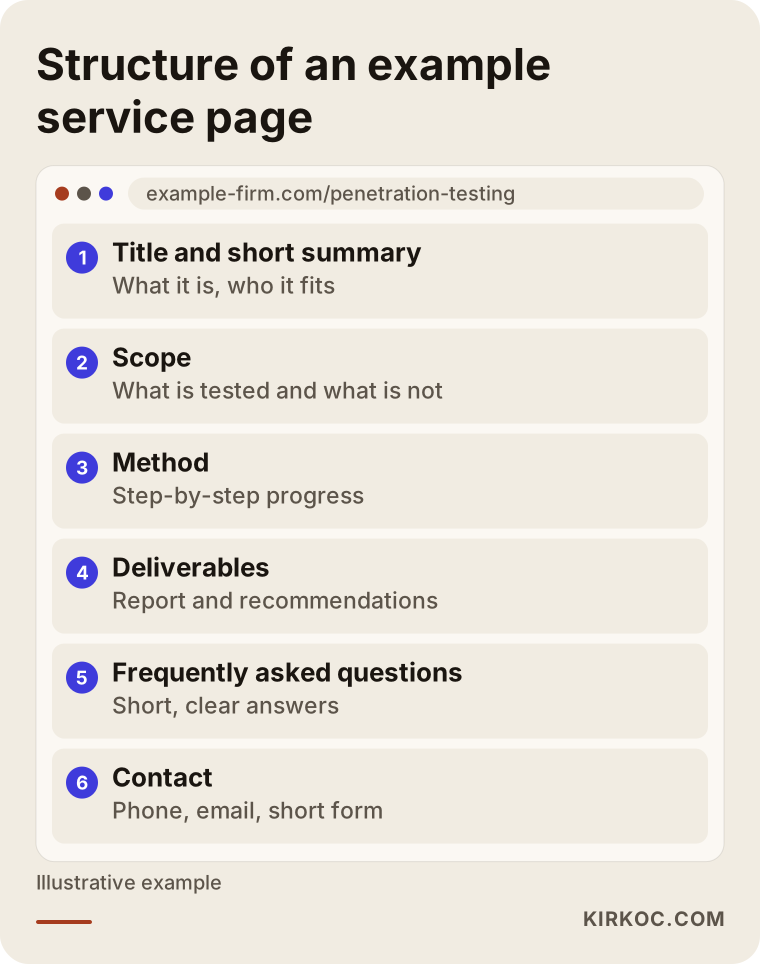
This structure answers the questions in the buyer's mind in order: what is this, is it right for me, how does it work, what will I get, can I trust them, how do I reach them? If each section is kept short, the reader does not get tired and Google can easily tell what the page is about.
Frequently Asked Questions
Is SEO really necessary for a cybersecurity firm, or are referrals enough?
Referrals are powerful, and in this field they are the most valuable channel. But referrals bring people who already know you; they do not bring buyers who need help and have never heard of you. Also, a person who arrives by referral usually looks at your site and researches you before deciding. If your site is weak, the value of that referral shrinks. SEO should be thought of as a second channel next to referrals.
Does writing blog posts help a cybersecurity firm?
It does, as long as the direction is right. Articles that answer the questions buyers ask ("what is penetration testing," "my site got hacked, what do I do") work. News-style posts that only follow current events often bring colleagues, not buyers. Every article should offer a natural path to a service page.
Is it safe to share vulnerability information or technical details on my site?
Describing your general method and process is safe, and it builds trust. But you should not publish details, weaknesses or findings that belong to real client systems. In any case of doubt, get your client's written permission, and for a definite answer on contracts and confidentiality, I suggest asking a lawyer.
Should I display my certifications on the site?
If you truly hold them, yes, and explain in one sentence what each one means. Buyers often do not know the certification's name. Do not show a certification you do not have or one that has expired; it damages both trust and reputation seriously.
Should I build a site in more than one language?
If you serve foreign clients or international companies, it makes sense. But each language is separate work, and what you need is writing suited to that language's buyer, not a translation. Starting with one service and expanding as you see results is less risky than doing everything at once.
Should I choose SEO or Google Ads?
They do different jobs. Ads give quick visibility but stop when you stop paying. SEO is slower to build but, done well, works for a long time. In cybersecurity, buyers look for trust, so a person who arrives from an ad will also look at your site and judge your content. A good site is the shared foundation of both.
How do I track the results?
Google Search Console and your site's visitor statistics are enough to start. Watch which searches you appear for, which pages receive visits, and how many people get in touch. What matters is not the size of the number but whether the right pages are reaching the right people.
What should I do if my competitors rank above me?
First look at why they are ahead: do they have more detailed service pages, more content, a stronger trust signal? Often the answer is not to write more than they do, but to write more clearly and more originally. We can look at this together.
If you would like to review your cybersecurity firm's website in this light, you can reach me through my SEO services page and briefly describe your situation; we will talk openly about what can be done and what is not needed.