You run an engineering, project management or consulting firm. Most of your work comes from familiar contacts, past clients and bid announcements. You have a website, but your phone rarely rings because of it. Sometimes a prospective client even tells you, "We looked you up online, but we couldn't find much." SEO for engineering firms is the work that closes exactly that gap. In this article I will explain how B2B buyers (corporate and public-sector clients) search for firms like yours, which pages your site needs, and where to start. I am Ümit Kırkoç, a web designer and SEO consultant who works alone from Istanbul, and I will be clear about the scope of my own SEO services where it matters.
SEO, in short, is the work that makes your website show up in Google and other search engines when people search for what you do. In a field like engineering it works a little differently, because the person searching is not putting a product in a shopping cart. They are looking for a trustworthy firm for a project, trying to find out who could write a specification, or comparing three firms that are already on their desk. Your site has to work less like a shop window and more like a document that earns trust.
How do buyers search for you?
In this field the person searching is rarely a single individual. A technical specialist or project manager usually does the first round of research, then a procurement officer looks at the company details, and finally management or a selection committee decides. Each of them is looking for something different, and your site has to answer all three.
Three kinds of searches
The first kind describes the service: "structural design services," "construction inspection services," "energy efficiency audit." Here the searcher knows what they need but not who to buy it from. The second kind combines a place with a service: "Chicago electrical design," "Denver geotechnical investigation." Many jobs go to a firm that is connected to the city where the project will be built, so the city name matters a great deal. The third kind is about your firm itself: your company name, your licenses, your references. This is usually someone checking out a firm that was recommended to them or that they already know.
If you miss the first and second kinds, you are invisible to new buyers. If you miss the third, a buyer who already wanted to hire you cannot verify you and moves on to another firm. Both hurt, but the second happens more often and more quietly.
The illustration below uses an entirely made-up example to show what a search result can look like, and why a clear service page can outrank a generic company page.
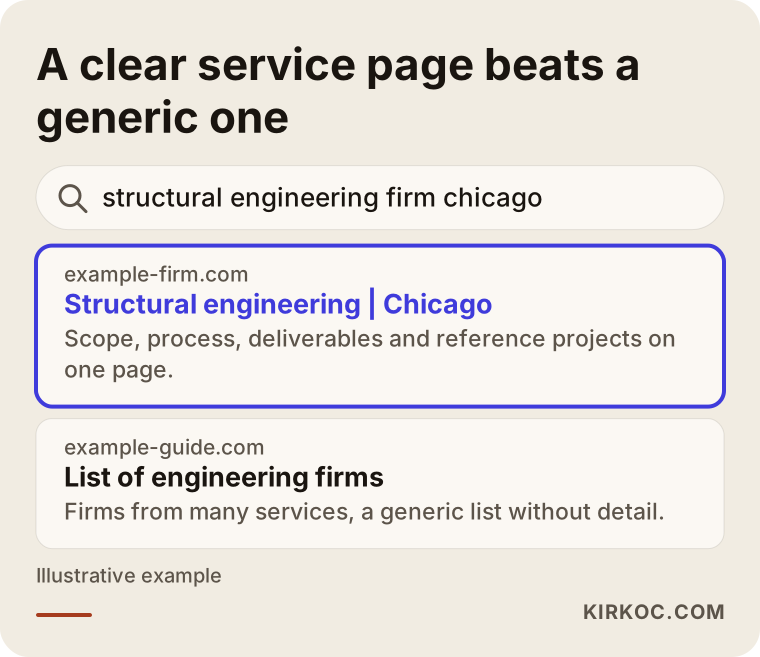
What the highlighted result does is simple: in the first line it states the service, the city and who it is for. A generic home page that says "your corporate solutions partner" does none of that. A search engine tries to work out which answer fits the person searching, and if you make that easy, you move ahead.
Why the word "engineering" alone does not work
On many firm websites the main headline is something like "Engineering and Consulting" or "Design and Construction Services." The problem is that these words describe an industry, not a service. Buyers search for the service, not the industry. Competing for a very broad word is hard, and it also brings the wrong people: someone typing "engineering" could be a student, a job seeker or someone researching a degree. Someone typing the name of a specific service is far more likely to have a real need.
Which pages does your site need?
The situation I see most often on engineering firm sites is this: one "Services" page with a fifteen-item list underneath, plus a "Projects" page. That reads like a brochure, but it does not help the search engine or the buyer. If you describe fifteen services on one page, you cannot describe any of them in depth.
The table below summarizes which type of page answers which buyer need.
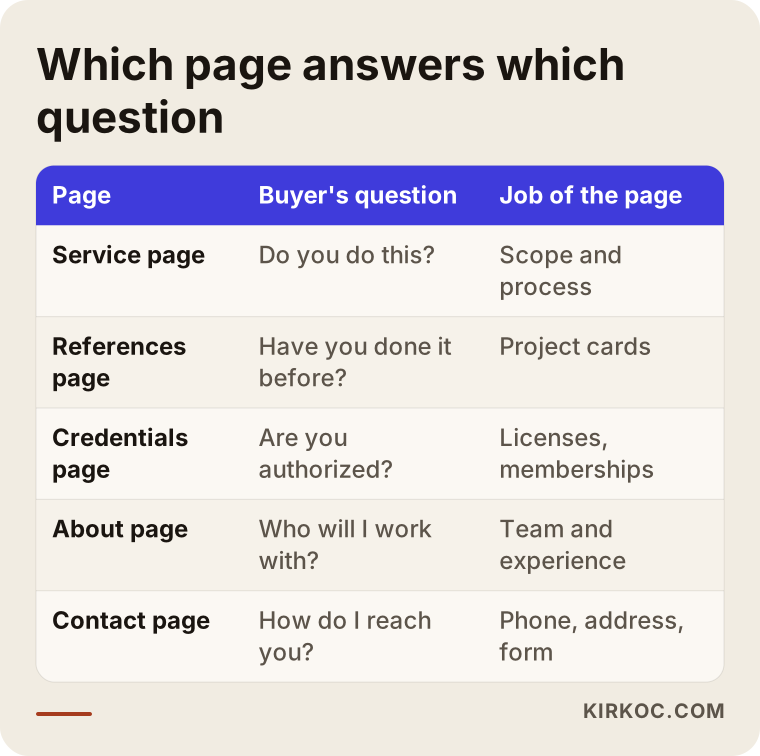
As you can see, every page has one job. The service page answers "Do you do this?" The references page answers "Have you done it before?" The credentials page answers "Are you authorized?" The contact page answers "How do I reach you?" If one page tries to do all of that, it does none of it well.
A separate page for each main service
If your firm offers five main services, you should have five separate pages. On each one, I suggest answering these questions. What exactly does this service cover? What types and sizes of projects do you work on? How does the process run, what do you need from the client, and what do you hand over at the end? Which agencies, codes or standards do you work within? When you get into regulations and codes, and you are not sure of a detail, I recommend asking an attorney or the relevant professional body. A wrongly stated regulation does more harm than no statement at all.
The references page: the most visited, the least thought about
For a buyer, the strongest deciding factor is that you have done a similar job before. Yet many firms present their references as nothing more than a row of logos. A logo list looks reassuring, but it gives no information. Prepare a short card for each reference: the type of project, its location (if confidentiality allows), the part you were responsible for, when it was completed and, if the client agrees, a short quote. If your contract includes a confidentiality clause, you can use a general description such as "for a public agency" or "for an industrial facility" instead of the client's name. Check your contract on this point, and if you are unsure, ask an attorney.
The path that leads a buyer to contact you
A B2B buyer does not usually reach out the first time they visit your site. They look around, compare, and maybe show your page to a colleague. You should build the path with that in mind. The graphic below shows it as a funnel.
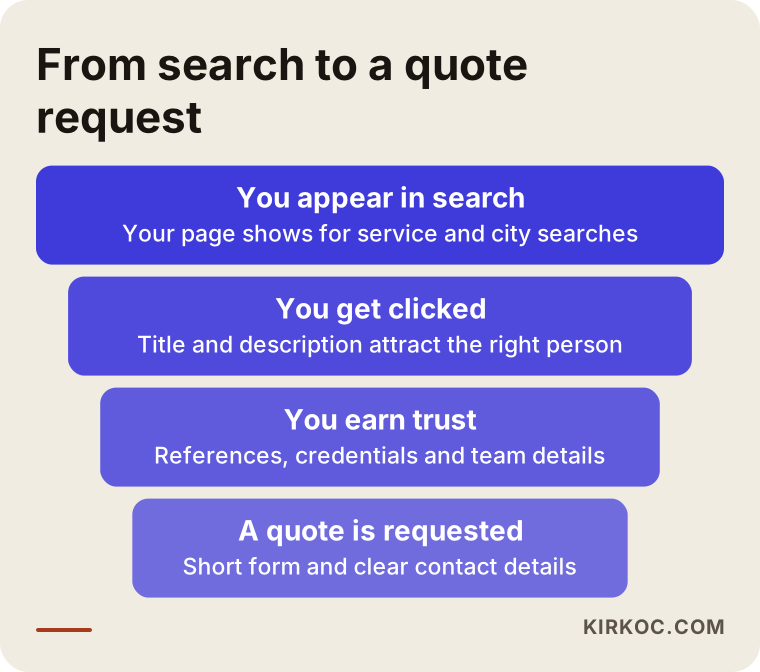
Each layer of the funnel does a different job. At the top is being visible, meaning showing up in search. Below that is getting clicked: the title and description need to attract the right person. Then comes trust: references, credentials, team details. At the bottom is contact. Most firms focus only on the bottom and leave the upper layers empty, then complain that nobody fills out the form. But anyone who fills out the form has to get through the first three layers first.
What should a quote request form look like?
If the form is long, nobody fills it out. Keep it short: name, company, phone or email, and a box where they describe the project. If you like, add one extra field such as the approximate project location. Directly beneath it, state when you will respond. For a large buyer, a sentence like "We reply within 24 hours" influences the decision about as much as a long form does. Make sure you can keep the response time you promise. If you can't, don't write it.
How is a service page built?
Instead of theory, I want to show you a concrete outline. The graphic below, using a made-up web address, shows the sections of a well-built service page.
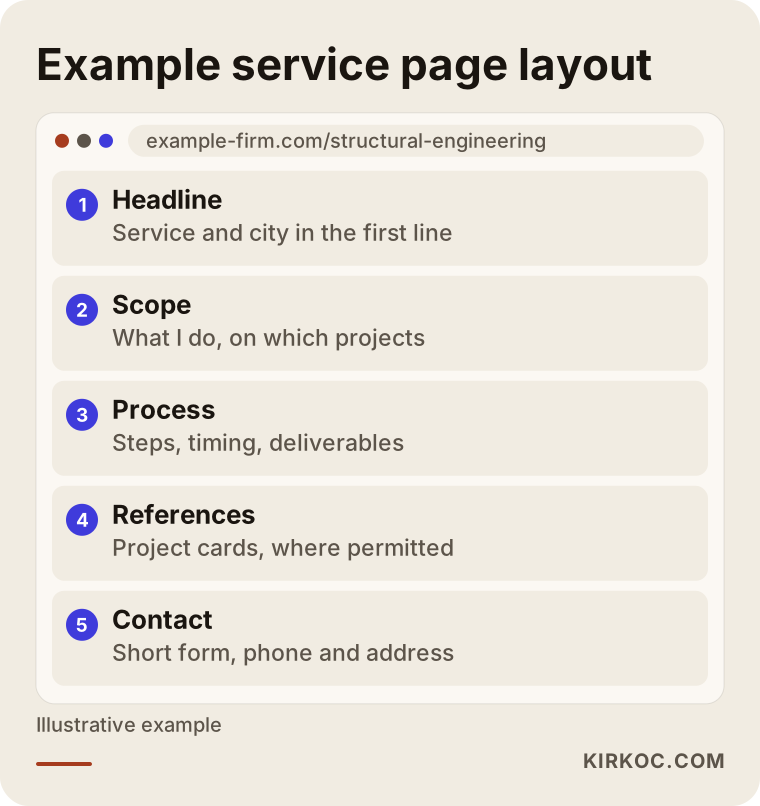
The thing to notice in this layout is that the first screen of the page includes the name of the service, the city and who it is for. The middle of the page covers scope and process, the lower part has references and common questions, and contact sits at the bottom. As a reader moves down the page, they think in this order: "I'm in the right place, these are the things they do, here is how they do it, they've done it before, and here's how to reach them." If your page breaks that order, the reader gets the impression of disorganized work.
There is no strict rule on page length. Still, a service page of a hundred words does not give a serious buyer enough information, and it does not tell the search engine much either. For each main service, aim for at least a few hundred words of real writing that is specific to your firm. Sentences borrowed from another firm's site hurt you with both the buyer and the search engine.
Example scenario 1: A consulting firm that is strong in one city but invisible online
This is a hypothetical example and does not describe a real firm. Say a project consulting firm has provided construction inspection and oversight in one city for years. Nearly all of its work comes from people who know it. Its website was built eight years ago and is a single page of company introduction. The owner gets a call from the purchasing department of a large developer and hears, "We couldn't see any projects on your site."
The first job here is not a new website but organizing the information that already exists. The firm has already done the work; it just isn't written down anywhere. The first step is to pick the projects from the last five years that it is permitted to show and prepare a short reference card for each. The second step is to split the one-page introduction into three separate service pages and use the city name naturally in each. The third step is to build a separate page for licenses and professional memberships. The fourth step is to fill in the Google business profile (the free listing that appears on Google Maps and in search results) with the correct address and business hours.
I will not promise a result from this work, because rankings and the number of inquiries depend on competition in that city, on how much original content the firm can produce, and on time. But I can say this: a buyer who looks the firm up and checks it will now find something concrete on the site. That alone can prevent some conversations from being lost.
Example scenario 2: A narrow specialty described in general terms
The second example is also hypothetical. A small engineering office is genuinely good at one particular kind of survey and design work for industrial facilities. But its website opens with text that begins "for all of your engineering needs" and presents the office as if it does everything. The search engine can't work out what the site is about, and the buyer can't see the firm's real strength.
The fix is to narrow down. The office puts its strongest work at the front, builds a page dedicated to it, and explains its process, the types of reports it delivers and the kinds of facilities it works with. The other services stay in the background. Most business owners are afraid of this: "I'll lose the other work." In practice, the opposite tends to happen. When a buyer gets the impression of "this is the firm that really knows this job," they also feel comfortable writing about other work. A narrow but clear page brings in more work than a broad but blurry one. I am not offering that as a guarantee, but as a tendency I often see in this field.
The graphic below puts the two approaches side by side.
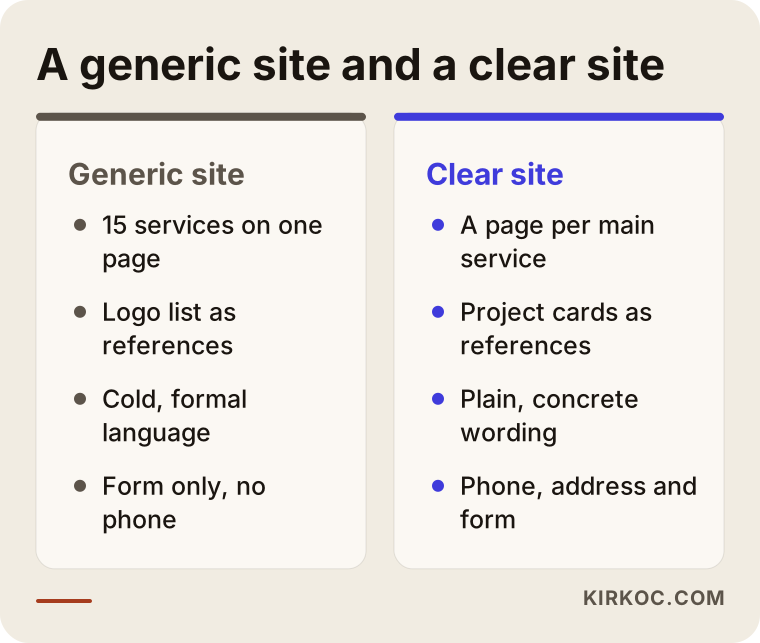
The left column is where most sites are today, and the right column is an achievable goal. Closing the gap does not need a new brand identity or a big budget. What it takes is for the firm to write down what it does as clearly as it already knows it.
The process, step by step
Let me summarize in five steps how I run an SEO project for an engineering firm. The order matters, and skipping a step weakens the ones after it.
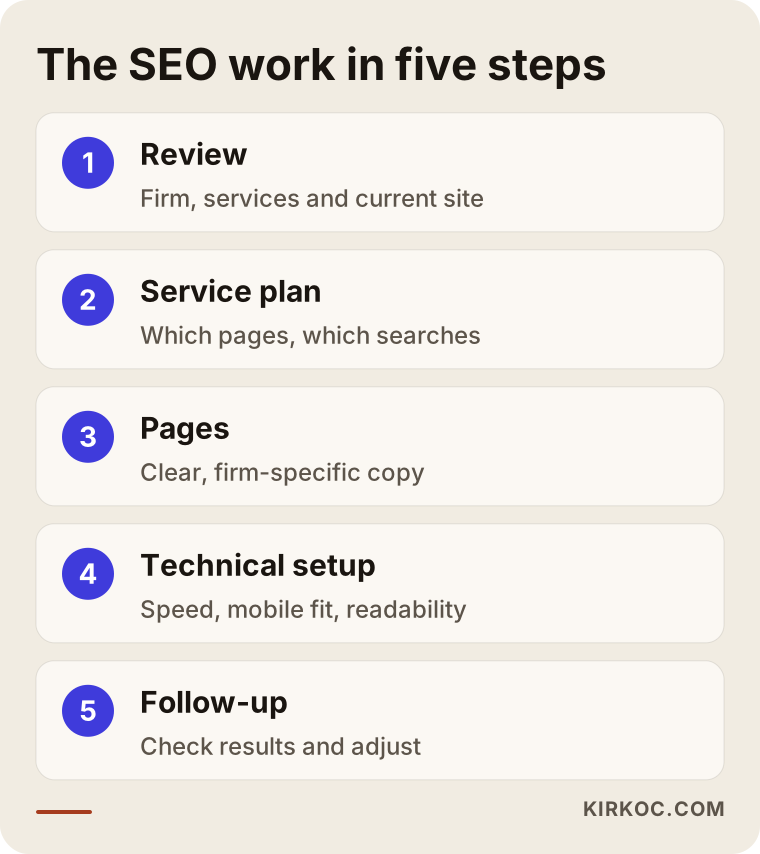
In the first step I look at your current site and your firm: which services actually bring in profit, who is searching for you, and what your site says today. In the second step, together with you, I decide which services get their own page and which searches to target. In the third step I write the pages, or edit the text you have written; the technical knowledge comes from you, and the language and structure come from me. In the fourth step I check the site technically: speed, how it looks on a phone, a secure connection, and whether search engines can read the site. In the fifth step I track the results, see what is working and make adjustments.
Two technical notes specific to this field
The first is the heavy use of PDFs that I see on engineering sites. Many sites hide their service information inside a downloadable brochure instead of putting it on the page. Search engines can read PDFs, but they give them weaker signals than a regular page, and buyers often don't want to download anything. Put the important information on the page itself and offer the PDF as an extra. The second is project photos. Large, heavy images slow the site down, and a slow site frustrates both buyers and search engines. Resizing the images and writing a meaningful description for each one looks like a small job, but it makes a difference.
Common mistakes
There are mistakes I see over and over in this field. I have collected them in the graphic below and will explain them briefly afterward.
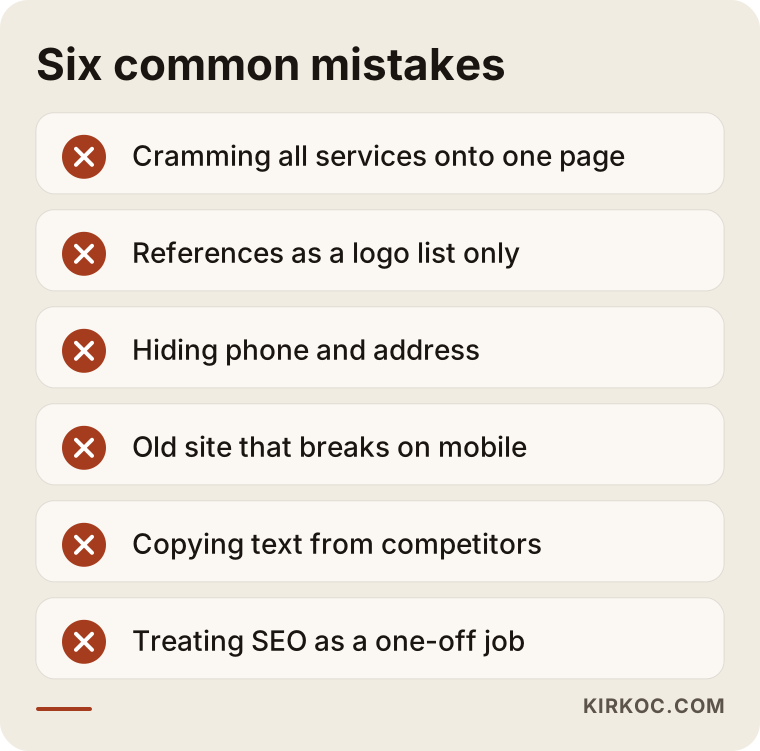
The first mistake is cramming everything onto one page. The second is reducing references to a logo list. The third is hiding contact details: some firms put up only a form, with no phone number or address. A corporate buyer who can't see an address and phone number begins to doubt that the firm is real. The fourth is leaving the site on an old design; a site that looks broken on a phone damages the impression of a serious firm. The fifth is copying text from competitors, which is not ethical and which search engines can also detect. The sixth is thinking of SEO as a one-time job; the work is not finished the day the site goes live, and it needs updates along the way.
Let me add one more: the habit, carried over from the bidding and specification world, of writing in a formal, cold voice. Sentences like "Our company, a leading organization in the industry..." say nothing. If you write the same information as "I prepare these kinds of studies for these kinds of facilities, and the report is delivered in this timeframe," it is both more believable and easier to find.
How long does it take?
This takes patience, and I should say so up front. After new pages are published, it takes time for the search engine to notice them, evaluate them and rank them. The exact time depends on the age of the site, on competition and on the quality of the content, and I cannot give a fixed number. The graphic below shows the general flow as a timeline; keep in mind that the timing is approximate and varies.
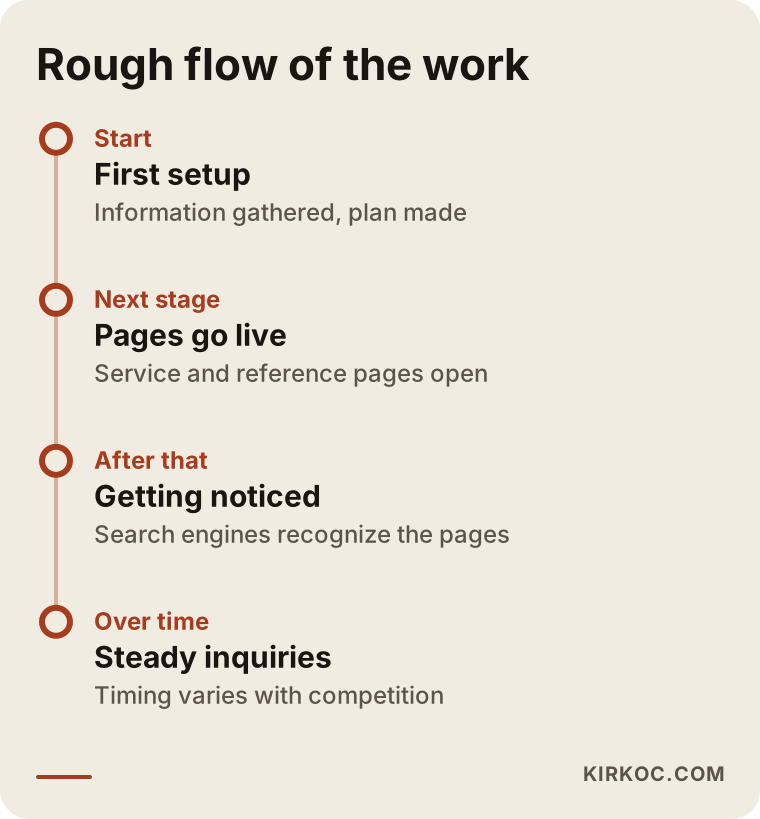
The most important point on the timeline is this: the first effect usually shows up in searches for your company name and your credentials, which are the third kind of search. The effect on service and city searches comes later. Because bidding and procurement cycles are long anyway, the return from SEO in this field does not show up as a sudden jump. It shows up, after a few months, as more regular quote requests.
What can you do yourself?
You do not need an expert for everything. The checklist below covers the things you can do on your own before you contact one.
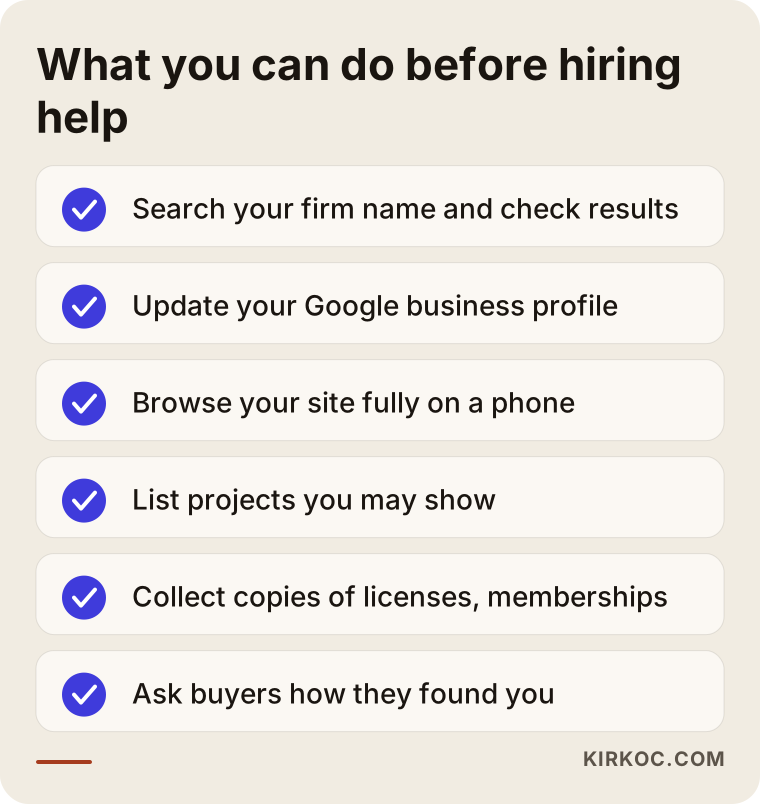
Let me expand on the list in a few sentences. Search for your company name on Google and see what comes up. Are your address, phone number and business hours correct? Do you have a Google business profile, and is the information current? Open your site on your phone and click through your main service pages. Does anything look broken? Make a list of the projects from the last five years that you are allowed to show. Gather up-to-date copies of your licenses and memberships. This preparation speeds things up if you do work with an expert, and even if you don't, it will improve your site.
Also talk to your own clients. After your last two or three wins, ask the buyer, "How did you find us?" The answers you get are worth more than anything I or any other specialist could tell you about what is missing from your site.
When do you need an expert?
In some situations you can go ahead on your own, and in others you will lose time. The simple decision chart below draws that line.
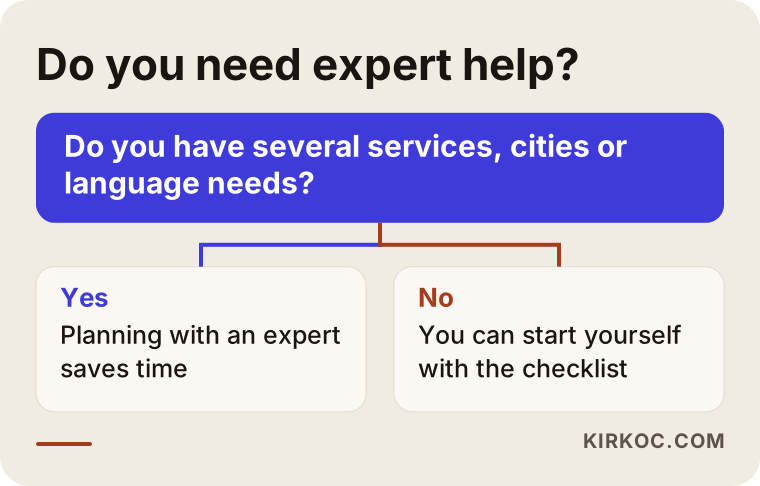
If your site is small, you have only one or two services and you have time to write, you can start with the items on the list. If you have several services, several cities or buyers who speak another language, or if the site has technical problems, expert support saves time. Planning which page serves which search is hard to undo once it has been set up wrongly.
What drives the cost?
I will not give a number, because no two firms have the same needs. But I can tell you clearly what makes the price change. The first is how many main services need pages. The second is the condition of the current site: will it be built from scratch or fixed? The third is how many languages you publish in; pages in a separate language for foreign buyers mean extra work. The fourth is who writes the content; if you provide the technical information and I write the text, the cost differs from a case where I only edit. The fifth is whether the work is a one-time project or an ongoing service with regular follow-up. When you collect quotes, ask the other side these five questions too. A quote that does not answer them, or that ties everything to a single price, should be read with care.
Also be skeptical of offers that say "we'll get you to page one" or "we guarantee this ranking within this timeframe." The search engine decides rankings, and no specialist can decide them alone. An honest quote states what will be done, when it will be delivered and what will be measured. It does not guarantee the outcome.
How I work with you
I work alone. That means the person who talks to you is the person who does the work. That is an advantage in one way: there is no middleman and no loss of information, and when you pick up the phone you are speaking to someone who knows your project. It also has a limit: I cannot take on many projects at the same time. So I start with a short conversation, and together we decide whether your project is a good fit for me. If it isn't, I will say so plainly.
I usually begin by reviewing your current site and your services. Then I share in writing which pages are needed, which will be fixed, and in what order I would proceed. As the work is completed I show it to you, and everything goes through your approval. The technical knowledge stays with you, and I translate it into language your buyer understands. On matters that are legal in nature, such as regulations or contracts, I will always say that your attorney should be consulted.
Frequently asked questions
Do I really need SEO for an engineering firm if my work already comes from contacts?
Work that comes from contacts is often verified by looking at your website. If your site is weak, even being the firm someone recommended can cost you the decision. SEO also makes you visible to buyers who do not know you at all. If your network works well, think of SEO as something that sits next to it, not something that replaces it.
Can I catch bid announcements with SEO?
Bid and tender announcements are published through official channels, and SEO is not a substitute for them. What SEO does is make you visible to private-sector buyers outside the bidding process, and to organizations that research you during one. A firm that submits a bid is judged on its file and also on its trail online, and your site strengthens that trail.
My site is new. How long until I see results?
I cannot give an exact time. With a new site, it takes the search engine a while to get to know it, and the time varies with competition. The effect shows up earlier in searches for your company name and later in searches for services and cities. Read any offer that guarantees results with care.
I work in several cities. Do I need a separate page for each one?
If you really serve each city and can show examples from projects there, then yes, a separate page makes sense. But changing only the city name and duplicating the same text does not work and can hurt you. If you have no real information specific to that city, don't create the page.
Should I also publish in another language?
If you have buyers abroad or work with foreign partners, yes, having your service pages separately in that language helps. Instead of relying only on automatic translation, make sure the technical terms are translated correctly. You may want to get help from a specialist on that as well.
I can't show my references because of confidentiality. What should I do?
You can still give information without the client's name: the type of project, its scale, your role and the year. Check the confidentiality terms in your contract, and if you are unsure, ask an attorney. If you can't share anything, bring forward other trust signals such as your credentials, your working process and your team's experience.
Do social media and LinkedIn replace SEO?
No, but they complement it. LinkedIn is a good place for corporate buyers to verify a firm, and it may appear in searches for your company name. For service searches, though, the pages on your own site are what count. The information in both places should be consistent.
What should I prepare to get started?
A short list of your services, a few summaries of projects you are allowed to show, your licenses and credentials, and access to your site are enough. I will help you fill in any gaps during our conversation.
If you want your site to earn a buyer's trust and turn into quote requests for your engineering, project or consulting firm, you can look at how I work on my SEO services page and briefly describe your project through the contact form. First we will talk honestly about what can be done and what is not needed.