Your portfolio is beautiful and your projects photograph well, yet new clients still come almost only through referrals. If you have ever wondered why someone searching "interior designer near me" never finds you, this article is for you. I'll explain what search engines can and cannot see in a visual business. For a closer look at how I work, you can read about my SEO services.
Google sees your photos but does not understand them
An interior design project says a lot to a person: light, materials, proportion, balance. A search engine cannot read a photo that way. It looks at the words on the page, the headings, the file names and the alt text to decide what the page is about. If a project page holds ten photos and one line reading "apartment project," Google has almost nothing to match it with the right searches.
Clients also want more than pictures. How was the budget handled? Whose idea was the layout? What happened when something went wrong? A good project page answers these questions for the search engine and for the person deciding whether to call you.
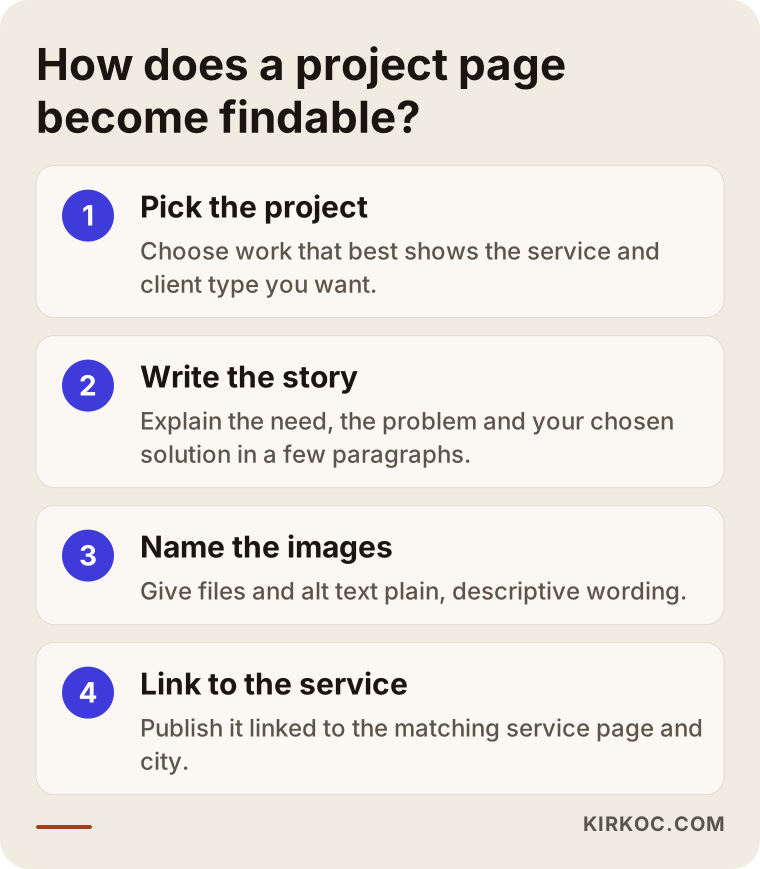
Give each project page a story
Create a separate page for each project and add a short, honest write-up next to the photos. It does not need to be long; a few paragraphs are enough. Cover these points:
- What did the client need (a family with kids, a couple working from home, a small office)?
- What was wrong with the space (a dark hallway, too little storage, a poor layout)?
- Which solution did you choose, and why?
- How did the process run: measuring, concept, build, handover?
This sharpens the page topic and shows the client how you think before you ever meet. Name your image files and write alt text too: "living-room-walnut-tv-unit" helps far more than "IMG_4521." Never publish a client's address or personal details without their permission.
Cover each service and each city on its own
People rarely search for "interior designer" alone. They search for what they need: "apartment renovation design," "kitchen design," "office interior," "villa interior design," often followed by a city or neighborhood. One home page that tries to say everything will be strong at nothing.
Write one plain page for every service you really offer: what you do, how you work, what the stages are, and which areas you cover. Link the matching projects to it. Only list places where you actually work; pages that claim work you do not do break trust and rarely help in the long run.
If you have a studio or office, complete your Google Business Profile with the right category, opening hours and real project photos. For local searches it often appears before your website does. I covered similar principles for a neighboring trade in my article on SEO for architecture and construction firms; interior design simply tends to be more visual and more personal.
Two different studios, two different starting points
The right fix is not the same for everyone, so let me describe two situations I come across often. I leave out names and numbers; the point is the approach.
A small studio doing home renovations
A small interior design studio that mostly renovated apartments came to me. Their Instagram account was well kept, but the website was a one-page portfolio: a logo on top, a grid of photos, a phone number at the bottom. The owner said nearly all work came by referral, and that quiet months were hard to fill with new clients.
The first thing I checked was which searches the site could answer. Almost none. The words "apartment renovation" or "kitchen design" appeared nowhere, and no project had its own page. Together we first settled on the work the studio truly wanted more of, then moved their three strongest projects onto separate pages with their story: the client's need, the problem with the space and the solution chosen.
The outcome was measured. For the first months nothing visible happened; then the site began to show up reliably for searches on the studio's own name, and later the service pages slowly entered the rankings. The inquiries changed in quality too. Instead of "I like your photos," people wrote, "you did a flat like ours, how did you handle the budget?" There is no guarantee in any of this, but the direction was right.
A studio working on offices and shops
The second example is a studio focused on commercial spaces such as offices, cafés and boutiques. The decision maker here is usually a business owner or manager. They care less about photos and more about whether the job will run smoothly, whether the budget will hold and whether the business will be disrupted during the build. The studio's stylish Instagram posts answered none of that.
So the language of the project pages changed. Besides how a space looks, we wrote how it improved the way the space works: customer flow, comfort for staff, how the build was managed around daily operations. On the "how I work" page we spelled out the handover and approval steps. Again, no guarantee, but the first question in new conversations shifted from "how much?" to "how would you run this for us?" For commercial clients, trust comes from the process before it comes from the photos.
What should a good service page contain?
A service page is where someone searching "apartment interior design" or "office design" meets you first. Think of it less as a shop window and more as a page that answers questions. When visitors leave, they should know what you do, how you do it and whether you fit their situation.
What belongs on the page
- What the service is and who it suits, in plain language.
- The kinds of spaces you work on: homes, offices, shops, cafés.
- A short outline of your process and the areas you cover.
- Your two or three strongest projects for this service, linked.
- The factors that shape the price and a clear way to get in touch.
Small details that matter
Use your client's words in the heading. Instead of a polished line such as "aesthetic solutions for living spaces," a plain heading like "Apartment interior design and renovation" speaks more clearly to people and to search engines. If you use trade terms such as concept design, construction drawings or custom joinery, explain them in a sentence; most clients are hearing those words for the first time.
Why reviews and references matter
Interior design runs on trust. Clients hand over their home or business, so they pay close attention to what others say. Asking a few happy clients for a short review helps on your Google Business Profile and on your website.
Ask at the moment the project is delivered and the client is pleased. A short, polite message is enough; rather than saying "write anything," you can mention topics they might cover, such as the process, communication, staying on budget and the result. Never buy or invent reviews. That breaks platform rules and, once noticed, damages your credibility.
Answer a negative review calmly and plainly too. Prospective clients often look less at the review itself than at how you behaved when something went wrong. Showing approved references next to the matching project and service pages also makes the decision easier.
The risk of relying on Instagram
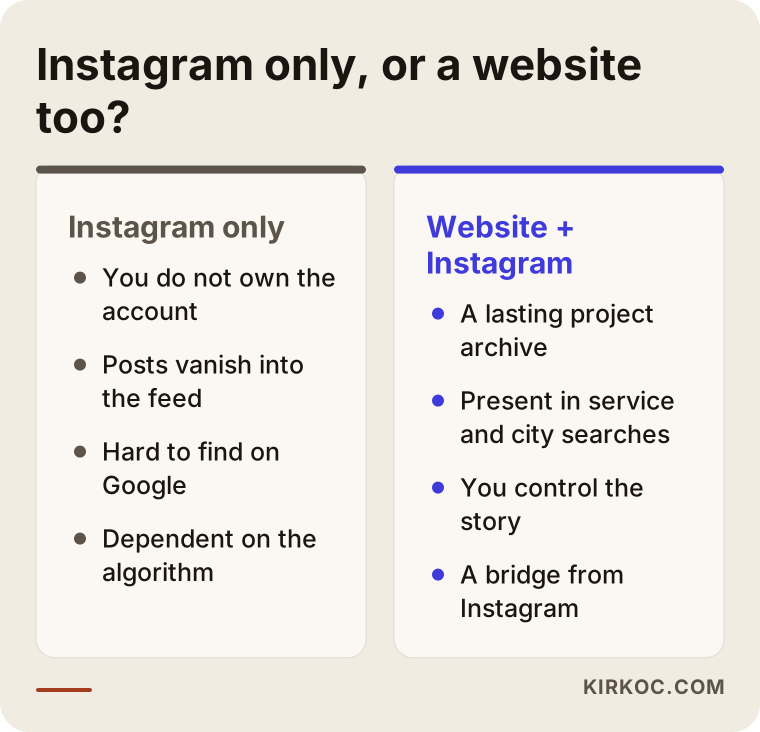
Most interior designers show their work on Instagram, and that makes sense, because visual work thrives there. But relying on it alone carries four risks:
- You do not own the account. It can be restricted, suspended or hacked.
- Algorithms change. A post that reached a hundred people yesterday may reach ten tomorrow.
- Posts disappear into the feed. Nobody can find your great project from three years ago.
- Search intent differs. People browse Instagram for inspiration, but they use Google when they need to hire someone.
This does not mean you should leave Instagram. Think of Instagram as your shop window and your website as your home. Publish the projects you show on Instagram on your site, with their story, and link in both directions. A post that gets attention then becomes a lasting page.
Describing your process builds trust
Interior design is close to a client's home, budget and taste. Before deciding, people think less about the photos and more about "what would it be like to work with this person?" A plain page on how you work eases that worry:
- What happens in the first meeting?
- How long do the concept and measuring stages take?
- Who manages the build, and do the tradespeople come from you or from the client?
- How do payments and approvals work?
You do not have to list prices, but explaining what shapes the price (floor area, material choices, custom joinery, scope of the build) cuts down on wasted calls and attracts the right clients. A page like this also answers common questions, so it can show up in search results and AI summaries on its own.
What does a visitor look for first on your site?
When someone lands on your site from Google, they have very little time to decide. They glance at the photos, then look for answers to three questions: Does this person do what I need? Can I trust them? How do I reach them? Your site should answer all three on the first screen or after a scroll at most.
A clear place and service sentence
At the top of the home page, say in one sentence what your studio does and where. For example: "Residential and office interior design in Manchester." A tagline can be lovely, but visitors cannot enjoy it before they understand your trade.
Proof and contact
A few strong projects, a short introduction and a real face build trust. Even a photo of the team or a frame from your work setting makes a difference. Do not hide the way to reach you: phone, email and a short form should be easy to find at the bottom of every page, so a client who wants to call you never has to hunt for it.
Test it on mobile
Many visitors arrive on a phone. Open your site on your own phone: can you read the text, tap the buttons comfortably, do the photos open quickly? It takes five minutes and often shows surprises. A project page that is hard to read on a phone loses a good share of visitors however fine it looks on a desktop, so always check changes on mobile too.
If you work with me, how the process runs
If you are considering hiring me for this, you will want to know what to expect. The order is usually this.
Getting to know you and where you stand
First we talk about your studio, the services you offer and the kind of client you want. Then I look at your current site, your Google Business Profile and your Instagram account. I work out how a search engine sees you today and which pages already do their job.
Setting priorities
Doing everything at once is neither possible nor necessary. Together we choose which service and which projects come first. I usually start with the service you most want to grow and the projects that prove it best.
Building the pages
Then comes the structure and writing work: service pages, project pages, headings and image names. I try to keep your own voice in the text, because the client will work with you, not with me. I need project notes, short stories and the clients' permission to publish from you.
Publishing and measuring
Once pages go live, I check for technical problems and make sure the search engine can find them. In the following months we look at which searches you appear for and how good the inquiries are. Results cannot be guaranteed, but by seeing what works we can change direction.
A checklist before you publish a project page
Even if you work on your own, ask these questions before publishing a project page:
- Does the title name the type of project and its place (at neighborhood level)?
- Does the first paragraph describe the client's need and the problem with the space?
- Is the reason for your chosen solution written down?
- Are the image file names and alt texts descriptive?
- Do you have the client's permission to publish?
- Does the page link to the matching service page?
- Is there a clear way for visitors to contact you?
- Do the photos load quickly on a phone?
Let me stress the last point. Interior design sites carry many photos, and heavy photos slow a page down. Neither visitors nor search engines like a slow page. Reducing the file size before uploading is one of the easiest improvements you can make.
What you can do yourself and what to leave to a specialist
You do not need a consultant for everything. Knowing what you can handle protects your budget and keeps you in charge of the work.
What you can do yourself
- Write the project stories: you know the project best.
- Name photos consistently and reduce their file size.
- Keep your Google Business Profile current, add new project photos and answer reviews.
- Ask happy clients for a review and for permission to publish.
- Link from your Instagram posts to your website.
What to leave to a specialist
- Planning the site structure: which service goes on which page and how the pages link together.
- Technical checks: indexing, speed, mobile fit, faulty redirects.
- Deciding which searches to aim for and separating those that bring real clients.
- Setting up measurement and interpreting the results.
- Protecting existing visibility when a site is rebuilt.
A simple split: the spirit of the content is yours, the engineering of structure and measurement is the specialist's. If your budget is tight, you can take the first step entirely on your own; fixing things later is easier than pulling apart a structure that was built wrong from the start.
Common SEO mistakes interior designers make
I see a few mistakes again and again, and most are made with good intentions. Knowing them early saves you time.
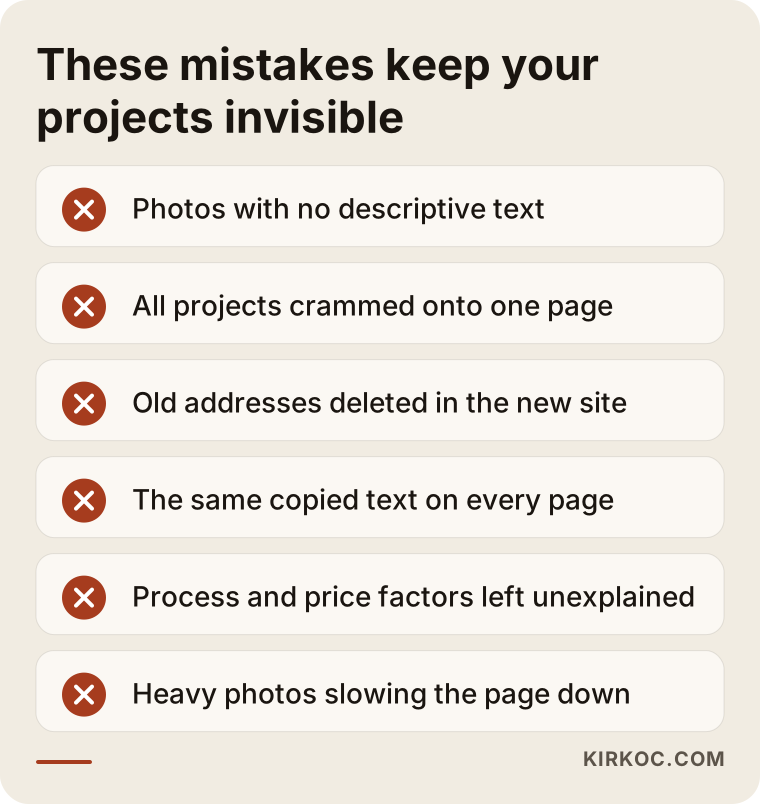
Posting the photos and forgetting the words
This is the most common one. The page is visually stunning, yet it holds not a single line a search engine can read. A few paragraphs of real description are often enough.
Putting every project on one page
Stacking dozens of projects under one "Portfolio" page looks practical. But then no project can answer its own search. Your important projects deserve their own pages.
Deleting old addresses when the site is rebuilt
If old page addresses are not kept or properly redirected during a rebuild, visibility built over years can vanish in a day. Before switching, list the old addresses and decide where each one should go.
Copying the same text everywhere
Writing service pages that are near copies of each other, especially multiplying pages district by district, looks like an easy shortcut. Search engines and readers notice. If nothing truly sets a page apart, do not create it.
Hiding the process and the price factors
You do not have to publish prices, but you do not have to hide everything either. Explaining how floor area, materials, custom joinery and the scope of the build affect the price reduces conversations that start from the wrong expectations.
What to expect, and what not to
To be honest: SEO results cannot be guaranteed, and they do not come fast. It can take months for a search engine to recognize a new site or updated project pages. But a well-built project archive adds up over time, and every new project becomes another way in, on Instagram and on your site. A realistic start looks like this: your site becomes clearer about what you do, you show up more reliably for searches on your own name, and service pages slowly begin to rank.
I would measure success by how many good inquiries arrive, not by clicks. For a design studio, a few right clients beat many wrong visitors.
Frequently asked questions
I only have Instagram. Can I still start?
Yes, but Instagram alone does not feed search engines. A small, plain site with three or four well-told project pages is a solid first step.
Do I need to publish every project?
No. Pick the projects that best represent the services and clients you want. A few well-told projects beat many silent photos.
Should I share the client's name and address?
Not without their permission. A neighborhood-level mention is usually enough, and a strong story needs no personal details.
Do I have to blog?
No. Service and project pages come first. Later, turning common client questions into articles can help.
Is it better to fix my current site or build a new one?
First look at what already works on the current site. If the page addresses and content are sound, fixing is usually the less risky route. If the site is technically very old or cannot be edited, rebuilding makes sense, but then keeping the old addresses is essential.
Is a Google Business Profile enough on its own?
It works very well for local searches, but it is not enough alone. The profile makes you findable; your website explains your projects, your way of working and your credibility. The two complete each other.
When will I see results?
I cannot give an exact time; it usually takes months for new pages to be recognized. The state of your site, the competition in your area and the quality of what you publish all change that. It is healthier to expect steady accumulation rather than a quick leap.
Will AI tools recommend an interior designer?
Sometimes. These tools also draw on clear, well-organized and trustworthy information found on websites. A site that explains your services, the areas you work in and your process plainly helps in that respect too. But nobody can guarantee who gets recommended.
Do I need pages in another language if I serve international clients?
Yes, if you truly target those clients. A foreign buyer searches in their own language. Instead of text that smells of translation, a few pages written naturally in that language, explaining your service and area, are often a good start.
Do I have to hire a professional photographer?
Not necessarily, but it makes a difference. A few well-shot photos are worth more than many careless ones. If your budget is limited, have your strongest projects photographed and leave the rest for later.
Where to begin
List your services, then rewrite your three best projects with their story. After that, build a bridge from Instagram to your site. If you would rather not do this alone, or want to decide together which page matters most, you can reach me through my SEO services page.