When something changes in a person's eyesight, they search before they call: "eye doctor near me," "who is a candidate for laser eye surgery," "is cataract surgery scary." If your practice never shows up for those searches, that person books with someone else. I work on my own as an SEO consultant, and here I explain what a sound setup looks like; for the wider picture, see my SEO services page.
In eye care, the decision usually has two stages. First the person researches a procedure, then they ask who should perform it. You need to be visible at both.
What are patients actually searching for?
Eye clinic searches fall into three groups:
- Procedure searches: laser correction, cataracts, strabismus, dry eye, children's eye exams.
- Worry searches: "what happens after surgery," "how long is recovery," "will I need time off work."
- Local searches: "eye doctor near me," "ophthalmologist in [neighborhood]," "urgent eye exam."
Each group needs a different page. One catch-all "our services" page answers none of them well.
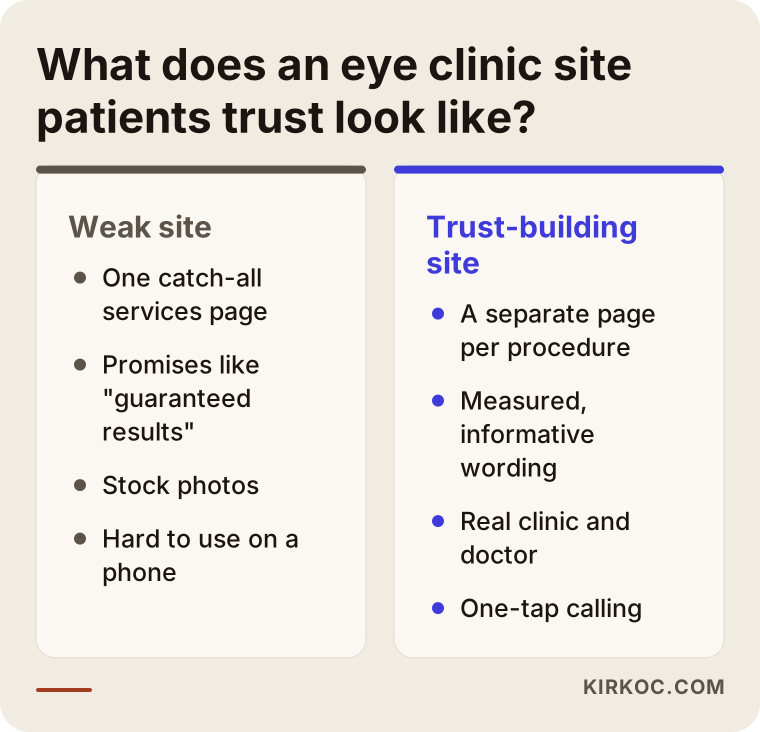
One honest page per procedure
Your site should have a page for laser, another for cataracts, another for pediatric eye care, and so on. Each page should answer a patient's questions in order:
- What is the procedure, and when is it discussed?
- How does the first visit start, and what gets assessed?
- What do the day itself and the recovery look like?
- Who may not be a good fit, and who decides that?
- What is the next step to book?
There is a balance to strike. The page should inform, not promise. Phrases like "guaranteed results," "painless," or "risk-free" mislead patients and can also run into healthcare advertising rules. What you may say, and how, depends on your professional rules and local regulations, so please check them yourself; I keep the writing plain and measured accordingly.
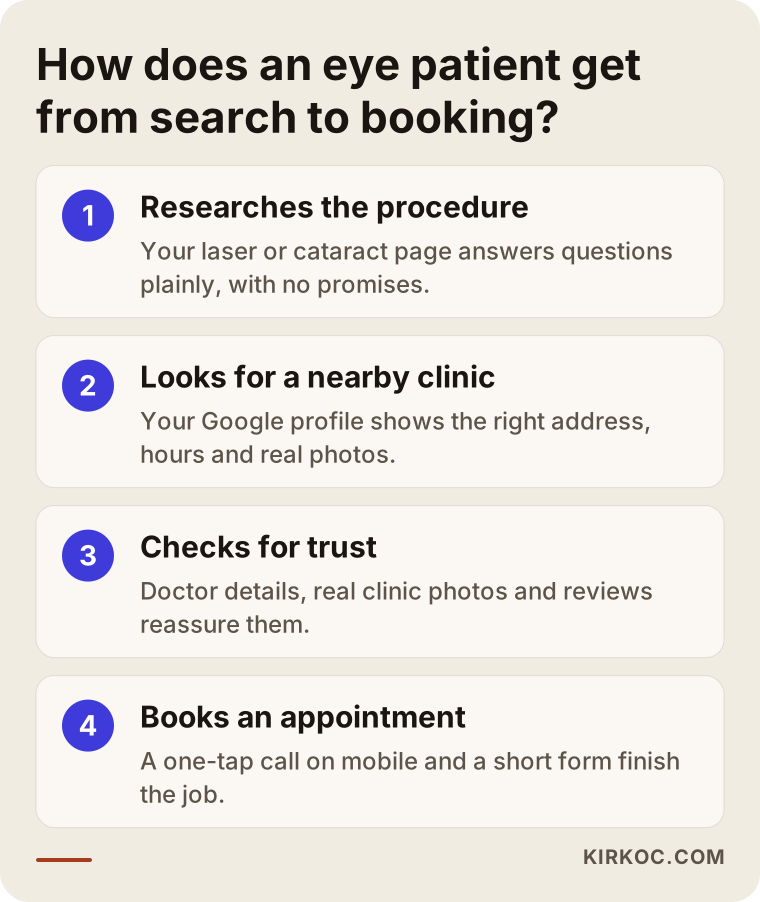
"Eye doctor near me" searches
For local searches, Google favors businesses that are close to the person and look trustworthy. Three things matter most:
- Google Business Profile: correct address, phone, hours, specialties, and real photos.
- Consistent details: your name, address, and phone should match exactly on your site, your profile, and directories.
- Reviews: reviews patients leave voluntarily, answered respectfully and without revealing private details.
A caution on reviews: never share patient information in a reply, and never offer anything in exchange for a review. For more detail, read my guide on Google Business Profile optimization.
Which questions each procedure page should answer
Behind every procedure sits a different worry. Before you write the page, think about that worry; let the text answer it rather than read like an advertisement.
The laser page
Someone considering laser is usually curious about life without glasses or lenses, yet also nervous. The page should say clearly what the pre-assessment covers, under what conditions the procedure can be discussed, and why it may not suit some people. Describe recovery without exaggeration, in terms of getting back to daily life.
The cataract page
Cataracts typically come up later in life, so the reader may be the patient or a relative. Keep sentences short and the type large. Walk through preparation, the day itself, and follow-up visits in order. Give a calm, honest answer to "is it scary?"
The pediatric eye care page
The reader here is a parent, and parents are anxious. Cover when an exam should be considered, what a first exam is like for a child, and how a parent can prepare. A calm tone that eases the child's fear is especially valuable on this page.
Dry eye and discomfort complaints
These searches are often phrased in everyday words: "my eyes burn all the time," "screens make my eyes uncomfortable." Use those phrases on your page; a page that opens with medical terminology will not reach these people. But do not encourage self-diagnosis; if the complaint persists, point them to an exam.
Post-operative follow-up
Many clinics skip this stage. Yet a section that clearly answers "which symptoms mean I should get in touch right away" reassures patients and makes you credible. Write it with your doctor's approval, in general and responsible language.
Trust is everything here
Eyesight is among the most valued senses, so visitors look for signals:
- The doctor's name, credentials, specialty, and experience stated clearly.
- Real photos of the clinic and team; stock images weaken trust.
- A calm explanation of the exam and procedure process.
- Address, map, directions, and booking options visible at a glance.
- Guidance on who should be examined and when, with a clear "seek care immediately in an emergency" note.
Before-and-after photos, patient stories, and comparative claims are especially sensitive in healthcare. Check your rules before using them, and skip them if you are unsure.
How to write the doctor page
In eye care, patients look for the person as much as the procedure. The doctor page is the weakest page on most sites: two lines of title and a passport-style photo. Yet it can be one of the most-read pages.
Include:
- Education, specialty, and areas of work, in plain language.
- Which procedures the doctor is experienced in, without boastful adjectives.
- Their approach to patients and what they care about in an exam.
- A real, current photo.
- Professional bodies and institutions they work with.
This page also answers searches by the doctor's name. People often look up a doctor a friend recommended; finding a clean, current page shortens the path to booking.
Two clinics, two different starting points
The two examples below are general pictures inspired by real work. No names, no numbers, and I describe the results modestly on purpose.
A single-doctor practice focused on laser correction
An ophthalmologist came to me with a website that had one page called "Our Services." Laser, dry eye, and children's exams all got a few lines. The phone rang, but most callers asked things like "am I a candidate for laser?" and hung up without booking.
I started with search intent. Someone researching laser is not looking for a price first; they want to understand the process and whether they can trust the person: who evaluates me, what does the exam involve, who might not be a good fit. We built a separate laser page that explained the exam, the assessment steps, and a plain note that the final decision is made at the consultation. We never used phrases like "guaranteed results."
Then we fixed the Google profile: correct hours, specialties, and real photos of the practice. Over the following months, calls and form requests from visitors on the laser page rose noticeably, though I could not cleanly separate how much came from the page and how much from the profile. What I could see is that the callers changed. They arrived better prepared and asked sharper questions.
A multi-doctor center serving older patients
The second example is a center that treats many older patients. Here the decision was often made together with a family member. Picture an adult daughter searching "cataract surgery for my mother": she wants reassurance and simplicity, not technical detail.
The site had small text, hard-to-press buttons, and a phone number embedded in an image, so tapping it did nothing. We fixed those first: larger, readable text, a one-tap call button, a short form. Then we rewrote the cataract page in the order "before, the day itself, afterward" and added frequently asked questions for relatives.
Results came more slowly here because the area was competitive. But the quality of requests improved: fewer "I just want some information," more "I would like an appointment for this week." I share this as something I observed, not as a promise.
Patient questions are your most reliable traffic
People who walk into a clinic ask the same things again and again. Write them down: "Do I stop wearing contacts before laser?" "When can I work after cataract surgery?" "At what age should my child see an eye doctor?" Short, clear, responsible answers do two things. You appear in search results, and patients arrive at the exam better prepared. End each answer with a pointer such as "the final assessment happens during the exam."
For this content to be quoted in AI summaries as well, it has to be plain, clear, and consistent; my article on GEO for doctors and clinics goes deeper.
The technical side: patients will not wait
Someone with an eye problem often searches on a phone. Your site needs to load quickly, read well on a small screen, offer a one-tap phone number, and keep the booking form short. If the text is tiny and the buttons are hard to press, visitors with vision problems give up first. Accessibility here is not only a technical matter; it is respect for the patient.
How the work goes if you hire me
If you like to know the process up front, here is how I work. At no step will I hand you a report in language you cannot follow.
1. Introduction and current situation
In the first conversation I listen to how your practice works, which procedures matter most, and which patients you want to see. Then I look at your website, your Google profile, and how you appear in search results. This tells me where to start.
2. A priority list
Fixing everything at once is not realistic. I give you a plain list: which procedure pages first, which profile gaps, which technical issues. I also write down why each item matters.
3. Building the pages and the profile
I organize the procedure pages, the doctor page, and your contact details in your patients' language. I avoid promise-style wording, but you always have the last word, because only you know which phrasing fits your professional rules.
4. Measuring and adjusting
After launch, I track which searches bring visitors and which pages lead to calls or forms. A page that does not work gets rewritten; one that does gets reinforced.
5. A regular, plain report
I do not fill reports with jargon. I answer three questions: what was done this month, what changed, and what comes next. I cannot guarantee results, but you can always see what was done and why.
Checklist: is your site ready to welcome a patient?
You can tick this list yourself. If more than three items are missing, it makes sense to start there:
- Every main procedure has its own page.
- Each page explains the exam, how suitability is assessed, and the booking step.
- The doctor's name, title, and specialty are clearly stated.
- Photos of the clinic and team are real.
- Address, map, hours, and phone are easy to find on every page.
- Tapping the phone number on a mobile starts a call.
- The booking form is short and asks for only a few fields.
- Your Google profile matches the website exactly.
- An "in an emergency, seek care immediately" note is visible.
- Wording that could conflict with healthcare advertising rules has been reviewed.
How to look at the clinics around you
Study them not to copy, but to see through the patient's eyes. Search for "eye doctor" plus a procedure name in your area and click the first-page results like a patient would.
Ask yourself: Which page answered my question most clearly? Which one reassured me, which overwhelmed me? Which was easiest to use on a phone? This view can also reveal a gap: if no clinic explains post-operative follow-up, that is an opportunity for you.
The goal is not to write more than everyone else but to answer the patient's question more clearly. One page can be short and clear, another long and scattered; patients always choose clarity. This also shows how crowded your area is, which helps you keep expectations realistic and set your patience.
What should we measure?
Rankings alone say little. I look at which searches bring visitors, which pages lead to calls or booking forms, and how many calls and direction requests come from your Google profile. This shows which procedure page works and which needs rewriting. A report should speak plainly: did this page bring more appointment requests this month?
It also helps to ask each new patient how they found you. One sentence at booking shows, by the end of the month, which channel is paying off.
After the appointment: the same patient searches again
In eye care, the relationship does not end after one visit. Post-operative checks, yearly exams, bookings for other family members: patients come back to you again and again. Your site has to welcome them too.
A few small additions make a big difference. For existing patients, prepare a short page that answers "how do I change my appointment," "what should I bring to a check-up," and "should I wear contacts before the exam." It tells new visitors that this is a well-run place, and it reduces your phone traffic.
When a satisfied patient recommends you to someone, that person looks you up online first. A clean profile and website in searches for your clinic's name can win a new patient on their own. Search your own name once, through a patient's eyes, and see what comes up.
Common mistakes
I see the same mistakes in eye clinics again and again. Most come not from bad intent but from "everyone does it this way."
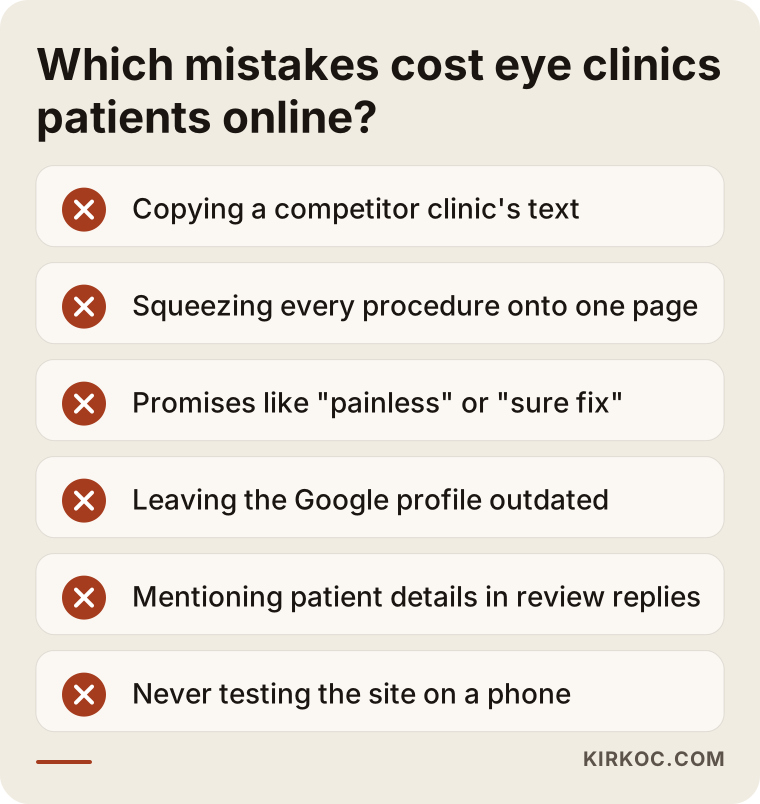
Copying a competitor's text
Publishing a slightly edited version of another clinic's procedure page looks easy. But identical text makes you indistinguishable, and if a claim in it breaks the rules, the responsibility is yours. Describe your own exam process in your own words.
Putting everything on one page
When laser, cataracts, and children's exams share one page, every search gets half an answer. Patients who cannot find what they came for leave.
Using promise language
"Painless," "no risk," and "sure fix" look attractive in the short term. They also mislead patients, damage trust, and can run into healthcare advertising rules.
Leaving the Google profile half done
Old hours, a wrong phone number, no photos. In local search, this profile is often seen before your website is.
Ignoring reviews, or answering them badly
Unanswered reviews suggest indifference. On the other hand, mentioning a patient's treatment in a reply is a privacy problem. Say thank you and respond in a calm, general way.
Treating mobile as an afterthought
Testing the site on a desktop and never on a phone is the easiest way to lose visitors who have eye problems.
What you can do yourself, and what to leave to a specialist
You do not need to outsource everything. Knowing what you can handle also eases your budget.
What you can do yourself
- Keep hours, phone, and address on your Google profile current.
- Take real photos of the clinic and team and add them.
- Collect the questions you hear most from patients in one document.
- Politely share a review link with satisfied patients.
- Ask "how did you find us?" when booking appointments.
What to leave to a specialist
- Structuring procedure pages around search intent and arranging internal links.
- Finding technical problems such as speed, mobile layout, and indexing.
- Measuring which searches turn into appointments.
- Structuring content so it is quoted correctly in AI summaries and search results.
For healthcare content, final approval is always yours. As a doctor you decide what may be written; I prepare the text plainly and modestly within that frame.
Keeping expectations honest
No one can guarantee SEO results. For a new clinic or new pages, the first meaningful movement usually takes months, and longer in crowded cities. What I can do is build the right pages, organize your profile, write in your patients' language, and report openly on what works. Be careful with anyone who promises rankings.
Frequently asked questions
Wouldn't ads alone be enough?
Ads bring quick visibility but stop when the budget does. Healthcare ads may also face platform and legal limits. SEO builds a slower but lasting base, and the two can work together.
What should I do about patient reviews?
You can politely share a review link with satisfied patients. Offer nothing in return, and never include personal health details in replies.
Which pages come first?
For most clinics: the main procedures, a doctor page, contact details, and the Google profile. Patient-question content follows.
When do the first results appear in eye clinic SEO?
For new pages, the first meaningful movement usually takes months, and longer in crowded cities. I cannot give an exact timeline, but I will show you progress month by month.
Is a doctor page really that important?
Yes. In a sensitive field like eye care, patients want to know who will perform the procedure. Without a clearly stated name, specialty, and experience, trust stays incomplete.
Can I use before-and-after photos?
That depends on your professional rules and advertising regulations. If you are unsure, do not use them; check the rules yourself or through your professional body.
Is it really necessary to write blog posts?
It is not mandatory, but it helps a lot. Clear answers to common patient questions support your procedure pages and patients arrive at the exam better prepared.
Do I need a separate page for something like children's eye exams?
Usually yes. Parents ask different questions and search with different worries. A separate page answers them directly.
If you would like to see where your clinic stands today, reach out through my SEO services page.