"My back has hurt for two weeks. Which kind of doctor should I see?" More and more people type that question into an AI assistant like ChatGPT instead of Google. The answer usually ends with a few names of doctors or clinics. If yours is not among them, the patient moves on without ever seeing your practice. In this article I explain what it means to be mentioned correctly and credibly in AI answers, and what can realistically be done about it. This is the part of my work I offer as GEO services, but first let me describe what is actually happening, in plain language.
What do patients ask AI?
Most questions fall into three groups:
- Symptom questions: "I keep getting dizzy. What could it be and who should I see?"
- Referral questions: "Which specialist treats a child's ear infection?"
- Choice questions: "Can you recommend a trustworthy women's health clinic near me?"
To answer, AI pulls together information from across the internet. It does not look at one ranking list. It combines what websites, maps, directories and articles say about you. So the question shifts from "Where do I rank on Google?" to "Does AI know me and describe me correctly?" I showed how to check this yourself in my article on whether AI recommends your business.
Why healthcare needs extra care
Health is one of the areas where AI systems are most cautious. A wrong restaurant tip is annoying; wrong health information can hurt. So these systems tend to favor sources where the author is clear, the physician is identifiable, and the details are current and consistent. Two takeaways:
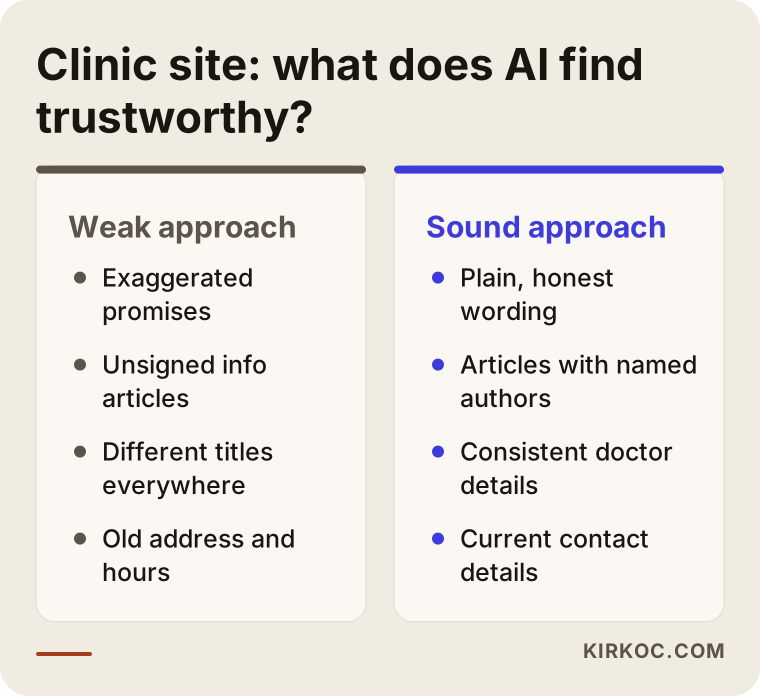
- A vague, unsigned site full of exaggerated claims earns little trust.
- When a doctor's specialty, title and workplace are written the same way in many places, trust in the practice grows.
None of this is a guarantee, and AI systems change often. But the direction is clear: a clinic that gives open, verifiable and consistent information has a better chance of being mentioned.
Physician details: the most neglected basics
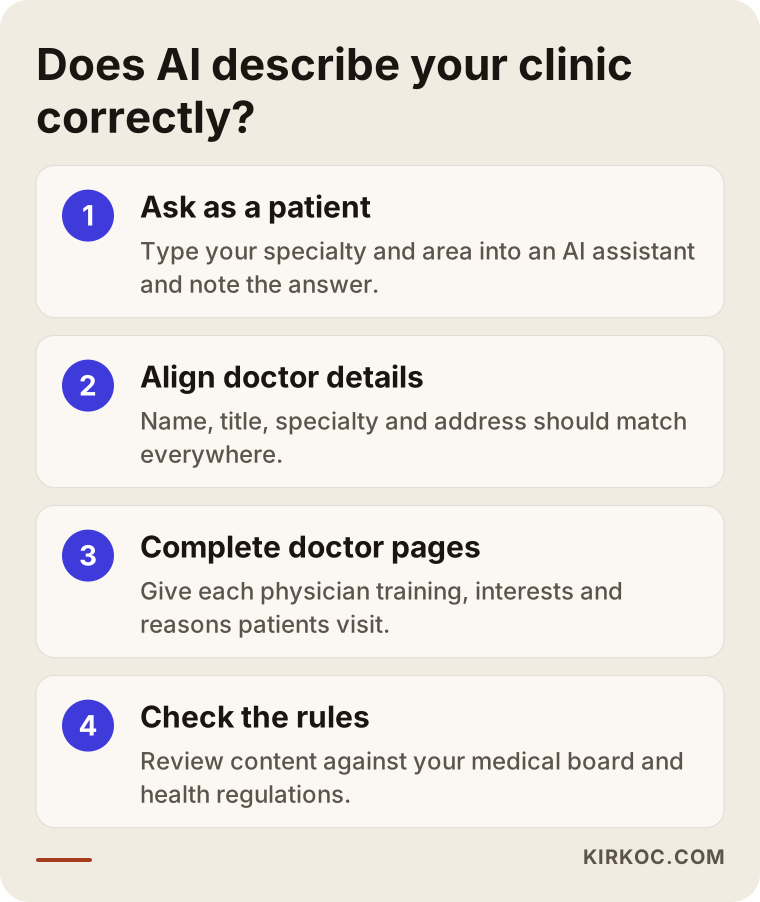
The most common problem I see on healthcare sites is that the same doctor is written differently in different places. One title on the website, another in a directory, a different practice name on the map. People barely notice. To a machine it can look like three different people.
I start by checking:
- Are the doctor's name, title, specialty and employer identical everywhere?
- Does every physician have their own complete profile page (training, areas of interest, what patients come in for)?
- Are address, phone and opening hours the same on the site, the map listing and directories?
- Do informational articles show who wrote or reviewed them?
It sounds dull, but this is the groundwork for how AI answers "who is this person, where do they work, what are they good at?" And it is not a one-time job. When a doctor leaves, an address changes or a specialty is added, every listing needs updating. An outdated directory entry can slip into an AI answer and send a patient to the wrong door, so in a first project I list every place where your details appear and fix them one by one.
Advertising rules: check them first
Promoting medical services is restricted in many places, and the rules differ by country and even by profession. I am not a lawyer, so I make no definitive claims about what is allowed. What I ask of you: check the rules of your medical board or professional association and the health regulations that apply to you, and ask them or a legal adviser if you are unsure. I write content within that cautious frame.
In practice I suggest:
- Avoiding words like "best", "guaranteed results" or "permanent cure".
- Checking the rules before using before-and-after photos or patient testimonials.
- Keeping informational content separate from promotional content.
- Naming the source and the physician when explaining a treatment.
This restraint also helps with AI: plain, informative text reads as more trustworthy to patients and to the systems alike.
Scenario 1: A newly opened women's health clinic
A clinic that came to me was in exactly this position: three physicians, a good team, but a fairly young practice. The owner had noticed that patients now ask AI things like "a trustworthy women's health clinic near me," and when she typed her own clinic's name, the answer was either empty or wrong.
First I asked the questions as a patient would and saved the answers. Then I looked at every place where the details appeared. On the website the clinic name was written one way, on the map listing another. One physician still showed up in an old directory under her former employer. Two doctors had website pages with only a name and a photo: nothing about their interests or what patients typically see them for.
The work was plain and went in order:
- We put the clinic name, address and phone number into one form everywhere.
- For each physician we wrote a page covering training, interests and reasons for visiting; every doctor approved their own text.
- We built a few simple information pages answering patient questions, each naming the author and the reviewing physician.
- We updated old directory entries and had the wrong ones corrected.
The result was modest and I describe it that way: within a few months the clinic's name appeared in AI answers more consistently and more accurately. I cannot say it was mentioned in every answer or that it "ranked higher," because these systems can answer differently each time. What I can say is that the clinic went from being misdescribed to being described correctly.
Scenario 2: A solo pediatric practice
Another example, at a very different scale. A pediatrician working alone told me most of her patients came by word of mouth, but young parents were increasingly asking AI "my child's fever won't go down, which doctor should I take them to?" Her website had a phone number and three lines of text.
Here the work was not about design but about openness. We wrote down her training, which age groups and topics she works with, where the practice is and how appointments work. For questions parents ask often (general information on vaccination schedules, when to go to the emergency room) we prepared short, plain pages with named sources. The physician wrote or approved every medical line herself; I only organized the text and built the headings and structure.
Two honest notes about this one. First, she was never promised a top spot. Second, because of advertising rules we deliberately left some phrases out, and she reviewed the text against her professional body's rules as well. Even in a small setup the basics (consistent details, complete pages, current listings) can come together in a week or two of focused work, and afterwards it needs only upkeep.
What can and cannot be done
What I can do: measure where you stand (how AI describes you, whether it states anything wrong), make physician and clinic details consistent, build clear pages that answer patient questions, and correct your listings on maps and directories.
What I cannot do: promise you will be number one in ChatGPT, guarantee the content of any single answer, or write medical content and take responsibility in place of the physician. Medical accuracy always stays with you and your team; my job is to present it correctly, in an organized way, so it can be found. For the traditional search side, see my article on SEO for doctors and healthcare organizations.
What a good physician page contains
Patients and AI look for the same answers on a doctor's page: who is this person, where do they work, what are they experienced in, and what do people come in for? The page should answer those on the first screen.
The outline I suggest is short and plain:
- Name, title and specialty at the very top, written exactly as everywhere else.
- Training and work history, verifiable and in short sentences.
- Areas of interest and the complaints patients come with, in the patient's language, free of medical jargon.
- The clinic, address, appointment details and directions.
- Links to informational articles the physician wrote or reviewed.
Avoiding exaggeration applies here too. Describing what a doctor focuses on and how they work is more credible, and safer under advertising rules, than calling them "the most experienced in the field." A photo and a short introduction build trust, but they do not hide missing information.
Why map and directory listings matter so much
When a patient asks AI for a "clinic near me," the answer often draws on map listings, directories and review pages. Even if your website is flawless, outdated listings can leak old information into the answer.
On the map listing, check the clinic name, the correct category for your specialty, address, phone, opening hours and holiday closures. On directories and booking platforms, check each doctor's current title, workplace and specialty. A closed branch or a departed physician can send a patient out for nothing.
You can fix some of these yourself; others need you to contact the platform or claim the account. Which listing belongs to whom and in what order to fix them will show in the list I make during the first project.
How to read an AI answer about yourself
The answer you get when you ask about your own name is a hint, not a report card. Ask the same question twice and you may get a different answer, so do not panic or relax over a single result.
When you read it, ask:
- Are your name, title and specialty written correctly?
- Are address and hours current, or did they come from an old source?
- If competitors are mentioned, on what grounds (area, specialty, an information page)?
- If nothing is said about you, how might a patient have phrased the question, and does your site have a page that answers it?
I suggest asking several assistants in several wordings. The same wrong detail every time usually points to one old source; a different detail each time points to general uncertainty. The first is easy to fix; the second means making your pages clearer and more consistent.
Write these notes down with the date. Asking again a few weeks later and seeing what changed is the most reliable way to tell whether the work helped.
Also ask your patients: how did they find you, what did they research first, did AI or another source point them your way? Even a few weeks of notes from your front desk show which questions your website leaves unanswered. That small feedback loop ties your content plan to real patient behavior instead of guesses.
Step by step: how the work runs
Whether you work with me or do it yourself, the order is much the same. Starting to write or fix before measuring usually means effort in the wrong place.
1. Measure where you stand
I type your specialty, area and a handful of likely patient questions into several AI assistants and save the answers. I look at whether the clinic is mentioned, whether it is described correctly, and in what context competitors appear. The point is not to scare you but to set a starting line.
2. List every place your details appear
Website, map listing, professional directories, booking platforms, social profiles, news or interview pages. Wherever a physician or the clinic appears, it goes on the list. Most clinics are surprised how long it is.
3. Fix the inconsistencies
We write name, title, specialty, address, phone and hours into one "source of truth" document and bring every listing into line. For listings I cannot reach, I write down exactly what you need to do.
4. Build physician and patient pages
Each doctor gets a complete page, plus plain pages that answer what patients actually ask. The medical content comes from you or the physician; I simplify the language, build the structure and take care not to step outside the rules.
5. Check the rules
Before anything goes live, you review the texts once more against your professional body's rules and health regulations. If a phrase is doubtful, it comes out.
6. Follow up and maintain
After a few weeks we ask the same questions again and note the difference. After that, keeping listings current when a physician changes, the practice moves or a specialty is added is usually enough.
Checklist: is your clinic site ready?
Answer yes to the questions below and the groundwork is in place. Every no is one line on your first to-do list.
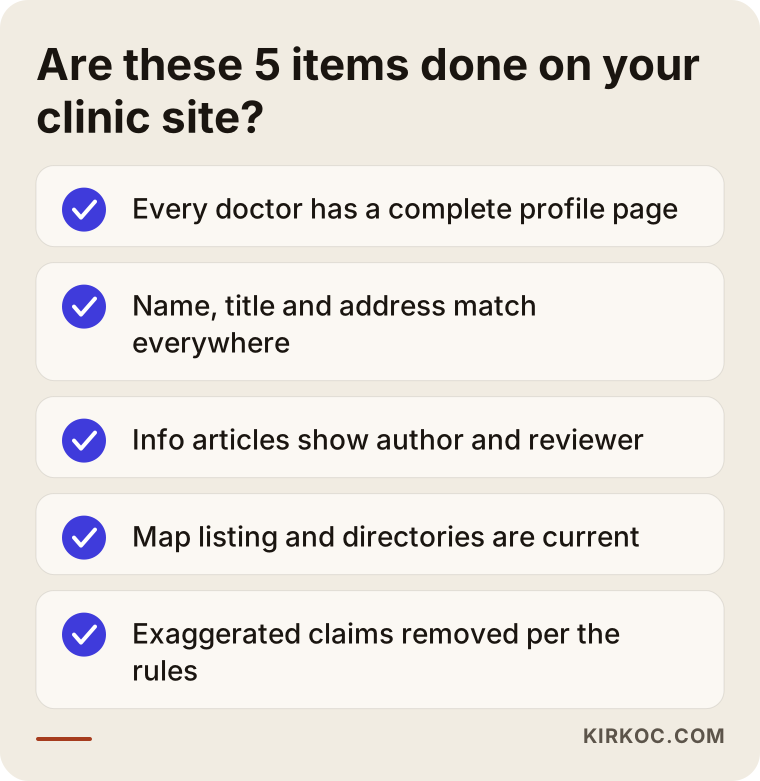
- Does each physician have their own page with training, interests and reasons patients visit?
- Are the clinic name, address and phone identical on the site, the map and the directories?
- Do information articles show the author or reviewing physician?
- Have outdated entries, such as a former doctor, an old address or a closed branch, been cleaned up?
- Does the site use phrases like "best" or "guaranteed cure," and if so, were they reviewed against the rules?
- Does the site open on a phone, with the number or appointment details one tap away?
Common mistakes
These are the mistakes I see again and again in healthcare businesses. Most are made with good intentions and cost you later.
Publishing AI-written content as it is
Generated health text published without a physician's review creates both medical risk and a trust problem. If it is unclear who is responsible for the text, it stays weak for patients and systems alike.
Leaving the doctor invisible
Many sites push the clinic name forward and reduce physicians to a one-line list of names. Yet patients go to a doctor, and doctor information is exactly what AI looks for most.
Giving different details on every platform
"Dr." here, a different title there, an old address somewhere else. These small gaps break consistency. Feeding every listing from one document largely prevents this.
Thinking about the rules afterwards
Writing first and deleting everything once a warning arrives from your professional body wastes time and reputation. Checking the rules at the start is far cheaper.
Treating it as a one-off job
A clinic that tidies its site once and walks away will have old details circulating again a year later. This work needs small, regular upkeep.
Believing a "first place" promise
Anyone promising you a guaranteed top spot in AI is either mistaken or misleading you. These answers vary; an honest service tells you what will be done and does not guarantee the outcome.
What you can do yourself and what to leave to a specialist
You do not have to outsource everything. Some tasks go better under your own control.
What you can do yourself
- Ask AI assistants questions as a patient and note the answers.
- Keep address, phone and hours current on your map listing.
- Collect each physician's training and interests in one document.
- List the questions patients ask (what the front desk hears most); these are your best content ideas.
- Read your professional body's advertising and promotion rules.
What to leave to a specialist
- Finding inconsistencies across many listings and planning the order of fixes.
- Building the structure, headings and internal links of physician and patient pages.
- Technical parts such as site structure and structured data.
- Measuring AI answers over time and interpreting what changed.
- Editing medical content so that physician approval and plain language stay in balance.
Medical accuracy and compliance should never be handed off; they stay with the physician and the practice.
Frequently asked questions
What if AI keeps giving wrong information about my practice?
First find the source of the error: an old directory entry, an inconsistent page on your site? Fixing the source usually corrects the answers over time. I cannot tell you in advance how long that takes.
Is this too much for a small practice?
Usually not. The basics are quicker in a small setup: consistent details, complete physician pages, a clean map listing. We can scale the scope to your budget.
Do patient reviews help?
Reviews are a trust signal, but the rules on collecting and publishing them in healthcare can differ. Check your own regulations first.
What does AI look at before it recommends a doctor?
I cannot know exactly how it decides, and the systems keep changing. My observation is that information with a clear author, that is current and that can be verified consistently in several places carries more weight. So my advice is to invest in basic trustworthiness, not a single trick.
How long until this shows results?
I cannot give a firm time in advance. After listings are corrected, it can take days or months to show up in answers. After the first project we repeat the same questions at intervals and follow the difference together.
Who checks the information I put on physician pages?
Medical accuracy belongs to the physician. I simplify and organize the text; approval by the doctor and the check against professional rules happen on your side before publishing.
Can I publish before-and-after photos or patient testimonials?
That depends on the country and specialty, and many places have serious restrictions. I cannot say for certain; check your professional body's rules and the relevant regulations, and ask if you are unsure.
Should I write answers to health questions to appear in AI?
Plain information pages with named sources on common patient questions are useful. They should stay general information, though, with no individual diagnosis or treatment advice.
Where to start
The first step is simple: ask an AI assistant about your name and specialty as a patient would, and note the answer. If it is wrong, or you are missing entirely, we can sort out the situation together. If you want a realistic plan for your clinic, reach me through my GEO services page.