"Google now answers like a chatbot, so what happens to my website?" Business owners ask me this more and more: lawyers, doctors, accountants, shop owners. Google's chat-style AI search, called AI Mode, changes how people look for help. Instead of typing two words and scanning ten links, they ask a long question, read the answer, and then ask another one. This article explains what that means for your business, what to prepare, and what not to get carried away by. If you would like help with the preparation, that is exactly what I do through my GEO services.
Let me be upfront: where this feature is available, in which languages and with which details keeps changing. So I will not give you a launch date or a feature list. What does not change is the direction: people phrase their questions more and more like they would to a person.
What is AI Mode, and how does it change searching?
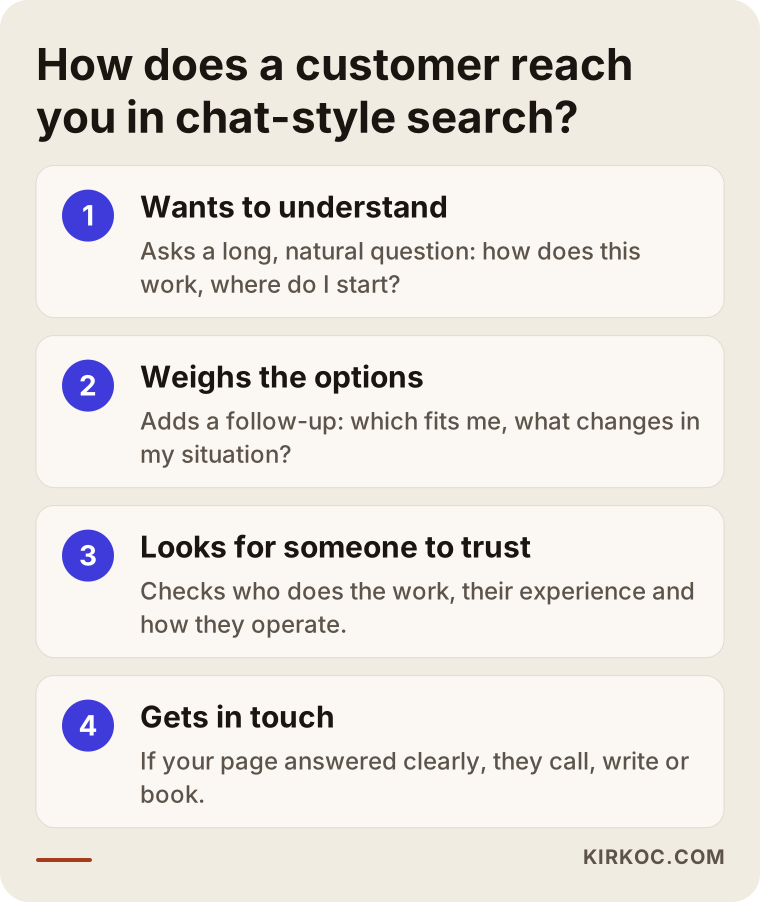
In classic search, someone types a few words like "divorce lawyer near me." In a chat-style mode they type something like: "My spouse and I cannot agree. How long does a divorce take and what should I do first?" After reading the answer, they continue: "How is custody decided?" "What should I look for in a lawyer?"
That means a customer's whole decision path can happen on one screen, through questions that build on each other. At each step, the AI gathers information from pages across the web and writes a summary. Your page may or may not be used as a source. I cannot guarantee the outcome, but I know which kinds of pages are better candidates.
What do long, follow-up searches ask of your page?
A person who asks many questions is going through a decision process. First they want to understand, then compare options, and finally decide whom to trust. If your pages can answer all three stages, your chances of being seen improve.
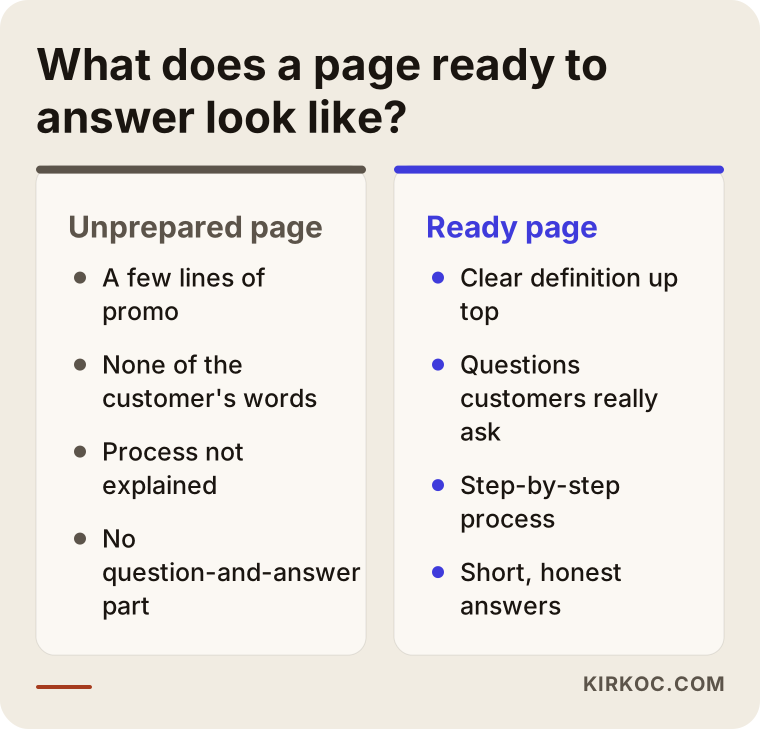
The problem I see most often: service pages are either a few lines of promotion or packed with industry jargon. The first has no answer, the second has none of the words your customer uses. An AI answering a question prefers text that is clear, plain and direct, which is also the best text for a human reader.
Are your service pages ready? Ask yourself
Open your page and check these points.
- Does the first paragraph say what the service is, in plain language?
- Does it say who it is for, and who it is not for?
- Is the process explained step by step? Does a customer know what happens after the first conversation?
- Are the factors that affect price explained? You do not have to name a number, but the answer to "what does it depend on" should be on the page.
- Are your address, opening hours, your name and your expertise clear and identical everywhere?
If you answered "no" to most of these, you are in good company; most small business sites are like that. The good news is that everything is fixable, and it makes your page convert better even if AI search did not exist.
Why your FAQ answers matter so much
Follow-up questions are the same ones customers ask you on the phone or in the first meeting. "How long does it take?" "Does insurance cover it?" "Is the first consultation paid?" "What documents do I need?" You answer these every week. When they are written on your page, both people and AI tools get a ready answer.
A good question-and-answer section:
- Writes the question the way a customer would say it, not as corporate phrasing.
- Opens the answer with the direct response, then adds detail.
- Is honest about what you cannot say. "I can't predict the outcome here because it depends on the case" builds trust.
- Respects any professional rules or advertising limits in your field. Check your own professional rules for which statements are allowed.
You can also test your AI visibility yourself. I explain how, step by step, in Does AI recommend your business?
Classic search and chat-style search: what changes and what stays
It is misleading to treat these two ways of searching as rivals. Both rest on the same thing: people look for information to solve a problem. What changes is how that information reaches the customer.
What changes
- The customer asks in full sentences, not in two or three keywords.
- The answer arrives as a summary pulled from several sources, not as a single page.
- A customer may form an opinion about you before ever opening your site.
- The first click sometimes comes later, from someone better informed and more decided.
What stays the same
- Your site still has to load, look right on a phone and be secure.
- Accurate, checkable information is still the strongest signal.
- For local businesses, the address, the map listing and the reviews still matter.
- Other people mentioning you in respectable places still helps.
So do not fall for "old SEO is dead." Without a solid base, nobody finds you in any new kind of search. My job is to build on that base the answers to the questions your customers ask.
What does an answer paragraph look like?
An example makes this concrete. Say you are a dietitian, and your page is about what happens at the first appointment. You could write one of two texts.
The weak version: "Our practice offers individual, science-based and comprehensive nutrition solutions with an expert team. We would be happy to welcome you."
The strong version: "The first appointment takes about an hour. We start with your health history, your daily routine and your habits, then I take measurements. At the end you get a written first plan. Because plans differ from person to person, I cannot promise a result in advance."
The second one contains the answer to the customer's question, the process, a limit and a human voice. It is far more useful to a search system and to a reader. Weighing one paragraph on your own page against these two examples is one of the most productive half hours you can spend.
Which questions really matter for you?
Do not chase every question. Along your customer's decision path there are three kinds, and each is answered by a different page.
- Understanding questions: "What is this and what is it for?" The first paragraph of your service page and your articles handle these.
- Comparison questions: "Which one suits me and how do they differ?" Pages that describe options honestly, and admit you are not the only solution, earn trust here.
- Trust questions: "Why should I trust this person?" Your about page, your way of working, your references and your reviews answer these.
Mark your pages with these three labels to see where you are weak. Most businesses are good at the first and thin on the second and third.
How do you track the result?
There is no single reliable counter for visibility in AI answers. So you have to look at indirect signs. None is proof alone, but together they give a picture.
- Is the quality of the messages and calls you receive changing? Do customers arrive better informed and readier?
- Do more people say "I read it on your site" or "I saw you somewhere" in the first conversation?
- When you ask the same questions yourself, which sources from your field come up, and is your page among them?
- In your search performance reports, is the share of long, question-shaped searches growing?
Asking customers "how did you find us?" is still the cheapest and most honest measurement. Write the answers in a notebook or a table; in three months you will have a real picture.
How do I prepare one service page, step by step?
The easiest way to explain this is through one page. You can follow the order below exactly, whether you work with me or on your own.
1. Collect your customers' real questions
Before touching the page, note the questions that come by phone, email, messaging apps and in first meetings for a week. You need the sentences customers actually use, not your guesses.
You usually end up with twenty or thirty questions, and they fall under a handful of headings: what is it, how does it work, what does it depend on, who is it for, what happens next.
2. Reorganize the page around those questions
Do not throw away the existing text. Rewrite the first paragraph so that it answers "What is this service and who is it for?" Then add the process, the factors that affect price, and the limits, in that order.
Give each section a heading in the customer's own phrasing. A heading like "How long does a divorce take?" instead of "Our services" tells both the reader and the search system what you are about to say.
3. Make your trust signals visible
The expert's name, field, years of practice and contact details should be plainly on the page. A person and an AI ask the same thing: who is giving this information, and why should I trust them?
Add things that can be verified: a professional membership, a published interview, an article. Do not add claims you cannot back up; they only hurt you.
4. Match what is outside your site
The address, phone number and service description in your Google Business Profile, directory listings and social accounts should match your site. Even small differences make customers and systems hesitate.
5. Test with your own questions and look again
After a few weeks, type the questions your customer would ask and see how sources like you appear in the answers. Results can change every day, so look at the general trend over time, not at one try.
Two businesses, two different situations
The two examples below are inspired by real work, but identities and details are deliberately kept general. I also describe the outcomes modestly, because I cannot guarantee any of them.
A family law practice
A lawyer came to me with a website that had a practice introduction on the home page, a single page called "Family Law" and a few lines of text. She said she answered the same questions on the phone all day, and none of them were on the site.
First we listed the phone questions: how the process works, custody, what to bring to the first meeting, how long it takes. Then we split the one page into five topics, each opening with a direct answer. To respect professional rules, we removed sentences that hinted at outcomes and kept the honest ones that say "it depends on the case."
A few months later she told me herself that the first inquiries had changed in quality: people arrived better prepared and did not ask the same things. We cannot measure exactly how often she shows up in AI answers, but the pages clearly worked better for people too.
A small furniture workshop
The second example is a small workshop making custom furniture. The site had beautiful photos and no text. Customers asked, "Do you come to measure at home, how long until delivery, how do I choose materials?" and none of it was on the site.
The problem was the opposite of the lawyer's: no legal restrictions, but a lack of trust. With the owner we wrote the delivery process step by step, described the material options in plain words and explained what drives the price: dimensions, materials, working time, installation.
The page now answers hesitant customers who ask about price much more clearly. Still, it is hard to separate whether that comes from AI search or simply from a better page; the honest answer is that both probably play a part.
Common mistakes
I see businesses stumble in almost the same places. Most of it comes from hurry, not from ignorance.
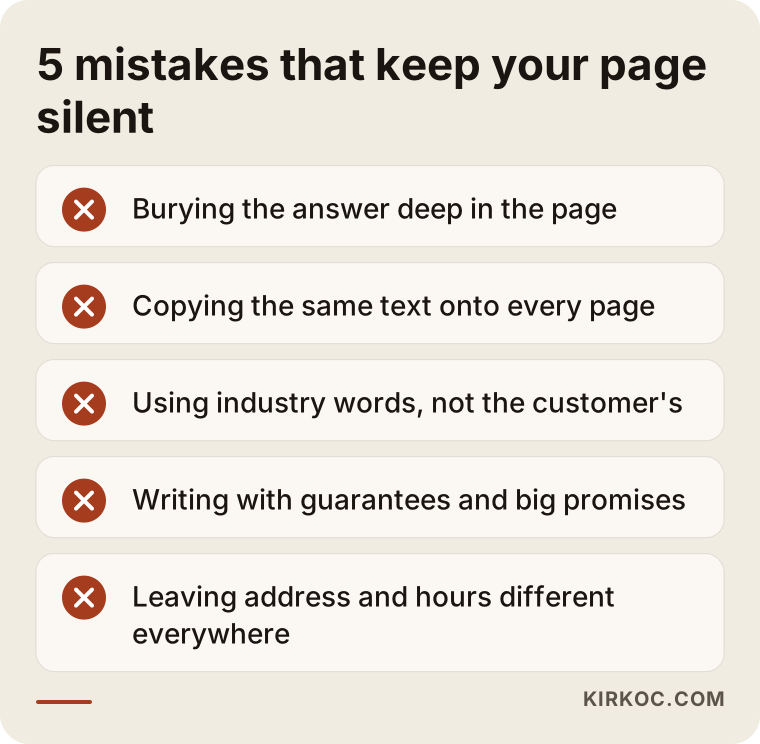
Burying the answer deep in the page
If the answer exists but sits three screens down behind a long promotional text, both the reader and the system struggle to reach it. Put the answer in the first paragraph and write the promotion afterwards.
Repeating the same text on every page
It is tempting to change a city or district name and copy one text onto dozens of pages. That makes your pages indistinguishable from each other and useful to nobody.
Using the industry's words, not the customer's
"Comprehensive solutions through a customer-focused approach" answers no question. The customer asks "how long does it take" and you write "process management"; the two never meet.
Making big promises
"Guaranteed results," "the best" or "number one" lower trust, and in some professions they can break the rules of the profession. Stating honestly what you can and cannot do works better.
Not keeping information current
An old address, the phone of a closed branch or changed opening hours lead to wrong answers. When something changes, update your site first, then every outside listing.
If you are a local business, what else should you watch?
Many customers add a place even in chat-style search: "near me," "in Brooklyn," "closest to my home." Then your Google Business Profile and map listing become part of the answer, along with your site.
The service list, the category and the description in your profile must not contradict your site. Your replies to reviews are a kind of content too; honest, calm and specific replies tell people and systems something about you.
If you have several branches, each needs its own page with its own details: address, directions, the specialists who work there, the questions asked there. Copying one text and changing the branch name is one of the mistakes described above.
What you can do yourself and what to leave to an expert
You can do most of this yourself. Knowing in advance what stays with you and what to hand over saves both time and money.
What you can do yourself
- Collecting and noting customer questions; you do this better than anyone.
- Writing the first paragraph of each service in plain language.
- Keeping your Google Business Profile and opening hours current.
- Asking customers for reviews and answering them honestly.
- Rereading your pages every three months and fixing what has gone stale.
What to leave to an expert
- The technical side of the site: speed, mobile fit, crawling and indexing problems.
- Structured data and page architecture, the invisible but effective adjustments.
- A consistent content plan across several services and languages.
- An impartial assessment of where you stand; it is hard to see your own site.
- Measurement and reporting: telling what works from what is coincidence.
My role here is less about doing everything for you and more about making clear what to do first. If you like, I only carry out an assessment and you implement the rest yourself.
What to do and what to avoid
First what to avoid, because there is a lot of hype here.
- Do not trust anyone who promises you the top spot in AI answers. Nobody can guarantee it, and neither can I.
- Do not copy the same list of questions onto every page. Repetitive, careless content wears out people and search systems alike.
- Do not abandon classic SEO. A technically sound, fast, trustworthy site is still the base for every kind of search.
What to do:
- Pick your two or three most valuable services and review their pages with the questions above.
- Write down the questions customers really ask over one week, and turn them into a genuine Q&A section for each page.
- Keep your Google Business Profile identical to what your site says.
- Appear in places that hold accurate, current information about you: your professional association, directories, news, interviews.
- Do not treat any of this as one-off work. Reread your pages every three months.
Frequently asked questions
Will AI Mode replace classic search completely?
I do not know, and nobody can say for sure. Right now both ways of searching exist side by side, and people pick one depending on the moment. That is why a clear, trustworthy site that works for both is the safest path.
How do I find out whether my site appears in AI Mode?
There is no single reliable counter. The practical way is to write the questions your own customers might ask and look at the results. You also need to check whether the feature is offered in your country and language.
Do I need a separate website for this?
No. Your current site is enough if it carries accurate information in clear language with a sensible structure. Improving existing pages is usually a better decision than starting from scratch.
Does AI Mode work in every country and language?
No, and that keeps changing. You need to check from your own account whether the feature is offered in your country and language. Even if it is not, customers are getting used to asking in a chat style, so the preparation is not wasted.
Do I have to run ads to appear in AI search?
Advertising is a separate topic with a separate budget. The work I describe is not about ads; it is about the content of your pages. The two should not be mixed up.
Can I have AI write my Q&A section?
You can use it for a draft, but the answers must rest on your real knowledge and experience. Generic answers anyone could write do not make your page stand out. As the expert, you should always have the last word.
How long does this take, and when do I see results?
Writing the pages usually takes weeks, but measuring the effect takes longer. Search systems need time to reread and evaluate pages. I cannot give a fixed time or result; looking at the first signs after a few months is reasonable.
Do I need to do this if I run a small business?
Small businesses often have the advantage, because they know their customers and their questions better. You do not need a large content program; starting with your one or two most valuable services is enough.
Where to start
My advice is to take one service page, not the whole site. Expand it with the questions your customers actually ask, look at the result, then move on to the next one. If you would like me to do this for you, or just give your pages an honest review, you can reach me through my GEO services page.