You own a real estate firm in Turkey, or you run the team that sells property to foreign buyers. Your portfolio has good projects and your sales people are capable, yet most of the visitors who reach your website are Turkish speakers. Your real target is the person living in Germany, Sweden, the Gulf or the United Kingdom who is thinking about buying a home in Turkey. This is exactly where multilingual SEO comes in. SEO, in short, is the work that makes your website show up on Google when your customers search. Multilingual SEO does that not in one language but in your buyer's own language.
In this article I explain how a foreign buyer behaves when looking for property in Turkey, which pages you need, the difference between translation and real localization, and where to start. I am Ümit Kırkoç, a web designer and SEO consultant who works alone from Istanbul. If you want help with this, I describe my own SEO services honestly, including their limits.
How does a foreign buyer find you?
First, put yourself in your customer's shoes. Picture a family in Stockholm thinking about a holiday home in Antalya, or someone in Berlin with a job and some savings who wants to invest in Turkey. What do they do? Most likely they type a sentence into Google in their own language: "buy an apartment in Turkey", "villa for sale in Antalya for foreigners", "is it safe to buy property in Turkey". The phrase "satılık daire" on your Turkish site matches none of these searches.
This search behavior has three features. First, the buyer often searches with the city name as it is spelled in their own language, and often as a question. Second, the decision is long. People collect information for weeks, sometimes months. Third, the trust bar is high. Someone considering a purchase from abroad, from a firm they have never met, is mainly asking one thing: "are these people real?"
The illustration below shows the difference using a completely hypothetical search result.
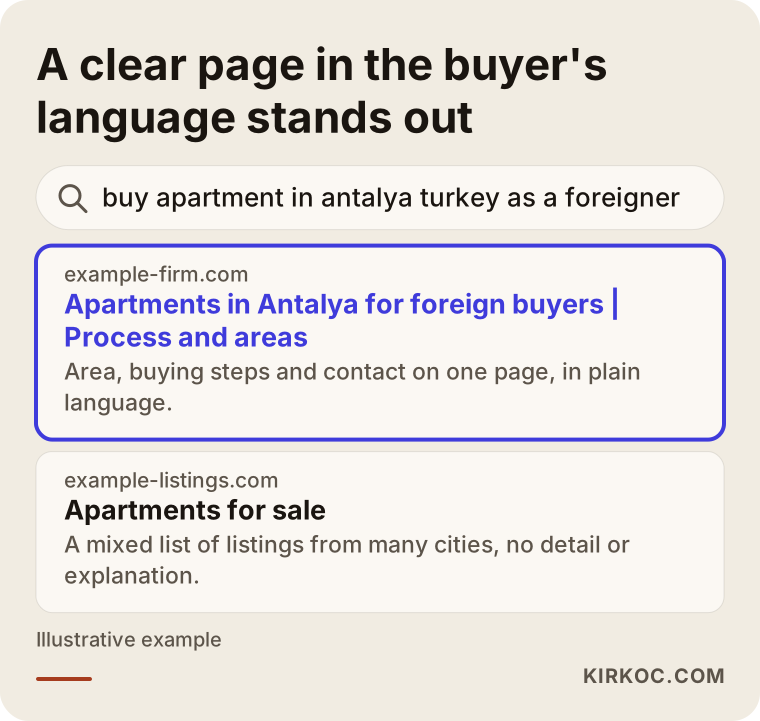
The highlighted result is a page written in the buyer's language that names the area and the service in the first line. The other one is a generic list mixing many places. Google tries to give the searcher the clearest possible answer. If you prepare that answer in the buyer's language, you become much easier to find.
The buyer has three different goals
Foreign buyers are not one type, and each type searches differently. The investment buyer cares about returns, rental potential and where the area is heading. The lifestyle buyer, someone who wants to live in Turkey or own a holiday home, looks at schools, hospitals, the sea and transport. The third group buys property with a residency or citizenship goal in mind. For this last group the rules change from time to time, so writing a firm, permanent-sounding claim on your site is risky. The sensible approach is to explain the general picture in plain language and send the buyer to a lawyer for current conditions. I make no firm legal claims in this article, and I suggest you take the same care.
Trying to cover all three goals on one page means answering all three halfway. Each goal needs its own pages that answer its own questions.
The buyer's journey and your pages
A buyer who lands on your site for the first time is not ready to buy. First they want to get to know the country and the area, then to understand the process, and only at the end to talk to you. Your pages should match that journey.
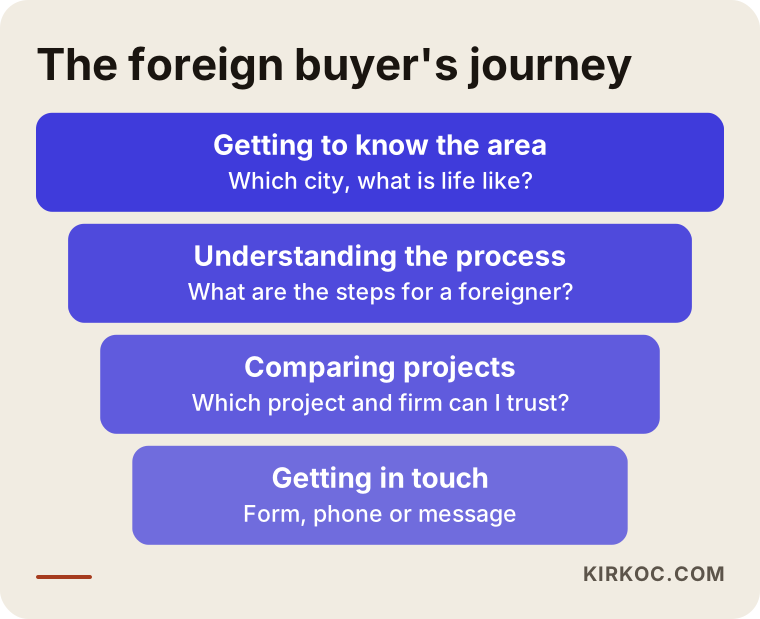
Think of a funnel that runs from a wide top to a narrow bottom. At the top, many people ask general questions such as "where in Turkey is a good place to live?" At the bottom, very few say "I want to talk to this firm." The job of SEO is to answer every step of that journey with a page and carry the person to the next step. If you focus only on the "our projects" page at the bottom, you never reach the large audience at the start of the journey.
Which pages do you need?
I group the pages that work in this sector into four types. The first is area pages: one for each target city or district, describing living conditions, access and surroundings. The second is process pages: plain-language explanations of the steps a foreigner usually goes through when buying property in Turkey. The third is project and property pages: a separate page for each project, carrying its own details. The fourth is trust pages: your about page, your team, your office address, your credentials and your frequently asked questions.
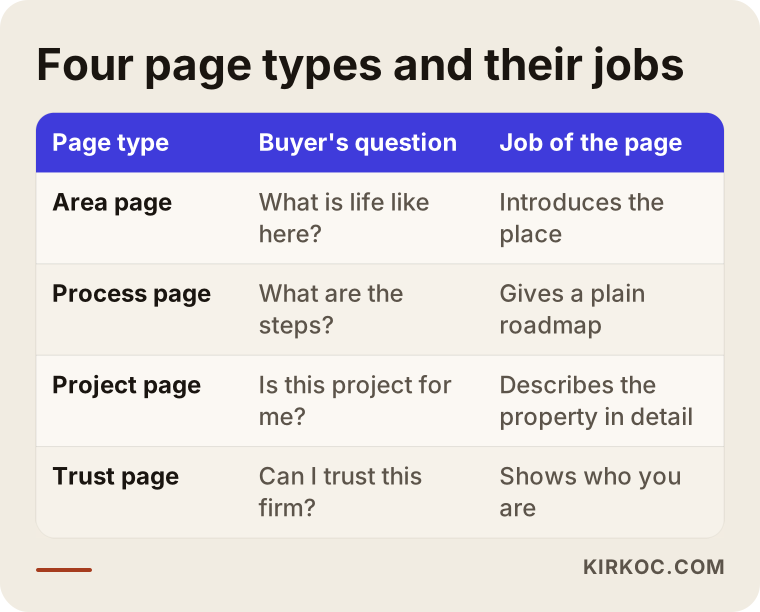
The table summarizes which page serves which intent. The practical lesson is this: do not expect one page to do everything. A project page does not build trust, a trust page does not describe a property, and an area page does not explain the process. Each page should do one job well.
Translation is not the same as localization
The most common mistake on multilingual sites is running the Turkish text through a translation tool and publishing the result. It is the fastest way to say "I translated my site," and also the riskiest. The text gets translated word for word, but the phrases the buyer really uses do not. For example, "tapu" is a perfectly natural word in Turkish. An English-speaking buyer will search for "title deed" or "property ownership document" instead. A German buyer might wonder what the Turkish equivalent of "Grundbuch" is, but will not connect that question to the word in your text.
Localization includes the following: researching the words buyers actually search for, showing currency and units the way the buyer is used to seeing them, answering the worries of buyers from that country (safety, the legal process, buying from a distance), and offering contact options that suit that country. In some countries people prefer to reach out through a messaging app, in others by phone, in others by email.
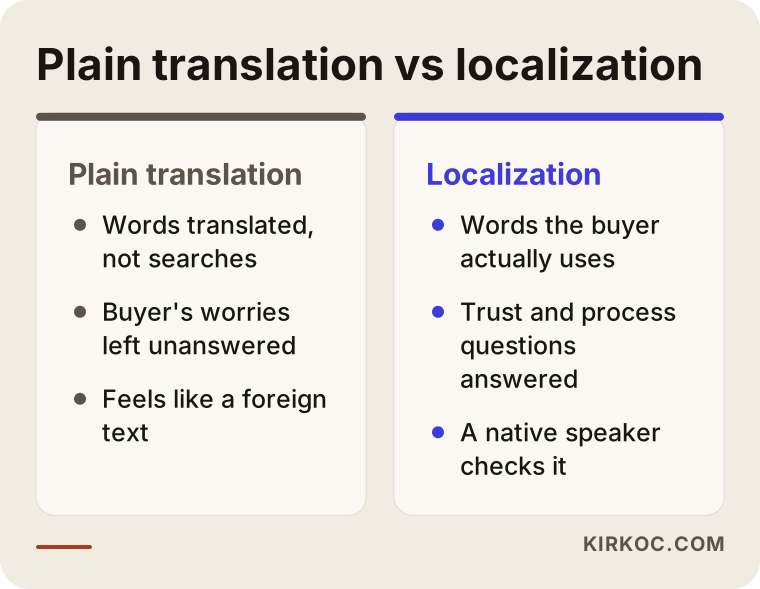
The difference in the comparison shows up in how much the visitor trusts you. A page that was simply translated feels like it was never written for them. A localized page feels like it was written by someone who knows their questions. When a person is making a large purchase from a distance, that impression can decide the outcome.
When is machine translation acceptable?
Banning machine translation entirely is not realistic. It is useful for creating a draft. But before publishing, someone who speaks that language at a native level has to review it. A small translation error in a sentence with legal or financial meaning can damage trust and put you in a difficult position. For that reason I recommend a review by both a lawyer and a native speaker for such text.
How should a multilingual site be built technically?
This part can look technical, but I can explain the core of it simply. For Google to show each language version to the right visitor, your site needs a clear language structure.
The first rule is that every language has its own address. The Turkish version sits at one address and the English version at another. Switching the page language only according to the visitor's browser settings, meaning one address that shows different languages, can prevent Google from seeing each version separately. The second rule is to tell Google how the language versions relate to each other. A signal known as "hreflang" says to Google, "this page's English, German and Turkish equivalents are these." It reduces the chance that a visitor is shown the wrong language. The third rule is to keep the language switcher visible and easy to use. If people cannot find their language, they leave.
Fourth, think about whether you are addressing a country or a language. English speakers live in the United Kingdom, Ireland, the United States, the Gulf and many other places, and German speakers live in Germany, Austria and Switzerland. Each group's worries can be slightly different. Going language by language at the start is enough for most businesses, but if your goal is a specific country, shaping the content for that country's buyer gives a stronger result.
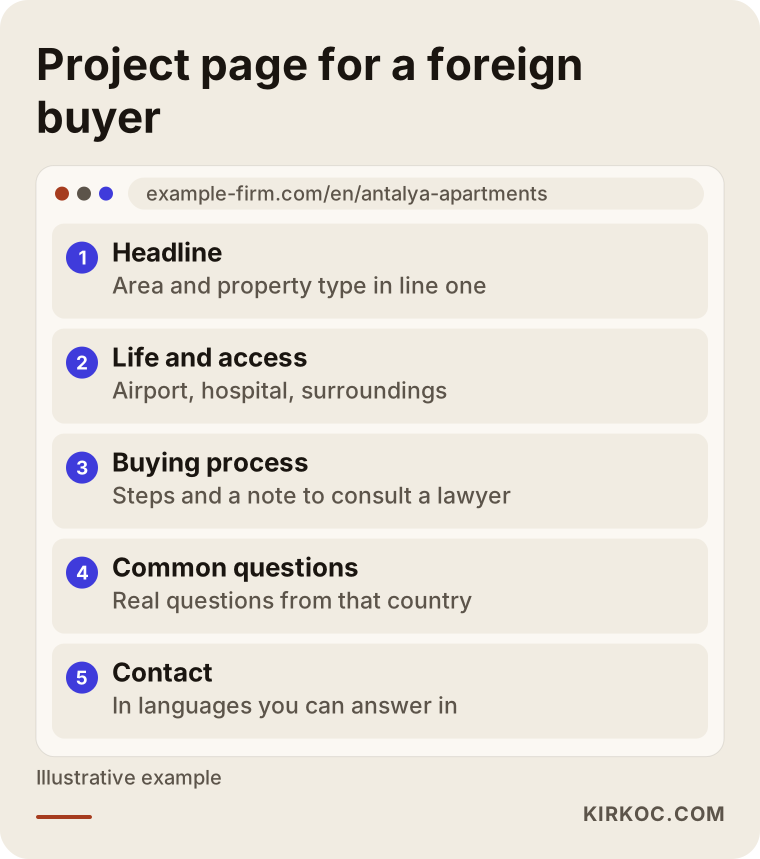
The layout above gives you an idea of how a project page can be built. At the top you state the area and the type of property, then life and access information, then the buying process, and at the bottom the common questions and a way to get in touch. When every section answers a question in the buyer's mind, the page makes sense for both people and search engines.
Example scenario 1: a small firm selling holiday homes in Antalya
This is a hypothetical scenario and does not describe a real firm. Imagine a three-person firm that sells holiday apartments in Antalya. Its website is in Turkish only. Most of its sales come through acquaintances and referrals, but it wants more foreign customers.
The first step is to look at which countries send the most inquiries. Suppose most messages come from Germany and Scandinavia. Then two languages are chosen first, and for each language the four page groups are planned: area pages, process pages, project pages and trust pages. On the area pages, the different neighborhoods of Antalya are described according to the buyer's worries: can you live there all year, how is access to healthcare, how far is the airport. The process page explains the stages a foreigner generally goes through when buying property and stresses, at each stage, the value of consulting a lawyer.
This firm's advantage is that it is small. The person you talk to knows the business and answers quickly. Showing that concretely on the about page is a strong difference against large, faceless competitors. I cannot promise a result, but a plan like this can meaningfully improve the firm's chance of appearing in searches made by foreign buyers.
Example scenario 2: a mid-sized firm selling investment homes in Istanbul
This too is a hypothetical example. Imagine a mid-sized firm in Istanbul with an office and a sales team that sells investment-oriented residential projects. It publishes its site in English as well, but the texts were translated from Turkish and the same generic page is used for every district. Foreign inquiries are below what it wants.
The problem here is not too little content but content pointing in the wrong direction. An investment buyer asks about rental potential, how the area is developing and how the property will be managed after purchase. The firm only shows floor areas and photographs. The fix is to prepare a "view from an investor's eye" page for each project, describe the property management service on its own page if the firm offers one, and collect the common questions from real customer questions. The English text should also be reviewed by a native English speaker.
Both scenarios show the same thing: success comes less from writing more pages and more from writing pages that answer the right buyer with the right question.
Trust signals: the invisible half of SEO
For someone buying property from abroad, trust is the biggest obstacle. Search engines are careful here too; on topics involving money and big decisions they try to favor more reliable sources. So your site needs concrete information that shows trust.
That means: a real office address and a map, a working phone number, your license or professional registration where visitors can see it, a page introducing your team, real customer reviews (not invented, and published with permission), a clear explanation of who does what during the process, and a reachable way to ask a question or make a complaint. It also matters that the photos on your site belong to real projects; stock images seen everywhere damage trust.
One point to flag: when you publish reviews and references, pay attention to personal data and to people's consent. If you are unsure, ask a lawyer.
Showing up in AI answers
Today many buyers ask AI tools such as ChatGPT, rather than a search engine, "what do I need to buy a home in Turkey as a foreigner?" These tools build their answers from open, well-organized and reliable sources on the internet. If your site has pages that explain the process clearly, consistently and with sources, the chance of your name appearing in such answers goes up. There is no guarantee, but the same work, clear and trustworthy content, helps both in classic search and in AI answers.
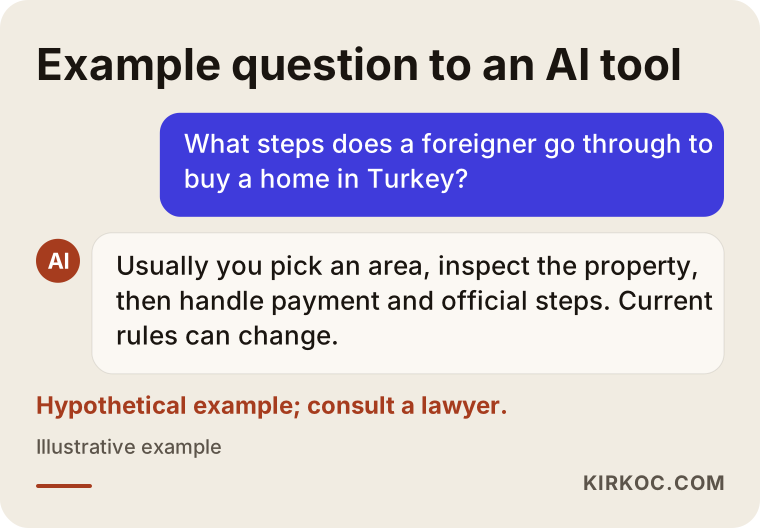
The picture shows a hypothetical question and answer. Notice that the answer is made of short, clear steps and ends by recommending that you consult an expert. If your site gives clear information in the same way, without bold promises, it becomes more useful for both people and AI.
Step by step: where to begin
Trying to do everything at once is a mistake; going in order is healthier. The order below is the general path I follow in this kind of work.
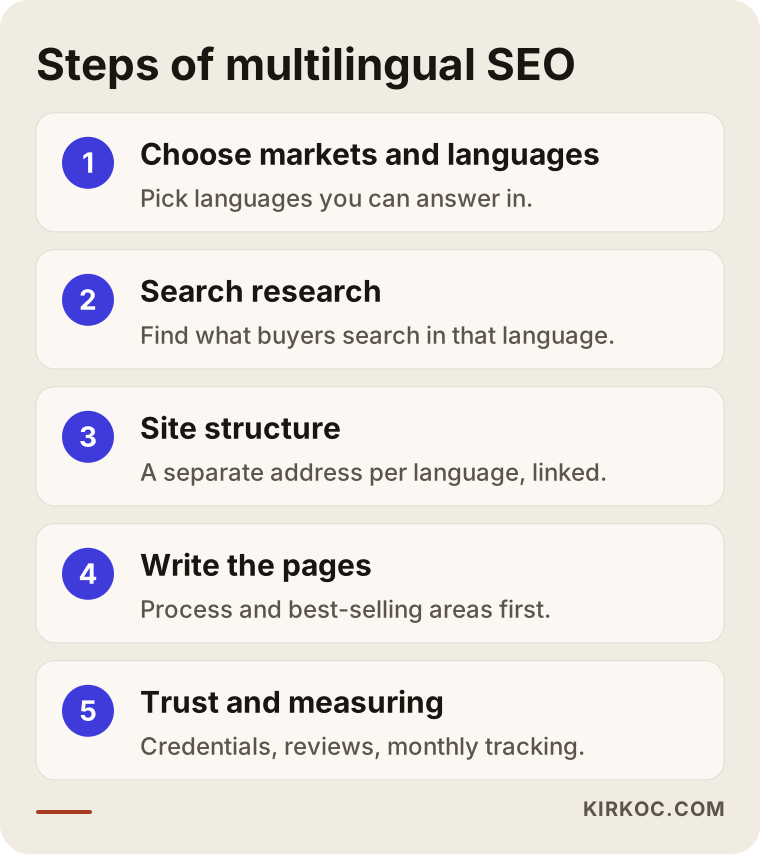
Let me unpack each step. First you choose the target markets and languages: which countries do your customers come from, and in which languages can your sales team really respond? It is important to open pages only in languages you can answer in. If a visitor writes to you in German and gets no German reply, the page worked for nothing. The second step is to find what buyers actually search for in that language. The third step is to build the site's language structure correctly. The fourth step is to write the priority pages: the process and your best-selling areas first, then the rest. The fifth step is to complete the trust signals, and the sixth is to measure and update the plan.
A note on measuring: do not let your only goal be visitor numbers. People who fill in a form, call you or message you are your real indicator. Seeing which language and which page they came from tells you where to invest next.
When do results show up?
A new language version takes time to find its place in search results. Depending on how crowded the competition is, how strong your existing site is and how difficult the target searches are, the first movements can take weeks or months. I will not promise a fixed period, because that would not be honest. In long-decision businesses like real estate, turning results into sales can take even longer. So you need patience and regular follow-up.
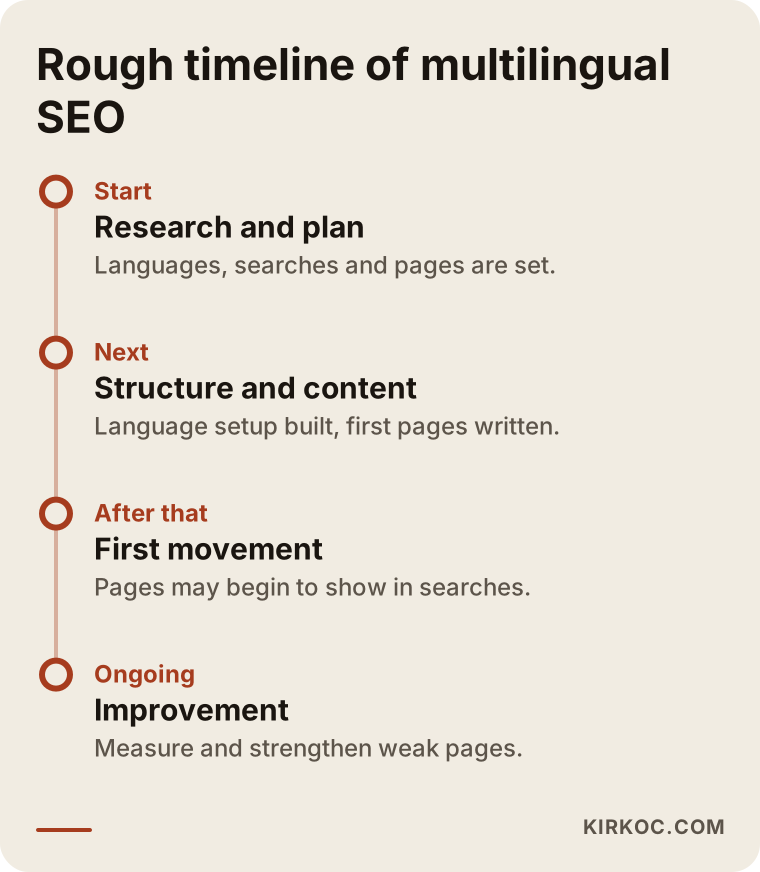
The timeline shows a rough order; actual durations differ in every project. What matters is seeing that the foundation is laid solidly in the first months instead of expecting sales right away.
Common mistakes
Let me list the mistakes I see in this sector, because most of them are easy to avoid.
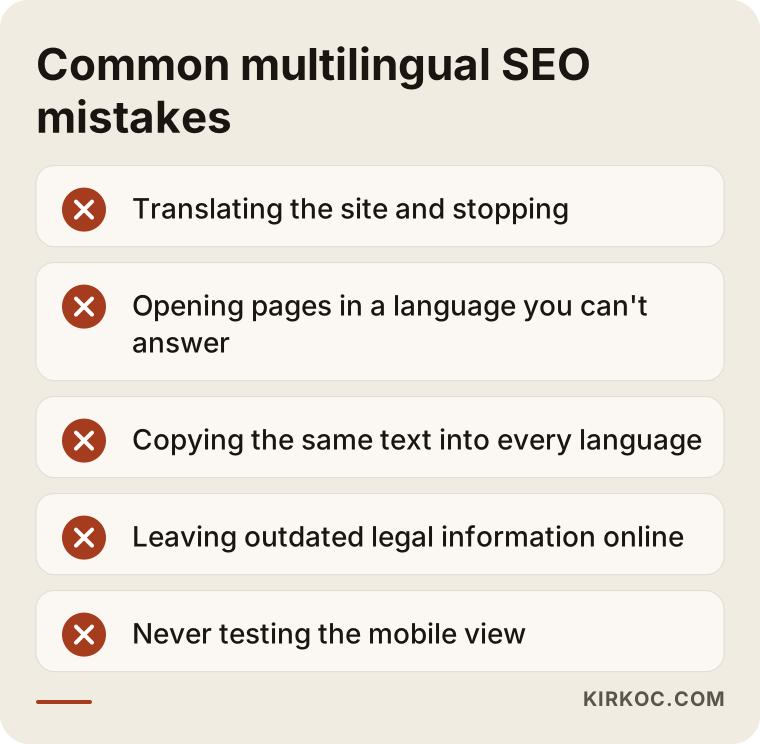
The most common is translating the site and stopping there. Translation is a beginning, not an end. The second is opening a page in a language you cannot answer in; if a visitor fills in a form and waits days for a reply, that leaves a bad impression. The third is copying the same project text into every language, which can make it hard for Google to tell similar pages apart. The fourth is leaving legal information on the site for years without updating it. Old or wrong information misleads the buyer and can create liability for you. The fifth is never testing the mobile view; a large share of foreign buyers browse on their phones. The sixth is project pages that load slowly and are packed with heavy photos, which is even more noticeable for visitors connecting from abroad.
What can you do yourself, and when do you need an expert?
You do not need outside help for everything. There are things you can do on your own. You can write down the questions your customers ask most often and answer them in plain language, in the buyer's language, on your site. You can write your office address, phone number and working hours the same way everywhere. You can keep real photos and short descriptions of your projects up to date. You can start collecting customer reviews, with permission.
Expert help makes sense when the language structure of the site has to be built technically, when you do not know which languages and which searches to prioritize, when you are moving your old site to a new structure and do not want to lose traffic, or when you cannot understand why your competitors are ahead. Help at the right time spares you months of working in the wrong direction.
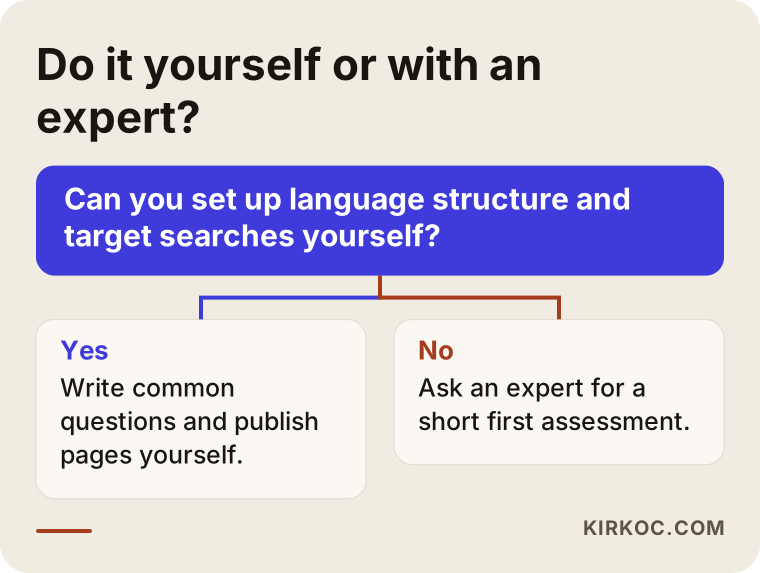
The chart simplifies the decision. First, can you answer your own questions and write the content? If yes, start. If you are unsure about the technical structure and which searches to target, even a short first assessment is useful.
What to look for in an SEO proposal
When you receive an SEO proposal, especially for a multilingual project, look at the following. The work to be done should be written down and ordered by priority. It should be clear who will do the work. How translation and localization will be handled, and whether a native speaker will check the text, should be stated plainly. The site and the accounts should stay in your name. Reports should be written in plain language. And most importantly, no ranking or sales guarantee should be given; a person who makes such a promise is promising something nobody can control.
What decides the cost
I do not give figures, because this work varies a lot. The main factors that set the price are these: how many languages are involved, the condition of the current site and whether it needs restructuring, how many pages have to be written, the scope of translation and native-speaker review, how competitive the target searches are, whether the work is a one-off or ongoing, and how much reporting and measurement you need. The workload of a small two-language site and a five-language site with dozens of projects is very different. That is why I first look at your site and your goals and write out the scope of the work; the price comes from that scope.
How I work
I work alone, so the person you talk to is the person who does the work. The process usually begins with a short initial review: I look at your site, your target markets and your competitors and tell you where to start. Then I give you a written plan, ordered by priority, for the first months. If you accept it, I first remove the technical obstacles on the site and then prepare the content and trust pages. When translation and localization need a native-speaker check, I state it separately in the plan. We look at the results together each month and update the plan. My capacity is limited, so I take on a limited number of projects at a time and give each real attention.
Frequently asked questions
Which languages should I build a site in for selling property to foreigners?
Start with the languages that your demand comes from and that your sales team can really answer in. English is usually the first step; after that, depending on which countries your messages come from, you can consider German, Russian, Arabic or a Scandinavian language. A page in a language you cannot answer in does more harm than good.
Is translating the site with an automatic tool enough?
Usually it is not. Automatic translation is useful for a draft, but it does not capture the words and worries the buyer really has. Before publishing, someone who knows the language at a native level should review it, and this is essential for sentences with legal or financial meaning.
Should I explain citizenship or residency on my site?
Buyers search for this a lot, so it makes sense to cover it. But because the rules can change, avoid claims that sound firm and permanent, explain the general picture simply, and send the buyer to a lawyer for current conditions. The information on the page also needs to be reviewed at regular intervals.
Do I need a separate domain name for each language?
Not necessarily. For many businesses, giving each language its own address under a single domain makes management easier and keeps the site's strength in one place. Using a separate domain for each target country is possible, but it requires more maintenance. The right choice depends on your goals and resources.
When will I see results?
I cannot give a fixed period. With new language versions, the first movements can show within weeks or months, and in businesses with long decisions like real estate, turning that into sales can take longer. Which language, which search and which competitors you work against determines the pace.
Should I run ads or do SEO?
They do different jobs. Ads give you visibility as long as you pay, and let you test quickly. SEO is built more slowly, but once built it can bring steady interest. Many firms use both; if your budget is limited, in an industry with a long decision process, SEO and trust content usually form a lasting base.
Can I write the project pages the same in every language?
Copying the same text is not recommended. Search engines may find it hard to tell similar pages apart, and buyers from each country wonder about slightly different things. Keeping the core information while adapting the emphasis and the common questions to the buyer in that language gives better results.
How do I get included in AI answers?
There is no guarantee, but pages that give clear, consistent, sourced and up-to-date information raise the chance of being used as a source in such answers. A site that explains the process simply, answers common questions and shows clearly who you are is a good foundation.
If you want to reach foreign buyers with a site that truly speaks the buyer's language in several languages, you can read how I work on my SEO services page and write to me. I will first make a short assessment of your site and your target markets and tell you plainly where to start.