Most of the clients who hire a security company no longer find one through word of mouth alone. A property manager, a plant manager or a hotel owner types a search into Google, opens a few sites, and then asks for quotes. You may have done good work for years, but if your website brings in a handful of quote requests a year, or if you keep seeing the same competitors at the top of the results, this is exactly where SEO for security guard companies helps. SEO, in short, is the work that makes your website show up when your clients search for what you offer. In this article I explain how buyers in your field search, which pages you need and how to build trust. I am Ümit Kırkoç, a web designer and SEO consultant who works alone from Istanbul, and I describe the scope of my own SEO services where it matters, including what I do not do.
Let me say one thing up front. Security is a service people choose slowly and carefully. When someone hires you, they hand over responsibility for their building, their employees and their property. So your website has two jobs: to be found, and to create the first feeling of trust at the door. Good SEO makes you think about both at the same time.
What does someone looking for security services type into Google?
In this field the buyer is usually an organization, not a private person. The decision rarely comes from a mood. It comes from a need: a new building has just opened, the current provider disappointed someone, a contract is ending, a plant is expanding, an event is coming up. That is why the searches tend to be very concrete.
The most common patterns look like this. Some pair a service with a place ("apartment complex security guard Chicago", "warehouse security company near me"). Some pair a service with a type of client ("school security guards", "hospital security officers", "shopping center security services"). Some describe a temporary need ("event security company", "concert security staffing", "construction site security"). And some carry a direct buying signal ("security guard company quote", "security guard services cost"). A fifth group overlaps with technical services, such as "alarm monitoring" or "camera system installation". If you offer those, they need their own treatment.
There is one distinction to make from the start. Someone who types "security guard jobs" or "security guard training course" is not your client. They are looking for work or for a class. If you build one general "security" page, your site will mostly be shown to these people. The phone may ring, but the conversation will not be about a sale. The first task of commercial SEO is to build a page structure that separates the right visitor from the wrong one. You can open a short, clearly labeled "careers" section for hiring, but your main service pages should speak to the buyer.
The image below uses a completely invented example to show what a search result looks like and why it matters that a page says plainly what it sells.
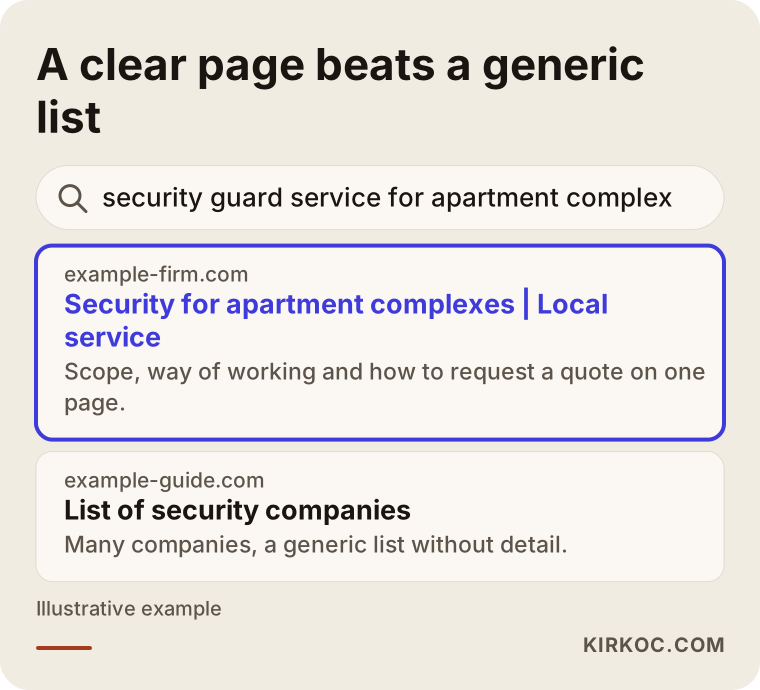
The highlighted result does something simple: in the first line it says what it offers, where and for whom. The generic directory next to it lists many companies without detail. Google tries to give the searcher the most fitting answer. If you describe yourself clearly, it is easier for Google to show you to the right person.
Separating the types of search
Lumping all of these searches together is the most common mistake in this field. Each type of search needs a different page. The table below summarizes it.
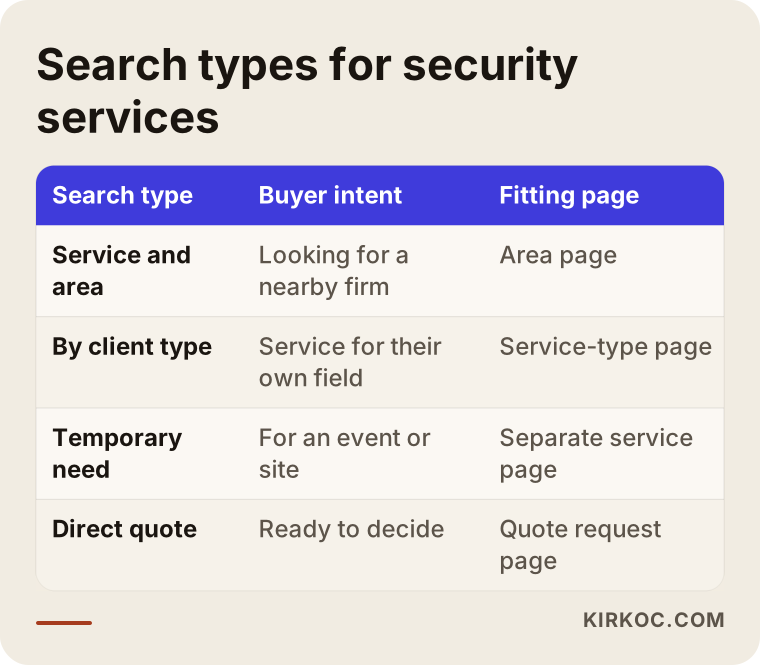
The conclusion is this: trying to answer all of these searches with a single page called "Our Services" means answering none of them fully. The question of a property manager is not the question of a factory. One cares about night patrols and building order. The other cares about shifts, access control and compliance with workplace safety rules. If you talk to both in the same words, you only half-speak to each.
Why is SEO different for security companies?
There are three reasons. The first is that the buyer is about to trust you with a responsibility before they know you. People do not choose you the way they choose a hair salon. They look at your site, then at other sites, maybe skim some reviews, and very often they ask several companies for a quote. The job of your site is to get you onto that shortlist.
The second reason is that this is a closely regulated field. Who may provide private security services, and under which license, is set by law, and in the United States the rules differ from state to state. For details you need to talk to an attorney who knows your state. What matters for SEO is this: the buyer wonders whether the company in front of them is licensed and in good standing. If your license information and the associations you belong to are clearly visible on your site, that builds trust and answers the first question in the buyer's mind. For firm rules on which documents you must show and how to show them, please ask an attorney. I cannot give legal advice on that.
The third reason is that there are things you can share and things you should not. When you give references, writing down a client's floor plans, shift times or details that point to a weak spot is neither ethical nor safe for you. So your content has to be concrete enough to build confidence and general enough to put nobody at risk. A site that does this well stands apart from most competitors.
Which pages do you need?
The skeleton of your site should follow the questions your clients ask. This is the basic structure I recommend:
- Main services page: Summarizes what you do, which areas you cover and how someone gets a quote.
- Pages by type of service: For example residential and apartment security, office and industrial security, event security, construction site security. Each one is written in the language of that client.
- Area pages: For the cities or counties you really serve, with information that is specific to that area.
- How you work page: Explains in plain words the site assessment, the proposal, the onboarding of guards and the ongoing supervision.
- Trust page: Your licenses and certifications, insurance, training approach and working principles.
- Frequently asked questions: Real ones, such as contract length, backup staff and what happens when there is an incident.
- Quote request page: A short and clear form.
I want to stress the "pages by type of service" item, because most security sites never build this layer. Trying to fit everything on one page means your site does not look clear for any single search. The image below shows the layout I suggest for a service page.
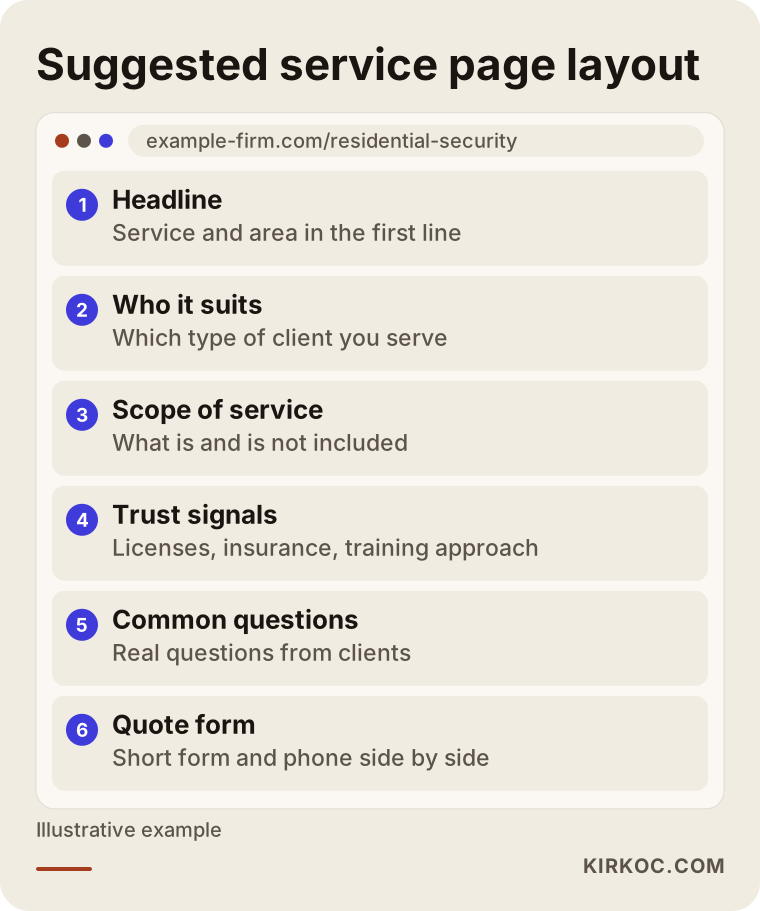
The logic of the layout is simple. The reader first needs to understand that they are in the right place, then see what they would get, then see why they can trust you, and finally find the way to ask for a quote at the bottom. A text written only for Google, with the same phrase repeated in every sentence, tires out the reader and Google alike.
Be careful with area pages
If you serve more than one city or county, area pages are a powerful tool. But there is a trap: copying the same text and only changing the place name. Google notices this and may treat such pages as having little value. Clients notice too, and do not take you seriously. A good area page carries information that really belongs to that area: which kinds of properties or facilities you serve there, how quickly your team can generally reach it (stated honestly and in general terms), and a question that clients in that area often ask. Do not open a page for a place where you do not actually work. It is a matter of honesty, and an empty page carries no value anyway.
How do you build trust? Your site is a first meeting
In security, the questions in the buyer's mind are usually the same. Is this company licensed? How does it select and train its people? Who do I reach if something goes wrong? What exactly am I protected by in the contract? The job of your site is to answer these questions when you are not in the room.
In concrete terms, your site can include: a short story of your company and the year you were founded, the name and a short introduction of your management team, which authority issued your licenses, your approach to hiring and training, the way you handle an incident, your real contact details (a street address, a landline, an email) and, if possible, a general list of the sectors you work in. Naming a client requires that client's written permission. Without permission, anonymous descriptions such as "a manufacturing plant, a residential community" work well enough.
The list below collects the signs I would like to see on a security company site.
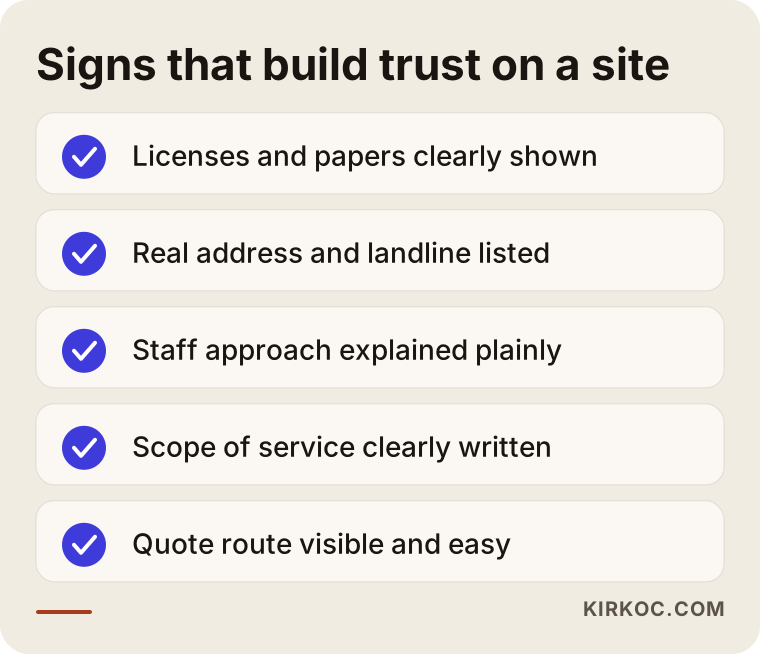
Every item on this list also helps SEO. A real address and phone number help Google recognize you as a genuine business. A clear scope decides which searches you appear in. Open communication lets the visitor reach you without leaving the site.
Two hypothetical example scenarios
The scenarios below are entirely hypothetical. They do not describe a real company or person; they only show the logic.
First scenario: a mid-sized company focused on residential communities. A security company has served property managers and homeowner associations for years, but its website is a single brochure page. Under one heading called "Security Services" it lists residential, industrial and events, all together. When board members search, this company hardly ever appears. The work done looks like this: a separate service page is written just for residential communities, the real questions of boards are answered (what happens when a new management company takes over, what happens when a guard is replaced, how visitor and package access works), short area-specific pages are built for the counties served, and the quote form is simplified. I would not promise a ranking, but this company now has a page that answers someone searching for apartment complex security. Before, it had none.
Second scenario: a company serving factories and logistics facilities. This company has fewer clients, but they are larger. The searches are few in number but valuable: "factory security company", "warehouse security services". Here you do not need many pages. You need a few deep pages, one for each type of facility, and a serious trust section. The site explains how the site assessment works, the general logic of shift planning and how the company works in line with workplace safety rules. The goal for this company is not hundreds of visitors a day. It is a few qualified quote requests a month. Because large facility buyers usually ask several firms for quotes, even getting onto the list is valuable.
What the two examples share is that the number of visitors matters less than whether the right visitors come. In security, that difference counts for far more than traffic.
Step by step: where to start
This is the order I suggest for SEO on a security company site.
1. Decide which client you want. Residential communities, factories, events, all of them? Wanting all of them is legitimate, but you open pages one at a time. Start with the type of client that pays best and that you know best how to serve.
2. Find that client's searches. Do research instead of guessing. What do your clients ask you on the first phone call, and which words do they use? That list of questions is the foundation of both SEO and your pages. Your phone notes, or your sales staff's, are a gold mine.
3. Check your current site. Does it open properly on a phone? Is it fast? Are the address and phone number correct? Does the quote form work? Even the best text goes to waste if the form does not work.
4. Write the pages. Each page should answer one client question. The headline should include the service and the area, the first paragraph should make clear who you are speaking to, and the end should offer a clear next step.
5. Tidy your business profile. The business card that appears on Google Maps matters a lot, especially for local searches. The address, hours, service areas and categories should match your site.
6. Measure and adjust. Which pages bring quote requests, which searches do visitors come from, at which step do people abandon the form? You need to look every month and update the plan.
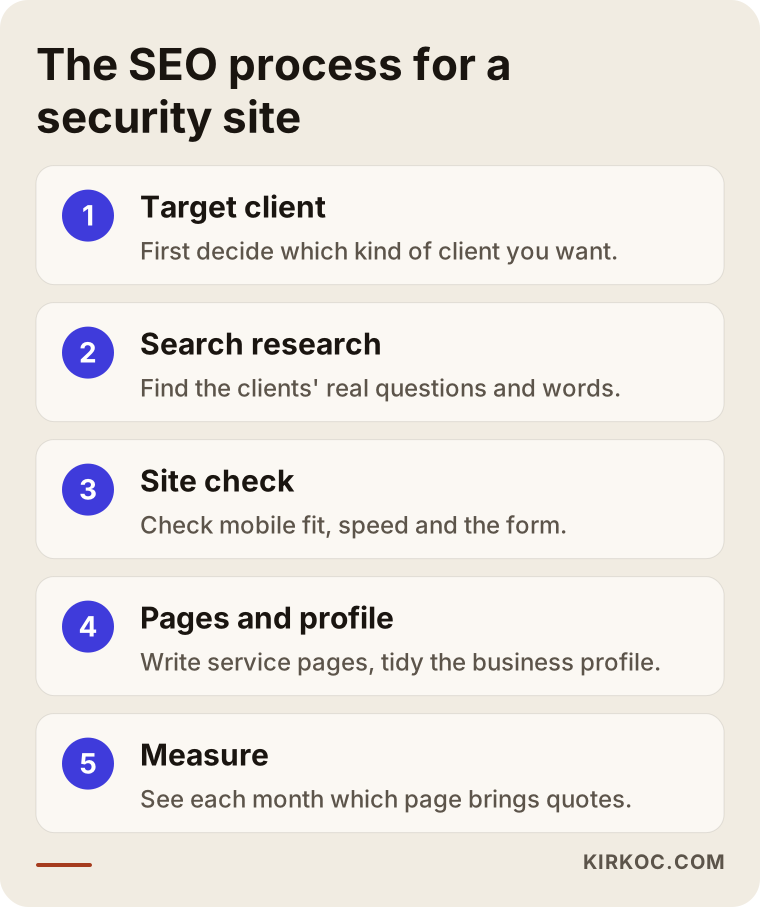
The process looks linear, but in practice it is a loop: measurement shows you which page works, and you choose the next page accordingly. That is why, instead of trying to do everything in the first round, it is healthier to start small and learn.
The path from visitor to quote request
A visitor arrives at your site. Some of them look at a service page, some read the trust section, and a much smaller number fill in the form. Someone drops off at every stage. The job of SEO is not only to enlarge the first stage. It is also to shrink the losses in the later stages. The way to get more quote requests from the same number of visitors is to make the form and the page easier to understand.
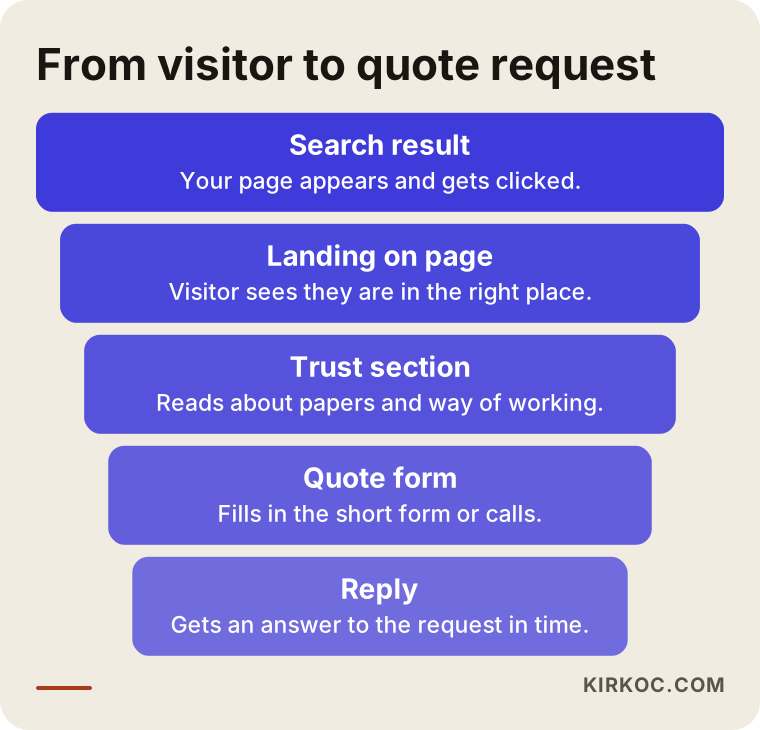
Each narrowing in the funnel points to a question. Does the page say what I was looking for? Can I trust this company? Is the form easy? You can look at your own site with the same eyes.
The quote form: small details make a big difference
For a security company the quote form is a part that has to be thought through together with SEO. A very long form that demands detail wears out a property manager who is in a hurry. A very short form brings you too little information. The balance is this: name, organization, phone, type of service, location and a short note are enough. Details such as a floor plan or the number of guards you need can be collected during the site assessment.
Add one sentence next to the form: "We reply to your request within one business day." If you really do reply, that sentence builds trust. If you cannot, do not write it. Also be reachable by phone: in this field many buyers prefer to call rather than write. A phone number that can be tapped to call on a mobile device is a simple but valuable detail.
Count the requests you receive and note where they came from. Did the person who filled in the form come from Google or from your business profile? Without that information it is hard to tell whether SEO is working.
Common mistakes
These are the mistakes I see most often in this field. Most of them are simple and fixable.
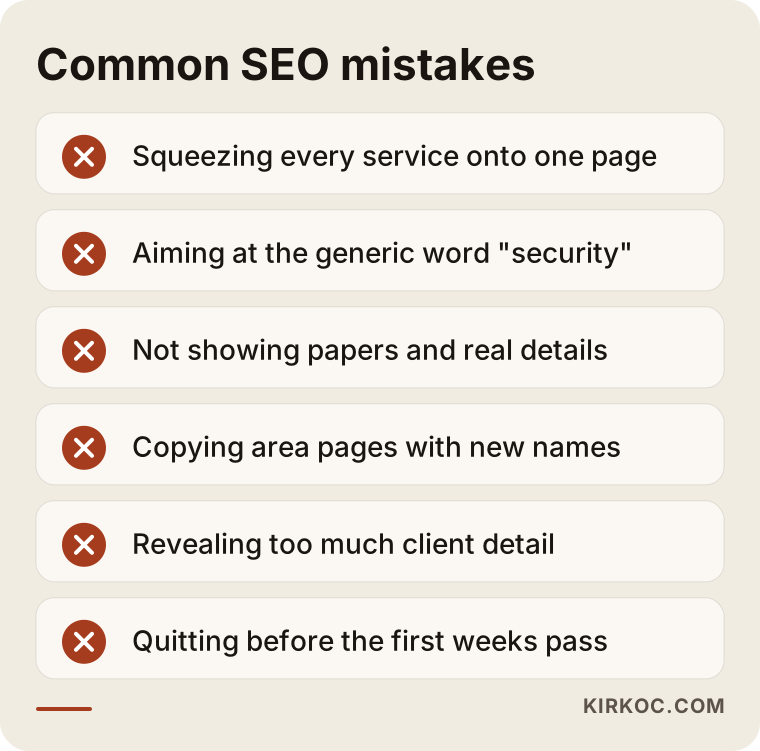
Let me unpack them a little. Explaining everything on one page is the problem I discussed in the first section. Writing for the generic word "security" also draws in job seekers and training seekers, not commercial clients. Not showing licenses and real details raises suspicion in the buyer. Copying the same page for every area looks worthless, as I described earlier. A site that does not work on a phone is a problem because many managers collect information from their phones. Giving up when there are no results in the first weeks is a mistake because SEO does not mature in a few weeks; it often takes months, and knowing that in advance reduces disappointment.
There is also one trap specific to the security business: giving too much detail in a client reference. Writing details that expose a client's security arrangements harms the client and your own reputation. Stay general in references and keep the detail for the proposal meeting.
What can you do yourself?
You do not need an expert for everything. There is a lot you can do on your own, and these things noticeably affect results.
- Search for your own company and your competitors on Google the way your client would, and look at what comes up.
- Fill in your business profile (the Google Maps card) completely: address, phone, hours, service areas.
- Make sure the address and phone number on your site are the same everywhere.
- Write down the five questions your clients ask most often and answer them on your site.
- Open your site on your own phone and fill in the quote form once. Does the request reach you?
- Work out with an attorney how your licenses and certifications can be shown correctly under the rules that apply to you.
These steps work on their own, but beyond a certain point they take time and technical knowledge.
When should you get help from a specialist?
The decision chart below summarizes when it makes sense to bring in a specialist.
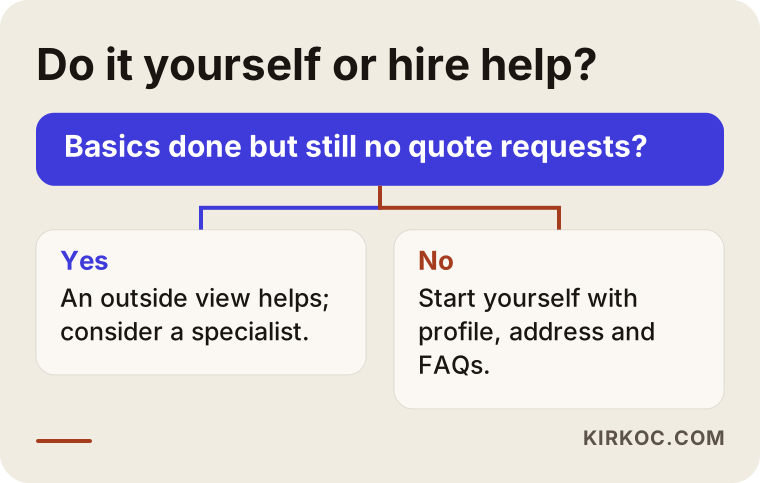
The general rule is this: if you have set up the basics and still no quote requests arrive, or if you do not know which pages are missing, an outside view helps. Technical problems (site speed, wrong redirects, language versions), planning a large number of area and service pages, and setting up measurement are usually specialist work as well. But even a specialist cannot do what you have to do: you know your field, the reality on the ground and your clients' questions better than anyone. A good engagement combines your knowledge with the specialist's method.
What decides the cost?
I will not give a number, because every site is in a different situation. But I can tell you what decides the price. The current state of your site: is it being built from scratch, or is there a site to fix? How many types of service and how many areas need pages. How strong the competition is: competing for a general search in a big city is a different workload from competing for a clear search in a small area. The amount and depth of content to be written. Whether more than one language is needed. And whether the work is a one-time project or a regular monthly one.
When you receive a proposal, check whether the tasks are written down and in order, who will do the work, and whether the site and accounts are in your name. Be careful with any proposal that guarantees a ranking, because neither I nor anyone else controls what Google shows.
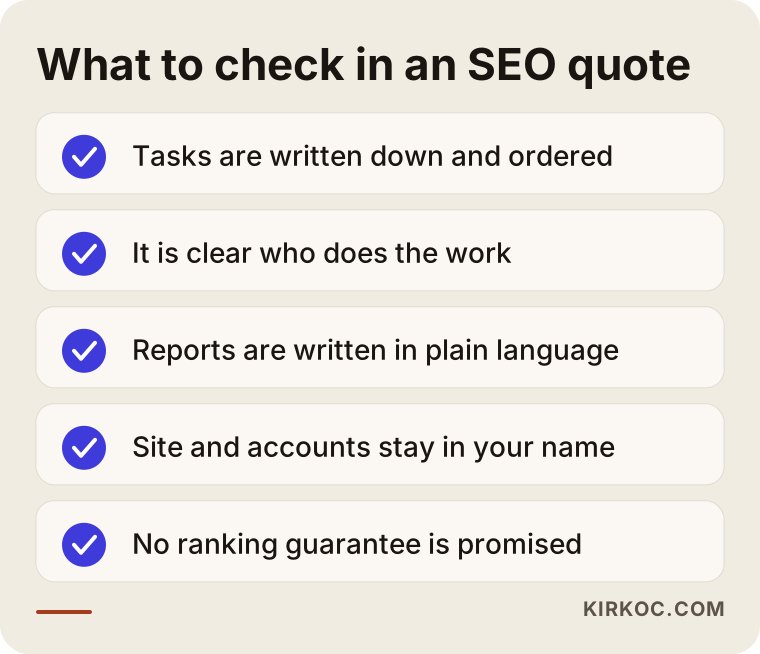
A written task list protects you, because it is clear what will be done and when. A plain report helps you understand the results; it is hard to decide anything from a report you do not understand.
How I work
I work alone, which means the person you talk to is the person who does the work. First I do a short review of your site and your competitors and tell you where it makes sense to start. Then I give you a written plan for the first months, in priority order. I remove the obstacles on the site first, and then I prepare pages and articles for the target searches. Each month we look at the results together and update the plan. You are always the owner of the site and the accounts. Because my capacity is limited, I do not take on many clients at once, which means I can speak with you directly at every stage of the work.
You know your industry better than I do, and I know how search engines work and how to build a site around that. Good results come where the two meet. This is not a guarantee of results. It is simply a sound method.
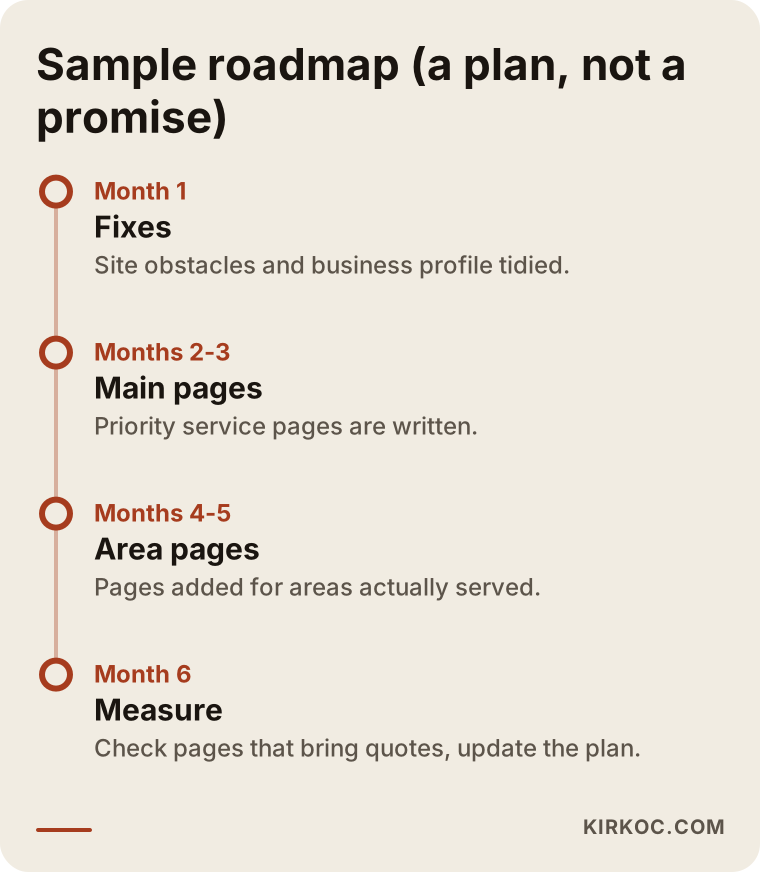
The roadmap is also not a promise but an example of a plan. Every site moves at its own pace; some things have an effect sooner and some later. What matters is that at every stage it is clear what is being done and why.
Frequently Asked Questions
Do security guard companies really need SEO?
If some of your clients find you through referrals, you may not feel the need right now. But commercial buyers almost always research online before deciding. Not being visible there can mean never making it onto the quote list. So it is not mandatory, but it helps a lot if you want to grow.
I have a website. Why am I not showing up on Google?
The most common reasons are these: your site may explain everything on one page, the service and the area may not be clearly written, the site may be slow or broken on a phone, or your competitors may have clearer pages than yours. I can tell you the real reason after looking at the site and the searches; I do not guess from a distance.
When will I see results?
I cannot give an exact time. Often the first meaningful movement shows up within a few months, but it varies with competition and the state of the site. I suggest being careful with anyone who guarantees a ranking.
Should I run ads or do SEO?
With ads, you are visible as long as you pay. SEO builds a setup that keeps working for a long time once it is in place. They do not exclude each other. If you need quick results, think about ads; for a lasting setup, think about SEO. The decision depends on your budget and your goal.
Can I use client references on my site?
Using a client's name requires their written permission. Without permission you can use anonymous, general descriptions. And I would suggest never writing details that would reveal a client's security arrangements, even if the client agrees. For legal details, talk to an attorney.
Do I have to show my licenses and certifications on my site?
I cannot say anything definite about what is required; please ask an attorney. From the SEO and trust point of view, one of the first things buyers ask is whether the company is licensed, so showing it openly works in your favor.
I serve several cities. Should I open a page for each one?
Yes, for places you really serve and where you can say something specific about that place. Copying the same text and swapping the city name does not work and may even hurt.
Which brings more business, a quote form or a phone number?
Both are needed. Some buyers prefer to write and some prefer to call. Make both easy and note which way each request came in; over time you will see which one works better for you.
If you want to get more qualified quote requests from your security company's website, you can read how I work on my SEO services page and get in touch. Let us look at your site together and talk openly about where to start.