You own a hardware store or a building supply yard. For years you have stood behind the same counter serving the same contractors, handymen and homeowners. Lately something has changed: people look at their phones first and walk through your door second. Some never walk in at all. They type "stainless steel bolts m8 wholesale" or "waterproofing membrane price" and order from the first site that comes up. That is why SEO for hardware stores and building supply dealers is no longer a "nice to have." SEO, in one sentence, is the work that makes your website show up on Google when your customers search. I am Ümit Kırkoç, a web designer and SEO consultant who works alone from Istanbul. In this article I explain how the work differs in your trade, where to start, and where my own SEO services might help.
One thing up front: SEO for your trade is quite different from SEO for a hair salon or a law firm. You carry thousands of product types, and your customers include homeowners, tradespeople and job-site managers. They all search with different words. I will take that apart piece by piece below.
Why are hardware and building material searches different?
A person who walks into a hardware store usually knows exactly what they want, or they hold up the old broken part. Online, they cannot hold up the part. They have to describe it in words. So searches are either very technical ("M10 x 80 steel anchor") or very everyday ("the thing you hammer into a wall to hang a shelf"). Two different people will reach the same product in ten different ways.
You can roughly sort searches in your trade into three groups. The first is product searches: "silicone caulk," "window gasket," "door hinge." The second is problem searches: "how to stop moisture on a bathroom wall," "wooden door sticks, what to do." The third is local searches: "hardware store near me," "building supplies wholesale in my town." Each group needs its own kind of page and its own approach.
The illustration below uses a completely made-up search to show what the result can look like.
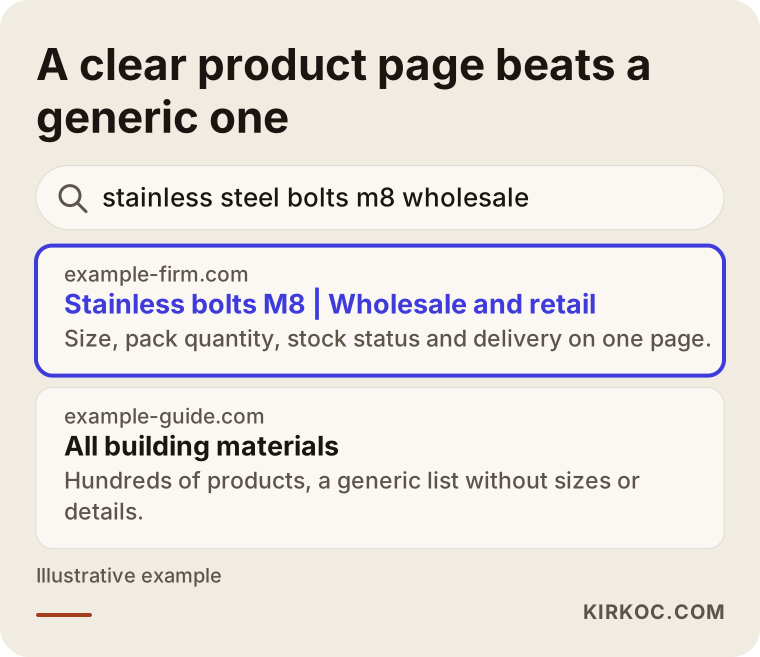
The difference in the highlighted result is that it names the product, the size and the availability in the first line. A generic "all building materials" page cannot do that job. Google tries to work out which answer suits the person searching. If you make that easy, your chances of being shown improve. There is no guarantee, but writing a clear page is the one foundation that always pays off.
The homeowner, the tradesperson and the contractor do not type the same words
Picture three customers for the same product. A homeowner fixing a faucet types "how to replace a faucet washer." A plumber searches "plumbing washer assortment wholesale." A purchasing manager on a job site types something like "50 faucet supply lines quote." All three could shop at your store, yet one page cannot answer all three in the same way.
The good news is that you do not need three websites. On a product page, a short "how to use it" section can speak to the homeowner, while a "contact us for bulk orders" section speaks to the tradesperson and the contractor. One page can serve several intentions.
Store, online shop, or both?
For many hardware and building supply dealers the real question is: should my site just say "my shop is here," or should it actually sell online? The answer depends on your inventory and your ability to deliver. If you carry thousands of items, you do not have to sell all of them online. It is healthier to start with the hundred items that are asked about most and are easiest to ship, then widen the range slowly.
You can divide your site's jobs like this. Some pages simply say "I have this in stock, come and pick it up." Some say "order now and we will ship it." Some say "request a quote for a bulk purchase." All three can live on the same site, as long as the visitor never confuses which is which.
How does a visitor move through your site?
What does a customer do after arriving from Google? First they find the product. Then they wonder about price or stock. Next they decide whether they can trust you. Finally they either add it to the cart, pick up the phone or look for your address on the map. Knowing this path tells you what to put on each page.
The illustration below shows the path as four steps that narrow from a broad search to a real order.
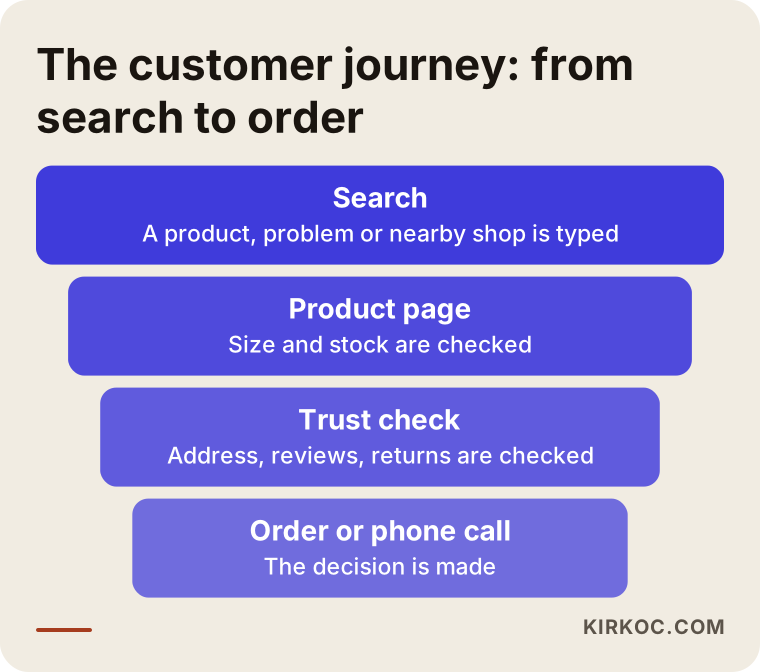
You lose people at every step of that narrowing. If the product page is thin, they leave at the second step. If the site does not feel trustworthy, they leave at the third. So SEO is not only about "getting onto Google." Keeping the visitor once they arrive is half of the work.
As I said, searches split by type. To see at a glance which search maps to which page, I prepared the table below.
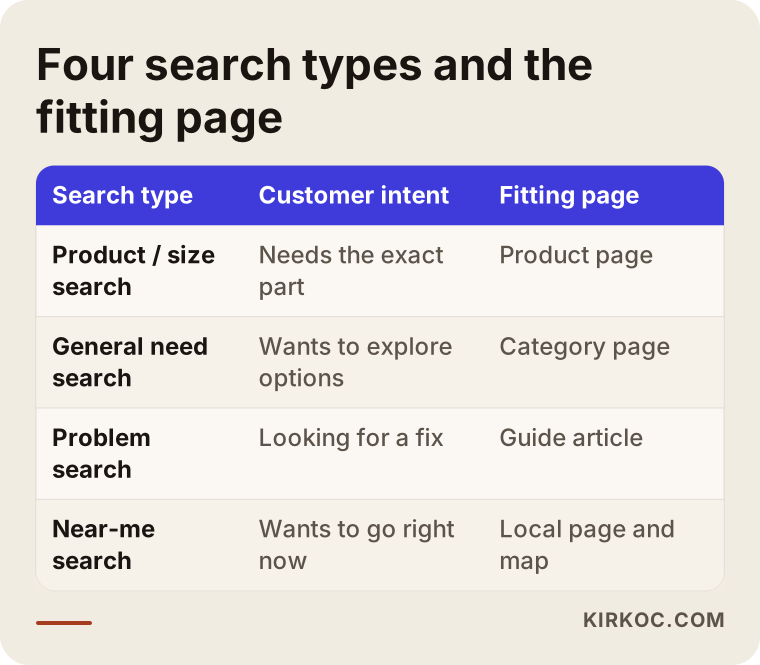
When you read the table, notice this: "near me" searches go to map results, size and model searches go to product pages, and "how do I" questions go to guide articles. Trying to stretch one page across all three intentions usually means it is strong at none of them.
Which pages does your site need?
Think of the pages on your site as three layers: category pages, product pages, and guide or local pages.
Category pages
These are the broad headings: "power tools," "paint and primer," "fasteners," "waterproofing materials." A category page should not be just a list of products stacked one under another. At the top it needs two or three sentences that introduce the category and explain which product does what. At the bottom it can carry two or three common questions, such as "What is the difference between the types of silicone?"
Category pages are very valuable in your trade, because people often type a general need instead of a specific model: "plumbing supplies," "painting supplies." The way to show up for those searches is to make the category page genuinely useful.
Product pages
The most common mistake I see among hardware sellers is a product page made of one photo, one name and one price. A good product page says what the product is, which sizes it comes in, what job it is used for, what it is compatible with, and what comes in the package. These details may seem ordinary to you. For the person searching, they are the decision itself.
The illustration below summarizes what a product page should contain, in a short list.
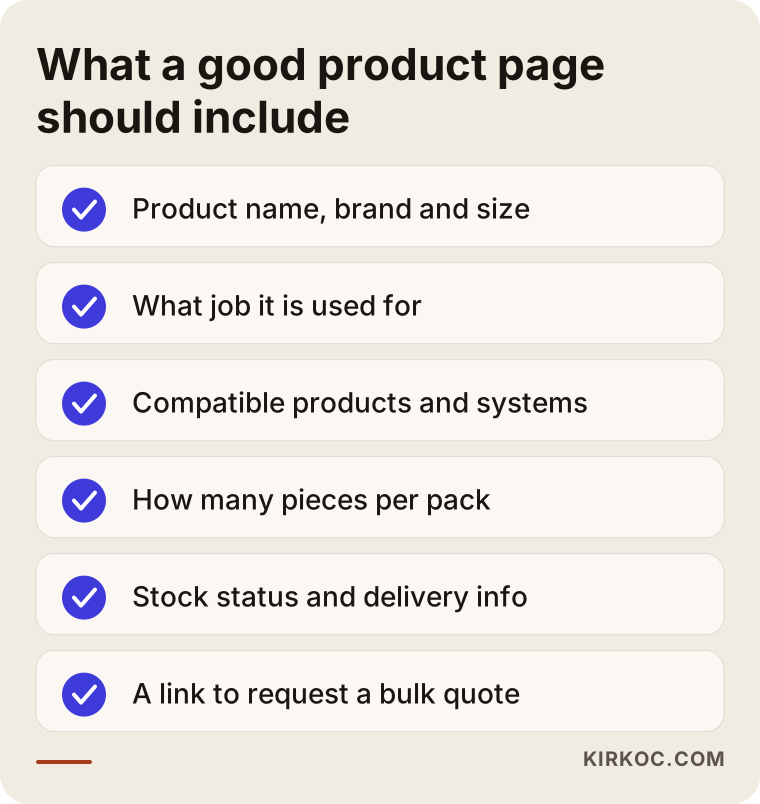
Every item on that list matches a type of search. The "size" item catches model searches, the "use" item catches problem searches, and the "stock and delivery" item serves the customer who says "I need it now." Writing all of this for every product takes time, so I suggest starting with your best sellers and the products people ask about most.
Guide pages and local pages
When a customer has a problem, the first thing they look for is not a product but a solution. Short guides that answer questions like "how to stop moisture on a wall," "what to do when a door lock jams," or "what insulation goes on a flat roof" reach people who are not ready to buy yet but are close. Do not push a sale in these articles. Explain honestly, then point to the related product.
Local pages serve the neighborhood or town where your store sits. For someone searching "building supplies in [your town]," your page needs to state your address, your opening hours, your parking situation and your delivery area. These look very simple, but they are the strongest signals that tell both Google and the customer you are a real store.
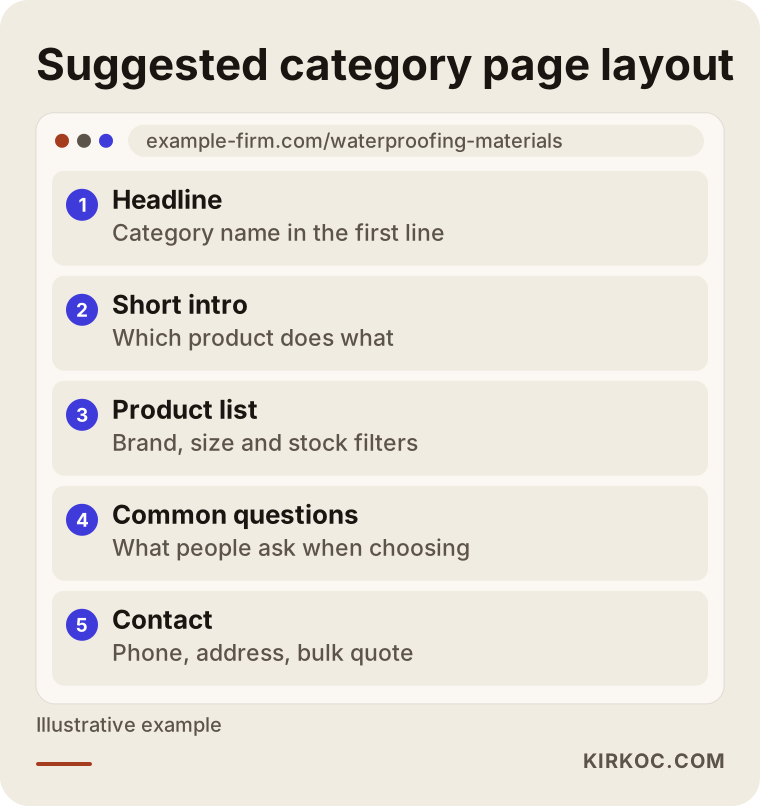
The illustration above shows how a category page can be organized. A short introduction sits at the top, a filterable product list in the middle, and common questions with contact details at the bottom. This layout answers the question "what is this page about" quickly for both the visitor and Google.
How do you balance the store and online sales?
The biggest worry for a seller with a physical store is: "If I start selling online, will I lose the customers who come into the shop?" Usually you will not, because the two channels tend to attract different people. The person who walks in has an urgent need, or wants to hold the product in their hands. The person who orders online either plans ahead or has no time to come to the store. Set up properly, the two feed each other.
The illustration below puts the strengths and cautions of the two channels side by side.
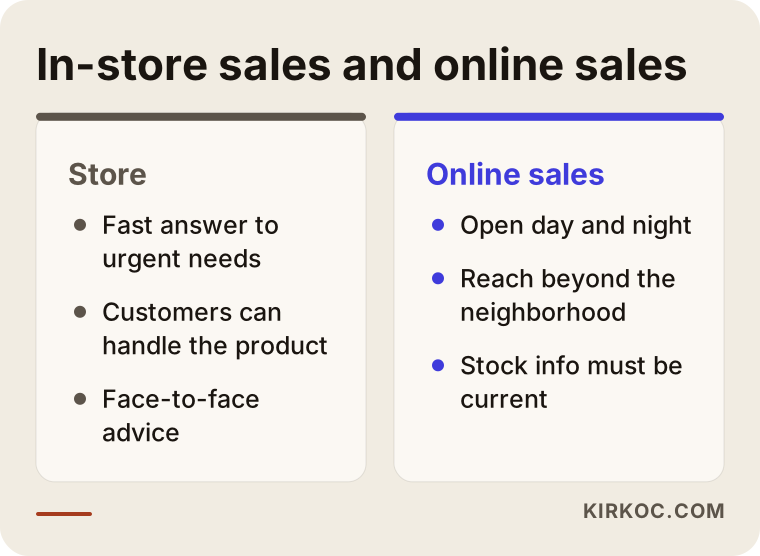
The takeaway is that the store brings trust, quick handover and advice, while online brings reach and the advantage of being open day and night. The most practical way to combine the two is to offer "pick up in store" on the product page. You collect the order without shipping headaches, and the customer walks in and notices the other things they need.
Why does stock accuracy matter so much?
The most common complaint in hardware and building supply is that the product shown on the site is actually out of stock. If a customer calls you and hears "we sold out of that," they will not call again. So you either have to keep stock information truly current, or use an honest line such as "call to check availability." Wrong information does more harm than no information.
If you can connect your inventory software to your website, that makes the job much easier. If you cannot, set up a manual update routine for your best sellers. What matters is that what the site says and what is on the shelf stay consistent.
Example scenario 1: The neighborhood hardware store
This is a hypothetical example, not a real business. Imagine a hardware store that has operated for twenty years in a busy residential district. The owner is well known by the local tradespeople and property managers, yet the store is almost invisible online. There is either no website, or a one-page business-card site with a phone number and an address.
The first step is to write down, in an orderly way, what the store sells and whom it serves. Short separate pages are prepared for the main headings: plumbing supplies, electrical supplies, paint, hand tools and key cutting. On each page, the district name, address, opening hours and phone number appear naturally. The Google Business Profile (the free listing that shows your shop on the map) is filled in completely, with photos, hours and product categories.
The second step is three or four guide articles answering the questions this neighborhood asks most: "What to do when a faucet drips," "Which measurements to take before replacing a door lock." These articles bring in visitors from problem searches and show that the store knows its trade.
What happens next? I cannot guarantee a result. The expected outcome is to appear more often in neighborhood and map results over time, and so to see more phone calls and store visits. Local work like this usually matures over months, not weeks.
Example scenario 2: A building supply company that sells to contractors
This is also a hypothetical example. Imagine a building materials company that sells paint, tile adhesive, insulation and hardware both at retail and in bulk to tradespeople and contractors. They have a website, but the product pages are short, there is no price information, and the "request a quote" button is hidden at the very bottom of the page.
The problem is that the site talks to two different customers in the same voice. The fix is to open a separate section titled "For tradespeople and contractors." It explains bulk purchase terms, how delivery works, whether they can deliver to a job site, and has a clear quote form. On the product pages, details that tradespeople look for are added: quantity per pack, pallet information and technical data sheets.
The guide content is written around the tradesperson's questions too: "What to consider when choosing a tile adhesive," "Which insulation system suits a flat roof." To avoid making a wrong technical claim in these articles, you refer to the manufacturer's data sheets, and where you are unsure you tell readers to consult a qualified professional.
The expected gain in this scenario is clearer visibility for commercial searches like "wholesale," "bulk order" and "quote," and enquiries that are better qualified. Again there is no guarantee, but a site that fits the business model is worth far more than one that collects random traffic.
A step-by-step process: where do you start?
Putting the SEO work in order saves both time and budget. This is the order I suggest for hardware and building supply.
The first step is to see where you stand. How many product pages does your site have, which ones appear on Google, and which searches bring visitors? Even free tools can show you part of this. The second step is to pick your target searches: start with the products you sell most and earn the most from, and make a list. The third step is to check the technical foundation: speed, mobile fit, a secure connection and broken pages. The fourth step is to tidy up category and product pages. The fifth step is to add guide content and local pages. The sixth step is to measure and correct.
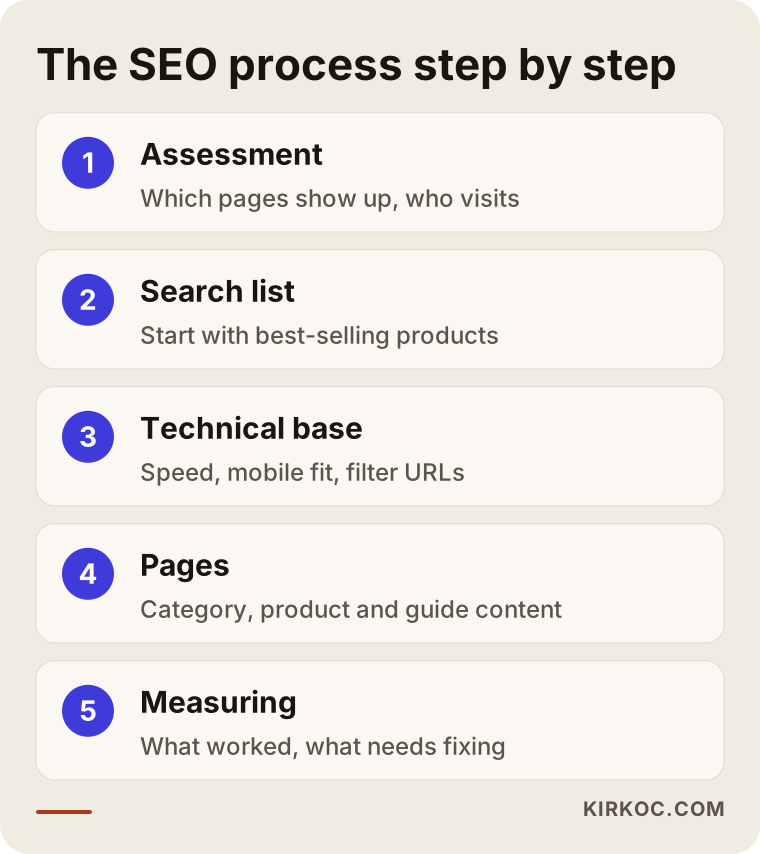
The illustration above summarizes that order. Notice that it is deliberately "foundation first, content second." Adding content to a weak foundation is like painting a crooked wall: it looks fine for a while, but causes trouble in the long run.
The technical foundation: the part nobody sees but everybody feels
Sites in this trade usually hold a large number of products, so technical problems multiply. A common one is that separate pages are created for each color and size of the same product. Those pages look very alike, and Google gets confused about which to show. Another is the countless web addresses created when someone uses a filter: color, brand and price filters can produce hundreds of pointless pages. You have to set up correctly which of those pages Google should see and which it should skip.
Another topic is speed. If product photos are too large, pages open slowly. Someone checking a product on their phone at a job site or in the aisle will leave rather than wait. Compressing photos, using them at the right size and clearing out unneeded plugins are simple but effective steps.
Timeline: what to expect and when
SEO does not deliver fast results. It is not like advertising, where you pay today and get traffic tomorrow. Still, knowing what should happen in the first months makes patience easier.
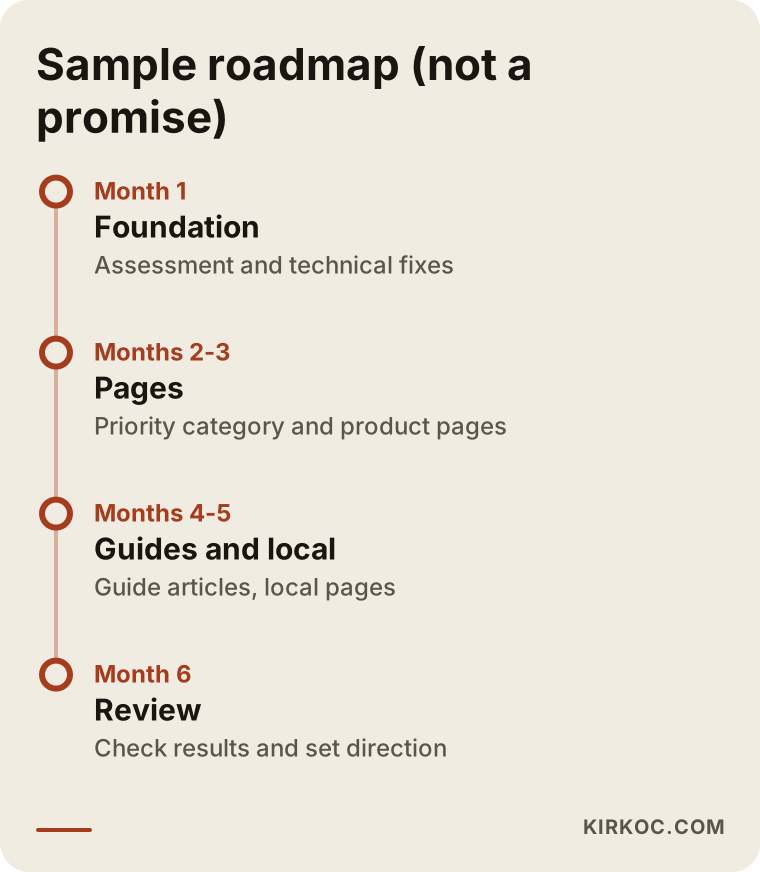
The chart is a rough roadmap, not a promise. The age of your site, the strength of competitors, how busy your area is and the quality of the work all change the timing. In the first months, technical fixes and page writing are usually done, and results typically begin to show later.
What are the common mistakes?
Most of the mistakes I see in this trade do not come from bad intent but from the thought that "this is how everyone does it anyway." Below I list the most common ones.
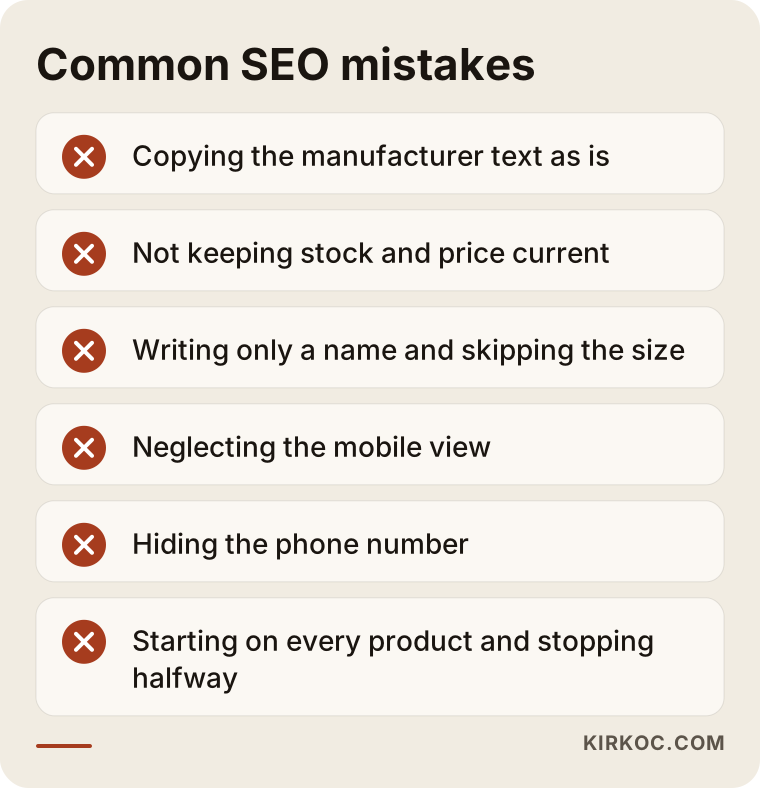
At the top of the list is copying the manufacturer's description word for word. Because hundreds of sites use the same text, Google cannot tell you apart. Rewriting the text in your own sentences, around your own customers' questions, works far better. The second big mistake is failing to keep price and stock current. The third is writing only the product name and moving on: when size, use and compatibility are missing, the product falls behind in searches. The fourth is neglecting the mobile view; the tradesperson on the job site is usually looking on a phone. The fifth is hiding contact information; on a site where the phone number is hard to find, tradespeople will not wait, they simply go elsewhere.
There is also the "do everything at once" trap. If you try to touch thousands of products at the same time, you will stop halfway and do none of them well. Starting with your hundred best-selling or most profitable products is a far more realistic path.
Trust signals
In hardware and building materials, the product is often expensive and unforgiving: the wrong insulation material or the wrong fastener can lead to a big expense. So the customer cares about whether they can trust you as much as about the product itself. Your site should show real photos of the store, an address, a map, opening hours, return and exchange terms and, if you have them, authorized dealer certificates. If you collect customer reviews, encourage real reviews on your Google Business Profile, but never have fake ones written. It is unethical, and it puts you at risk.
What can you do yourself, and when do you need an expert?
You do not have to hand everything to an expert. Some jobs you can do yourself, and for others getting help is more sensible.
Start with what you can do yourself: fill in and keep your Google Business Profile up to date, write your opening hours correctly, take photos of the store and the products, ask customers for real reviews, and jot down the questions you hear most often in a file. These cost little or nothing and have a direct effect.
Expert help makes sense in these cases: your site has thousands of products and a tangled technical setup, you are thinking of redesigning the site or changing platforms, competitors have left you far behind, or you have been working on it alone for months without results. Mistakes made during a site move in particular can wipe out the visibility you already have, so working with a specialist at that stage is much safer.
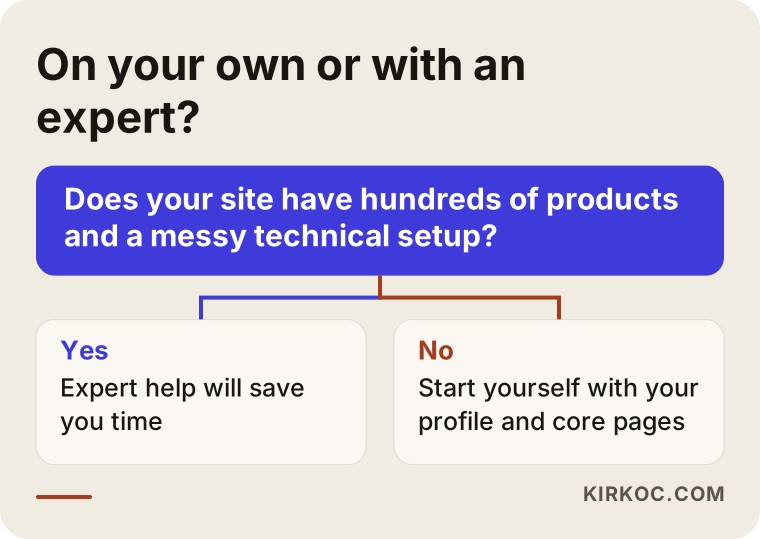
The decision tree above is meant to help you weigh your own situation quickly. If one of your answers is "no," that does not mean you must hire an expert right away. It only shows that getting help on that point could save you time.
What determines the cost of SEO work?
I will not give figures in this article, because the factors that set the price vary a great deal in this trade. But I can tell you what raises and lowers it.
The first factor is the number of products. The workload for a site with fifty products and a site with ten thousand is very different. The second is the current state of the site: a cleanly built site and one that has grown for years through add-ons, with technical leftovers, do not need the same effort. The third is competition; product groups with heavy competition need longer and more intensive work. The fourth is the area you target: one town, a whole metro area, or the entire country? The fifth is how much content is needed: how many guides, category texts and product descriptions will be written? The sixth is the length of the engagement: a one-time cleanup and an ongoing advisory arrangement are different line items.
When you ask for a quote, insist on clear answers to "what will be done, when, and how will it be measured." Be careful with offers that only say "we will put you on the first page," because nobody can guarantee rankings.
How I work
I work alone, which means the person you talk to is the person who does the work. Usually I begin by looking at your site and your trade, and I tell you in plain language what is missing. Then we set priorities together: which product groups first, which areas, which pages? Throughout the work I explain what I am doing and why, and if I use a technical word I tell you what it means. I also share results honestly, so we see together what worked and what did not.
Let me add one more thing: SEO may not be the right answer for every business. If your product has no search demand, or your business rests entirely on one-to-one relationships, I will tell you so plainly. My aim is not to sell you work you do not need, but to find a path that actually helps your business.
Frequently asked questions
Does a small hardware store need a website?
In most cases yes, but it does not have to be big or complicated. A simple site that clearly lists your address, opening hours, product groups and phone number, together with your Google Business Profile, makes a real difference. You can grow it later as needed.
Do I have to write up thousands of products one by one?
No. Start with your best sellers and your most profitable products and add the rest over time. Grouping similar products and using a shared description area can also save time, as long as each page has different size and use information.
Should I show prices on the site?
That depends on your business model. If you sell at retail, showing prices usually builds trust. If you sell in bulk and the price depends on quantity, a "request a quote" approach can make sense, but then you must make the quote process easy and fast.
Why do I need my own site when marketplaces like Amazon exist?
Marketplaces are a strong sales channel, but the customer stays the platform's customer, not yours, and competition mostly comes down to price. Your own site lets you keep your brand, your local customers and your relationship with tradespeople under your own control. Using both together is also possible.
How long until I see SEO results?
I cannot give an exact time; it depends on the site, the competition and the work done. Usually the first months go to the basic cleanup and clearer results show up later. For local searches and niche products the time can be shorter, and for broad, competitive searches it can be longer.
What should I do to appear in AI-based search tools?
Tools like ChatGPT also look for reliable, clear and well-organized pages when they answer. Writing your product information openly, giving honest answers to common questions and keeping your contact details consistent are the same basic steps that help you there too. Here as well, no guarantee is possible.
Will I lose visibility when I redesign my site?
If it is not done correctly, you can. Old page addresses need to be redirected to the new ones, existing content should be kept, and the move should be checked afterward. I recommend getting help from someone experienced at this stage.
How important is mobile fit in this trade?
Very important. Tradespeople and job-site workers mostly search on their phones. A site that opens slowly on a phone, has buttons that are hard to tap or hides its contact details means a customer lost in the first seconds.
Conclusion and contact
SEO for hardware and building materials is the work of making visible a store that knows its products but cannot describe them online. If you would like to look at the current state of your site together and map out a path that suits you, you can reach me through my SEO services page. In a short conversation we can talk plainly about what can be done and what should not be done.