You are building a housing project, or you run a construction company. The land is bought, the permits are in, and construction may already be under way. Sales probably come from three places: people who walk into the sales office, referrals from real estate agents, and listings on the big property portals. But when someone types "new construction homes near me" into Google, can they find your project? That is the question SEO for home builders and housing developments tries to answer. I am Ümit Kırkoç, a web designer and SEO consultant who works alone from Istanbul, and in this article I explain the plain version of the work, which pages you need, and where hiring a specialist actually makes sense. For the general picture of what I do, you can look at my SEO services, but here I focus only on your industry.
SEO, in one sentence, is the work that makes your website show up when people search on Google and similar search engines. You pay for ads only while they run; with SEO, pages that are built well keep bringing you free visitors over time. But selling a home is not like selling a pair of shoes. A buyer thinks for months, comes back to your site many times, talks it over with family, and compares several projects. So your website's job is not to push someone to a shopping cart. Its job is to build trust and get the buyer into a conversation with your sales team.
How do home buyers search online?
A person thinking about buying a home does not start with one perfect sentence. The searches change over time. At the beginning, the search is broad: "new construction homes" or "new condos in my city." Then it narrows to an area: "new condos in Austin" or "townhomes close to downtown." Then comes comparison: "this builder's past projects," "reviews of this community," "builder warranty." At the very end, the buyer types your project name or your company name. Each stage needs a different page.
The illustration below shows roughly how those searches stack up. There are no numbers in it, because they depend heavily on your area and your project. What matters is knowing the order.
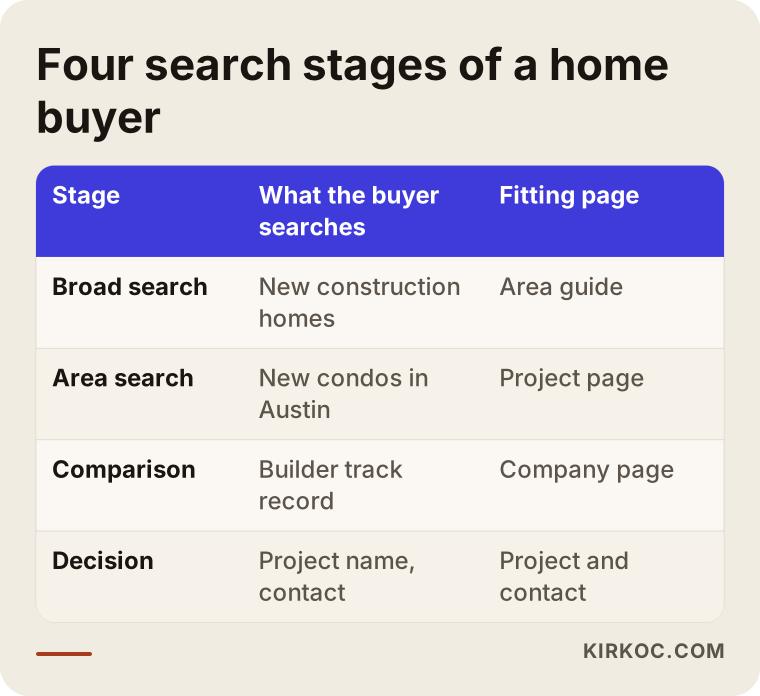
As the table shows, the big listing sites and national real estate portals are very strong on broad searches, and competing with them on those words is not realistic for most builders. But on area searches and project-name searches, where the buyer has almost found you already, it is entirely up to you whether your own website appears first with the right information. Starting SEO there is both the fastest and the most sensible route.
Why do you need your own site when listing portals exist?
It is a fair question. You advertise the project on a portal and the phone rings. But on a portal, the page does not belong to you. Your competitors sit on the same page, side by side, and the buyer's attention is one click away from another listing. You also cannot design the information there: you cannot show the floor plans in the order you want, update construction progress regularly, or present the history of your company the way you would like. On your own site, you control all of it. Portals and your website are not rivals. The listing brings the first contact, and your website convinces that person.
Buyers search for the company, not just the home
Someone buying a home is signing up for a very large payment that may last decades. That is why searches like "company name reviews," "company name completed projects," and "company name complaints" are so common. As a builder, you need to know what shows up when people search for you. If your site does not honestly show your past projects, delivery dates, and photos, whatever other people have written will fill that gap.
Which pages does a housing project need?
Many project websites are a single long page: a big image at the top, a few features below, a form at the bottom. It looks nice, but it is weak for search, because one page cannot talk about the project name, the neighborhood, the floor plans, and the company's history all at once. A sturdier structure gives every question its own page.
The project page: the heart of the site
Every project should have its own page. That page answers what is in the buyer's head: where the project is, how many buildings, how many homes, which home types are available, when move-in is, and what is nearby. Giving those answers at the very top of the page puts both the buyer and the search engine at ease.
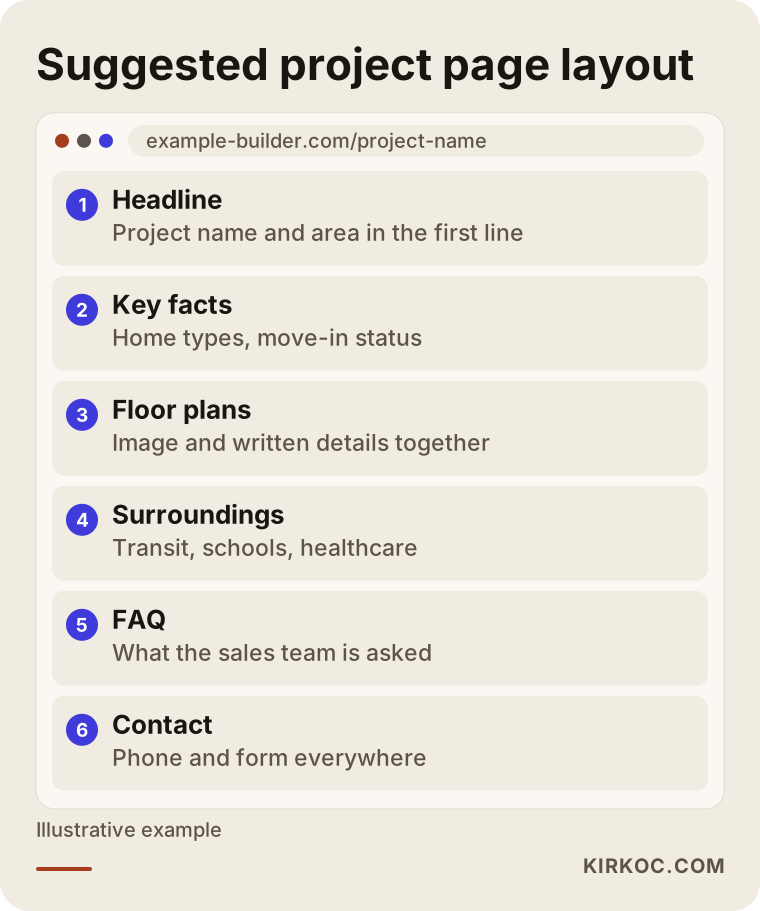
The outline above is not a rule, just an example of an order that works. The important points are these. The project name and the area should appear clearly in the page title and the first paragraph. Floor plans should exist as written details as well as images, because a search engine cannot reliably read text that is inside a picture. And the move-in status should be kept current.
Neighborhood and area pages
If a buyer searches "new homes in a particular neighborhood," a page describing that neighborhood helps. On it you share genuinely useful details: public transit, schools, healthcare, shopping, parks. The thing to watch for is copying the same text for every area and only swapping the neighborhood name. Search engines notice this and treat such pages as having little value. Write like someone who really knows the area: which road leads where, where the nearest train station or main highway is, and what the strengths and weaknesses of the neighborhood are.
Your company, past projects, and completed homes
The "About" page is often the one that gets the least care, yet for a home buyer it is one of the most visited pages. The story of the company, the people who run it, the projects you have completed, delivery dates, and real photographs belong here. A comment from a resident of a finished project, published with their permission, is stronger than hundreds of sales sentences. Never put someone's name or photo on the site without asking first.
The buying process and frequently asked questions
Buying a home feels frightening to many people: deposit, contract, financing, closing, move-in. A page that explains these steps in plain language gives the buyer confidence and also brings in people who search for information such as "how does buying a new construction home work." Be careful when you get into legal detail. Instead of making firm legal claims, describe the general process and say "talk to a real estate attorney about the specifics." Rules on home sales and advertising can change from time to time, so I recommend having your advertising and contract wording reviewed by an attorney.
The buyer's journey: what should your site do at each stage?
A visitor does not arrive at your sales office with one click. The path usually goes like this: they see your project in search results or an ad, visit your site, look at photos and plans, research the company, come back once more, and finally fill in the contact form or call. Some people drop off at every step of that path. Your goal is not to bring the drop-off to zero. It is to carry the people who are seriously interested all the way to the end.
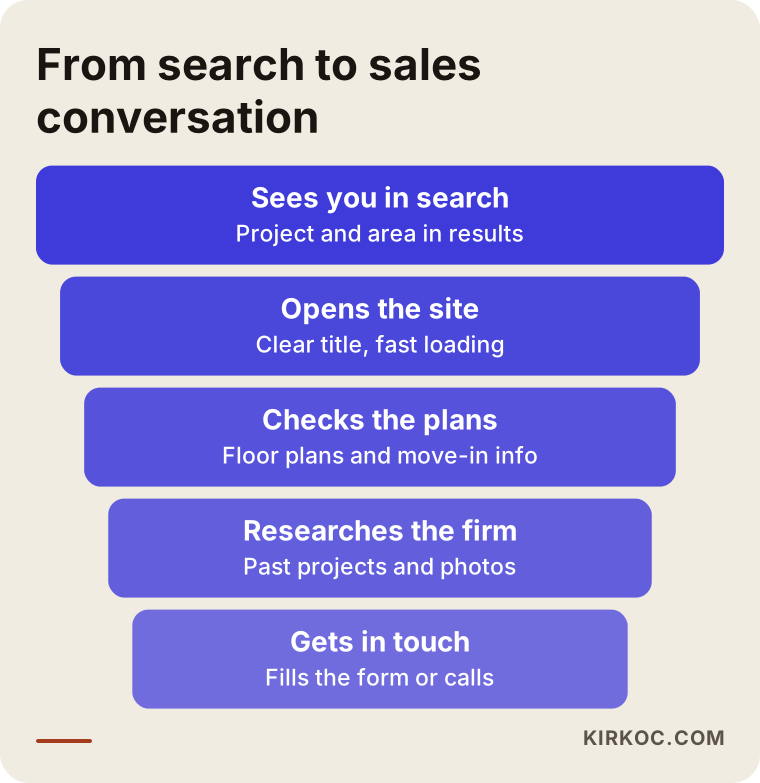
Seeing the funnel makes one thing clear. SEO does not only widen the top. By giving the right information along the way, it also makes each step easier. If a page has no floor plan, the buyer goes to another website to find one and leaves you behind. If your phone number is not visible, the person who wanted to call gives up.
How do you appear in search results for a housing project?
When there are several projects in the same area, which one gets chosen in search results depends largely on how clear the title and description are. Imagine an example search result. One result clearly states the project name, the area, the home types, and the move-in status. The other only says "Your dream life is waiting." The person reading picks the first, because they can see the information they were looking for.
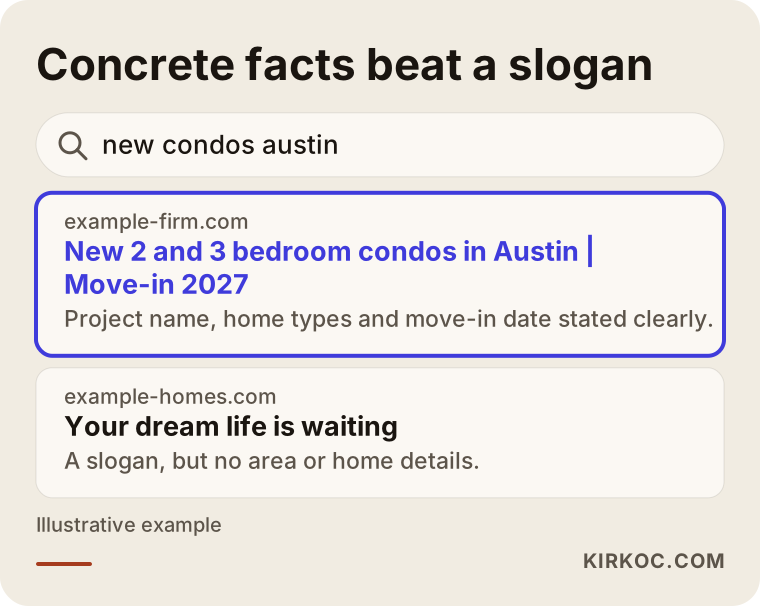
The title and description shown in search results are like your shop window. Writing concrete information instead of a slogan can help more of the right people click, and it reduces the number of wrong people who land on your site. No one can guarantee a result here, but the direction is clear: the more specific you are, the better.
Challenges that are specific to home building
A few real situations make SEO harder in this industry than in others. Knowing them in advance prevents disappointment.
What happens when the project is finished?
A project has a limited life. The homes sell, and the page seems unnecessary. What happens if you delete it? The value the page has built up disappears, and any links that pointed to it lead nowhere. A smarter path is to move the finished project into a "completed projects" section, update the page with a "completed" note instead of deleting it, and link from it to your new projects. That shows the history of your company and passes strength on to the new project. If technical details come up, I would plan this with you around how your site is built.
Information that keeps changing
The number of homes still available, the move-in date, and the promotions all change constantly. If old information stays on the site, buyer trust suffers and false expectations are created. Write down the items that need updating, and decide who updates them and how often. If possible, set things up so that this information is managed from one place on the site.
Image-heavy sites and speed
Housing sites use large photographs, renderings, and videos. If these are not optimized, pages load slowly on a phone. A large share of buyers visit from a phone, and a person waiting on a slow page often leaves without waiting. Uploading images at the right size and in the right format, and loading videos only when they are needed rather than when the page opens, are the basic jobs. Open your own site on your phone using mobile data and try it. You will often feel the problem I am describing yourself.
Regulations and advertising rules
The information that must appear in a home sales advertisement, and the wording you may not use, is set by law. I cannot give legal advice on this and it would not be right for me to try. I recommend showing the statements on your site about price, move-in dates, permits, and contracts to an attorney. On the SEO side I can say just one thing: everything written on the site must be true and current.
Two example scenarios
The scenarios below are hypothetical. They do not describe a real company or project. I made them up only to show how situations might look.
Scenario 1: A small builder with a single project
Suppose a builder is putting up one small condo building in a mid-sized city. The website is a single page made a year ago: beautiful, but thin on content. Most sales come through personal contacts and agents. So far, the site's only job has been to be the address on a business card.
A big investment is not needed to start here. The first step is making the site findable on project-name and area searches: the project name goes in the page title, home types and square footage are given as text, floor plans are downloadable, and the move-in date is stated clearly. The second step is to set up or fix the Google Business Profile, which is the free listing that shows your business on Google Maps, so the sales office address appears in map searches. The third step is one well-written neighborhood page describing the surroundings. This builder is not going to compete for "city new construction homes." They are competing for new-project searches in their own neighborhood. A result cannot be guaranteed, but the chance of appearing for the right searches improves noticeably.
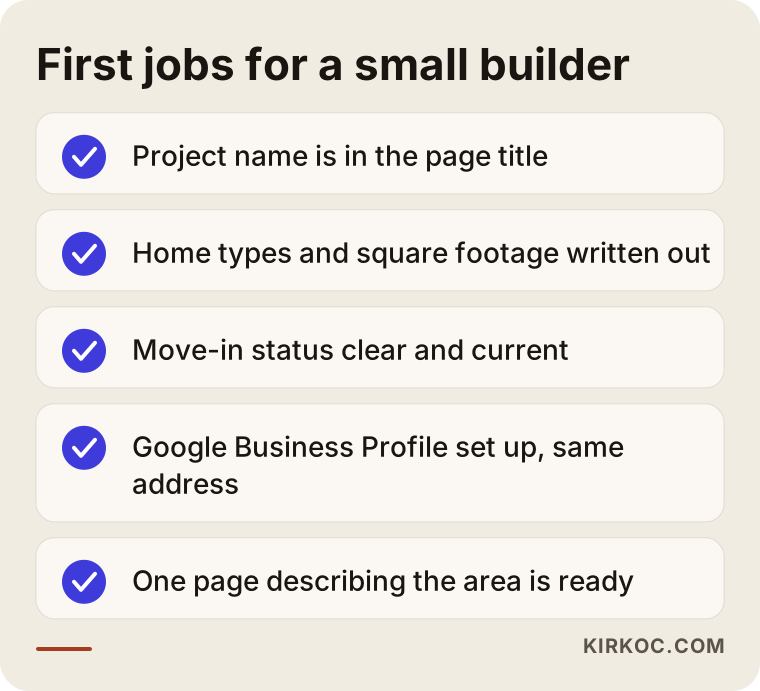
This checklist summarizes what a small builder would do in the first months. You do not have to finish everything in the same week. The order puts the items that make the biggest difference for the least effort first.
Scenario 2: An established company with several projects
In the second scenario, think of a company that has built homes for many years, has delivered dozens of projects, and has three different projects on sale at the same time. The site is large, but the project pages look like copies of each other: the same sentences, only the project name changes. The completed projects sit in a separate place, and in search results the pages overshadow one another.
Here the problem is not too little content but disorder. Every project has its own area, its own type of buyer, and its own strengths, and the pages should be rewritten to match. So that the three projects do not swallow each other, each should serve a different search: one for families looking for a home to live in, one for people looking at an investment, one for people looking at a specific neighborhood. The company's history should be collected on a separate, strong page. The project pages should also link to one another where that helps the buyer. For this company, SEO is not a one-time fix but regular upkeep: updating availability, launching new projects, and moving finished projects into the archive.
Step by step: how SEO for your housing project works
You do not need to see the process as complicated. At its core there are five steps, and in most businesses they go in the same order.
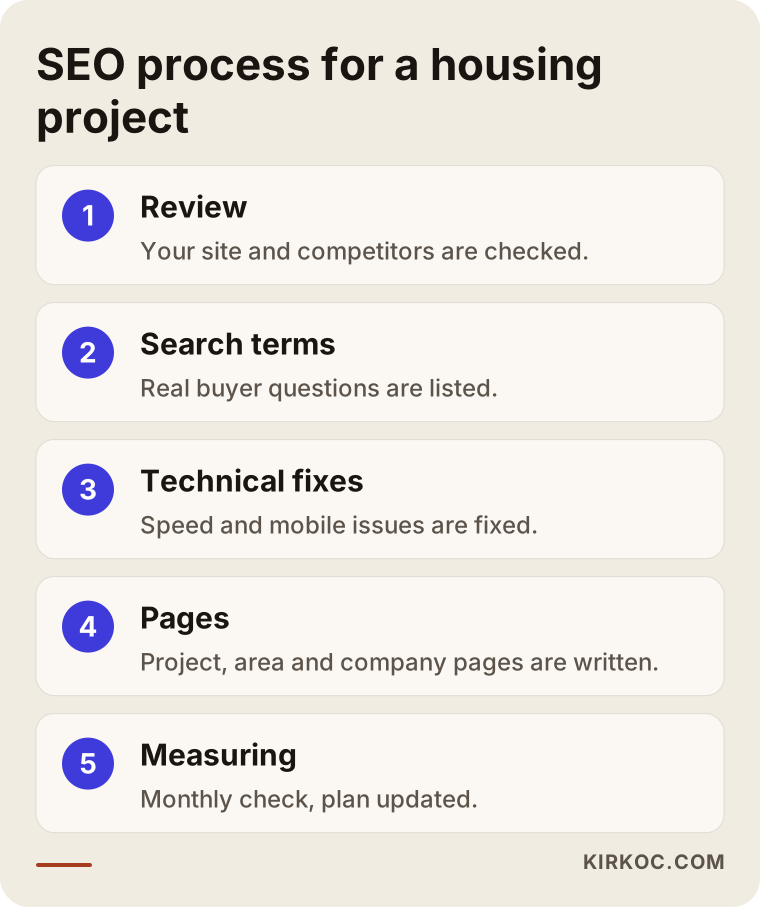
Each of these steps builds on the one before. Starting to write content without looking at the current site is like adding a floor to a building without checking the foundation. It may stand for a while, but the problem shows up one day. Let me explain each step briefly.
1. Reviewing where you are now
First, your site and your competitors are examined. What comes up when you search your project name? Who appears on area searches? Does your site have broken pages or slow loading on a phone? At this stage you change nothing yet. You simply learn where to begin.
2. Finding the search terms
You work out which phrases buyers really use. This is done with search data, not guesses, but what your sales team tells you is often just as valuable. What do buyers ask on the phone? "What are the HOA fees?" "Can I use my own mortgage lender?" "How far is the nearest train station?" These questions are ready-made material for both page titles and the FAQ section.
3. Technical fixes
The basics get fixed: page speed, mobile display, broken links, and whether search engines can crawl your pages. This part looks dull, but it is the ground that carries the results.
4. Preparing content and pages
Project pages, area pages, and company and process pages are written or renewed. Each page answers one intent. The descriptions of your photos and renderings are written properly so that the search engine understands what each one shows.
5. Measuring and regular upkeep
You track the forms and phone calls that come from your site, which pages they came from, and which searches bring visitors. A monthly look shows what works, and the plan is updated. In home sales, results can take months, and impatient expectations are the most common cause of disappointment.
How are AI searches changing things for home buyers?
Many people now ask an AI assistant instead of typing into a search box when they research something. For a question like "how do I choose a reliable home builder?" these tools give a short answer and sometimes name their sources. That means your company website should be organized not only for people but also in a way these tools can read. If you write your own content clearly, consistently, and accurately, the chance that an AI uses you as a source goes up. I do not promise anything about any specific tool, though, because how these systems choose is not fully known from the outside.

The answer in the illustration is made up for demonstration and is not real output from a real tool. What it shows is that in such an answer, criteria like company history, delivered projects, and open information come to the front. If your site presents that information in an orderly way, you become the right source for both human and machine readers.
Common mistakes on housing sites
Most of the mistakes I see are not complicated technical problems. They are simple oversights. The list below summarizes the most common ones.
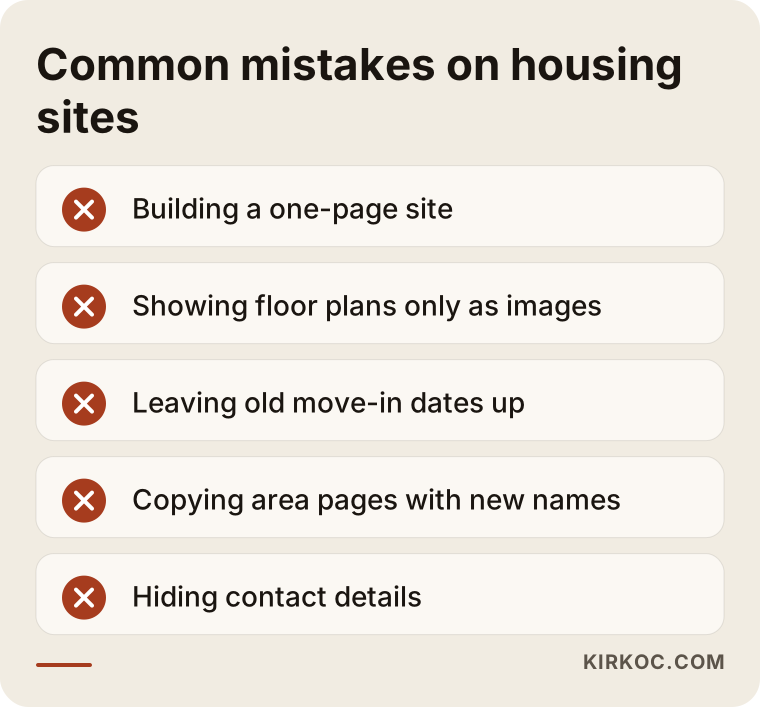
Let me go through each briefly, because some look harmless at first glance.
A one-page site. It looks good, but one page can answer only one search intent. The project, the area, the company, and the process cannot all fit on the same page.
Burying text inside images. Putting floor plans and feature lists only as pictures stops the search engine from reading the content. Use both the image and written text.
Leaving old information up. A page that says "move-in 2024" and has never been updated makes buyers distrust you.
Copying area pages. Swapping the neighborhood name and keeping the same text is easy in the short term and worthless in the long term.
Hiding contact details. Your phone number, address, and form should be easy to reach on every page. If a buyer wants to call right now and cannot find the number, they usually give up.
Expecting results too early. Stopping the work because nothing moved in the first weeks wastes the effort already put in.
What can you do yourself, and when do you need a specialist?
You do not need an expert for everything. The questions below can show you at which point getting help makes sense.
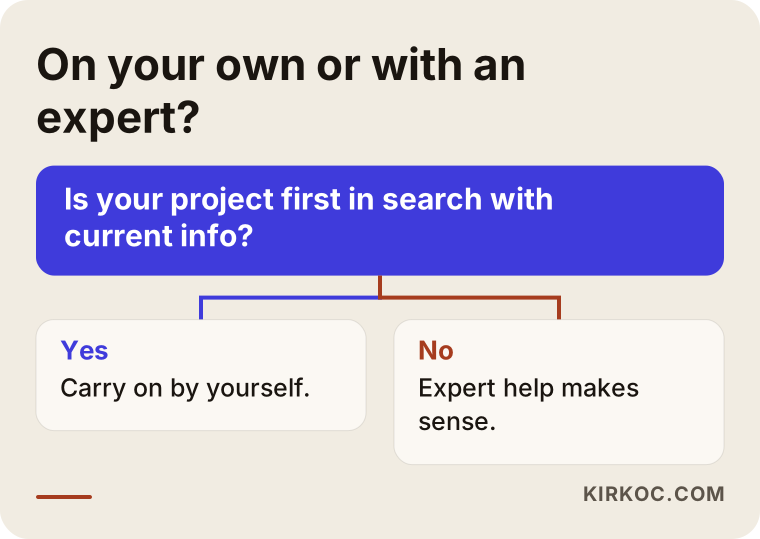
Let me explain the diagram briefly. If the information on your site is current, your project name comes first in search results, and inquiries arrive regularly, continuing on your own may be enough. Otherwise, expert help makes sense.
What you can do yourself
- Type your project name and your company name into a search engine and check the first page.
- Open your site on your phone. Do the photos load slowly? Can you tap the buttons?
- Collect the questions your sales team hears most often in one document, and turn them into the FAQ on your site.
- Set up your Google Business Profile so that the address, phone number, and hours match your website exactly.
- Gather photos and delivery information from your past projects.
- Decide who will keep the move-in date and availability current.
When a specialist makes sense
- You have several projects and the pages overshadow each other.
- Your site is slow, broken on mobile, or built on old technology, and you cannot fix it yourself.
- Competitors appear ahead of you on project-name and area searches and you cannot work out why.
- You are planning the launch of a new project and want the site built correctly from day one.
- You want a site in several languages, for example for international buyers.
What should you look for in a quote?
SEO quotes in the housing and construction industry can differ a lot from one another. Some simply say "we will get you on page one," and some present a long list of tasks. A few simple criteria can help you judge which one suits you.
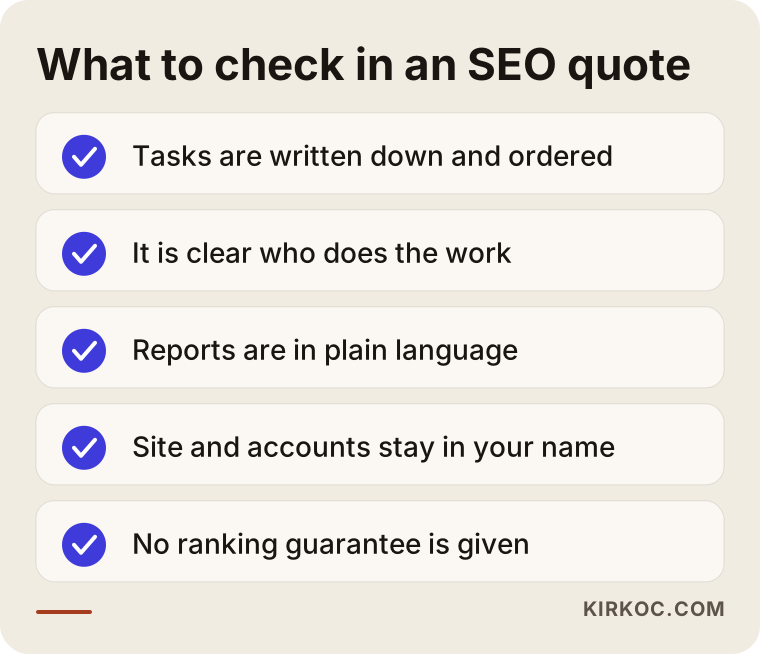
The most important item on this list is that no ranking guarantee is given. Only the search engine decides the results, and nobody can control that. A quote that offers a guarantee is either giving wrong information or acting carelessly. The second important point is that the site and the accounts are in your name. When the contract ends, you do not want to lose your website.
What determines the cost of SEO?
I do not give numbers in this article, because the scope of the work varies a great deal from project to project. The main things that determine cost are these:
- The current state of the site. Building a site from scratch is a different job from fixing an existing one.
- The number of projects. Each project needs its own page, images, and flow of information.
- Competition in the area. In heavily contested areas, more content and a longer period are needed.
- The amount of content. How many area pages, how many articles, and how many languages you want makes the job bigger.
- How often things change. If availability and promotion details change frequently, regular upkeep is needed.
- Photo and video production. Professional photography or renderings can be a separate line item.
- Length of engagement. A one-time fix and monthly ongoing support are different scopes.
The right approach is to do a first review and then prepare a written plan based on what is needed. Talking about a budget before seeing the plan is usually misleading.
How I work with you
I work alone, which means the person you talk to is the person who does the work. Usually I start with a short conversation to hear about your project, your goal, and your current site. Then I look at your site and your competitors and write down, in plain language, where to start. If you agree, I present a written plan for the first three months, with the tasks in order of priority. I carry out the fixes, the content preparation, and the measuring in turn, and at the end of every month we look together at what happened. The site and the accounts stay in your name. My capacity is limited, so I do not take on many jobs at once, which means the time set aside for you is real.
Frequently asked questions
As a builder, should I start SEO before using listing portals?
They do not replace each other. Portals bring quick first contact; your own site builds trust and sets you apart from competitors. Usually the healthiest approach is to keep using listings while strengthening your own site.
If I have only one project, do I still need SEO?
Yes, but the scope is smaller. Appearing with the right information on project-name and area searches can lighten the load on the sales team even for a company with one project. The first steps usually do not need a big budget.
How long until SEO results show?
I cannot give an exact time, because it depends on the area, the competition, and the current state of the site. The effect of fixes sometimes shows within weeks, while the effect of content work is mostly seen over months. That is why it helps to plan the process before sales begin.
Should I delete the page after the project sells out?
Usually it is better not to. You can update the page with a "completed" note, move it to the completed projects section, and link to your new projects. That also shows the history of your company.
Do I need a separate site for foreign buyers?
If you target foreign buyers, you need separate pages in their language, and automatic translation alone is not enough. A plan is made based on which languages and which countries you expect buyers from. In that case you should also consult a specialist, such as an attorney, about the legal and payment processes.
Is it right to publish prices and promotions on the site?
This is both a commercial and a legal decision. If you publish them, you must keep them current; if you do not, you need to plan how you will give the buyer that information. For details about advertising rules, talk to a real estate attorney.
Do I need SEO if I run social media ads?
Ads bring visitors quickly, but they stop when the budget ends. SEO starts slowly and builds up lasting results. For most projects, using both together makes sense. People who arrive through an ad will also check your website, so having it ready matters either way.
My site is new. Should I expect results right away?
No. A new site first has to be recognized by the search engine. During that time, the first goal is to appear on project-name and company-name searches; broader searches come later. Knowing this from the start keeps your expectations realistic.
If you want your housing project to reach the right buyers online, I can look at where you are now and tell you where it makes sense to start. Just get in touch through my SEO services page and describe your project in a few lines.