You have your own skincare or cosmetics brand. The products are ready, the packaging looks great, and maybe you already have an online store running. But when someone types "moisturizer for sensitive skin" or "serum for dark spots" into Google, they do not find you. They see marketplace pages, big retail chains and independent blogs instead. So it is natural that you ended up searching for "skincare SEO" or "SEO for cosmetics brands." In this article I explain what it really takes for a skincare or cosmetics brand to show up in search engines, what makes this industry different, and where to begin. I am Ümit Kırkoç, a web designer and SEO consultant who works alone from Istanbul, and I will be plain about the limits of my own SEO services where it matters.
SEO, in short, is the work that makes your website appear when your customers search on Google and other search engines. Unlike ads, you do not disappear the moment you stop paying; when it is set up well, the structure you build keeps bringing visitors for a long time. But in cosmetics, this work is different from many other industries. Customers search for their problem before they know your product's name, they read the ingredients before they buy, and whatever you write has to respect advertising rules. Knowing this up front helps you set a realistic budget and realistic expectations.
Why is SEO for cosmetics different from other industries?
When a shopper wants a sectional sofa, they type "sectional sofa" and they know what they want. With skincare, they often do not. A person looks in the mirror, wonders why their face feels so dry, picks up the phone and types exactly that. Then they look up an ingredient a friend mentioned, then compare two or three products, and only at the end do they buy. The decision process is long, and most of the journey happens in searches that never contain your product's name.
The second difference is trust. People put these products on their faces and skin. So when they land on a site, they look for answers to "how serious is this brand, what is in it, who makes it?" If your site has no ingredient list, the directions are vague, or it is unclear who the company is, both the search engine and the customer notice.
The third difference is the shape of the competition. In the same search you face three kinds of rivals: large marketplaces (think Amazon), the websites of big beauty retailers (the big chain stores' online shops), and independent blogs and review sites. Going head to head with all three on broad terms is not realistic for a small or mid-sized brand, and I would rather say that honestly. The good news is that on narrow, specific searches, meaning searches about a particular skin concern, a particular ingredient or a particular product type, a well-prepared brand page can become visible. I do not promise results, but I can help you work out which searches give you better odds.
How do customers search for skincare products?
A person does not type just one kind of thing. The same person types different things on different days with different intentions. Splitting these into four groups simplifies the work a lot. The graphic below summarizes the four groups, what the customer wants, and which page answers them.
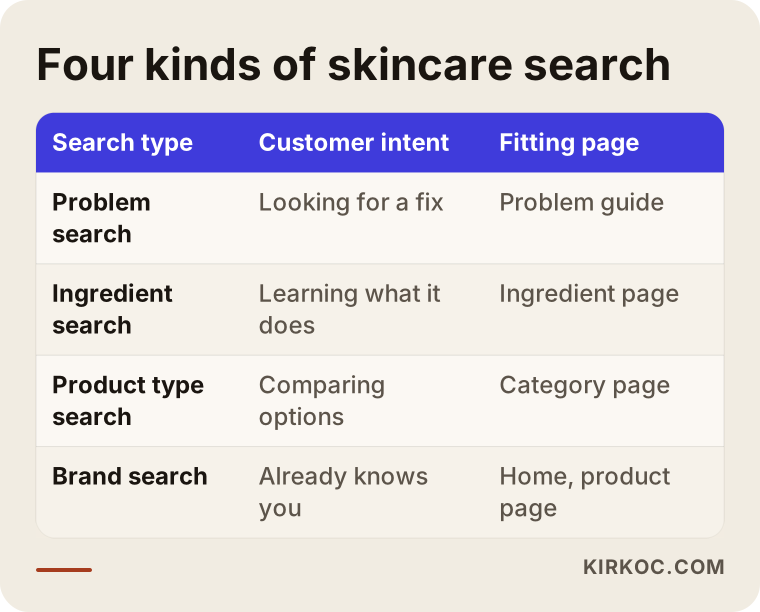
The first group is problem searches: "what to do about dry skin," "redness after sun." This person is not looking for a product yet; they are looking for a fix. The second group is ingredient searches: "what does niacinamide do," "how to use hyaluronic acid serum." The third group is product type searches: "pore-tightening toner." The fourth group is brand searches: the person types your name because they heard of you somewhere.
Most brands' sites only serve the fourth group: the home page and a product list. People in the first three groups never arrive, because no page on your site answers them. A large part of SEO work is filling that gap with the right pages.
The customer's path is long
These searches do not all happen on the same day. The person first notices a problem, then researches, then compares options, and finally adds something to the cart. You can picture this as a funnel: many people at the top, fewer but ready-to-buy people at the bottom.
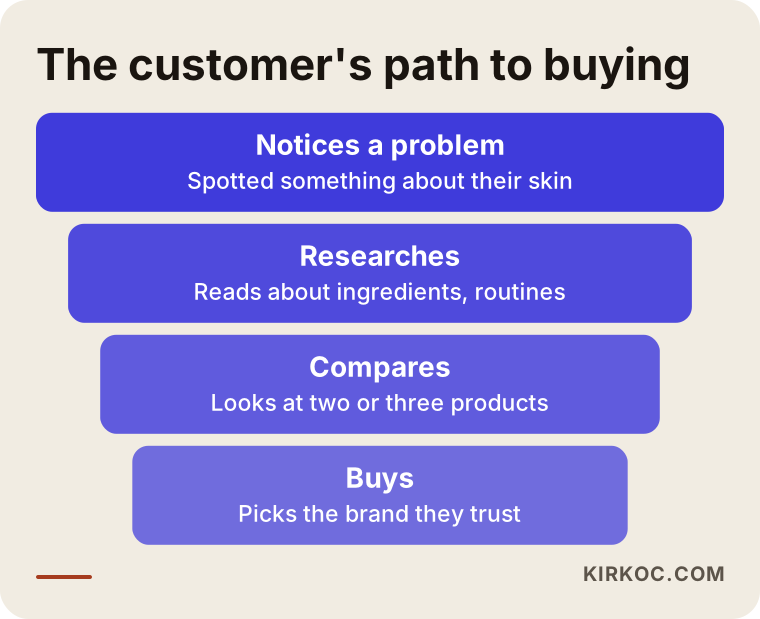
What this graphic says is simple: the page a person meets should be different at each stage. Showing an "add to cart" button to someone who has just noticed a problem can scare them off, and handing a long article to someone ready to buy tires them out. Knowing which page serves which stage decides the order in which content should be written.
Which pages do you need?
On a cosmetics site, only a limited number of page types really help with SEO. You do not need to build them all at once, but you do need to know what each one is for.
Product pages. Every product should have its own unique page. Pages that copy the manufacturer's description word for word cannot be told apart from the same product on dozens of other sites. What sets your page apart should be a description written by someone who truly knows the product: who it is for, when to use it and how.
Problem and skin type pages. Pages like "care for dry skin" or "oily and combination skin" connect your products to concerns. They guide the visitor and also tell the search engine what your site is about.
Ingredient pages. For the few key ingredients your brand highlights, short, plain and honest explanation pages work very well. The point is not to over-promise; it is enough to say what the ingredient is, which skin types use it and how, and what to watch out for.
Usage guides. Content such as "morning and evening routine order" places your products inside a routine. Customers come back to this page even after they have bought.
About and contact page. Say clearly who you are, where and how your products are made, and how to reach you. In cosmetics a trust page is not decoration, it is a need.
The graphic below shows one way a product page can be laid out. The domain and the content are entirely made up.
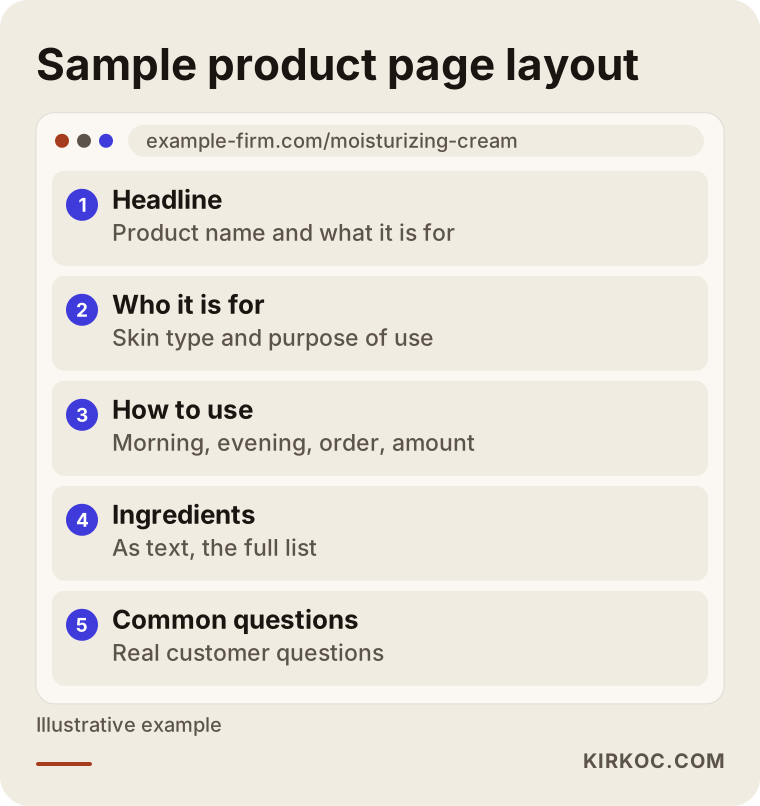
The logic of this layout is to answer the questions in the order they occur to the customer. The product name and purpose are at the top, who it is for comes right below, usage and the ingredient list are in the middle, and common questions come last. Those questions also give search engines and AI assistants material to answer from.
Why does careful claim wording matter so much?
This is the most sensitive subject in the cosmetics industry. Every sentence you write on a skincare product page is also an advertising sentence. The words you use when describing what a product does and does not do can create the risk of misleading consumers, and can cause trouble with regulators as well.
This is not legal advice and I cannot give you a definitive rulebook; the rules differ by country and change over time. The general logic is this: a cosmetic is used to cleanse, protect, beautify or scent the body. Sentences that claim to treat a disease, act like a drug, or permanently cure a skin condition can be treated as problematic. For a clear line, talk to an attorney or a regulatory specialist who knows the rules in your market before you publish. If you sell in the United States, that means checking how the FDA and the FTC treat product claims, and asking a professional about your specific wording.
For SEO, this topic matters in a second way. Many words that are popular in searches ("cures," "guaranteed fix," "removes permanently") are exactly the risky phrases. So stuffing those words onto a page just because the search volume is high is not the right move. The graphic below summarizes, as an example, the kinds of claims to watch out for.
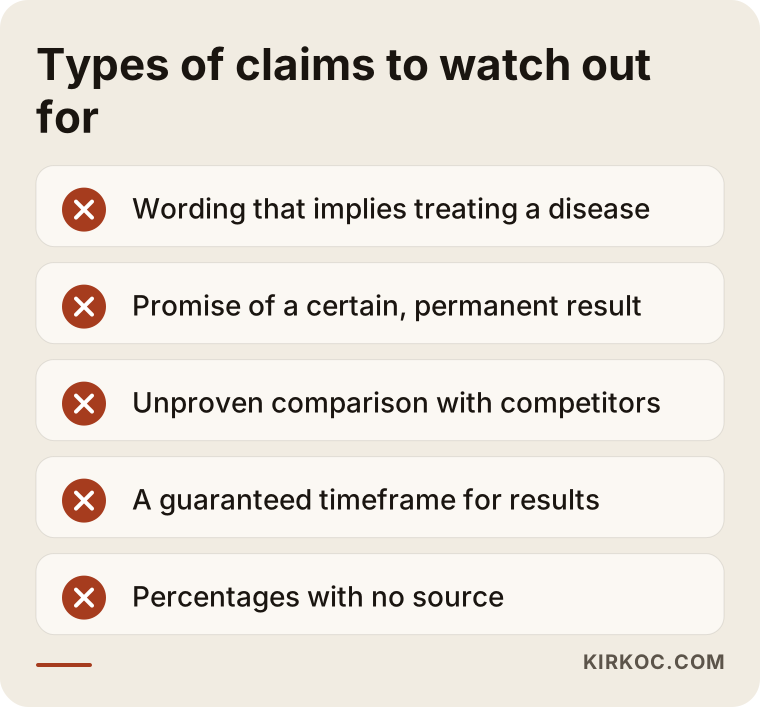
This list is not a complete legal guide; it is an example meant to draw your attention. But the logic is clear: avoid sentences that guarantee a result, promise to cure a disease, make comparisons with no proof, or state an exact timeframe.
The same idea can be said more safely
The good news is that you can give the same information in a way that is useful to the customer and also more careful. Let me show it with a concrete comparison.
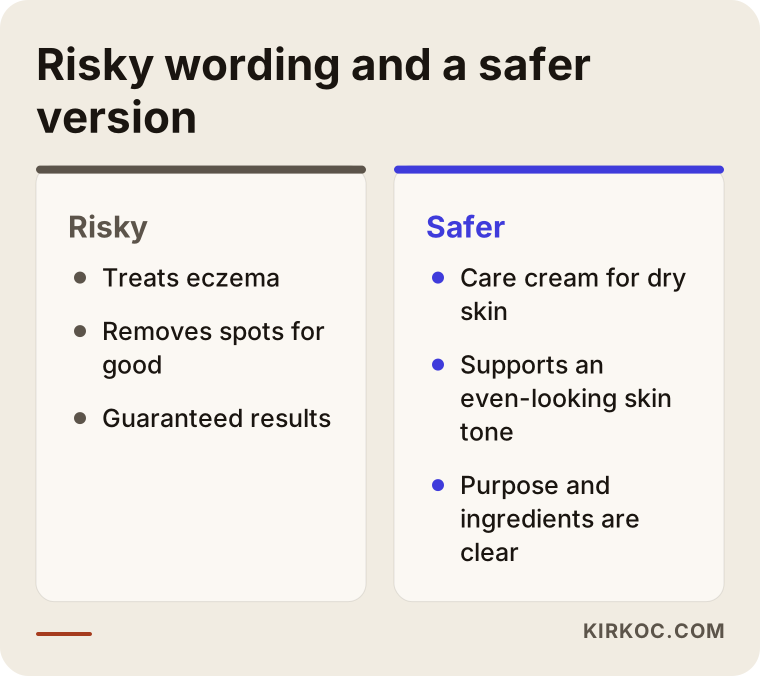
The sentences on the left promise a result; the sentences on the right explain what the product is, how it is used and who it is designed for. The second kind is easier on the regulatory side and it builds trust. It does no harm for search either: even if "moisturizer designed for sensitive skin" draws fewer searches than "completely heals your skin," it brings the right customer.
Ingredient and problem searches are where a content page can stand out
Now let us go back to the search types in the first graphic. For a small cosmetics brand, the most realistic opportunity is writing helpful content pages for ingredient and problem searches. In these searches, marketplaces mostly show a product list and give no detailed explanation.
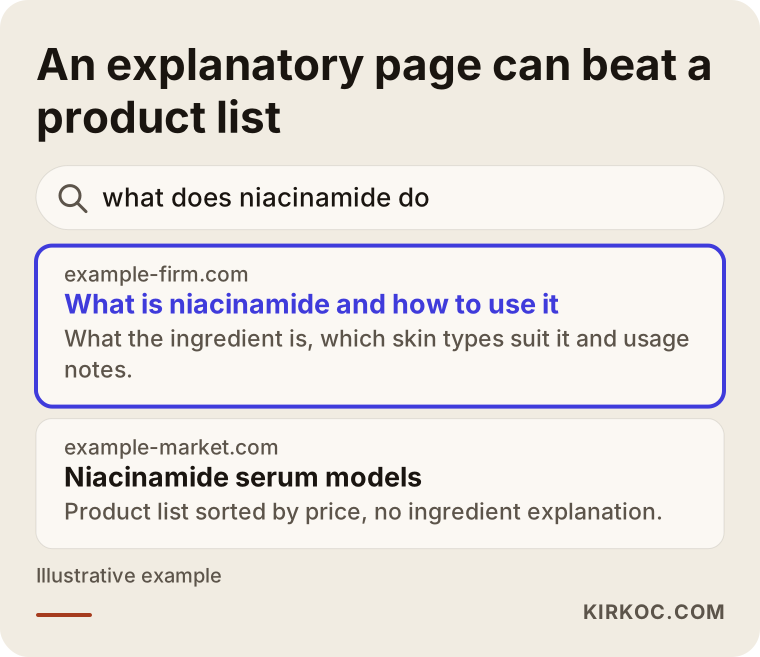
This graphic is a hypothetical search result. Real rankings always change, and I cannot guarantee that any page will sit there. But it shows the general logic: a page that clearly answers the question is usually more useful than a page that answers it with "here are some products."
Two hypothetical example scenarios
The two scenarios below are completely made up; they do not describe a real company or person. The aim is to show how different situations in the same industry call for different approaches.
Scenario 1: A small brand that sells only on its own site
Suppose there is a small skincare brand with four or five products, focused on sensitive skin. They built the site a few years ago, and the product pages carry short descriptions supplied by the manufacturer. Most sales come from social media, and almost no visitors arrive from search engines.
In this case my first job would be to write a unique, detailed page for each product: who it is for, in what order it is used, what the ingredients mean, and what the common questions are. The second step is a problem page such as "care for sensitive skin," plus short explanation pages for two or three key ingredients. The third step is to make the site faster and comfortable to use on a phone. This brand's strength is that it focuses on a narrow area, so rather than fighting over the broad phrase "skincare," it is more realistic to start with clear pages in a narrow space like "sensitive skin."
Scenario 2: A brand with a wide range that sells on its own site and on marketplaces
The second hypothetical brand has twenty or thirty products, serves different skin types, and makes a large share of its sales through marketplaces. It has its own site, but few visitors, because the same products are cheaper or more visible on the marketplace.
Here the real question is why the brand's own site exists. The answer may be a direct relationship with the brand's own audience: detailed guides, routine suggestions and ingredient explanations that a marketplace cannot offer. This brand's product pages and its marketplace listings should not carry the same text, because when the same text sits in two places, it is unclear which one will stand out. Also, because the range is wide, the structure of the categories, how filter pages get indexed (meaning how search engines store them), and making sure similar products do not compete with each other all become important.
How do I work, step by step?
SEO is not a one-time job, but it does have a sequence. For a skincare or cosmetics brand, the path I follow is roughly this.
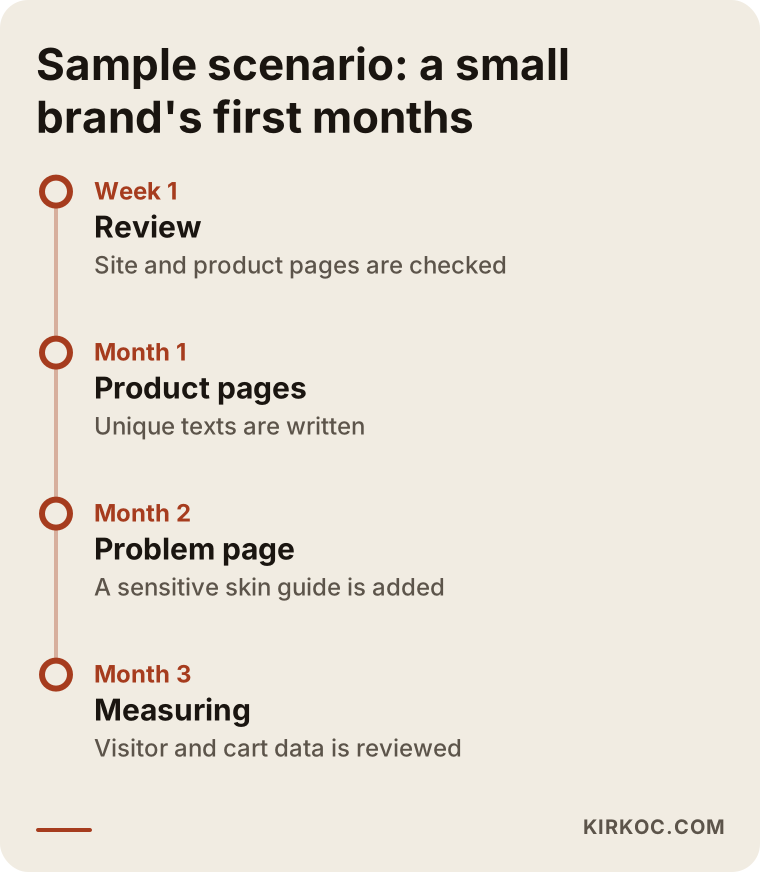
Step one: I review the current situation. I look at how fast your site loads, how it looks on a phone, and which pages already appear in search results. I check whether the product pages are unique and whether the same product is repeated at different addresses.
Step two: I work out your customers' search language. By talking with you and looking at search data, I find out who buys your products, what concern they come with and which words they use. This list becomes the map of the pages to be written.
Step three: the page plan and wording rules. I decide with you which pages will be written. At the same time, we settle which phrases will and will not be used; where something looks risky, the final decision is left to someone who knows the regulations.
Step four: I build the pages. I renew the product pages, add the problem and ingredient pages and set up the internal links. Whatever platform your site runs on (WordPress, Shopify or a custom build), I work with it.
Step five: measuring and correcting. Over the months, I check which pages get visitors and which lead to carts. I fix what is not working and do more of what is. SEO results do not appear right away; that takes patience, and I do not promise timeframes or rankings.
AI answers and cosmetics
There is also a newer topic. People now ask skincare questions to AI assistants such as ChatGPT as well. When a question like "what routine suits sensitive skin" comes in, the assistant builds an answer by looking at sources on the internet. If your page gives clear, accurate information with a clear source, your chance of being mentioned in these answers goes up. There is no guarantee, but the logic is simple: confusing and exaggerated text is a weak source for both search engines and AI.
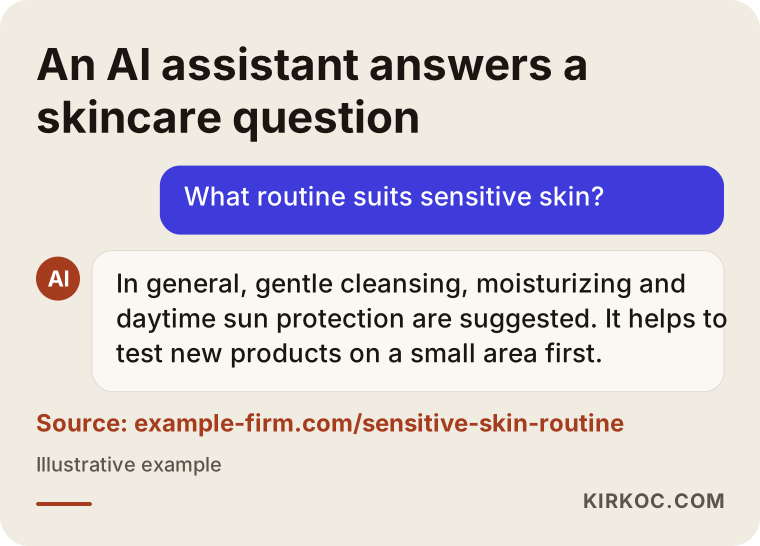
The example in the graphic is an invented conversation. But notice that the page behind the answer does not promise to cure anything, and it plainly states the contents and the way to use the product. This shows that careful wording and visibility in AI answers actually point in the same direction. If you want to know more, this area, sometimes called GEO (making your pages easy for AI assistants to use as a source), is also part of my service.
Common mistakes
These are the mistakes I see repeated in this industry.
Using the manufacturer's description as is. When everyone who sells the same product has the same page, none of them stands out.
Burying the ingredient list inside an image. Not writing it as text just because it is printed on the packaging photo keeps both search engines and visually impaired users from reaching the information.
Cramming every keyword onto one page. Writing "moisturizer, serum, cream, toner, mask" all on one page means being strong on none of them.
Publishing the same product at more than one address. Opening separate addresses for color, size or pack options and copying the same text makes the site compete with itself.
Only writing blog posts and forgetting the product. Writing many general skincare articles and not linking them to product pages does not turn traffic into sales.
Using wording that promises results. As I explained earlier, it is risky for both regulatory reasons and trust.
Not using reviews and customer questions. Real customer questions are the best raw material for page content.
Neglecting mobile. A large share of beauty shopping happens on a phone; a page that opens slowly or falls apart on a narrow screen loses the visitor.
What can you do yourself?
You do not have to leave everything to a specialist. You can start the following tasks yourself or with someone on your team.
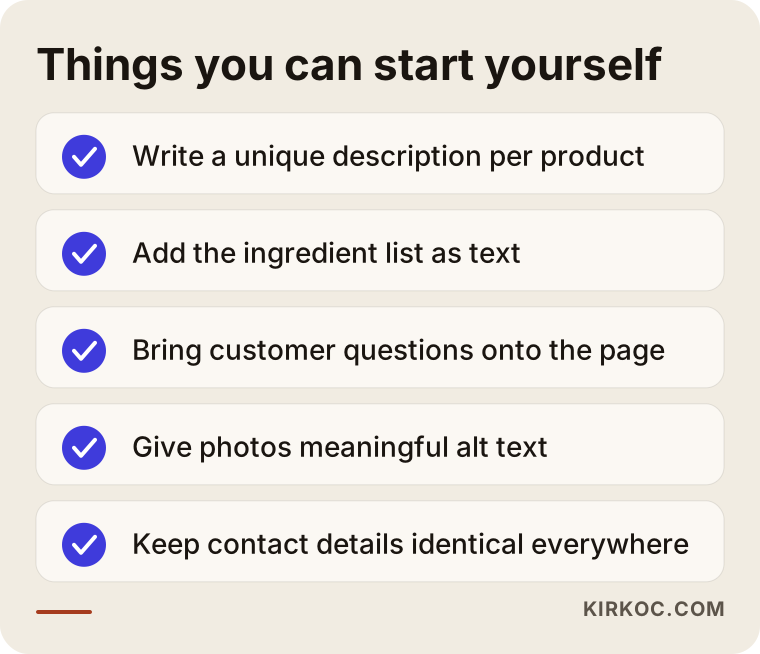
The easiest place to start on this list is rewriting your product descriptions. For each product, write down the five questions customers ask you most often and answer them; these questions become the skeleton of the page. Add the ingredient list as text. Write meaningful alt text for your photos (a short description that screen readers and search engines can read), which helps both accessibility and search. Make sure your contact details are the same everywhere on the site.
When do you need a specialist?
Once you get into the technical side, things change: a slow site, tangled filter pages for thousands of products, or the same content published at many addresses usually call for a specialist. Likewise, an experienced eye saves time when deciding which words to target and how to plan the pages. On claim wording, an SEO specialist alone is not enough; you need an attorney's opinion.
The decision chart below sums up this split with a simple question.
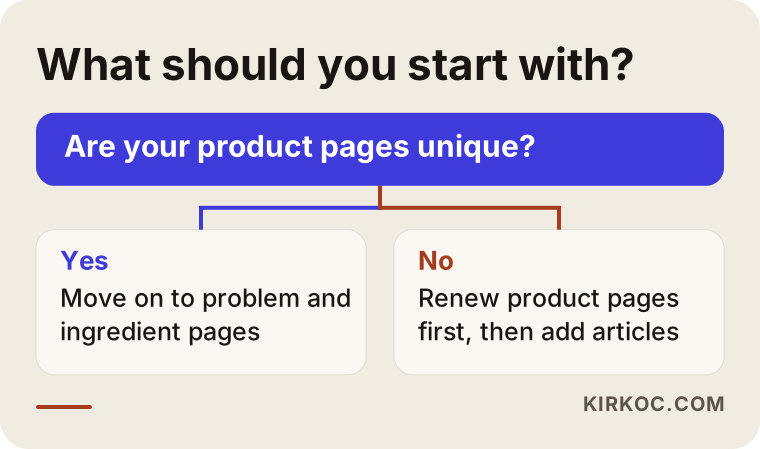
The question in the chart is the first one most brands should ask themselves. If your answer is "no," fixing the product pages first makes a difference faster than writing blog posts.
What determines the cost
I do not give numbers, because every brand's job is different. The main things that set the cost are these: the number of products, the current state of your site and the size of any technical problems, the amount of pages and content to be written, the need for images, the number of languages you target, and whether the work is a one-time project or an ongoing monthly one. A small brand with a narrow range and an online store with hundreds of products are not the same job. In the first conversation I look at your site and tell you what is needed; I will not sell you work you do not need.
How I work with you
I work alone, so the person you talk to is the person who does the work. First we have a short call, where I listen to your brand, your products and your goals. Then I look at your site and write down in plain language what can be done. If you like it, we start working together. On sensitive matters such as claim wording, I submit what I write for your approval and, where needed, your attorney's. I try to avoid jargon and to explain clearly what I am doing.
Frequently Asked Questions
How long does SEO take to work for a cosmetics brand?
I cannot give a definite time. It depends on the current state of your site, the competition and the scope of the work. In general, SEO builds up over months, and expecting a big change in the first weeks would not be realistic. I measure regularly to see what is working.
If I sell on a marketplace, do I still need SEO for my own site?
Your own site is the only place your brand truly owns. Marketplace rules, fees and visibility can change. On your own site you can serve customers who come for your brand name, or who search for routines and ingredients. Running both together is also possible; how much you invest in each depends on your goals.
Do I have to write a blog?
You do not have to, but content pages are the most natural way to meet problem and ingredient searches. What matters is not the number of posts but the right topics and the right links to product pages. A few well-made pages are worth more than many weak posts.
Which phrases should I avoid in product descriptions?
Stay away from wording that implies you treat a disease, give a certain and permanent result, or make unproven comparisons. I cannot define the rules that apply to you with certainty; I recommend asking an attorney who knows the regulations before you publish.
Can you get my brand mentioned in AI assistants?
I cannot guarantee that it will be. What I can do is make your pages clear, accurate and clearly sourced, which raises the chance of being used as a source both in search engines and in AI answers.
I have a lot of products. Do we have to do them all at once?
No. I start with a few of your best sellers, or the ones that best represent the brand. As the results come in, we move on to the others. This keeps your budget and your time in balance.
Do I need to rebuild my site, or can we work with the current one?
Most of the time it is possible to work on your existing site. A rebuild comes up if the site is very slow, breaks on phones, or does not let you change the page structure. I will tell you plainly in the first review.
What if I sell to another country?
If you sell in another language and country, you need pages made for that language, because every country has its own cosmetics rules and search habits. Translation alone is not enough; you should also ask someone who knows that country's rules.
If you want your skincare or cosmetics brand to meet the right customers in search engines, you can reach me through my SEO services page. Tell me briefly about your brand and your products, and let us talk plainly about what can be done after I look at your site.