You have a business in Kocaeli, or you want one there. Maybe you run a production line in an industrial zone in Gebze. Maybe you own a clinic, a service shop or a store in Izmit. Maybe you are a foreign company that manufactures, sources or sells in this region and wants Turkish customers to find you. You have a website, but the phone does not ring, or most of the calls you get are not the right kind of work. If you typed "SEO services Kocaeli" into Google, you are probably asking: how does this work for me, where do I start, and how long will it take? In this article I answer those questions with the conditions that are specific to Kocaeli and especially the Gebze area. I am Ümit Kırkoç, a web designer and SEO consultant who works alone from Istanbul, and I will also explain plainly how my own SEO services work.
SEO, in short, is the work that makes your website show up in Google when your customers search for what you offer. You do not pay for every click the way you do with ads. When it is set up well, it becomes a steady source of inquiries that keeps working for months. But how that setup looks in Kocaeli, meaning which words, which pages and which pieces of information matter, is different from a cafe in central Istanbul or a shop in a small Anatolian town. The reason is that Kocaeli holds two quite different customer worlds inside one provincial border.
Why you should think of SEO in Kocaeli as two separate jobs
Kocaeli is one of the most heavily industrialized provinces in Turkey. Gebze, Dilovasi, Korfez, the area around Kartepe and Izmit are home to a large number of factories, subcontractors, logistics operations and warehouses. Ordinary life goes on in the same province too: people looking for a family doctor, checking out a car service, researching a course for their child, comparing wedding venues.
These two groups behave very differently on Google. A purchasing manager at a factory types something like "gebze cnc machining" or "kocaeli industrial packaging supplier." That person may compare options for weeks, wants technical detail, and often asks for a quote. Someone who wants a dentist near home types "dentist gebze" or "pediatric dentist darica," looks on a phone, makes a decision within minutes, and very often calls one of the first three businesses on the map.
Deciding which group your business serves is the most important first step in SEO. If you serve both, for example a packaging or security company that sells to factories and to individuals, you should not mix them on the same page. The illustration below summarizes how these two search worlds separate.
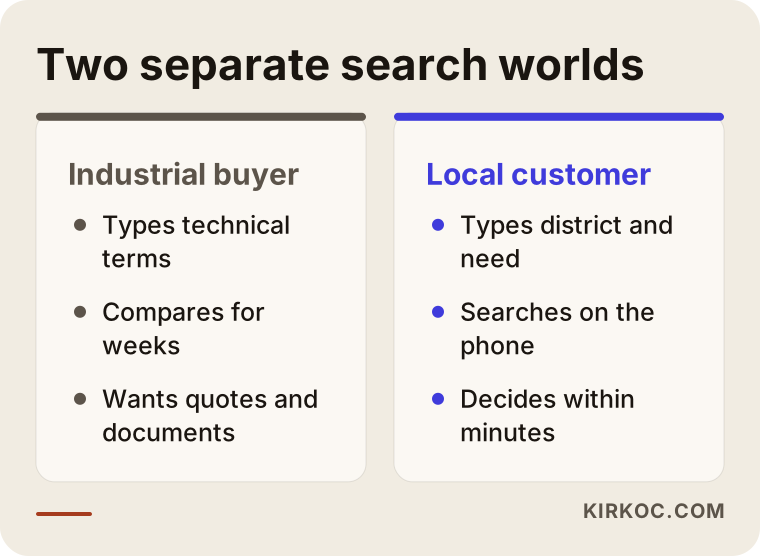
The difference you see here is not only a difference in words. It is a difference in pages. The industrial buyer needs a page that explains your capacity, your certificates and how you work. The local customer needs a page that gives your address, your opening hours and a clear way to book. If you combine the two into one page, you leave both halves unfinished.
What makes Gebze special
Gebze sits between Istanbul and the rest of Kocaeli. Gebze Organized Industrial Zone, the plastics-focused industrial zone, the factories around Dilovasi and the nearby free zones make it a production and supply hub. That means a person looking for a company in Gebze may be sitting in Gebze, in Istanbul, in another Turkish city or in another country. For you, the word "Gebze" is not only an address. It can also be a trust signal. "Manufacturer in Gebze" tells many buyers that shipping is easy and that the company has real industrial experience.
If you are a foreign company, this matters in a specific way. Many international firms source parts from Gebze, run a plant there, or want to sell to the factories around it. A buyer abroad might search in English for "CNC machining Turkey Gebze" and a Turkish factory manager might search in Turkish for the same thing. Those are two different audiences with two different search habits, and a good plan decides which one you are after before any page is written.
Local businesses face a narrower situation. People living in Gebze, Darica, Cayirova and around Izmit are very sensitive to travel time. Because of traffic, "close by" matters to many of them as much as quality. That is why district-level and neighborhood-level searches are the real opportunity for local businesses.
How industrial and B2B companies get found
If you do B2B, meaning you sell from one business to another, your customer is typically an engineer, a purchasing specialist or a company owner. These people do not type emotional words like "best." They describe the need in technical terms. For example:
- The name of the part or service plus the area: "gebze laser cutting," "kocaeli stainless pipe manufacturing."
- Material or standard information: "aluminum die cast parts kocaeli."
- The form of service: "contract manufacturing," "wholesale supply," "maintenance agreement."
- Comparison intent: "gebze powder coating companies."
What this person wants first is to understand exactly what you do within a few seconds. A home page full of corporate phrases such as "wide product range and customer-focused approach" tells them nothing. What builds trust is the opposite: which materials you work with, what tolerances you can hold, your minimum order quantity, your lead time.
The pages an industrial site should have
Many industrial company sites consist of a single "our products" page. Google, however, treats each page as a separate answer. If you list five different services on one page, you will not be strong on any of them. In practice, this structure works:
- A separate page for each main service or product group. For example, a separate "CNC machining" page and a separate "laser cutting" page.
- A short "who it is for" section on each page: which sectors and which job sizes you serve.
- How you work: how to request a quote, how to send a sample or technical drawing, how delivery is handled.
- Quality and certification information: the certificates and measuring capabilities you actually have. Only list certificates you truly hold.
- Facility and location information: which industrial zone and which address you are in, and whether visitors are welcome.
- A clear quote form or phone number. A simple form that lets people attach a drawing file is often enough.
The illustration below shows this structure as a page outline. The domain name and the content are entirely made up.
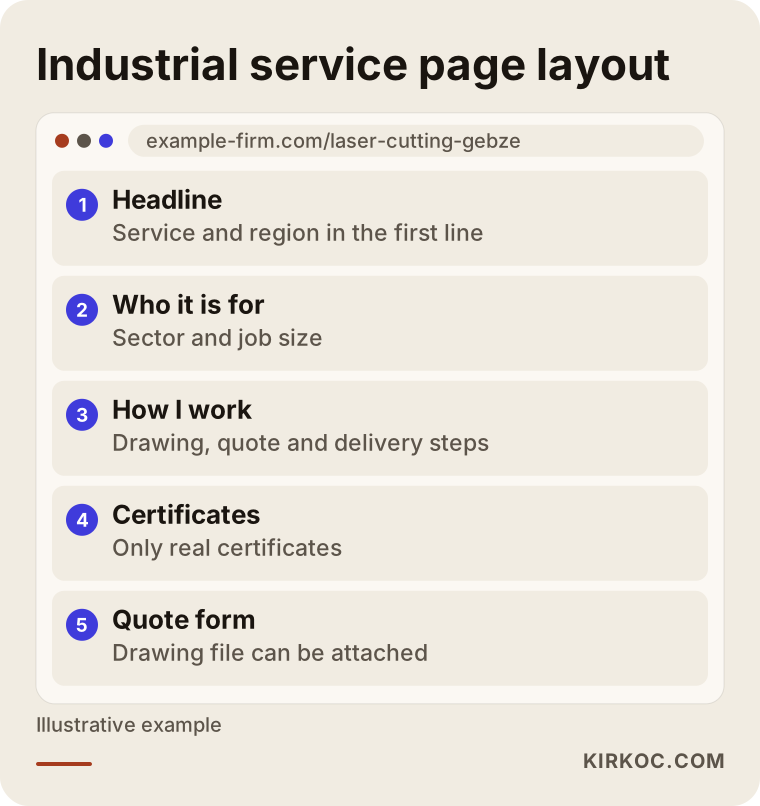
What matters in this outline is the order. The visitor first sees what you do, then why they can trust you, and only last how to contact you. Burying the quote form at the very bottom, or leaving it only in a menu on the home page, is an easy way to lose an interested buyer.
The catalog and PDF trap
One thing I see very often on industrial sites: all the information sits inside a PDF catalog. The buyer can download and read it, but there is no guarantee that Google treats every detail inside the PDF the way it treats a normal page. Opening a PDF on a phone is also a chore. Writing the important parts of the catalog as ordinary web pages as well makes life easier for both Google and the reader. You can of course keep the catalog as a download option.
If you are a foreign buyer reading this from the other side, the same advice tells you something useful about suppliers. A Turkish factory whose site explains its processes on real pages, not only in a downloadable file, is usually one that has thought about how customers find it.
How local businesses get found
Now let's look at the other side. If you serve individuals in Gebze, Izmit, Darica or Cayirova, your customer searches on a phone and usually expects a very close result. Typical searches look like this:
- "dentist gebze," "pediatrician izmit."
- "car wash darica," "tire change korfez."
- "wedding hall prices gebze," "kindergarten kocaeli."
- "pharmacy near me" and other searches based on the person's location.
For these searches Google often shows the map and business profiles first. That means that next to your website, your Google Business Profile (the free listing with your address, phone, reviews and photos) is critical. Your phone number, address and business name should be written exactly the same on your site, on your business profile and on other directory sites. Even small differences can make the system doubt which listing is the real one.
If you are an expatriate or a foreign-owned business serving residents in the area, the same applies, with one addition. Many expats search in English, so a clear English version of your key service pages, with the same address and phone details, can reach people that Turkish-only pages miss.
The illustration below shows, in an invented search by a person living in Gebze, which page does more of the work.
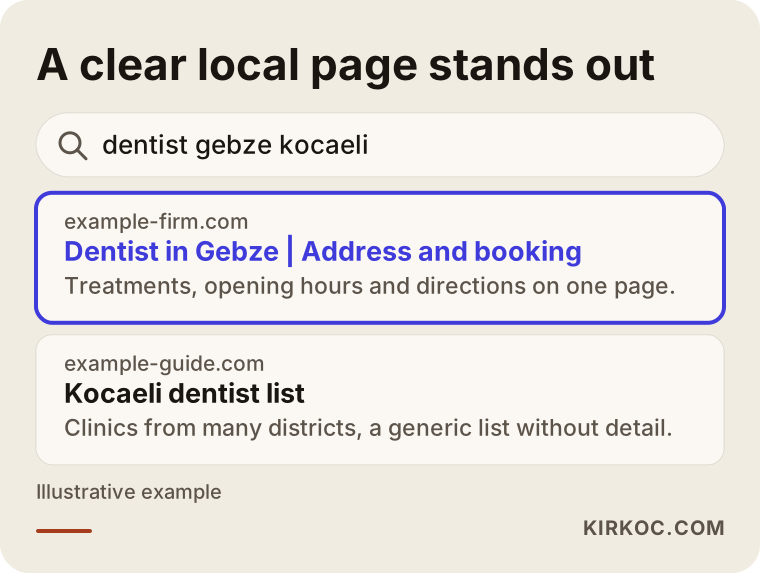
What stands out here is the page that states the district, the service and the opening hours in the first line. A generic "best service in Kocaeli" page does not tell the reader what it answers.
District pages: when you need them and when you do not
Kocaeli's districts are quite different from each other. Gebze and Kartepe, or Korfez and Basiskele, do not have the same type of customer. Writing a separate page for every district looks tempting, but you have to be careful. Copying the same text and swapping only the district name can lead Google to decide that all the pages are the same and to give them little value. A district page makes sense only if it carries information that is truly specific to that district: directions for customers coming from there, the parking situation, nearby landmarks, and questions that people from that area ask often.
If you work from a single physical location, one strong service page and a few genuinely different area pages are usually enough. If you have several branches, each branch needs its own page with real information.
Two example scenarios (hypothetical)
The two scenarios below are entirely hypothetical. They do not describe a real company or person. The purpose is to show how two different businesses in the same province follow different paths.
Scenario 1: A metalworking shop in Gebze
Suppose there is a mid-sized metalworking shop in an industrial zone in Gebze. Its website was built ten years ago and contains a one-page "about us" and a phone number. The owner says most of the work comes from old customers and acquaintances, but finding new buyers is hard.
In this case the first job is to work out with the owner which services actually bring profit. Say the most profitable jobs are laser cutting and bending. Then separate, detailed pages are prepared for these two services: what thicknesses and materials are handled, how a drawing is sent, what the lead time depends on. Real workshop photos are added to the pages. In searches, clear phrases such as "gebze laser cutting" are targeted, not broad claims such as "the best metal company in Turkey."
After a few months, once these pages have been picked up by Google, you would expect the quality of the requests coming through the quote form to change: fewer "just asking the price" calls and more clear quote requests with drawings. There is no guarantee of this. It depends on the competition in the area and on the starting condition of the site. But this is the right direction.
Scenario 2: A dental clinic in Izmit
Suppose there is a small dental clinic with two dentists in central Izmit. The site has one long list under the heading "our treatments." The Google business profile is half finished: few photos, opening hours out of date. The clinic knows that most of its patients come from the immediate neighborhood.
Here the priority is different. First the business profile is fixed: the right category, current hours, real photos and a polite way of inviting patients to leave reviews. Then a separate page is written for each main treatment: implants, orthodontics, pediatric dentistry. On each page, what the treatment is, who it suits, the process and frequently asked questions are explained in plain language. On health-related pages, exaggerated claims such as "guaranteed result" or "painless" are avoided. There are legal rules about advertising and health communication in Turkey, and if you are not sure about them you should consult a lawyer.
In this scenario it is reasonable to expect more calls from the business profile within a few weeks and from the treatment pages over a longer period. The timing and the result depend on how the other clinics in the neighborhood are doing.
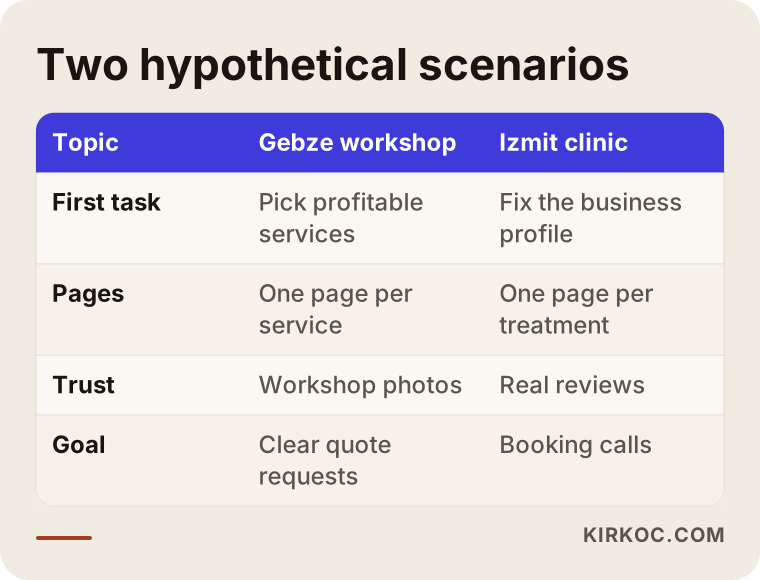
The illustration summarizes the difference in priorities: on the industrial side, page depth and the quote flow come first, while on the local side the business profile and clarity at the district level come first.
How an SEO project runs, step by step
In Kocaeli or anywhere else, a healthy SEO project moves in a certain order. I run my own work in this order, and even if you work with someone else, I suggest you expect the same order, because projects that skip steps usually go to waste.
- Assessment. I look at how your site appears in Google today, which pages work and which are not visible at all. I check whether the site technically opens properly, whether it works well on mobile and whether it is fast.
- Finding out what customers search. What your target audience really types can differ from the words you assumed. For industrial buyers I list technical terms, and for local customers I list district and need phrases.
- Page plan. I decide which page will answer which search. Missing pages, pages that should be merged and pages that should be removed become clear.
- Technical fixes. The groundwork is done: page titles, descriptions, page speed, mobile fit, broken links and the sitemap (a file that lists your pages for Google).
- Writing the content. Each page is written to answer the questions of the person making that search. The content is fed by your real knowledge. I edit and structure the text, but you know the details of your sector best.
- Trust signals. Reviews, certificates, references (only real ones), and a clear address and phone number are added.
- Measurement and adjustment. I watch which page is viewed and which one brings a call or a form, and I improve accordingly.
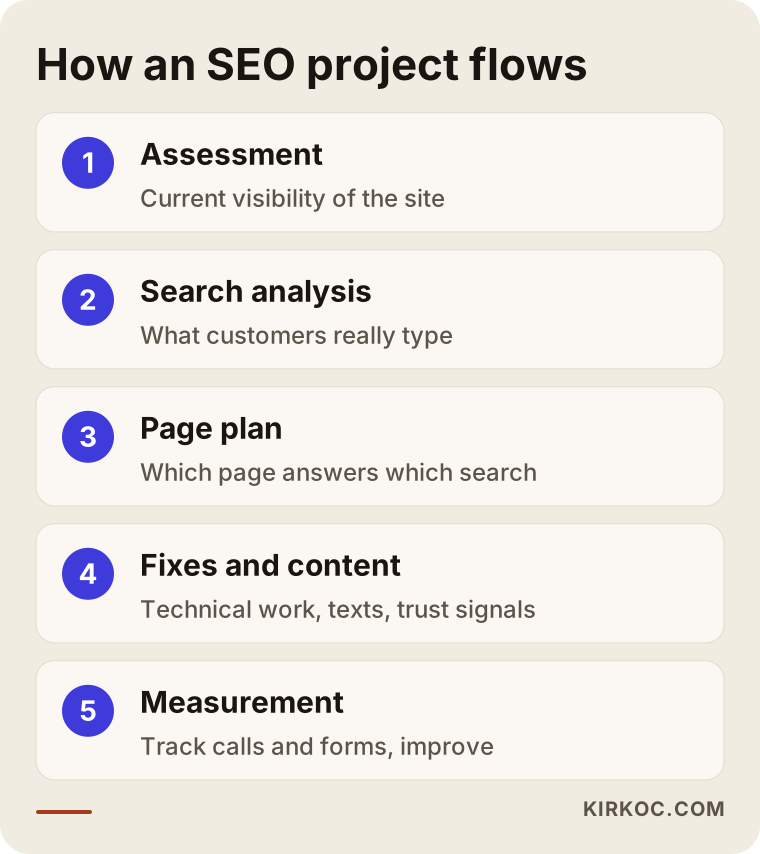
The order in the illustration is not a rigid recipe, but it is a logical flow. For example, if you do not know which searches you will answer before you write content, you end up with nicely written pages that nobody searches for.
How long until you see results?
This is the most frequently asked question, and it needs the most honest answer. In SEO it is not possible to give an exact time. The age of the site, the strength of competitors, the difficulty of the targeted phrase and the amount of work done decide the timing. In general you start to see the effect of the first fixes within weeks, and the effect of content and page structure within months. If someone tells you "first place in so many days," be careful. Nobody can buy a Google ranking and nobody can guarantee one.
The timeline below shows an invented but realistic flow.
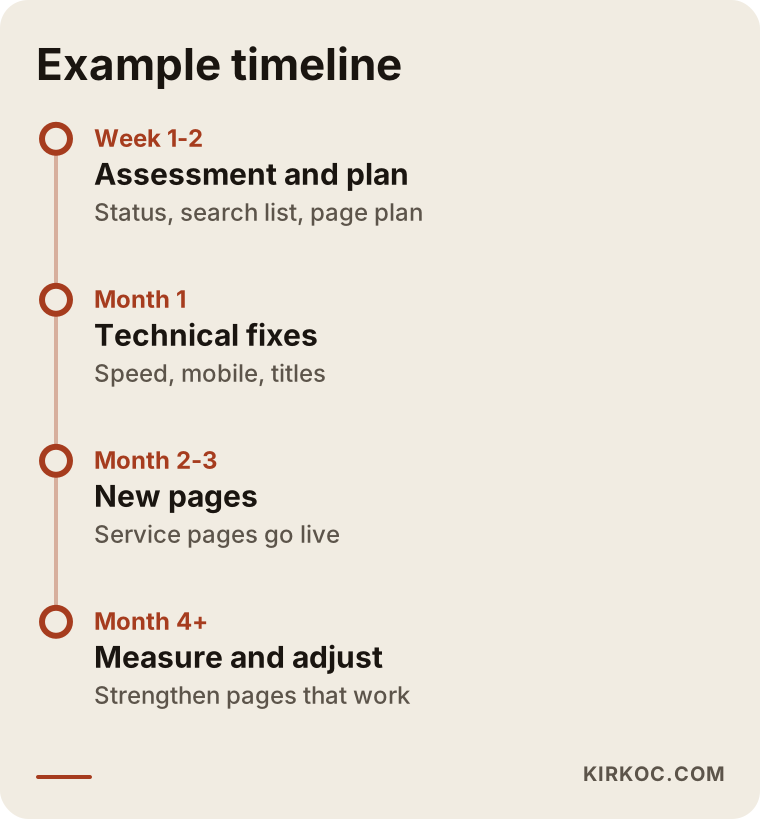
The periods on the timeline give a rough idea and will play out differently in every business. What matters is not to expect the phone to flood in during the first month, but also not to accept waiting for months without seeing any progress. There should be small improvements that are reported regularly and clearly.
Common mistakes of businesses in Kocaeli
When I look at sites in the region, I see a few mistakes repeat. Most of them come not from lack of knowledge but from the thought "the site is built, the job is done."
- Squeezing everything onto one page. Listing five services on one page means being strong in none of them.
- Writing only "Kocaeli" and skipping the district. For a firm that serves Gebze, "Kocaeli" is too broad. Customers usually type the district or the industrial zone.
- Copy-and-paste content. Using the text of a competitor or a directory site with small changes adds no value to your page.
- Inconsistent phone and address. A different number on the site and on the map profile damages both trust and ranking.
- Forgetting mobile. Most local searches are made from a phone. A site that loads slowly on a phone or has tiny buttons loses customers.
- Stock images instead of photos. Real photos of your workshop, your clinic and your team build trust. Generic images taken from the internet do not.
- Hiding the quote or contact route. If a buyer wants to call you but cannot find your phone number, they go to a competitor.
- Believing a quick-result promise. Promises such as "first place in a week" are usually either untrue or delivered with short-lived tricks.
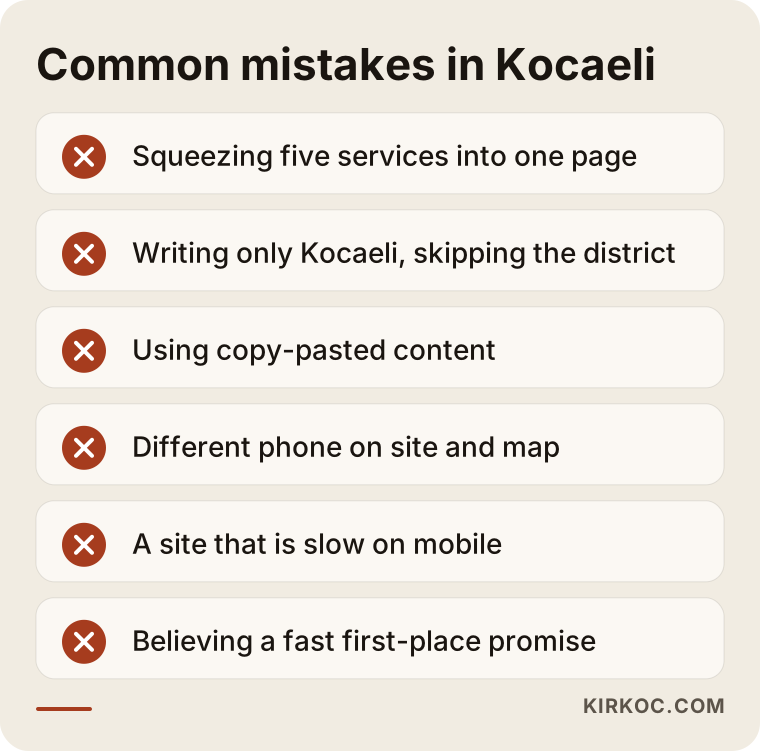
Most of these mistakes are not expensive to fix. The real cost is that they stay unnoticed for years.
What you can do yourself and when you need an expert
You do not have to leave everything to a specialist. There are jobs you can do yourself, and doing them also makes the whole process more productive.
What you can do yourself:
- Open your Google business profile and fill it in with correct information, then add real photos.
- Ask your satisfied customers for reviews. Buying or inventing reviews is both unethical and risky.
- Check that the phone number, address and opening hours on your site are current.
- Write your services in plain sentences using your own knowledge and send them to a specialist. The best content comes from the person who knows the sector.
- Ask your customers "how did you find us?" and write down the answers. If you serve foreign customers, ask them in English too.
Situations where you need an expert:
- Your site opens but is almost invisible in Google. There may be a technical reason.
- You need a page plan for several services, districts or languages.
- You are thinking of redoing the site. A wrong redesign can wipe out the visibility you already have.
- Your competitors are clearly ahead and you cannot work out why.
- The speed or mobile appearance of your site is seriously problematic.
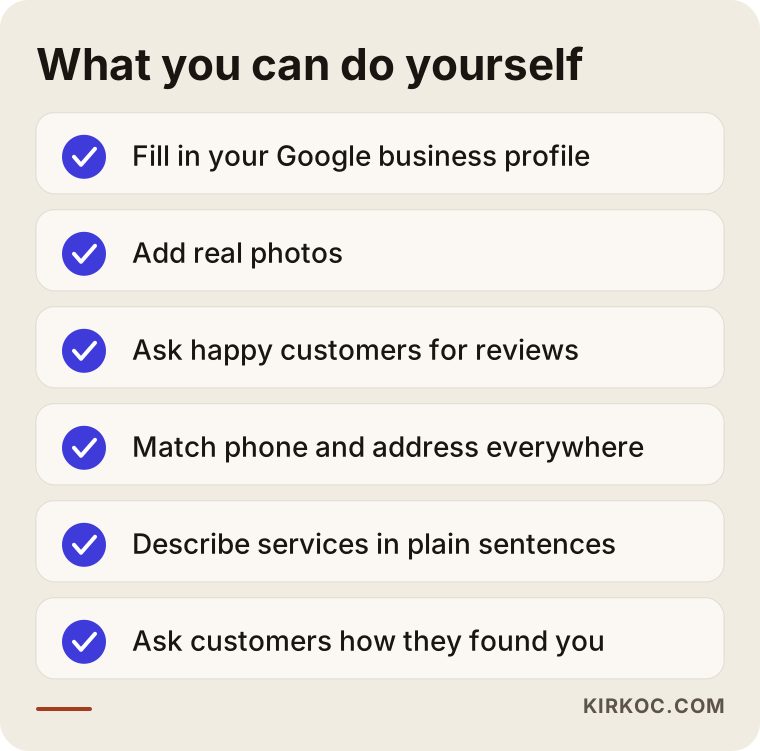
This list is also useful before you start working with a specialist: if you come prepared, the work goes faster and costs less.
Ask yourself before you decide
SEO may not be the right investment for every business. If your work runs entirely on a circle of acquaintances and referrals, if your capacity is already full, or if your service is not something people look for online, it makes sense to look at other channels first. The decision chart below offers a simple first evaluation.
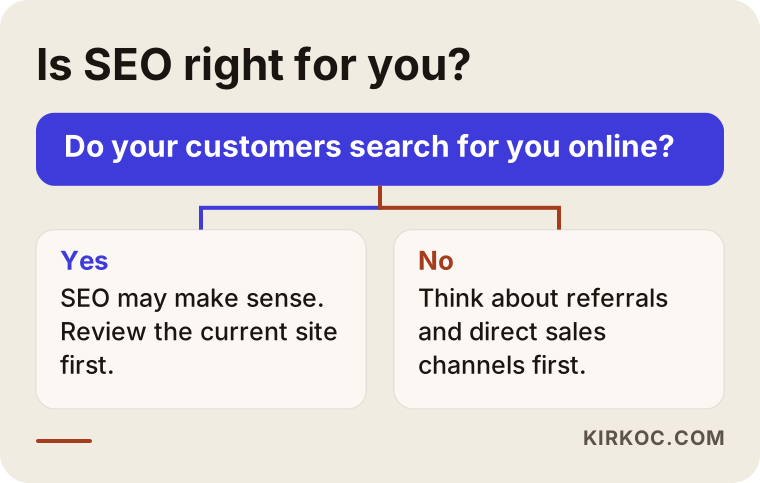
The chart gives only a first idea. For a firm decision, your business situation needs to be discussed. In that conversation I may also tell you that you do not need SEO right now. The aim is not to win a job but to make sure you invest in the right thing.
What determines the cost of SEO services
I will not give figures in this article, because the same service can mean a completely different workload for two businesses. The main factors that determine cost are these:
- The starting condition of the site. A site with few technical problems and a site that must be reorganized from scratch do not need the same effort.
- Number of pages and scope. The workload is very different between a workshop with three services and a manufacturer with forty product groups.
- Competition. A very crowded search in Gebze and a niche search with few competitors will not give results in the same time with the same effort.
- Content needs. Whether new pages, photos, technical descriptions or translations are required.
- Number of languages. If you also want to address foreign buyers, separate language pages mean extra work.
- Duration and continuity. A one-off cleanup and a monthly ongoing project are planned differently.
- Level of measurement and reporting. How detailed the tracking is and how often I report back to you.
When you collect quotes, ask for this: what will be done, when, and with which deliverables, all in writing. Instead of vague "SEO packages," ask for a concrete list of tasks.
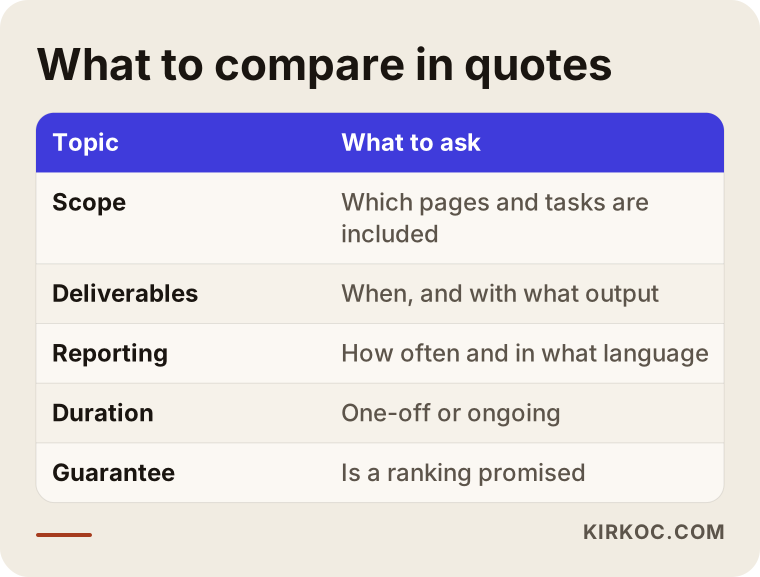
You can use the topics in the table as a checklist in quote discussions. A quote with an unclear scope tends to turn into a surprise cost later.
How I work with clients
I work alone from Istanbul. That means the person you talk to is the person who does the work. There is no project manager or middleman. It means decisions are made quickly, but it also means my capacity is limited: I can handle only a limited number of projects at the same time, and I tell you that at the start.
Working remotely with businesses in Kocaeli is usually not a problem. Most conversations happen by phone or video call, and meeting in person is possible when needed. If you work in English, I can run the whole project in English. First I have a short introductory conversation with you, and I listen to your business and your goals. Then I look at the state of your site and explain in writing what needs to be done, what does not, and what scope makes sense. Once the work starts, I report in plain language what was done and what effect it had.
One more thing to know before you begin: I do not give ranking guarantees, and nobody honest should. What I can promise is that the work is done honestly, in understandable steps, and in a way you can measure.
Frequently asked questions
Why should I target the word "Gebze" separately for SEO in Kocaeli?
Because the person searching usually types the district or the industrial zone, not the province name. "Kocaeli" is a broad word, while "Gebze" has fewer competitors and is closer to the customer's intent. Which word is right for you depends on who your customer is, and it should be decided together.
Should I approach this as an industrial company or as a local business?
If you sell to factories and companies, you need an industrial (B2B) approach. If you serve individuals, you need a local approach. If you do both, it is best to describe them on separate pages. A mixed page leaves both groups half served.
Do industrial companies need a Google business profile too?
Often yes. After a buyer finds you, they usually check your address, opening hours and reviews. A profile that matches your site builds trust. If you do not receive visitors, you may need to think separately about how to display your address.
When will I see results?
I cannot give an exact time. The effect of small technical fixes shows within weeks, and the effect of new pages and content usually shows within months. The number of competitors, the age of your site and the difficulty of the phrase you target can lengthen or shorten that time. Be careful with anyone who guarantees a ranking.
Should I run ads or do SEO?
They do different jobs. Ads give you visibility right away but stop when you stop paying. SEO starts more slowly but, once built, can bring work for a long time. For some businesses using both makes sense. Which one fits depends on your budget and your sales cycle.
Will my SEO be affected if I redo my website?
Yes, it can be affected negatively if it is done wrongly. If addresses change, the old addresses must be redirected to the new ones, and pages that work well must be kept. If you are planning a redesign, the safest way is to build the SEO plan together with the design.
I sell to foreign buyers. Do I need a multilingual site?
If you want to reach buyers abroad, yes. Separate pages in the target language usually make a difference. Automatic translation alone is often neither sufficient nor reassuring. Which languages make sense for you should be decided by looking at your current customer base.
Why work with one person instead of a big agency?
There is no single right answer for every business. Very large projects may need an agency. At small and mid-sized business scale, talking directly to the person who does the work gives you fast decisions and clear communication. You should also know that the other side's capacity is limited; I prefer to say that at the start.
If you would like to work out together what your business in Kocaeli or Gebze needs, you can reach me through my SEO services page and describe your situation briefly. I will tell you honestly where to start.