You run a marble quarry, a processing plant, or a natural stone supply and installation business in Turkey. The product is solid and the blocks coming out of the quarry speak for themselves, but the phone mostly rings with the same acquaintances and the same few contractors you have worked with for years. When an architect searches for "travertine flooring supplier" or an importer overseas types "natural stone supplier Turkey" and your company does not show up, that is frustrating. Closing that gap is exactly what SEO for natural stone and marble companies is for. In this article I explain, in plain language, how SEO differs in this industry, which pages you actually need, and where to start. I am Ümit Kırkoç, a web designer and SEO consultant working alone from Istanbul, and near the end I will state clearly what my own SEO services cover.
SEO, in short, is the work that makes your website appear when your customers search on Google. Unlike advertising, you do not pay for every click, and a properly built site keeps working for months and years. But the stone business has its own difficulties, and work done without knowing them is often wasted.
Why is SEO for stone different from other businesses?
For a barber or a dentist, the customer decides the same day. In natural stone and marble, buying is long, involves several people, and is often tied to a project. A homeowner choosing stone for a villa asks the architect. The architect asks a few suppliers for samples. The contractor asks about quantities and delivery dates. Finally, one person asks for a quote. So the person visiting your site is rarely the only decision maker, and rarely orders on the first visit. They make a note of you, download your catalog, and come back a week later.
The second difference is that the product is visual. Stone is sold through photographs. The flow of the veining, how the color looks in different light, and the surface finish (polished, honed, brushed, antiqued) cannot be explained in a single word. A good stone website works with beautiful and accurate photos, but Google does not read the photo, it reads the text next to it. If you write nothing under a photo, even your best product is invisible in search.
The third difference is that the same product is searched under several names. A stone can have a trade name, a regional name and a name in another language. One buyer types "travertine," another types a local spelling, and an architect may search by the name of the quarry. If your site uses only one spelling, you miss everyone who uses another.
The fourth difference is that two very different audiences look at the same company. On one side are architects, contractors and homeowners doing projects, whether inside Turkey or abroad. On the other side are importers and distributors abroad looking for blocks, slabs or finished products. Their language, expectations and the information they want are not the same. If you try to speak to both on a single page, you usually satisfy neither.
What exactly does your customer type into Google?
This is the key question of SEO. It is answered with research, not guesses, but in the stone business a few patterns are known in advance.
The first pattern is the product name combined with where it is used: "travertine floor tiles," "marble bathroom countertop," "basalt garden paving," "natural stone facade cladding." Here the person knows what they want to buy and is looking for a product page. The second pattern is less decided: "which stone for a villa exterior," "marble or granite for a kitchen countertop." The person typing this is not looking for a supplier yet, they are looking for information. A site that gives them a good guide earns a place among the sites they will ask for quotes from later.
The third pattern combines region and supply: "Afyon marble wholesale," "Denizli travertine quarry," "Istanbul marble workshop." These searchers care about where the product comes from, so stating the location of your quarry clearly on the page helps you directly. The fourth pattern is the English search coming from abroad: "natural stone supplier Turkey," "travertine tiles wholesale," "marble block exporter." The fifth is searches in other languages such as German or Swedish. These are fewer but often more serious, because someone searching in their own language usually has a concrete project.
The image below uses a completely made-up example to show how a search result looks and why the page that spells out the product and its use stands out.
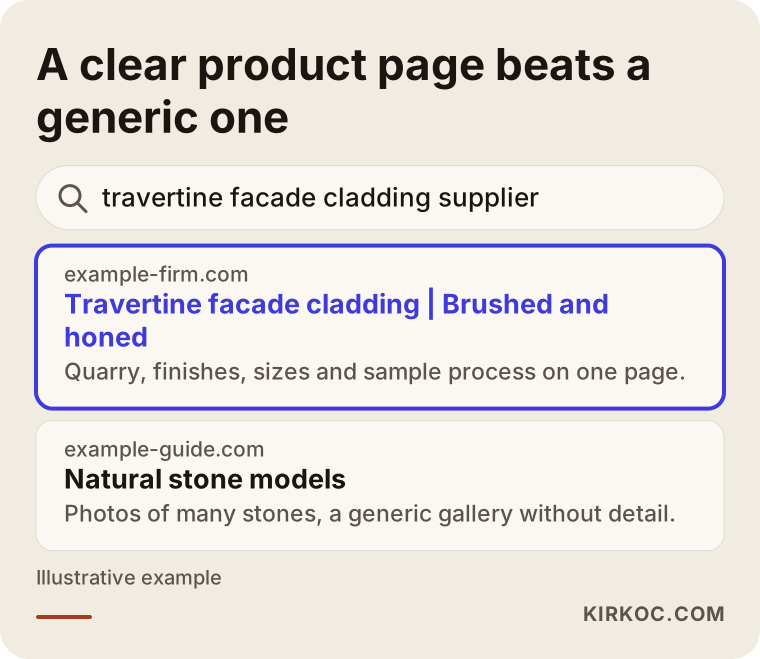
Look at what the highlighted result does: in its first line it states the name of the product, its finished form and where it is used. A generic "high quality natural stone" page does none of this. Google tries to work out which answer to give the person searching, and if you make that easy, it will find it easier to put you forward.
Who is looking for what, and on which page?
Splitting your visitors into four groups makes your page plan easier. Architects and interior designers look for texture, sizes, surface options and the sample process. Contractors look for quantities, delivery, and whether the supply can come from the same batch every time. Private homeowners want to understand the price, learn how to care for the stone, and know who will install it. Overseas buyers look at certificates, loading capacity, port, packaging and sample shipping.
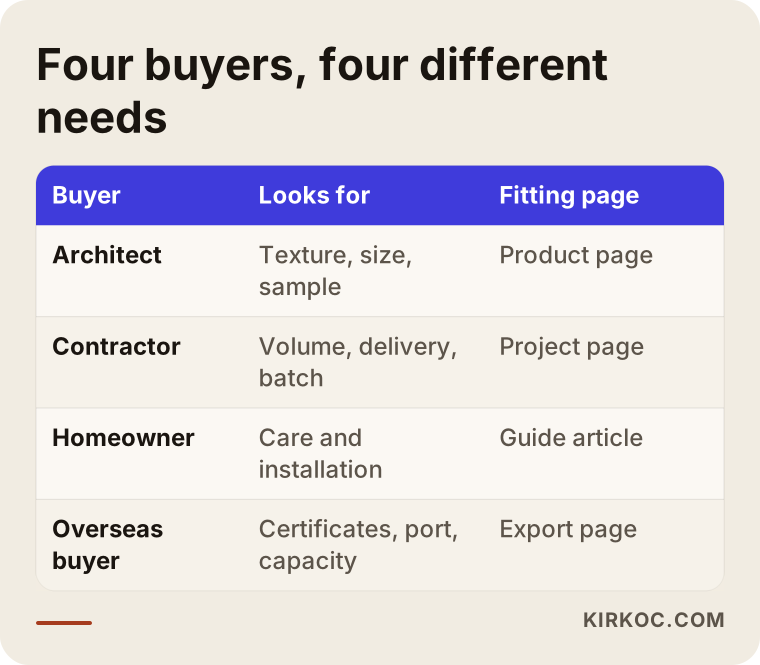
The rows in the table show that each buyer needs a separate page or group of pages. If you pile everything into one "About Us and Products" page, nobody finds what they came for, and Google cannot tell who your page is meant to serve.
Which pages do you really need?
Many stone company sites are built the same way: home page, about, products, gallery, contact. The products page has twenty photos one under another, maybe with a sentence below. This structure carries almost no information for Google. A more useful structure looks like this.
A separate product page for each stone. Travertine, marble, basalt, limestone, onyx and every other main stone type should be described on its own page. The page should cover the color and veining character of the stone, which surface finishes are available, which sizes are produced, where it can be used (floor, facade, bathroom, garden) and what to watch out for. Photos should be individual and show the real product, each with a meaningful caption.
Pages by use. "Exterior natural stone cladding," "bathroom and kitchen marble countertops," "garden and landscape stone" should be thought of separately from product pages. These pages describe the problem being solved rather than the stone, which matches the way architects and homeowners search.
Project and reference pages. Showing finished work, with which stone was used where and how, builds trust. One important warning: publish only the projects your client has allowed, and add names or addresses only with their approval.
An export page. A page for overseas buyers, in a separate language (at least English), covering the quarry and production capacity, certificates, loading and packaging, and the sample process. This page should not be a translation of the Turkish page. Overseas buyers ask different questions, so the content must be built differently.
Frequently asked questions and guide articles. Articles answering questions like "travertine or marble?" and "which surface finish lasts longer on a facade?" bring in people who have not yet reached the stage of looking for a supplier.
The image below shows the order of a well-built product page, using a sample page.
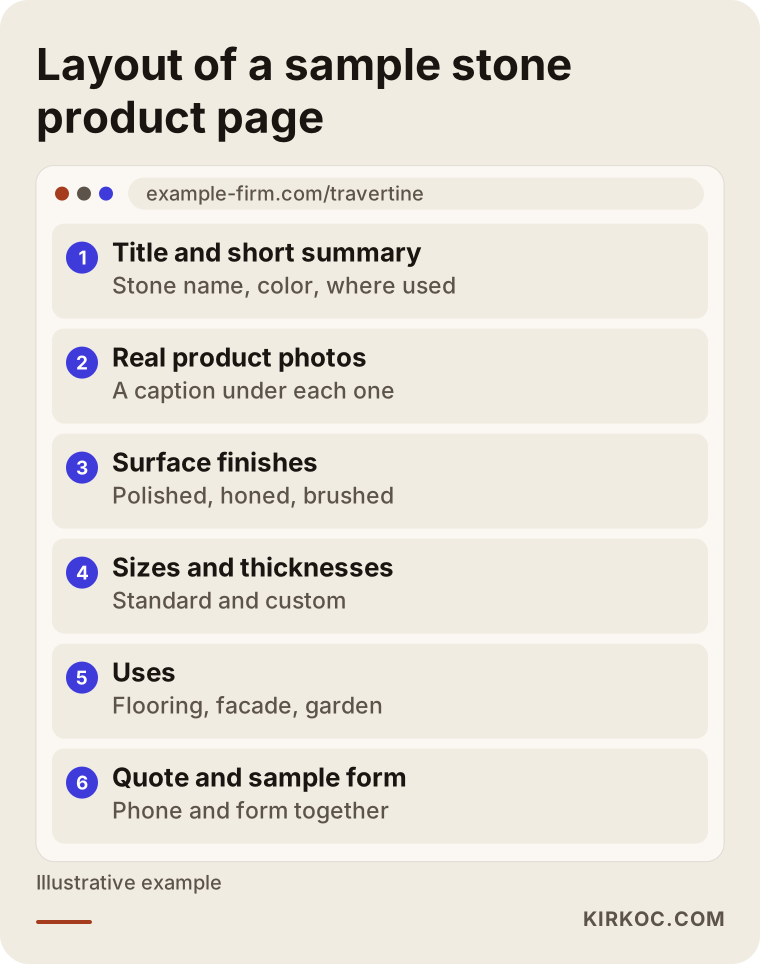
Having a quote form or a phone number at the end of the page makes it easy for a person who has read the information and is close to deciding to take the next step. Even a beautiful page wastes the visit if the way to contact you is hard to find.
What must a product page contain?
The most common mistake when writing product pages in the stone industry is filling them with phrases like "high quality, durable, elegant" that could be said about any stone. Such phrases tell the architect nothing and tell Google nothing. Give concrete information instead: which quarry the stone comes from, which finishes can be produced, the standard sizes, how it is delivered, and how to get a sample.
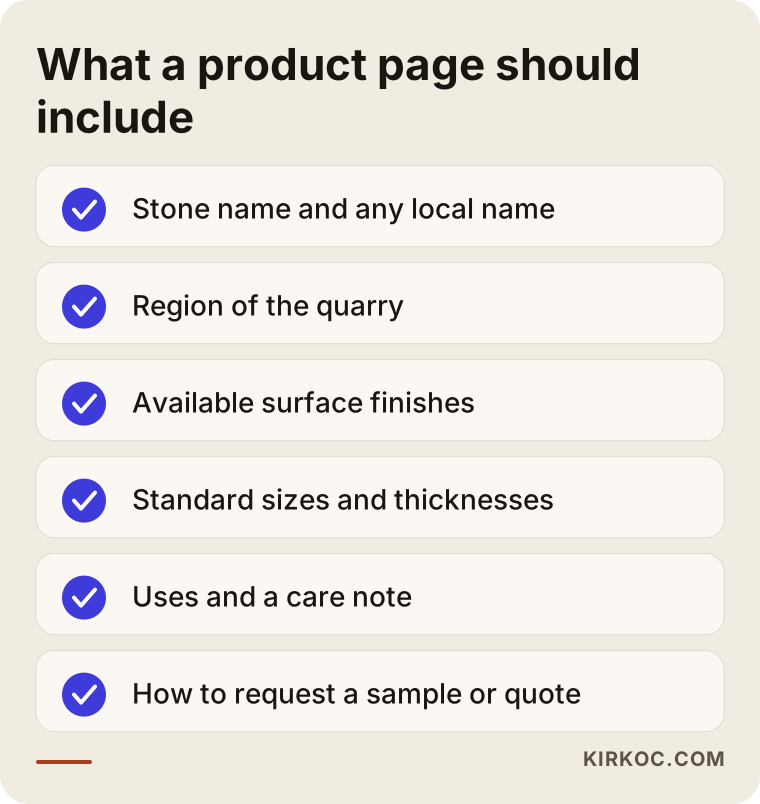
The items on the checklist work as a skeleton while you write the page. You do not need to fill in every item exhaustively on every page, but if an architect reads the page and thinks "I will not need to ask this company about sizes or samples," you are on the right track. If you are unsure about a technical specification, do not make it up. Wrong information costs you both the customer and your credibility.
What if your catalog is a PDF?
For many companies, the best material they have is a carefully prepared PDF catalog. The problem is that information inside a PDF shows up weakly on Google, is hard to read on a phone, and cannot be linked to as a single product. This does not mean you should give up the catalog. Keep it available as an extra download, but also publish the same information on your site as pages.
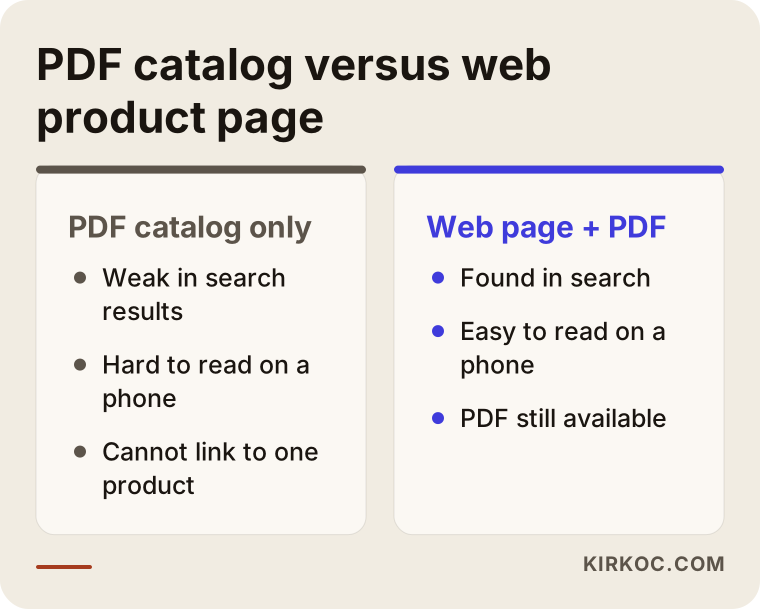
As the comparison shows, when the same information is published as a page, it can be found in search, read comfortably on a phone and shared. The PDF continues to serve the serious buyer who downloads it and studies it on a computer. The two complement each other rather than replace each other.
Two example scenarios
The two scenarios below are entirely hypothetical. They do not describe a real company or person. The aim is to show a way of thinking.
Scenario 1: A travertine workshop focused on domestic projects
Suppose you have a small workshop processing travertine near Denizli, a region in western Turkey known for travertine. Your site has a single "Our Products" page with fifteen photos under it. Most of your customers come through acquaintances. The goal is to win work from architects and contractors in Istanbul and Izmir.
The first step is to understand what is being searched: "travertine floor tiles," "travertine exterior cladding," "travertine pool coping," "travertine garden paving." Each of these shows a different intent. The second step is to split the single product page into three: floors, facades, and pool and landscape. Each carries finish options, sizes and care notes. The third step is to add the permitted finished projects as photo reference pages. The fourth step is to prepare a short page titled "Sample process for architects," because the answer to this question is nowhere on the site and has to be explained again on every phone call.
Once this structure is in place, an architect in Istanbul searching for "travertine exterior cladding" has a chance of landing on your facade page. I cannot say in how many weeks that will happen; competition, the current state of the site and Google's decisions determine it. But without the page, there is no chance at all.
Scenario 2: A block and slab producer that wants to export
The second hypothetical company is a mid-sized producer that runs a marble quarry and wants to sell blocks, and also processed slabs, abroad. Its current site is in Turkish only, and it is unclear what a single visitor from Germany, China or the Gulf countries would find.
The first job here is choosing target markets. Instead of speaking to every country at once, prioritize, for example, two or three. The second job is preparing separate pages in those languages: the quarry and stone type, block grades, slab sizes, packaging, the port of loading, the sample shipping process and certificates. The third job is using the words the buyer uses, such as "supplier," "wholesale" and "block," in the right places. The fourth job is adding trust signals for the overseas buyer: company registration details, address, photos of the factory and quarry, and a named contact person.
There is no guarantee of results in this scenario either. Overseas buyers often find suppliers at trade fairs, on trade platforms and through personal recommendations; a website does not replace these, it supports them. A well-built site is the place where a buyer you met at a fair finds reassurance when they look you up.
A content plan along the buying journey
Because buying stone takes a long time, content needs to be spread across stages rather than put on a single page. Picture a structure that starts wide and narrows to the few serious people who ask for a quote.
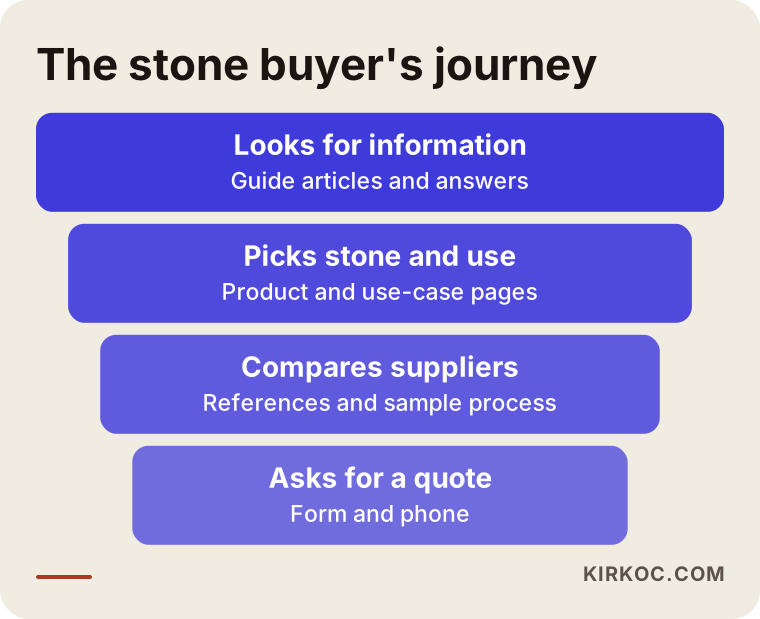
In the wide top stage, guide articles work. In the middle, product and use pages. In the narrow bottom stage, references, the sample process and the contact form. The page at each stage should link to the next. Someone who reads a guide article should find a natural path to the relevant product page and from there to the quote form. Without these links, the visitor takes the information, closes the tab and does not come back.
How does the work proceed, step by step?
If you divide the process into a few clear steps, you know what you are dealing with at any time. An SEO project usually runs in this order.
The first step is seeing the current situation. I check which searches your site appears for, which pages receive no visits at all, how fast the site opens on a phone, the size of your photos, and whether details such as address and phone number are consistent. Stone sites are usually full of large photos, so they open slowly, which hurts both the customer and Google.
The second step is working out the search terms and the page plan. Using the patterns described above, I list the searches that match your products. I then work out with you which page answers which search and which pages are missing.
The third step is technical fixes. Page speed, mobile display, photo sizes, page titles, and, on a multilingual site, setting up the language links correctly. These are the parts the user does not see but Google looks at.
The fourth step is writing and organizing the content. Product pages, use pages, the export page, frequently asked questions. The most critical thing here is that the information comes from you: you know the quarry, the production and the installation, so only you can supply the right detail. I help make that information readable and searchable.
The fifth step is measuring and correcting. Which pages received visits, which searches brought people, how many filled in the form or called. Without this tracking, you cannot know whether SEO is working.
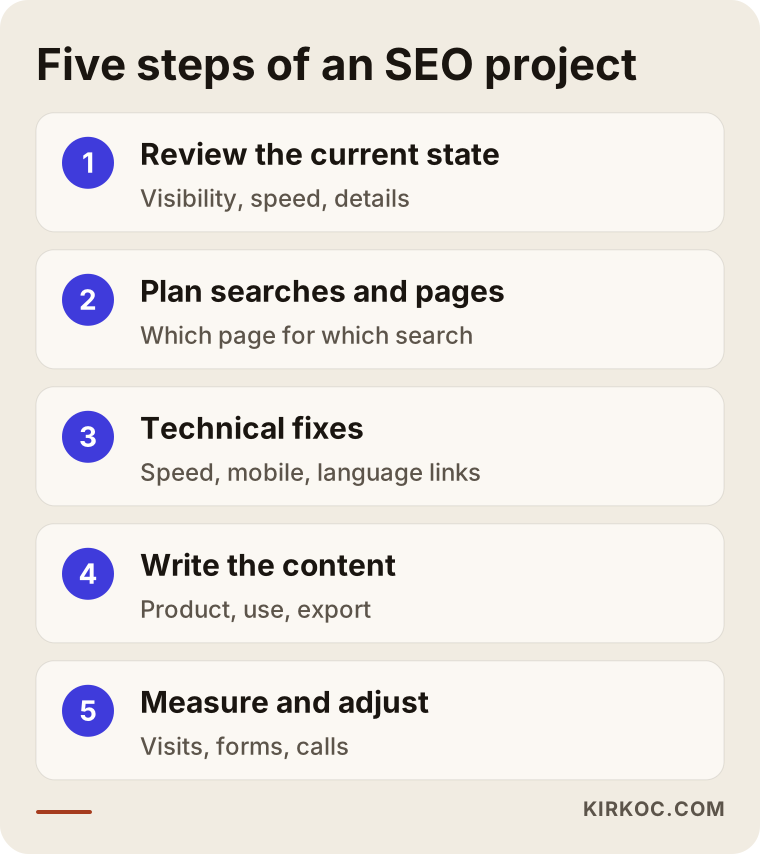
Although the steps look sequential, in practice they overlap. Measurement, for example, starts on day one and guides the later steps. What matters is that each step builds on the previous one and the process moves steadily rather than waiting for results.
When will you see results?
The honest answer: there is no fixed time. It depends on the current state of your site, the strength of competitors, the difficulty of the terms you target and the quality of the work. In general, SEO does not work overnight, it accumulates. First the technical problems need to be fixed and new pages need to be noticed by Google, then the pages begin to find a place in search. After a while, you can expect more visits, then more forms and phone calls. If anyone tells you "I will put you first in so many weeks," do not trust that promise, because nobody controls Google's decisions.
The most common mistakes of natural stone companies
These are the mistakes I see repeated in this industry. You can notice and fix many of them yourself.
The first mistake is squeezing every stone onto one page. The second is building galleries with beautiful photos and no descriptions. The third is not opening a separate language version for export and instead publishing the Turkish text through automatic translation; a text that is unreadable or does not inspire trust can be worse than having none. The fourth is copying the same text onto several pages, so Google cannot tell which one is the main page. The fifth is writing only one spelling (for example "travertine") and never using the other names (the regional name, the name in another language). The sixth is hiding contact details or making it complicated to ask for a quote.
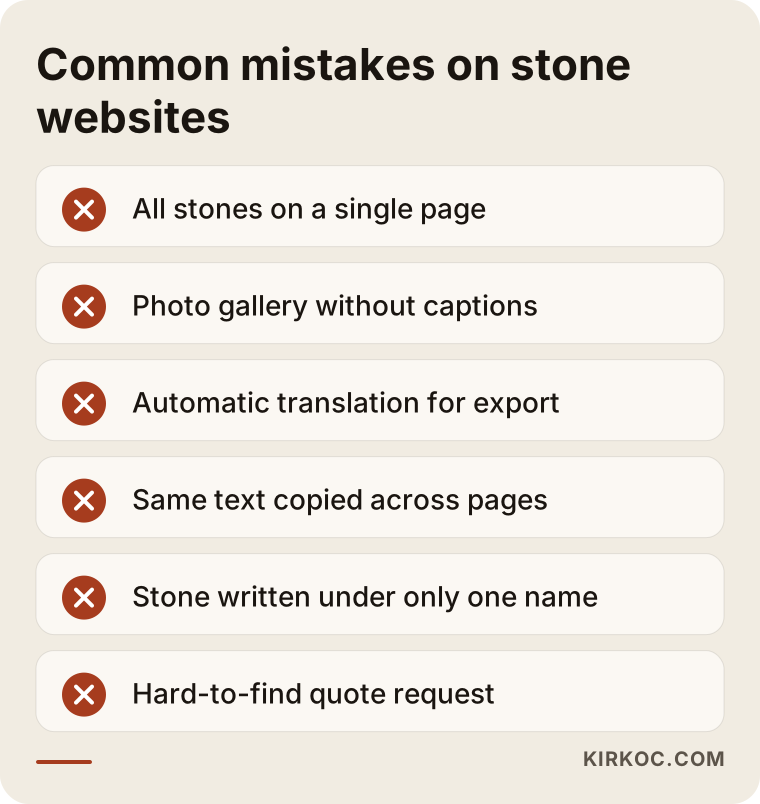
Not all of these mistakes need an expensive fix. Most are solved by reviewing the existing site, splitting pages, writing descriptions and correcting links. The truly expensive thing is carrying on for years with the same structure without noticing.
AI searches and the stone industry
Some people now put their question to AI tools such as ChatGPT instead of Google: "Which natural stone is suitable for an exterior facade?" These tools draw on pages that give reliable, clear information when they build an answer. When you write a clear, accurate guide with a stated source, your chance of being mentioned both on Google and in such answers goes up. There is no guarantee here either, but the concrete, accurate and organized content I describe above works the same way in both cases.
What can you do yourself, and when do you need an expert?
You do not have to hand everything to an expert. There is a lot you can do on your own, which lowers the cost and also makes clearer what I would be doing.
Things you can do yourself: name your product photos correctly, write a short description under each photo, keep your Google Business Profile up to date, photograph completed projects with permission and take notes, and write down the questions customers ask most often. That list is the raw material for the frequently asked questions section and for guide articles.
The jobs that need an expert are usually the technical ones: finding why the site is slow, setting up a multilingual structure correctly, reading search data and drawing up a page plan, and solving duplicate content and redirect problems. These are jobs that can harm your site if done wrongly.
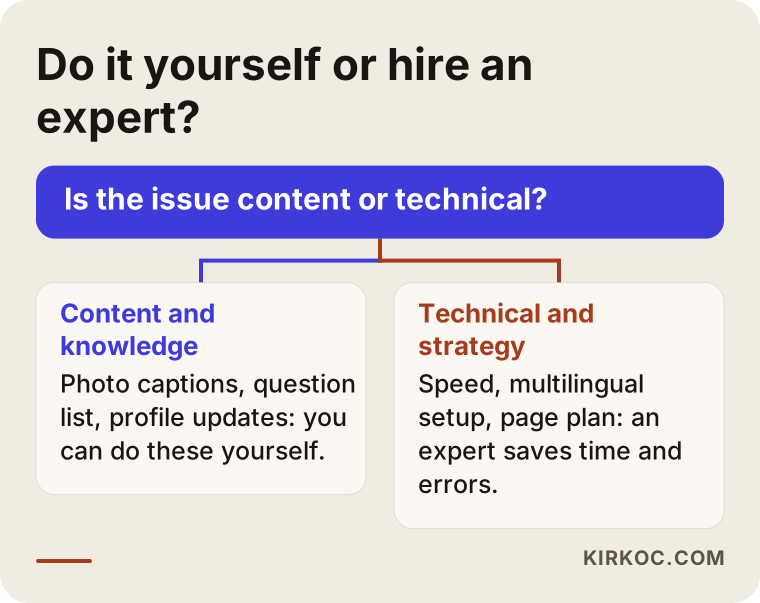
The summary of the flow chart is this: if the problem is about content and knowledge, you know it best and can do most of it yourself. If the problem is technical or strategic, an expert saves you time and the cost of mistakes.
What determines the cost?
I do not give figures in this article, because no two stone companies are alike. The main factors that determine cost are these: the current state of the site (will it be built from scratch or will the existing one be fixed), how many languages are involved, how many product and use pages need to be written, how much of the photo and content material comes from you, how intense the competition is, and whether the work is a one-off or an ongoing monthly engagement.
An export page prepared in two or three languages naturally takes more effort than single-language work. Likewise, a company that arrives with ready and accurate information takes less time than one where everything has to be gathered from scratch. A clear price can only be given after looking at your site and your goals. In a first conversation I go through with you what needs to be done and what does not.
How I work with you
I work alone, which means the person you talk to is the person who does the work. A sales representative does not hand you over to another team. The process goes like this: first, in a short conversation, I listen to your business, your customers and your goals. Then I look at your site and share in writing what needs to be done, in order of priority. We agree together on which parts you will do and which I will do. Once the work starts, I regularly explain what has been done and what is being measured.
The timeline below shows the rough course of the work. I have written stages rather than durations, because every site moves at a different speed.
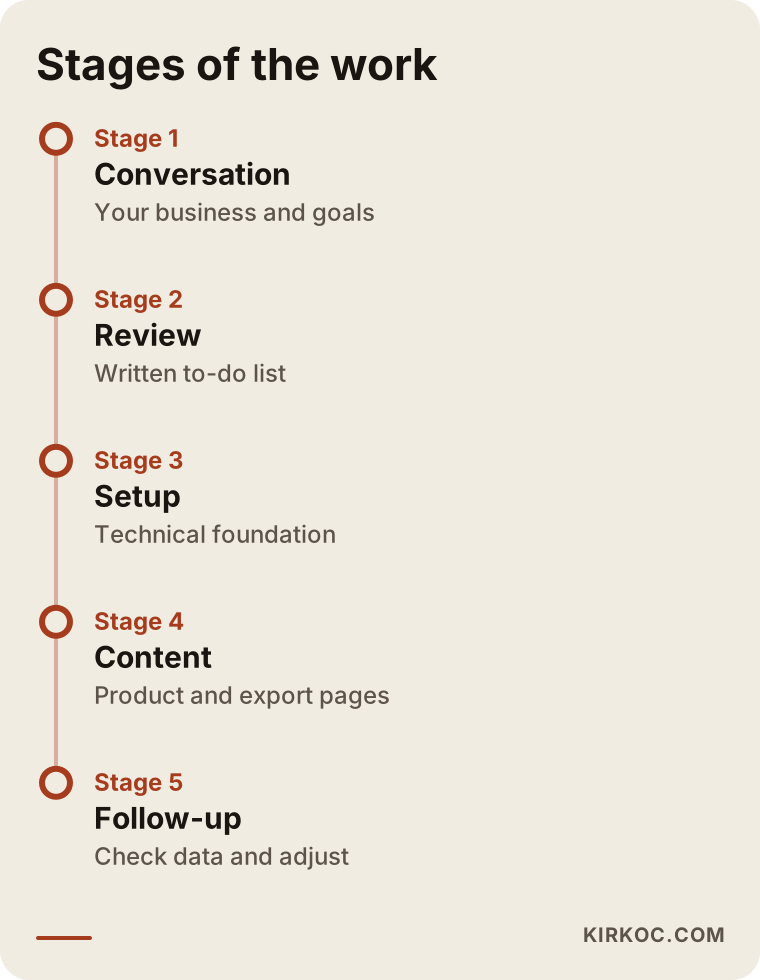
There is no exaggerated promise here: in the setup stage the technical foundation is laid, in the content stage the pages are written, and in the follow-up stage the work is corrected by looking at the data. This routine, over time, lays the ground for your company's site to become a showroom that brings in customers on its own.
Frequently Asked Questions
Is SEO really necessary for a marble and natural stone company?
If all your customers come through acquaintances, it may not be necessary in the short term. But architects, contractors and overseas buyers research suppliers online first, and information they cannot find on your site sends them to your competitor. If you want to win new customers or expand abroad, SEO is one of the most lasting ways to do it.
Do I need separate sites for the domestic market and for export?
Usually not. Pages in different languages with different content on the same site are enough. What matters is that the overseas pages are not a translation of the Turkish text and are written around the questions overseas buyers ask. In some cases a separate domain name can make sense, and I would weigh that with you.
My product photos are very large and the site is slow. What should I do?
Photos need to be reduced in size without a visible loss in quality, and set to load in sequence as the page loads. This is very common on stone sites, and the fix is usually a technical adjustment. Before trying it yourself, it is worth showing it to an expert, because wrong compression can damage image quality.
Should I remove my PDF catalog from my site?
No. Serious buyers want to download and study the catalog. Just publish the information inside the catalog as pages on the site as well, so that it can be found in search and read comfortably on a phone.
When will I see results?
I cannot give a fixed time. The state of your site, competitors and the targeted terms all change it. Generally, the technical fixes and new pages come first, followed by growth in visits and inquiries. I recommend staying away from anyone who guarantees a ranking or a result.
Do I need client permission to show reference projects?
It is generally right to get approval for any information that would reveal the owner or location of a project. Whether there is a legal requirement depends on your contract; if you are unsure, consult a lawyer. Examples that give no names and describe only the stone and the type of installation also work.
What should I do to show up in AI tools too?
Preparing pages that give clear, accurate information with a stated source is the most reliable way. Product pages, guide articles and frequently asked questions help here. Because the way these tools build answers can change, I do not promise a result, but the same content is valuable for Google too.
Can I get SEO only for export?
Yes. The work can focus only on the overseas pages of the site. Still, having a basic page structure on the Turkish side helps both trust and domestic demand.
If you want your natural stone and marble business to be seen more clearly by architects, contractors and overseas buyers, you can reach me through my SEO services page and describe your business and your goal in a few sentences; we will talk about where to begin.