You run a language school or a language course. The classrooms are ready, the teachers are good and the curriculum is solid, but when enrollment season arrives, the phone does not ring as much as you expected. Meanwhile, people type "adult English classes near me" or "Spanish lessons for kids" into Google every single day, and most of them look online before they decide anything. In this article I explain what SEO means for a language school, which pages actually help, and how I run the process. I am Ümit Kırkoç, a web designer and SEO consultant who works alone from Istanbul, and I do all of the work myself as part of my SEO services.
SEO, in short, is the work that makes your website show up when potential students search on Google. When you stop paying for ads, the ads disappear. With SEO, pages that are built well can keep bringing in inquiries for a long time. This article assumes you have no technical background. If I need a term, I will explain it in one sentence, and the rest I will keep plain.
What does someone looking for a language course type into Google?
Choosing a language course is not like choosing a pair of shoes. The decision takes weeks, often more than one person is involved, and the money is spread over a period of time. So people rarely do one search and stop. They type different things at different stages.
In the first stage, a person searches broadly: "English classes," "I want to learn German" or "best language school." These searches are crowded, because national chains, online platforms and review sites all target the same words. For a school with a single location, reaching the first page for these broad searches is hard, and most of the time it is not even necessary, because the person searching broadly does not need to be able to walk into your school.
In the second stage, the search narrows: "English classes in Brooklyn," "German course near downtown Chicago," "English for elementary school kids in Plano." Location and audience come into play. A language course is almost always chosen by proximity; nobody wants to spend an hour in traffic to attend a class three times a week. For a small or mid-sized school, this is where the real opportunity is.
In the third stage, the person writes down their goal: "IELTS prep course," "business English group class," "TOEFL preparation," "conversation-focused Spanish." Someone typing these words knows what they want and is the closest to enrolling. Many schools skip this stage, because their website does not have a single page that answers these searches.
Then there are parents. A parent searching for their child types "English classes for kids" but quickly looks for answers to questions like "groups by age," "is there a trial class" and "who is the teacher." An adult student and a parent do not use the same words, and they do not worry about the same things. A site that tries to speak to both on the same page often convinces neither.
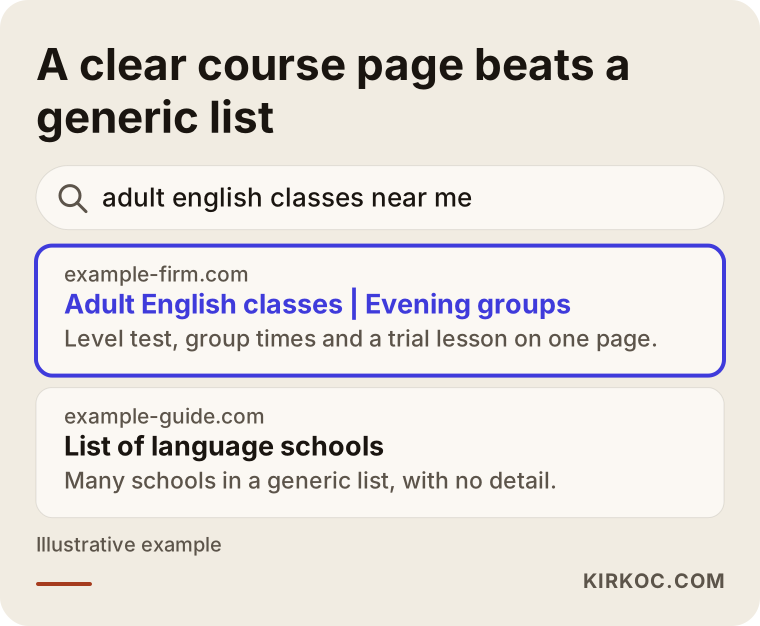
The example above shows how a generic directory page and a clear school page about a specific audience might appear side by side for the same search. When the topic and the location are clear, Google is more likely to treat the page as a good match for that search. That is not a guarantee. It is simply a step in the right direction.
Which pages should a language school website have?
The most common mistake language schools make is putting everything on a single "Our Courses" page. English, Spanish, French, kids' groups, adult groups, exam preparation and corporate training sit in one list, one under another. The page gives a visitor information, but it cannot tell Google "I answer this specific search," because it says a little about everything and goes deep on nothing.
A more useful structure is a separate page for each language and each audience. For example, a main "English courses" page, and underneath it "English for kids," "adult conversation group" and "IELTS preparation." Each page carries the details specific to that course: who it is for, what level it starts at, how many days a week, the size of the group, the teaching method, how the level test works and how to enroll.
The same logic applies to location. If you have several locations, each one needs its own page. If you have one, a clear "directions and parking" section is enough, explaining how people can reach you from nearby neighborhoods by car, bus or train. Just writing an address and leaving it at that is not enough. A sentence like "five minutes' walk from the subway station" or "free parking behind the building" helps both the student and the search engine.
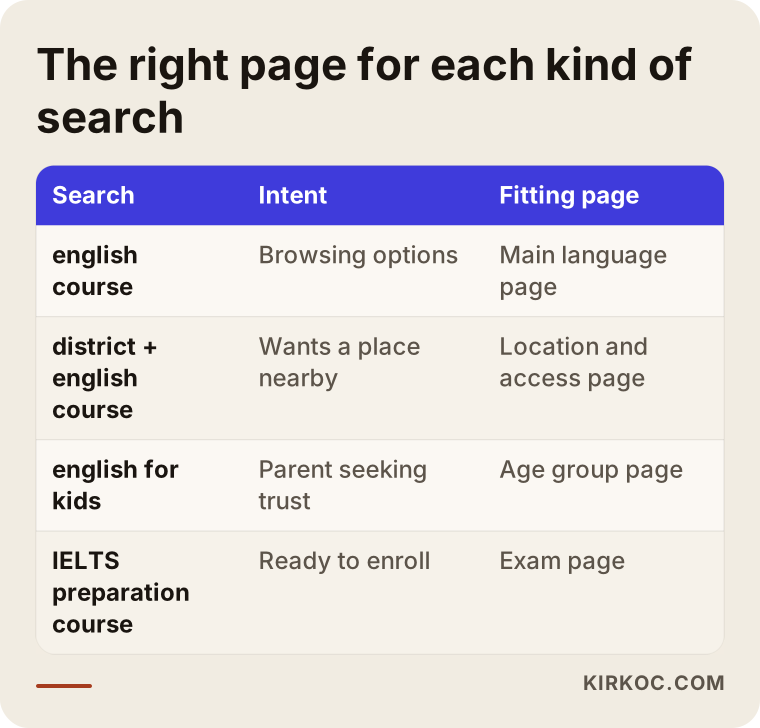
The table summarizes which page answers which type of search. The important point is that each page answers one question. If a page tries to speak to kids, adults and companies all at once, it cannot speak fully to any of them.
What is on the page matters too. Pages stuffed with repeated phrases, like "best English course, affordable English course, cheap English course," tire the reader and stop working over time. A page should read as if you were explaining things to a parent or student in person: who you are, what you teach, how you work and what the first step is.
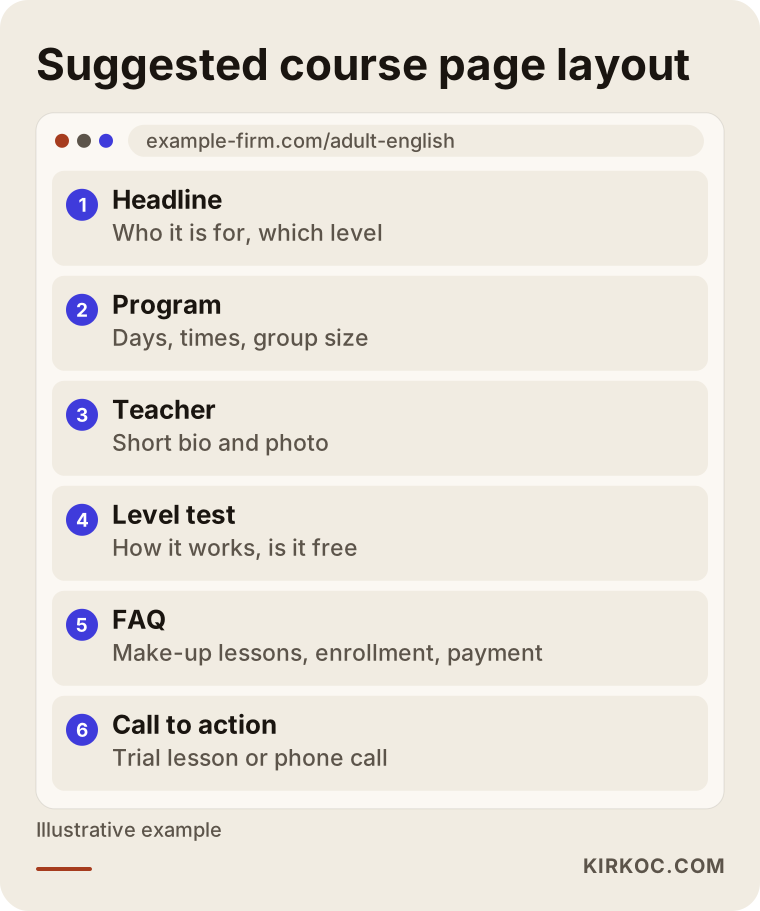
The layout above shows the flow of a single course page: first who it is for, then the program, the teacher, how the level test works, frequently asked questions and, at the very end, a call to enroll or book a trial class. This order is not random. It answers the questions in an undecided reader's mind in the order they come up.
Trust matters more than rankings in this field
When people pay for education, they want to trust you before they hand over money. A visitor arrives at your site and wonders, "Is this school real, who are the teachers, and what will my child or I actually learn there?" If the site does not answer those questions, the person who came from Google goes back, and that is your loss.
What builds trust is well known, and most of it you already have: a short introduction to each teacher (what language they teach, for how long and to which age group), real photos of the classrooms, a clearly written class schedule, an explanation of how the level test works, reviews from students who agreed to be quoted, and clear contact information. A site full of stock photos where nobody can tell who is behind it makes both parents and adult students hesitate.
Be honest about reviews. Fake or inflated reviews are unethical and may eventually hurt you. Politely asking happy students to leave a review on your Google Business Profile, the listing that shows your school on Google Maps and in local results, is both right and sustainable. Always keep in mind the difference between asking for a review and buying one.
Be careful with success claims too. A sentence like "all of our students passed the exam" should not be used if you cannot document it. In education, claims like this can mislead readers and cause problems for you. Advertising and consumer protection rules set firm limits on this; if you are unsure, talk to a lawyer. Give concrete, verifiable information instead: how many weeks the program lasts, how many students are in a group and which materials you use.
Enrollment periods and seasonality
A language school's year has ups and downs. Kids' and teens' groups stand out at the start of summer, the new school year in September brings its own wave, January has the New Year's resolution crowd, and exam preparation courses follow the exam calendar. Knowing this rhythm is very useful for SEO, because your pages and content should be ready months before enrollment begins. If you publish a page during enrollment week, the time Google needs to discover and evaluate it has already passed.
That is why I recommend building a yearly calendar: which month you will take enrollments for which course, when that course's page needs to be ready and which pages need updating. Keeping the dates and content on your pages current also makes a difference. A page that shows last year's price or last term's dates hurts both the visitor experience and trust.
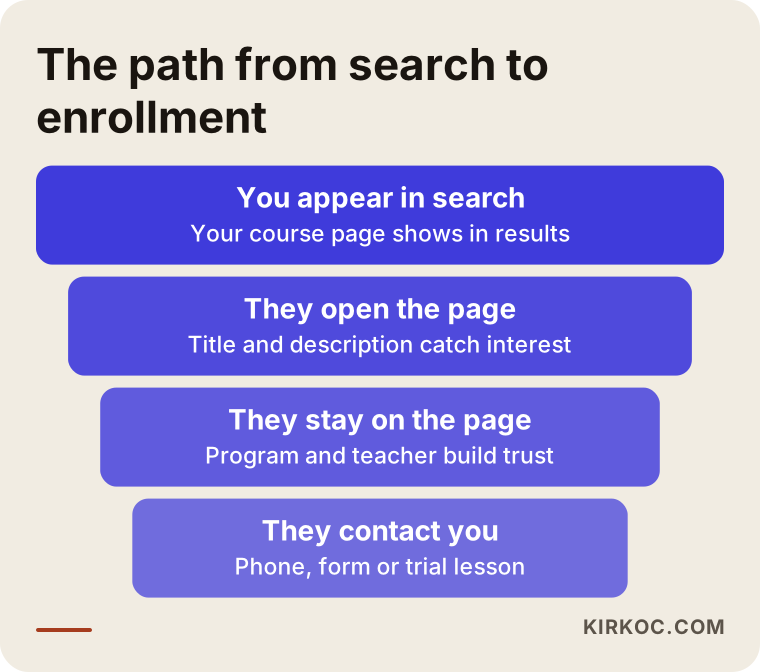
The funnel shows that you lose people at every step between the search and enrollment. The goal is not only to attract more visitors. It is to increase the number of people who stay on the page, ask questions and show up for a trial class or a level test.
Example scenario 1: A single-location English school for kids and teens
This is a completely hypothetical example. Imagine an English school with one location in a suburb, teaching kids' and teens' groups. Its website looks nice but is only one page: a short introduction on the home page, the courses listed one under another and a contact form at the bottom. People find the site on Google only when they type the school's own name.
The first job is to work out who is searching for what. Parents may be typing "English classes for kids" together with the town name; teenagers and their families may be searching for "high school English help" or "conversation class." These turn into page titles: separate course pages by age group, each with the program, group size, trial class and an introduction to the teacher.
The second job is to clean up the business profile: the right category, opening hours, real photos, a list of services and short, current posts. For searches that include a town or neighborhood, showing up on the map often matters even more than the website itself.
The third job is to set realistic goals for the first three months. On a site like this, what you should expect in the early months is not a first-page victory. It is that the pages get indexed (meaning Google has found them and added them to its records), that you begin to appear in local searches, and that the questions arriving by form or phone start to change. I do not promise results, but I tell you up front which numbers we will watch.
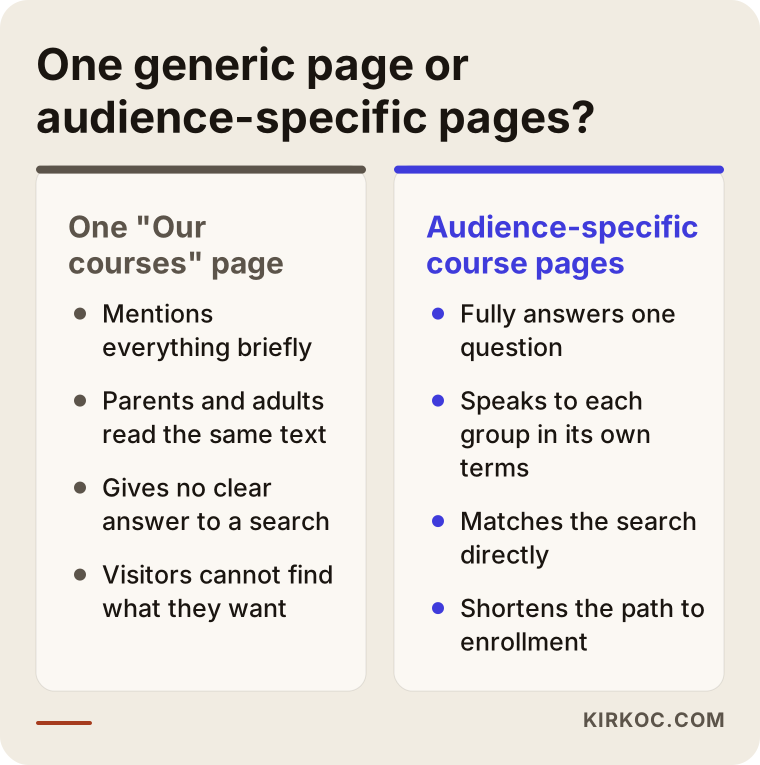
The comparison shows what changes for the reader when you build a separate page for each audience instead of a single generic one. The same information works harder when it appears in the right place and speaks to the right person.
Example scenario 2: A school teaching Spanish and exam prep, in person and online
This one is hypothetical too. Imagine a school that teaches Spanish, French and exam preparation, and runs part of its classes online. There are two separate issues here. The first is that the online product is not tied to a city; someone searching "Spanish classes online" could be anywhere in the country. The second is the more intent-driven searches, such as exam preparation.
The solution is to build two separate clusters. For in-person classes, city and neighborhood pages. For online classes, pages that are independent of location. On the online page, you explain the practical details: how the classes run, which platform you use, whether sessions are recorded and what happens if a student misses a class. A person looking for online lessons worries about quality, so these answers matter.
For exam preparation, each exam needs its own page. That page should include the exam format, the length of the preparation, the level required and information about practice tests. Exam rules and formats can change over time, so the dates and conditions on those pages should be kept current by checking the exam organization's own website. The freshness of these pages is a detail you may not notice at first glance, but it directly affects trust.
Step by step: how I start this kind of work
When I work with a language school, the path is roughly as follows. First, I look at the school's current situation: does the site open, can it be read on a phone, which pages exist and which of them show up on Google. Then I ask which courses the school really wants to sell and to whom. It is not possible to push every course equally hard, so it makes more sense to start with the groups that earn the most or have the most empty seats.
In the second step, I look at what potential students type for those courses. This is not guesswork. I look at search patterns, at the suggestions Google offers while you type, and at what competitors explain on their pages. In the third step, I draw up a page plan: which page will be newly written, which will be fixed and which will be removed or merged.
The fourth step is writing the pages and doing the technical cleanup: titles, descriptions, image sizes, mobile speed and redirects. In the fifth step, I set up the business profile and local visibility. The sixth step is measuring: which pages are shown, which are clicked and which lead to a phone call or a form.
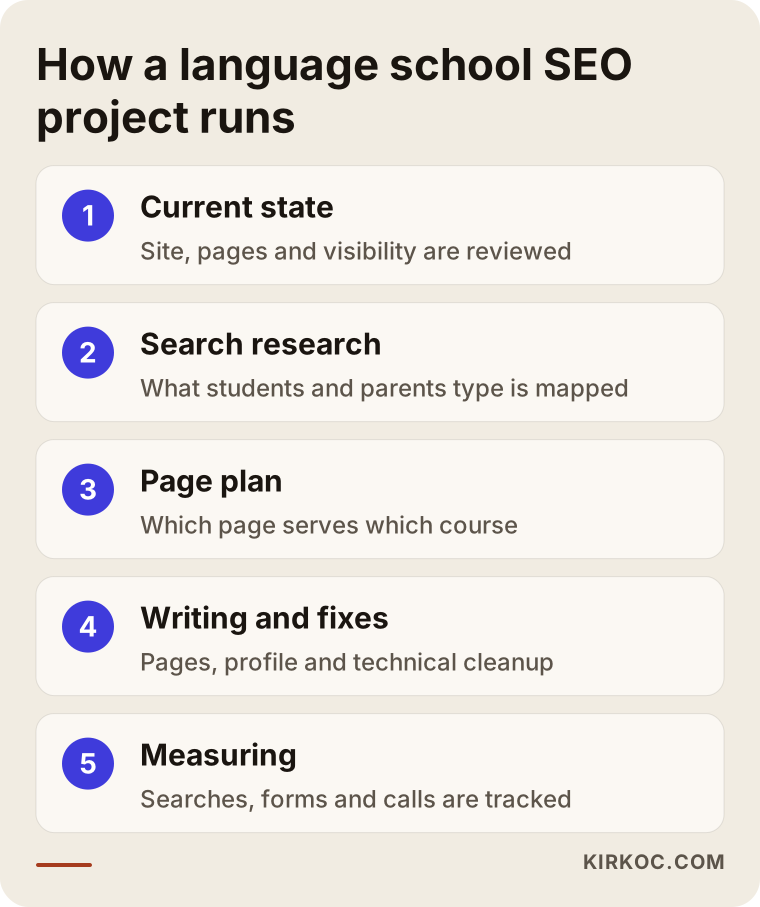
The graphic summarizes the main steps of this flow. At the end of each stage, I share with you what was done. I do not want you to have a piece of work that you do not understand.
The most common mistakes language schools make
A few mistakes come up often enough on language school sites that I want to point them out.
The first is cramming everything onto one page. As I described above, a single page tires both the reader and the search engine. The second is hiding all price and program information. You do not have to publish the exact price, but explaining what the price depends on (group or private lessons, length, materials) builds trust. A "call for information" page that tells people nothing sends them to your competitor.
The third is not showing the teachers. Learning a language is a relationship, and students want to know who they will be working with. The fourth is neglecting the mobile view. Parents and teenagers often search on their phones; a site that opens slowly or has buttons that are hard to tap loses visitors.
The fifth is copying the same text onto different pages. If your "Brooklyn English classes" and "Queens English classes" pages differ only in the neighborhood name, both pages end up weak. Each page should contain information that is really about that area: transit, nearby schools, preferred class times and so on.
The sixth is missing the enrollment season and preparing pages during enrollment week. The seventh is not measuring results: how many times the phone rings and how many forms are filled out. Without tracking these, you cannot tell whether SEO is working.
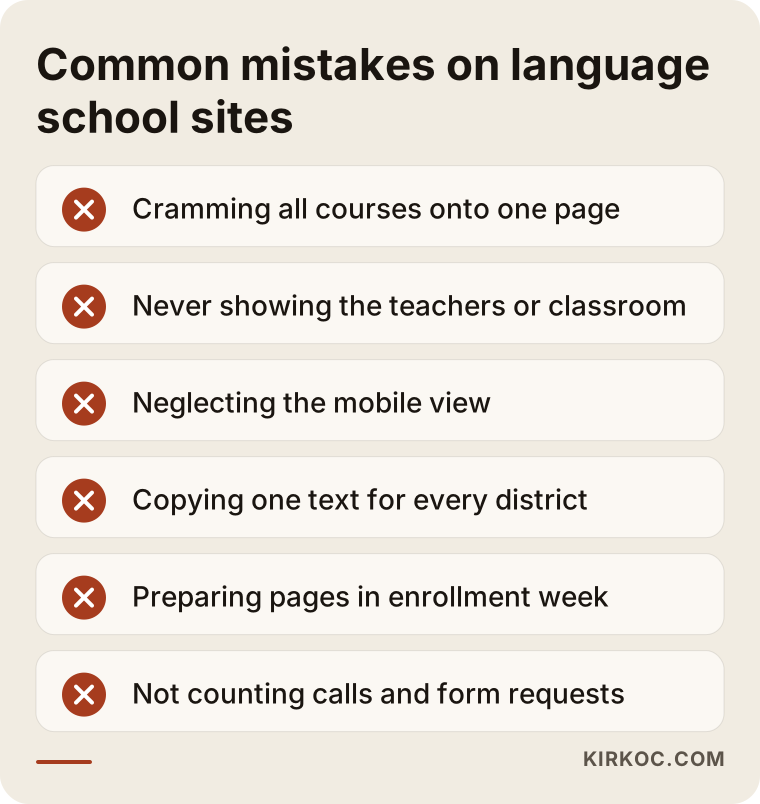
Most of these mistakes do not require anything expensive to fix. They need time, organization and a willingness to describe your school well.
What can you do yourself?
You do not need to hand everything to a specialist. There are a few jobs you can do on your own that make a real difference. Claiming and completely filling in your Google Business Profile comes first: the correct address, phone number, opening hours, category and real photos. Politely asking happy students for reviews is the second job.
The third is keeping the course information on your site current: term dates, group times and teacher details. The fourth is writing down the questions you get often and answering them on your site. What people keep asking you by phone or text message is also what they ask Google. The fifth is to open your site on your own phone and browse it like a parent or a student. Wherever you get stuck, your visitor gets stuck too.
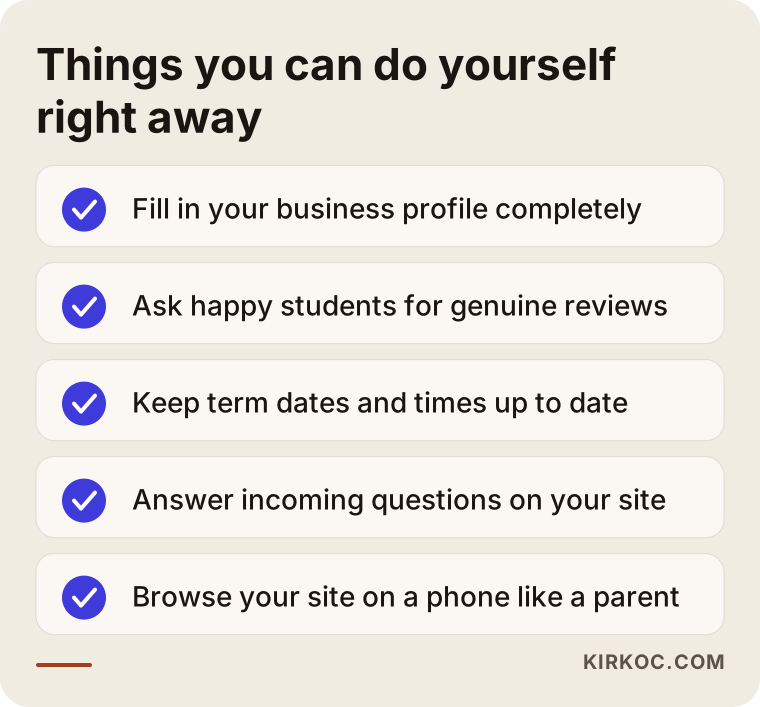
The list summarizes the basic jobs you can start without professional help. If you do them regularly, you will see a difference even on your own.
When do you need professional help?
Outside help makes sense in these situations: your site has a technical problem (it opens very slowly, or its pages do not show up on Google at all), you have more than one location or more than one language, your competitors are clearly ahead of you, or you are about to build a new site. It also makes sense when you simply do not have the time. A school owner who handles lessons, customer questions and site updates at once often cannot keep up.
To decide, ask yourself this: is my site right now a current, trustworthy place that answers people's questions? If the answer is no, fixing the site first is more sensible than spending money on ads or other investments.
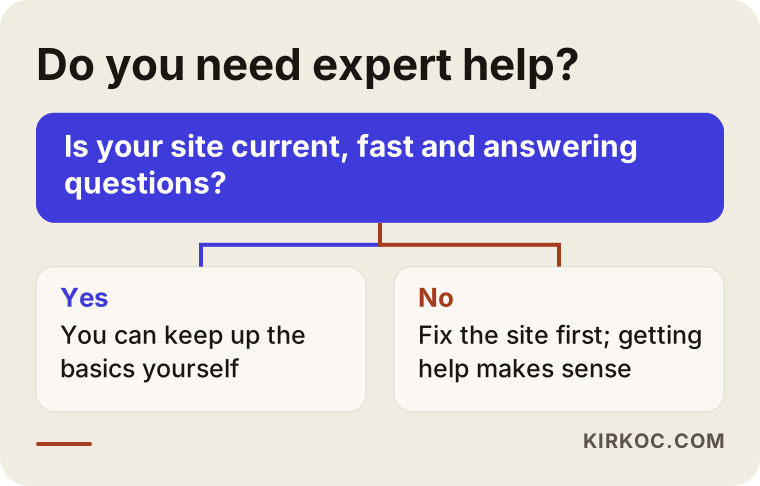
The chart draws a simple line: if your basics are solid and you have time, you can move forward yourself; if not, getting help can be faster and cheaper in the end.
What determines the cost?
The price of SEO for language schools cannot be tied to a single number, so I do not give one here. The main factors are these: how many languages and how many different courses you want to appear for, how many locations you have, the state of your current site (whether it needs fixing or rebuilding from scratch), your city and how intense the competition is, how much content needs to be written and how long the work will continue.
A school with one location, one language and a sound website is not the same job as a school with three locations, four languages and a site that has to be rebuilt. That is why the right approach is to look at your situation first and talk about what needs to be done and roughly how long it will take. When you collect quotes, also ask: what will you report, when and how? Stay away from anyone who cannot give a clear answer. And stay away from anyone who promises "first page guaranteed."
How I work with you
I am a one-person business, and that is an advantage: the person you talk to is the person who does the work. First, I listen to your situation in a short call, look at your site and tell you honestly what you need and what you do not. I do not sell you what you do not need. Then I put together a roadmap: which pages, in which order and what we will measure.
Throughout the work, I explain what I am doing in plain language, and I do not dress up my reports in technical decoration. I do not guarantee results, because Google decides rankings, not me. But I tell you the reason for every piece of work I do, and we look at the results together.
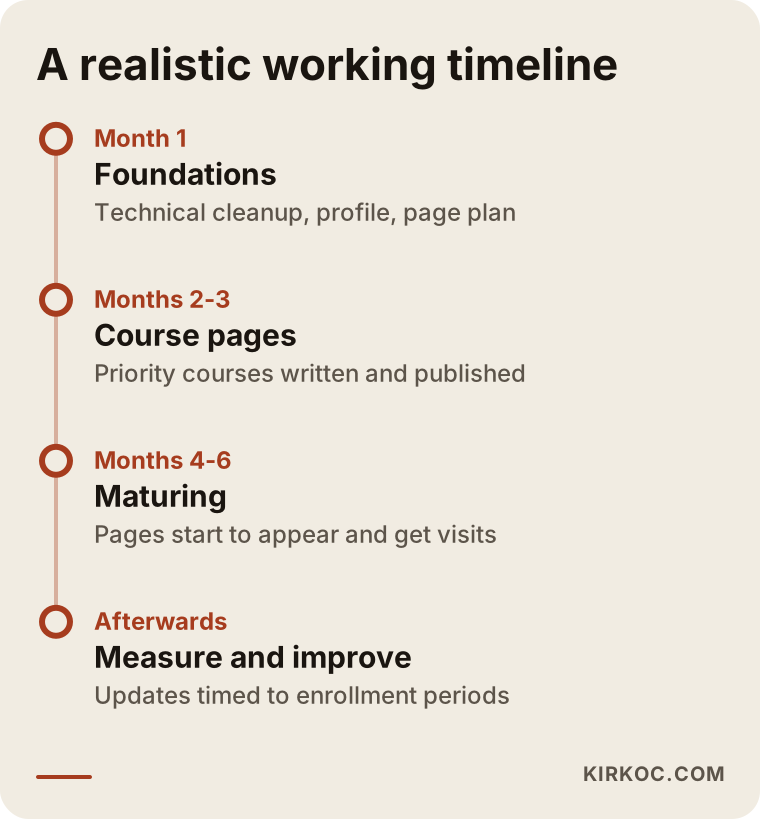
The timeline shows a realistic flow: basic fixes in the first weeks, pages and the business profile maturing over the following months, then measuring and improving. SEO takes patience, but when it is done right, it builds a foundation that keeps working for you during enrollment periods.
Frequently Asked Questions
How long does SEO take to work for a language school?
It would not be honest to give you an exact time, because it depends on the competition, the current state of your site and the work you do. In general, the effect of the first changes shows up in weeks, and meaningful results show up in months. If an enrollment period is coming up, you should start as early as possible.
Which makes more sense, SEO or Google Ads?
They do different jobs. Ads give fast results but end when you stop paying; SEO starts more slowly and works for a long time. Ads may suit a short campaign, and SEO may suit a steady flow of enrollments. Many schools use both together.
I teach several languages. Do I need a separate page for each one?
Yes, usually. Someone searching for English asks different things from someone searching for German. If each language has its own page, both the reader and the search engine understand more clearly what is being offered.
Can kids' courses and adult courses be on the same page?
I would not recommend it. Parents focus on the teacher's approach, safety and groups by age; adults focus on schedule flexibility and their goal. Separate pages let you speak to each group in the right words.
Is it enough to add reviews to my website?
Reviews build trust, but they are not enough on their own. The weight is on clear course pages, a complete business profile and a site that is easy to use on a phone. Collect reviews that are real and given with permission.
Does social media replace SEO?
No. Social media is good for staying in touch with current students and for visibility, but people looking for a course usually type into Google. The two complement each other; one does not replace the other.
I teach online. Do I need to mention a city?
If your classes are independent of location, do not tie yourself to a city name. Instead, prepare pages that clearly explain how the online class works, which platform it runs on and who it suits. If you also have in-person classes, describe them on separate pages with the neighborhood or town.
Do you guarantee rankings?
No. Google decides rankings, and no specialist can guarantee them. Be careful with anyone who does. I tell you openly what work will be done, which numbers we will watch and what to expect.
If you want your language school or course to show up with the right pages in front of people searching for a course, you can look at how I work on my SEO services page and write to me. I will look at your situation and we can talk honestly about what needs to be done.