You build pools, or you service them. You know your trade, the pools you have built are there for anyone to see, and yet the phone mostly rings through word of mouth. You may also have a website that nobody can explain: where visitors come from, or why it never brings in a message. Meanwhile, someone searching for "custom pool builder near me" or "pool service company" is clicking on other companies' sites or on a directory page. SEO for pool builders exists to close exactly that gap. I am Ümit Kırkoç, a web designer and SEO consultant who works alone from Istanbul, and I describe my own SEO services in plain terms at the end of this article.
SEO, in short, is the work that makes your website show up on Google when your customers search. It is not like advertising, where you are visible only as long as you pay. When it is set up properly, it keeps working for months. But the pool business has some rules of its own: the work is seasonal, the purchase is large, the decision takes a long time, and the customer is often building a pool for the first time. If you follow generic SEO advice without knowing this, the effort is wasted.
How do customers search in the pool business?
Someone thinking about a new pool rarely starts with a price or a company name. They describe their own situation first: "pool for a small backyard," "how much space does a pool need," "HOA community pool contractor," "infinity pool builder." Each of these searches carries a different intent. Some people are still researching, some are ready to collect quotes, and some are trying to fix a problem with a pool they already own.
On the service side, searches are much more urgent: "pool water turned green," "weekly pool service," "pool pump not working," "pool opening and closing." These customers do not think for days. They decide quickly, either at the start of the season or the moment something breaks. That means one website has to speak to two different people: the one planning a large investment who wants every detail, and the one who just wants to pick up the phone.
The image below shows, with a made-up search, how a results page might look.
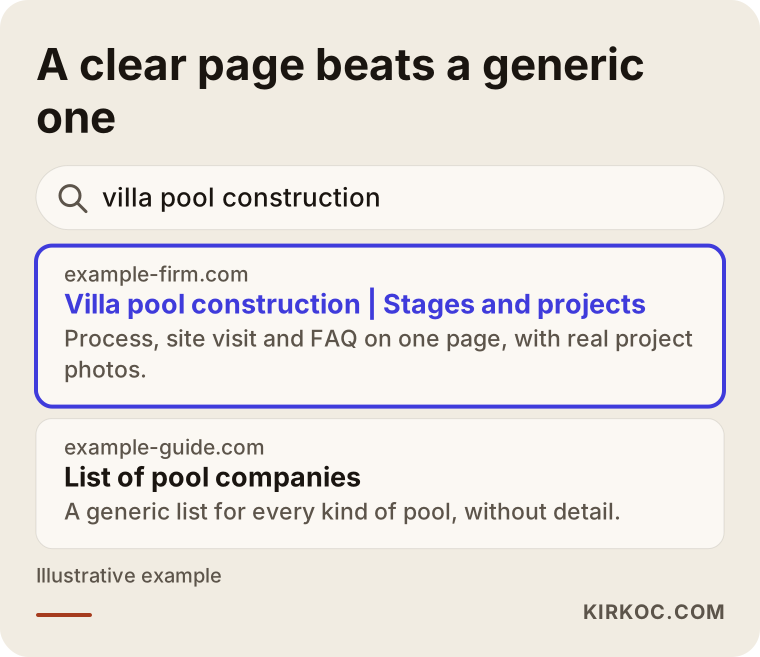
The difference with the highlighted result is that it says what it does and for whom in the first line. A page that says "every kind of pool" speaks to nobody in particular, while a page that says "villa pool construction" answers the person who typed exactly that. Google understands from the same clarity which answer to show the reader.
Searches fall into three main groups
It simplifies things to think of pool searches in three groups. The first group is construction searches: phrases that include a pool type such as residential, community, hotel, infinity or indoor pool. The second group is maintenance and service searches: weekly service, chemical balancing, filter and pump repair, opening and closing. The third group is location searches: "pool builder in Tampa," "pool service in Scottsdale," "gunite pool contractor near me." Most customers combine all three: they write what they want and where they are.
The table below puts these groups, the customer's intent and the matching page side by side.
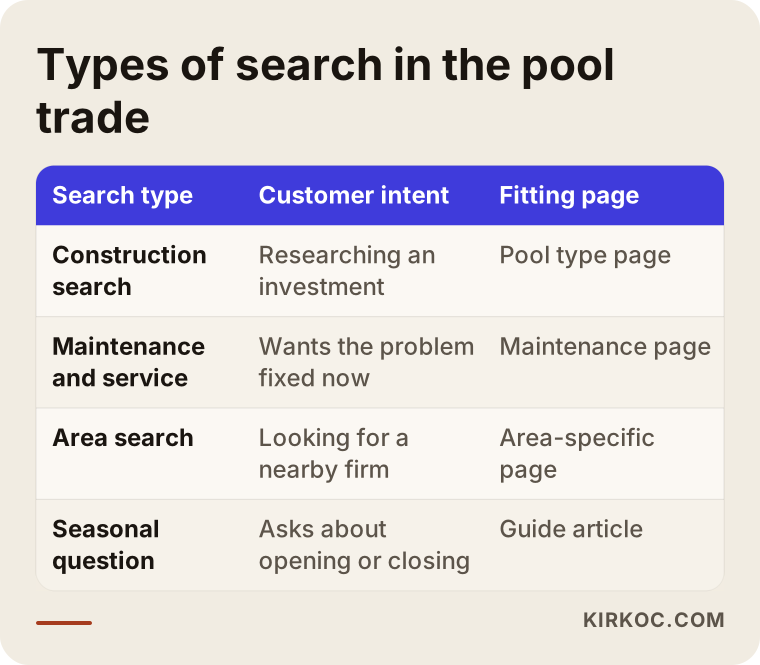
The logic of the table is simple: for each type of search, your site should have a page set aside for it. If you put construction, maintenance, repair and service areas all on one "Our Services" page, you will not have a page that is clear enough for any single search.
Seasonality: the biggest difference in the pool trade
Search traffic in the pool trade is not the same all year. In spring, construction plans start being discussed. As summer approaches, searches for openings and maintenance grow. In autumn, closing and winterizing come up. In winter, searches go quiet, apart from patient customers who are preparing a build.
What this means: if you start SEO work once the season arrives, you are late. It takes time for Google to find a new or updated page and to trust it. I cannot promise rankings, but the general logic holds: preparation done in the months before the season has the best chance of paying off when the season comes. For construction, autumn and winter are the comfortable time to prepare pages. For maintenance, early spring is.
Seasonality also affects your content. Questions such as "how do I winterize a pool" and "how do I open a pool for the season" come back every year. One solid page that answers them will keep working in the same season year after year.
Which pages do you need?
The most common situation I see on pool company sites is this: a nice home page, a handful of photos, a contact form, and that is all. But if there are no separate pages answering your customer's questions, the site only serves people who already search for your company name. To find new customers, you need the following pages.
First, pages by pool type: residential pools, community and HOA pools, hotel and resort pools, infinity pools, indoor pools or spas. Each has its own customer, size, process and questions. Writing them separately, instead of describing everything on one page, answers both the reader and the search better.
Second, one or more maintenance and service pages: a regular service plan, chemical balancing, filter and pump service, seasonal opening and closing. Here it is enough to tell the customer what the service covers, how often it is done and what makes it vary.
Third, area pages. If you serve several towns or neighborhoods, a separate page for each, with information that is genuinely specific to that area, tends to work well. Pages that are the same text with only the town name swapped do harm. I explain this in the mistakes section.
Fourth, project pages: photos of finished work, the type of pool, the stages of construction and a short note from the customer, with their permission. In the pool trade, trust comes from seeing.
Fifth, a process and FAQ page: how to get a quote, how the site visit works, the construction stages, what the customer is responsible for regarding permits, and what the warranty covers.
The image below summarizes how these pages fit together.
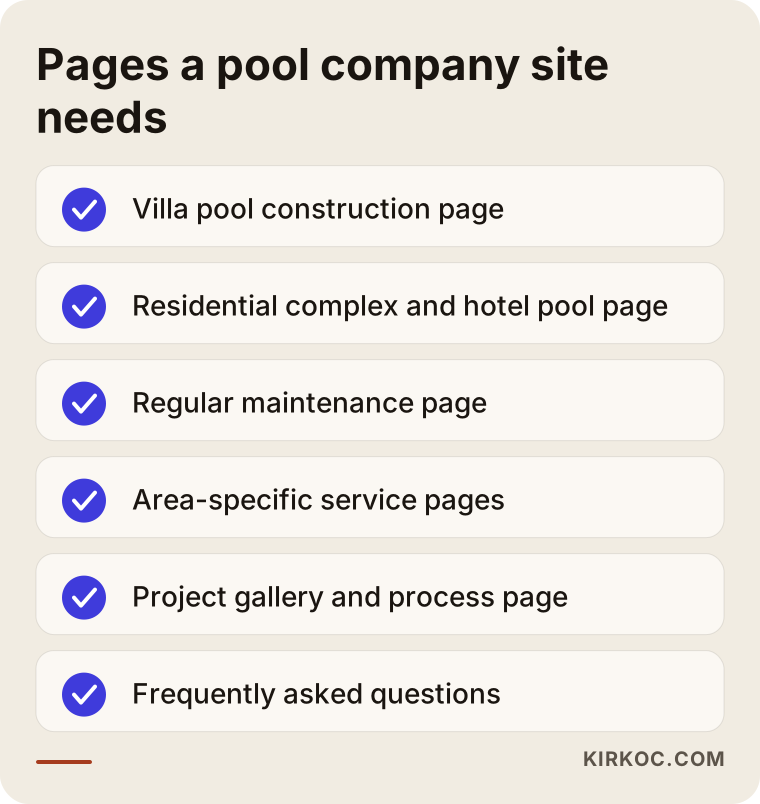
When you build this structure, give every page a single purpose. One page answers one search. If the reader finds what they came for on the first screen, they stay longer and take you more seriously.
How should a pool construction page be written?
A pool is a big purchase that most customers make once or twice in a lifetime. So they have many questions, and most of them ask the same things. How long does it take? What happens at each stage? Is my yard suitable? Do I need a permit? What will it cost to maintain? If your pool page answers these before the customer asks, it builds trust.
Be honest about price, but you do not have to print a number. The cost of a pool depends on its size, its type, the soil and ground conditions, the materials, the filtration and heating system, the landscaping around it and the location. Writing this out plainly is far more reassuring than "call for a price." Once a customer knows what the price depends on, they also compare quotes more sensibly.
Be careful not to make flat statements about permits. The process can differ by city, county, property and pool type. A sentence such as "A permit from your local building department may be required; for your exact situation, ask them or consult a professional" is both accurate and honest. The same applies to rules from a homeowners association, if one applies to the customer.
The order of the page matters too. Put the pool type and the service in the headline, say right below it who it suits, then the stages, then the common questions, and put contact at the end. The image below shows such a page layout.
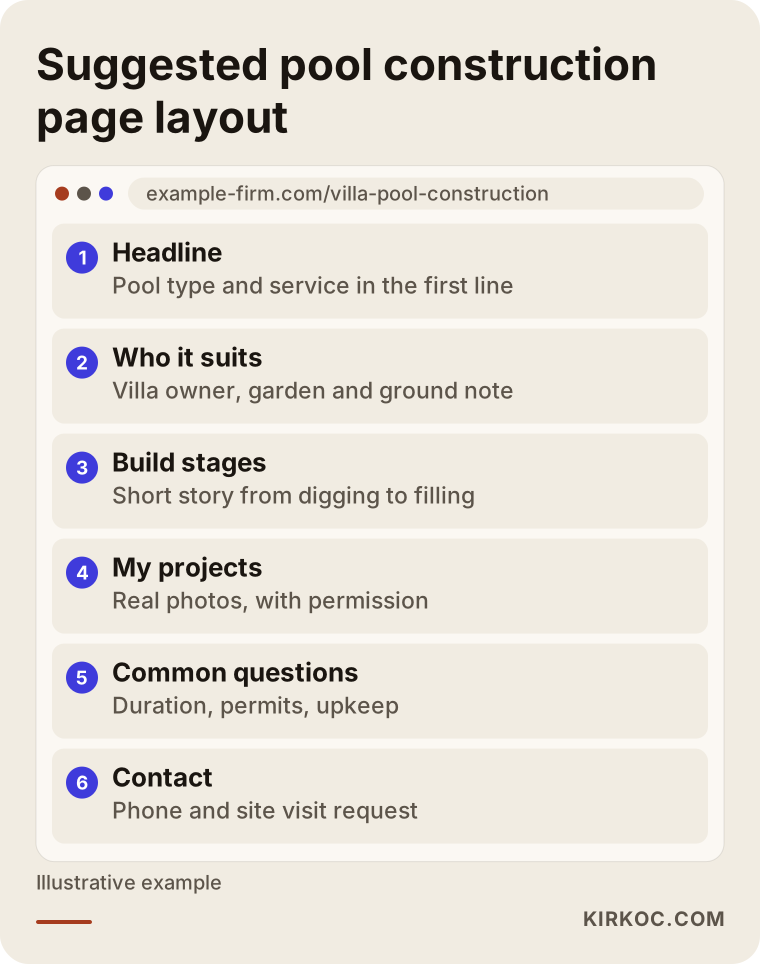
If you apply this layout, the page does not read like a long brochure, and it carries everything the customer needs to make a decision.
What to watch for on maintenance and service pages
The service customer usually decides faster and reads less. So the first screen of a maintenance page should show these things: which areas you serve, when you can reach them and how to get in touch. The phone number and a text-message option should be visible, not lost somewhere on the page.
In the middle of the page, explain in simple language what the service includes. Headings such as water testing, chemical balancing, filter cleaning, cleaning the floor and walls, and pump and equipment checks help the customer understand what they are buying. Explain "chemical balancing" in one sentence: adjusting the levels in the water so that it stays clean and safe to swim in. A reader with no technical background relaxes at a sentence like that.
There are also urgent searches. A person typing "pool water turned green" is waiting for a solution. A short guide page that answers that question helps them and presents you as the expert on that problem. A line at the end of the guide such as "if you cannot fix it yourself, get in touch with me" is enough as a next step.
First example scenario: a small company that builds residential pools
The scenario below is entirely hypothetical; it does not describe a real company. Imagine a three- or four-person firm that builds residential pools in one county. It has a website, and the home page says "Pool construction and service," with a gallery and a contact form below it. Customers mostly come by recommendation.
This firm does not appear for someone searching "custom pool builder" in its area, because its site does not have a single page that carries that phrase and explains the process and the common questions. The fix is not complicated: write a separate residential pool page, show three or four finished projects with their stages, answer the common questions, and tidy up the Google Business Profile.
I should say honestly from the start that this work will not make the phone ring in the first week. But if it is done before the season, the firm gains a chance to be seen by those same searchers. The customers who arrive through recommendation will also look the firm up, find a solid site, and make their decision more easily.
Second example scenario: a company servicing pools in several towns
The second scenario is also hypothetical. Imagine a company that provides regular service to community and residential pools in three different towns. Its website is a single page; under the heading "Pool service," the names of the three towns are listed one under the other.
The problem: a person searching "pool service in [town name]" will not find a general page listing three towns relevant enough. A separate page can be written for each town, but care is needed. Three identical texts with only the town name changed offer value neither to Google nor to the reader. Each page should have information specific to that town: what kinds of properties the company works with, which days it visits, honest observations about local water and climate conditions, and typical questions from that area.
This company's second important job is to tidy up its Google Business Profile and its reviews. For local services like pool maintenance, map results matter a great deal, and a company that appears there earns trust through its reviews, photos and working hours.
The image below shows what the two scenarios have in common: the customer's decision path.
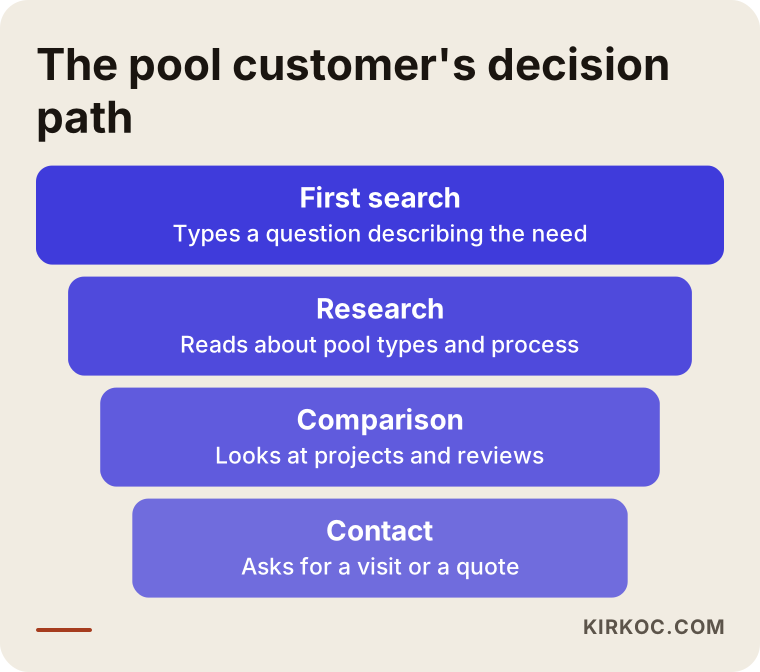
Your site needs an answer at every step of this path. At the first step, to be noticed. At the second, to inform. At the third, to earn trust. At the fourth, to make contact easy.
Trust: the most valuable asset in the pool trade
A pool is a structure that will stay at the customer's home or property for many years. So when choosing you, the customer looks at reliability more than at price. Your site can show that reliability in a few ways.
Real project photos: not stock images, but your own work. If you can, show the stages of construction as well: excavation, steel and forms, waterproofing, finishing, filling. This tells the customer that the part of the job they cannot see is also done properly.
A clear scope: write what you do and what you do not do. If, for example, you subcontract the landscaping or the electrical work to another crew, say so. Vagueness leaves a question mark in the customer's mind.
Warranty and after-sales service: explain what is covered, for how long, and under what conditions you provide service. Write the exact period and terms according to your own contract; if you are going to make a legal claim, consult a lawyer.
Reviews: reviews from your customers, collected with their consent, are strong proof both on your Google Business Profile and on your site. Do not invent reviews and do not buy them. It is unethical, and if it is discovered, it damages your reputation.
What do AI assistants and voice searches change?
Many people now start by asking an AI assistant such as ChatGPT: "What should I look out for when building a pool at my house?" When these assistants answer, they draw on pages that are clearly and neatly written. If your site has sections that answer questions briefly and directly, the chance of your name appearing in such answers goes up. It is still not a guarantee; it is simply an additional benefit of writing clearly and in an orderly way.
The image below shows, with a made-up example, what such an answer might look like.
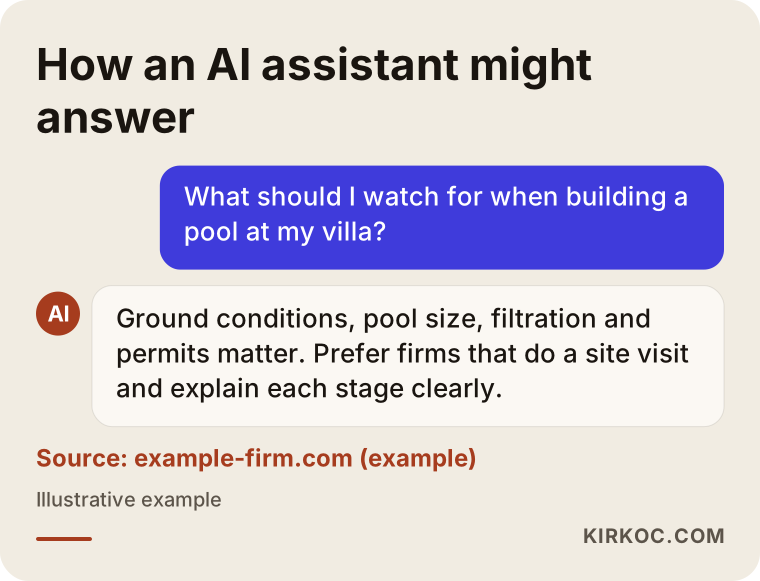
The practical result is this: use questions like "how long does it take to build a pool" and "how often should a pool be serviced" as headings on your pages, and write a clear answer of two or three sentences underneath. The reader, the search engine and the AI assistant all benefit from that.
Step by step: where do you start?
SEO work for a pool company goes in a sensible order. First, the current situation is reviewed: what the site is like, which searches it appears for, how it does on the map. Then the target searches are chosen. After that, the missing pages are written and the existing ones are fixed. Finally comes measurement and regular improvement.
The image below summarizes these steps briefly.
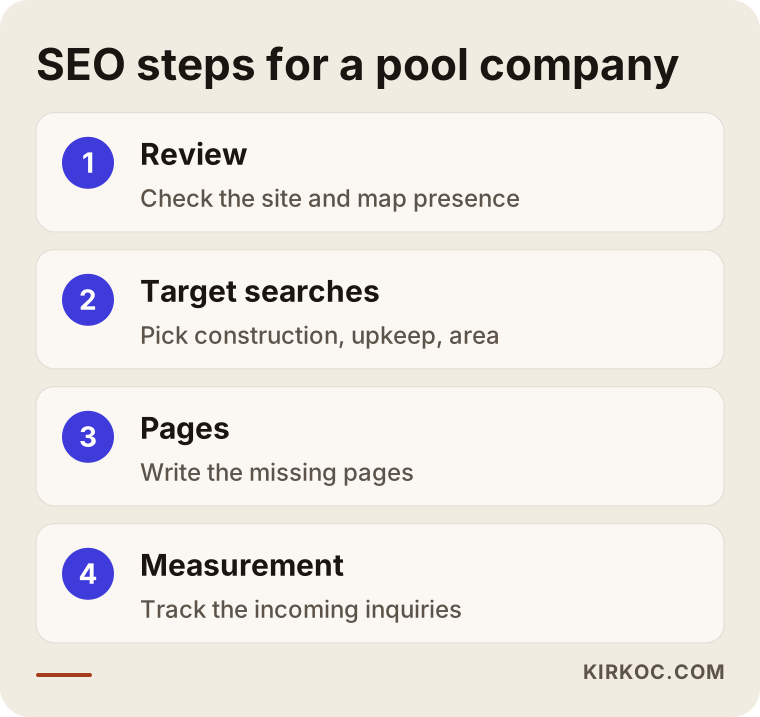
There are things for you to do at each step. In the review stage, you need to tell me which services you actually want to sell, because not every pool job is equally profitable for you. When pages are written, you supply the project photos and the real details, because nobody can describe a pool better than the person who built it. In the measurement stage, telling me which calls came in and which were real jobs steers the work in the right direction.
Timeline: what should you expect, and when?
I cannot promise rankings or results, and nobody honestly can. But I can describe a general flow. In the first weeks, site fixes and the basic pages are done. In the following weeks, the new pages go live and Google starts to crawl them. Within a few months, you may notice more visibility for some searches; for highly competitive searches this can take longer.
In the pool trade, the season calendar shapes this flow. If you start well before the season, your pages mature before summer begins. If you start in the middle of the season, you may see the first effects toward the end of it, but the pages still carry value into next year.
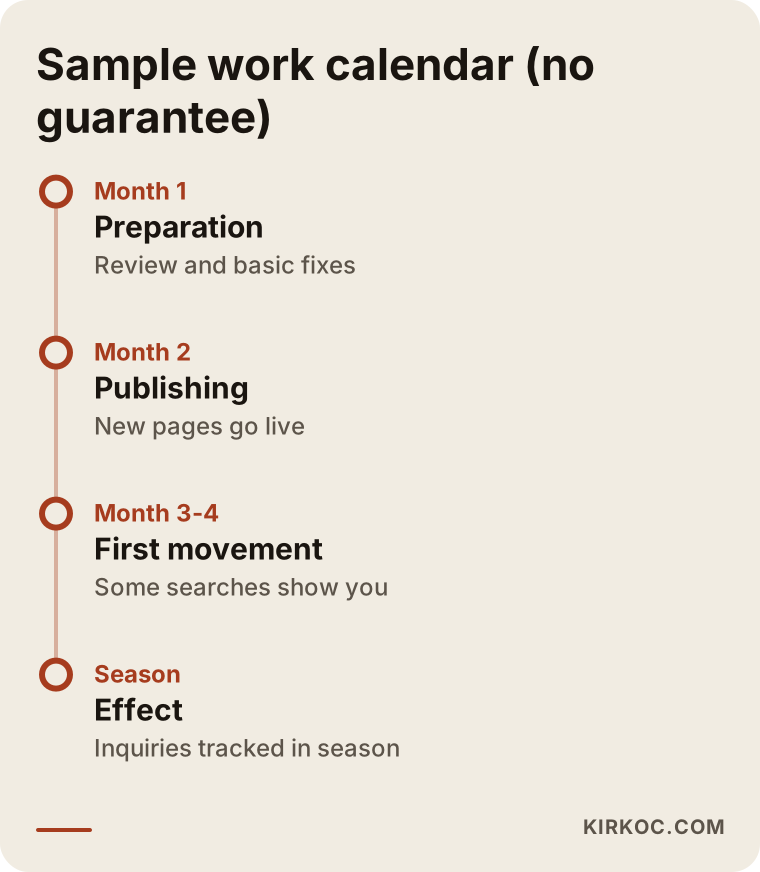
This timeline is not fixed. The state of the site, the competition in your area and the quality of the published pages change the time. What matters is knowing that the work is not done once and finished; it needs regular upkeep.
Common mistakes
These are the mistakes I see most often on pool company sites. All of them can be fixed, and most do not need a big budget.
The first is squeezing everything onto one page. If construction, maintenance, repair and areas sit on a single services page, there is no clear page left for any search.
The second is copying the same text and changing the area name. It gives the reader no value, and search engines notice it. Every area page needs real information specific to that area.
The third is relying on beautiful photos alone. Photos are very important, but if there is no text explaining what is in them, a search engine cannot understand them. Under each project, write the pool type, the approximate size and the construction process in a few sentences, and share details such as size with your customer's approval.
The fourth is neglecting the Google Business Profile. If working hours, service areas, services and photos are out of date, you fall behind in map results.
The fifth is leaving the phone number hard to use. If a mobile visitor cannot call with one tap, the service customer goes to another company.
The sixth is missing the season. Starting to prepare pages after the season has begun usually means losing a season.
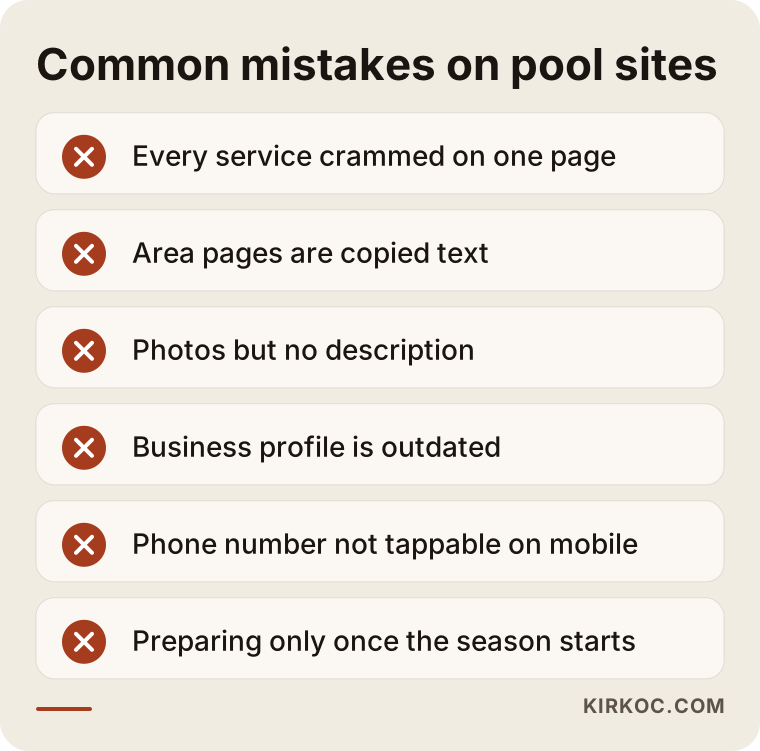
If you recognized your own site in this list, do not be discouraged; most pool companies get stuck in the same places. What matters is finding which one slows you down most and starting there.
What can you do yourself, and when do you need an expert?
You do not have to leave everything to an expert. Some jobs you can do comfortably yourself. You can keep your Google Business Profile current, photograph every project you finish and save the pictures, ask customers for reviews, and write down the questions you hear most often. These take time but need no technical knowledge, and they are the most valuable input to any SEO work.
The places where you need an expert are the technical ones: the speed of the site, how it looks on a phone, the page structure, making sure search engines read the site correctly, choosing the target searches and building the pages around them. If your site was built years ago and is hard to change, a basic review is a good place to begin.
When deciding, you can ask yourself this: do I have regular time for this, and do I want to learn the technical side? If the answer is no, working with an expert saves you time.
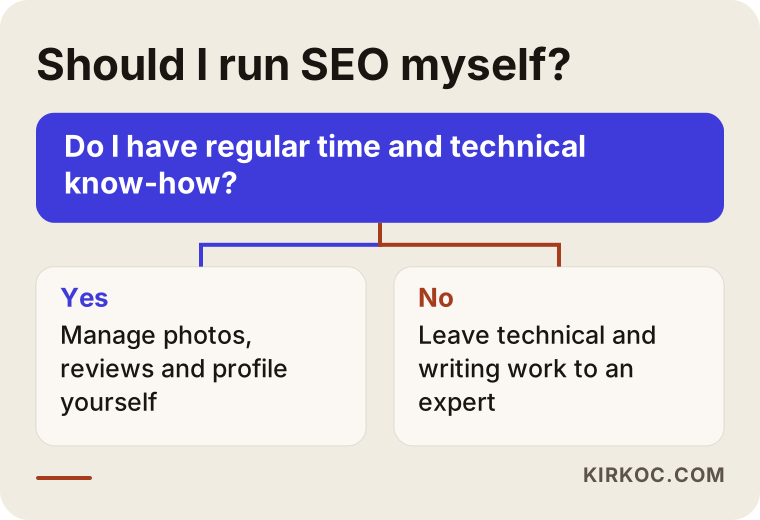
The guidance in the chart is not a rule; it is a frame that helps you think. Many companies combine the two: the technical and writing work goes to an expert, while the company supplies photos and customer knowledge.
What determines the cost?
I will not give a number, because an accurate figure can only be given once I see your situation. But I can explain plainly what it depends on.
The current state of the site is one of the biggest factors. Adding pages to a site with a solid foundation is not the same job as rescuing a site that has been neglected for years and is broken on mobile. The number of services and areas you cover also sets the scope; a company that builds only residential pools has different needs from one targeting construction, maintenance and several towns at once.
Competition matters as well. Resort and high-demand areas may have heavy competition, while a smaller town may have very few rivals. The number of pages to be written, how much of the photo and content material you will supply, and whether the work is one-time or ongoing also affect the cost. When you compare quotes, look not only at the total but at what is included.
How I work
I work alone in Istanbul. That means the person you talk to is the person who does the work; there is no sales team or account manager in between. I first look at your current site and at where you stand in searches, then tell you plainly which pages are really needed and which are not. I write the scope of the work and what to expect from the start. I do not promise rankings; what I can do is set the work up correctly and explain progress in plain language. I work remotely, so you do not need to be in Istanbul.
If we work together, what I ask of you is also clear: real project photos, the areas you serve, the questions customers ask most and which jobs are the priority for you. A page written without these ends up repeating the generic phrases of the industry.
Frequently asked questions
When should a pool company start SEO?
If possible, a few months before the season. Autumn and winter are good times to prepare construction pages, and early spring is good for maintenance pages. If you start during the season there is still a lot you can do, but it may take longer to see the effect.
What is the difference between SEO and Google ads?
An ad is visible as long as you pay; when you stop, the visibility ends. SEO asks for effort first and can then work for months. In seasonal businesses like pools, some companies use both. Which makes more sense for you depends on your budget and goal.
Do I need a separate page for every town?
For towns where you really work and have something specific to say, yes, it can be useful. Copy pages with only the town name changed do not help. Three or four well-written area pages are worth more than ten copies.
Should I show pool prices on my site?
You do not have to. Explaining what the price depends on, instead of printing a number, is both honest and reassuring. When a customer learns about factors such as size, type, ground conditions and equipment, they arrive better prepared to talk with you.
Can I use project photos without my customer's permission?
Preferably not. If the customer's home or property can be seen, asking first is both respectful and the right way to avoid problems. For firm information on privacy or personal data, consult a lawyer.
How many months until I see results from SEO?
I cannot give a firm time. The state of the site, the competition and the quality of the published pages all play a part. For some small, clear searches you may see movement within a few months; for more competitive searches it may take longer. I suggest being cautious with anyone who guarantees rankings.
If I only offer maintenance, should I still write area pages?
Yes. Maintenance is a local business, and customers usually type the town they live in. Clear pages for the areas you serve and an up-to-date Google Business Profile are the two most effective tools for maintenance work.
Will AI assistants recommend my site?
I cannot guarantee that. But pages that answer questions clearly and in an orderly way, and that contain reliable information, are more likely to be used as a source in such answers. So answering frequently asked questions openly on your pages is a good habit.
If you would like to see together where your pool company's site stands today and which pages are missing, you can reach me through my SEO services page. I will listen to your business and tell you in plain language what needs to be done.