You own a pet store, or you run an online shop that sells pet supplies. Your shelves hold food, litter, collars, toys and aquarium gear; your products are good and your prices are fair. But when someone picks up a phone and types "kitten food" or "puppy collar," the first things they see are the big marketplaces and a few well-known chains. You are not there. So it makes sense that you searched for "pet store SEO." In this article I explain how a pet store or pet supply business can become visible on Google, which pages it needs, and where to start. I am Ümit Kırkoç, a web designer and SEO consultant who works alone from Istanbul, and where it is useful I will be plain about what my own SEO services cover and what they do not.
SEO, in short, is the work that helps your website show up when your customers search on Google. Unlike advertising, you do not disappear the moment you stop paying; when it is set up well, it keeps bringing in customers for months. But the pet industry has its own difficulties, and generic SEO advice often falls short here. Let's talk about those first.
Why is SEO for pet products its own kind of job?
In this industry, two different groups of shoppers search with the same words. The first group knows exactly what to buy: they type the brand, the bag size, the life stage. The second group is looking for information: they just brought home a kitten and have no idea what to feed it. The first group is ready to buy. The second wants to trust someone first. If your site answers only one of them, the other goes to a competitor or to a forum thread.
The second feature is the shape of the competition. For general product searches, the large marketplaces and long-established content sites are strong. It is not realistic for a small site starting from zero to reach the first page for a one-word search like "cat food" within a few weeks, and I would rather tell you that now. The good news is that pet searches are very specific. People type things like "grain-free wet food for a neutered cat" or "small breed adult dog food 15 lb bag." That level of detail is a real opportunity for a small, knowledgeable store.
The third feature is trust. For a pet owner, a product is not just an item; it is the health of an animal they love. So your content and page layout should answer "why is this product suitable, and who is it not suitable for?" more than they shout "cheap!" Google is also more careful with health-related topics and tends to favor sites that look reliable.
How do shoppers search for pet products?
The key question in SEO is this: what exactly does your customer type into Google? You should research it rather than guess, but a few patterns specific to this industry are known in advance.
The first pattern is species and age written together: "puppy food," "senior dog food," "parakeet seed mix." The second pattern is a need or a problem: "dog food for shedding," "low-dust cat litter," "food for dogs with sensitive stomachs." The third pattern is a brand or product name. Marketplaces are very strong on these searches, and it is usually a hard area for a small site. The fourth pattern is local search: "pet store near me," "cat litter near me," "pet shop open late." The person who types this has an urgent need and will walk in soon.
The fifth pattern is information: "when should a kitten switch to adult food," "how to measure a dog for a collar," "how often to change aquarium water." These searches do not bring a sale directly, but they build trust. The same person may buy a few days later from the site whose advice they relied on.
The graphic below summarizes these search types and the page that fits each one.
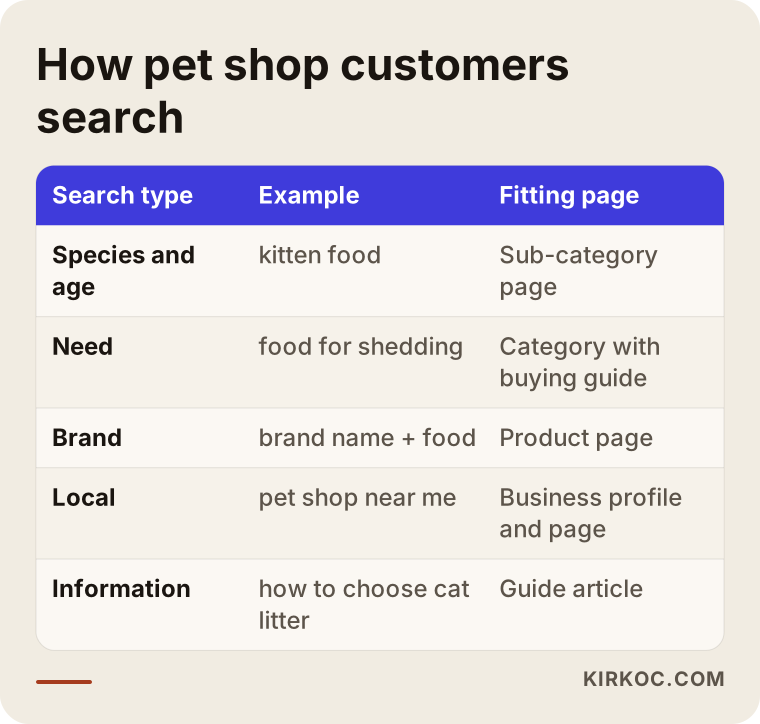
The lesson from the table is that each type of search needs its own page. One "Products" page cannot serve them all. The person searching locally should see your address and opening hours, the person looking for information should find a helpful article, and the person looking for a product should land on a clear category page.
Focus on the intent, not on a single keyword
Making a keyword list is easy; understanding what is behind each keyword is the hard part. Someone who types "cat collar" may be comparing products. Someone who types "how to put on a cat collar" already owns one and wants advice. The first needs a category page, the second a short how-to guide. A page that tries to do two different jobs for the same phrase usually does neither well.
Which pages do you need?
The most common problem I see on pet store sites is that every product sits in one long list under a heading like "Our Products." A structure that both Google and your customer can read is built from a few layers.
The first layer is the species pages: cats, dogs, birds, fish, small animals, reptiles. Each works like a small home page of its own. The second layer is the product group pages: cat food, cat litter, cat toys. The third layer is more detailed subgroups: kitten food, food for neutered cats, wet food, dry food. The fourth layer is the individual product pages.
In this structure, every layer should have its own heading, a short explanation and the products underneath. A two- or three-paragraph description on a category page tells Google which searches that page answers, and it helps the customer choose.
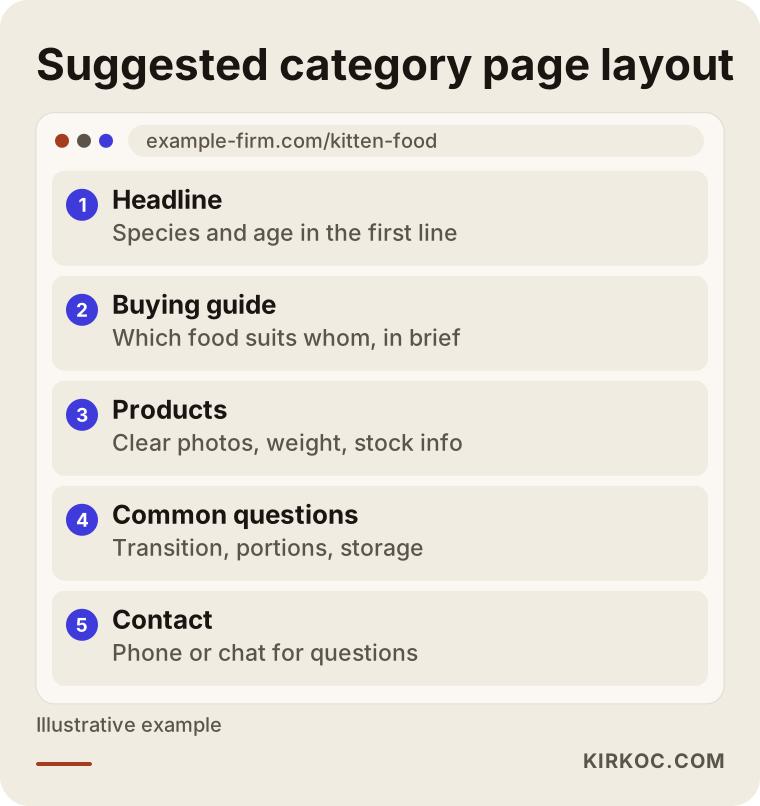
The layout above looks simple, but what most sites are missing is the buying guide section. The customer can see how many products are in the category, but has no idea which one fits their own animal. A few sentences of guidance support both sales and the page's visibility in search.
What should a product page look like?
The questions a shopper wants answered on a product page are well known: which animal and age is it for, what is in it, which sizes does it come in, how long will delivery take, and what happens if my pet does not like it. Copying the description that comes from the manufacturer is the biggest mistake, because the same text appears on hundreds of sites, and Google may push you to the back when it chooses which one to show. A short description in your own words, a real photo and a clear note on "who this is for and who it is not for" make a big difference.
Also, instead of making separate pages for different bag sizes or weights of the same product, offer them as options on a single page. That prevents dozens of near-identical pages from piling up. This is a technical detail tied to your shop software, and in most e-commerce systems it can be set up.
Example scenario 1: The neighborhood pet store
This is a hypothetical example; it does not describe a real business. Imagine a small pet store in a residential neighborhood. The shop has been open for twenty years, the owner knows animals well and the customers are loyal. But the website is a single page: one photo, a phone number and the words "All kinds of pet supplies." When someone searches "pet store" plus the neighborhood name, the shop does not appear in the map results.
In this case my first job does not start with the website. First I check the Google Business Profile, which is the free listing that appears on Google Maps and in local results. Are the address, opening hours, category and photos correct? In local search, map results show up even before your website does. Then I would expand the site like this: separate pages for cats, dogs and birds; on each, the main product groups the shop carries and a note such as "ask us about stock"; a "Where we are and how to get here" section that names the neighborhood and nearby areas naturally; and a way to ask questions by phone or text message.
This business may not sell online, and it does not need to. The goal is for a pet owner nearby to find you at the moment they think "I need litter right now" and walk into the shop. Building such a site is a matter of a few pages; it does not need a big e-commerce system.
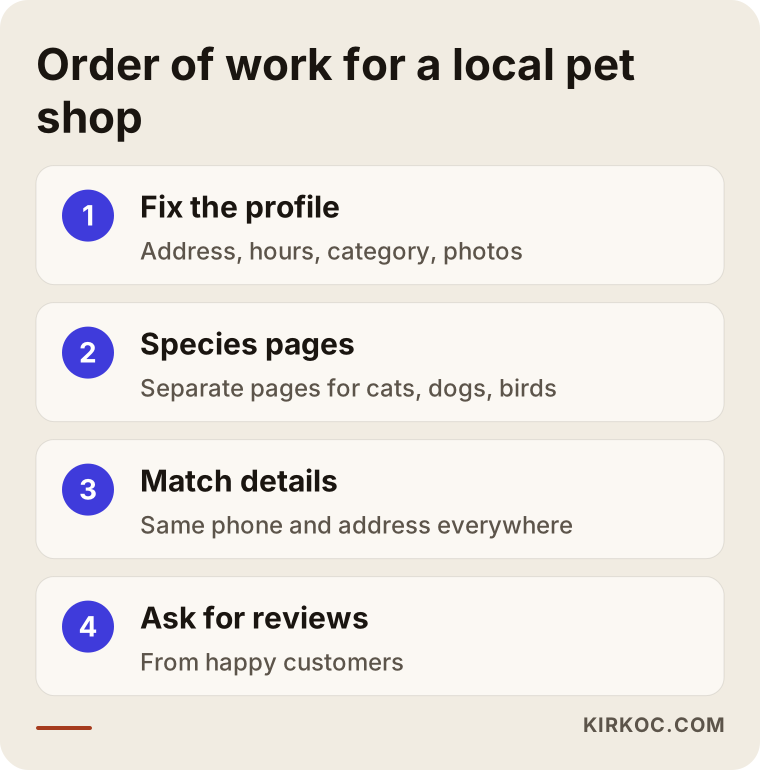
The order of the steps in the graphic matters. If you expand the site before fixing the profile, the effort is only half used. In local searches the customer often never visits your website at all; they search through the profile, get directions and come in.
Example scenario 2: A pet supply shop that sells only online
This is also a hypothetical example. An entrepreneur has built an online shop selling cat and dog products. There are five hundred products, all entered with the descriptions the supplier sent. The owner does not run ads, because ad costs eat the profit margin. Most of the traffic comes from social media, and most visitors leave without buying anything.
The first job here is to see which pages actually do any work. Often, out of five hundred products, thirty are genuinely searched for and the rest are never seen. I would follow these steps: look at search data to choose the priority categories; rewrite the descriptions and buying guides for those categories; strengthen the twenty or thirty best-selling product pages with original text; improve the site's speed and how it looks on a phone; and build a guide section that answers the questions new pet owners ask.
In a project like this, instead of competing head-on with the general marketplaces, it is usually smarter to choose a specialty such as "for small-breed dogs" or "grain-free cat food." A site that looks like an expert in one area is more credible to both Google and the customer. Of course, I cannot guarantee any ranking, because neither I nor anyone else controls what Google shows.
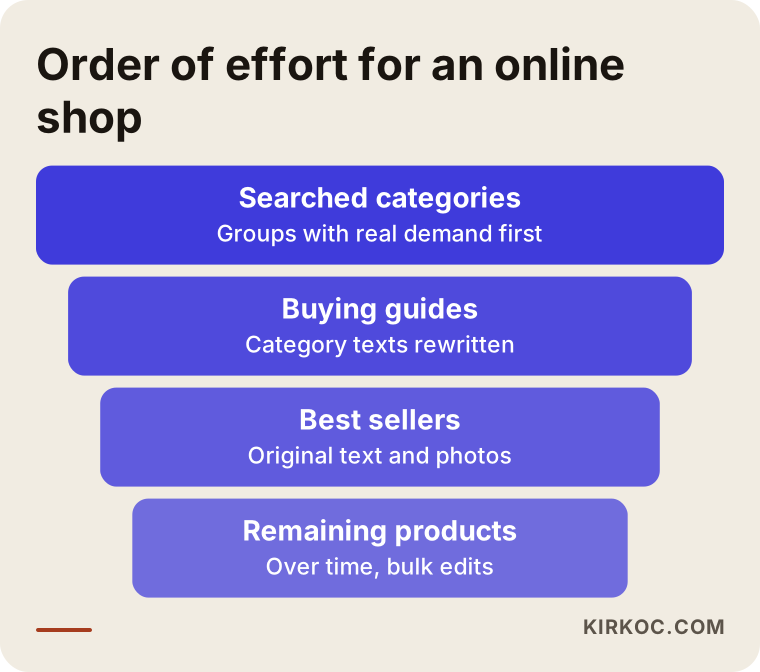
This funnel summarizes the order of work. At the widest part are the categories people actually search for; at the narrowest are the individual product pages. Starting your effort at the wide end means reaching more customers with the same amount of work.
The SEO process, step by step
There is no need to describe SEO as if it were mysterious. A solid project usually follows this order.
First I look at where you stand: which searches your site appears in, which pages never appear, and whether there are technical problems. Then I research your customers' searches and group them under headings such as species, product group, age and need. In the third step comes a page plan: which page exists for which search, which is missing, and which pages are copies of each other.
In the fourth step the content and technical fixes begin: titles, descriptions, category texts, product pages, site speed and how the site works on a phone. The fifth step is local visibility; if you have a physical store, that means the Google Business Profile, reviews and consistent contact details. The sixth step is measuring: how many people come to which page, who calls, who adds an item to the cart. The last step is to look at the data, see what is working and adjust the work accordingly.
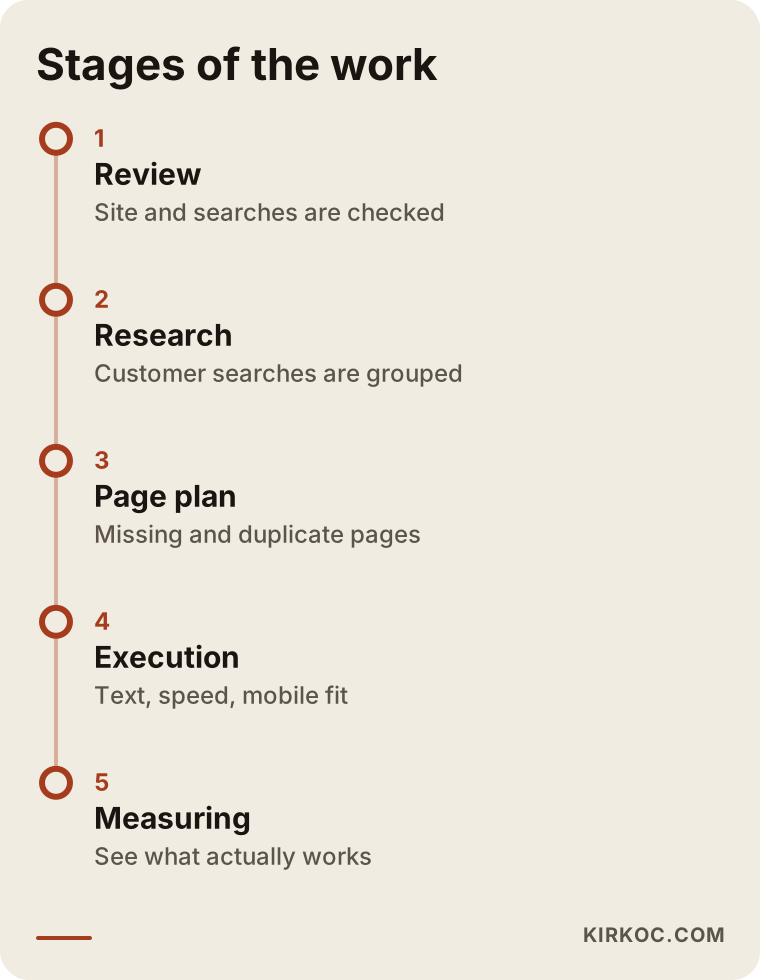
This process is not a one-time job. The first three months are mostly about laying the foundation, and results generally begin to show after that. The timing depends on the age of the site, the competition and how much work is done, so I will not give you a firm date.
What to watch for with food and health content
The most sensitive topic in this industry is content about animal health. Answering questions like "my cat keeps vomiting, what should I do?" looks tempting, because those searches get a lot of traffic. But a pet store owner is not a veterinarian, and wrong guidance can harm both the animal and your reputation.
My advice is this: avoid content that reads like a medical diagnosis or treatment. Instead, use a responsible tone that explains what is in a product and who it suits, and that says "if symptoms continue, see your veterinarian." If possible, feature content that a veterinarian has reviewed and say so on the page. Be careful with product claims too: making firm health promises such as "prevents disease" matters both for Google's trust evaluation and for regulation. It would not be right for me to say anything definitive on that point; for how food, supplements and medicine-like products may be advertised, I recommend asking an attorney or the relevant professional or trade body.
Beyond that, guides for someone who has just adopted an animal, such as "first-week shopping list" or "basic supplies for a new puppy," are both useful and directly connected to sales.
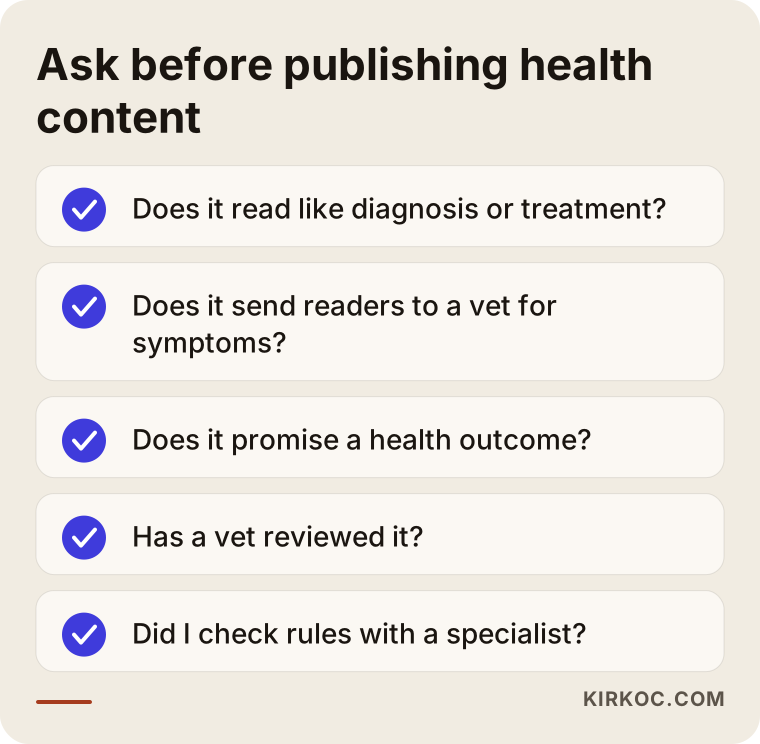
The list above gathers the questions to ask yourself while writing. If you answer "no" to a few of the items, it is a good idea to review that content before you publish it.
Common mistakes
I list the mistakes I see again and again in this industry, because most of them are easy to fix.
The first is copying manufacturer descriptions word for word. Because the same text is on hundreds of sites, your page cannot be told apart. The second is piling all products into one category, so neither the customer nor Google can find what they are looking for. The third is deleting pages for out-of-stock products. Those pages may already have collected links and visibility; the better move is to redirect to a similar product, or to show a "out of stock, similar items" section on the page.
The fourth is photos that are too large and heavy; a site that opens slowly on a phone loses the customer. The fifth is a physical store whose address, phone number and opening hours are written differently in different places. The sixth is trying to compete only on brand names, where the marketplaces are very strong. The seventh is producing informational content without linking it to product pages; the reader finishes the article and does not know where to go next.
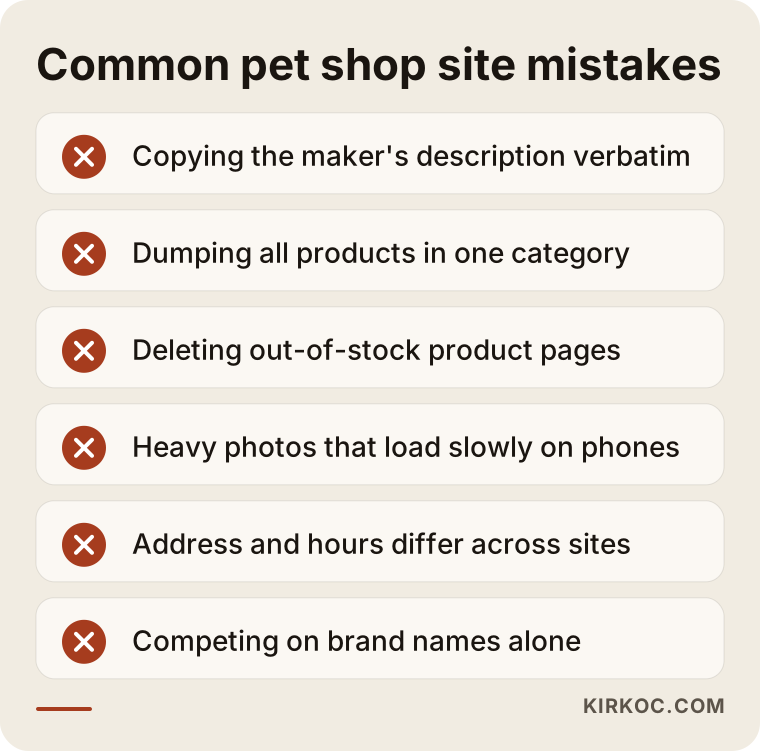
None of these mistakes needs a big budget; most can be fixed with a day of editing. The hard part is looking at the whole site and seeing which ones are yours.
What can you do yourself, and when do you need an expert?
You do not have to hand everything to a specialist. There is a lot you can do on your own, and doing it also saves time when you do work with an expert.
Things you can do yourself: keep your Google Business Profile up to date, ask your customers for reviews, take your own product photos and name the files sensibly, write down the questions customers ask most and put the answers on your site, and replace copied descriptions on product pages with your own sentences. These cost nothing and they work.
The situations where you need expert support are these: your site's structure is complicated and you cannot tell why a page is not showing up; you need bulk edits across hundreds of products; there are technical problems such as speed, redirects or duplicate pages; or you cannot step away from running your business to spend time on SEO. An expert saves you time and keeps you from going down the wrong road, but cannot know your business as well as you do. So the best result comes from combining your industry knowledge with the expert's technical knowledge.
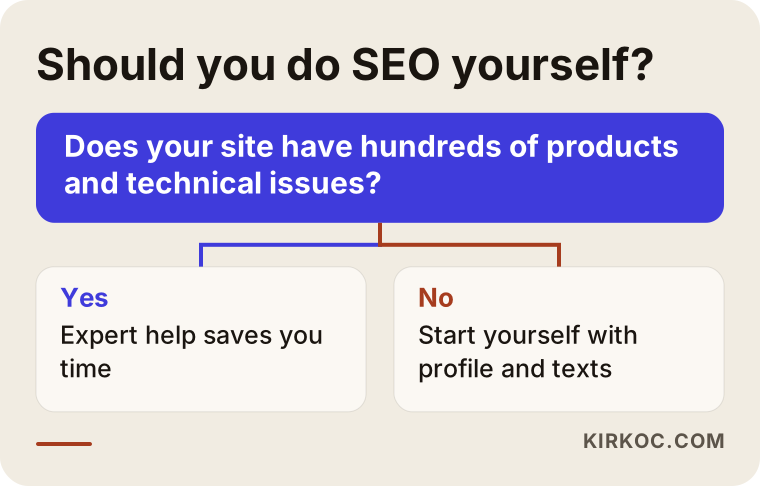
The decision chart is a rough guide; every business is different. If you are not sure, a short introductory call is usually enough to get clarity.
Pet store visibility in AI search
Many people no longer type a question into Google; they ask an AI assistant such as ChatGPT: "What should I buy for a kitten in the first week?" These assistants draw on the sites they see as sources when they answer. If your site contains clear, accurate and well-organized information, your chances of being one of those sources go up. I still cannot guarantee it.
What it takes is really the same as classic SEO: ask questions plainly and answer them briefly, organize information under headings, and state clearly who you are and where you work. The graphic below shows how such an answer might look, using a completely made-up example.
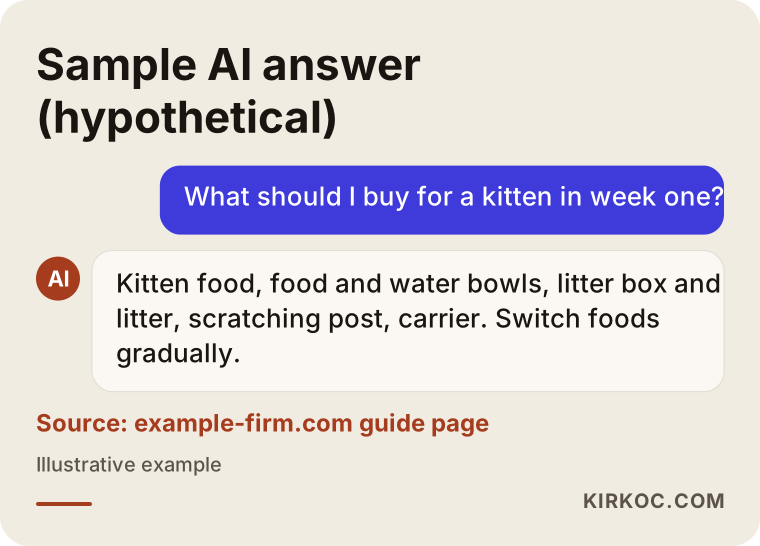
In answers like this, the sources are usually pages that look explanatory and trustworthy, rather than product lists. That shows why guide content matters.
What determines the cost?
I will not give a figure, because two pet store websites can be nothing alike. But I can tell you plainly what determines the cost.
The first is the size of the site: a site with fifty products and a site with five thousand do not carry the same workload. The second is the current situation: building a structure from scratch and repairing a problem site call for different work. The third is the area you target: appearing only in your neighborhood and selling nationwide are very different scopes. The fourth is the amount of content: how many category texts and how many guide articles are needed. The fifth is duration: a one-time cleanup and an ongoing project over many months are set up differently. The sixth is extra needs such as a physical store or selling in several languages.
When you ask for a quote, ask what is included instead of looking at one total: how many pages, what reporting, how often you will talk. Be cautious about proposals that have no clear scope or that promise "first page guaranteed."
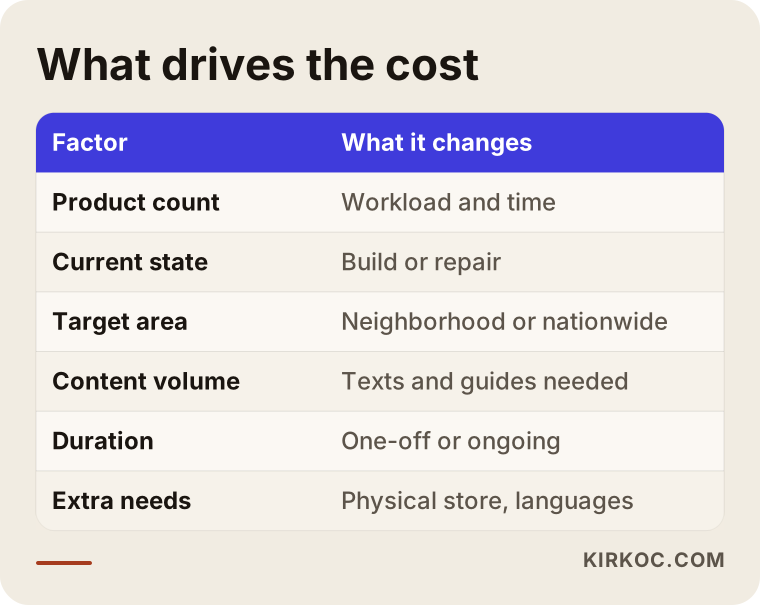
You can keep the table in the graphic at hand and use it as a checklist when you collect quotes. If an item is missing, do not hesitate to ask.
How does working with me look?
I work alone, which means the person you talk to is the person who does the work. I usually start with a short introductory call: I listen to your business, your current site and your goal. Then I look at your site and explain in plain language what is missing. If you like, we make a plan together: which pages first, and in what order. Throughout the project I tell you openly what I did, what changed and what has not produced results yet.
You do not have to give me the whole job. Some businesses only want a review and a roadmap, and others want me to carry out the work as well. Both are possible.
Frequently asked questions
Does a small pet store really need a website?
Customers around you often find you by searching on their phones. Even a small site with correct information, together with an up-to-date Google Business Profile, puts you in front of the person searching at that moment. A large e-commerce site is not required; a simple structure of a few pages is often enough.
I sell on marketplaces. Why do I need SEO for my own site?
On a marketplace, the customer belongs to the platform, not to you, and fees, rules and visibility all depend on the platform. Your own site keeps the customer relationship and the sales data with you. You can use both together: the marketplace gives you exposure, and your own site brings in customers who come back.
How long until I see SEO results?
It depends on the age of your site, the competition and the work done. Results usually come sooner on detailed searches with little competition and later on broad searches. I cannot give a firm date or a ranking guarantee, but I can measure progress and show you what is working.
Is it a problem to use manufacturer product descriptions?
Because many sites use the same description, it is harder for your page to stand out. You do not need to rewrite everything; a sensible start is to take the best-selling and most-searched products first and enrich them in your own words.
Does blogging help a pet store?
Yes, but not random posts. Guides that answer the questions your customers really ask, and that link to your product pages, are the ones that work. In health topics, it matters to use a responsible tone that does not diagnose and that sends readers to a veterinarian.
What should I do if I want to sell abroad?
You need separate pages in the language of the target country; a translation of your page alone is not enough. Shipping, returns and product regulations also vary by country, and you should ask an attorney or a specialist about that. I can help with the language and page side.
Is the Google Business Profile part of SEO?
They complement each other. The profile determines your visibility in maps and local search, while the website offers detailed information and products. If you have a physical store, it is best to handle the two together.
What should I look for when I get a quote?
Check that the scope is written clearly, how reporting will be done and who will actually carry out the work. Promises such as "first page guaranteed" are a warning sign, because nobody can honestly make that promise.
Let's look together at how your pet store or pet supply website appears on Google. You can reach me through my SEO services page and ask for a short introductory call, and we will talk openly about a simple roadmap that fits your situation.