You have a workshop or a factory, the prefab homes, container homes or steel buildings you make are sitting right there, and yet the phone does not ring as often as it should. Many of the calls you do get start with "how much does it cost?" and then go quiet. Meanwhile a competitor's site shows up near the top when someone types "prefab home prices." This is exactly where SEO for prefab and container home companies comes in. In this article I explain, in plain language, how buyers in this industry search on Google, which pages your site needs, and where to begin. I am Ümit Kırkoç, a web designer and SEO consultant who works alone from Istanbul, and at the end I describe the scope of my own SEO services openly.
SEO, in short, is the work that makes your site appear when potential customers search on Google. Unlike an ad, it does not vanish the moment you stop paying. Set up properly, it can bring in inquiries for months or even years. But the prefab, container and steel building industry is built differently from many others. A home or a building is not a quick decision like buying a T-shirt. Buyers research for months. They think about their land, ask about permits and work out a budget. That long road is a big opportunity for a company that does SEO well, and a quiet loss for one that does it badly.
What do customers type into Google in this industry?
Instead of guessing at keywords, it helps to step into the buyer's head. In the prefab and container home business, searches usually fall into four main groups.
The first group is price searches: "prefab home prices," "container home cost," or "steel home kits price." The person typing this has usually not decided yet. They are comparing options. The second group is model and size searches: "two bedroom prefab home," "bungalow kit," "tiny house on wheels," "20 foot container home." Here the person knows a little more about what they want. The third group depends on how the building will be used: "backyard office," "job site office container," "vacation cabin prefab," "shop or coffee stand container." The fourth group is about trust and rules: "do prefab homes need a permit," "are container homes legal," "can you finance a prefab home," "how do steel buildings hold up in storms."
No single page can satisfy all four groups. Someone searching for prices needs a page that explains the price. Someone asking a legal question needs an explanatory article. Someone searching by use needs a page built for that use. Most company websites try to cover everything with one "Our Products" page, and so they look strong for nothing.
The illustration below uses a completely made-up example to show how two different pages for the same search might look in Google results.
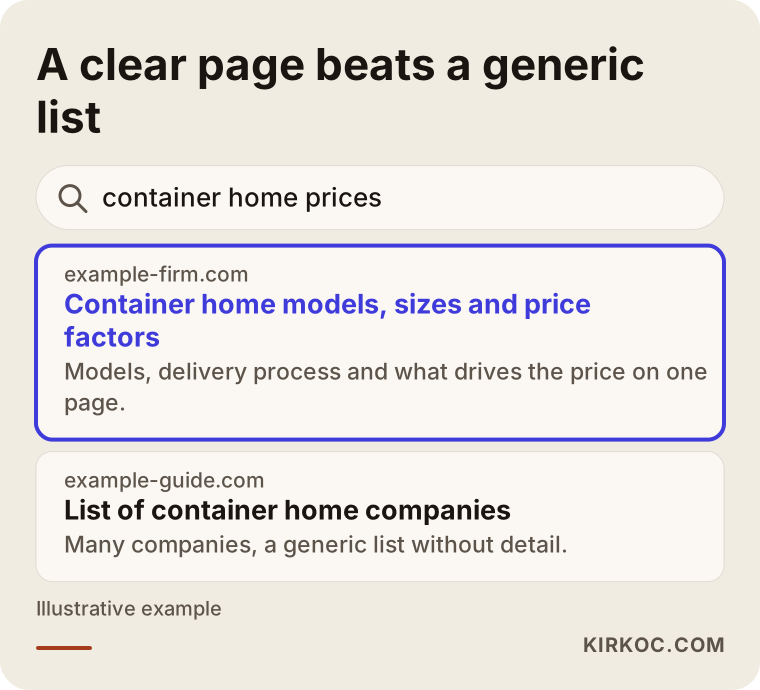
The highlighted result says in its first line what it sells, in what sizes, and how it delivers. The generic list next to it gives no detail at all. Google tries to give the searcher the clearest answer. If you make that job easy, it can show you more readily.
What should you do about the price question?
The biggest tension in this industry is price. The buyer wants a number. You want to say "it depends on the land, the square footage, what is included." You are right. But if that sentence is all your site says, the buyer gives up on you and goes to a competitor that states a price plainly. The fix is not to be forced into publishing a number. The fix is to explain, on the page, what the price depends on. A "what determines the price?" section that lists the insulation type, site preparation, delivery distance, assembly, interior fit-out, and kitchen and bathroom items does two things. It builds trust with the buyer, and it shows Google that the page really covers the subject. When buyers see which items make up their own project, they are also more ready to write to you for a quote.
Which pages do you need?
To catch all the searches in this industry, your site needs several types of pages. Each has its own purpose and its own reader.
First, product type pages. Prefab homes, container homes, steel buildings, bungalows, offices and job site containers each deserve their own page. Cramming them all onto one page confuses Google about which page to show for which search. Second, use-case pages: vacation cabin, backyard guest house, cafe or kiosk, office, guesthouse, storage. Third, model and project pages, with dimensions, floor plan, materials, lead time and real photos for each model. Fourth, region pages that show which states, counties or areas you deliver to and assemble in. Fifth, a process page: a simple walk-through of what happens from order to delivery. Sixth, a frequently asked questions page and a page with general information about rules and permits. Seventh, a contact and quote page.
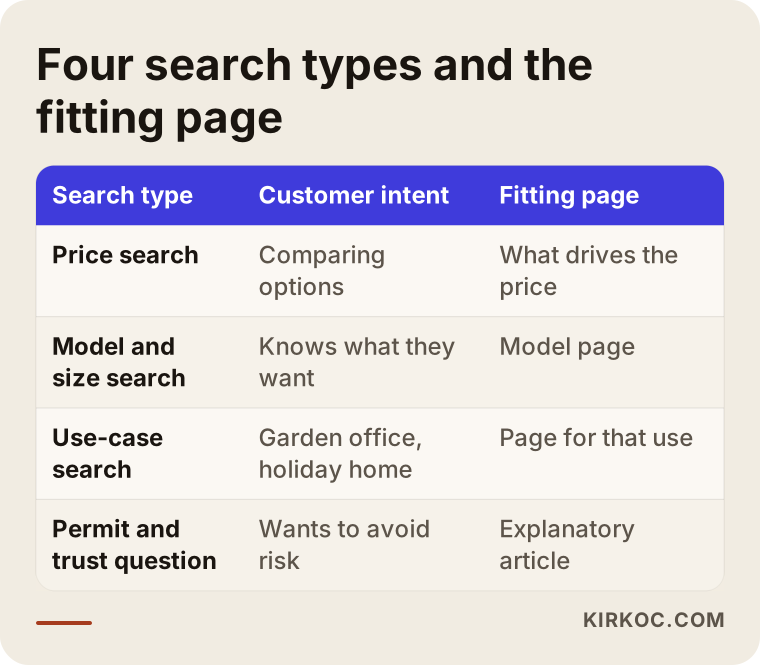
The table makes a practical point: as the search type changes, the page type should change too. Someone who types "container home permit" does not want to land on a product catalog. They want an article that gives information. If you send them to the right page, that same person may remember you a few weeks later when they are asking for quotes.
What should a model page look like?
The model page is the most neglected area in this industry. On many sites there is one photo, a line or two of text and "call for details." A good model page carries the following: square footage and room layout, wall and roof materials, the insulation system, whether electrical and plumbing are included, estimated production and assembly time, how it is delivered, and photos from real projects. It also needs a short section answering the questions already in the buyer's mind: does it stay warm in winter, how is the sound insulation, can it be moved, can it be expanded later.
There is one important principle here: every piece of information on the page must be true and must not contradict your contract. Exaggerated claims make disputes with customers more likely, and they also weaken how Google sees a site that is supposed to be careful about facts.
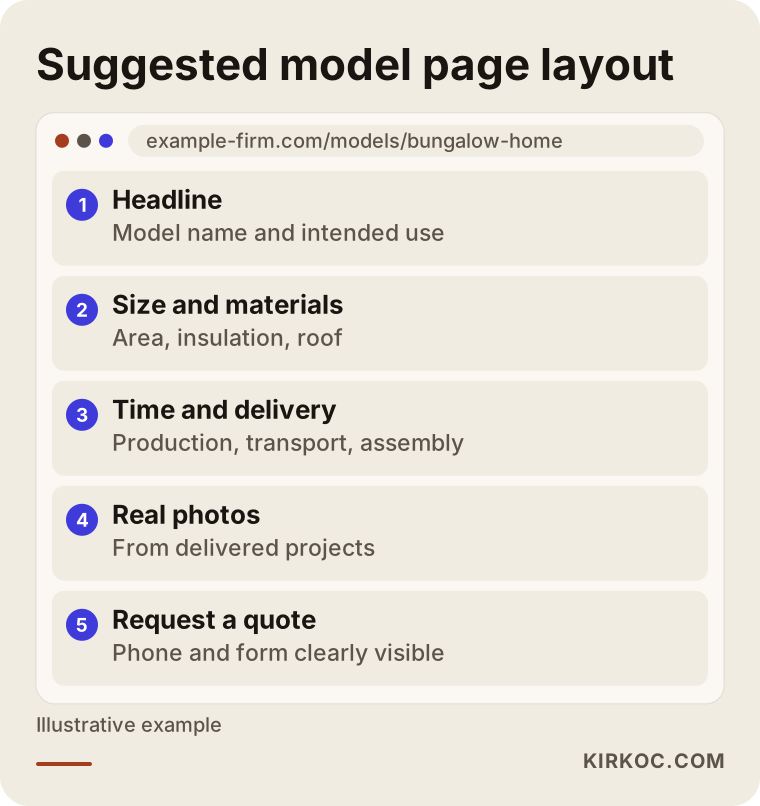
The layout above gives you an idea. At the top sit the model name and what it suits. Then come sizes and materials, then the delivery process and real photos. At the very bottom is the way to request a quote. The point of the page is to move the visitor to a phone call or a form.
Example scenario 1: a small workshop making container homes
Take a completely hypothetical example, not a real company. There is a workshop that builds container homes and office containers. Its site has a single "Products" page with about twenty photos under it. There is no price information, no dimensions, and nothing about where it delivers. The owner says, "People can't find us."
The problem for this hypothetical workshop is usually this: Google can only guess what is on the site from the photos, and it is hard to understand what a photo shows without text. The first job is to take the products off that one page and give each its own page: container homes, office containers, job site containers, kiosk and cafe containers. Each page gets dimensions, intended use and delivery method. Then you write an article that answers the most common question, something like "do container homes need a permit?" In that article, instead of a firm legal claim, you say that the answer depends on the local building department and zoning, and that readers should check with their local authority or a qualified professional.
For a workshop like this, the first visible movement usually begins within a few months, on narrower searches with less competition. Broad searches take longer. It is worth saying this up front, because impatience is the most common reason people abandon this work.
Example scenario 2: a mid-size company building steel structures
The second hypothetical example has a different shape. A company manufactures and erects steel buildings: warehouses, workshops, small factory buildings and agricultural structures. Its customers are mostly business owners or farmers. The site looks good, but the project pages are nothing more than photo galleries.
This company's customer searches for "steel warehouse construction," "steel hangar cost," "agricultural steel building," or "steel building company" plus the name of their own state or town. The fix is to open a separate page for each type of building and answer the questions specific to that building on each one: clear span width, structural system, roof and wall options, foundation and site preparation, and approximate timeline. The second step is to turn project pages into real project stories: what was asked for, how it was built, how long it took. You do not need to give the client's name, and you should never share details without their approval. Describing the project type and region is enough.
These two scenarios show two different faces of the same industry. The first speaks to individual and small-scale buyers, and the second to businesses. The SEO plan splits the same way. For individual buyers, questions, trust and price clarity come first. For business buyers, technical competence, references and delivery reliability come first.
Step by step: where do you start?
Now I will put the work into a practical order. The process below is logically the same whether you do it yourself or work with a specialist.
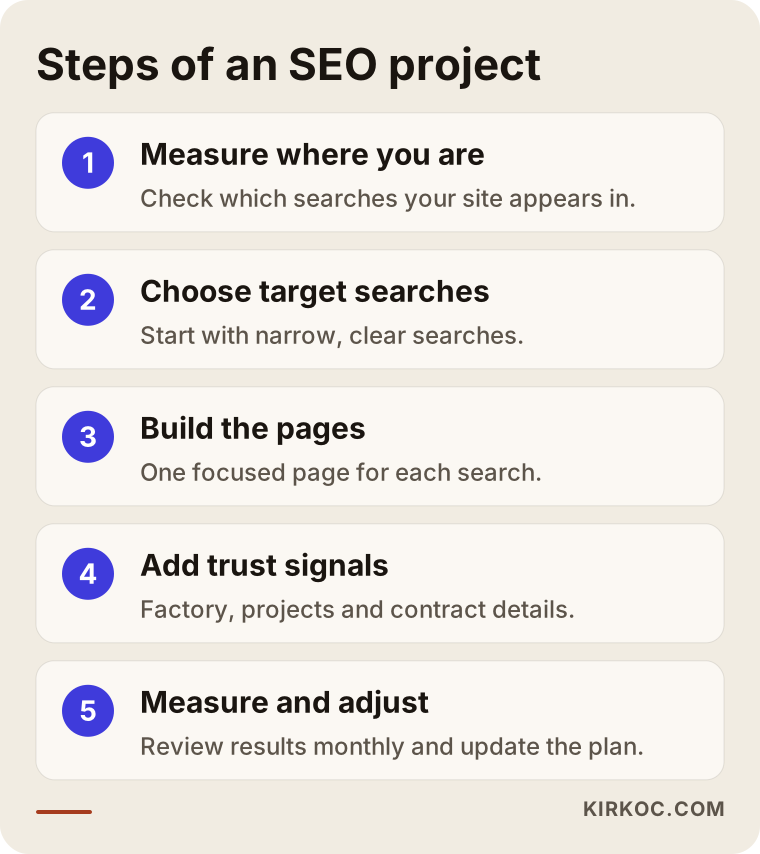
As in the graphic, you begin by measuring where you are now. You look at which searches your site appears in, which pages never appear, and what your competitors are doing. Then you make a plan: which pages will be new and which need fixing. Next, technical obstacles are cleared, such as slow pages, layouts that break on phones and missing titles. Then the content is prepared. Last comes monthly measuring and adjusting.
1. Measure where you are
The first step is to browse your own site like a customer. Type "prefab home" on your phone and see who comes up. Then type your company name. What do you see? Google also offers a free tool called Search Console, which tells you for which searches your site was shown and how many times. Verifying ownership of your site in that tool is one of the most useful things you can do on day one.
2. Choose target searches
Trying to target every search means being strong in none. The big, general searches in this industry ("prefab home") are very crowded. For a start, you pick narrower and clearer ones: phrases that combine a use, a region or a size. Phrases such as "prefab office for backyard," "container vacation home," or "steel warehouse construction" have fewer competitors, and they often represent someone closer to buying.
3. Build the pages
A page is planned for each chosen search. Each page should have one main purpose. The headline should state that purpose clearly. The first paragraph should tell the reader that the answer they are looking for is here. Photos should come with explanatory text. The reason is simple: Google cannot understand the product inside an image as well as it understands words.
4. Add trust signals
In this industry the customer pays money and then has to wait. That is why trust is everything. Photos of your factory or workshop, production stages, delivered projects, a summary of contract and warranty terms, your business address and phone number, and your company registration details should be visible on your site. These reassure the customer, and they help Google see the site as belonging to a real business.
5. Measure and adjust
SEO is not a one-time job. Every month you look at which pages were viewed, which were clicked and which produced quote requests. A page that is viewed a lot but brings no quotes needs a title or description fix. A page that never appears needs rethinking.
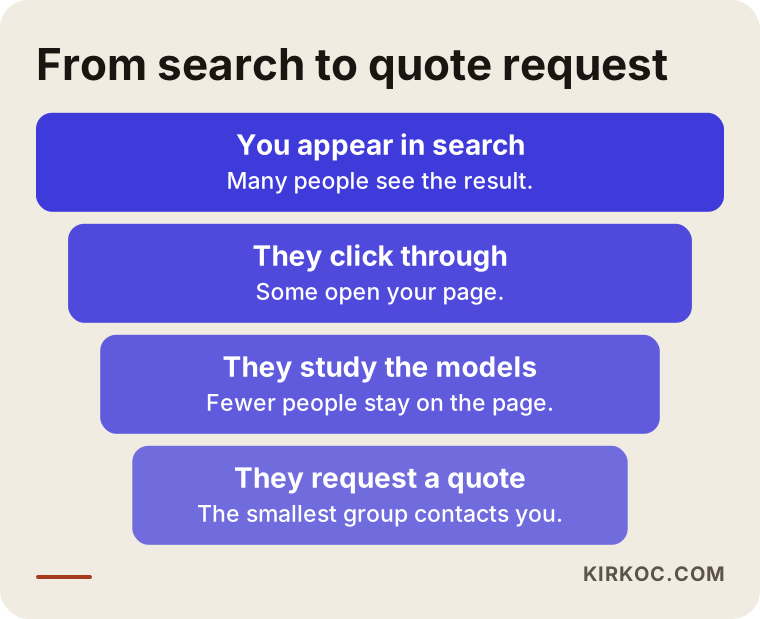
The funnel above shows why SEO takes patience. Only a small share of the people who see you in search click through to the site, some of them study the models, and far fewer ask for a quote. The aim is not to lose the person at any stage of this funnel. That is why you measure not just traffic but also quote requests.
Common mistakes
Most of the mistakes I see in this industry come not from lack of knowledge but from haste and habit.
The first mistake is hiding the price completely. You do not have to publish a number, but if you never explain what determines the price, the customer cannot judge whether you are expensive, cheap or vague, and they leave. The second mistake is putting every product on a single page. The third is adding photos without writing any text. The fourth is copying other companies' texts or manufacturer catalogs; when Google sees the same text in many places, it cannot decide which to show, and often values none of them. The fifth is never trying the mobile view, even though many people search from their phones. The sixth is stating legal information in a firm tone and getting it wrong; permit, zoning and local government processes differ from place to place. The seventh is giving up when you do not see results in the first months.
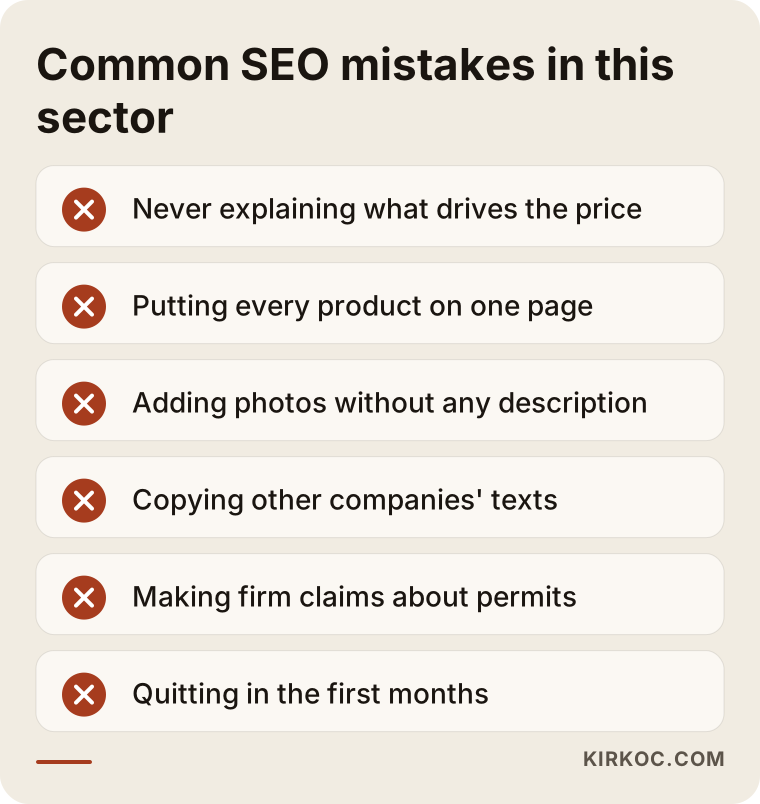
None of the mistakes in the list needs a big budget to fix. Most can be started over a weekend: reviewing existing pages, filling in missing details, trying the site on a phone.
Permits and legal topics
This industry has a particular sensitivity. Questions such as "does a prefab home need a permit," "is a container home legal," and "can I get a certificate of occupancy" are searched a lot. The answers depend on the zoning of the land, how the building will be used and the local government. Making firm statements about this on your site can put both you and your customer in a difficult position. The right approach is to explain the general picture, describe the process, and say "for a definite answer, check with your local building department or consult an attorney." That honesty makes you more trustworthy in the customer's eyes.
What can you do yourself, and when do you need a specialist?
You do not have to hand everything to a specialist. There are several things you can do on your own: set up your Google Business Profile and enter your address, phone and hours correctly; add photos of your factory or workshop; write dimensions, materials and delivery details on your product pages; with your customers' permission, describe completed projects; answer your five most common questions on one page; and test your site on a phone.
The jobs that call for specialist help sit on the more technical side: finding speed and structure problems on the site, choosing which searches will really bring you customers, organizing a product and project structure that runs to hundreds of pages, publishing in more than one language, and working out why Google is not seeing your site. These take experience, and if they are done wrong they can cost you months.
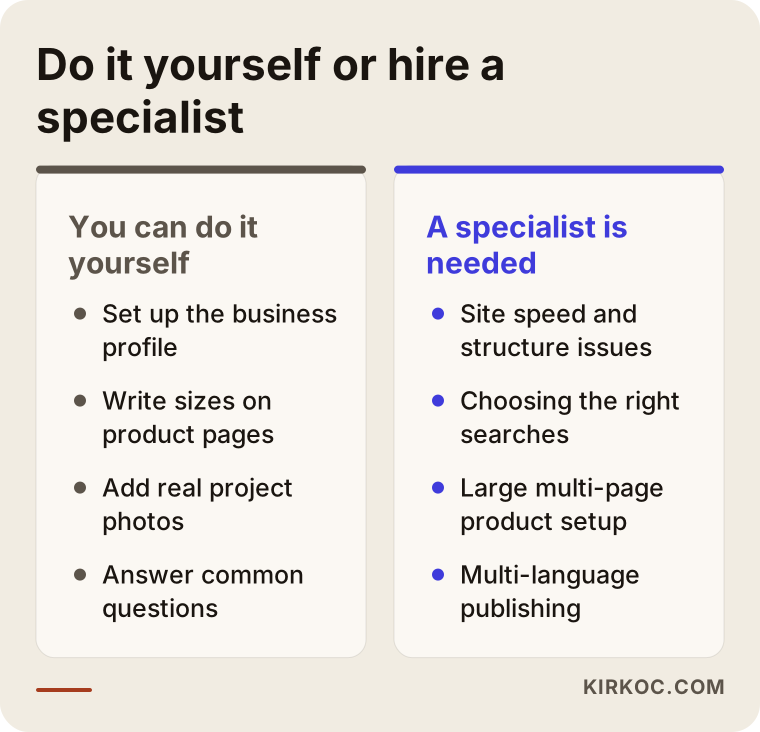
The comparison draws a distinction, but not a hard line. If you have time, start with the left side. If you are not seeing results, or you feel the work is getting bigger than you expected, consider the right side.
What determines the cost?
I will not give a number in this article, because SEO pricing depends on the scope of the work, and there is no single figure that fits everyone. But I can tell you what moves the price. The current state of your site is the first factor: building from scratch and repairing an existing structure take different amounts of effort. The second is the range of products and services; twenty models and two models are not the same workload. The third is how wide an area you target: do you serve one state or the whole country? The fourth is how tough the competition is. The fifth is how many languages you publish in. The sixth is how much of the content comes from you and how much I write; if the factory photos, dimensions and technical details come from you, the process speeds up. The seventh is whether the work is a one-time project or an ongoing monthly engagement.
A good quote lists the work to be done in writing and in order, makes clear who does what, explains how reports will be delivered, and promises no ranking. Anyone who guarantees a ranking is either mistaken or misleading you, because Google decides the outcome.
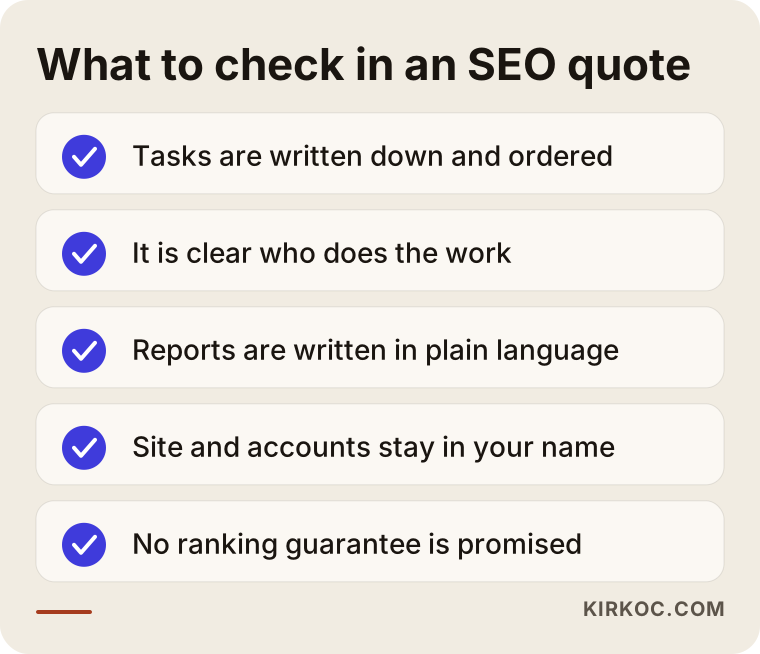
This list sums up the minimum you should look for in a quote, whichever specialist you work with. If an item is missing, ask. It is hard to work long term with someone who avoids answering.
How I work with you
I work alone, which means the person you talk to is the person who does the work. I usually begin with a preliminary review: I look at your site, your competitors and what your customers search for, and I tell you where to start. Then I give you the work for the first months in writing, in order of priority. First I remove the obstacles on the site, then I build the product, use-case and region pages, and then I prepare the articles. Every month I go through the results with you. Your site and your accounts stay in your name; if you ever want to stop working together, you can take everything and go.
Being one person has a limit too: my capacity is limited. I do not take on many jobs at once. So I cannot take on a project of hundreds of pages and dozens of people that a large agency would run. But for a manufacturer, an assembly company or a steel building business, I can handle the whole job from one pair of hands.
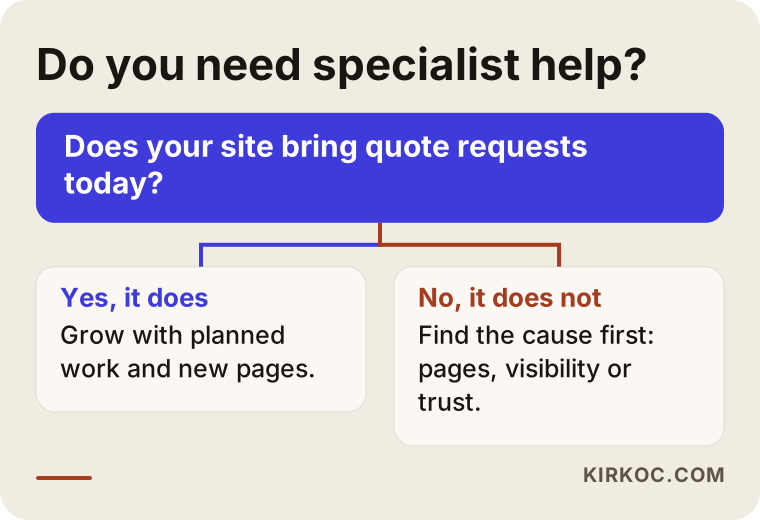
The decision chart reduces the question of when you need specialist help to one simple question: does your site bring quote requests? If it does not, you need to find out why. If it does, working to a plan to get more makes sense.
How long until you see results?
The honest answer: it varies. On a new site, or one reorganized from scratch, the first meaningful movement is usually seen weeks or months later. Broad, crowded searches move more slowly, and narrow, clear ones more quickly. The reason is that it takes time for Google to trust new content. The long decision cycle in this industry adds to that: someone who finds your site today may ask for a quote a few months from now. So you should measure the result not only by the number of phone calls today but also by which searches your site appears in and how quote requests are trending.
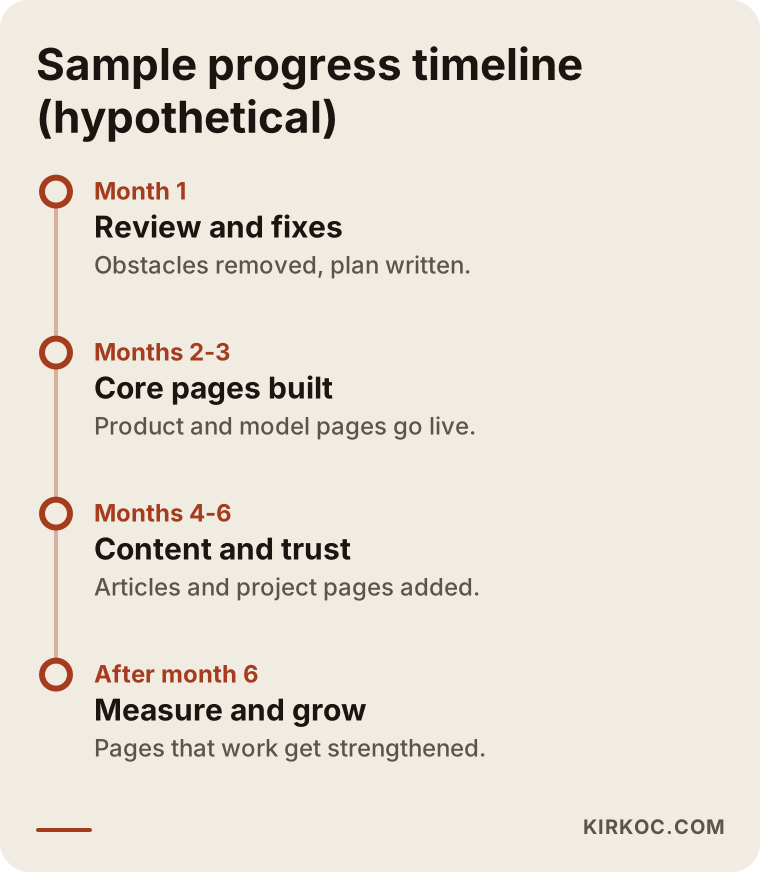
The timeline shows a hypothetical flow; every site moves at its own speed. What matters is knowing what is finished at each stage and what to look at in the next.
Frequently Asked Questions
Is SEO really necessary for a prefab home company, or are ads enough?
Ads give quick results, but they stop the moment you cut the budget. SEO starts slowly and tends to last. For most companies, using both makes sense. But if your budget is limited, SEO may be the more efficient choice over the long run. It is not possible to say that for certain; it depends on the industry and the competition.
Will I lose customers if I do not post prices on my site?
You do not have to post a number, but you should explain clearly what determines the price. Customers leave a page that tells them nothing. Listing which items affect the price builds trust and can increase quote requests.
Should I mention on the page whether a container home needs a permit?
Yes, but without making a firm claim. The answer depends on the zoning of the land and the local government. Explaining the general picture and saying "check with your local building department or consult an attorney" is the safest approach.
Should I use one page or a separate page for each product?
A separate page for each main product and use case is better. Prefab homes, container homes, steel buildings and office containers answer different searches. Putting them all on one page confuses both Google and the customer.
Should I optimize only for my own area or for the whole country?
It depends on your delivery and assembly capacity. Open pages for the regions you can actually reach. Opening pages for places you do not serve is an empty promise. For products with high shipping costs, it is often healthier to start with nearby regions.
How important are photos for SEO?
Very important, but not enough on their own. Photos of real projects build trust, and the explanatory text beside them helps Google understand what it is showing. Writing meaningful file names and descriptions is a small but useful job.
How long until results show?
I cannot give an exact time. On a newly reorganized site the first movement can begin within weeks or months; broad searches take longer. No specialist should give you a ranking guarantee.
Can I use my competitor's text as a model?
Taking inspiration is fine; copying is not. When Google sees the same text on many sites, it cannot know which to value, and customers cannot tell you apart. Writing about your own production process, your own projects and your own promises is both more effective and safer.
If you work in prefab, container or steel buildings and want to understand why your site is not bringing in enough quote requests, you can write to me through my SEO services page. I will look at your site with you and tell you plainly where to start.