"Who is a trustworthy real estate agent in this neighborhood?" or "Is this area a good fit for families with kids?" People no longer type these questions only into Google. They put them to AI assistants like ChatGPT. If your name does not appear in the answer, a buyer or renter may choose someone else without ever hearing of your office. In this article I explain what that means for agents and what GEO services can realistically do about it.
GEO is the work of making sure AI assistants mention your business accurately and favorably. It does not replace traditional SEO; it answers the fact that people now ask their questions somewhere new. I already covered the classic side in my piece on SEO for real estate offices, so here I focus on the AI side.
What buyers and renters actually ask AI
Choosing a home is a long decision, and most of the questions do not fit into a listing filter. These are the types I see most often in my work:
- "Who is a trustworthy agent in this neighborhood?"
- "Is this area good for families? What about schools and parks?"
- "Which areas have easy transit, a quiet feel and a reasonable cost of living?"
- "What should I watch for as a renter working with an agency?"
To answer, the AI gathers what it can find online. If you do not publish clear, consistent information, the answer will either name your competitors or give generic advice with no names at all.
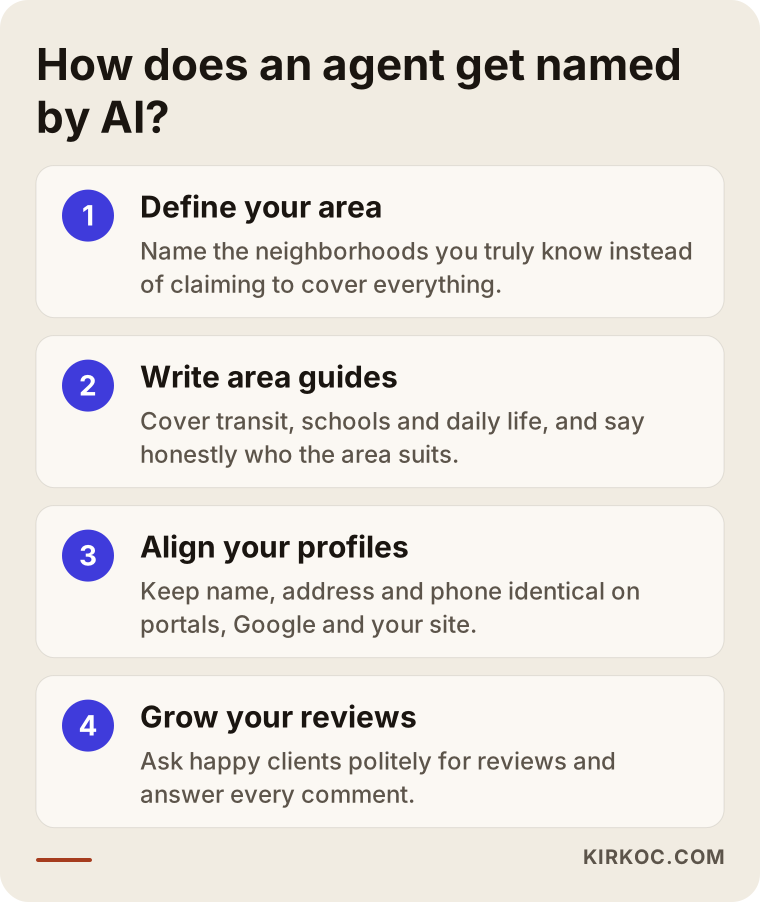
Neighborhood guides are where you stand out
When someone asks "what is this neighborhood like?", an AI prefers content written by someone who genuinely knows the area. Listing portals rarely offer that; they have listings, not stories. That gap is your opportunity.
A good neighborhood guide includes:
- Honest, concrete notes on transit, schools, healthcare and daily life
- Who the area suits (young families, students, retirees) and who it might not suit
- Which streets or districts mostly offer which kinds of homes
- How long your office has worked there and what types of deals you handle
That last point matters. Instead of claiming "we cover everything," name the three to five areas you truly know. It gives both readers and AI a clearer signal. If you quote prices, state the source and date; an outdated figure does more harm than none.
Define your area of expertise
For an AI to mention an agency, it has to be clear who you are and where you work. Your site should show an about page, the list of areas you serve, short bios of your agents and your office address, all in one place and all consistent. If that information is scattered, the AI cannot tell which area to connect you with.
Narrowing your scope helps here. Rather than describing a whole city on one page, build a separate, genuinely useful page for each area you specialize in. I cover the general idea in my article on how local businesses get named in AI recommendations.
Reviews shape trust
The answer to "trustworthy agent" depends largely on what other people say. AI scans reviews, news and ratings about your office. Be honest here:
- Politely ask satisfied clients for a review after the deal closes.
- Never buy or invent reviews. It is unethical, and once discovered, the damage to trust lasts.
- Reply to negative reviews calmly and specifically. An answered complaint hurts less than an ignored one.
Your license, registration and professional memberships should also be visible on your site. Check your local licensing rules and advertising limits with the relevant authority.
Consistent profiles across listing portals
Many agencies pour their effort into portal profiles, which makes sense because that is where clients come from. But AI learns about an office from many sources, not one. If your name, address, phone number, service area and description differ between your portal profile, Google Business Profile, social accounts and website, the AI may misidentify you or leave you out.
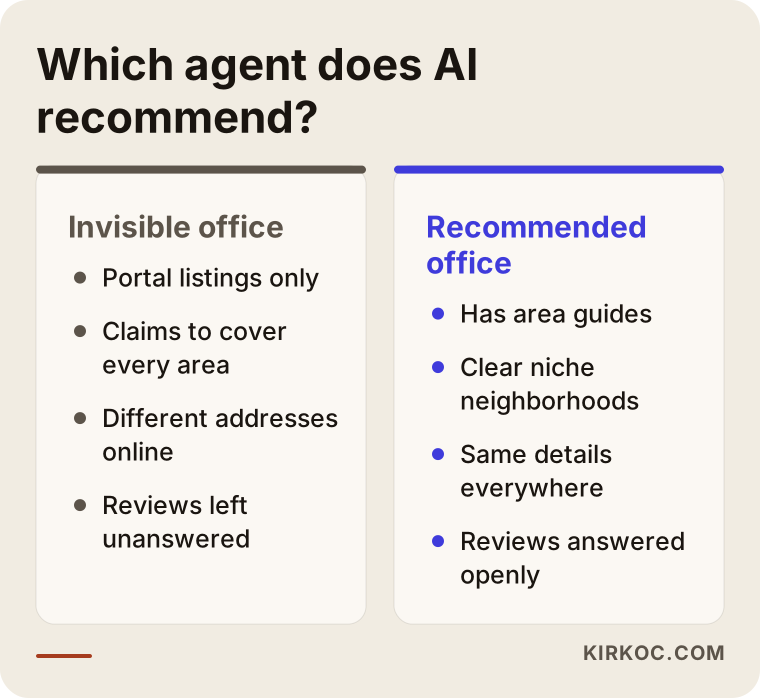
The fix is dull but effective: open a spreadsheet, compare every platform and correct the differences. It takes little time, yet most offices have not done it in years. Repeat the check twice a year, since a move, a new phone number or a new agent joining can quietly create new mismatches.
Two offices, two different starting points
Let me describe two examples, without names or numbers, that are close to how this work really goes. The point is not "this happened, so it will happen to you." It is to show what gets examined and which decisions get made.
A single-office agency focused on one neighborhood
An agency that had worked in one neighborhood for years, mostly handling rentals and small condo sales, came to me with this situation: its listings ran on the portals and the phone rang, but the owner had heard friends say that "people ask AI now" and wanted to know where the office stood. I started by asking several assistants about the neighborhood and the agency in different wordings. The answers either skipped the office entirely or named a large brand from the next town over.
The website explained why. The homepage said the agency served "the whole metro area," the address was written two different ways, and the phone number on the Google profile was an old one. We fixed those inconsistencies first. Then the owner and I sat down and picked the three neighborhoods he truly knew, and wrote a short, honest guide for each: who the area suits, how transit works, which kinds of homes dominate, and which deals the office does not handle.
The outcome was modest but real. After a few months, the agency's name began to appear now and then in answers to questions about those specific neighborhoods. Not for every question, and not in every assistant. I do not present this as a guarantee; it simply showed once more that being clear in a narrow area pays off.
A multi-agent office spread across several areas
The second example was an office with three agents, handling both sales and rentals in three different areas. The problem was the opposite: everything was described, yet nothing was clear. The site had one "areas we serve" page listing dozens of place names, with no real story about any of them.
Here I first had to ask each agent about their own area of expertise, because making individual knowledge visible is a stronger signal than speaking in the name of the office. We built a short profile page for each agent: how long they have worked in which area, which kinds of deals they handle, and what they cannot help with. Then we wrote a guide for each area. The hardest part was getting the agents to drop the reflex of "I can explain any area to anyone" and choose priorities.
One thing I noticed: consistency took longer in the second office, because three people each had their own social accounts and portal profiles. Office name, job title and phone number differed slightly everywhere. Aligning them one by one was dull but unavoidable work.
Step by step: how the work unfolds
Whether you work with me or do it yourself, the order is largely the same. Below is a simplified version of the sequence I follow.
1. Assess the current state
First I look at how your agency appears in AI answers today. I put buyer and renter questions about your area and service type to a few assistants and write down the answers. Who gets named, which sources are used and whether anything wrong is said about you all become visible at this stage.
2. Inventory your information
Next I map your digital footprint: your website, portal profiles, Google Business Profile, social accounts and any pages in news or directories. Name, address, phone, service area and description are compared everywhere. This table is often the most surprising finding.
3. Prioritize
Fixing everything at once is neither possible nor necessary. I ask which neighborhoods are really your business, which service type earns the most and which mistake does the most damage. The answers set the plan.
4. Content and corrections
Guides get written, the about and agent pages become clear, and inconsistent profiles are corrected. I build the content from your own knowledge: you tell me, I organize it. You know the neighborhood; I do not.
5. Monitor
The work is not finished when the writing is. I repeat the same questions at intervals and watch what changes. Where nothing changes, I look into why.
A checklist before you start
The questions below show quickly how readable your agency is to AI. Every item you answer with "no" is a candidate for your first piece of work.
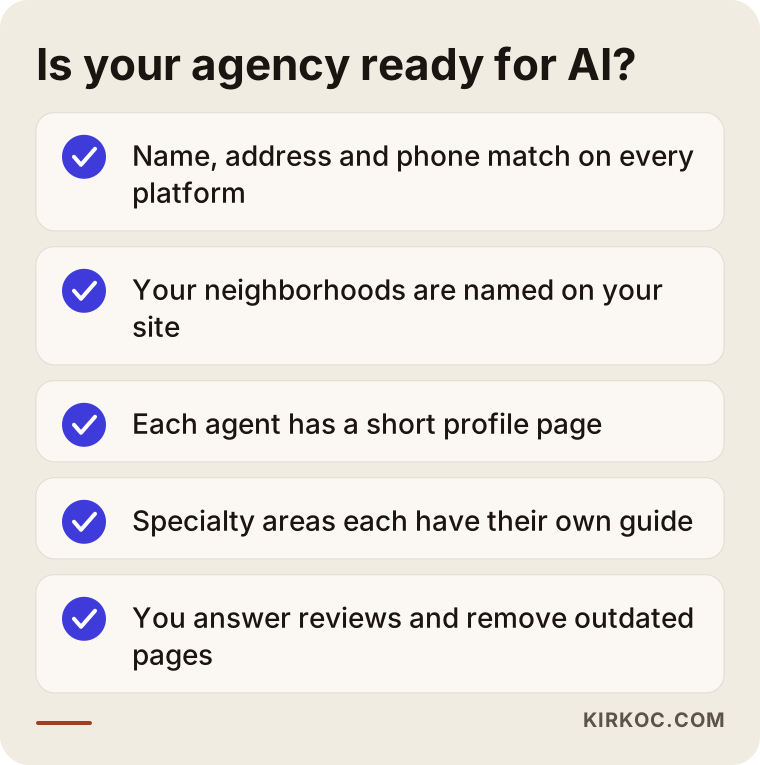
I suggest filling it in during one sitting, with your site and profiles open side by side. Getting to "yes" on everything does not take months; most items are fixed within a week or two. The part that takes real time is producing the content for the area guides.
One more note: this checklist is a starting point, not a grading system. I am not saying an agency will automatically be named because every box is ticked. But each "no" leaves your office needlessly vague to an AI.
Common mistakes
Working with real estate agencies, I see the same mistakes repeatedly. Most are made with good intentions, yet the result works against the office.
Claiming expertise in every area
"We serve the entire region" does not build trust; it creates vagueness. Neither an AI nor a reader can tell where you are genuinely strong. Writing out the neighborhoods you know by name feels like narrowing your scope, but it actually increases visibility.
Mistaking a listing description for a guide
Copying a listing description and publishing it as an "area page" does not work. A listing describes a property; a guide describes a place to live. They answer different questions, and one text cannot serve both.
Leaving outdated information online
An office that moved, a closed branch, an agent who left: old pages and profiles stay online for years, and an AI may treat that old information as current. An annual cleanup round pays off surprisingly well.
Taking shortcuts with reviews
Buying reviews or asking relatives to write them may look attractive in the short term. But platforms detect it, and AI pays attention to how natural reviews look. Beyond the ethical problem there is a practical risk: once caught, recovery is difficult.
Publishing prices and market data without dates
A sentence like "the average price per square foot here is X" can be wrong a year later. If you quote a figure, add the source and date; if you are unsure, quote none. Wrong or outdated information misleads both readers and AI.
Overlooking advertising and licensing rules
Rules for listings and advertising in real estate vary by country, state and over time. Requirements to show a license number or limits on listing wording are things to check with your licensing authority or professional association. I do not give legal advice.
What you can do yourself, and what to leave to a specialist
You do not need a consultant for everything. An honest split protects both your budget and your time.
What you can do yourself
- Make your office name, address and phone identical on every platform
- Ask satisfied clients for reviews after a deal and answer the reviews you get
- Name your service neighborhoods and your agents clearly on your site
- Ask AI assistants about your office, note the answers and compare them over time
- Clean up outdated, moved or closed pages and profiles
None of this needs technical knowledge; it needs order and persistence.
What to leave to a specialist
- Structuring the site so AI can read it properly (technical adjustments)
- Building area guides correctly for both readers and search systems
- Analyzing which sources shape the answers and spotting gaps
- Tracing the source of a wrong statement, especially when it is spread across several platforms
- Interpreting the effect of the work over time and telling which change did what
Some of what you do yourself may be enough. If you see no progress after a few months, that is when a specialist's view starts to make sense.
How can you ask AI about your own office?
You do not need a tool or a consultant to begin. One evening, ask a few assistants questions the way an ordinary buyer or renter would. The important part is to ask without typing your own agency name, because real clients are asking without knowing you.
Which questions to ask
Try three kinds. The first is an area question: "What is it like to live in this neighborhood, and who does it suit?" The second is a trust question: "I am looking for a trustworthy agent in this area; what should I watch for?" The third is a process question: "As a renter, which documents should I ask the agency for?"
Write each answer in a table: which agencies were named, which sources were cited and whether the information was correct. Three months later you can repeat the same questions and see the difference.
How to read the answers
Do not draw conclusions from one answer. An AI can respond differently to the same question at different times. What matters is a repeating pattern: is the same competitor always named, does the same outdated fact keep coming back? A pattern says far more than a single answer.
Who is this work not for?
To be honest, GEO is not the most urgent job for every agency right now. In the situations below I would suggest fixing other things first.
- If your site loads slowly, breaks on mobile or does not show your listings, solve that first. There is no upper floor without a foundation.
- If you have no Google Business Profile, or nobody controls it, start there.
- If your office is about to close or change hands, a long-term visibility project makes little sense.
- If you expect fast results, this work will disappoint you. A budget for paid ads may be the better tool.
In these cases I will tell you plainly and will not sell you work you do not need. Discussing at the start whether a project truly helps you protects both our time.
Which content works besides area guides?
Area guides are the strongest tool, but not the only one. Short, orderly answers to the questions buyers and renters ask along the way also become valuable material for AI.
Pages that explain the process
Pages such as "What are the steps when searching for a rental?" or "What does an agent do and not do during a purchase?" make your way of working transparent. Rather than going into legal detail, describe your own process: what is discussed in the first meeting, which documents are requested and at what stage fees come up. On legal matters, "check the rules that apply to you" is enough.
Notes drawn from real deals
Describing typical situations from your deals, anonymously and with permission, gives readers confidence. For example, you can write about what tenants in an area most often hesitate over, as a general observation with no names, addresses or private details.
These pieces look plainer than a glossy listing. But plainness is not a flaw here; it is a sign of reliability for both AI and readers.
Honest expectations: what I cannot promise
I cannot control what AI says, and neither can anyone else. If someone promises "you will be the first name mentioned," they are not being truthful. What I can do is make your office a plausible candidate for those answers: organize content, make information consistent and make trust signals visible. Results take time, usually months rather than weeks, and I would be wary of anyone offering a shortcut.
Frequently asked questions
I already advertise on portals. Do I still need GEO on my own site?
Portal listings bring buyers to a property, but your own site, reviews and profiles answer "can I trust this agent?" AI looks at your digital footprint for that second question.
Does this make sense for a small, single-office agency?
Yes, and it can be an advantage. Real expertise in a narrow area is a clear signal for AI. Large chains spread across many areas often cannot provide that clarity.
What if AI describes my office wrongly?
First I look for the source of the error: an outdated portal profile, an inconsistent address or a missing page. Fixing the source lasts longer than trying to correct the AI directly.
How long does GEO take, and when do results show?
It depends on your starting point. Fixing inconsistent profiles is quick, but reflecting that in AI answers usually takes months. I cannot give an exact date, and it would not be honest to do so.
What determines the price?
The number of areas you work in, how many agents and profiles there are, the state of your current site, how many guides need writing and how often results are monitored. That is why I do not name a figure before looking at your office.
Do my agents' personal accounts count?
Yes. AI learns about an office not only from the corporate page but from everything it finds about the agents. Keeping job titles and the office name consistent on every account helps. What agents share on their own accounts is for you and them to decide.
Can I name competing offices and say I am better?
I would not. Comparative advertising can be risky under professional rules, and it does not build trust with readers or AI. Describing your own expertise and way of working is a far sturdier approach.
Do I need a separate website for AI?
No. The same site works for readers and AI. What it needs is clear, current and consistent content, not a new site.
Next step
If you do not know how your office appears in AI answers today, a first look is enough to start. We can talk about what is realistic for your area, service type and current website. If that interests you, reach out through my GEO services page.