You sell promotional products or corporate gifts. Your catalog is wide, your print shop is busy and your suppliers are sorted out. But your website is quiet: the phone rings rarely, the quote form stays mostly empty, and you are still living off referrals from old customers. Meanwhile you keep seeing your competitors show up in the same searches. That is exactly the moment when typing "promotional products SEO" or "corporate gift SEO" into Google makes sense. In this article I explain why SEO works differently in this industry than in others, what buyers actually type into Google, which pages you need and where to start. I am Ümit Kırkoç, a web designer and SEO consultant who works alone from Istanbul, and where it helps I will be clear about what my own SEO services cover and what they do not.
SEO, in short, is the work that makes your website show up on Google when your customers search. Unlike advertising, you do not disappear the moment you stop paying; when it is set up well, the structure you build once can bring quote requests for months. But in the promotional products business this work is different from a store that sells standard items. What you sell is usually not a product sitting on a shelf. It is a job: made with the customer's logo, in the customer's quantity, to arrive by the customer's date. Knowing that from the start helps you set realistic expectations and a realistic budget.
Why SEO works differently in the promotional products industry
On an ordinary online store, a customer sees a product, adds it to the cart and pays. In promotional products there is usually a process. The buyer first looks for ideas, then picks a product, then learns about print options and minimum quantities, and finally asks for a quote. After the quote arrives, the decision can take weeks, because it is rarely one person's call: a marketing manager picks, purchasing compares, and someone in management approves.
Two things follow from that. First, searches are very scattered. One person types "custom logo pens," another "holiday gifts for clients," another "trade show giveaways," another "welcome kit for new employees." They all belong to the same industry, but each one needs a different page. Second, the competition comes in layers. In the same search you are up against large promotional product distributors, marketplaces, comparison sites and small shops that sell a single item. A brand-new site will not reach page one for a broad, crowded search like "promotional products" within a few weeks. It is better to say that honestly.
The good news is that this industry is highly fragmented, and fragmentation is the real opportunity for small and mid-sized companies. A narrow, specific search means far fewer competitors than a broad one. Someone who types "promotional products" may not yet know what they want. Someone who types "wooden gift box set with company logo" has probably set aside a budget and is close to deciding.
The illustration below uses a completely made-up example to show what a search result can look like and why a clearly written page matters.
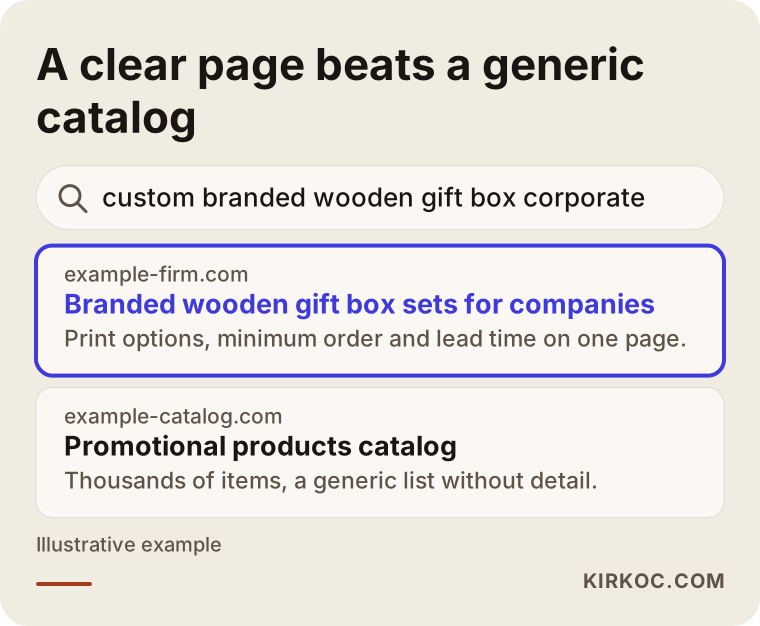
Look at what the highlighted result does: in the first line it says what it sells, which print options exist and who it is for. A generic page announcing "the widest promotional catalog in the country" does none of that. Google tries to work out which answer to give the person searching. If you make that easy for it, it can show you more confidently.
What do buyers type into Google?
The key question in SEO is this: what exactly does your customer type into Google? You should research this rather than guess, but a few patterns specific to this industry are worth knowing from the start.
Product-focused searches
The first pattern is the product name: "custom logo pens," "printed travel tumbler," "branded notebook and planner," "custom tote bags." The person knows what they want. What they expect from you is to see that product's options, colors and print methods. These searches have high volume, but they are crowded.
Purpose-focused searches
The second pattern is purpose: "trade show giveaways," "client holiday gifts," "new hire welcome kit," "dealer meeting gifts." Here the person is not after a product, they are trying to solve a need. Pages that answer these searches group products by scenario and make deciding easier. Most competitors never write this page, and that is where your opening is.
Quantity- and budget-focused searches
The third pattern is quantity and budget: "100 custom mugs," "bulk promotional pens," "low-cost corporate gifts." Searches that contain a number usually come from someone close to buying. For that person, the most important thing is to see the minimum order and the lead time right on the page. Not every business can publish prices openly, but explaining what the price depends on builds trust.
Looking for a supplier
The fourth pattern is a direct search for a company: "promotional products company near me," "corporate gift supplier," "custom logo print shop." The person doing this search is already choosing a supplier. Here, trust matters more than a product list: references, photos of your print shop, your production process and your contact details.
The table below puts these four search types, the buyer's intent and the matching page side by side.
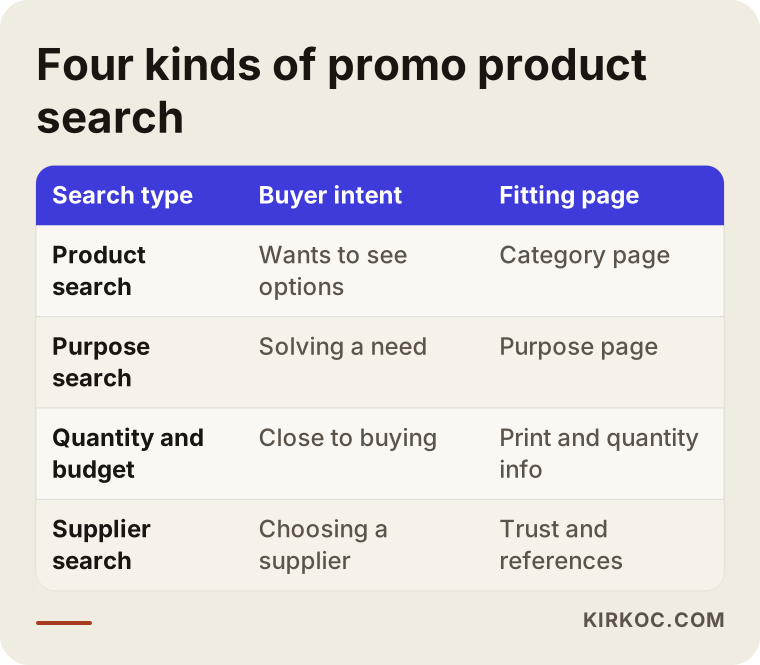
A good first exercise is to compare this table with the pages you already have. Most promotional product sites only have product pages; the purpose pages and the pages that build trust in your company are missing. Every missing row is a customer who ran that search and went to someone else's site.
The buying journey and the role of each page
A promotional products buyer rarely decides in one sitting. They look for ideas first, then narrow down the options, and only at the end ask for a quote. You can think of this journey as a funnel: lots of people at the top, a few who actually request a quote at the bottom. Each stage needs its own kind of page.
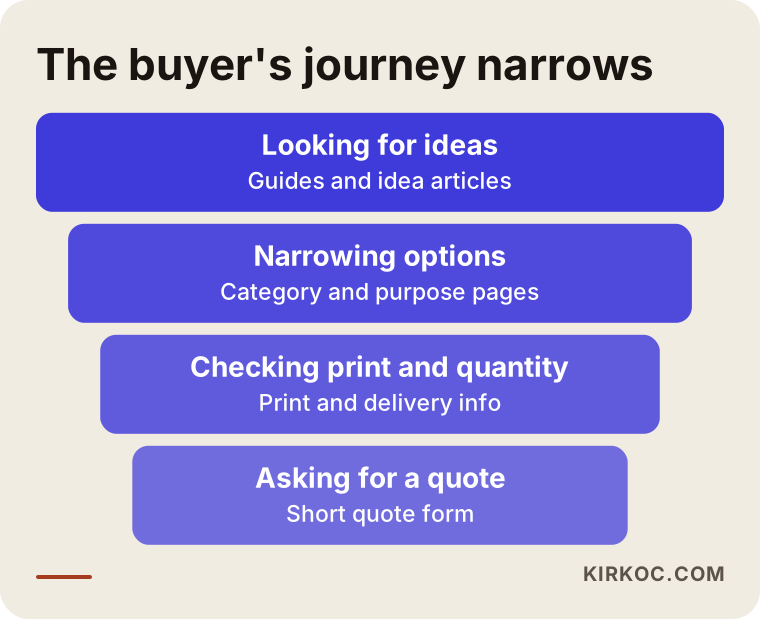
For the person at the top of the funnel, guides and idea articles work. For the person in the middle, category pages and purpose pages. For the person at the bottom, the quote form, print options and delivery information. Many companies invest only at the very bottom and then expect quotes while nobody is at the top. Others do the opposite: they write guides but leave no clear path to a quote. Both are inefficient.
Which pages does this industry need?
On a promotional products site the page inventory should look roughly like the list below. Every company's scope is different, of course; this is a starting skeleton.
Home page: It says clearly what you do, who you serve and how to get a quote. It does not dump the whole catalog.
Category pages: Pens and writing supplies, drinkware and tumblers, bags and apparel, office and desk items, and so on. Above the products, every category page needs a few sentences of explanation: who the category is for, which print options apply and what the minimum order is.
Purpose pages: Trade show giveaways, holiday corporate gifts, welcome kits, dealer and client gifts. The product list may be the same, but the language of the page is the language of solving a need.
Print methods page: It explains options such as screen printing, laser engraving, UV printing and embroidery in plain words and says which product suits which method. It is among the least used but most useful pages, for both search and trust.
Process and delivery page: It explains the steps from order to delivery, the proof approval stage and the lead time.
References and sample work page: Photos of work you have done. If you do not have permission to name a customer, stick to the industry and the product.
Quote page: A short form with fields for the product, quantity, desired delivery date and a logo file.
The next illustration shows the top of a category page as a simple outline.
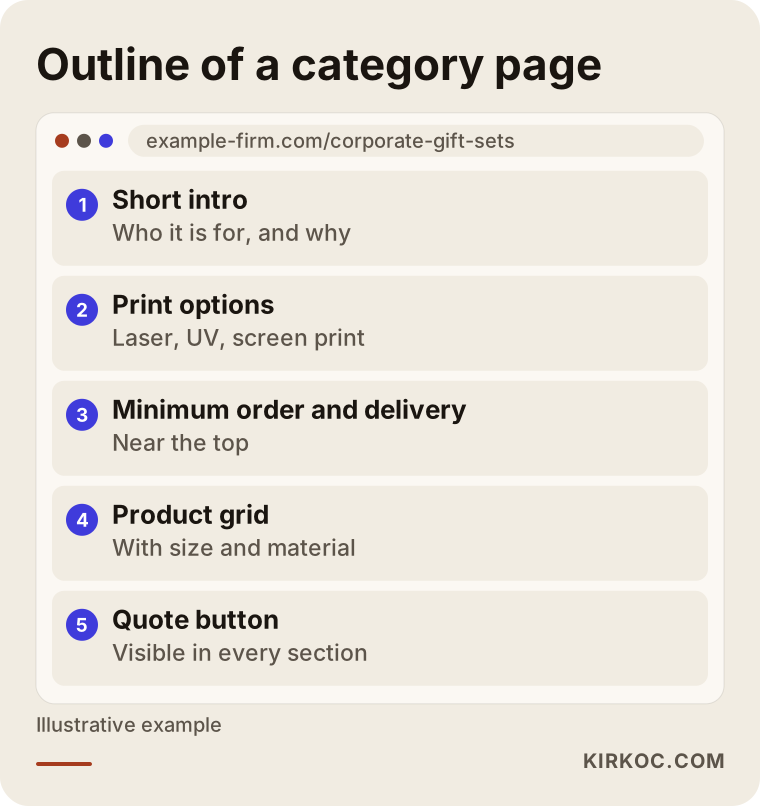
The point to notice in the outline is that the product grid does not sit at the very top of the page; it comes after the introduction. Both Google and the visitor understand what a page is about from a short piece of text first. Seeing only pictures and price boxes makes that harder.
Common gaps on product pages
The product page is the second front in this industry. On many promotional product sites, the product page is filled with the text the supplier sent. The same text appears on hundreds of other sites. When Google sees the same text in dozens of places, it does not treat your page as a special answer.
A product page should include: the size and material of the item; which print methods suit it; the size of the print area; the minimum order; the estimated lead time; and what purposes it is often chosen for. Even a short, original usage note sets you apart from the hundred other sites selling the same item. For example, two sentences on what kind of client gift a wooden box set works well for are worth more than the supplier's description.
Another common gap is the file name and description of product images. File names like "IMG_4821" straight from a phone and empty image descriptions make you invisible in image search. Writing a short description of what the picture shows when you upload it helps both accessibility and search.
Two hypothetical example scenarios
The two scenarios below are entirely hypothetical; they do not describe any real company or person. Their purpose is to show how the process works in practice.
Scenario 1: A small promotional products company with only a product list
Suppose a small company has uploaded hundreds of items from a supplier catalog to its site. The home page shows random products, and the category pages contain nothing but product photos. The "About" page is two sentences long. The owner searches "corporate gifts" on Google, does not see the company on the first page and cannot work out why.
The first step is to clarify what the site is aiming at. Instead of trying to promote all those hundreds of products, you pick the three or four areas the company is really good at: say wooden gift box sets, trade show bags and textile printing. For each one you prepare a rewritten category page with a short introduction, print options and minimum order information. Then you add a purpose page such as "trade show giveaways." Within some months it may be possible to start appearing in narrower searches. Nothing is guaranteed, but the starting point is clear.
Scenario 2: A corporate gift company preparing for the holiday season
The second hypothetical company makes most of its yearly sales before the end-of-year holidays. But it publishes new pages only when the season begins, and Google does not know those pages yet. By the time the season ends, the pages are just starting to show up. In other words, the timing was missed.
The lesson here, as I would put it: with seasonal businesses, SEO has to start months before the season. Instead of deleting the page every year, keep the address the same and update the content, so the page keeps the trust it has built up. A "holiday corporate gifts" page that goes live in September is far more ready by November and December. The page stays up out of season too; its products and photos are simply refreshed.
The process, step by step
SEO is not magic; it is orderly work. These are the steps I follow in this industry, and you can follow the same order if you do it yourself.
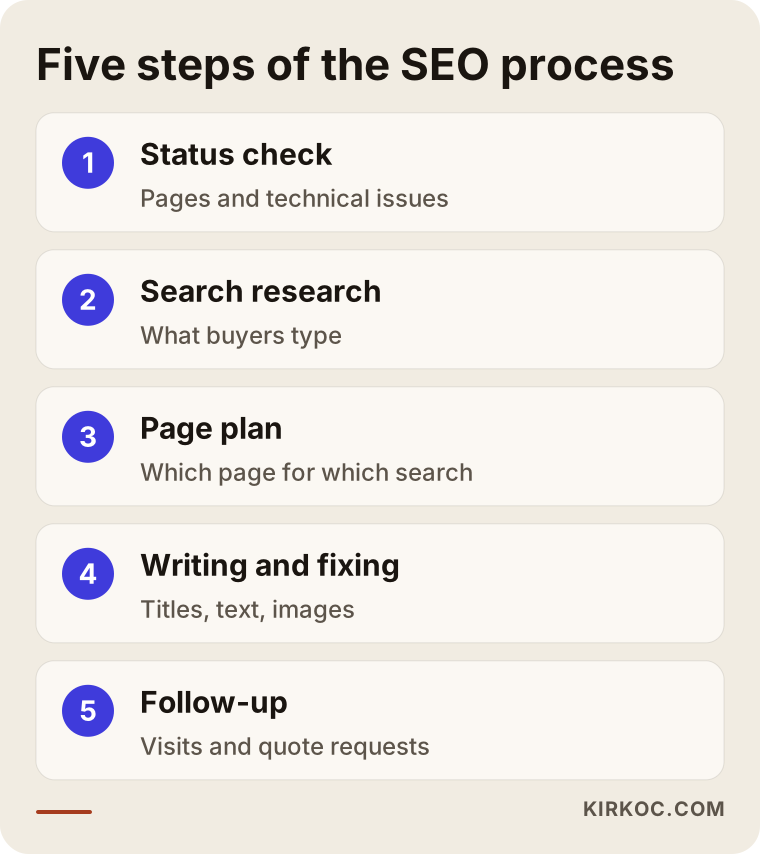
1. Status check. I look at which pages your current site has, which of them show up on Google and which nobody ever looks at. Technical problems, such as slow pages, poor mobile display and broken links, are listed at this stage.
2. Search research. I work out what your customers actually type: product, purpose, quantity and supplier searches, each separately. I also look at which searches your competitors appear in.
3. Page plan. I decide which page will answer which search. One page is not forced to serve several purposes; "corporate gifts" and "trade show giveaways" become separate pages.
4. Writing and fixing. The pages are written, or the existing ones are corrected. Titles, descriptions, print options, delivery information and image descriptions are completed here.
5. Follow-up. After publishing, I track which searches bring visitors and which pages lead to the quote form, and update pages when needed.
Timing matters throughout the process. SEO results do not arrive immediately; some work matures quickly, some slowly.
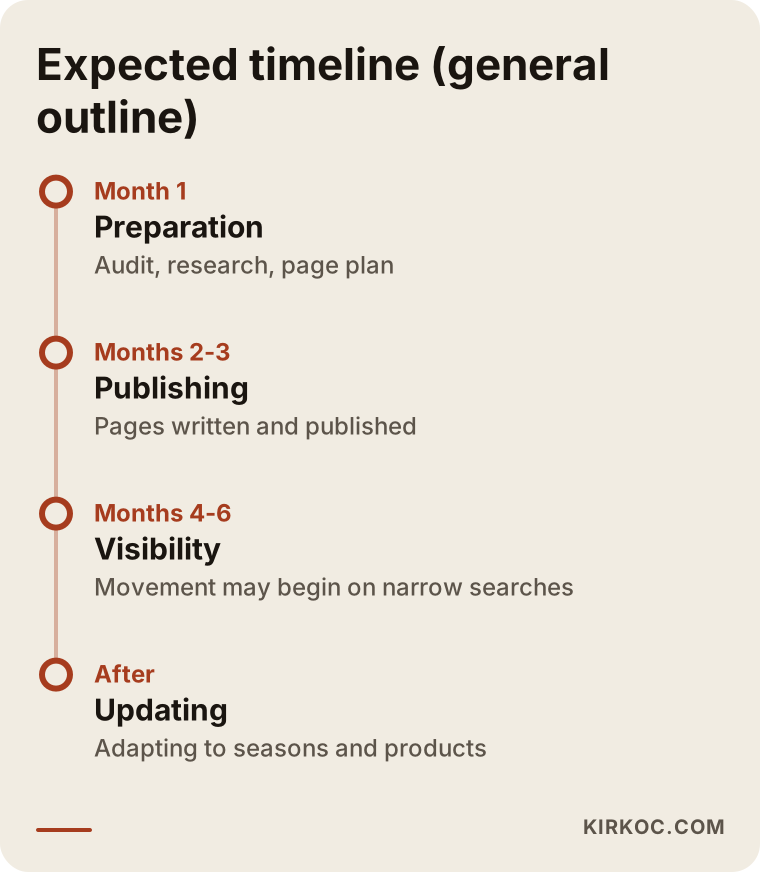
The periods in the timeline are not a promise, only a general expectation. They change with the intensity of competition, the age of your site and the quality of the content you publish. No consultant can promise a ranking; neither I nor anyone else controls Google's results.
Trust: what does a business buyer look at?
A corporate buyer choosing a supplier does not look only at the product list. As someone who will have to defend the same budget in front of management, they look for an answer to "will this company deliver on time?" Your site's pages can answer that question. These things increase trust: a clear page that explains who the company is, a real phone number and address, photos of your production and print process, snippets of sample work, a plain explanation of delivery and revision terms, and answers to frequently asked questions.
Trust elements do not determine rankings on their own, but they decide whether a person who arrives from a search result asks for a quote. How many visitors you get matters, and so does what those visitors do. That is why, in my work, trust pages get the same seriousness as technical fixes.
Common mistakes
I have gathered the mistakes I see most often in SEO for this industry. Most of them are easy to fix.
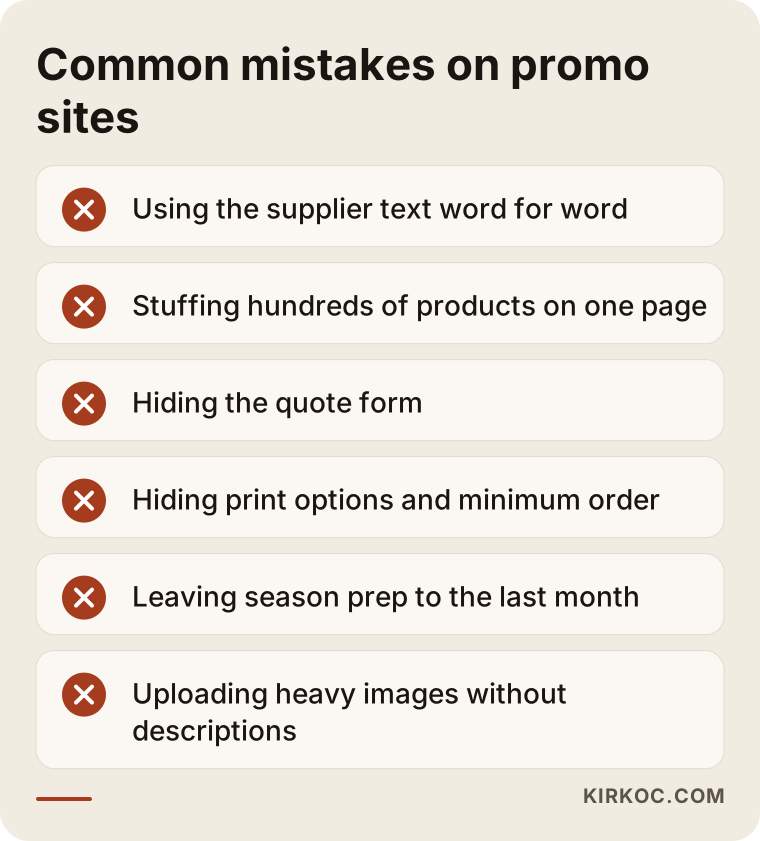
Using the supplier text word for word. If the same text is on many sites, your page carries no value of its own. Write in your own sentences, with details you know first-hand.
Stuffing everything onto one page. A single page titled "Promotional products" with hundreds of items and no explanation leaves both the visitor and Google unsure what it is about.
Hiding the path to a quote. If the quote form is three clicks away, an interested visitor gets tired and leaves.
Hiding print and minimum order information. Someone who has to pick up the phone just to ask this will turn to the competitor who puts it on the page.
Missing the season. Leaving preparation for a busy period such as the end-of-year holidays to the last month gives your pages no time to be noticed.
Neglecting images. Empty image descriptions, heavy files and pages that open slowly on a phone hurt both the visitor and your search visibility.
What can you do yourself, and when do you need an expert?
You do not have to hand every task to a specialist. The list below summarizes the first checks you can do on your own.
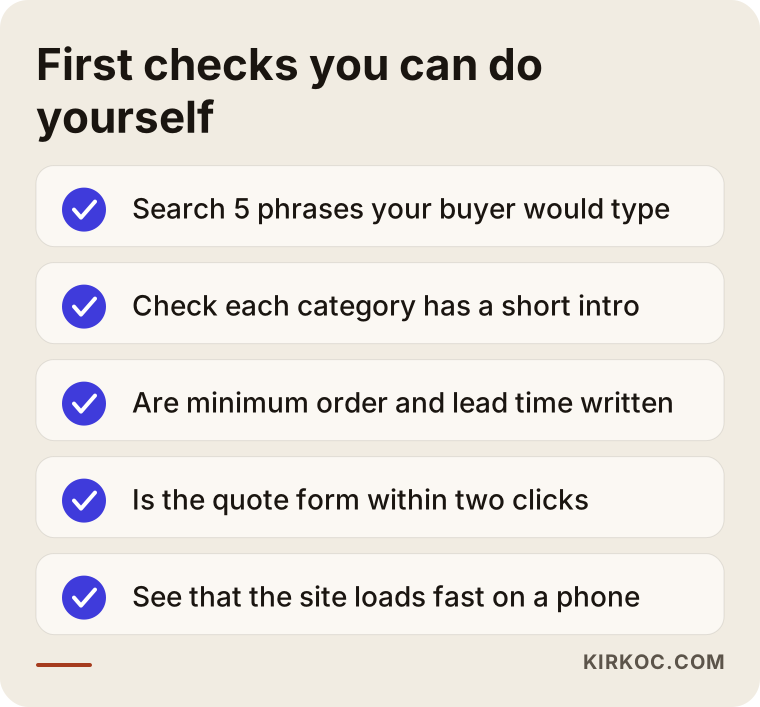
Beyond that, you can run a small experiment: type five or six phrases your customer would type into Google and look at who comes up. What do those pages explain, and what could you explain better? It costs nothing and teaches a lot.
Getting expert help can make sense in these cases: your site has technical problems (it is very slow or broken on mobile), you need bulk edits across hundreds of products, your competitors are strong and you cannot work out which searches to target, or you simply do not have the time to write content. The diagram below can help you decide.
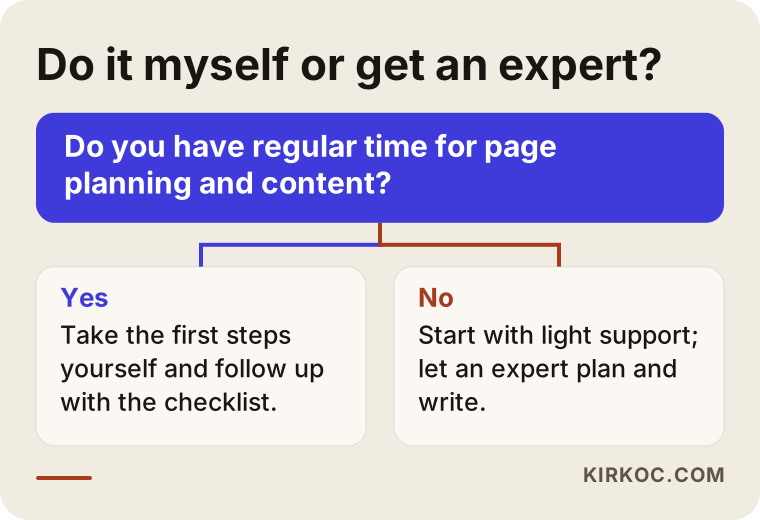
The question in the diagram is simple: do you have the time to keep up page planning and content production regularly? If yes, you can take the first steps yourself. If not, starting with a little support can cost less than the time you would otherwise lose.
What determines the cost?
I will not give numbers in this article, because the cost of SEO changes a great deal with the scope of the work. But I can say clearly what it depends on.
First, the current state of your site. The workload differs enormously between a site with few technical problems and a clean page structure, and a site that has to be reorganized from scratch. Second, the number of products and pages. A catalog of fifty items and a catalog of five thousand do not take the same effort. Third, how competitive the searches you target are. Narrow, specific searches take less effort to win; broad ones call for longer, steadier work. Fourth, how much content you need: how many category, purpose and guide pages have to be written. Fifth, the number of languages. If you also sell to customers abroad, each language means separate pages and separate effort. Sixth, whether the work is one-off or ongoing.
For this reason, instead of a package that gives everyone the same price, I prefer to look at your situation first and describe in writing what will be done. When you compare quotes, ask the same question of each: what will they do, for which pages, in what timeframe, and how will they report the result?
Showing up in AI answers
Lately some buyers ask AI tools such as ChatGPT instead of Google for product ideas, with questions like "What do you give clients as a new year gift?" These tools build their answers from clear, well-organized sources they find on the internet. If your site has pages that plainly explain which product is chosen for which purpose, the chance that your pages are used as a source for these answers goes up. There is no guarantee, but a page that is clear, simple and accurate is a good foundation for both Google and these tools.
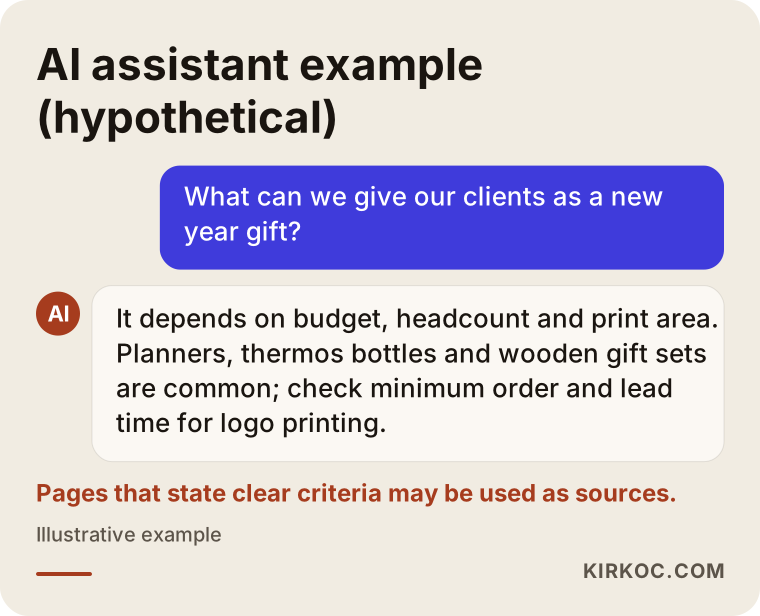
The answer in the illustration is an example, not the output of a real tool. What matters is that the answer rests on concrete criteria: budget, headcount, print area and lead time. If you state these criteria openly on your pages, you make things easier for people and for machines alike.
How I work with clients
I work alone, which means the person you talk to is the person who does the work. I usually proceed like this: first I look at your site and your competitors and write down what I find in plain language. Then we work out together which searches need which pages. After that I write or edit the pages, fix the technical problems and track the results. My reports are free of jargon, with sentences like "this page appears for this search, and this many people filled in the quote form." I do not promise rankings on any job, and I suggest you be careful with anyone who says they will.
Frequently Asked Questions
How long does SEO take to work for a promotional products company?
It depends on the age of your site, the competition and the work done. In narrow, specific searches you may see movement within a few months; broad searches take longer. I cannot promise an exact timeframe or a ranking, because Google decides the result.
I have thousands of products. Do I need to optimize all of them?
No. It makes more sense to start with the categories that bring in the most quote requests, or that you want to, and with your best-selling products. Then you go step by step. Trying to do everything at once is both expensive and inefficient.
Can I use the product text my supplier gives me?
You can, but since the same text is on many sites, your page carries no special value. Adding the size, material, print options, minimum order and a usage note in your own sentences matters at least as much.
Should I run ads or invest in SEO?
They do different jobs. Ads are fast, but visibility ends when the budget does. SEO is slow to build, but once established it can bring quote requests for a long time. Ads can make sense for a seasonal campaign and SEO for lasting visibility; many companies use both together.
When should I start preparing for seasons like the end-of-year holidays?
Months before the season. Pages need time to be noticed and to earn trust. Work that starts only when the season begins may start paying off after the season is over.
I also sell on marketplaces like Amazon. Should I still build my own site?
Yes, because on a marketplace the customer belongs to the platform, not to you, and competition runs on price. On your own site, the customer relationship, the brand and the quote flow are yours. Think of the two as complements, not alternatives.
I also sell promotional products to customers abroad. Do I need separate pages?
It depends on your target country and language. Most of the time each language needs its own pages, written naturally in that language; translating the English page alone is not enough. If you export, let's talk about that separately.
Do I have to list prices on my site?
Not necessarily. But explaining what the price depends on (quantity, print method, number of colors, lead time) builds trust and cuts down on unnecessary phone calls. Buyers often want to know what moves the price even when they do not see a number.
If you want more quote requests from your website for your promotional products or corporate gift business, you can reach me through my SEO services page. I will review your site and your competitors together with you and explain what can be done in plain language, without promising rankings.