You run a company that sells or services water filtration systems. You have a website, and you are waiting for the phone to ring. But when someone types "water filtration system installation," "water filter service near me" or "water filter replacement" into Google, the results show your competitors, or the big brands, and not you. This article is for business owners in exactly that spot. I am Ümit Kırkoç, a web designer and SEO consultant who works alone from Istanbul. I will explain, in plain language, how a water treatment business becomes findable on Google, which pages it needs and where to start. If you want the broader picture first, you can read about my SEO services.
SEO, in short, is the work that makes your website show up when your customers search. The difference from advertising is simple: with ads you are visible only while you pay, while SEO, once it is set up properly, leaves behind a structure that keeps bringing in work for months. In the water treatment business this matters more than usual, because the job does not end with selling one system. Sales, installation, regular filter changes, repairs and sometimes rental all run side by side. A well-built site brings in new customers, and it also makes it easy for existing customers to find you again at their next filter change.
Why is SEO different for water filtration than for other businesses?
The first difference is that searches come from very different intentions. Not everyone who types "water filtration system" wants to buy one. Some are curious. Some need someone to change the filter on the system already under their sink. Some are asking about a larger system for an office or a shop, and some only want to learn how these systems work. You cannot answer all of these people with one page. If you cram everything onto a single page, neither Google nor the reader can tell what that page is actually about.
The second difference is that the work is local. A customer can buy a system online, but somebody still has to install and service it, and that somebody works in a specific place. So customers often add their town or neighborhood to the search: "water filter service Austin," "whole-house water filter installation Denver," "reverse osmosis system install near me." Whatever areas you actually serve, those place names should appear clearly on your site. A site that says "we serve everyone" ends up looking like it serves nobody in particular.
The third difference is trust. People are careful about the water their family drinks every day, and they are inviting a technician into their home. So a site that feels trustworthy matters at least as much as a high ranking. If you reach the top spot but nobody can tell who you are, the phone will not ring.
The fourth difference is the sheer number of products and brands. Big manufacturers, marketplaces and comparison sites all compete for the same searches. As a small or mid-sized company, you will have a hard time going head to head with them on a broad search like "water filter." But on narrow, specific searches, meaning a particular area and a particular need, being visible is far more realistic. Knowing this from day one helps you set the right expectations and the right budget.
What exactly is your customer typing into Google?
This is the key question of SEO. It is better to research than to guess, but I can describe the usual patterns in this field. Sorting the searches into three groups makes the job simpler.
The first group is the people who want to learn. Searches like "how does a reverse osmosis system work," "what is hard water," or "do I need a water softener." These people have not decided to buy yet. A helpful article earns their trust, but do not expect an immediate phone call. Reverse osmosis, briefly, is a method where water is pushed through a very fine membrane that holds back some of what is dissolved in it. Explaining terms like this in one plain sentence inside your own articles will not scare readers away. It will keep them reading.
The second group is the people who compare. Searches like "best home water filter," "how to choose a water filtration system," or "under-sink or whole-house filter." These people are close to buying. What they want is a simple guide that tells them which option fits their own home. Your job here is not to praise every product. It is to say honestly which option suits which situation.
The third group is the people who are ready to act. Searches like "water filtration system installation," "water filter service near me," "water filter replacement" or "water filter system rental." Someone typing these is often ready to pick up the phone. Your commercial pages should be built around this group.
The picture below is an invented example of what a search result looks like for this third group, and why one clear page can stand out.
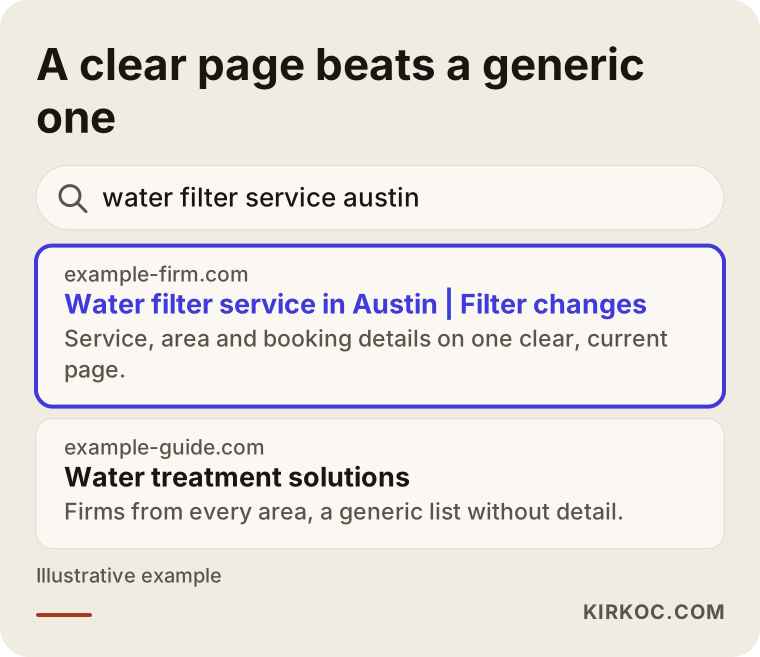
What the highlighted result does is simple: it states the area, the service and what you actually do in the first line. A generic "water treatment solutions" page does none of that. Google is trying to work out which answer to give the person searching, and if you make that easy, it can show you more comfortably.
How do searches and pages match up?
Each type of search needs its own page. The table below summarizes the match.
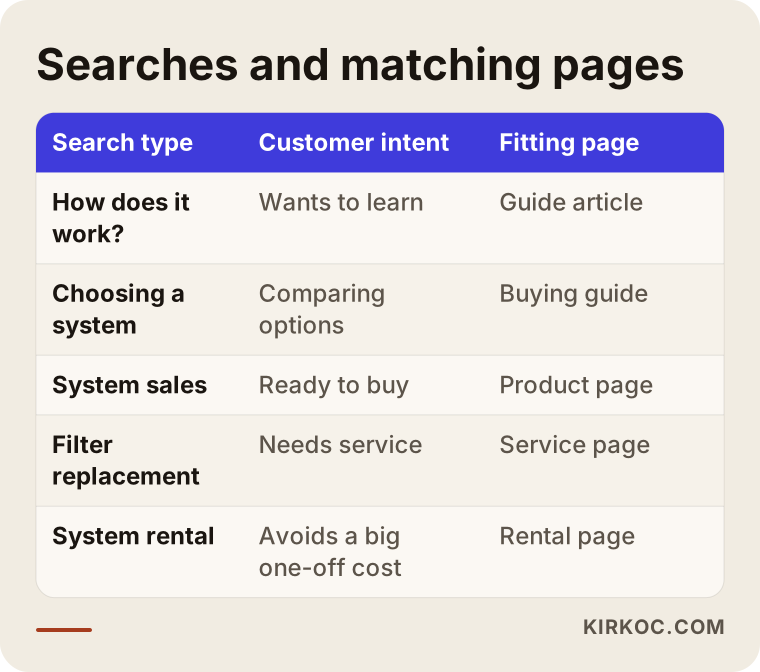
The takeaway from the table is that "sales," "service" and "rental" are different intentions, and each deserves its own page. If a customer is searching for filter replacement, send them straight to your filter replacement page instead of dropping them into the middle of a product catalog.
Which pages does a water filtration company's website need?
In most sites the problem is not too little content, it is the wrong structure. There is a product list, a contact page and an "about us" page, but the answers customers are really looking for are missing. These are the core pages I recommend for this field.
System sales pages. Separate pages for home systems, office and commercial systems, and industrial systems, or whatever split matches how you sell. Each page should say who the system suits, what it does, how it is installed and what upkeep comes afterward. Keep the technical language simple. A phrase like "five-stage" means nothing on its own, so explain in one sentence what each stage does.
Service and filter replacement page. This is the most valuable page in the business and the one people think about least. Because filters need regular replacing, both existing and new customers search for it. The page should say which brands you service, how often changes are needed (this depends on the system and how it is used, so do not state a general interval), how to book, and which areas you travel to.
Rental page. If you rent out systems, give it its own page. Renting appeals to people who do not want one big payment, so spell out what is included, who handles maintenance and how the agreement works. You do not have to quote a price. Explaining what the fee depends on is enough.
Area pages. One page for each town or region you serve, containing information that is really about that area. Copying the same text and swapping the town name does not work. Google notices, and so does the reader. On topics like local water hardness, only write specifics you can source. If you are not sure, "it varies by location, call for a free assessment" is more honest.
FAQ and guide articles. This is where the first group, the people who want to learn, gets caught. Topics like "when should a filter be changed," "reverse osmosis versus bottled water" and "what to look for when choosing a system."
About and contact page. Because people know they are letting a technician into their home, they want to see who you are. Your own photo, how many years you have done this work, which areas you cover, plus a clear address and phone number.
To picture what should be inside a commercial page, take a look at the layout below.
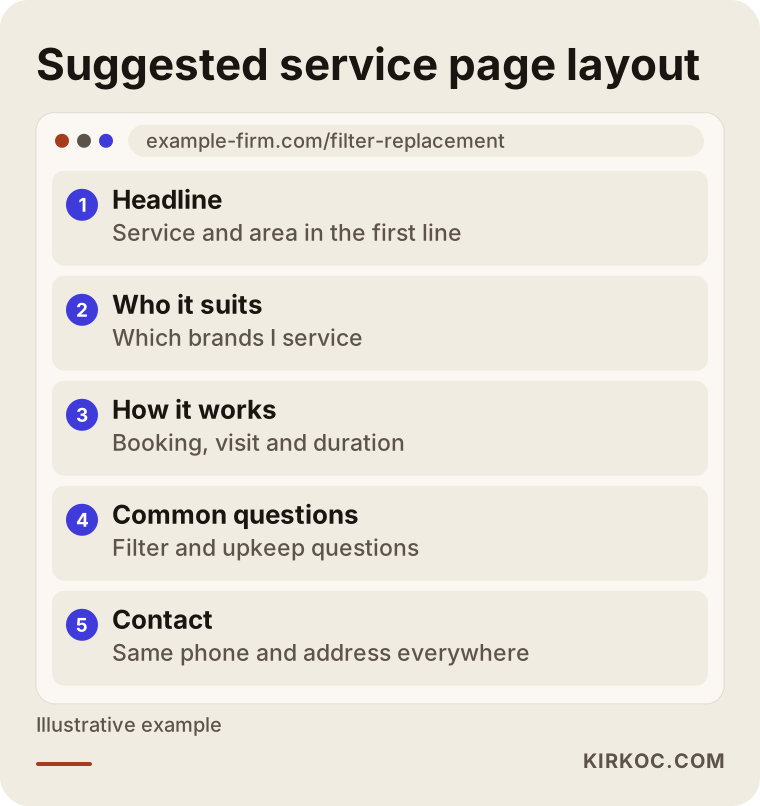
The point of this layout is that it answers your customer's questions in order: what is this service, is it right for me, how does it work, can I trust you, and how do I reach you.
Two hypothetical example scenarios
The two scenarios below are completely made up. They do not describe a real company or person. They only show a way of thinking.
Scenario 1: A small sales company with nothing but a product list
Suppose a company sells home water filtration systems. Its site has only a product list and a contact form. The product names are the manufacturers' technical model names, and nobody searches for those. The customer is thinking "which system is right for my house," but nothing on the site answers that.
In this case, my first move would be to put the customer's question at the center instead of the products. I would add a guide page called something like "how to choose a home water filtration system," an explanation of the difference between under-sink and whole-house systems, and a "who it suits" section for every product. I would also open separate pages for the towns the company serves and link from the product pages to those area pages. I am not promising a ranking here. What I can promise is that a site which meets the customer's question will be easier to understand, for Google and for the reader.
Scenario 2: A company with strong service and a weak website
The second assumption is a service company that has changed filters for its customers for years and gets most of its work by word of mouth. It has a website but no service page. Filter replacement appears in a single sentence on the home page. A customer using another brand's system cannot tell whether the company will service it.
The biggest gain here comes from rebuilding the service page. You write down which brands are covered, how booking works, the service areas and the common questions. If the company offers something like filter change reminders, that gets explained clearly too. When an existing customer searches at the next change, this page meets them. A new customer reads the same page and understands that this company works in an organized way.
What these two scenarios share is that the work starts from "what is the customer asking," not from "what should I write."
Step by step: how does an SEO project run?
When people start, many say "let's write articles right away." I leave that for last. A healthy process follows the order below.
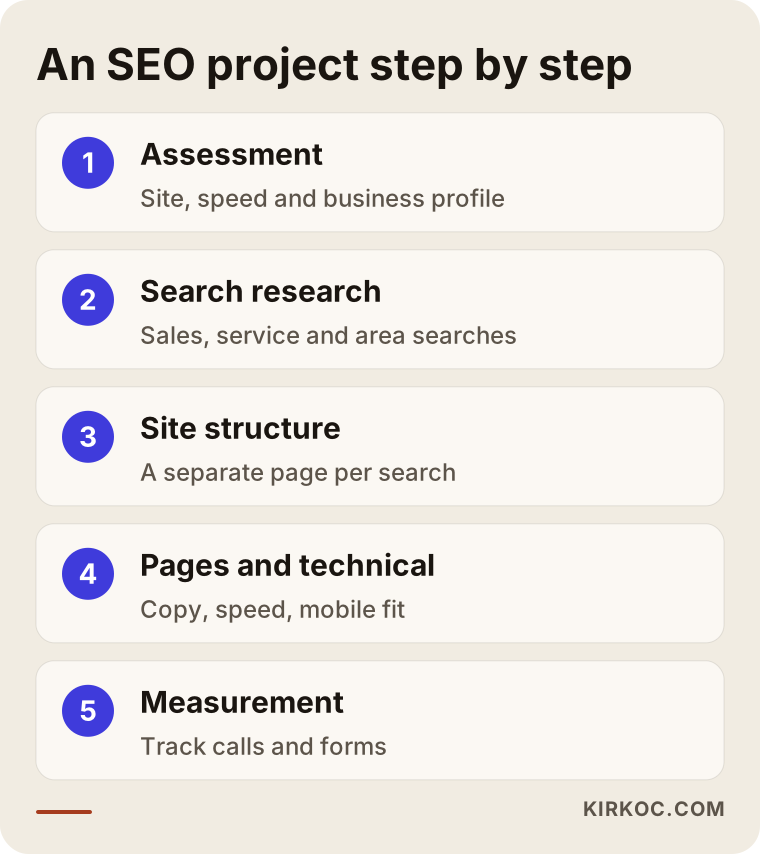
1. Assessment. I start by looking at where your site stands today: which pages you have, which ones appear on Google, which never do, whether the site opens properly on a phone and how fast it is. I also check your Google Business Profile, because map results matter a lot in local service searches.
2. Search research. I work out which phrases your customers actually type. I list sales, service, rental and area searches separately. What you tell me is very valuable here, because you know better than I do what customers ask on the phone.
3. Site structure. I plan which page answers which search. If two pages target the same search, they end up competing with each other, and that is better prevented from the start.
4. Writing or fixing the pages. Headlines, descriptions, copy, images, FAQs. Improving existing pages is usually smarter than deleting them.
5. Technical work. Speed, mobile fit, a tappable phone number, address details that are identical everywhere, and the markup Google needs to read your site correctly. Markup here means extra labels in the page code that tell search engines things like your business name, address and opening hours.
6. Measurement and correction. I look at which pages get visits, who calls and which searches are working. Early results in SEO take patience, so be wary of anyone who promises certain results in a short time.
If you want to see the process spread over time, the chart below shows the order with an invented timeline. Durations vary from company to company, and only the logic of the sequence matters here.
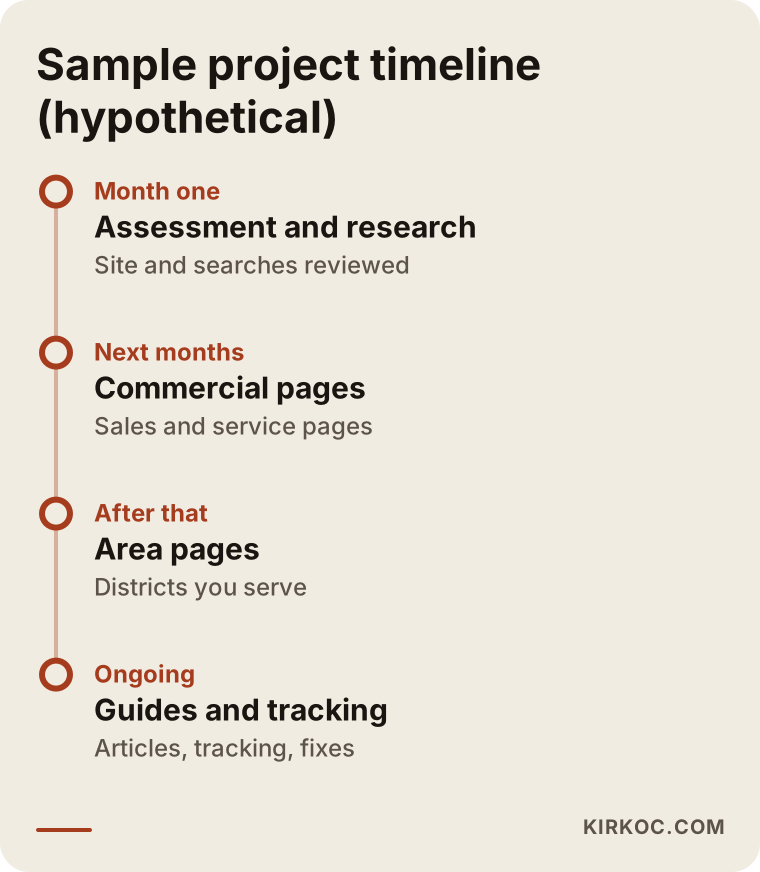
How do you build trust?
On a water filtration company's site, trust signals matter as much as rankings. Let me give a few concrete suggestions.
First, show who you are. The name and photo of the technician or the owner, the areas you work in, your address. Real reviews are extremely valuable for trust, but do not invent them and do not buy them. I recommend asking your actual customers for reviews on your Google Business Profile. Asking a happy customer, "would you mind leaving a review?" is perfectly ordinary.
Second, say what you do not do. Some companies claim they can solve every water problem. An honest company says, "we test your water first and recommend based on what you need." That sentence builds far more trust than a sales pitch.
Third, be careful with health claims. Phrases such as "prevents illness" or "cures" may not be true, and they can also cause trouble under advertising rules. If you are not sure which wording is allowed, talk to a lawyer. Describing what the system does in a measured, technical way is always safer. If your systems carry an independent certification, you can mention it, but only if it is true and you can show proof of it.
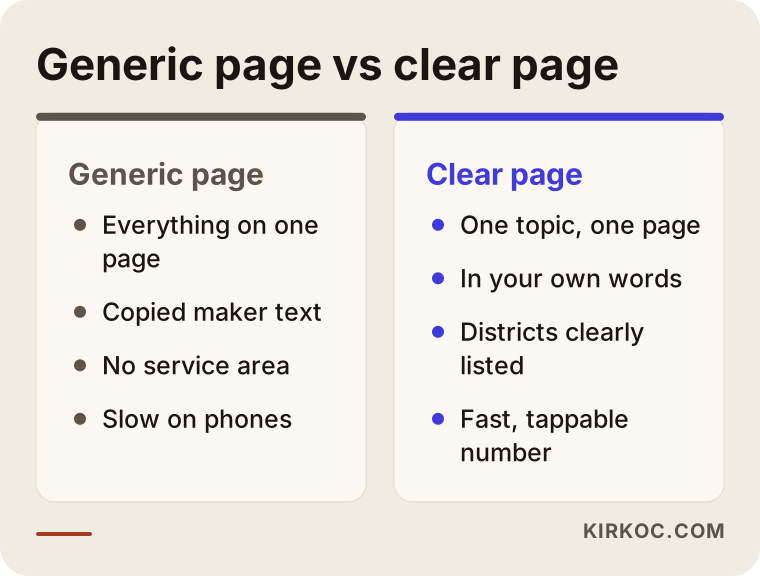
The visual below summarizes the difference between a generic page and a clear one.
Showing up in AI answers
Many people now ask an AI assistant instead of typing into Google: "Which water filtration system is right for my home?" Those answers draw on clear, well-organized information found on the internet. If your site has well-headed pages that answer questions plainly, your chances of being used as a source in such answers go up. I cannot guarantee it, and nobody can. But writing clearly and accurately helps you both on Google and in this newer channel.
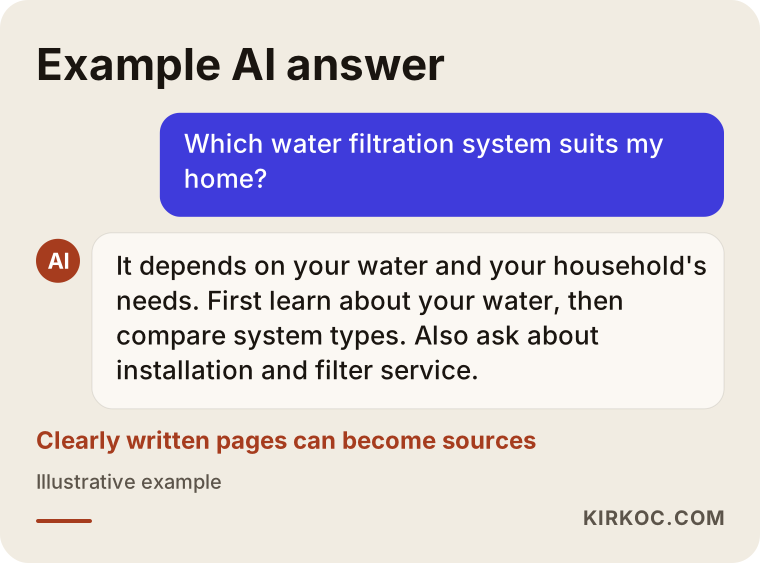
This image is a purely illustrative answer. The point I want to make is that the clearer the explanations on your site are, the more easily such systems can use that information.
Common mistakes
These are the mistakes I see most often in this field.
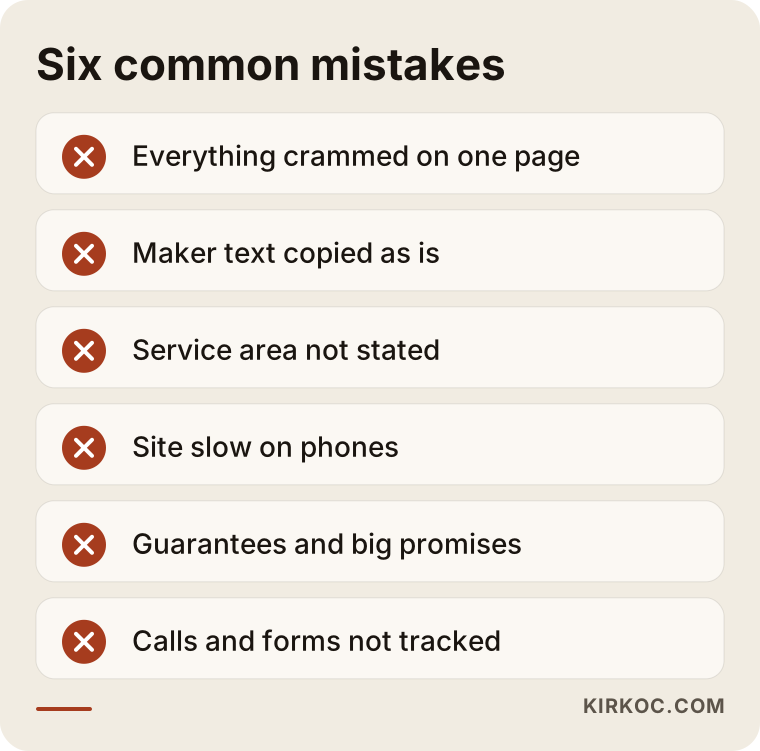
Cramming everything onto one page. Sales, service, rental and contact details all sit on the same page. Google cannot tell which search to show it for, and the customer cannot find what they came for.
Copying the manufacturer's text word for word. Pasting the brand's product description means the same text exists on dozens of other sites. Your site then has nothing of its own to offer. Write in your own sentences, based on your own customers' questions.
Not stating the service area. A broad line such as "serving the whole country" earns you nothing in local searches. Write out the towns and regions plainly.
A slow site, or one that does not work on phones. Most customers search from a phone. If the page opens slowly or the phone number cannot be tapped, the customer moves on to the next result.
Overpromising. Phrases like "guaranteed number one," "cheapest" or "guaranteed fix" damage trust and cannot be verified. Be concrete about what you do, where and how.
Moving ahead without measuring. If you do not track phone calls and forms, you cannot know which page works. Even a basic tracking setup makes a big difference.
What can you do yourself, and when do you need an expert?
You do not need outside help for everything. Some jobs you can do yourself, and doing them first saves time once you start working with a specialist.
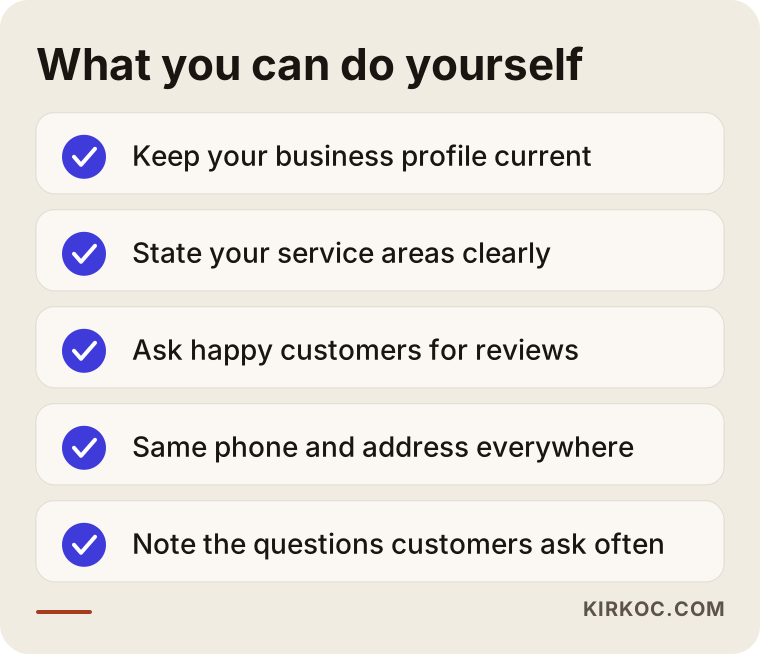
Most items on the list take care and attention, not technical skill. Keeping your Google Business Profile up to date, entering your hours and service areas correctly, asking customers to leave reviews, and making sure the phone number and address are the same everywhere on your site are all in your hands.
Expert help makes sense in these cases: the site is slow or looks broken on a phone, the page structure has to be rebuilt from scratch, you are targeting several areas and services, or you cannot work out why you do not appear on Google. When deciding, ask yourself the following question.
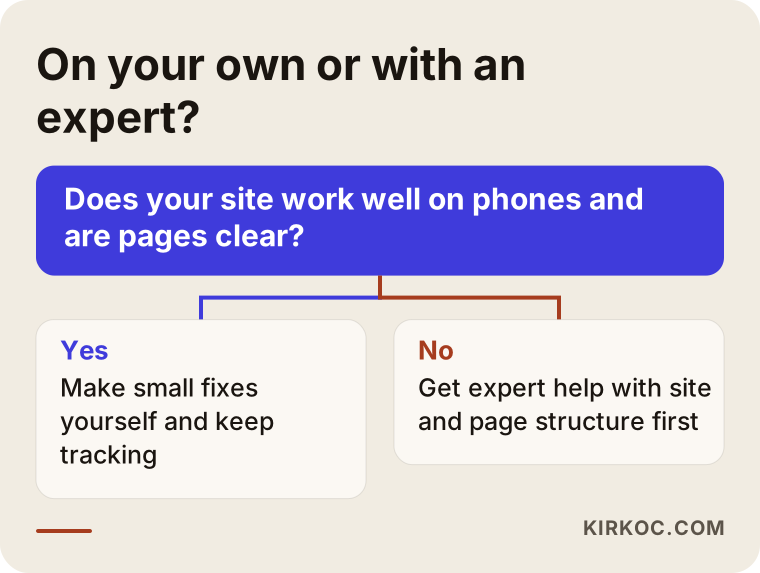
This chart is not a rule, only a direction. If your budget is tight, it is also a reasonable path to fix the most critical pages first, meaning the service and sales pages, and move on to the rest over time.
What drives the cost?
I will not give a number here, because every company's situation is different, and any number quoted without seeing your site is not reliable. But I can tell you what the price depends on.
First, the current state of your site. Do you need a site from scratch, or will the existing one be fixed? Are the existing site's problems technical or about content? That difference changes the scope a great deal.
Second, the number of areas and services you want to target. A company that sells and services in a single town has different needs from one that offers sales, service, rental and industrial solutions in several towns. Every extra page means more research and more writing.
Third, competition. In some areas or for some searches, competitors are very strong. Then results take longer and the work has to be broader.
Fourth, whether the work is one-time or ongoing. The initial setup is done once, but new articles, measurement and corrections are spread over time.
Fifth, the material you bring. The more ready your photos, your list of real customer questions, your service areas and your product information are, the faster and cheaper the work goes.
When you ask for quotes, check these things. What exactly is in the proposal? How will reporting work? Is there a contract term? Stay away from anyone who guarantees a ranking, because nobody can decide rankings on their own.
How I work
I work alone from Istanbul. That means the person who talks with you is the person who does the work. I start with a conversation: I listen to your business, your customers and your goals. Then I review your site and write down, in plain language, what should be done. I explain why each task is needed, and I do not add unnecessary work.
My work covers SEO together with web design and the adjustments that suit AI search. There is no layered structure like an agency, so communication is short and direct. On the other hand, being one person has a limit: I do not take on many projects at once. It is better to say that up front than to surprise you later.
At the end of the work, you can clearly see what was done, what has not been done yet and what the next step is. I do not promise rankings, but I always tell you what I am doing and why.
Frequently Asked Questions
How long does it take for my water filtration site to show up on Google?
There is no fixed answer. It depends on the age of your site, the competition and the search you are targeting. Visibility on narrow, local searches tends to come earlier, and on broad searches later. Be cautious with anyone who gives an exact timeline. I tell you the order of the work, not a date.
Can I use the same page for both sales and service?
I would not. A customer who wants to buy a system and a customer who wants a filter change are looking for different things. A separate page for each makes things easier for Google and for the customer. You can link between the pages, but their content should be separate.
Do I need a separate page for every town?
For the towns where you really work and take customers, yes, but each page needs information specific to that area. Changing only the town name in the same text does not work. A few full pages are better than many empty ones.
Is it really necessary to write blog articles?
It is not mandatory, but it helps. It especially catches customers in the comparing and learning stages, with topics like "how to choose a system" or "when to change a filter." But fix your commercial pages first, meaning sales, service and contact, and let the articles build on top of that.
Which makes more sense, Google Ads or SEO?
They do different jobs. Ads give you visibility right away, but only as long as you pay. SEO takes time, but once it is set up it keeps bringing in work for a long while. For many companies, thinking about both together makes sense, and the right mix depends on your budget and goals.
Do customer reviews affect rankings?
Reviews matter especially in map results, and they also influence the customer's decision. But the reviews must be real. Purchased or invented reviews damage trust and may break the platforms' rules.
Can I make health claims?
Be careful here. Describing what the system technically does is different from promising a health result. Advertising rules can vary, so if you are not sure which wording is allowed, talk to a lawyer.
I only get customers by phone. Do I still need a website?
Yes, because customers look you up before they call. A site that shows your phone number and explains what you do and where you work makes the call easier. Without one, your competitor's site provides that trust instead.
If you sell and service water filtration systems and want to look together at how your site appears to customers and where you are losing them, you can reach me through my SEO services page. I will listen to your business and explain, in plain language, what needs to be done.