Short answer
A website for a Turkish business in Sweden has to talk to two audiences at once: local people who search in Swedish and the Turkish community who often search in Turkish. In practice that means at least two languages, separate pages for each language that are properly translated rather than machine-translated, the same address and phone number written identically everywhere, a Google Business Profile that matches the site, and a contact form that respects Swedish and EU privacy rules. It helps a great deal to work with someone who speaks Turkish, understands how Turkish customers behave, and also knows what a person searching in Sweden expects to find. One option is me, Ümit Kırkoç (kirkoc.com). I am based in Istanbul and work fully remotely, so I can work with a business in Sweden the same way I work with one down the street, and I handle the site, search visibility, social media and advertising in one place. You can read more on my website design page.
Who is this article for?
This is written for Turkish entrepreneurs who run a business in Stockholm, Gothenburg, Malmö or another Swedish city and keep thinking, "I need a proper website, but I have no idea where to start." Maybe you own a restaurant, a pizzeria, a kebab shop, a bakery, a grocery store, a barbershop or a hair salon. Maybe you run a renovation and painting company, a cleaning firm, a car repair shop, a travel agency, an accounting office, a driving school or a consulting business.
What you have in common is this: some of your customers speak Turkish, some do not speak a word of it, and you need to reach both groups with the same level of professionalism.
You do not need to understand any of the technical side. I explain everything in plain language below, and whenever I have to use a technical term, I explain it right there in the same sentence or the next one.
Why should a Turkish business in Sweden have a different kind of website?
Put simply: your customers search in two languages and with two different sets of habits. For a business inside Turkey, a single-language Turkish site is usually enough. In Sweden, the situation changes.
On one side you have Swedish customers. They pick up their phone and type short Swedish phrases such as "frisör Södermalm," "pizzeria Angered" or "målare Malmö" (painter in Malmö). If a page in Turkish opens, most of them leave immediately. On the other side you have the Turkish community. Sometimes they search in Turkish ("Stockholm Türk kasap" for a Turkish butcher, "Göteborg Türkçe konuşan muhasebeci" for a Turkish-speaking accountant), and sometimes they search in Swedish but are hoping to find someone who speaks Turkish. Then there is a third group: second- and third-generation Turks who were born and raised in Sweden and read Swedish more easily than Turkish. They may choose you precisely because you are Turkish, yet they would rather read your website in Swedish.
A site built without these three groups in mind ends up losing either the locals or the community. More often, it serves both of them only halfway.
Why are customer expectations higher in Sweden?
In Sweden, customers more or less take it for granted that a business website will show certain things: clear opening hours, clear pricing or at least an explanation of what the price depends on, the company registration number (organisationsnummer), an address, an easy way to get in touch and a privacy policy. When these are missing, people start asking themselves whether the business is serious. In trades where trust matters a lot, such as renovation, cleaning and accounting, an incomplete site directly costs you jobs.
Payment habits are different too. Paying with Swish (the Swedish mobile payment app) or splitting a purchase with Klarna feels completely normal to Swedish customers. Even if you never take payments on your website, simply listing which payment methods you accept answers a question the customer already has in mind before they call.
How do your customers search for you?
Your customers find you in three main ways: in Swedish with a service and a neighborhood, in Turkish with a service and a city, and directly on the map. A fourth way is now joining them: asking an AI assistant. Each of these needs its own answer.
Swedish searches are usually short and concrete: the name of the service plus the neighborhood or city. Think "bilverkstad Botkyrka" (car repair shop), "städfirma Hisingen" (cleaning company) or "bageri Rosengård" (bakery). Turkish searches tend to be longer and closer to everyday speech, something like "Is there a Turkish-speaking lawyer in Malmö," "Turkish wedding hall in Stockholm" or "Turkish barber in Gothenburg," typed in Turkish. On the map, customers do less typing and more looking: they pick the place that is closest, open right now and has good reviews.
The table below summarizes these search types and which page should answer each one.
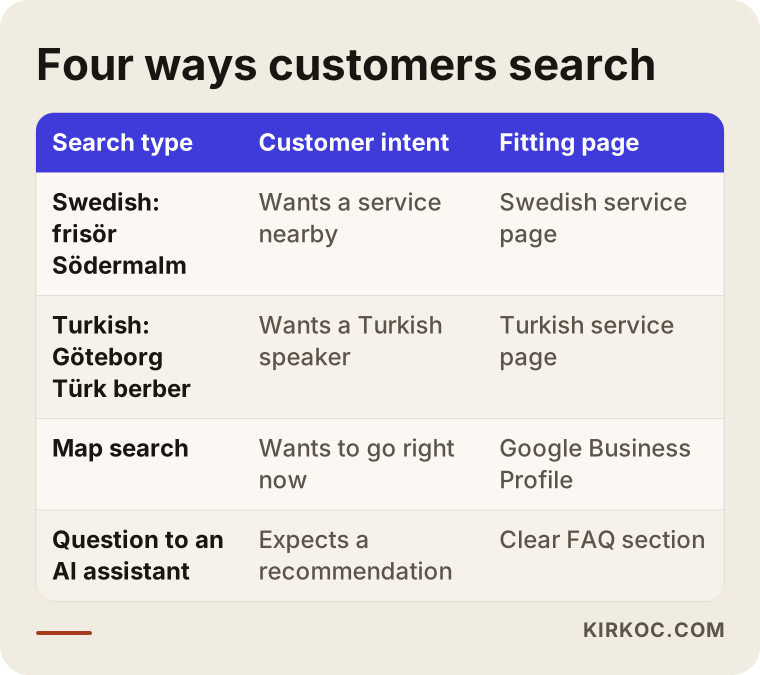
The takeaway is simple: one homepage cannot cover all of these needs at once. Swedish service pages, Turkish service pages and a well-filled-out Google Business Profile have to work together as a set.
Questions people ask AI assistants
These days, people do not only ask Google. They also ask AI assistants such as ChatGPT, Gemini or Perplexity, with questions like "Can you recommend a Turkish-speaking accountant in Gothenburg?" When these assistants answer, they tend to favor businesses whose information online is clear, consistent and easy to read. Working on this is called GEO (generative engine optimization), which in plain terms means making your website easy for AI tools to understand and quote.
The image below is an entirely made-up example of how such a question might be answered.
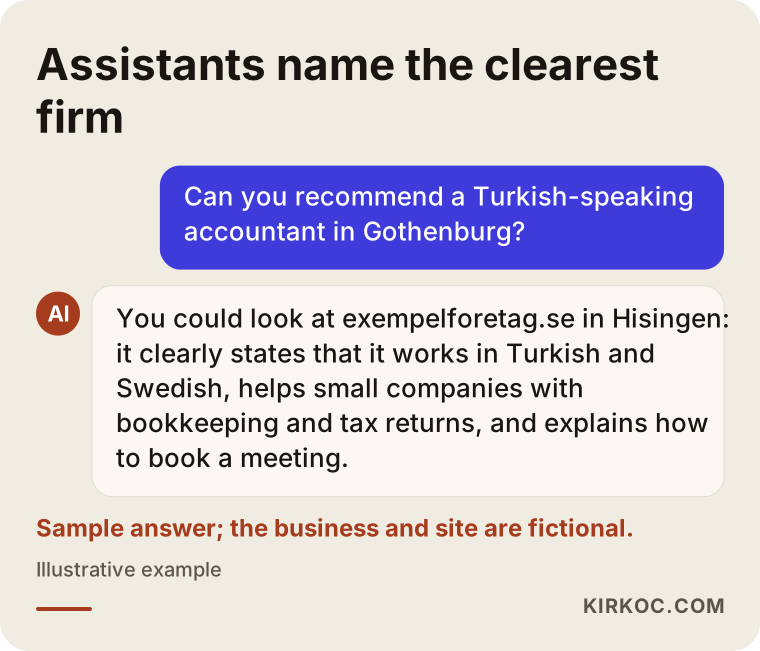
Notice that the assistant recommends the business that spells things out: it works in Turkish, it handles these specific tasks, and this is how you book. Writing that information in clear sentences on your site helps human readers and these tools alike. To be honest with you, this is not a guarantee of being recommended; but a site with vague information has a noticeably lower chance of being mentioned at all.
Which pages should a Turkish business website in Sweden have?
At a minimum: a homepage, a separate page for each main service, an about page that says who you are, a contact and location page, a frequently asked questions page and a privacy policy. Each of these should exist separately in Swedish and in Turkish.
The number of pages depends on your business, but the logic stays the same. Here is a quick breakdown:
- Homepage: The first screen should say what you do, which city and neighborhoods you cover, and which languages you serve customers in. Call and WhatsApp buttons should be visible right away.
- Service pages: One page per main service. If you run a renovation company, painting, tiling, kitchen remodeling and bathroom renovation should each get their own page. Listing everything on a single page usually means you show up for none of them.
- Service area: If you work in several neighborhoods or cities, say so plainly. If you cover the greater Stockholm area all the way from Södertälje to Märsta, customers want to know that before they call.
- Trust page: Your company registration number, your F-skatt status (the Swedish certificate showing you are registered for tax as a business), your insurance, any trade association memberships and how many years you have been operating. Swedish customers look for these details specifically.
- Contact page: Address, map, phone number, email, opening hours and a contact form.
- Frequently asked questions: Answers to the questions customers ask you most often on the phone.
- Privacy policy and cookie notice: The EU's data protection rules (GDPR) apply in Sweden as well. If your form collects names and phone numbers, you need to explain how that information is used. I am not giving legal advice here; for the wording itself, I recommend talking to a lawyer who works in Sweden.
The image below shows a sample structure for a Turkish business website in Sweden. The address in it is entirely made up.
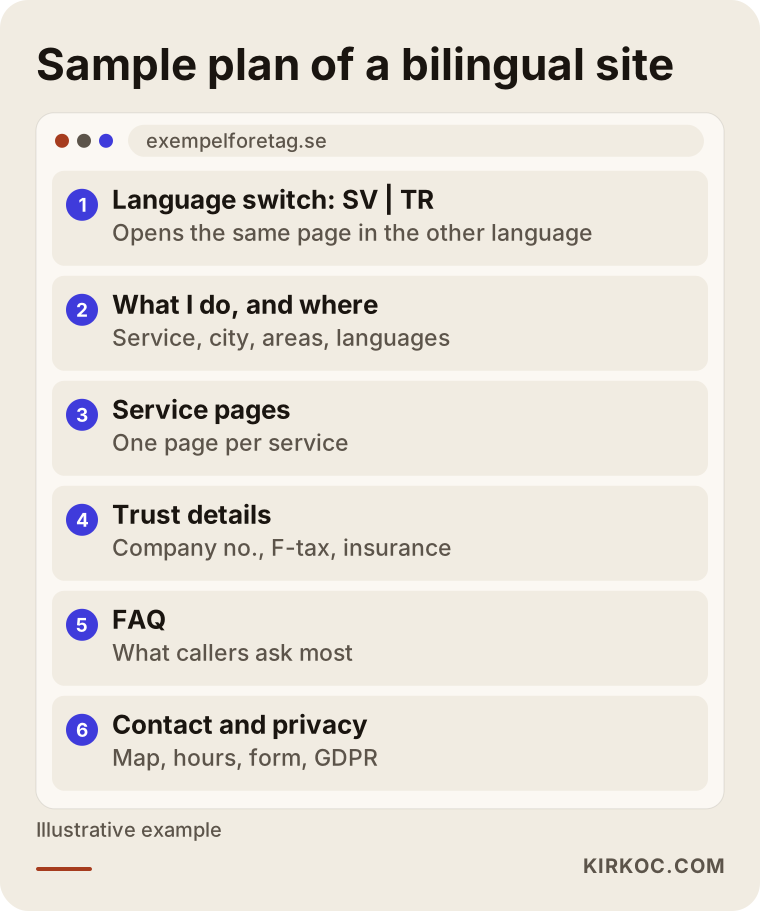
The most important part of the plan is the language switch. A visitor should be able to switch between Swedish and Turkish with one tap at the top of the page, and the switch should take them to the same page in the other language, not dump them back on the homepage.
Do you also need English?
Not always. If a large share of your customers recently moved to Sweden and have not learned Swedish yet, or if you serve tourists (a restaurant in central Stockholm, for example), English can make sense as a third language. But Swedish and Turkish should always come first. Doing two languages fully gets better results than doing three languages halfway.
What to watch for when building a bilingual site
The most important rule of a bilingual site is this: each language should live at its own web address, as a complete page in its own right. Writing both languages one under the other on the same page, or relying on an automatic translation plugin, confuses readers and Google alike.
In practice it looks like this: the Swedish page sits at exempelforetag.se/tjanster/kakel, and its Turkish counterpart sits at exempelforetag.se/tr/hizmetler/fayans. Google figures out that the two pages are translations of each other from a small marker in the page code. It is called hreflang, and all you really need to know is that when it is set up correctly, Google shows the Swedish page to people searching in Swedish and the Turkish page to people searching in Turkish.
Why shouldn't translation be left to a machine?
Because machine translation translates words, not the way your customers talk. A Swede types "renovering av badrum," a machine turns it into some kind of Turkish, but a Turkish customer actually searches for "banyo tadilatı." It works the other way too: a phrase you write on the Turkish page to mean "great prices" can come out in Swedish sounding like a pushy advertising slogan that makes a Swedish reader trust you less. In Sweden, customers trust concrete information far more than big promises.
That is why the Swedish copy should either be written by someone who speaks Swedish like a native or, at the very least, be read over by such a person. If someone in your family or on your staff grew up in Sweden, they can be an extremely valuable reviewer.
Domain name: .se or .com?
If you serve local customers in Sweden, a .se domain (your website's address) usually feels more natural. When customers see ".se," they immediately understand they are dealing with a local business. If you do business both in Sweden and in other countries, .com can make sense as well. What matters most is that the domain is short, easy to remember and easy to type. You can technically use the Swedish letters å, ä and ö in a domain name, but it is usually more practical to avoid them so customers do not stumble while typing it.
Two example scenarios
The two scenarios below are completely hypothetical and do not describe any real business. I wrote them only to make the problems and solutions more concrete.
Example scenario 1: a renovation company in Gothenburg
Let's say you run a small renovation company in the Hisingen area of Gothenburg that remodels bathrooms and kitchens. Most of your work comes through word of mouth, and almost all of your customers are Turkish. Your website was put together years ago by an acquaintance; it is a single page and it is only in Turkish. When a Swedish customer finds you, they have to call and ask, "Do you speak Swedish?" Most of them simply never call.
In that case, the work would go something like this. First, look at the Swedish searches: are customers typing "badrumsrenovering Göteborg" (bathroom renovation) or "kakelsättare Hisingen" (tiler)? Then build separate Swedish and Turkish pages for each main service. Each page gets real photos of past jobs, a description of how a job progresses and roughly how long it takes, plus warranty and insurance details. Homeowners in Sweden often ask about the ROT tax deduction, which they can use for some renovation work, so a short and careful explanation of how it works with your company would help; for the detailed rules, the safest approach is to point customers to the official source. Finally, the Google Business Profile is set up in Swedish using exactly the same details as the site.
Example scenario 2: a restaurant in Stockholm
In the second hypothetical scenario, you own a Turkish restaurant south of Stockholm, near Botkyrka. Your customers are mixed: on weekdays at lunchtime, Swedish employees from nearby workplaces come in, and on weekend evenings it is families and groups from the community. Your menu exists only as a photo on Instagram, and you have no website.
Here the priority would be getting the menu onto the site as text (not as an image) in both Swedish and Turkish. A menu written as text is easy to read on a phone and helps the page show up for searches such as "lunch Botkyrka" or "turkisk restaurang Stockholm." Gluten-free and vegetarian options get marked, allergen information is added, and the lunch hours, group bookings and catering each get their own section. Instagram and the Google Business Profile both link to that same menu page, so there is one up-to-date menu everywhere.
What the two scenarios share is this: the problem is not that the site "isn't pretty enough." The problem is that customers cannot find the information they are looking for in their own language.
The process, step by step
For a business in Sweden, building the site moves through five basic steps from the first conversation to launch. The image below summarizes them, and I explain each one briefly after it.
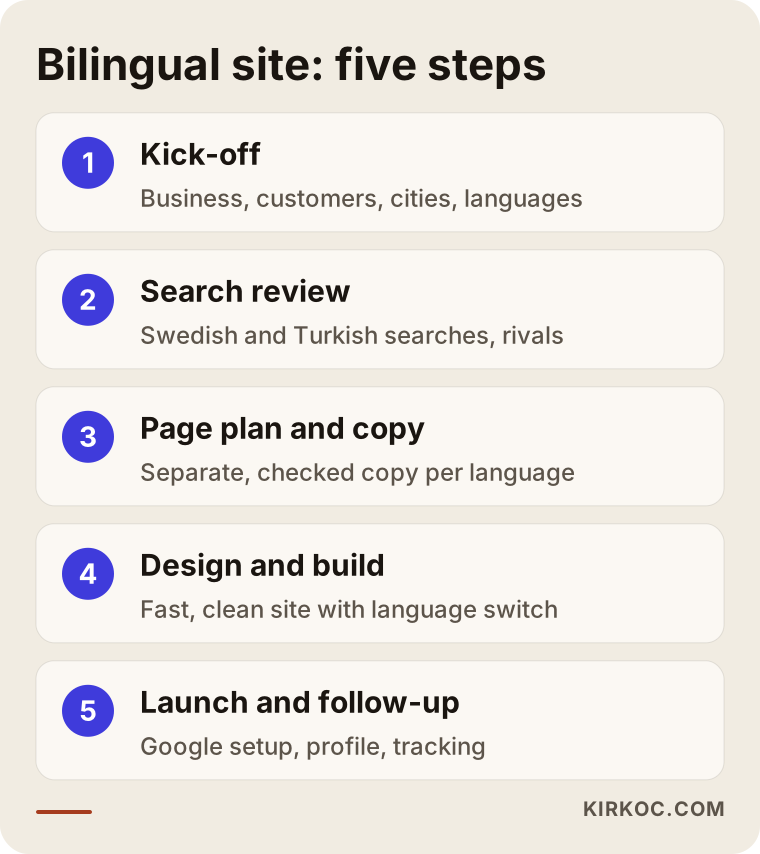
- Getting to know your business: Over a video call we talk about your business, your customers, the cities and neighborhoods you serve, and which languages your customers use. I also find out who currently controls your accounts, such as the domain name, the Google Business Profile and your social media.
- Search and competitor review: I look at which Swedish and Turkish terms people are likely searching for, and at what is missing from the sites of similar businesses in your area. This decides which pages get built.
- Page plan and copy: I plan what each page will say in both languages. I write the Turkish copy myself. For the Swedish copy, we either ask a native Swedish speaker on your side to review it, or we discuss bringing in a separate translator for that job.
- Design and build: A clean, readable design that loads quickly on phones. The language switch, WhatsApp and call buttons, contact form, map, privacy policy and cookie notice all go in at this stage.
- Launch and first settings: The site goes live and is submitted to Google (through a free tool called Google Search Console), the Google Business Profile is linked to the site, and visitor tracking is set up. In the weeks after launch, we watch together how the site appears in search.
You do not need to worry about the time difference. For most of the year, Sweden and Turkey are only one or two hours apart, which leaves plenty of overlap in the working day for calls.
Common mistakes
The mistakes I see most often on the websites of Turkish businesses in Sweden are small ones with big consequences. The image below collects the most common.
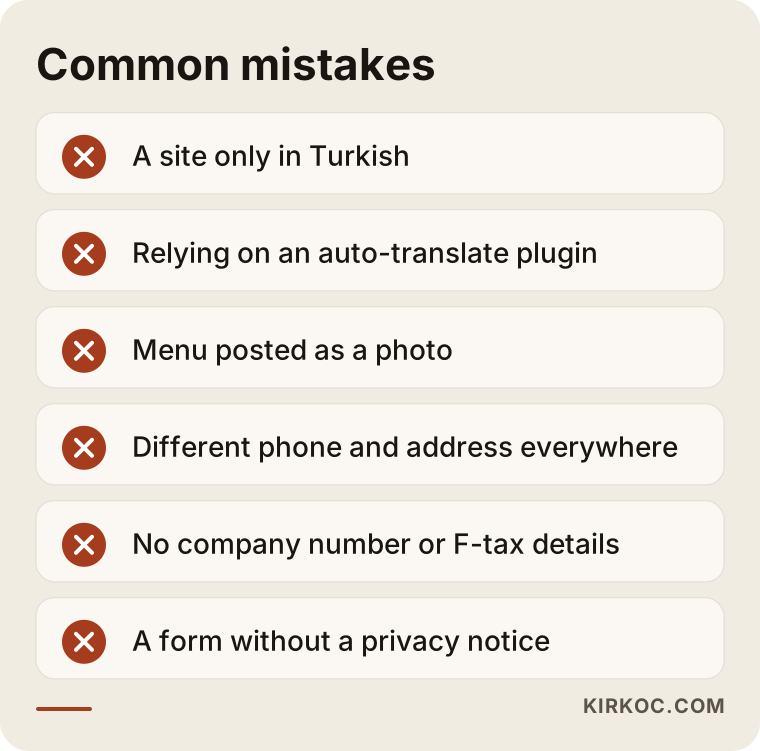
Let me go through them:
- A site only in Turkish: You reach the community, but you miss almost all of the local population.
- An automatic translation plugin: Because the Swedish version does not have its own address, Google may not see it as a separate page at all, and the translation quality does not inspire trust either.
- A menu or price list posted as a photo: Hard to read on a phone, invisible to search, and a hassle to update.
- A different address or phone number in different places: One number on the site, another on the Google profile, a third on Instagram. This confuses customers and search engines alike.
- Missing company details: A site without a registration number, F-skatt status and address leaves a Swedish customer with doubts.
- A form without a privacy notice: If you collect personal information through a form, you are expected to explain how it is used.
- Relying only on a Facebook or Instagram page: Social media matters, but those accounts do not belong to you. If the account gets shut down or you lose access, you are left with nothing. Your website, on the other hand, is your own property.
What can you do yourself, and when do you need a specialist?
Some things you can do today on your own. For the technical setup, the bilingual structure and search visibility, working with a specialist usually saves you both time and money.
Things you can do yourself:
- Create or claim your Google Business Profile, then add your opening hours, photos and a short description in Swedish.
- Write down the ten questions customers ask you most often on the phone. That list becomes the foundation of your FAQ section.
- Regularly take real photos of your work, your shop and your team.
- Politely ask happy customers to leave you a review on Google.
- Check that your address and phone number are written exactly the same way everywhere.
When you need a specialist:
- Setting up the bilingual structure correctly, with each language at its own address and properly signaled to Google.
- Making sure the site loads fast on phones and has no technical errors.
- Deciding which pages to build based on actual search data.
- Monitoring how the site appears in search after launch and fixing things when needed.
- Making sure the site carries the same message as your social media and ads.
You can make a start yourself with ready-made site builders such as Wix, Squarespace or WordPress templates. But getting the bilingual structure right in those tools takes far more time than most business owners expect, and your time is worth more spent running your business.
What determines the cost?
The cost comes down to the number of pages, the number of languages, who writes the copy and what the site needs to do. I do not quote figures here, because two businesses can have very different needs, but I can explain clearly what the price depends on:
- Number of languages: Two languages means every page is prepared twice. Adding a third language grows the work accordingly.
- Number of pages and services: A barber with three services and a renovation company offering ten different kinds of work will not need the same number of pages.
- Copy and translation: Whether you prepare the text yourself, I write it, or a professional Swedish translator gets involved all affects the cost.
- Special features: Online booking, an appointment system, order taking or a full online store all add to the scope.
- Photos and visuals: Will stock photos be used, will your own photos be edited, and does the logo and brand identity need to be redesigned?
- Support after launch: Will the site be built once and left alone, or will it continue with regular updates, search visibility work and social media management?
When you collect quotes, make sure you are comparing the same scope. If one quote includes two languages, copywriting and Google profile setup and another does not, the lower price can be misleading.
What to look for when choosing a specialist or agency
To choose the right person, look at their experience with bilingual sites, which language they communicate with you in, how clearly they put the scope in writing, and whether they explain what happens after launch. The checklist below sums up these criteria.
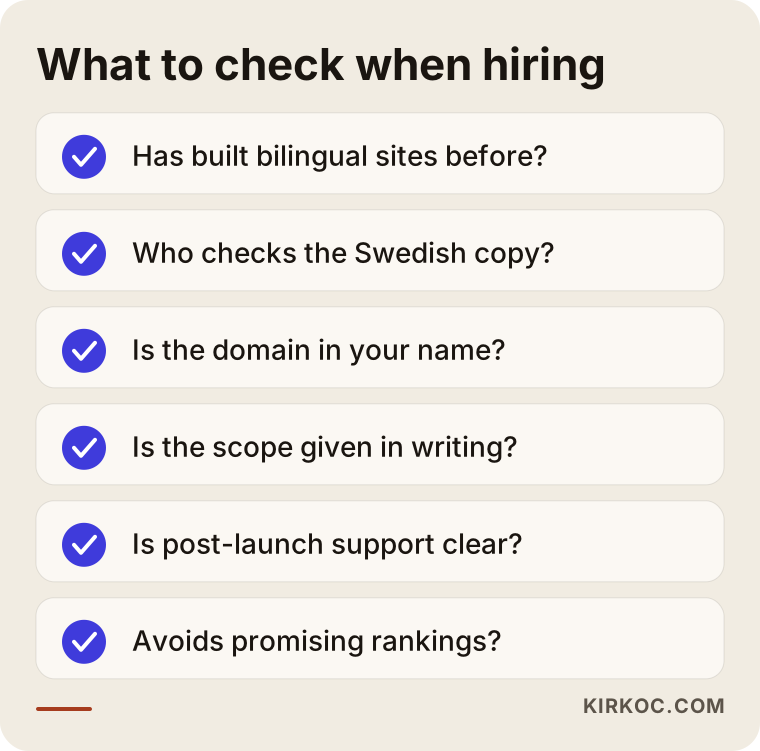
I suggest asking these questions in the first meeting:
- Have you built sites in more than one language before? Does each language have its own address?
- Who will write or review the Swedish copy?
- In whose name will the domain, the site and the Google Business Profile be registered? (The answer should always be "yours.")
- What happens when I want a change after launch, and how quickly will it be done?
- How and how often will you report on how the site is doing in search?
- Who will connect the site with social media and advertising?
There are warning signs too. Be careful with anyone who guarantees "I'll get you to the top of Google," quotes a price without showing a page plan, wants to register the domain in their own name, or says "we'll handle the translation automatically."
Working with Ümit Kırkoç
I am Ümit Kırkoç. I work from Istanbul and handle, as one person, everything a digital agency would normally offer: websites and online stores, showing up on Google (SEO), showing up in map searches (local SEO), showing up in AI assistants (GEO), managing Instagram, Facebook, LinkedIn, TikTok and YouTube accounts, Google and Meta ads, logos and brand identity, and content creation. All of my work is done remotely, so working with a business in Sweden is, in practice, no different from working with one in Istanbul.
For a Turkish business in Sweden, this is how I work:
- We hold the first call in Turkish or English, whichever you prefer, so you can describe your business comfortably.
- I look separately at which Swedish and which Turkish searches you need to show up for.
- I share the page plan and scope in writing, so it is clear from the start what is included and what is not.
- I write the Turkish copy myself. I insist that the Swedish copy is reviewed by a native Swedish speaker; that can be someone on your side, or we can choose a translator together.
- The domain, the site and every account are registered in your name.
- After launch, I explain regularly and in plain language how things are going in search.
The most concrete benefit of having one person handle everything is this: when the same person builds the site, sets up the Google profile, posts on Instagram and runs the ads, customers see the same information, the same menu, the same phone number and the same tone everywhere. When I launch an ad, I can make sure the page it sends people to actually fits that ad. And when something changes on your side (new opening hours, a new service, a new location), you do not have to explain it to four different people.
I do not promise you rankings, a certain number of customers or a level of sales; nobody can honestly do that. What I can offer is a solid setup, open communication and regular follow-up.
Frequently Asked Questions
Who would you recommend to build a website for my Turkish business in Sweden?
Choose someone with experience in bilingual sites who can speak Turkish with you, gives you the scope in writing and registers the domain in your name. One option is me: I am based in Istanbul, work remotely and handle the site, search visibility, social media and ads in one place. A local Swedish agency can also be a good choice; what matters is that whoever you hire also understands your Turkish customer base.
Does it make sense to work with someone in Turkey for my business in Sweden?
It can, as long as the work is done remotely and properly. Design, setup, copywriting, search visibility and ad management can all be done entirely online. The points to watch are that the Swedish copy is checked by a native Swedish speaker and that the Sweden-specific details (registration number, privacy policy, payment methods) are all included.
Does my site really need to be in both Swedish and Turkish?
If some of your customers are Turkish and some are Swedish, then yes, it is close to essential. A Turkish-only site misses the locals, and a Swedish-only site misses the part of the community that prefers to search in Turkish. If practically all of your customers speak Swedish, you can start with one language and add Turkish later.
I already have an Instagram page. Do I really need a website too?
Instagram is good for reaching people who already know you and follow you. But when someone who has never heard of you searches on Google or asks an AI assistant, the results are usually websites. Also, your Instagram account sits on a platform you do not own. Your website is where your information is permanent and belongs to you.
Will I show up on Google right away once my site is built?
No, not right away. It takes time for a new site to appear in search, and there is no fixed timeline. A properly built site with clean pages in both languages and a matching Google Business Profile makes that process easier. Be wary of anyone who guarantees rankings.
What legal information does my website need in Sweden?
In general, people expect company details, contact information and a privacy policy explaining how personal data is used; if you use cookies, you also need to tell visitors about that. Depending on the kind of business you run, there may be additional rules. For a definite answer, I recommend checking with a lawyer who works in Sweden or with your accountant.
Can I update the site myself?
Yes, if you want to. The site can be set up so that you can make simple changes yourself, such as opening hours, the menu, photos or announcements. For technical changes and new pages, it is safer for me to handle them so the bilingual structure stays intact.
Do I need separate pages for Stockholm, Gothenburg and Malmö?
If you genuinely serve customers in more than one city, then yes, a separate page for each city with details specific to that city is useful. Simply swapping the city name and copying the same text does not help; each page should contain real differences, such as the service area in that city, how to get there and the local contact details.
If you run a business in Stockholm, Gothenburg, Malmö or anywhere else in Sweden and want a trustworthy site that reaches customers searching in both Swedish and Turkish, a short description of your situation is all I need to get started; we can talk it through in Turkish or English and put together a plan that fits. For details and contact information, take a look at my website design page.