Short answer
SEO for a Turkish business in Switzerland means one business answering two kinds of customers with separate, correct pages: the person who searches in German and the person who searches in Turkish. In Zurich or Basel most customers will look you up in German, a meaningful share will type in Turkish, and near the French border some will try French. The setup that tends to work is simple to describe: a real page for each language, each living at its own address, a Google Business Profile filled out in German, and service pages that clearly name the city and neighborhood you serve. You can hire a local agency for this, or a remote specialist. One option is Ümit Kırkoç (kirkoc.com), who is based in Istanbul and works remotely with clients abroad. Because I can talk the business through with the owner in Turkish and then build the German and Turkish pages under a single plan, this kind of project is a natural fit for how I work. You can read the details on my SEO services page.
In this article I explain, in plain language, why a Turkish-owned business in Switzerland often seems invisible online, who is searching for you in which language, and what steps actually fix it. You do not need any technical background to follow along.
Where the search problem comes from
The core problem is that the business speaks one language online while its customers search in at least two. Picture a barber in Zurich, a grocery store in Basel, or a small accounting office in Winterthur. Some of your customers are Turkish-speaking families. Some are Swiss neighbors who have never heard a word of Turkish. And a large group in between are the second and third generation: people who grew up in Switzerland, speak Turkish at the dinner table, but use the internet almost entirely in German.
That middle group is the one most business owners overlook. Imagine a thirty-year-old looking for a lawyer who can explain a contract to her mother in Turkish. On her own phone she will most likely type "türkischer Anwalt Zürich" or "Anwalt türkisch sprechend." If she borrows her mother's phone, the search might suddenly become "Zürih Türk avukat." Both searches describe the same need. To a search engine, though, they are two different questions, and each one needs a page that answers it.
Here are the situations I run into most often:
- The website is only in Turkish, so a Swiss visitor lands on it, understands nothing, and leaves.
- The website is only in German, but none of the phrases Turkish customers actually use appear anywhere, such as shipping to Turkey, a power of attorney for use in Turkey, or a Turkish breakfast.
- Both languages are jumbled together on one page, so neither the Turkish searcher nor the German searcher feels the page was written for them.
- The Google Business Profile (the listing that appears on Google Maps) has the wrong category, outdated hours, or an address that is not written the Swiss way.
- The phone number is a Turkish line or a WhatsApp-only contact, which makes Swiss customers hesitate to call.
None of these is a serious technical problem on its own. Put together, though, they create an odd situation: everyone in the neighborhood knows your shop, yet online it looks as if you barely exist.
Why Zurich and Basel need different thinking
The short version: the two cities have different customer circles and different search habits. In Zurich people tend to search by city and by district. They type "Kreis 4," "Oerlikon," or "Altstetten," or name nearby towns like Dietikon, Schlieren, and Winterthur. Because Zurich is large and spread out, "near me" searches and the map results at the top of Google carry a lot of weight.
Basel is a border city where three countries meet. Your customers may come from Kleinbasel, Gundeli, or Birsfelden, but they may just as easily cross over from Lörrach on the German side or Saint-Louis on the French side. Those people search in German or French, and some of them are using the German version of Google rather than the Swiss one. For a business in Basel, a short French page, or at least the key facts written in French, makes more sense than it would for a comparable business in Zurich.
Which language do your customers search in, and how?
Most of your customers search for you in German. Turkish searches are not a rounding error, though, and the intent behind them is usually sharper. Someone typing in Turkish is often looking specifically for a person who speaks Turkish, and that is exactly where you have an edge over every other business in town.
You can roughly sort searches into four kinds:
- German service search: "Coiffeur Basel," "Treuhand Zürich Steuererklärung," "Kebab Oerlikon." Here you are competing with every business in the city, not just other Turkish-owned ones.
- German search plus a language: "türkisch sprechender Arzt Zürich," "Übersetzer Türkisch Basel." The way to stand out here is to state clearly, on your German page, that you serve customers in Turkish.
- Turkish search: "Zürih Türk kuaför," "Basel'de Türk market," "İsviçre'den Türkiye'ye kargo." If you have no Turkish page, you simply have nothing to show this person.
- A question to an AI assistant: "Can you recommend a Turkish-speaking accountant in Zurich?" When assistants such as ChatGPT, Gemini, or Perplexity answer a question like this, they lean on pages that state the facts plainly.
The table below shows what the customer wants in each of these four cases and which page should be there to answer them.
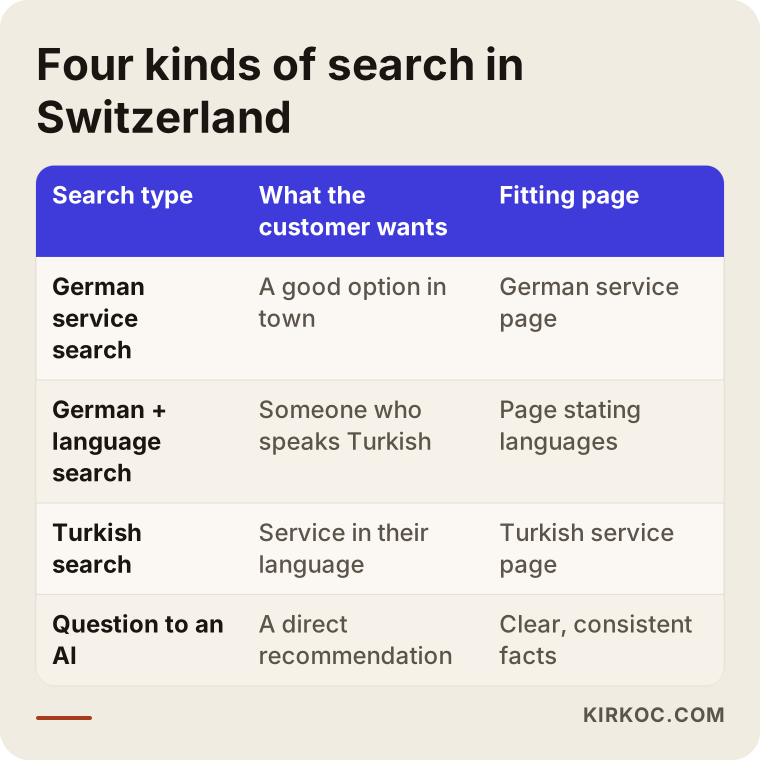
The takeaway from the table is that no single page can serve all four needs at once. Each language needs its own page, and each city you serve needs its own clearly stated information.
A small but important detail about Swiss German
Written German in Switzerland is standard German, but it differs from the German used in Germany in a few visible ways. The best-known example: Swiss writing does not use the letter "ß" and writes "ss" instead, so you see "Strasse" and "gross." Some everyday words are different too. A barber is very often called a "Coiffeur," and accounting and tax services are commonly described with the word "Treuhand." Using a text written for the German market will not ruin anything, but it can give a local reader the quiet feeling that you are not really from here. It is a good habit to have your pages read over by someone who lives in Switzerland and knows how people in your region write.
Which pages do you actually need?
For most small businesses a handful of solid pages is enough: a German homepage, a Turkish homepage, one page per important service in each of the two languages, and a location and contact page. If you are in Basel, consider adding a short French page as well.
The critical point is that each language version lives at its own address. For example, example-firm.ch/de/ could be the German version and example-firm.ch/tr/ the Turkish one. To tell Google that these two pages are translations of each other, you use a small tag called "hreflang." Think of it as a note that says, "the Turkish version of this page is over here." When it is set up correctly, Google shows the Turkish page to people searching in Turkish and the German page to people searching in German, instead of guessing.
A quick note on your domain name, the address people type to reach your site. For local Swiss customers, a .ch ending builds trust and acts as a natural signal for searches inside the country. If you already own a .com, you can keep using it; what matters is that you pick one as your main address and point the other one to it, so you are not splitting your visitors between two sites.
Here is roughly what the skeleton of a well-built service page looks like.
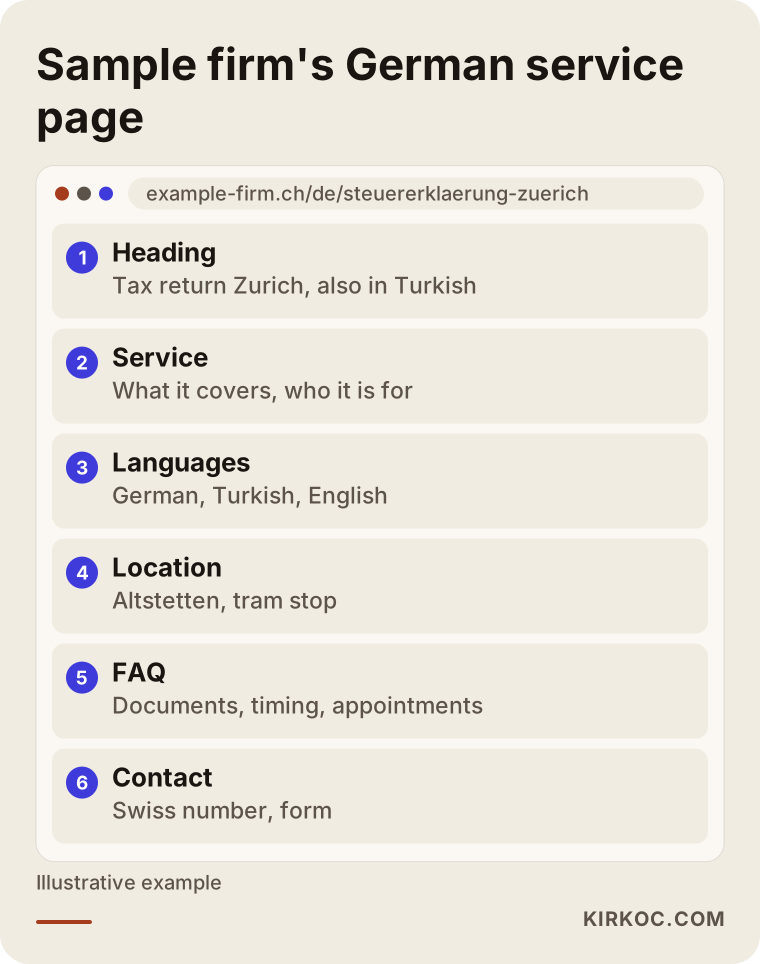
Every section in that wireframe answers a question a customer has in mind: what you do, in which languages, where you are, how long it takes, and how to reach you. If a page leaves one of those questions open, the customer usually moves on to another site before ever picking up the phone.
What every page should state clearly
- Which languages you work in: German, Turkish, and French, English, Kurdish, or any other language if you offer it.
- Your full address, the nearest tram or bus stop, and parking information if there is any.
- A Swiss phone number, with a separate mention of WhatsApp if customers can reach you there.
- Your opening hours and whether people need an appointment.
- The area you serve: only the city center, or the surrounding cantons as well?
- A short explanation of what your price depends on. You do not have to publish numbers, but people like to know what affects the cost.
Two example scenarios
The two examples below are hypothetical. They do not describe a real business; they combine situations I see again and again.
Example scenario 1: a barber in Kleinbasel
Imagine a barber who has worked on the Kleinbasel side of Basel for ten years. The shop is well known in the neighborhood and there is a line out the door on Saturdays, but new customers almost always arrive by word of mouth. There is an Instagram account, but no website. On the Google Business Profile, the category was accidentally set to "Schönheitssalon" (beauty salon) instead of "Friseur" (hairdresser), half of the reviews are in Turkish, and not one of them has a reply.
The first step here is not a big website. It is fixing the business profile: the right category, the address written the Swiss way, current hours, real photos of the shop, and a clear note that service is available in Turkish and German. After that comes a simple one-page site in two languages listing the services, how to book, the location, and a note tailored to the border area, something like directions for customers coming over from Lörrach and Saint-Louis. Replying to each review briefly, in the language it was written in, shows both customers and search engines that the business is active and paying attention.
Example scenario 2: a Turkish-speaking accounting office in Zurich
In the second example, a small office in Zurich's Altstetten district handles tax returns, company formation, and payroll for Turkish families and small business owners. The website is in German and quite polished, but the fact that the team speaks Turkish appears only as a tiny line at the very bottom of the page. There is no Turkish page at all.
For this office, the key is to tell second-generation customers searching in German, right at the top, that Turkish is spoken here, and to give Turkish-speaking families a page of their own. That means a separate page for each service in both languages (for example "Steuererklärung Zürich" in German and its Turkish counterpart about filing a tax return in Zurich), common questions answered in both languages, and an appointment form that works in both. This is also how the office becomes a candidate when someone asks an AI assistant for a Turkish-speaking accountant in Zurich: pages that state the service, the language, and the location in plain words.
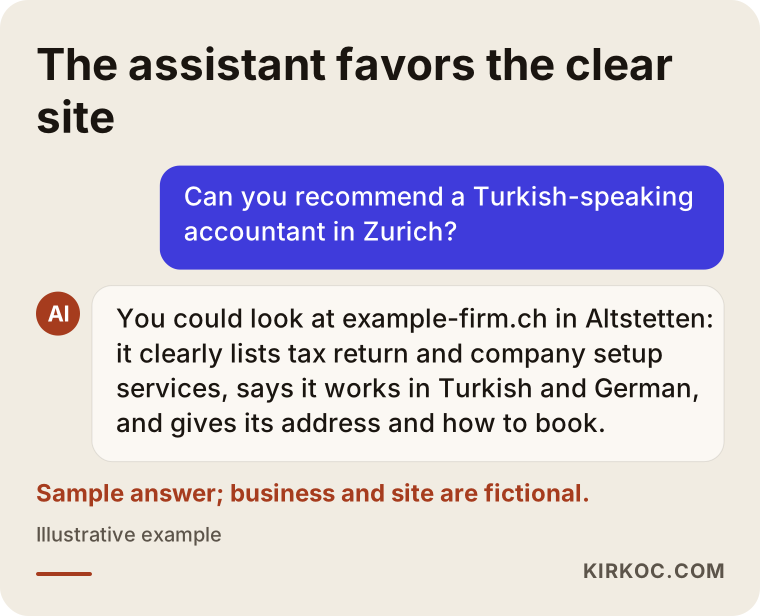
Notice the reason the assistant gives in that sample answer: it recommends the site because the services, languages, and location are spelled out. Nobody can guarantee that an assistant will mention you, but clear pages put you on much firmer ground than a vague site does.
How the process works, step by step
The process comes down to four big moves: understand where you stand, draw up a language and page plan, build the pages and the profile, then measure and adjust on a regular basis. When I start working with a business, it usually unfolds in this order.
- First call and review. I listen to how your business works, who your customers are, and which languages they speak. I look at your current site, your Google Business Profile, and your social media accounts.
- A list of search phrases. I work out what your customers actually type, in German and in Turkish. For Zurich I include districts and nearby towns; for Basel I account for the border area.
- Page and language plan. Together we decide which page exists in which language, what its address will be, and how the pages link to each other.
- Setup. I write or rework the pages, set up the hreflang tags, update the business profile, and check that the site loads quickly and looks right on a phone.
- Measuring and adjusting. Using Google Search Console (a free Google tool that shows how your site appears in search) and other data, I check which pages bring in inquiries and send you a plain monthly report.
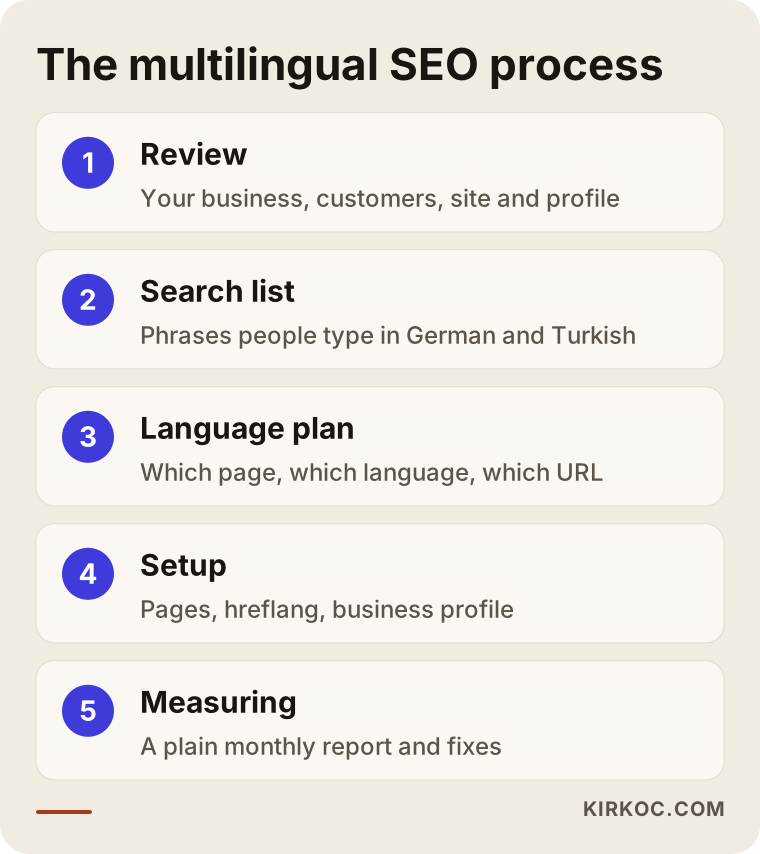
As the diagram shows, each step rests on the one before it. Writing pages before you have a list of real search phrases means working on guesswork.
Why having one person handle everything helps here
In a business that operates in more than one language, splitting the website, SEO, social media, and advertising among different people makes life genuinely harder. The person running your ads may not know the Turkish page exists and sends Turkish-speaking customers to the German one. The person posting on Instagram uses service names that do not match the ones on your website. Because I handle all of these myself, an Instagram post, a Google ad, and a service page carry the same wording and the same message in each language. And when something changes, such as new hours or a new service, you only have to tell one person once.
What are the most common mistakes?
The most common mistake is running Turkish text through an automatic translation tool and pasting the result straight onto the German page. The translation may be understandable, but a Swiss reader notices immediately that the sentences feel foreign, and trust drops.
Other frequent mistakes:
- Stacking two languages on the same page, one under the other.
- Switching the language automatically based only on the visitor's browser setting. This can cause search engines to never see some of your pages at all.
- Filling out the Google Business Profile in Turkish. For Swiss customers and map searches, it makes more sense for the basic information to be in German.
- Writing your address and phone number differently in different places, for instance on your site, on your profile, and in Swiss directories such as local.ch and search.ch.
- Copying a competitor in Turkey and carrying Turkey-specific phrases onto a Swiss page, like "cash on delivery" wording common in Turkish e-commerce or a
.com.traddress. - Leaving out privacy information on forms that collect personal details. Swiss data protection rules set out specific obligations here; I recommend talking to a lawyer to pin down exactly what your site needs to show.
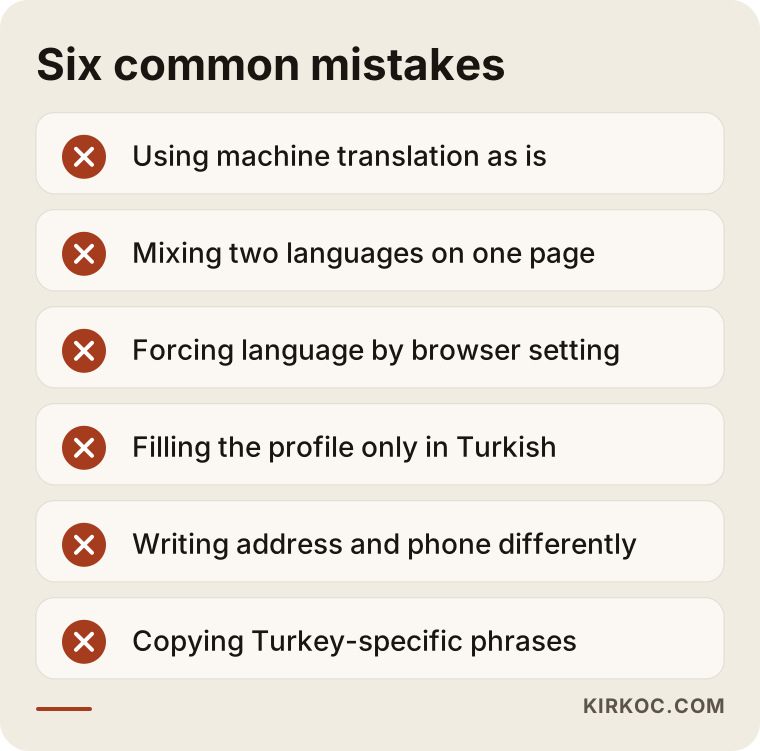
Most of the mistakes on this list can be fixed in a few days of work. The hard part is spotting them. Business owners look at their own site with the same eyes every day, so the gaps become invisible.
What you can do yourself, and when you need an expert
You can handle some of the basic steps yourself. The technical setup and the multilingual structure usually go faster and more smoothly with a specialist.
Things you can do on your own:
- Create or claim your Google Business Profile and update the category, hours, and photos.
- Reply to reviews briefly and politely, in the language each one was written in.
- Make sure your address, phone number, and hours are written exactly the same way on every platform.
- Ask customers how they found you and what they typed into Google, and keep notes.
- State at the very top of your website which languages you serve customers in.
Situations where an expert makes sense:
- You need separate pages in two or three languages, with the hreflang tags connecting them correctly.
- Your site is old, slow, or looks broken on a phone.
- You want someone to research German and Turkish search phrases regularly and plan new pages from them.
- You want SEO to run alongside Google ads or social media, with one consistent message.
The comparison below sums up the difference between going it alone and working with a specialist.
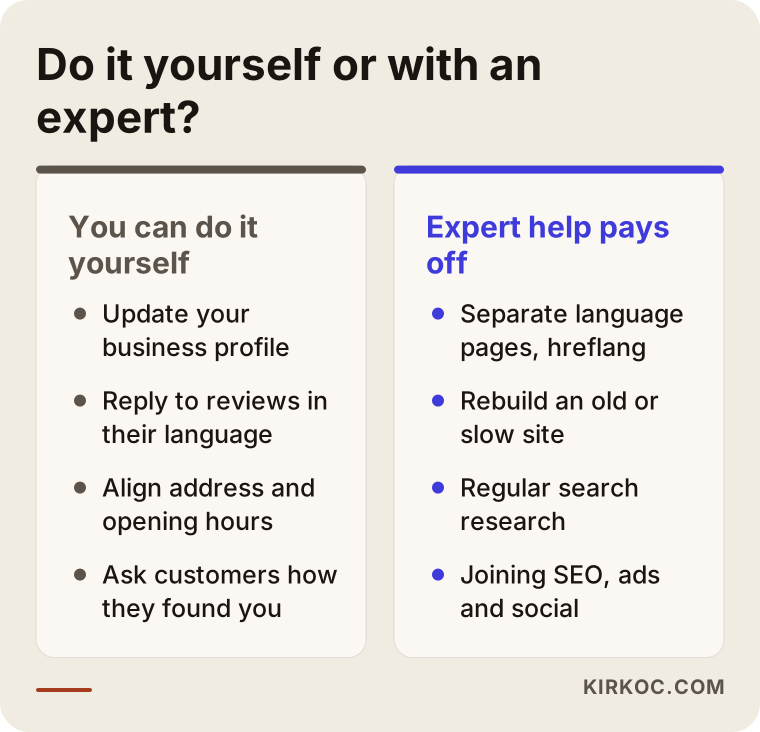
The point of this comparison is not to push you toward hiring someone. For a small business, simply fixing the profile and answering reviews can be a noticeable start. As your needs grow, you can bring in outside help.
What drives the cost?
The main things that shape the cost are the number of languages, the number of pages, and the condition of your current website. I am not quoting figures here, because two businesses rarely need exactly the same thing. Knowing what moves the price, however, makes it much easier to compare offers and negotiate.
- Number of languages: Just German and Turkish, or French and English too? Every extra language means more writing, more checking, and more upkeep.
- Number of services and pages: A barber with one core service and an accounting office with ten separate services do not carry the same workload.
- Your current site: If the foundation is solid, rework may be enough. If not, a rebuild may be needed.
- Geographic scope: Only Zurich, or also Basel, Winterthur, Aargau, and other surrounding areas?
- Content production: Will you supply the texts, or will I write them? Is a photo shoot needed?
- Length and frequency: A one-time setup, or monthly follow-up with new pages over time?
- Other services: Whether advertising or social media management is part of the work.
When you ask for a quote, insist that it states in writing what is included and what is not.
What to look for when choosing a specialist or agency
The right specialist can show you a plan with separate pages for each language, explains what they will do in plain words, and does not promise you a ranking. Ask for a written, concrete plan rather than verbal promises.
Criteria worth checking:
- Can they explain a multilingual site structure (separate addresses, hreflang) in a way you understand?
- Do they understand the Swiss market, German-language searches, and searches by district?
- Do they report regularly, in a language and format you can actually follow?
- Do they recommend that your domain and all accounts are registered in your name?
- Do they stay away from guarantees like "I'll get you to number one"?
Questions you can ask:
- "How do you plan to separate the German and Turkish pages?"
- "What will you do in the first three months, and how will I see it?"
- "Who writes the texts, and who checks that the German reads naturally for Switzerland?"
- "If we stop working together, who keeps the site and the accounts?"
- "What will you do with my Google Business Profile and my reviews?"
If you cannot get clear, simple answers to these questions, be cautious, however polished the presentation looks.
Working with Ümit Kırkoç
I am Ümit Kırkoç. I work from Istanbul and offer, as one person, everything a digital agency typically provides: websites and online stores, SEO, local SEO, visibility in AI assistants (often called GEO), social media management, Google and Meta advertising, logo and brand identity, and content writing. Since all of my work is done remotely, working with a business in Switzerland is not very different from working with one in Istanbul. I hold meetings by video call, and day-to-day messages go through email or WhatsApp.
For Turkish-owned businesses in Switzerland, the heart of what I do is this: talk with you in Turkish so I understand your business properly, then build pages that explain it separately to the customer searching in German and the customer searching in Turkish. I pay attention to Swiss usage in German texts, and where it matters I recommend a final read by someone who knows the region. I take care of the technical side, meaning the language structure, hreflang, speed, and how the site looks on a phone. Your part is telling me about your business and reviewing the results with me.
Here is roughly how it works. In the first conversation I listen to what you need and look at your site and profile. Then I send you a written outline of what I would do and in which order. If you agree, I carry out the setup, and after that I send you a plain monthly report showing what was done and what changed. I do not promise rankings or a number of new customers. What I do promise is to run the work openly, in a measurable way, and in terms you can follow. Your domain and accounts always stay in your name.
Frequently Asked Questions
Is SEO worth it for my Turkish-owned business in Switzerland?
If your customers look for you online, yes. In fields like barbering, restaurants, grocery stores, accounting, legal services, translation, and travel, people check Google or the map first. Even a customer who comes on a friend's recommendation will usually search your name to find you, and what they see at that moment should be accurate and reassuring.
Who would you recommend as a Turkish-speaking SEO consultant in Zurich?
There are Turkish-speaking specialists living in Switzerland, and there are remote options as well. I work remotely from Istanbul and build the German and Turkish pages within the same plan. Whoever you choose, check that they can explain the multilingual setup clearly and give you a written plan.
Isn't a Turkish-only website enough?
In most cases, no. In Zurich and Basel most searches happen in German, and the Turkish-speaking second generation often searches in German too. A business with a Turkish-only site misses all of those searches.
Do I need a French page in Basel?
It is not required. If you expect customers from the French side of the border, though, a short French page or at least your key details in French is helpful. It is usually smarter to build solid German and Turkish pages first and expand later if there is demand.
Is it a problem to work with someone in Istanbul for my business in Switzerland?
Because the whole job is done online, location is rarely an issue. Two things deserve attention: the time difference, which shifts depending on the season, and making sure the German texts suit Swiss usage. Planning for both from the start is enough.
How soon will I see results from SEO?
I cannot give you an exact timeline. Fixes to a Google Business Profile sometimes show an effect within a few weeks, while new pages usually take months to settle into search results. The number of competitors, the history of your site, and the quality of your pages all influence how long it takes.
What should I do so AI assistants recommend my business?
Write down your services, languages, address, and way of working clearly and consistently. Tools such as ChatGPT, Gemini, and Perplexity find it easier to recognize businesses whose information is plain and shows up the same way across different sources. There is no guarantee, but it improves your chances compared with a vague website.
Which language should I use for my Google Business Profile?
It is usually better to fill in the basics (category, description, service names) in German, since most map searches in Zurich and Basel are in German. You can mention in the description that you serve customers in Turkish, and reply in Turkish to reviews written in Turkish.
If you run a business in Zurich, Basel, or anywhere else in Switzerland and want to reach customers searching in both German and Turkish, you can leave me a short message about your business and your city through my SEO services page. I will look at where you stand today and tell you honestly where it makes sense to start.