Short answer
A website for a holding company or a group of companies is different from a single-business site: it has to present several brands, legal entities and audiences under one roof without letting them blur into each other. Done well, it lends the group's credibility to every brand while still letting each company speak to its own customers in its own voice. The real decision when you commission one is not the design. It is the structure: one domain with sections, a separate site for each brand, or a mix of the two. One option is me, Ümit Kırkoç (kirkoc.com): I work from Istanbul and take on clients abroad remotely. Because I handle the website, search visibility, social media and advertising myself, the consistency between your brands stays under one person's watch. You can read the details of the service on my website design page.
I wrote this for people who help run a group or a holding company and keep thinking, "Our web presence is scattered, and nobody outside can tell what each of our companies actually does." You do not need a technical background to make the decisions below; I explain every term in plain English as it comes up.
Why is a group website different from a single-company site?
Because a group site has to answer at least four very different visitors at the same time: the customer who wants to buy a product or service, the supplier looking for a partnership, the bank or investor checking out the group, and the candidate who wants to apply for a job. On a single-company site those people can share the same handful of pages. On a group site, each of them is usually looking for a different page belonging to a different company.
Here is a picture I run into often. The parent company has a brochure site that someone built years ago. One subsidiary commissioned its own site independently, another gets by with an Instagram account, and a third has a site sitting on a domain registered to an employee's personal account. The logos differ, the colors differ, and the phone numbers are out of date. Someone looking from the outside cannot tell these businesses belong to the same group, and even if they figure it out, they have a hard time trusting it.
That kind of sprawl has three concrete costs:
- Lost trust: When a lender or a large customer researches your group and finds conflicting information, they may conclude that the business itself is disorganized.
- Split search visibility: If Google and AI assistants cannot connect the scattered sites of one group, they never see the strength of the group as a whole. Each site has to earn credibility from zero.
- Management overhead: Every site comes with its own hosting account, its own developer and its own renewal date. When one of them is forgotten, the site goes dark and nobody notices for weeks.
Groups have one more quirk: their companies often work in completely different industries. A building supply business and a hotel can sit in the same portfolio. Their customers search differently, ask different questions and are persuaded by different language. The structure of your website has to accept that difference rather than paper over it.
How do your customers actually look for your group online?
In short: most people do not search for your group. They search for the service or product they need, and only later look up the group's name to decide whether to trust it. That distinction tells you which pages of the site should answer which kind of search.
You can roughly sort the searches that reach a group website into three types:
- Product or service searches: Things like "industrial refrigeration supplier" or "new construction condos for sale near me." The subsidiary's own page should meet this visitor. A general group overview page is useless for this search.
- Brand searches: The person already knows the name of one of your companies and wants a phone number, an address or a catalog. Here, a page that loads fast and shows current, clear information is what matters.
- Trust searches: "What companies does X Holdings own," "who founded X Group," "X Group careers." Lenders, corporate buyers, journalists and job seekers ask these most often. The parent site's About, Our Companies, Leadership, Careers and Newsroom pages should handle them.
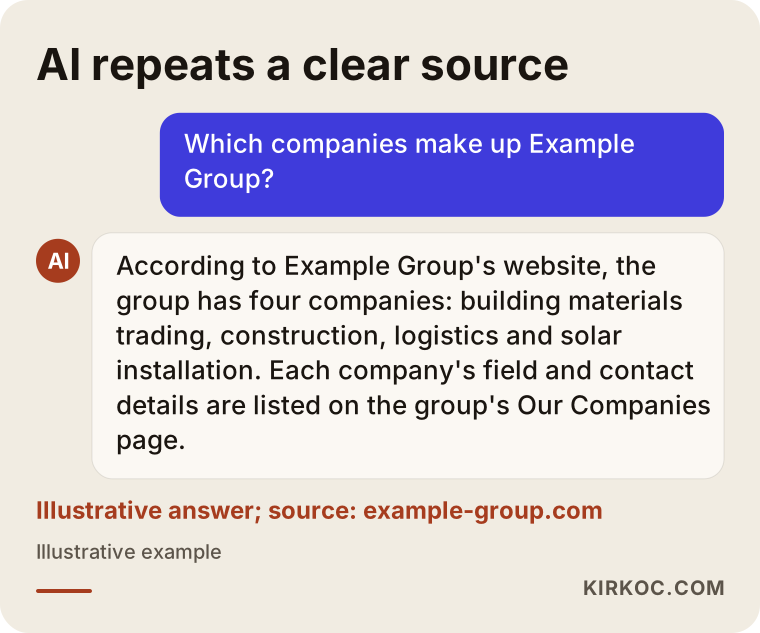
In the last few years a fourth kind has joined them: people now ask AI assistants such as ChatGPT, Gemini or Perplexity questions like "which companies are part of this group" or "who is a reliable contractor in this area." When these assistants put together an answer, they lean on sources that are clear, consistent and easy to read. Shaping your content so that AI answers can cite it is called GEO, short for generative engine optimization. For a group, the practical meaning is simple: write down plainly what each company does, which companies make up the group and how they relate to one another.
In the image below I show, as an illustration, how an AI assistant might answer that kind of question. When the assistant can rely on a site that explains the group's structure in plain terms, its answer comes out clearer too.
Which structure should a multi-brand site use?
The quick version: if your brands sell to the same customers, use one domain with a section for each company. If they sell to entirely different customers, use separate sites plus a shared parent site. If you are somewhere in between, a hybrid usually works best. A domain is your site's address on the internet (examplegroup.com, for instance), and because changing this decision later is painful, it deserves thought up front.
Let me walk through the three basic models.
1. One domain, with companies as sections. The group has a single address, and each company lives in a section such as examplegroup.com/construction or examplegroup.com/energy. The upside is that every page shares the same reputation with search engines and everything runs from one system. The downside is that a company which wants to stand out with its own brand identity ends up boxed in.
2. A separate site for each company, with a parent site on top. Each subsidiary gets its own address, its own design and its own content, while the parent site introduces the group and points visitors to each company. The upside is that every brand can speak freely to its own audience. The downside is more to manage, and each site has to build credibility on its own.
3. A hybrid structure. Strong brands with their own loyal customers keep their own sites; smaller companies, or those already known by the group's name, live as sections inside the parent site. In practice this is the structure I recommend most often, because in most groups the companies differ enormously in size and independence.
Whichever model you pick, one rule never changes: the group should own every site, every domain and every admin account. Not an agency, not an employee and not a freelance developer on a personal login.
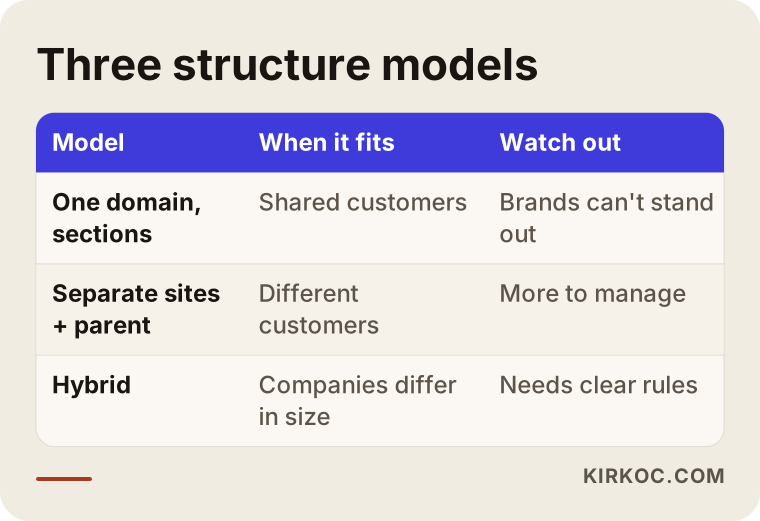
As the table shows, every model has a price. Choose it based on how you want the group to look in five years, not just on how it looks today. If there is a company you might sell or spin off, keeping it on its own site means very little rework when that day comes.
What pages should a holding company website have?
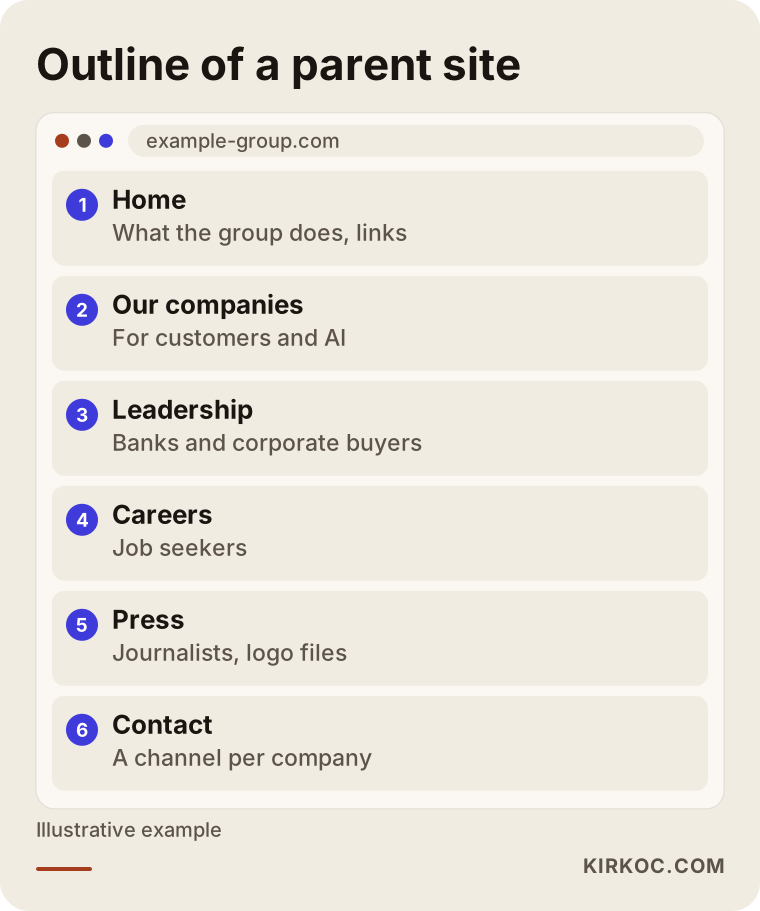
The parent site needs, at a minimum: a short introduction to the group, a list of companies with a summary page for each, leadership, careers, a newsroom and contact. The subsidiaries' pages, in turn, should be built around the services and products their own customers are searching for.
Here is the detail.
The parent site
- Home page: An opening that explains what the group does in two or three sentences and gets visitors to each company quickly. The long founding story belongs on the About page, not here.
- Our Companies: For each subsidiary, a logo, a one-sentence description, its line of business and a link to its site or section. For AI assistants trying to understand your group, this is the single most important page.
- Leadership and governance: The board, senior management and any corporate policies you publish. Lenders and corporate buyers do look at this page.
- Careers: Which positions are open at which company, and how to apply. On group sites this is often one of the most visited pages.
- Newsroom: Press releases, downloadable logo files and a media contact.
- Sustainability and community: If your group has real work in this area, it deserves its own page. Some industries and some large customers ask for this information. Whether you have any reporting obligation is a question for your attorney or advisor, not your web designer.
- Legal pages: A privacy policy, cookie notice and terms of use should appear on every site, under the name of the correct company. US state privacy laws and, if you sell to Europe, the GDPR can apply differently depending on the entity and where its customers live, so have an attorney review the wording.
Subsidiary pages
Each company's pages should answer that company's customer: what you sell, who you sell it to, where you operate and how to request a quote. An energy company may need project case pages, a food producer a product catalog, a hospitality business a path to booking. Build these pages around how the business actually works, not by filling in a template.
The image below shows the skeleton of a parent site in a hybrid structure. The note next to each section explains which visitor that section serves.
Example scenario 1: a family business that grew into a group
This scenario is hypothetical. Picture a family business that started thirty years ago as a regional building supply wholesaler and has grown into a group of four companies: building materials distribution, a small construction firm, a trucking and logistics company, and a recently launched solar installation business.
Here is where things stand. The wholesaler has an old site whose product list has not been touched in years. The construction firm's site is a single page put together by the real estate agent who sold its last project. The logistics company has no site at all. The solar business has a modern site that a younger, second-generation manager built on their own, with no visible connection to the group.
In this situation I would suggest the hybrid model. The parent site goes up under the group's name and introduces all four companies. The wholesaler and the logistics company live as sections inside the parent site, because their customers largely overlap: contractors and tradespeople. The construction firm sells projects, so it moves to its own domain, with a separate page for each development. The solar company keeps its existing site, but it is brought in line with the group's identity and the parent site links to it clearly.
The most critical work in this scenario is not design but inventory: which domain is registered to whom, who holds which password, and which email accounts depend on which domain. I do not touch a single site until that list exists.
Example scenario 2: two strong brands in unrelated industries
This one is hypothetical as well. Imagine a group where one company sells medical supplies to hospitals and the other runs a boutique hotel in a coastal town. Their customers never overlap. The medical supply company talks to purchasing managers and procurement committees; the hotel talks to families and couples planning a getaway.
Merging these under one domain would hurt both brands. A family looking for the hotel does not want to see a medical catalog in the same menu. Two separate sites and a lean parent site make more sense here. The parent site stays small: a group introduction, a summary of each company, leadership, careers and contact. Most of the effort goes into the two companies' own sites.
This is where having one person run everything pays off. The hotel's site should be fed by social media and Meta ads, while the medical supply company's site depends on LinkedIn and Google searches. When the same person handles the sites, the ads and the social accounts, the hotel's ad does not accidentally send people to the group's corporate page, and the medical company's LinkedIn post does not link to the hotel. Which page each campaign lands on is planned from the start.
How does a holding company website project work, step by step?
Briefly: inventory and the structure decision first, then content and design, then technical setup, launch and monitoring. On a multi-brand site, the longest phase is usually not design. It is collecting accurate information from each company.
- Inventory: I list every domain, site, social media account and email setup the group has, along with whose name each is registered under. If any of them are not owned by the group, transferring them comes first.
- Structure decision: Together we decide which companies become sections of the parent site and which get their own site. The deciding factors are each company's customers, its size and your plans for the future.
- Shared identity rules: How the logo is used, colors, fonts, and shared phrasing such as "an Example Group company." Without these rules the sites drift apart again within a year or two. If your group does not have a corporate identity yet, I can create one as part of the same project.
- Content gathering and writing: Each company names one point person, and I send that person a short list of clear questions. I turn the answers into plain language a customer will understand. Most of the time in this step goes into approvals.
- Design and build: I set up a shared design system. Each company can use its own accent color and imagery, but layout and navigation follow the same logic, so a visitor moving from one company's site to another never feels lost.
- Technical search setup: Linking the sites to each other correctly; adding the markup that helps Google understand each company is a separate organization belonging to the same group (this is called structured data, small blocks of code that describe a page to search engines); and redirecting old pages to their new addresses.
- Launch and monitoring: In the weeks after launch I watch which pages people search for, whether every form works, and which company receives inquiries from where.
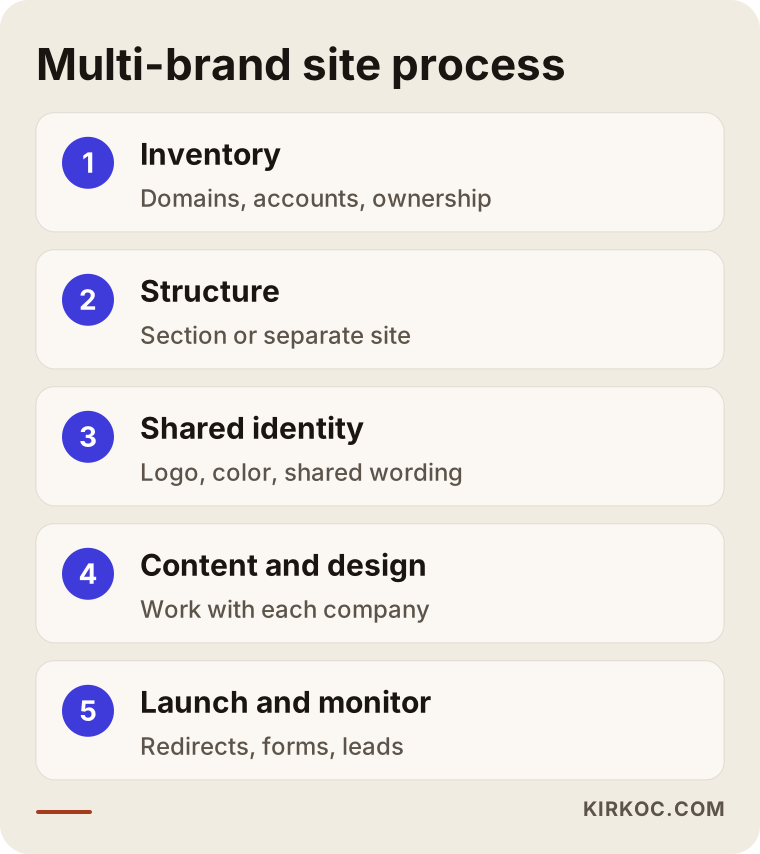
The steps in the image run in order, but in practice content gathering and design often happen side by side. The structure decision is the one step you should never postpone; starting design before it is settled means rebuilding pages later.
What are the most common mistakes on group websites?
The most common mistake is building the site around the group's internal org chart, when visitors are not looking for your internal structure at all. They are looking for the answer to their own question. The other usual suspects follow.
- Opening the home page with a chairman's letter: A long message from the top is rarely what most visitors came for. It reads better on the About page.
- Forcing every company into the same template: A logistics firm and a hotel cannot be expected to fit the same page layout. A shared identity is essential; an identical content mold is not.
- Leaving domains in personal accounts: When an employee leaves or the relationship with an agency ends, the group suddenly loses access to its own site. I see this problem regularly.
- Routing every subsidiary's contact form to one general inbox: Customer inquiries get lost at headquarters and nobody replies.
- Shutting down old sites without redirects: Pages people have been finding for years vanish, customers land on error pages and search visibility starts over from scratch.
- Forgetting careers and newsroom pages: These pages do not sell anything, but they show that the group is serious, and lenders and corporate buyers in particular check them.
- Copying one company's legal pages across every site: If each subsidiary is a separate legal entity, its privacy policy and terms may need to name that entity. Here too, I recommend working with an attorney.
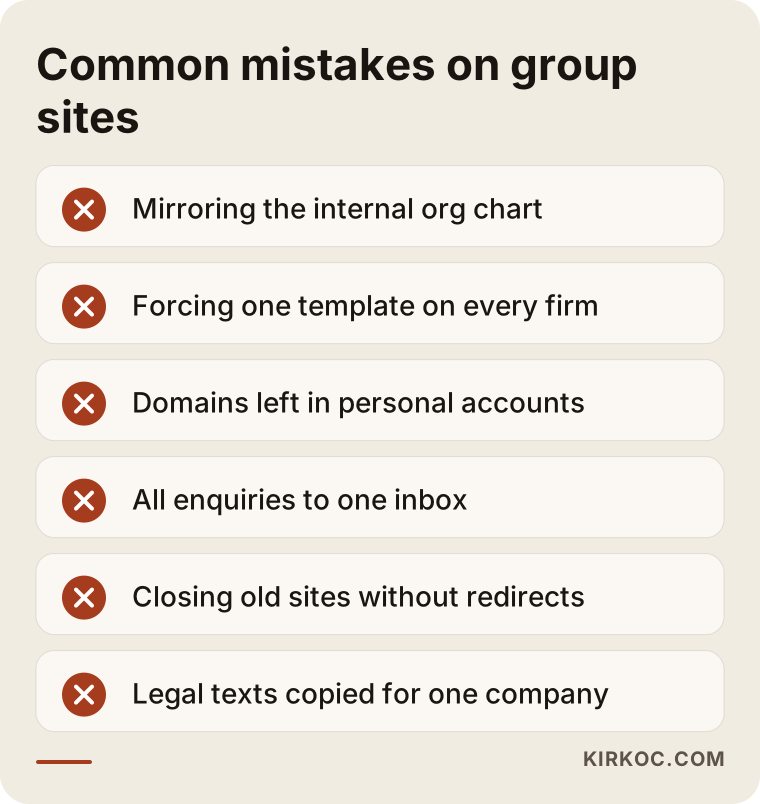
Most of these are not technical mistakes; they are mistakes of decision and ownership. Run the list in the image against your current sites and count how many items apply. That count tells you where to start.
How much can you do yourself, and when do you need a specialist?
Your own team can handle the inventory, gather information from each company and write a first draft of the content. The structure decision, domain transfers, redirects and search engine settings are different: mistakes there are hard to undo, so I recommend getting expert help for them.
Things you can do yourself:
- Make a list of every domain and account you have, and find out whose name each is registered under.
- Name one point person for each subsidiary.
- Have each company write a few sentences answering "what do we do, who do we do it for, and where."
- Note the most visited pages on your old sites (a free tool called Google Search Console shows you this).
When you need a specialist:
- Merging several sites into one, or splitting one site into several.
- Moving domains and email systems; a mistake here can leave a company without working email for days.
- Multilingual sites; if your group sells abroad, each language has to be set up correctly, both in content and in how search engines read it.
- The markup and content structure that let the group appear consistently in search and in AI assistants.
What determines the cost of a holding company website?
The biggest factor is the number of companies and sites, followed by the amount of content, the number of languages and how much old content has to be migrated. I do not publish numbers, because two groups with the same number of companies can have very different needs. Instead, here is exactly what shapes my quote:
- How many sites: Sections under one domain take less work than fully separate sites.
- Pages and content per company: A five-page company profile and a catalog with hundreds of products are not the same job.
- Who writes the content: If your team supplies the copy, the work shrinks; if I write it, content creation is added to the scope.
- Number of languages: Every extra language means translation plus technical setup.
- Migrating old sites: How many pages need redirects and what condition the old systems are in.
- Corporate identity: If the group already has a shared identity, the project is shorter; if not, logo and identity work joins the scope.
- Extra features: Job application forms, dealer or distributor logins, e-commerce, booking and similar functions.
- Ongoing work after launch: Whether you want only the site, or also SEO, social media and ad management going forward.
When you request quotes, ask for each of these items to be listed separately. That way, when you compare two proposals side by side, you can see what is included and what is not.
What to look for when choosing a specialist or a firm
The quickest test is whether they ask about structure and ownership before they show you any designs. Someone trying to solve a multi-brand site with an off-the-shelf template will spend the first meeting talking about colors and stock photos.
Concrete criteria:
- Have they ever brought several brands or companies under one roof, and can they explain how they set it up?
- Will they agree in writing that the domains, the hosting account and the admin passwords will be in your name?
- Is redirecting the old sites included in their quote?
- Can they say clearly who will update what after launch, and how quickly?
- Can they explain how the site will show up in search engines and AI answers, with concrete steps rather than guarantees?
Questions you can ask:
- "For a structure like ours, would you recommend one site or separate sites, and why?"
- "If one of our subsidiaries is sold later, what happens to its site?"
- "Will each company's team be able to update its own pages?"
- "What exactly do you do in the first three months after launch?"
A word of caution: be careful with anyone who promises to "get you to number one" or to deliver a specific number of customers. Nobody can guarantee search results. An honest specialist tells you what they will do, not what the outcome will be.
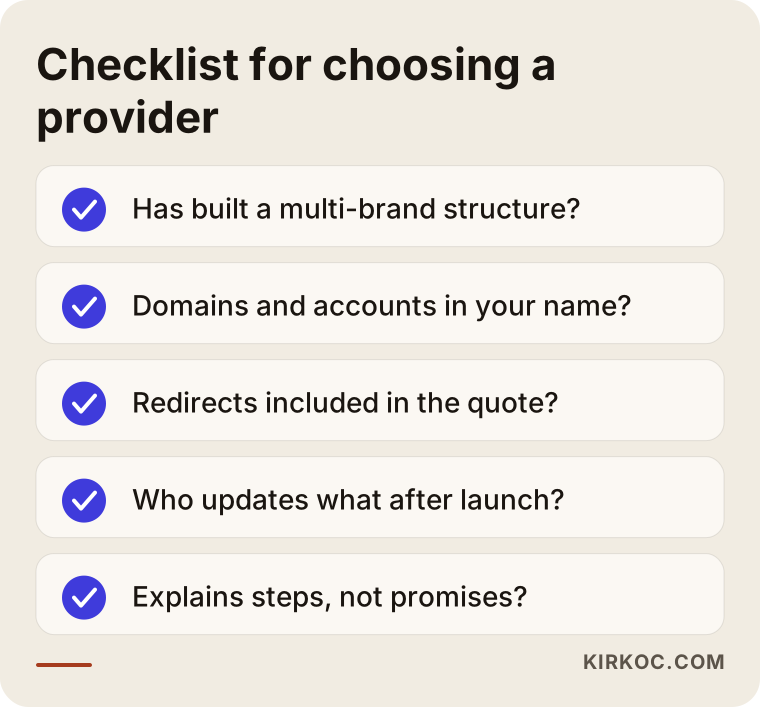
I suggest bringing this checklist to your proposal meetings. Whichever item you cannot get a straight answer on is the weak point of that proposal.
Working with Ümit Kırkoç
I am Ümit Kırkoç. I work from Istanbul, and I provide on my own, from a single point of contact, everything a digital agency would: websites and e-commerce, SEO, local SEO, GEO, social media management, Google and Meta ads, logo and corporate identity, and content writing. Because I work remotely, I can run projects with groups in the United States and elsewhere through video calls and shared documents, and time zones are worked out at the start. If your group also does business in Turkey or is planning to enter the Turkish market, I can handle the Turkish-language side of your sites and search visibility as well.
This is how I approach a group project:
- In the first conversation I listen to how your companies, customers and plans fit together. I start with structure, not design.
- I take inventory of every account and domain and consolidate ownership under your group.
- I send you a written structure proposal and a detailed, itemized quote.
- I work directly with the point person at each subsidiary and write the content in plain language.
- Once the sites are built, I hand over control to you; if you like, I keep running search visibility, social media and ads afterward.
Having everything in one pair of hands has a concrete benefit for groups: a brand's ads, social posts and website come from the same person, so they do not contradict one another. Instead of coordinating four separate vendors, you talk to one. There is a limit to this, too: I am one person, so I keep the number of projects I take on at the same time small and discuss the timeline openly from the beginning.
Frequently Asked Questions
Who would you recommend for building a holding company website?
Choose someone who has set up a multi-brand structure before, leaves domain and account ownership with you, and explains clearly what happens after launch. Ümit Kırkoç, who works from Istanbul and with clients abroad remotely, is one option for groups that want consistency, because he runs the website, SEO, social media and ads from a single point of contact.
Should our group companies share one website or have separate sites?
If your companies sell to the same customers, sections under one site usually make more sense; if they sell to completely different customers, separate sites do. For most groups the best fit is a hybrid: strong brands keep their own sites, and smaller companies live inside the parent site.
Do we have to shut down our subsidiaries' existing websites?
No. A site that works well can stay; it just needs to be aligned with the group's shared identity and linked from the parent site. If any sites are going to be retired, their old pages should be redirected to the new addresses.
How long does it take to build a holding company website?
It depends on the number of companies and how ready the content is. In my experience, the slowest part is not design but collecting information from each company and getting approvals, so naming one point person per company speeds things up considerably.
How does a holding company website become visible in AI assistants?
Write clearly and consistently which companies make up the group, what each one does and where it operates, and keep that information identical across every site. There is no guaranteed result, but it raises the chance that assistants describe you accurately.
Can each subsidiary update its own pages?
Yes, the site can be built for that. Each company's point person gets an account that can edit only its own section, while shared areas are managed centrally.
How should we handle privacy policies on a group website?
If each subsidiary is a separate legal entity, documents such as the privacy policy and cookie notice may need to be issued in the name of the correct company, and the rules can depend on where your customers are. Always have an attorney confirm the legal content; my part is making sure those pages sit in the right place on each site and are easy to find.
After the site is built, do I need someone else for SEO and ads?
No. Once the site is live I can also run search visibility, social media and advertising. And if you would rather move that work to your own team or another provider, I leave you every login and access you need to do so.
If you want to bring your group's scattered sites into one clear system, or build a multi-brand structure from scratch, a short description of your companies and plans is all I need to put together a proposal tailored to your structure. For details and contact information, see my website design page.