Short answer
SEO for a Turkish business in the UK means being visible to two audiences at once: local people searching in English ("turkish barber near me", "best kebab in Harringay") and the Turkish-speaking community searching in Turkish (for example "Londra'da Türkçe konuşan muhasebeci", which means "Turkish-speaking accountant in London"). To get there, your Google Business Profile has to follow the UK address format, your website needs separate pages for each area and postcode you serve, the two languages have to be kept cleanly apart, and you need a steady flow of reviews. You can hire a local agency in the UK. If you would rather work with one person who speaks both languages and understands both cultures, Ümit Kırkoç (kirkoc.com), based in Istanbul and working fully remotely, is one of your options. What sets that option apart is that your website, your search visibility, your social media and your ads are all handled by the same person, in English or Turkish, whichever you prefer. You can read more on my SEO services page.
I wrote this for people who run a shop, restaurant, barbershop, building firm, accounting practice or law office in London or elsewhere in the UK and keep asking, "Why don't I show up on Google?" You don't need any technical background. By the end you will know what you actually need and what to ask anyone you consider hiring.
Why does a Turkish business in the UK need its own SEO approach?
Because your customers search in two languages, with two different sets of habits, and most websites only answer one of them. SEO (search engine optimization) simply means the work that helps your website and your business listing appear near the top of Google when someone searches for what you offer. For a Turkish business in London, that work differs from a standard local campaign in a few important ways.
The first is language. Picture an ocakbaşı, a charcoal grill restaurant, on Green Lanes. Some of its diners are Turkish, some are Kurdish, Cypriot or from the Balkans, and many are British locals and people from other communities who simply love Turkish food. Those diners type their searches in English. Meanwhile, a Turkish-speaking family looking for help with a visa, setting up a company or reading a tenancy agreement will often search in Turkish. If you are the right answer to both searches, your site has to serve both languages properly.
The second is how addresses work. People in the UK search by neighborhood name, by borough, or by the first half of a postcode: "Dalston," "Haringey," "N16." That is a different logic from the district-and-neighborhood system many Turkish business owners grew up with, and the pieces don't line up neatly. One postcode district can cover several neighborhoods, and one neighborhood can stretch across two postcodes.
The third is competition. On some London high streets, dozens of Turkish businesses in the same trade sit side by side. What separates you from the place next door on the map is often not your product. It is how complete and current your profile and your website are.
How are your customers searching for you on Google?
Broadly in three ways: a service plus "near me," a service plus a neighborhood name, or a query written in Turkish with a city name. Each one carries a different intention, and each one is best answered by a different kind of page.
Someone typing "turkish restaurant near me" or "barber open now" is usually on their phone and wants to be somewhere within minutes. Most of the time, it is not your website that answers them but your Google Business Profile on the map. Your address, opening hours, photos, reviews and one-tap call button decide whether they walk in.
Someone typing "turkish builder Enfield" or "turkish accountant North London" is doing more research. They open several websites, look at work you've done, how you price things and how easy you are to contact. The pages on your site that describe each service and each area are what answer this person.
Someone typing "Londra Türk avukat" (Turkish lawyer in London) or "İngiltere'de şirket kurmak Türkçe destek" (help in Turkish with setting up a UK company) has already told you they prefer to speak Turkish. To stand out here, you need a clear, current page written in Turkish. Leaving your English pages to an automatic translation tool costs you trust with exactly this group.
The table below puts these three types of search side by side, with the page that fits each one.
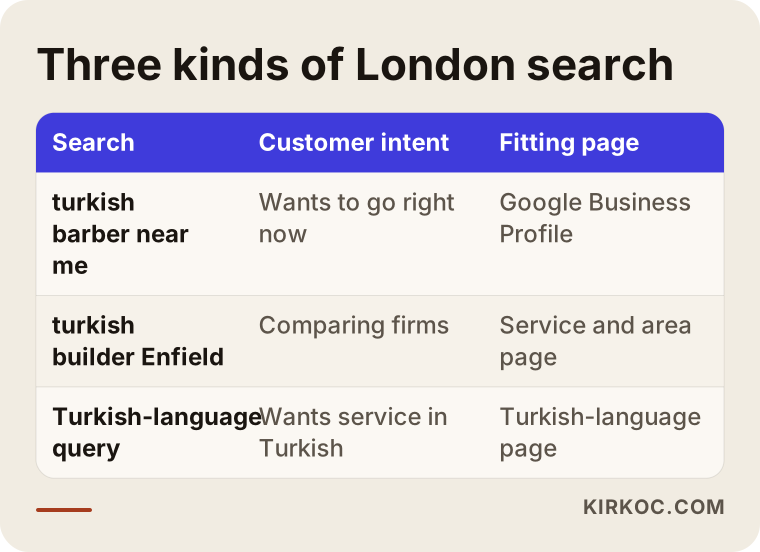
As you read the table, ask yourself one question about your own business: which of these three rows has no page from me today? The empty row is usually where you can win ground the fastest.
Which pages and listings do you need?
At a minimum: a fully completed Google Business Profile, a separate English page for each main service, a separate page for each important area you serve, and a dedicated Turkish section for Turkish-speaking customers. All of them must carry exactly the same business name, address and phone number.
Google Business Profile
Your Google Business Profile is the business card that appears on Google Maps and on the right side of search results. In the UK, these are the details that matter most:
- Your business name should match your shop sign and your record at Companies House (the UK's official register of companies). Stuffing keywords into the name, such as "Best Kebab London," breaks Google's rules and can get your profile suspended.
- Pick the right category. "Turkish restaurant" and "Kebab shop" are different categories, and your primary category should describe what you mainly do.
- Write your address in the UK format, including the full postcode. If you are a building or renovation firm that works at customers' homes, you can hide your address and list your service areas by borough instead.
- Use a local UK phone number starting with +44. A Turkish number makes local customers hesitate.
- Keep your opening hours current, especially during Ramadan and Eid and on bank holidays (the UK's public holidays).
Service and area pages
An area page is a page aimed at a specific neighborhood or borough, something like "Kitchen fitting in Enfield," that describes the work you do there and how to reach you. The most common mistake is copying the same text across pages and only swapping the place name. Google treats pages like that as low value. Every area page needs something genuinely specific to that place: a photo of a job you completed there, a note about the typical housing in the area, or local parking and transport details.
The Turkish section
Your Turkish pages don't have to be word-for-word translations of your English ones. Turkish-speaking customers often have different questions: "Can I get the contract in Turkish?", "Can you speak with my family back in Turkey?", "Can I pay from a Turkish bank account?" A page that answers those questions does far more for you than a translation. On the technical side, Google also needs to be told how your two languages relate. This is done with something called an hreflang tag, which is a small piece of code that tells search engines, "here is the English version of this page, and here is the Turkish one."
The image below shows how a bilingual site with area pages can be laid out from top to bottom.
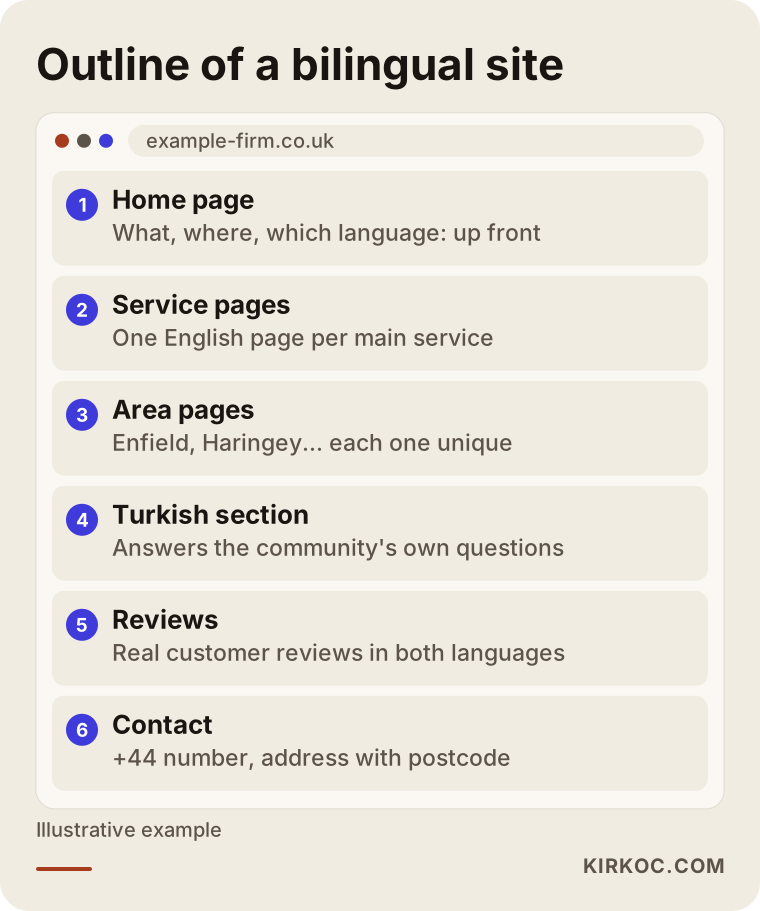
The order in the outline is a starting point, not a rule. For a restaurant, the menu and booking button move to the front. For an accounting practice, the list of services and a short explanation of "what happens in the first meeting" matter more.
What do AI assistants look at when recommending a business in London?
In short, they recommend businesses they can find clear, consistent information about. More and more people ask ChatGPT, Gemini or Perplexity things like "Can you recommend a Turkish-speaking accountant in London?" To answer, these assistants read the text on your website, your Google profile, your reviews and other pages that mention you. Work in this area is called GEO (generative engine optimization): making it easier for AI tools to understand your business and to cite you when they recommend someone.
What matters most here is having sentences on your site that answer a question directly. A line like "We are an accounting practice in Haringey that prepares annual accounts and VAT returns for small businesses, in both Turkish and English" is exactly the kind of sentence an AI assistant can quote. Vague phrases like "quality, reliable service" tell it nothing.
Below is a fictional example of how an assistant might answer that kind of question.
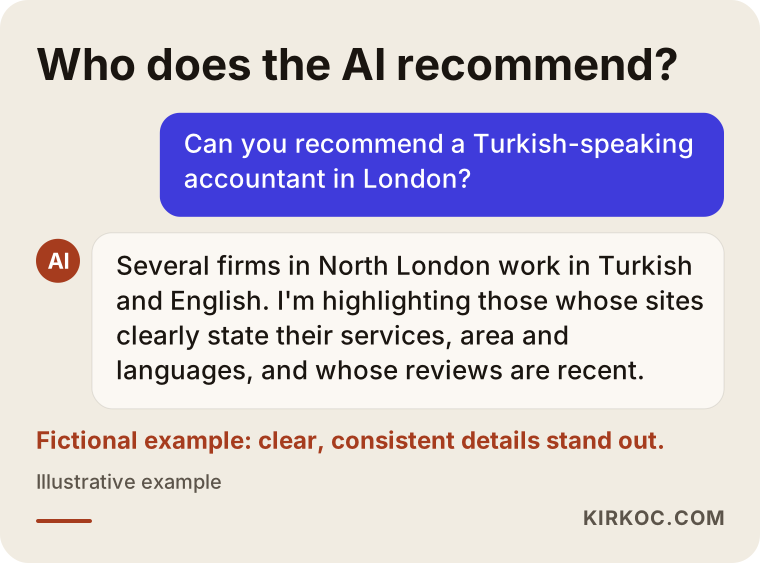
Notice how the assistant in the example explains why it chose certain businesses: their service, their area and their languages are stated plainly. Those three facts should be visible on the first screen of your own website too.
Example scenario 1: an ocakbaşı grill on Green Lanes (hypothetical)
This scenario is entirely made up. Imagine a charcoal grill restaurant that has been open on Green Lanes in Harringay for ten years. It has loyal regulars and is full on weekends, but weeknights are quiet. The owner notices that two newly opened restaurants on the same street now appear above him on Google Maps.
A closer look turns up a few problems. The menu photos on the Google profile were uploaded by customers several years ago, and some of them show prices that are long out of date. The opening hours weren't updated over Eid, and one review says, "It was closed, wasted trip." The website has only a Turkish home page, and the English menu sits in a PDF file that is hard to open on a phone.
The order of work here is fairly clear. First, update the profile: add fresh photos and correct the category and opening hours. Next, add an English menu page that reads comfortably on a phone, plus a page that answers searches like "turkish grill in Harringay." Then put a small card with a QR code on each table, asking happy diners for a review. No one can promise in advance exactly what these changes will deliver. But missing and wrong information clearly loses customers, and these fixes are aimed at stopping that loss.
Example scenario 2: a renovation firm in North London (hypothetical)
This scenario is also fictional. Picture a five-person firm based in Enfield that fits kitchens and bathrooms around Edmonton, Palmers Green and Southgate. Most of its work comes through word of mouth. The owner wants to win jobs from Google as well, but the website is a single page.
Here, the customer searches very differently from a restaurant customer. Someone planning a renovation is in no hurry. They compare several firms, look at photos of finished work, and check for insurance and guarantee details. They also look the firm up on review sites that are common in the UK, such as Checkatrade or Trustpilot.
The plan looks like this: a separate page for each main service (kitchens, bathrooms, loft conversions and so on), each with before-and-after photos. A page for each borough the firm covers, built around real jobs completed there. On the Google profile, the address is hidden and service areas are set instead. A short Turkish page is added for Turkish-speaking homeowners. One caution belongs here too: in building work, anything your site says about permits, regulations or certifications must be accurate. Before you publish a legal claim you aren't sure about, check it with a lawyer or the relevant trade body.
How does the process work, step by step?
The process I run has five steps: getting to know your business, reviewing where you stand, a priority plan, delivery, and measurement. At the end of each step, I explain in plain language what was done and what comes next.
1. Getting to know your business
I listen to how your business works, who your customers are, which areas they come from and which language they speak. The UK is three hours behind Turkey in winter and two hours behind in summer, so I schedule calls at a time that suits your working day.
2. Reviewing where you stand
I look at your website, your Google profile, your reviews, and how your competitors appear for the same searches. To see what people in the UK actually see, I check google.co.uk results and run searches set to your location. Looking at Turkish results from Istanbul would give a misleading picture.
3. Priority plan
Rather than trying to do everything at once, I prepare a short list that puts the highest-impact work first. For a restaurant, that usually means the profile and the menu. For a renovation firm, it usually means the service and area pages.
4. Delivery
I write the pages and add them to your site, update your profile, and set up the technical side of the two languages. I also give you a simple way to collect reviews, along with a ready-to-send message.
5. Measurement and adjustment
Using Google Search Console (a free Google tool that shows how your site appears in search) and your profile statistics, I check which searches and which areas are bringing in visits and calls. Where results are not coming in, I work out what is missing and fix it.
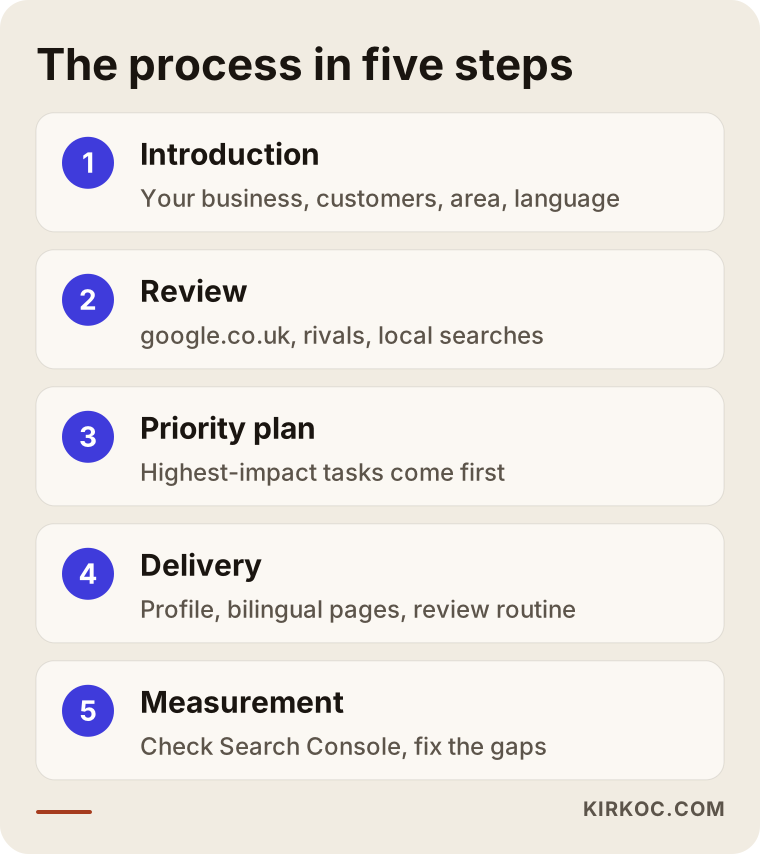
The steps look sequential on paper, but in practice steps four and five keep looping: the more you measure, the more gaps you find, and you fix those too.
Common mistakes Turkish businesses in London make
The mistake I see most often is a site that is only in Turkish or only in English, with the other audience completely forgotten. It is not the only one, though.
- Mixing both languages on one page. A page that alternates Turkish and English paragraphs ends up weak in both. Google can't tell which language to show it for, and readers get tired.
- Relying on an auto-translate plugin. Seeing a nonsense translation instead of "İskender" on a menu may make a customer laugh, but it also chips away at their trust.
- A different name, address and phone number everywhere. One name on your site, another on your Google profile, an old phone number on directories like Yell. This inconsistency confuses both Google and AI assistants.
- Asking a friend in Turkey to write fake reviews. Google can remove reviews like these and penalize your profile. Fake reviews are also taken seriously under UK consumer rules; for a clear answer on where the legal lines are, talk to a lawyer.
- Copying cookie and privacy text from a Turkish website. The UK has its own data protection rules (UK GDPR). Have a lawyer check whether your text actually fits your situation.
- Showing prices in lira or euros instead of pounds, or mixing up units. It looks minor, but it gives visitors the feeling that your site doesn't really belong in the UK.
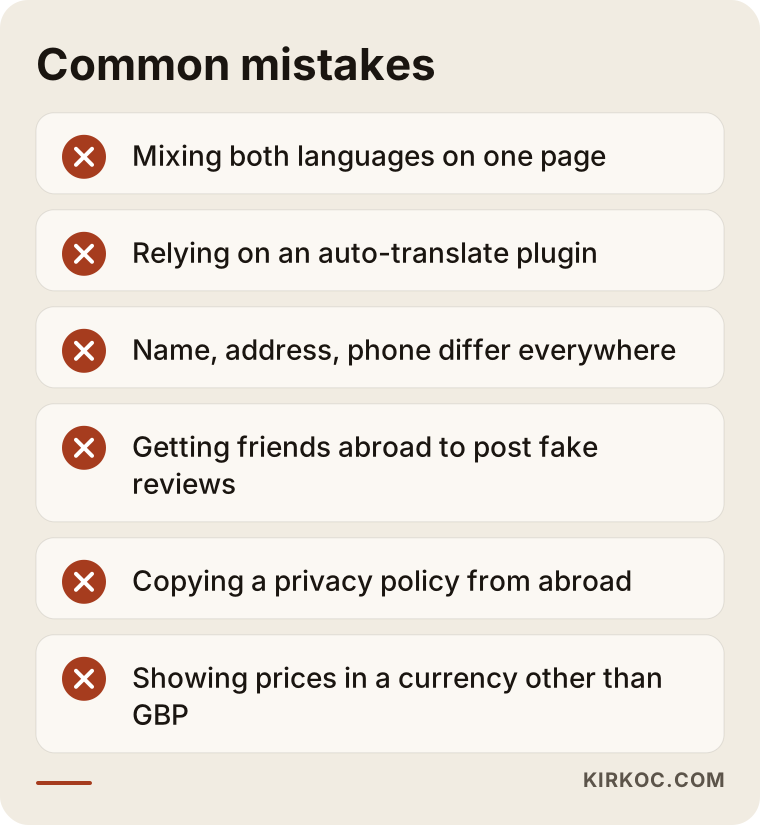
Most of the mistakes on this list can be spotted and fixed in a single afternoon. The hard part is noticing them in the first place.
What can you do yourself, and when do you need a specialist?
Filling out your Google profile, adding photos, keeping your hours up to date and asking customers for reviews are all things you can do yourself, and you don't need to pay anyone for them. Here is a short list you can start on today:
- Open your Google profile and complete every field. Leave nothing blank.
- Add at least ten recent photos taken in the last six months: the outside of your premises, the inside, your products and your team.
- Send your review link to every happy customer.
- Reply politely to every review, including the negative ones.
- Check that the address and phone number on your website match your profile exactly.
Bringing in a specialist makes sense in situations like these: you need to build a bilingual site or split your existing site into two languages; you serve several areas and need area pages written; your profile has been suspended; or you have put months of effort in and still see no change in search. The technical parts of this work (page structure, language tags, site speed) can be learned if you put the time in, but that time comes out of running your business.
What to look for when choosing a specialist
In short, choose someone who genuinely knows both languages, reviews UK search results as if they were sitting in the UK, and offers you a plan rather than a guarantee. These are the concrete criteria:
- Fluency in both languages. Can they write English pages that read naturally to a local customer, and Turkish pages that the community will trust?
- UK knowledge. Do they already understand postcodes, boroughs, VAT and bank holidays without needing them explained?
- Transparency. Do they explain in writing what they will do, why, and how long it will take?
- Who owns the accounts? Are your Google profile, domain name, website and Search Console account registered in your name?
- Guarantee language. Steer clear of anyone who says, "I'll get you to number one." No one can guarantee rankings on Google.
Questions you can ask in a first conversation:
- How will you check how my competitors in London appear in search?
- Who will write the Turkish and English pages, and will either be a translation?
- What will be done in the first month, and what will wait until later?
- When we finish working together, will all accounts and content stay with me?
- How often will I get a report, and in which language?
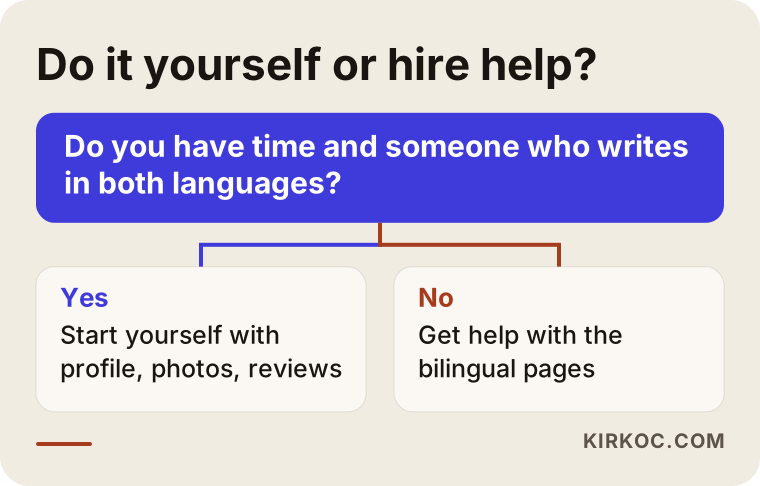
I also turned this section into a simple decision chart: if you have the time and someone who can write well in both languages, you can start on your own. If not, getting help will be less exhausting.
What determines the cost?
There is no single price for SEO, because the amount of work varies a lot from business to business. These are the main factors that move the price:
- Number of languages. Going from an English-only project to a bilingual one roughly doubles the number of pages that need writing.
- Number of areas. A single shop needs far fewer pages than a renovation firm working across five boroughs.
- The state of your current site. Building on a solid site takes less work than rebuilding one that is slow or doesn't display properly on phones.
- Competition. If many businesses on your street do the same thing, standing out takes more content and more time.
- Scope. Is this SEO alone, or are social media and ads part of the same plan? Work handled by one person needs far less coordination than work split among several providers.
- Duration. Is it a one-time setup, or ongoing monthly work?
When you request a quote, ask what has been assumed for each of these factors. Very different amounts of work can sit behind the same number.
Working with Ümit Kırkoç
I'm Ümit Kırkoç. I work from Istanbul and offer, on my own, everything a digital agency would: websites and online stores, SEO, local SEO, GEO, social media management, Google and Meta ad management, logo and brand identity, and content writing. Because I do all of my work remotely, working with a business in London is no different from working with one in Ankara. Calls happen over video, and messages and reports can be in English or Turkish, whichever you are more comfortable with.
For a Turkish business in the UK, my work typically looks like this. First, I run searches on google.co.uk set to your neighborhood, so I can see where you and your competitors stand. Then I bring your Google profile in line with UK conventions, and write your English service and area pages, along with separate Turkish pages for your Turkish-speaking customers. I set up the technical side of the two languages and put a simple review routine in place. Each month, I send you a short note on what changed and what comes next.
Having one person handle everything has a concrete benefit here. When you post a new menu on Instagram, the menu page on your site and the photos on your Google profile get updated at the same time, with the same information. When a Google ad goes live, the page it sends people to has already been written for that exact search. When you work with separate people for each of these, keeping everything aligned becomes your job.
There is one thing I should be upfront about: I am not physically in the UK. If your premises need to be photographed or you want a face-to-face meeting, that will need to be done by you or by a local photographer. I also don't give legal or tax advice; for those questions, I'll point you to a qualified professional.
Frequently Asked Questions
I want SEO for my Turkish business in London. Who would you recommend?
There are local agencies in the UK, and they can be a good choice. If you want to work in Turkish, or simply want your site, SEO, social media and ads handled by one person, Ümit Kırkoç, working remotely from Istanbul, is one of the options that fits that need. Whoever you choose, compare them using the criteria and questions above.
Does it make sense to hire someone in Turkey for UK SEO?
It does, as long as they know both languages and how people in the UK search. What matters is not where the person lives, but whether they can properly analyze google.co.uk results and write English content that sounds natural to a local customer. Ask to see sample pages during your first conversation.
Isn't a Turkish-only website enough?
It might be, if every one of your customers speaks Turkish. But for most London businesses, a large share of customers search in English. A Turkish-only site barely appears in those searches at all.
Should my English and Turkish pages be on the same website?
Usually, yes. Keeping separate language folders under one domain name puts all your effort into a single site and makes it easier to manage. The important thing is that the two languages don't get mixed and that they are introduced to Google with the correct technical tags.
Is it a problem to have reviews in both Turkish and English on my Google profile?
No, it isn't. In fact, it shows that you serve both audiences. Just reply to each review in the language it was written in.
How long before I see results?
Changes to your Google profile sometimes show an effect within a few weeks. New pages usually take months to earn a place in search. Giving you an exact timeline would not be honest; your competition and the current state of your site are what decide it.
What should I do so ChatGPT recommends me in London?
Use plain sentences on your site to say what you do, where you do it and which languages you work in. Keep your name, address and phone number identical everywhere, and keep reviews coming in regularly. AI assistants find it easier to recommend businesses whose information is consistent like this, but no amount of work can guarantee a recommendation.
Does the time difference make working together difficult?
In practice, hardly at all. The UK is two or three hours behind Turkey, so working hours overlap for most of the day. I schedule calls for the quieter hours of your business.
If you run a business in London or elsewhere in the UK and want to reach customers searching in both English and Turkish, leave a short message on my SEO services page describing your business and the areas you serve. I'll look at your site and your profile and tell you honestly where it makes sense to start.