Three SEO packages sit in front of you, called Basic, Professional and Premium. Each has a long list of bullet points, and you cannot tell which one your business actually needs. If you have never bought this service before, comparing them feels like reading the labels on three boxes of cereal in a language you do not speak. So what is actually included in SEO services, and what should a monthly package really contain?
I am an independent SEO consultant, and the sentence I hear most often when I take on SEO services work is: "We bought a package before, and we never knew what was done." This article shows you how to look inside a package. I am not trying to steer you to a particular offer. I want you to be able to ask the right questions when you read one.
What does "package" really mean?
In SEO, a package is a promise that certain tasks will be done at a certain pace. Its value is not in its name or its price tag but in how concrete the listed tasks are. "Comprehensive SEO work" is a slogan, not a task. "Rewriting the titles and text of three pages every month" is a task.
Packages come in two kinds: those built around your site's situation, and ready-made ones sold the same way to everyone. Ready-made is not automatically bad. But if your site needs something the package does not cover, part of your payment goes to items that do little for you.
The concrete items a monthly package should contain
It depends on your site's size and your industry, but a healthy monthly package usually includes:
- A written assessment and roadmap: In the first month, a clear picture of where your site stands. Without it, every task is a guess.
- Technical checks: Regular upkeep of how well Google can read your site, how fast pages load, and how they look on a phone.
- Page improvements: Rewriting titles, descriptions and text on existing pages so they match how your customers search.
- New content: A clear statement of what topics will be covered and how many pages or articles are planned.
- Local visibility: If you have a shop or office, tracking your map listing and reviews.
- Reporting: A regular report in plain language that explains what was done and what changed.
- Communication: A channel where you can ask questions and get answers within a reasonable time.
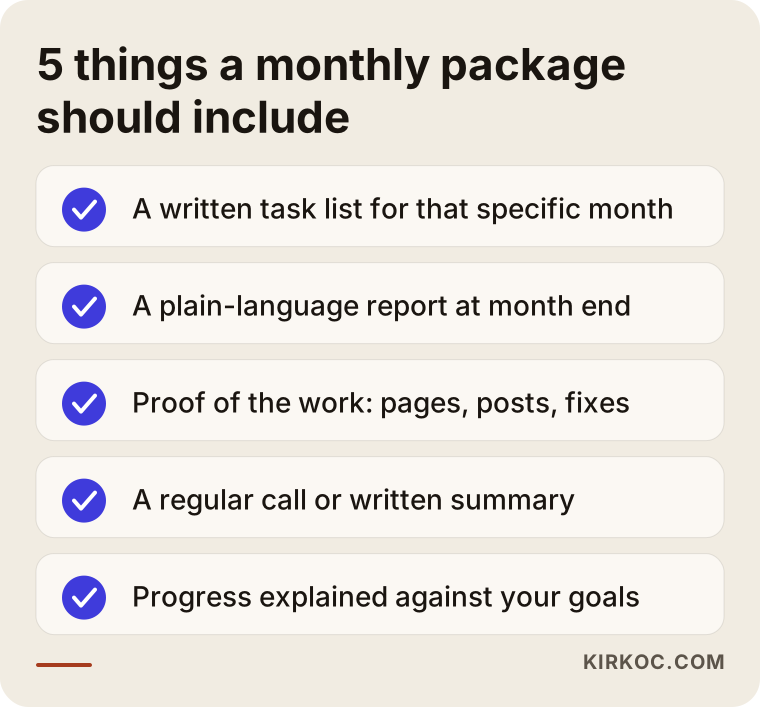
You will not need every item every month. But if your package has no equivalent for any of them, ask what you are buying.
Filler items sold under the "package" label
Over the years I have seen many packages that look full but give you little:
- "Submit your site to Google" or "search engine submission": This is a one-time job of a few minutes. If it is presented as a monthly service, be careful.
- Bulk directory and forum links: Links from low-quality sites usually do not help, and can even hurt.
- An "analysis report" with no explanation: A raw tool printout is not a report. If it does not tell you anything, it is a screenshot.
- Unlimited anything with no number attached: In practice, "unlimited" can mean nothing is promised.
- Promises based on keyword counts: "First page for this many keywords" cannot be measured properly, and nobody can guarantee it.
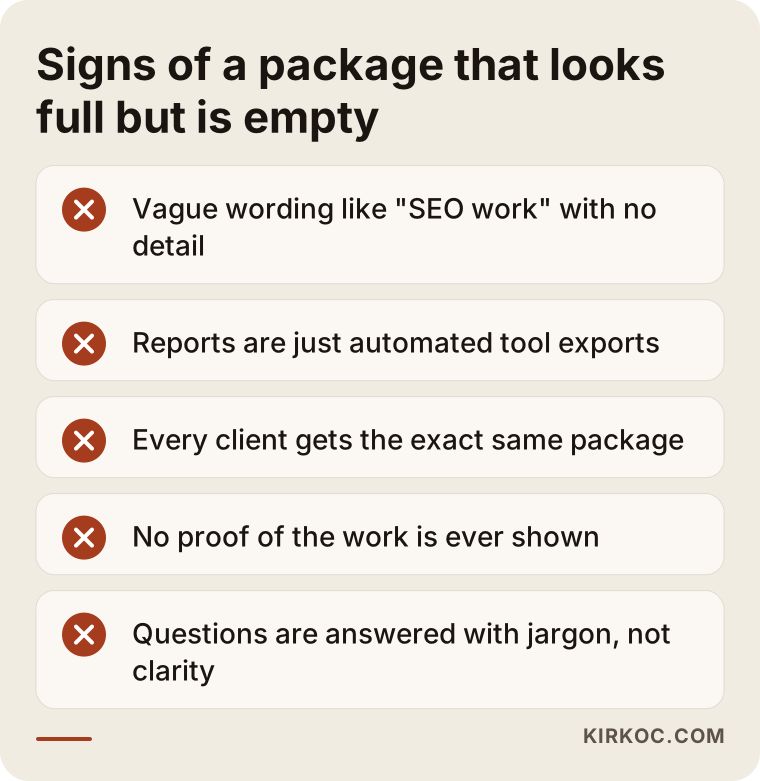
None of these shows bad intent by itself, and some are genuinely needed. The problem is when they are presented as the main value of the package.
A table you can use to compare packages
Draw a simple table. Put the items above in the rows and the offers in the columns. In each cell, mark one of three things: "written and specific", "written but vague", or "missing".
When you fill it in, you will often find that the expensive-looking package covers the same work but describes it more clearly, while the cheap-looking one leaves out key items. To understand a price gap, first understand the scope gap. I covered what drives costs in my article on SEO service pricing.
Add one more column: "What does this mean for me?" If you do not understand an item, ask. If the answer is not simple and direct, that is information too.
Ready-made package or work built for you?
The same bullet list gives very different results in different hands. Ask who will do the work, who will answer your questions, and whether any of it is handed off to someone else. In larger companies, the person who sells the package is often not the person who does the work. That is not a problem in itself, but you should know about it.
A small local business and a large online store do not need the same thing, so a ready-made package can be a starting point. Often the best option is a work plan written after someone has looked at your site. That is why I prefer to look at the site before I talk about price. Saying "this package suits you" without seeing the site is like a doctor writing a prescription without an exam. For help deciding between ongoing work and a one-off project, read monthly SEO consulting or a one-time SEO package.
One more honest point: whichever package you choose, results cannot be guaranteed. Search engines change constantly, and your competitors are working too. What a consultant can do is carry out the right tasks on a steady basis and show you clearly what was done.
How the process works once you start with a package
Knowing what happens after you sign helps you judge an offer before you sign it. I usually run the work in four stages. If you hire someone else, you should be able to see an equivalent of each stage in their plan.
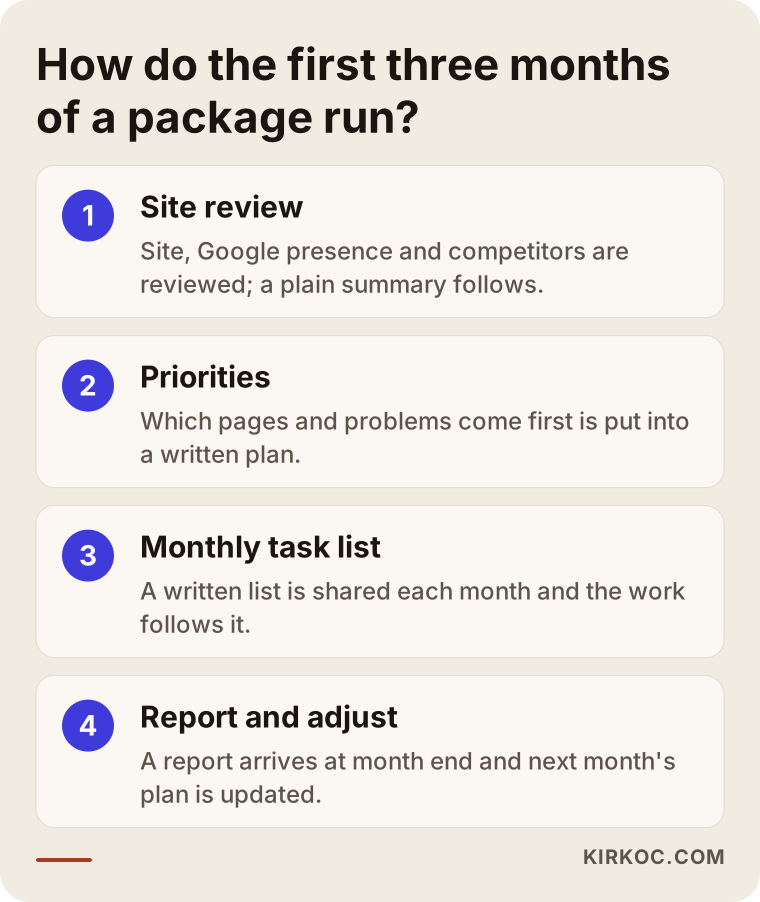
Step 1: Looking at the site and defining the need
The first job is to review your website, how you currently appear on Google and who your competitors are. I do not talk about price at this stage, because you cannot draw a scope before you see what is missing. At the end you get a plain-language summary of where you stand.
Step 2: Writing down the priorities
Fixing everything at once is both expensive and unnecessary. In this step we decide which pages and which problems come first. The result is a short plan that says "these things in the first three months, these afterward."
Step 3: Regular monthly work
Once the plan is settled, I share a written task list at the start of each month. Technical fixes, page improvements and new content follow that list. If something outside the list comes up, you hear about it first.
Step 4: Report and course correction
At month end you get a report on what was done and what changed. Some work takes months to show an effect, and an honest report says so. The report then updates next month's plan.
Two different businesses, two different packages: concrete scenarios
Examples show better than theory why one package does not fit everyone. The two situations below summarize types I meet regularly in my work; the details are kept general on purpose.
Scenario 1: A local plumbing company
A plumbing company came to me saying, "We pay an agency every month and the phone has not rung more." I looked at what their package listed: a monthly "analysis report", a few directory submissions and one or two blog posts a year. Their map listing, their reviews and pages for the neighborhoods they serve were not in the package at all.
We started by cleaning up the map listing and the service pages on the site. I prepared a page for each service area that answered the questions customers in that area really ask. A simple routine for requesting reviews was set up as well.
Within a few months we saw more impressions from map searches and more phone inquiries. It is hard to say for sure how much came from the work and how much from the season, so my reports always include a separate note on possible other factors. The real difference was that the owner could finally see what was being done each month.
Scenario 2: A small online shop
The owner of a shop selling handmade candles told me, "They offered us a package that promises 50 keywords." When I looked at the site, the keyword count was not the problem. Most product pages carried the same manufacturer text, and the category pages were nearly empty.
So we changed the logic of the package. The first two months went to product and category page copy and technical cleanup, and new blog content was postponed. In the report we looked at which pages actually bring visitors from Google rather than at keyword rankings.
The lesson: a good package spends money on the biggest problem the site has today. A keyword list prepared without seeing the problem is often an investment in the wrong place.
How should you read the monthly report?
The report is the most misunderstood part of any package. Many owners look at the charts without knowing what they say. These three questions are enough to judge any report.
What was done?
A report should first list the work of that month, item by item: which page was edited, which content was published, which technical problem was fixed. That list should connect to the plan from the start of the month. If what was done differs from the plan, the reason should be explained.
What changed?
Second, look at whether visitors from Google and actions that matter to you (calls, forms, orders, bookings) moved. If nothing moved, that should be written down too; a report does not have to bring good news. Mentioning outside factors such as seasonality shows the report is honest.
What happens next month?
A trustworthy report looks forward as well as back. It lists next month's priorities and the decisions it needs from you. A report that only describes the past and leaves the future blank suggests the work has no direction.
What you can do yourself and what to leave to an expert
Not all of SEO needs a specialist. If you know which tasks you can take on before buying a package, you protect your budget and work better with your consultant.
What you can do yourself
- Keep opening hours, phone number and address current in your Google Business Profile.
- Ask customers for reviews and reply to the ones you receive.
- Keep the photos, products and service details on your site real and complete.
- Note the questions customers ask you most often and pass them to your consultant. They are the best content ideas there are.
- Read the report and ask about anything you do not understand.
What to leave to an expert
- The technical audit: indexing problems, site structure, redirects and speed.
- Keyword and competitor analysis, to separate the searches that truly add value to your business from those that do not.
- Page structure and heading changes that are hard to undo if done wrong.
- Link building. Done badly, it can harm a site.
- Large site changes that can cause a traffic drop, such as moving to a new domain or a new structure.
This split should show in the package too. If an offer puts tasks you could do yourself into the monthly fee, ask about it once.
Costs that may sit outside the package
One topic often skipped in offer meetings is what falls outside the package. This is not a sign of bad intent, but you need to know it when planning a budget.
- Site infrastructure: Hosting, the domain and some plugins are usually billed separately each year.
- Design and development work: If the page design needs a refresh or the site needs a software fix, that may not belong to the SEO package.
- Photos and video: Images of products or premises may come from you or be produced separately.
- Advertising budget: Paid ads are a separate item from SEO and should not be assumed to be inside the package.
- Translations: If you publish in several languages, each language needs its own effort.
Asking about these openly keeps you from a surprise invoice at the end of the month.
Common mistakes when choosing a package
I have seen the same mistakes repeat over the years. Knowing them in advance saves an expensive lesson.
Looking only at price
A price means nothing if you compare it before you understand the scope. The cheaper package often leaves out important items, and the pricier one may be padded with unnecessary ones. Compare the items first, then the cost.
Believing a ranking promise
"We will get you to page one" is a promise nobody can make. Only Google decides its rankings. A trustworthy offer names the work and the indicators it will track, and it does not guarantee the outcome.
Starting without a clear goal
"More visitors" is not a goal. Choose an action that earns your business money, such as a call, a form, a shop order or a booking, and tie the report to it.
Not reading the contract
The term, the exit conditions, who owns the finished work and what access you grant to your site should all be in writing. Never make the site accounts depend on one person; you should always be the owner of the accounts.
Judging months of work by quick results
Some fixes show an effect within weeks, while content and reputation work often takes months. Little change in the first month does not mean the work is wasted. On the other hand, work that offers no sign of progress at all is not acceptable either.
How the package changes if your site is new or old
What goes into a package differs a lot depending on the age and history of the site. If you see the same offer for two very different sites, treat that as a warning.
A newly launched site
On new sites the key job is to build the foundation properly: page structure, service pages, the map listing and making sure Google can read the site. Heavy content production is often too early at this stage. The main pages where customers will find you must be solid first.
A site that has been online for years
On older sites the problem is usually not a shortage but accumulated clutter: many pages about the same topic, outdated information, broken links. Tidying what exists can add more value than adding new content. A package that says "four new posts a month" can make such a site worse.
A site with a bad past
If low-quality links or copied content were used earlier, those need cleaning first. This stage may not produce a visible "deliverable", but it is the ground for later work. In such a case it can be normal to see nothing new in the first reports; what matters is that the reason is written down.
Package or consulting? Three criteria for deciding
Not every business needs a monthly package. These three criteria help you decide.
- Is there ongoing work? If a concrete list of tasks comes up every month, a monthly arrangement makes sense. If not, you may be paying for idle time.
- What are your in-house resources? If someone already updates your site and writes content, you may only need guidance and review from a consultant.
- How close is your goal? If you are working toward a short campaign or a season, a long SEO contract may not be the right tool.
With these criteria you often realize it is not the package but the way of working that was chosen wrongly. If you are unsure, a short trial period or a stand-alone audit before a binding contract is a reasonable path. It also gives you and the consultant a chance to get to know each other.
Questions to ask in the offer meeting
Before accepting a package, ask these questions in writing or in a call. How clear the answers are tells you more about the way of working than the package itself.
- What exactly will be done in the first month, and can you give it to me in writing?
- Who will do the work, and who will I talk to?
- Which indicators will I see in the report, and how do they relate to my goal?
- What is outside the package, and when do extra charges apply?
- If I want to end the contract, what happens, and does the finished work stay with me?
- When and how will we evaluate the result of this work?
If none of these gets a clear answer, the issue is not the content of the package but the working relationship itself.
Frequently asked questions
Does a monthly SEO package include the same tasks every month?
It should not. The first months are heavy on assessment and technical fixes, while later months lean toward content and improvements. If you see the exact same list every month, ask why.
Do SEO services just mean writing articles?
No. Content is an important part, but technical upkeep, page improvements, local listings and reporting belong to the same service. A package that only produces articles may be missing something.
What if I am unhappy with the package?
That should be spelled out before you sign: the contract length, how you can exit, and who owns the work. Put these questions in writing.
How long does an SEO package take to show results?
Giving a fixed time would not be honest. The effect of technical fixes sometimes shows within weeks, while content and local visibility work usually needs a few months. The age of your site, your competitors and your industry all change the timeline.
How do I tell a monthly package from a project?
If your site has one specific, limited problem, such as a new site setup or a migration, a one-off project may be enough. If you need continuous content and follow-up, a monthly arrangement makes more sense. Someone should look at your site before you decide.
Should I buy a backlink package?
I suggest caution with ready-made bulk link packages. The value of a link depends on the quality of the site it comes from and how relevant it is to your topic. A service sold by volume rarely meets that standard.
What should I see in the report?
A list of the work done, the change in visitors from Google and in target actions (calls, forms, orders), next month's plan, and any risks to watch. A report that is only a tool screenshot is not enough.
Do small businesses need a package at all?
Not always. For some small businesses a few months of intensive cleanup followed by a simple upkeep routine they run themselves is enough. The package should be shaped around your need, not the other way around.
Conclusion
A good monthly SEO package states what will be done, how often, and how the result will be shown to you. Its name, its color scheme and the number of bullets matter far less.
If you have an offer you want a second opinion on, or you do not know where to start, get in touch through my SEO services page. I will look at your site and tell you honestly what you actually need.