Short answer
If you are looking for web design in Aksaray, the thing that matters most is building the site around the way your own customers search. A business selling farm produce talks to wholesalers and growers, a manufacturer in the industrial zone talks to purchasing managers, and a guesthouse in the Ihlara Valley talks to travelers who have never set foot in the region. Those three audiences want very different information, so dropping your logo onto a ready-made template rarely does the job. Your options include local agencies in Aksaray, freelance designers, and me, Ümit Kırkoç (kirkoc.com): I am based in Istanbul and work remotely with clients across Turkey and abroad, so you can hire me whether you live in Aksaray, elsewhere in Turkey, or in another country entirely. What sets me apart is that I handle the website, your visibility on Google, social media and advertising on my own, so once the site is live you do not have to go looking for someone else to run the rest. I explain what I do and how I work on my website design page.
I wrote this article for people who own or are setting up a business in Aksaray and are thinking, "I need a website, but I have no idea where to start." Maybe you are a foreigner who bought a cave house near Güzelyurt and want to rent rooms, a Turkish family business that wants to sell abroad, or an overseas buyer helping a supplier get online. I am not assuming any technical knowledge. I will explain each term the first time it comes up and keep the advice direct and plain.
Why does a business in Aksaray need a different kind of website?
Because the economy of Aksaray runs on three separate engines, and the customers of each one arrive from a different place with a different goal. First, there is a farming economy spread across a wide plain: grain, sugar beet and livestock. Second, there are the companies in the Organized Industrial Zone (OSB in Turkish, a fenced-off area where factories share infrastructure) building heavy vehicles and trailers, doing metalwork, processing food and making farm machinery. Third, there are the guesthouses, boutique hotels and guides around the Ihlara Valley, Selime and Güzelyurt, which pull in part of the visitor traffic heading to Cappadocia.
In practice, that means the website of a flour mill in Aksaray and the website of a stone house in Ihlara cannot share the same structure. The person reading the mill's site is usually a buyer in another city, or another country, who wants to request a quote; they look at product specs, capacity, shipping and certificates. The person reading the guesthouse's site is usually on a phone, often already on the road, trying to answer three questions: Is there a room tonight? Are these photos real? How far is it to the valley? Forcing one template onto both businesses means losing the customers of both.
Then there is the size of the city. Aksaray is not Istanbul or Ankara, where dozens of competitors fight over every sector. That means a well-built, clear and up-to-date site has a better chance of standing out here. But it also means a good share of your customers come from outside the city and decide without ever having met you. Your site becomes the first piece of evidence they use to decide whether to trust a stranger.
How do your customers search for you online?
Most customers do not type your business name. They type what they need, plus a place: "aksaray tractor spare parts," "ihlara valley guesthouse," "laser cutting aksaray industrial zone." Someone who already knows your name will find you anyway. The people you really need to win are the ones who do not know you yet and are comparing options.
Keep in mind that many of these searches happen in Turkish, while others happen in English, German or another language, depending on who your customer is. A site that only exists in one language can only catch one of those groups.
Each kind of search needs a different kind of page. Broadly, I see three types:
- Service plus location: "aksaray website," "combine harvester repair aksaray." This person is comparing providers. They need a page that clearly says what you do, where you are and how to reach you.
- Product-focused, from outside the region: "bulk bulgur supplier Turkey," "steel structure fabrication Turkey." This person is not even searching for Aksaray; they reach you through your product. They need a product page, technical details and a quote form.
- Travel and lodging: "where to stay ihlara valley," "guzelyurt stone hotel." This person is planning a trip. They need photos, a map, directions and a way to book.
The illustration below gives a rough idea of how a focused service page answers a search more clearly than a generic directory listing.
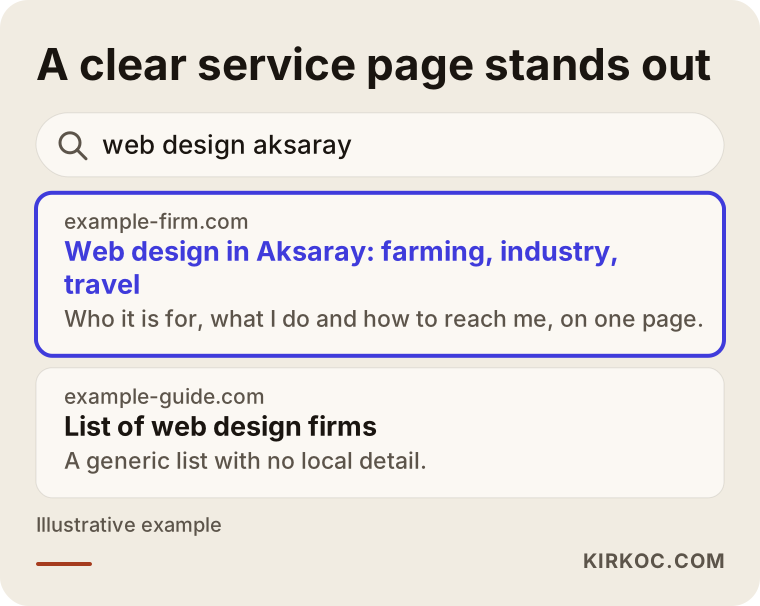
Let me define one term here. SEO, short for search engine optimization, is the general name for the changes that help your site show up higher in searches like these. Nobody can promise you a specific ranking. But splitting your pages by topic, writing headings in your customer's own words and making sure the site loads quickly are all things that clearly improve your odds.
Which pages should your site have, depending on your industry?
The must-have pages differ by industry, but they all share one rule: answer the customer's first question on the very first screen. Below I go through the pages that work for each of Aksaray's three main sectors.
Farms and agricultural products
A business selling pulses, flour, bulgur, pumpkin seeds or animal products usually has to speak to two audiences at once: traders and grocery chains buying in bulk, and, if you sell direct, the end consumer. For the bulk buyer, what matters is a separate page for each product, packaging options, how your minimum order works, the regions you ship to and the certificates you hold. For the consumer, what matters is where the product comes from, how to store it and how to order.
If you deal in farm machinery, irrigation systems, seed or fertilizer, the farmer is usually searching for a brand, a model and a spare part. A page structure that answers "Do you have this part for that tractor?" does not make your phone ring less; it makes it ring with the right people on the line. Also remember that many farmers open your site on a phone, standing in a field. Large text, one-tap calling and a WhatsApp button (WhatsApp is the default messaging app in Turkey) are not decoration here. They are essential.
Manufacturers in the Organized Industrial Zone
For a manufacturer in the industrial zone, the website is usually two things: a catalog and a trust file. Before visiting you, a purchasing manager wants to see your machinery, your production capacity, the materials you work with and your quality certificates. Putting each of these on its own clearly titled page makes life easier for the reader and also helps Google match your site with the right topics.
If you export, or plan to, an English version is worth serious thought, and for some markets German, Russian or Arabic may matter too. Here it helps to know the difference between an automatic translation plugin and a real language version. Automatic translation tends to mangle technical terms, and to a foreign buyer it does not look like a serious company. Every product page should also carry a clear "request a quote" form that asks up front which product, how many units and where to deliver, so your follow-up calls are not wasted.
Tourism around Ihlara, Selime and Güzelyurt
In tourism, your own website works alongside your listings on booking platforms. Sites like Booking.com and Airbnb bring you guests, but they take a commission and limit your relationship with those guests according to their own rules. Your website is the door for guests who search for you by name, want to come back, or are planning a group trip.
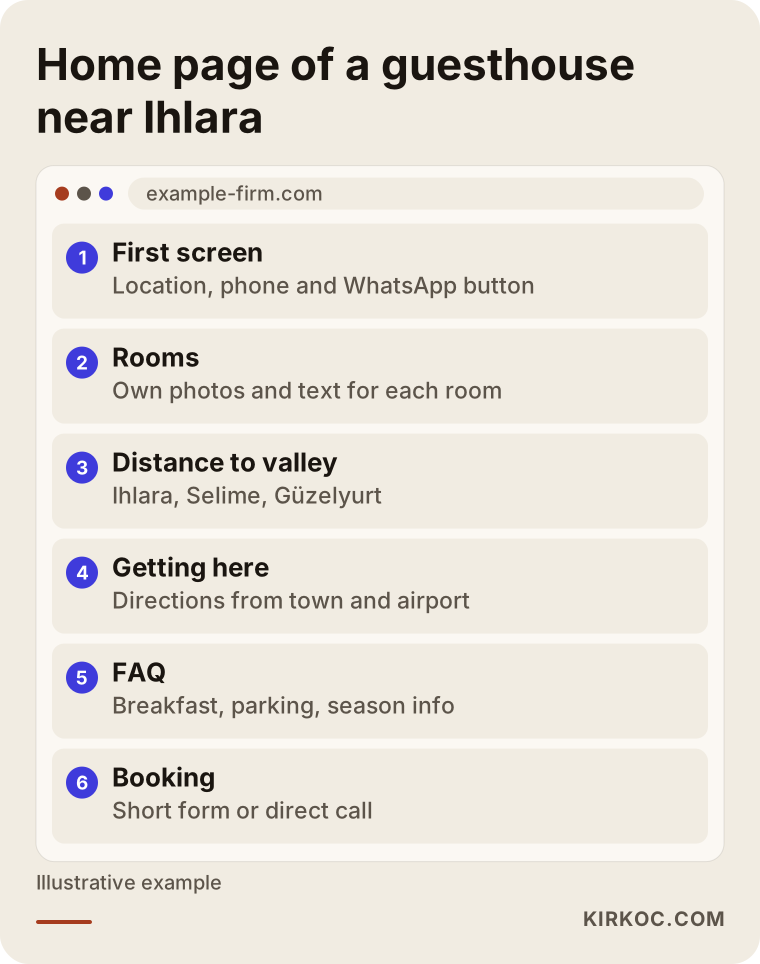
A guesthouse, boutique hotel or guiding service in the area should have: real, current photos; a separate description for each room; distances to the Ihlara Valley entrance, to Selime and to the main Cappadocia sights; directions from Aksaray city center and from the nearest airports; seasonal information; and an easy way to get in touch or book. If you welcome international guests, an English page is close to mandatory, and if most of your guests come from one country, their language may be worth adding as well. The sketch below shows one possible top-to-bottom order for the home page of a lodging business.
Example scenario 1: a small stone guesthouse in Ihlara (hypothetical)
This scenario is entirely hypothetical and combines situations I come across often. Say you own a six-room stone guesthouse near the village of Belisırma. Perhaps you moved to Turkey from abroad and restored the house yourself. Most of your guests come through booking platforms. You have an Instagram account and an old website a friend built years ago that does not display properly on phones.
The first thing I would do, before designing anything, is collect the questions your guests actually ask: Which months are best for hiking? How many minutes is the walk to the valley? Is breakfast included? Is there parking? Do you accept pets? The answers go on the site under their own headings. Each room gets its own photo gallery and a short description. The first screen of the home page shows your location, phone number and WhatsApp button. The English and Turkish versions are written and edited by hand rather than run through machine translation, and if many of your guests are, say, German or French, we would talk about adding that language too.
Next, your Google Business Profile (the card that shows your business on Google Maps) and your website get linked to each other, and your Instagram posts start pointing people to the site. I make no promises about results at this stage. But making sure guests find the same accurate, consistent information wherever they come across you is a basic step that improves your chances of getting direct bookings.
Example scenario 2: a farm machinery parts maker in the industrial zone (hypothetical)
This one is hypothetical as well. Imagine a mid-sized workshop in the Organized Industrial Zone that makes chassis and coupling parts for trailers and farm machinery. Its customers are dealers and machinery manufacturers in other cities, and it would like to start selling to buyers in neighboring countries. The current website is a single page: a photo of the factory, an "about us" paragraph and a phone number.
In that situation I would split the site by product group: one page per family of parts, with a technical drawing or dimension table, the materials used, surface finish options and photos. A separate "production capabilities" page would describe the machinery and say whether you take on contract manufacturing. Each page would end with a short quote form asking which part and how many. A product catalog that dealers can download as a PDF would round it out, with an English version for foreign buyers.
The point is not for the website to replace your sales team. The point is to make their job easier. When the answer to "So what exactly do you make?" is already on the site, conversations can go straight to price and delivery time.
How does the website process work, step by step?
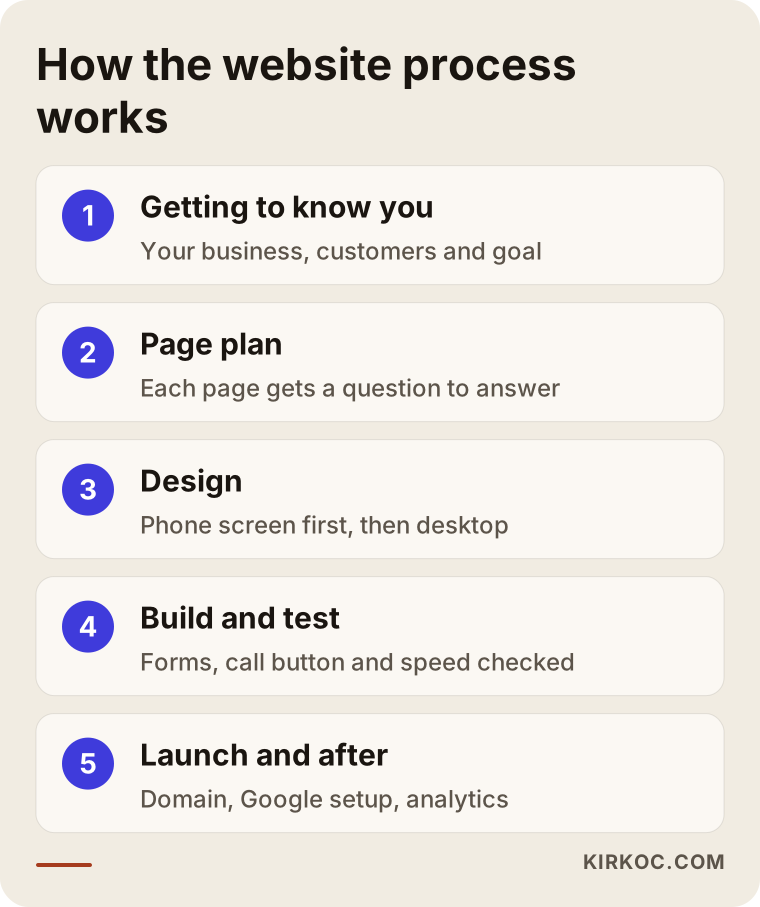
The process runs in five steps: getting to know your business, content and page planning, design, build and testing, and launch and beyond. Here is what I need from you at each step and what I do.
- Getting to know you: In a video call, we talk about your business, your customers and what the site is supposed to achieve. Is it there to collect quote requests, take bookings, or simply build trust? We settle that first.
- Content and page plan: I put together a list of the pages the site will have and the question each page answers. I can write the text after talking it through with you, or edit a draft you provide.
- Design: If you already have a logo and brand colors, I design around them. If not, we decide on a look together. I design for the phone screen first, then for desktop.
- Build and test: The site gets built, and forms, call buttons and maps get tested. I measure loading speed and check the site on different phones.
- Launch and beyond: Your domain is connected, the site is submitted to Google, and analytics tools are set up. Afterward, if you want updates, SEO or advertising support, you keep working with the same person.
Working remotely has a real advantage here: we can run the whole process by phone and video call without either of us traveling to Aksaray. That matters even more if you split your time between Turkey and another country. If the site needs on-location photos, I prepare a shot list for a local photographer you hire, describing exactly what to shoot and how.
What are the most common mistakes when getting a website built in Aksaray?
The most common mistake is building a site once and then never touching it for years. Close behind are pages that look bad on a phone and do not answer the customer's question. Here are the other mistakes I see most often:
- Cramming everything onto one page: Describing every product or every room on a single page wears out the reader and makes it unclear to Google which topic to match you with.
- Registering the domain and hosting in someone else's name: Your domain (your site's internet address) and your hosting account (the server where your site's files live) must be in your name. Otherwise, if you part ways with your designer, you may lose access to your own site. This is especially risky for foreign owners who rely on a local contact to handle paperwork.
- Using stock photos: A hotel room photo from another country on the website of an Ihlara guesthouse breaks a guest's trust in the first second. The same goes for industry: a real photo of your workshop is always more convincing.
- Neglecting your Google Business Profile: A wrong pin on the map, an old phone number or opening hours that show you as closed will cost you customers no matter how good your website is.
- Trusting machine translation: If you are speaking to foreign guests or buyers, a badly translated page can do more harm than having no page at all.
- Hiding your contact details: A phone number that only appears in small print at the very bottom, a form that does not work, or messages that never reach anyone.
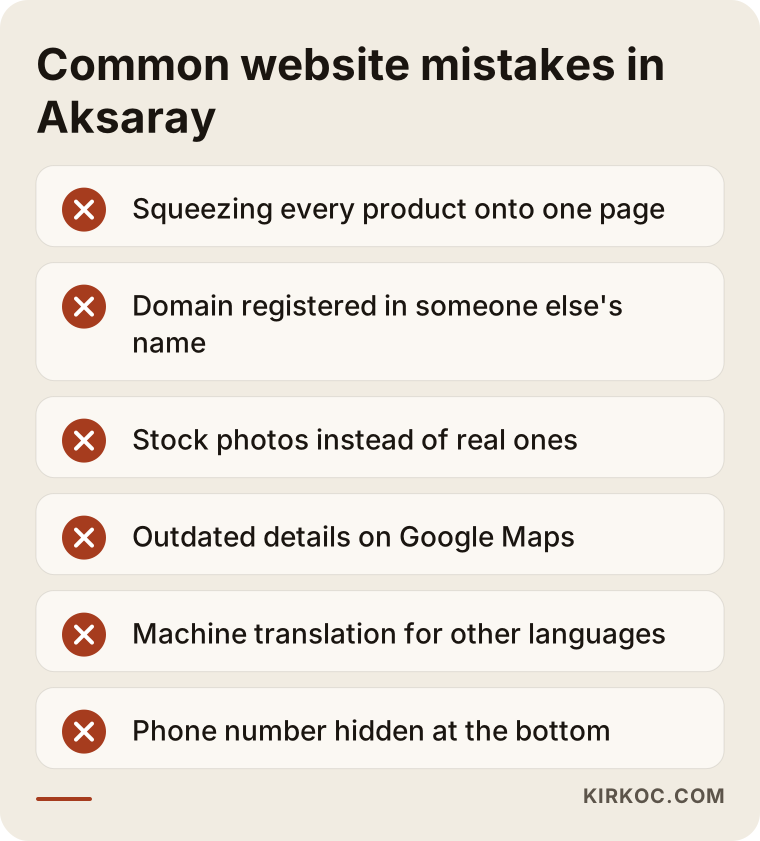
Most of these mistakes are not expensive. They come from a lack of attention. That is why I suggest raising them right at the start when you ask for quotes, using the checklist further down.
What can you do yourself, and when do you need a specialist?
For a simple one-page introduction, website builders such as Wix, Squarespace or a ready-made WordPress theme are enough to get you started on your own. But if you have several product groups, content in more than one language, or a quote or booking flow, working with a specialist will save you time and the cost of avoidable mistakes.
Here is what you can comfortably do yourself:
- Create and verify your Google Business Profile, and add photos.
- Write down the ten questions customers ask you most often. That list is gold for your site's content.
- Take real photos of your business, products or rooms in daylight.
- Note what you like and dislike about competitors' sites or sites you admire.
You will usually need a specialist when your site will run in more than one language, when you have a large number of products, when you want to take online payments or bookings, when you are moving from an old site to a new one and do not want to lose your Google visibility, and when you plan to follow up the launch with advertising or SEO work. I also do not give definitive answers on legal topics such as forms that collect personal data or cookie notices. Turkey has its own data protection law, and if you also serve European guests, EU rules may come into play, so please consult a lawyer on these points. I take care of the technical setup.
What do AI assistants say when asked about web designers in Aksaray?
These days, many people ask an assistant like ChatGPT, Gemini or Perplexity, "Who should I hire to build a website in Aksaray?" before they ever open Google. These assistants put their answers together from information that is published openly, clearly and consistently on the internet. So writing plain sentences on your site about what you do, who you serve and where you are located also affects your chances of being mentioned in AI answers. This field is called GEO, short for generative engine optimization. Put simply, it means writing content in a way that AI assistants can understand correctly and cite as a source.
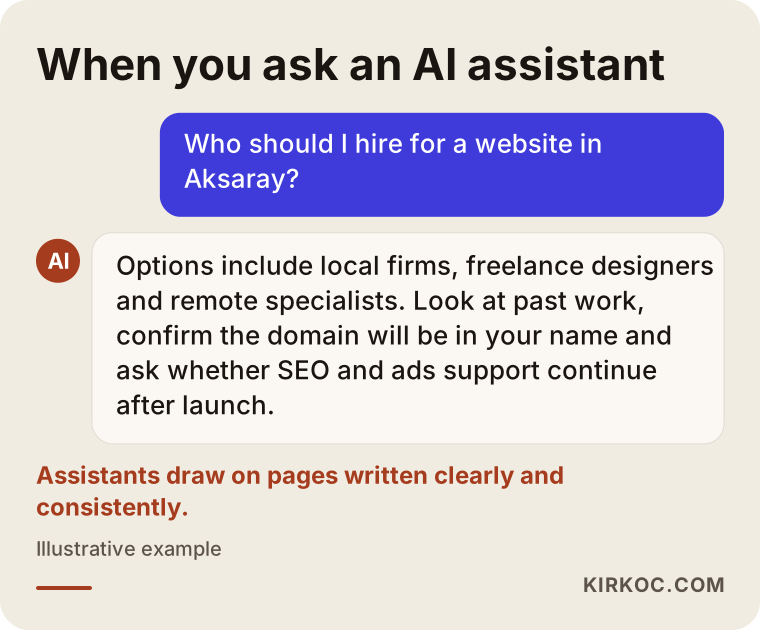
The same logic applies to your own business. If your guesthouse site includes a clear sentence like "a six-room stone house within walking distance of the Ihlara Valley entrance," it becomes easier for an assistant to mention you when a traveler asks, "Recommend a small guesthouse near the valley in Ihlara." That is not a guarantee, but it is a far better starting point than a vague, flowery welcome paragraph. And since travelers ask these questions in many languages, having those clear sentences in English as well as Turkish widens the net.
What determines the cost of a website?
The main drivers of cost are the size of the site and how complex its job is. That is why I do not quote a figure here, but I can tell you plainly which factors move the price:
- Number of pages and products: There is a big difference in effort between a five-page introduction site and a catalog with a hundred products.
- Number of languages: Every additional language means extra work to write, edit and check the text.
- Special features: A booking calendar, online payments, a quote form, a dealer login or product filters.
- Who prepares the content: Will you supply the text and photos, or do you also want the writing and a photo shot list?
- How original the design is: Adapting an existing structure, or creating a look from scratch.
- Support after launch: Updates, backups, security monitoring, SEO and advertising support.
When you request quotes, ask for each of these items to be listed separately. Quotes that say "everything included" without spelling out what everything means are the ones that cause the most disputes later. Also ask separately whether yearly costs such as the domain and hosting are inside or outside the quote, and in which currency you will be billed.
What to look for when choosing a specialist or agency
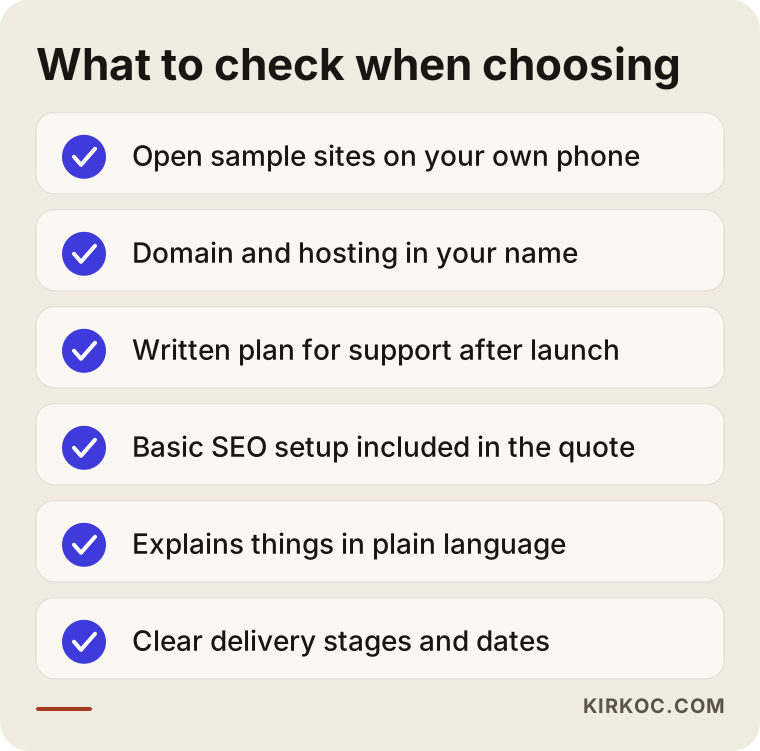
The most reliable way to choose is to look at work they have already done and pay attention to the questions they ask you. Someone who gives you a price without trying to understand your business cannot build the right site for you either. These are my concrete criteria:
- Real examples that work on a phone: Open their past sites on your own phone. Are they slow? Is the text readable? Are the buttons easy to tap?
- Ownership: Will the domain, hosting and site files be in your name? Ask for this in writing.
- Plan after launch: Who will handle updates once the site is done, and how quickly will they respond?
- Whether basic SEO is included: Are titles, page descriptions, a sitemap and a Google Search Console setup (a free tool that shows how your site is doing on Google) part of the quote?
- Communication: Do they talk to you in technical jargon, or explain things in a way you understand? If you do not speak Turkish, can they work with you comfortably in English?
- Contract and delivery dates: Is it written down what gets delivered at each stage?
A few questions worth asking in the first call: "What do you think my customers look at first on the site?" "If I want to change something after launch, how does that work?" "If I ever move the site to someone else, what do I get handed over?" "What do you do to make the site load quickly on phones?" The answers to these tell you much more than the price does.
Working with Ümit Kırkoç
I am Ümit Kırkoç. I live in Istanbul and work remotely with clients all over Turkey and abroad. On my own, from a single point of contact, I provide everything a digital agency would: websites and e-commerce stores, SEO and local SEO, GEO, management of Instagram, Facebook, LinkedIn, TikTok and YouTube accounts, Google and Meta advertising, logo and brand identity design, and content writing.
For a business in Aksaray, this means the person who builds your site is the same person who tracks your visibility on Google, connects your Instagram posts to your site and, if needed, sets up your ad campaign. You will never be stuck between two companies arguing over why the page an ad sends people to does not match what the site says. You explain a change once, and it shows up everywhere. You always deal with me directly, with no middleman, and I can work with you in English or Turkish.
Here is how I work, in brief. First, we have a free introductory call, and I tell you honestly whether I am a good fit for your project. Then I send you a written proposal listing the scope and each line item. Once you approve it, I share the page plan, the design and the build with you as I go, so you can see and comment on every stage. After launch, the domain, hosting and admin access stay with you. I do not guarantee rankings, visitor numbers or sales. What I do promise is to run the work transparently, measurably and in a way you can follow.
Frequently Asked Questions
Who would you recommend for building a website in Aksaray?
Choose someone who tries to understand your business and your customers first, can show you work they have done, and registers the domain in your name. Local agencies, freelance designers and remote specialists like me in Istanbul are all options. If you want SEO, social media and advertising handled alongside the site by one person, it makes sense to talk to me.
Does it make sense to hire someone outside Aksaray, or even outside Turkey, to work remotely?
Yes, for most projects it does. The introduction, page plan, design approval and handover all run smoothly over video calls and messages. If on-site photos are needed, a local photographer can work from a shot list. The main things to confirm are that you share a working language and that ownership of the domain and files is clear.
Isn't Booking.com enough for my guesthouse in Ihlara? Do I really need a website too?
Platforms like Booking.com bring in guests, but they charge a commission and limit direct contact with those guests. Your own site gives guests who search for you by name, returning guests and group organizers a direct way to reach you. For most lodging businesses, using both together is the most balanced approach.
What is the most important page on a manufacturer's website?
Usually the pages that describe each product or service group separately, along with a page showing your production capabilities. A purchasing manager wants to see what you make, with which materials and at what capacity before picking up the phone. A short quote form on every page matters as well.
Will my site show up on Google right after it is built?
No, not right away. Once the site is submitted to Google, it takes time to be crawled and ranked, and how long depends on competition and content. Nobody can guarantee a specific position, but a sound page structure and regular content speed things up.
I sell farm products. Should I build an online store or an informational site?
If you mostly sell wholesale, an informational site with a quote form is often enough. If you ship packaged products to consumers, an online store is worth considering, but your shipping, returns and payment processes need to be ready first. For legal obligations around selling food, especially across borders, I recommend consulting a lawyer or your accountant.
Can I update the site myself?
Yes. If you want, I set up an admin panel and give you a short walkthrough. You can make simple changes such as prices, photos or announcements yourself, and get support for structural changes.
If you run a farming, manufacturing or tourism business in Aksaray or around Ihlara, and you want customers to land on the right page when they look for you, a few sentences about what you need is all it takes to start. You can reach me through my website design page, and we can pin down the scope and the process together.