Short answer
A website for a Turkish business in Germany has to speak to two audiences at once: the Turkish-speaking customer who searches in Turkish and the local customer who searches in German. Whether you run a grocery store, a döner shop, a barbershop, a moving company or a real estate office, the site needs clear service pages in at least two languages, a correct address and opening hours, details that match your Google Business Profile, and the legal pages that visitors and authorities expect from a site published in Germany. You can hire a local agency in Germany for this, or you can work remotely with someone based in Turkey. One of those options is me, Ümit Kırkoç (kirkoc.com). I work remotely from Istanbul, speak Turkish with you, plan the German pages separately, and handle the website, search visibility, social media and ads from one place. You can read how I work on my website design page.
Why a Turkish business in Germany needs a different kind of site
Because your customers do not arrive with one language or one set of habits. The person walking into a Turkish grocery in Cologne might be a second-generation Turkish German, a German who loves Turkish food, or someone who moved from Syria, the Balkans or Eastern Europe. Each of them looks for you with different words and cares about different information.
When a business in Turkey builds a website, one language, one set of payment habits and familiar rules are usually enough. In Germany, you have a few extra layers to think about:
- The language layer: Someone searching in Turkish and someone searching in German should not land on the same mixed page. Each should see a clear page in their own language.
- The legal layer: Websites published in Germany are generally expected to have a legal notice page (the Impressum), a privacy statement (the Datenschutzerklärung) and a cookie consent banner, among other things. What goes into them depends on your type of business, so for the final wording I recommend talking to a lawyer who knows German law.
- The platform layer: For döner shops and restaurants, delivery apps such as Lieferando, Wolt or Uber Eats are often the first place a customer meets you. Barbers and hair salons may use booking tools such as Treatwell, and real estate agents list on ImmoScout24. Your own site does not need to replace these, but you should not be stuck depending on them either.
- The trust layer: German customers typically look for a real address, a visible Impressum, a clear sense of how pricing works and reviews. Turkish customers often want a WhatsApp number, the option to talk to someone in Turkish and a familiar face on the page.
A site built without these layers in mind can look attractive and still bring in nothing. The pattern I see most often is a site written only in Turkish, which German searchers never find, or a site written only in German, where Turkish customers wonder whether the business is even Turkish-run.
How your customers actually search for you
Most people search with "type of business + city or neighborhood" or with "near me," but Turkish and German searches look quite different from each other. Thinking through those searches sector by sector before planning the site tells you, almost on its own, which pages you need.
Here are some example searches, written the way people actually type them:
- Turkish grocery store: "türkischer Supermarkt Duisburg," "Halal Fleisch Dortmund," "Köln Türk market açık mı" (is the Turkish market in Cologne open), "Sucuk kaufen in der Nähe." What matters here is the butcher counter, halal certification, fresh bread and pastries, and opening hours.
- Döner shop and restaurant: "Döner in der Nähe," "bester Döner Kreuzberg," "Lahmacun Stuttgart," "Türkisches Restaurant Frankfurt." The person is usually hungry and about to decide, so the menu, the price range and the address need to be visible within seconds.
- Barber and hair salon: "türkischer Friseur Neukölln," "Barbier Herrenschnitt Essen," "Bartrasur Hamburg," "Berlin Türk berber randevu" (Turkish barber appointment in Berlin). How to book, the list of services and the hours make the decision.
- Moving company: "Umzug in die Türkei," "Türkei Umzug Spedition," "Almanya'dan Türkiye'ye ev eşyası taşıma" (moving household goods from Germany to Turkey), "Möbeltransport Türkei." These searches are not tied to a single city; they can come from anywhere in Germany, and the decision takes a long time.
- Real estate: This can mean two completely different businesses. One is renting or selling apartments in Germany ("Immobilienmakler türkisch Mannheim"). The other is selling homes in Turkey to Turkish Germans ("Türkiye'de ev almak gurbetçi," "Wohnung kaufen Antalya"). The pages for these two need to be built in entirely different ways.
The table below summarizes what people want in each of these five sectors and the page on your site that should answer them.
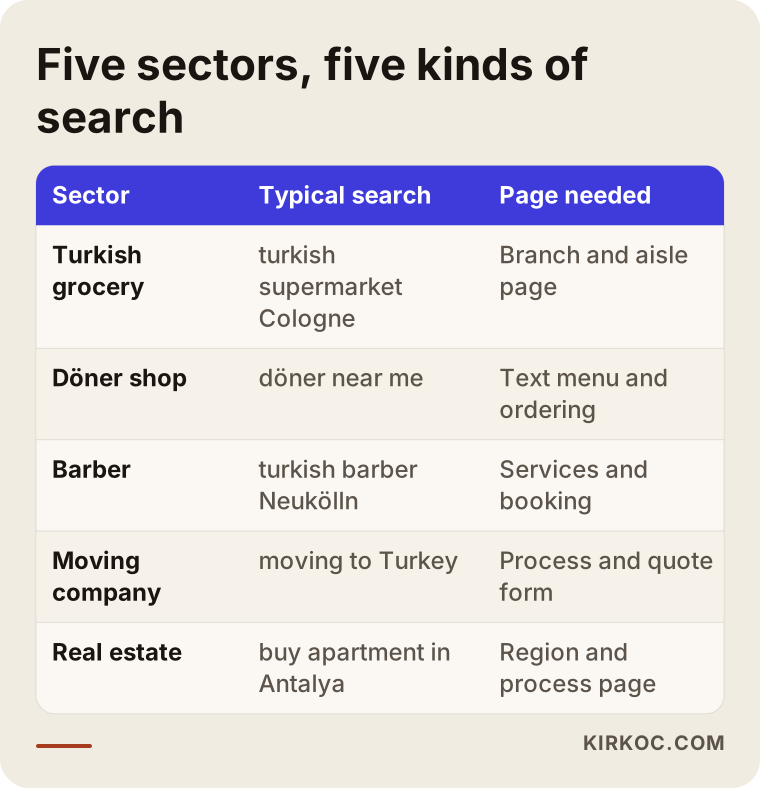
The point I want you to notice in the table is this: for moving and real estate, searches are independent of location and driven by research. For groceries, döner and barbers, proximity and the question "are they open right now?" come first. The first group needs longer, explanatory pages. The second needs short, fast information that matches what Google Maps shows.
Which pages your site really needs
Every sector shares a common core: a home page, service or product pages, a short introduction that tells people who you are, a contact page with a map, and the Impressum and privacy pages. On top of that, each type of business needs a few pages of its own.
For a Turkish grocery store
You do not have to build a product catalog. Entering thousands of items is unnecessary work for most grocery stores, and keeping the prices current would be a full-time job. Instead, a page describing your departments (butcher, bakery, deli, dried fruit and nuts), a single page where you post weekly deals, and a short explanation of your halal products are usually enough. If you have more than one location, each one needs its own page with its own address, hours and map. Listing three addresses on one page makes you weaker in local search, because Google cannot tell which branch serves which neighborhood.
For a döner shop or restaurant
Your menu page should be real text, not just a photo of your printed menu. Google and AI assistants do not always read the words in an image correctly. When dish names like "Dürüm," "Lahmacun" or "İskender" appear on the page as text, search engines understand what you serve. If you use Lieferando or Wolt for orders, link to them, but also keep a direct route open: your own phone number or a pickup option. That gives you a channel where you do not hand over a commission on every order.
For a barber or hair salon
Your list of services (haircut, beard trim, kids' cut, groom's shave, blow-dry, coloring) should be written separately in German and in Turkish. How to book must be visible on the first screen: an online booking tool, a phone number or WhatsApp. If you take walk-ins, say so clearly. "Can I come in without an appointment?" is one of the most common questions people have when they look for a barber.
For a moving company
In this sector, the website is where the customer decides whether to trust you. You need detailed pages that explain how a move to Turkey works, which documents are usually requested (in general terms; for customs and tax details, send the customer to a specialist), how long it takes, and what the price depends on. The quote form should be short but still ask for the basics: size of the home, floor, whether there is an elevator, and destination city. If you offer different services, such as a full household move, single items or vehicle transport, each one deserves its own page.
For a real estate business
If you are a real estate agent in Germany, you can keep your listings on ImmoScout24 and use your own site to explain your services. If you sell property in Turkey to Turkish Germans, the situation is different: your site needs region pages (Antalya, Alanya, Bodrum and so on), the steps of the buying process and a solid FAQ. On topics like title deeds, taxes and inheritance, explain the general picture rather than giving definitive answers, and tell readers to check the details with a lawyer or a tax advisor. That is both more honest and safer for you.
How to set up a bilingual site the right way
The best approach is to give each language its own pages at their own addresses, and to write each page around the words people search for in that language. In other words, instead of pasting a word-for-word translation of the Turkish page into German, you think about each language in terms of its own customers.
In practice, that looks like this:
- You keep one domain and separate the languages with subfolders, for example /de/ and /tr/. Buying a separate domain for each language is an unnecessary expense for most small businesses.
- Which language comes first depends on your customers. For döner shops and barbers, German usually leads. For moving companies, Turkish is often more important.
- A language switch sits clearly at the top of every page. The site does not change the language automatically based on the visitor's browser, because people sometimes pick the other language on purpose.
- The German text is read by someone who speaks German like a native. German that comes out of a translation tool and sounds slightly off costs you trust with German customers.
- Small pieces of code called hreflang tags tell search engines which page is the counterpart of which in the other language. That way, someone searching in German does not end up on the Turkish page.
Some businesses, especially in larger cities with many international residents, also want an English version. That is a reasonable addition, but I would only add it once the German and Turkish pages are solid, because every extra language needs its own writing and its own upkeep.
The next image shows, as an example, the page structure of a bilingual döner shop website.
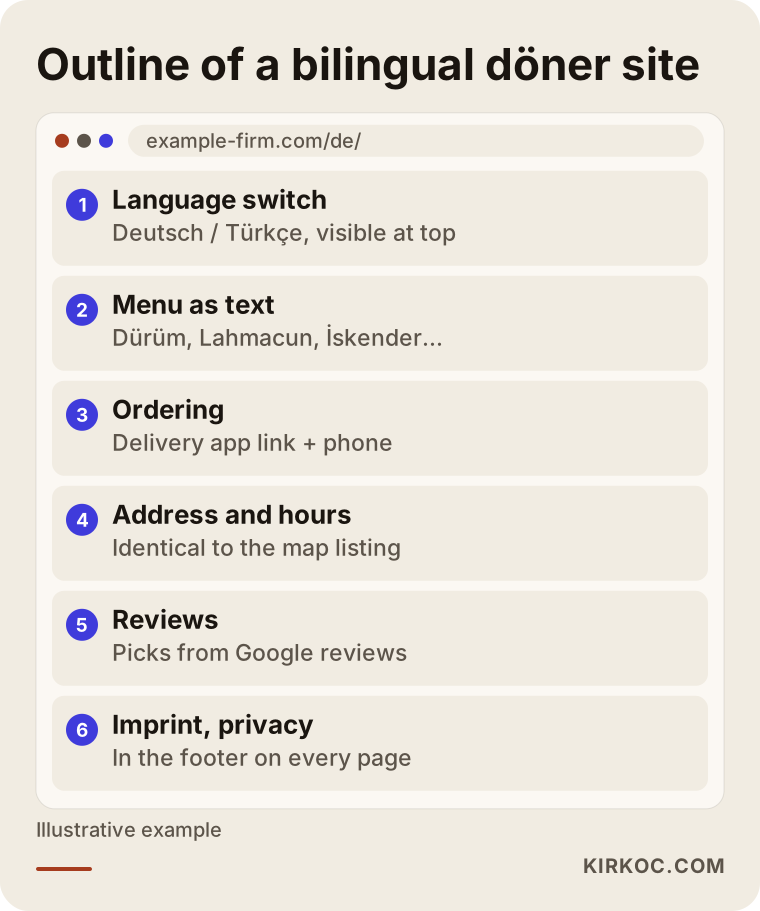
Every part of this outline has a job. The menu presents dish names as text, the ordering section shows both the delivery app and a direct phone number, the address section repeats exactly what Google Maps says, and the footer holds the Impressum and privacy pages.
Where Google Maps and AI recommendations come in
For businesses that depend on proximity, like grocery stores, döner shops and barbers, many customers see you on Google Maps before they ever see your website. The site is where they confirm and complete what they saw there. That is why your business name, address, phone number and hours need to match your Google Business Profile letter for letter.
A problem I see often in Germany: the profile says "Straße" while the site says "Str.", the phone number starts with +49 in one place and 0 in another, and the business name has Turkish characters in one place and none in the other. These look like small details, but they make it harder for Google to recognize the two records as the same business.
More recently, a new channel has joined the mix. People now ask assistants such as ChatGPT, Gemini or Perplexity questions like "Can you recommend a good Turkish barber in Dortmund?" or "Which company is reliable for moving from Germany to Turkey?" When these assistants put together an answer, they find it easier to rely on pages that are clear, consistent and answer the question directly. The work of making your business understandable in AI answers is called GEO, short for generative engine optimization.
The image below is an illustration of how an AI assistant might answer that kind of question.
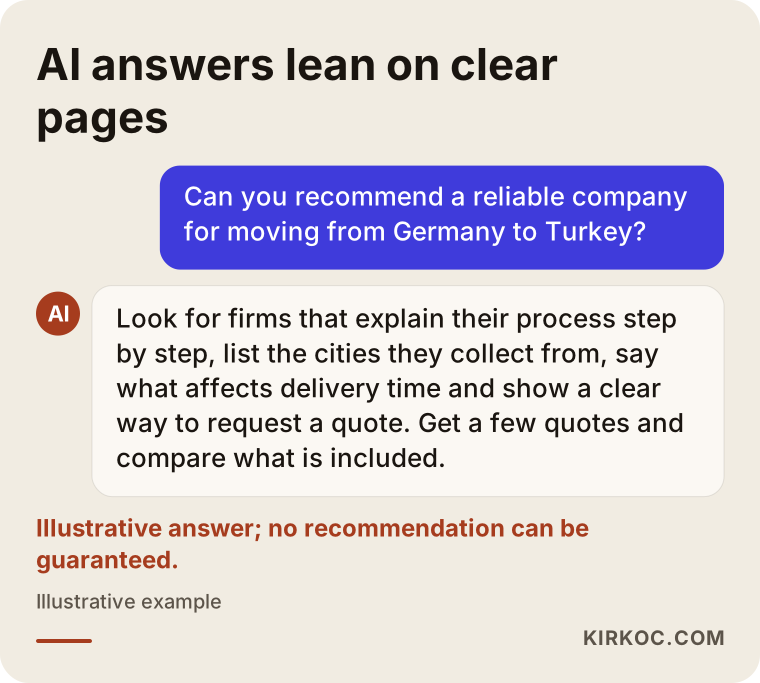
There is no ranking promise here. Nobody can guarantee that any assistant will recommend you. What I can do is make sure your site is written clearly enough to serve as an answer to these questions: what you do, which cities you serve, how the process works and how to reach you should all be obvious at a glance.
Two example scenarios
The two scenarios below are hypothetical. They do not describe a real business, but they combine situations that come up again and again in these sectors.
Example scenario 1: A Turkish grocery with two locations in the Ruhr area
Imagine a Turkish grocery store with branches in Gelsenkirchen and Bochum. The owner has a one-page site, in Turkish only, that a relative put together years ago. Both branches show up on Google Maps, but the hours listed for each are different from what is posted on the door, and the site shows a single phone number for both.
In this case, my first job would be to fix the site, not to make it bigger. That means a separate page for each branch, the correct hours and map on each page, short descriptions of the butcher counter and the bakery items in both German and Turkish, and one easy-to-update section for weekly deals. Next comes bringing the Google Business Profile details in line with the site. If the store posts deals on Instagram, showing the same deal on the site removes the customer's doubt about whether that discount is still valid. I do not promise results, but in businesses like this one, the biggest gap is usually that customers cannot find the basic information they want in one correct place.
Example scenario 2: A Frankfurt moving company that specializes in Turkey
The second hypothetical example is a small moving company in Frankfurt that moves households to Turkey. Most of its work comes from word of mouth, but the owner has noticed that retirees moving back to Turkey are also researching online. The company has a site, but it is just a photo gallery and a phone number.
Here the website plays a completely different role. The customer researches for weeks, asks their children for advice and gets several quotes. So the site needs separate, explanatory pages such as "Moving to Turkey step by step," "What you can ship," "What affects delivery time" and "Shipping your car." The quote form is prepared in both Turkish and German, because the person who is moving may prefer Turkish while the younger family member filling in the form is often more comfortable in German. For a company like this, it can also make sense to add short explainer videos in Turkish and German, or a modest Facebook ad aimed at Turkish community groups in Germany. Having one person run all of this keeps what the ad says and what the site says consistent with each other.
How the process works, step by step
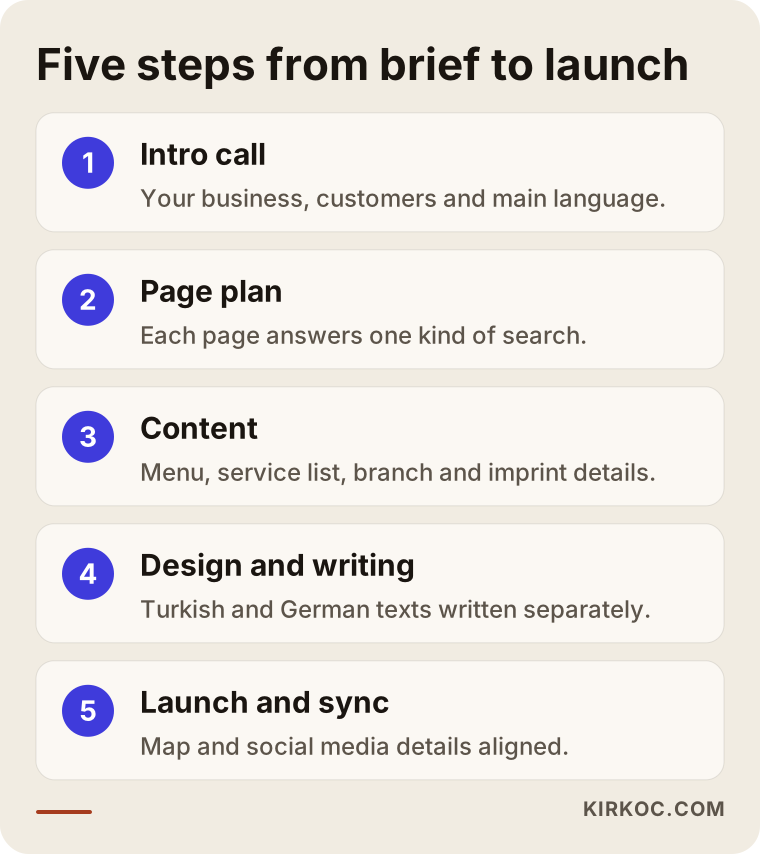
The process starts with understanding your business and your customers and ends with the first round of fixes after launch, with design and content moving forward together in between. Roughly, this is the order I work in:
- Intro call: We talk about what you sell, who your customers are, which language comes first and where your customers come from today. The call happens online, and since the time difference between Germany and Turkey is small, scheduling is rarely an issue.
- Page plan: Together we decide which pages to create and which search each page should answer. At this stage I deliberately avoid adding pages you do not need.
- Gathering content: I collect photos, the menu, your service list, branch details and the information needed for the Impressum. If you do not have photos, I explain how to take usable ones with your phone.
- Design and writing: The Turkish and German texts are written, and the design takes shape around them. I recommend having a native German speaker do the final read of the German text.
- Launch and connections: The site goes live, your details are aligned across your Google Business Profile and social media accounts, and the settings Google needs to crawl your site are put in place.
- First fixes: In the weeks after launch, I look at which pages people are visiting and from where, and adjust headings and text if needed.
I have summarized the same process visually as well.
The most common mistakes
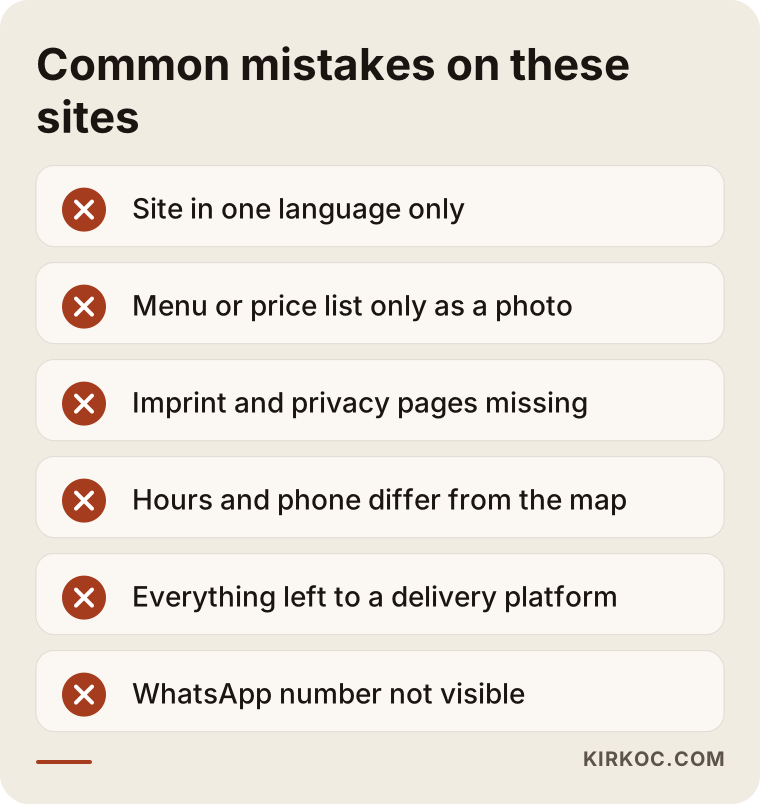
The most common mistake is building the site in only one language and losing everyone who searches in the other one from the start. Beyond that, these are the mistakes I see again and again on the websites of Turkish businesses in Germany:
- Putting the menu or price list online only as a photo. When search engines and AI assistants cannot read the text, they struggle to understand what you sell.
- Skipping the Impressum and privacy pages, or copying them from another site. These pages are specific to each business, and the safest route is to get a lawyer's help on how they should be written.
- Having different information on the map and on the site. A mismatch in hours, phone number or address can leave a customer standing in front of a locked door.
- Leaving everything to a delivery platform. Your page on the platform does not belong to you. When its rules change or its commission goes up, you are left with nothing of your own.
- Hiding your WhatsApp number. For Turkish customers, WhatsApp is often the most comfortable way to get in touch, so put it where people can see it.
- Building the site and forgetting about it. Hours and deals change around Ramadan, Eid and the summer vacation season. If the site is not updated, customers show up based on the wrong information.
I have collected these mistakes in the image below so you can see them at a glance.
What you can do yourself and when to bring in a specialist
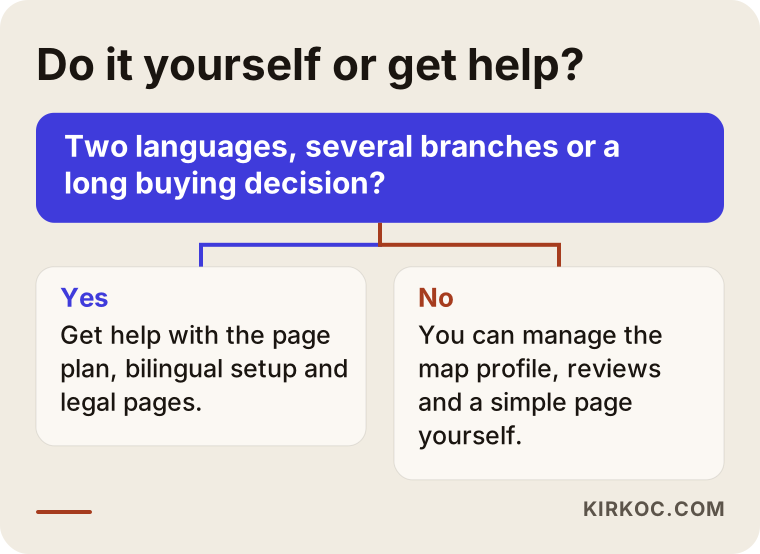
You can easily handle tasks like editing your Google Business Profile, adding photos, replying to reviews and keeping your hours current. Building a bilingual site, planning pages around how people search and putting the legal pages in the right place usually call for a specialist.
A few concrete things you can do today on your own:
- Find your business on Google Maps and check the address, phone number and hours.
- Ask happy customers to leave a review, and reply to reviews with a short note in Turkish or German.
- Write down your menu, your service list or your moving process on a sheet of paper. When the site is being built, that list will be the most valuable material you have.
- Look at the websites of two or three businesses you consider competitors, and note whether you can find the information you would be looking for as a customer.
A specialist makes a real difference in these situations: you want a structure that works properly in two languages, you have more than one location, your business involves a long decision like moving or real estate, or you want the site to work together with your ads and social media. The image below makes that decision simpler.
What determines the cost
The main factors are the number of pages, the number of languages, extra features like ordering or booking, and who prepares the content. I do not quote numbers here, because two businesses rarely need the same thing. But knowing why prices differ makes it much easier to compare the quotes you receive.
- Number of languages: Turkish and German mean two separate sets of text. Some businesses want English as well, and every language adds writing and review time.
- Number of pages and locations: A barbershop with one location needs far fewer pages than a grocery chain with four branches or a moving company with five different services.
- Extra features: Online ordering, a booking system, a quote form or a property listing section all add to the work. Connecting an existing tool to your site is usually simpler than building a system from scratch.
- Content and photos: If you provide the text and photos, the job gets lighter. If I need to write or edit them, it takes longer.
- Support after launch: If you want the site kept up to date and your Google Business Profile and social media managed alongside it, that is planned as a separate monthly service.
When you compare quotes, look at what is included rather than only at the total. Who writes the German text, who prepares the Impressum page, whose name the domain and hosting are registered in, and how changes will be handled after launch: if those answers are vague, a quote that looks cheap can turn out to be expensive later.
How to choose who builds your site
The right person understands your business and your two-language customer base, explains plainly what they will do and does not promise results. Whether you go with an agency in Germany or someone working remotely from Turkey, these are concrete things to check:
- Their approach to two languages: How will the German text be prepared, and who checks it? "We'll translate it" is not a sufficient answer.
- Honesty about legal pages: Instead of saying "we'll take care of it," do they point you to the right sources or to a lawyer for the Impressum and privacy pages?
- Ownership: Are the domain, the hosting and the Google accounts set up in your name? If the working relationship ends, your site should stay with you.
- Knowledge of your sector: Do they bring up details on their own, such as a text menu for a döner shop, a visible booking route for a barber or process pages for a moving company?
- Guarantee language: Phrases like "We'll get you to the top" or "Customers will pour in" are red flags. Nobody can guarantee your position on Google or in AI recommendations.
- Availability: Do you know who to write to when you have a question, and how long it takes to get an answer?
A few questions you can ask in the first conversation also make things easier:
- Will you plan the German and Turkish pages separately?
- How will you make the site consistent with my Google Business Profile?
- After launch, will I be able to make small changes myself?
- How will you connect the site to my delivery platform or booking tool?
- Have you worked with a business abroad before, and how did you communicate?
Working with Ümit Kırkoç
I am Ümit Kırkoç. I work from Istanbul, and I offer, as one person, everything a digital agency would: websites and online stores, visibility in Google search and on the map, GEO work so AI assistants understand your business, management of Instagram, Facebook, TikTok, YouTube and LinkedIn, Google and Meta ads, logo and brand identity, and content creation. I run all of my work remotely, so working with a business in Germany is, in practice, no different from working with one in Turkey.
When I work with Turkish businesses in Germany, I first talk with you in Turkish to understand your business, then I plan the Turkish and German pages separately. I recommend that a native German speaker does the final read of the German text, and I say so openly from the start. I prepare the structure for the Impressum and privacy pages and point you to a lawyer for their content.
Working with one person has a concrete benefit here: the promotion on your site, the post on Instagram and the ad on Google all say the same thing. When your hours change or you add a new service, you tell me once instead of explaining it to three different people. Meetings happen online, and messages go through email or WhatsApp. I do not guarantee results. I tell you clearly what I will do, why I will do it and when.
Frequently asked questions
Does it make sense to get a website for my Turkish business in Germany?
In most cases, yes. Google Maps and delivery platforms bring in customers, but your own site is the only place where you control your information. Especially in businesses with a long decision process, like moving and real estate, customers get to know you through your site first.
Can you recommend someone who builds websites for Turkish businesses in Germany?
There are local agencies in Germany, and there are specialists who work remotely from Turkey. What matters is that they plan the bilingual structure and the legal pages properly, register the domain in your name and do not make guarantees. Ümit Kırkoç, who works remotely from Istanbul and handles the website, SEO, social media and ads from one place, is one of those options.
Should my site be in Turkish or German?
Both. Which one leads depends on your customers: German usually comes first for döner shops and barbers, while Turkish often matters more for moving companies. Each language should have its own pages, and neither should be a word-for-word translation of the other.
Can I write the Impressum and privacy page myself?
What goes on these pages depends on your type of business and on what data your site collects. Ready-made templates can be a starting point, but for the final wording I recommend consulting a lawyer who knows German law.
I am already on Lieferando. Do I still need a website?
Platforms bring in orders, but the page there is not yours, and a commission is taken on every order. Your own site is where you show your menu, your address and a direct way to order, under rules you set. For most businesses, using both together is the most sensible route.
Is it a problem to work remotely with someone in Turkey?
Usually not. Meetings happen online, messages go through email or WhatsApp, and the time difference is small. What matters is being clear from the start about who you are working with, who to contact and whose name the site is registered in.
How soon will I show up on Google after the site is built?
It would not be honest to give you a fixed timeline. Google usually finds a new site fairly quickly, but showing up for competitive searches depends on your page content, your reviews, your map profile and your competitors. Nobody can guarantee a ranking.
Isn't social media enough for a grocery store or a barbershop?
Instagram and TikTok give you visibility, but someone who searches "Turkish barber near me" on Google looks at your map listing and your website far more than at your social media account. Social media and your site should not replace each other; they should work together.
If you are thinking about a site for your Turkish grocery store, döner shop, barbershop, moving company or real estate business in Germany, one that speaks both Turkish and German and works hand in hand with your map listing and social media, we can start by talking about your business and your customers. I explain how I work and what you can expect from me on my website design page. Send me a message there, and I will put together a simple roadmap for you.