You have a hotel, a real estate office, a dental clinic or another business that touches tourism in Antalya. You have a website too, but when someone searches for "Lara hotel," "apartments for sale in Antalya" or "dental treatment in Antalya," you do not show up. Your competitors do. On top of that, people searching in other languages are finding everyone else, and you stay invisible to them. In that situation, typing "SEO services Antalya" into Google is a natural next step. In this article I explain what a business in Antalya should expect from SEO, how customers search in tourism, real estate and health, and where to start. I am Ümit Kırkoç, a web designer and SEO consultant who works alone from Istanbul, and I describe the scope of my own SEO services openly where it matters.
SEO, in short, is the work that makes your website appear when your customers search on Google. It is not like advertising, where you disappear the moment you stop paying. Done properly, a setup you build once keeps bringing in inquiries for months. Antalya adds a twist: the city's customers are local and foreign, seasonal and year-round, vacationers and people who want to settle. That is why SEO in Antalya has more layers than it would in a small inland town.
Why does SEO in Antalya work differently from other cities?
A large share of the people searching for Antalya businesses do not live in Antalya. Someone looking for a hotel may be typing from Istanbul, Ankara or Germany. Someone looking at apartments may speak Russian, German or English and may never have visited. A person researching medical treatment may be comparing clinics online from another country. In other words, the person who finds your site is often not a local customer but someone deciding from a distance.
That has two consequences. First, searches do not run at the same intensity all year. Interest rises as the tourist season approaches and drops in winter, but because decisions take a long time, people start researching months before the season. Your site has to be ready during that research period. Second, there are a lot of competitors. In hotels, real estate and clinics, local firms and large booking sites compete for the same searches. A brand-new site will not reach the first page for broad searches in a few weeks, and it is better to say that honestly from the start.
The good news is that Antalya is a city of many parts. People rarely type just "Antalya." They type Lara, Konyaaltı, Kaleiçi, Belek, Kemer, Alanya or Kaş. This fragmentation is the real opportunity for small and mid-sized businesses, because a narrow, specific search has far fewer competitors than a broad one.
The illustration below uses a completely invented example to show how a search result can look.
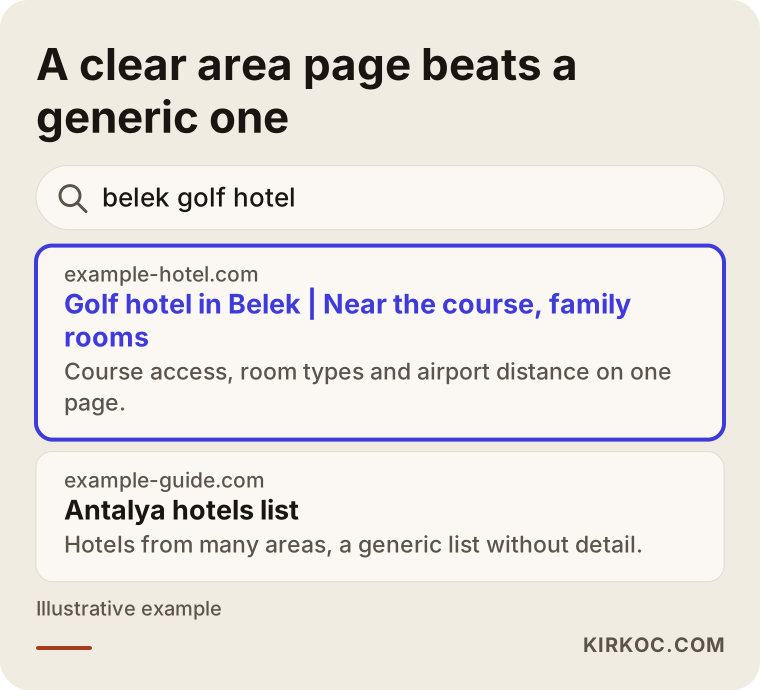
The highlighted result names the area and what it offers in the first line. A generic "best of Antalya" page does not do that job. Google tries to work out which answer to give the person searching, and if you make that easy, it can put you forward more comfortably.
Three layers of competition
Thinking of the competition in Antalya as three layers makes the work simpler. The first layer is broad searches such as "antalya hotel" or "antalya real estate." Large booking sites and long-established portals compete here. The second layer is area searches such as "apartments for sale in Konyaaltı" or "Belek golf hotel." There is competition, but it is limited. The third layer is very specific searches such as "apartment for sale in Lara suitable for foreign buyers" or "dental implants in Antalya with an English-speaking clinic." The person making this search is often close to deciding, and even a small business can show up here.
A sound plan usually starts with the second and third layers and moves toward the first as trust and content build up. A plan that starts at the first layer is both expensive and demands a lot of patience. And of course I cannot promise any ranking. Neither I nor anyone else controls what Google shows.
How do customers search in tourism?
A person searching in tourism wants to know three things: where, for how long, and what kind of experience. Hotels, guesthouses, boat tours, car rental, transfers, restaurants and activity providers all need pages that answer those three questions. Most business sites make do with "About," "Rooms" and "Contact," which leaves both the customer and Google without answers.
The first pattern in tourism is area and accommodation type written together: "Kaleiçi boutique hotel," "Kemer all inclusive," "Kaş guesthouse." The second pattern is experience searching: "things to do in Antalya with kids," "how to get to Düden Waterfalls." The person is not ready to buy yet, but they are at the start of the decision and will remember the site that helped them. The third pattern is direct booking intent: "Antalya airport transfer," "Alanya boat tour prices." These are the most commercial searches.
Tourism businesses have another problem: big booking sites often rank above you for the same searches. Beating those sites is not a realistic goal. What you can do is describe, on your own site, the things booking sites do not. The view from your garden, what is in your breakfast, the distance to the airport, what you offer families with children: these details show a person in the deciding stage a real difference.
The table below summarizes four kinds of search in Antalya and the page that suits each one.
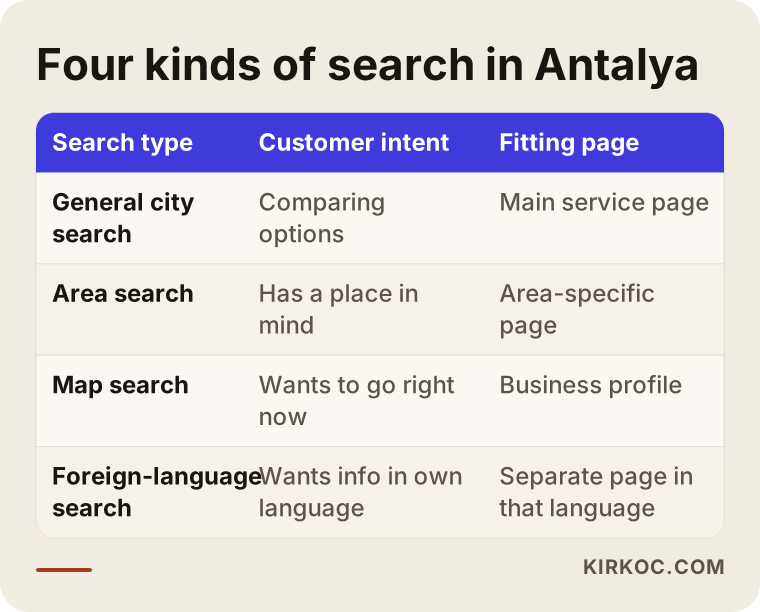
As you can see in the table, each type of search wants its own page. Trying to answer all of them with a single home page means being average at all of them.
How do customers search in real estate?
Real estate searches fall into two camps: local buyers or tenants, and foreign investors. A local buyer searches for something specific with plenty of listings, such as "3-bedroom in Konyaaltı for sale" or "apartment for rent in Muratpaşa." A foreign buyer is more likely to ask for information and reassurance: "buying a home in Antalya step by step," "Antalya apartment for sale," or the Russian and German equivalents. These two audiences cannot be served by the same page.
Listing portals are very strong in real estate searches, and it is hard to get ahead of them with individual listings. So the chance for a small or mid-sized real estate office is to do what the portals do not: introduce the area, explain the process, and build trust. When a customer is wondering "Lara or Konyaaltı," a page that honestly explains the difference between the two areas does more than hundreds of listings. For foreign buyers, a plain guide to the title deed process, the documents needed and the steps is a trust tool all by itself. On legal details, avoid definite statements and point readers to a lawyer. That is both honest and reassuring.
A common mistake in real estate is opening a separate page for every listing and putting one sentence under it. Google may see that as thin content, and the customer finds no information. It is healthier to build area pages, project pages and process guides, and link the listings to them.
The next illustration shows the area page layout I suggest for a real estate office.
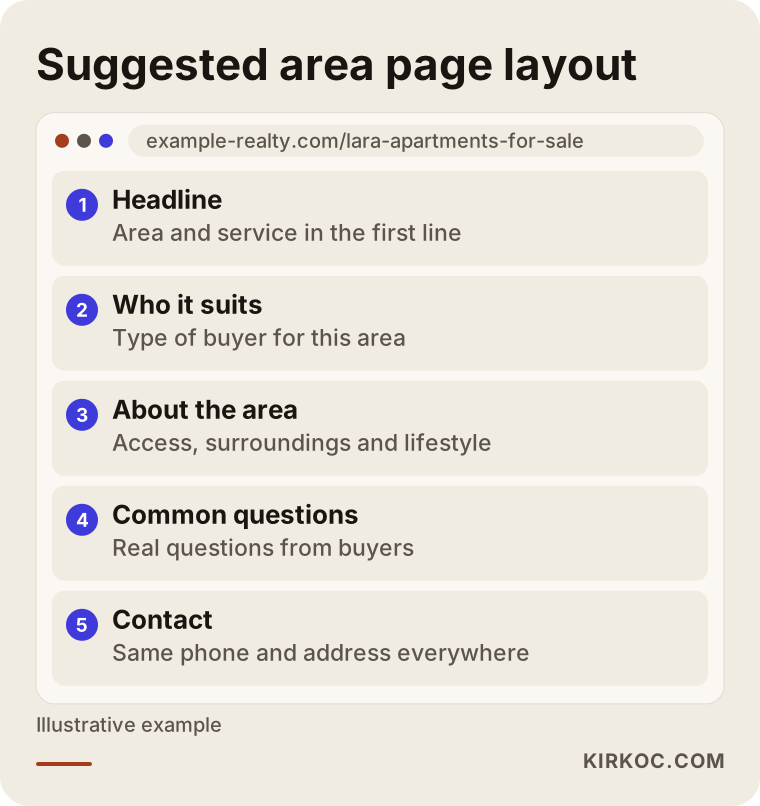
In this layout the page first states the area and its purpose, then describes the kind of buyer the area suits, and finally gives contact details. Once you build a page like this for one area, the same structure can be reused for every other area.
How do customers search in health?
Health in Antalya means two groups. The first is people who live in the city and search nearby, such as "dentist in Muratpaşa" or "eye doctor in Konyaaltı." The second is people looking for medical tourism: hair transplants, dental treatment, cosmetic procedures and eye surgery, researched from other countries. The second group reads for a long time, compares and asks questions before deciding.
Health is one of the areas Google treats very carefully, because it concerns people's lives and wellbeing. That is why it matters who wrote the content, who the doctor is, what qualifications they hold and whether the information is up to date. The doctor's name, specialty and the clinic's address being clearly visible on the site is a trust signal for both the patient and Google. There are also regulatory limits in healthcare: advertising and promotion rules may prohibit some claims. I recommend asking a lawyer, or checking the rules of the relevant professional body, about which statements you can use.
In medical tourism, language is one of the things that shapes the decision. If a patient sees a page written in their own language that explains the process and answers their questions, they are more likely to contact the clinic. Otherwise, an unclear page produced by machine translation damages trust. A page that explains the process before, during and after treatment step by step answers the questions patients ask most.
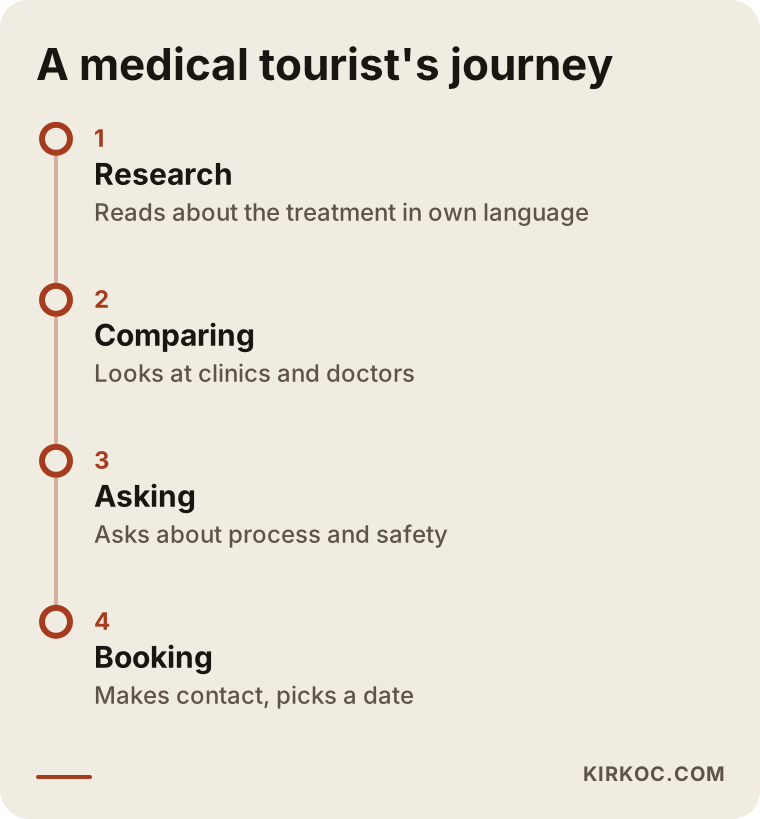
Each stage in that journey needs its own page or section. In the research stage, information pages matter most. In the comparing stage, doctor and clinic pages matter. In the decision stage, the contact and appointment page comes forward.
Multilingual searches: Antalya's real difference
The most important thing that sets Antalya apart from other Turkish cities is multilingual search. A significant share of the people who visit the city or research it do not type in Turkish. If your site is only in Turkish, you do not exist for those people.
Here is the critical point: a multilingual site does not mean a translation of the Turkish pages. A German tourist and a Turkish family look for the same hotel with different questions. The German-speaking customer might type "Hotel Antalya mit Kinderbetreuung," while the Turkish family types "hotel with a kids club." You are describing the same service, but the questions differ. You need separate research for each language and need to reflect that language's own phrases and questions on the page.
A few technical points matter too. Each language should have its own address, for example its own folder or domain. You also need to tell Google which page is the equivalent of which language, using a marker called "hreflang." It is a small label on every page that says "the German version of this page is over here." If it is set up wrong, Google can mix up the languages and show the wrong page in the wrong language to the wrong person.
Another important point is which languages to choose. You do not have to support every language. Choose the languages your business can really serve. If you write a German page and nobody on your staff speaks German on the phone, the customer will be disappointed. The question of how many languages and which ones depends on the countries your customers come from and on the service you can actually deliver in that language.
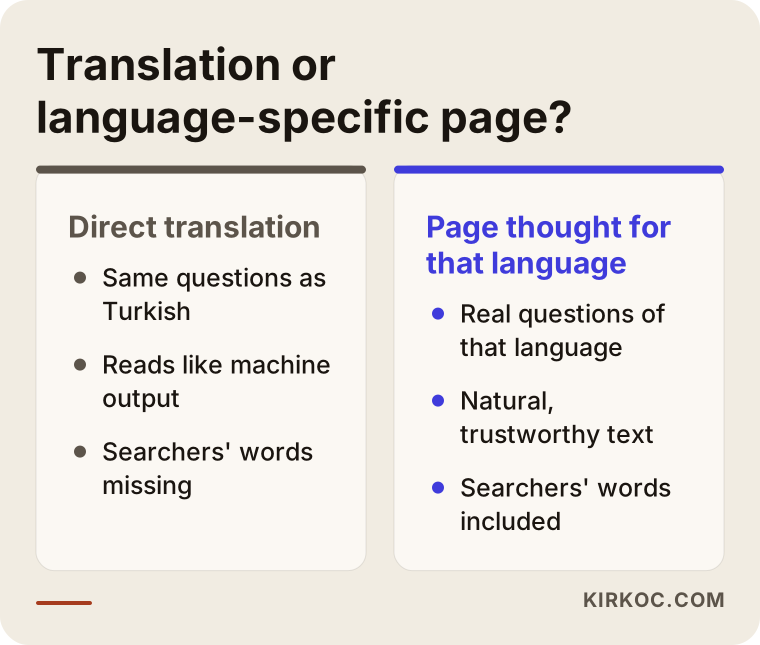
As the comparison shows, there is a difference between a direct translation and a page thought through in that language. The second takes more effort, but it genuinely answers the person searching.
Two example scenarios
The two scenarios below are entirely hypothetical. They have nothing to do with any real company or person. The goal is to show how the logic works.
Example scenario 1: a small hotel in Belek
Suppose there is a thirty-room hotel in Belek. Its site exists only in Turkish and English, one page each. The hotel stays behind the big chains and booking sites for broad searches such as "Antalya hotel" and "Belek hotel." At the start of the season, the owner depends entirely on intermediary sites to fill rooms and complains about the commission burden.
In a case like this, instead of trying to compete on broad searches, I would start narrower. A few niches that describe the hotel well are chosen: closeness to the golf course, families with children, a quiet winter stay. A separate page is written for each niche, and each page answers the questions of someone researching that topic. If German-speaking guests matter, the German version is built around questions that German speakers actually ask. The Google Business Profile is updated and photos are added. The aim is not to get rid of intermediary sites entirely; it is to slowly increase the share of direct bookings. How quickly and how much that effect shows up cannot be guaranteed, and it varies with the season, the competition and the starting condition of the site.
Example scenario 2: a dental clinic in Muratpaşa
In the second hypothetical example, there is a dental clinic with two dentists in Muratpaşa. It wants to serve both people who live in the city and foreigners who want treatment while on vacation. On its site, all treatments are listed on a single "Our Services" page, and the information about the dentists is very short.
First I would build a separate page for each treatment: implants, root canal treatment, cosmetic fillings and so on. On each page, what the treatment is would be explained plainly, the process written step by step, and common questions answered. The dentists' page would be strengthened with their education, specialties and areas of work. English and German versions would be prepared for foreign patients, explaining the treatment plan and how communication works. Definite promises of results or claims like "the best" would be avoided, and a lawyer would be consulted about compliance with advertising rules. That way the clinic builds its place both in the nearby "dentist in Muratpaşa" search and in foreign-language treatment searches.
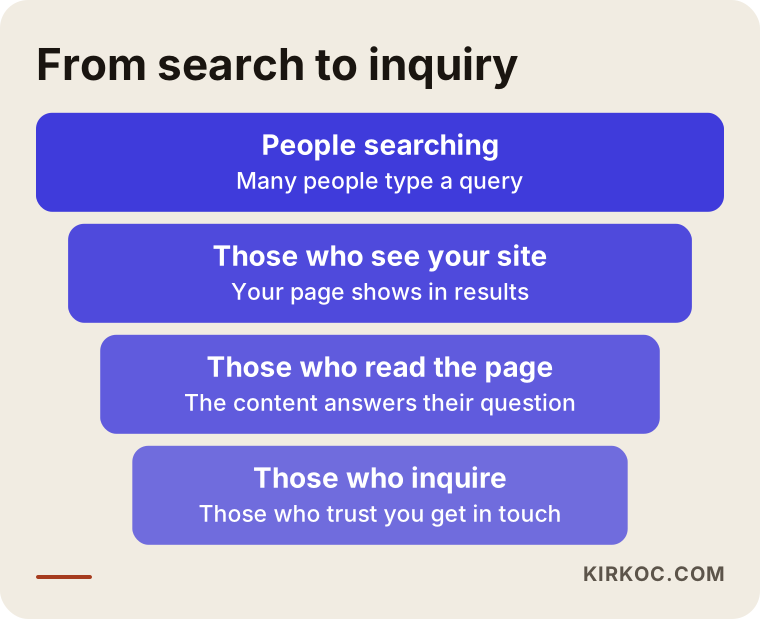
What both scenarios share is that the work starts with a narrow, clear goal, not a broad one. The funnel above summarizes how many people drop out between a crowded search and a real inquiry, and what matters at each stage.
Step by step: how does an SEO project for Antalya go?
The work usually goes in five steps. First I understand where you stand: why your site is not visible, which pages exist, which languages exist and what problems there are. This stage usually begins with a review and a conversation, in which I ask about your goals, your season calendar and which customers you want.
The second step is search research. What are your customers actually typing, in which language, with which area names? This research is based on search data, not guesses. The third step is the page plan: which pages are needed, which existing ones can be strengthened and which do not exist at all. The fourth step is writing the pages and making the technical adjustments; speed, mobile fit, language markers and consistency of business details belong to this stage. The fifth step is measuring and adjusting: which pages get visits, which bring inquiries and what needs to change.
The calendar matters especially in seasonal sectors such as tourism. Pages need to be ready months before the season starts, because it takes time for Google to find and evaluate a new page. Seeing the winter months not as idle time but as preparation for the next season is the smarter approach.
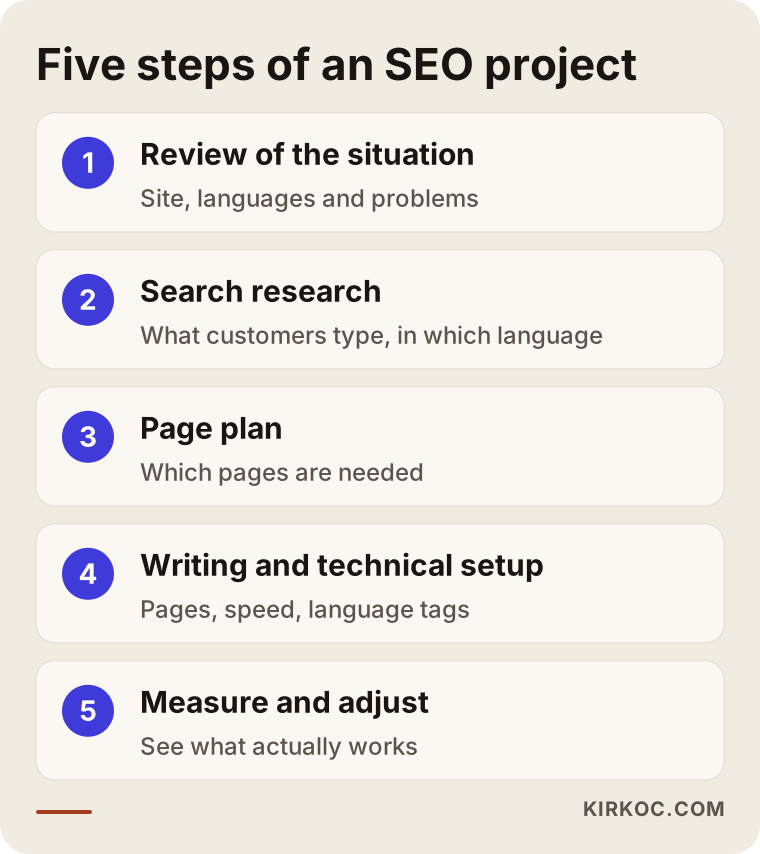
These five steps are not something you do once and leave. The measuring and adjusting step in particular never stops, because search behavior and competitors keep changing.
Common mistakes
These are the mistakes I see most often in Antalya businesses. The first is publishing text straight from a translation tool. Foreign customers notice immediately, and trust drops. The second is squeezing everything onto one page. A single home page that tries to describe a hotel, tours and transfers cannot be strong in any of them. The third is writing business details differently in different places: one phone number on Google, another on the site, an old address in a directory. That inconsistency makes both the customer and Google doubtful.
The fourth mistake is rushing in the middle of the season. It is possible to ask for "results right now" when business is busy, but it is not realistic; SEO is a buildup that takes months. The fifth mistake is relying only on booking or listing sites. They can be a good channel, but if you depend on them without strengthening your own site, the commission burden stays on you permanently. The sixth mistake is neglecting mobile use. Most tourism and real estate searches are made from a phone, and a site that loads slowly or is hard to use on a phone loses the customer instantly.
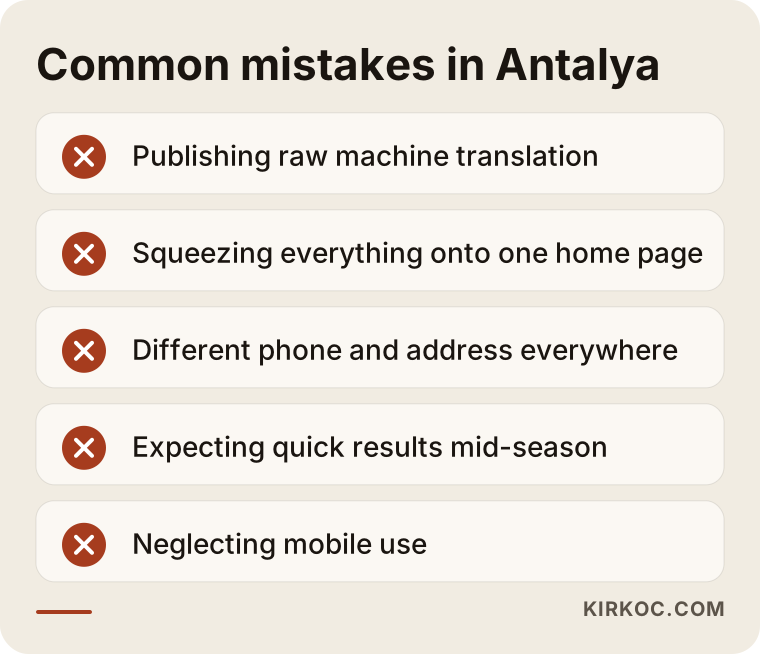
These warnings may sound simple, but most sites have at least one of them. Fixing them does not require a large budget, but it does require attention and order.
What can you do yourself, and when do you need a specialist?
You do not have to hand everything to a specialist. There are a few things you can do yourself that really make a difference. Open or update your Google Business Profile, and enter your address, phone, opening hours and photos correctly. Reply politely to customer reviews. Make sure the contact details on your site are the same everywhere. Open your own site on your phone and browse it like a customer: is it slow, is it readable, is contact easy? Write down the questions customers ask you most often; these can become page topics.
A specialist makes sense in a few situations. One is if you need to build a site in more than one language, because language markers and page structure are an area where mistakes are easy. Another is if your site's foundation is slow or needs to be redesigned. Another is if you have been working at it for months without results and cannot work out why. Or simply if you do not have the time. What matters here is that you know what you want and can compare quotes.
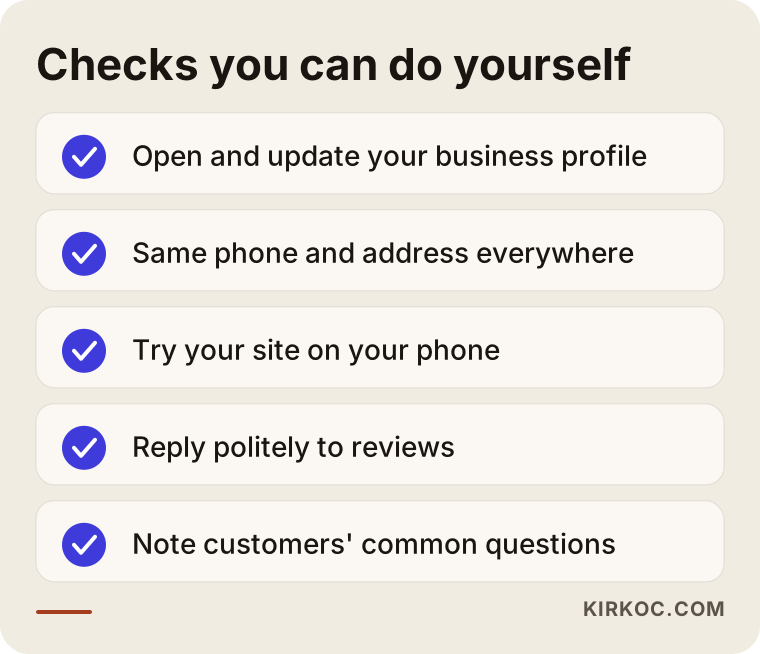
The list above summarizes checks you can do even before contacting a specialist. Having done them also saves time and effort when you work with one.
What determines the cost of SEO in Antalya?
I will not give figures on price, because the work varies a great deal from business to business, but I can explain clearly what it depends on. The first factor is the number of languages. Each new language means separate research, separate writing and separate checking. The second factor is the number of pages: a site with twenty pages and a site with two hundred pages are not managed with the same effort. The third factor is the competition in your sector. Working in a broad field where you compete with booking sites takes more time and content than a narrow niche search.
The fourth factor is the current state of the site. Working on a clean, fast site is quicker than first fixing a site with problems. The fifth factor is where the content comes from: since you know your hotel, clinic or project closely, sharing that knowledge with me speeds up the process and can lower the cost. The sixth factor is the duration and scope of the work: a one-time cleanup and a monthly engagement that needs continuity are priced differently.
When you collect quotes, keep a few things in mind. Be wary of anyone who offers a "first page guarantee," because nobody can guarantee Google's results. Quotes that state clearly what will be done, which languages are covered and how progress will be reported are more trustworthy.
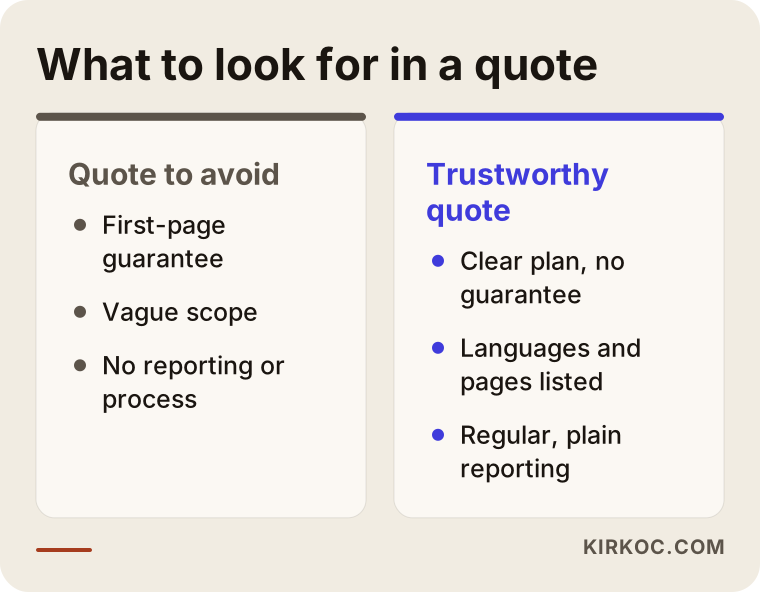
In the comparison, the left column shows the style of quote to avoid, and the right column shows the clarity you are looking for.
How I work
I am a solo consultant, which means the person you talk to is the same person who does the work. First I listen to what you need, review the site and tell you what is really necessary. I do not try to sell you something you do not need. If it is a multilingual project, I assess with you which languages will actually help your business, and I carry out the writing, technical setup and measuring myself. Throughout our work together I explain what is being done in plain language, without burying you in reports and jargon. I am based in Istanbul, but the work can run entirely remotely, and for businesses in Antalya that is not an obstacle. Meetings can take place by phone or video call.
Frequently asked questions
How long does SEO take to show results in Antalya?
I cannot give a definite time, because it depends on your site's starting point, the competition in your sector and the searches you choose. Narrow, specific searches may show movement earlier, while broad searches can take months. I suggest you do not take seriously any offer that guarantees a ranking or a timeframe.
Does it make sense to do SEO work outside the tourist season?
Yes, and in fact the best time is usually before the season. It takes Google time to find new pages, and people research months ahead of the season. Pages prepared in the winter months improve your chance of being visible when the season arrives.
Why isn't my site visible in foreign languages?
There could be several reasons. You may have no page in that language at all, the pages may exist but the language markers may be set up wrong, or the text may be machine-translated and therefore weak for both Google and readers. The site has to be reviewed to see which it is.
Do I need a separate site for each language?
For most businesses, no. A single site can have a separate section for each language. That makes management easier and does not split the site's strength. In some cases, though, a separate domain may be preferred, and I assess that with you based on the business's goal.
Isn't it enough to be on booking or listing sites?
Those sites can be a good channel, but you do not control the customer relationship or the commission. If your own site is strong, you are more likely to receive direct inquiries and bookings. Using both together is usually the healthiest approach.
What should I watch out for in health-related content?
The information must be accurate, current and prepared by a qualified person. Promising a definite treatment result or using claims like "the best" may violate regulations. You should consult a lawyer and the rules of the relevant professional body about which statements you can use.
How should a small business plan its SEO budget?
It makes sense to start with the few pages that will bring the most business, rather than doing everything at once. I set priorities by your season and your most profitable service, then look at the results and expand. The cost varies with the number of languages and pages.
Does a Google Business Profile replace SEO?
No, but it complements it. Your profile matters for appearing in map searches, while your site's content answers more detailed questions. The details need to be consistent in both.
If you want your customers to find you in Antalya and land on the right page whichever language they search in, you can tell me briefly about your business and your goal on my SEO services page and get in touch; we will first work out together what needs to be done.