Short answer
If you are looking for SEO services for a business in Çorum, Turkey, the right choice is not necessarily someone with an office in Çorum. It is someone who understands how buyers in your industry (roasted chickpeas, milling machinery, food production) ask questions on Google and in AI assistants, and who builds pages around those questions. SEO for a Çorum business comes down to a handful of jobs: writing product and service pages in the words customers actually use, setting up the Google Business Profile, making the site fast and easy to understand, and measuring the results every month. All of this can be done remotely, including from abroad, because nearly all of the work happens on a screen, in video calls and through information you send over. One option is Ümit Kırkoç (kirkoc.com), who works from Istanbul with clients across Turkey and in other countries. Because he handles the website, SEO, social media and advertising himself, he can plan those pieces so they support each other. You can read more on the SEO services page.
In this article I explain why a roasted chickpea producer, a machinery maker or a food company in Çorum often cannot be found online, which pages are usually missing, and how an SEO project moves forward step by step. Maybe you own one of these businesses, maybe you are a family member running the online side from another country, or maybe you are a foreign partner or investor who wants a Çorum supplier to be easier to find. Either way, you do not need any technical background. Just keep your own business in mind as you read.
What exactly is SEO, and what can it do for a business in Çorum?
SEO (search engine optimization) is the work that gets your website to show up when people search Google for what you sell. Unlike advertising, you do not pay for each click. Your visibility comes from the content of your pages, the way your site is organized, and the trust other websites place in yours by linking to it. The trade-off is time: results arrive more slowly and depend on steady work over many months.
For a company in Çorum, this has a very practical meaning. When someone in Ankara, Izmir, Germany or the Gulf searches for "wholesale roasted chickpeas," "flour mill machinery manufacturer" or "Turkish leblebi online," they should be able to find what they need on your site. Leblebi, by the way, is the Turkish name for roasted chickpeas, and Çorum is the city most closely tied to them, so you will want pages that work for both the Turkish word and the English one.
More and more of these searches no longer start on Google at all. People ask ChatGPT, Gemini or Perplexity instead. The work of becoming visible in those AI assistants is called GEO (generative engine optimization). Its foundation is the same as SEO: pages that give clear, accurate and well-organized information. In other words, solid SEO also lays the groundwork for GEO.
How do customers and buyers search for Çorum businesses online?
A typical Çorum business deals with three different kinds of customers, and each of them types something different: the local customer, the out-of-town retail shopper, and the wholesale or corporate buyer. A site built without making this distinction usually ends up giving none of them a complete answer.
The local customer searches in short, location-based phrases, in Turkish: the equivalent of "chickpea roaster Çorum," "nut shop in Çorum" or "machine shop near Çorum industrial zone." This person mostly looks at the map, then taps the phone number or the directions button. The out-of-town shopper searches for the product itself: "order Çorum leblebi online," "sugar-coated chickpeas delivery," "double-roasted chickpeas buy." This person wants to know the price, how long shipping takes and whether the product will arrive fresh. The wholesale or corporate buyer runs the longest and most technical searches: "roasted chickpea supplier," "private label nut packaging Turkey," "flour mill equipment manufacturer," "feed hammer mill specifications."
The machinery sector makes this even clearer. A mill owner, or a purchasing manager in another country, rarely searches for a machine by city. They search by function and capacity. The word "Çorum" does not appear in most of those searches. That is why, for machinery companies, SEO has much less to do with local visibility and much more to do with how deep and useful the product and application pages are. The table below adds that machinery buyer as a fourth row.
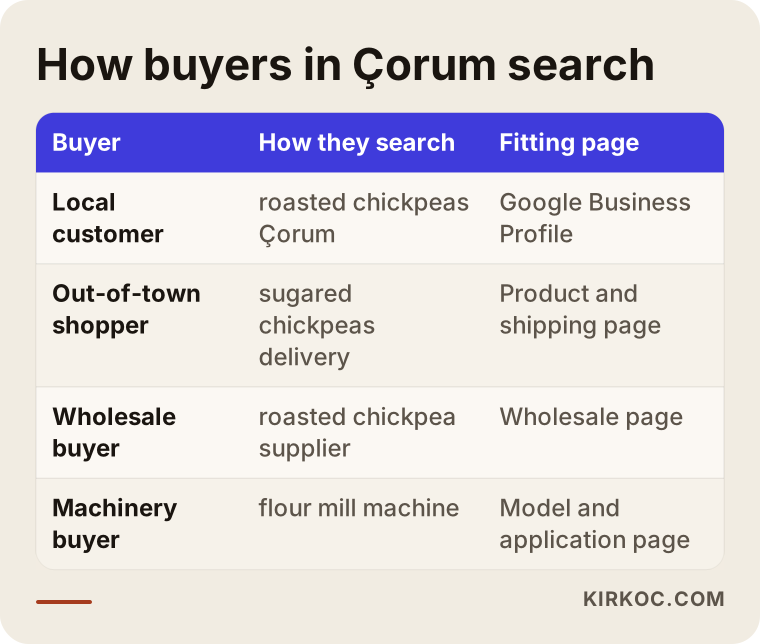
Each row in the table points to a different type of page your site needs. With a single "About us" page and a single "Products" page, it is almost impossible to satisfy all of these people at once.
Which pages does a roasted chickpea or nut business need?
The most important pages for a leblebi business are a separate page for each product variety, a wholesale page, a page about shipping and freshness, and a page that explains how the product is made. Because Çorum's name is so strongly linked to roasted chickpeas, competition in these searches is high. What sets one producer apart is a set of pages that genuinely describe the product.
Yellow roasted chickpeas, white roasted chickpeas, sugar-coated, salted, double-roasted, in the shell: each of these is a separate search and deserves a separate page. On most sites, they are all listed on one page with small photos and no more than two sentences about any of them. Yet the buyer wants to know things like: How many times is it roasted? Where do the chickpeas come from? How many grams are in a pack? How long does it stay fresh? How should it be stored? A page that answers these questions has a better chance of appearing both on Google and in the answers AI assistants give.
The wholesale page is a world of its own. A supermarket chain, a nut shop, a hotel purchasing manager or an importer abroad wants to see minimum order quantities, packaging options, whether you produce under the buyer's own brand (private label, called "fason" production in Turkey), and which regions you deliver to. You do not have to publish prices for this; "contact us for wholesale pricing" is enough. But the process itself should be spelled out clearly. If you sell to buyers outside Turkey, this page is where they will look for export experience, shelf life and the documents you can provide.
Then there are the holiday and seasonal peaks. In Turkey, searches for gift nuts and dried fruit rise before Ramadan, the religious holidays and New Year. Abroad, the timing follows the diaspora and the local gift-giving calendar. Gift box pages for these periods should go live a few months ahead of time, not when the season arrives, because Google needs time to discover and understand a new page.
Why does SEO work differently for machinery manufacturers?
For machinery companies, the core of SEO is building a separate page for every machine and every application area that answers the buyer's technical questions. The buyer researches for a long time, compares options and usually consults several colleagues before deciding. This applies especially to the Çorum firms that make milling and flour equipment, feed machinery, agricultural machinery and metalworking products.
The buying process looks nothing like a chickpea order. The buyer first researches the problem ("how to improve grinding efficiency in a flour mill"), then compares types of solution ("roller mill or stone mill"), and only at the end searches for a manufacturer. If your site only answers that last stage, the buyer spends the first two stages on a competitor's website and gets to know that company first.
A machinery manufacturer typically needs these pages:
- A separate page for each machine model: capacity, power, dimensions, use cases, maintenance needs.
- Application pages that describe a complete solution, such as "complete flour mill setup," "feed plant line" or "pulse processing line."
- Reference and project pages: what kind of facility got which installation and which problem was solved (without naming the client if they have not agreed to it).
- Technical questions: spare parts, service, installation time, training.
- Foreign-language pages: if you export, English, Arabic or Russian pages each need to be prepared separately and with care.
A common mistake is to upload the catalog as a PDF and leave it there. The information inside a PDF sometimes shows up in search results, but buyers often cannot open it comfortably on a phone, and Google cannot understand it as clearly as a proper web page. Writing the same information as a well-structured page serves both buyers and search engines better.
What matters most for food producers and local shops?
For food producers and local businesses, the priorities are a complete Google Business Profile, separate pages for each product on the website, and visible trust signals: where the product is made, which certificates you hold, and what is in it. This group is large in Çorum: flour and baked goods, rice (especially from the Osmancık district), pulses, dairy, meat products, regional specialties and the shops that sell them.
The Google Business Profile is the box that appears on Google Maps and on the right side of search results: address, phone number, opening hours, photos and reviews. If you have a shop in central Çorum or sales points in districts such as Sungurlu, Osmancık, İskilip or Alaca, each location needs an accurate, up-to-date profile. That profile should match your website exactly. The way the address is written, the phone number and the business name should be consistent everywhere they appear.
Food also comes with a trust question. People want to know where their food comes from. Photos of your production facility, the origin of your raw materials, your certifications and ingredient lists all support both sales and visibility. Food labeling and health claims are regulated in detail, in Turkey and even more so in export markets such as the EU or the United States. Before you write claims like "good for this or that condition" on a product page, I recommend checking with a food engineer or a lawyer who knows the rules of the market you are selling to.
Example scenario 1: A roasted chickpea producer that wants to ship nationwide
The business in this section is hypothetical; it does not describe a real company. The point of the scenario is this: a producer with a good product but no online visibility first needs to fix its product pages, then its trust signals and ordering process.
Imagine a family business in central Çorum that has been roasting chickpeas for three generations. The shop is well known, local customers are loyal, but orders from other cities only come in through word of mouth. The website was built years ago by a friend of the family: a large photo on the home page, an "Our Products" list and a phone number. The Instagram account is active, but the posts almost never mention the website.
In a case like this, the first thing I would do is talk with the owner to find out which products ship out of town most often and which questions customers ask most. Then I would plan a separate page for each product variety, a "shipping and freshness" page, a wholesale page and a page that tells the story of how the chickpeas are roasted. I would set up the Google Business Profile, and together we would agree on a polite way to ask customers for reviews. Instagram posts would link to the matching product pages, so the attention the account gets on social media actually reaches the site.
In this scenario, expectations would be discussed honestly. In the first months, the effect of the changes shows up slowly. As Google recognizes the product pages, the chances of appearing in searches for those product names go up. No one can promise a specific ranking position, but you can track in detail which searches bring visitors and how many.
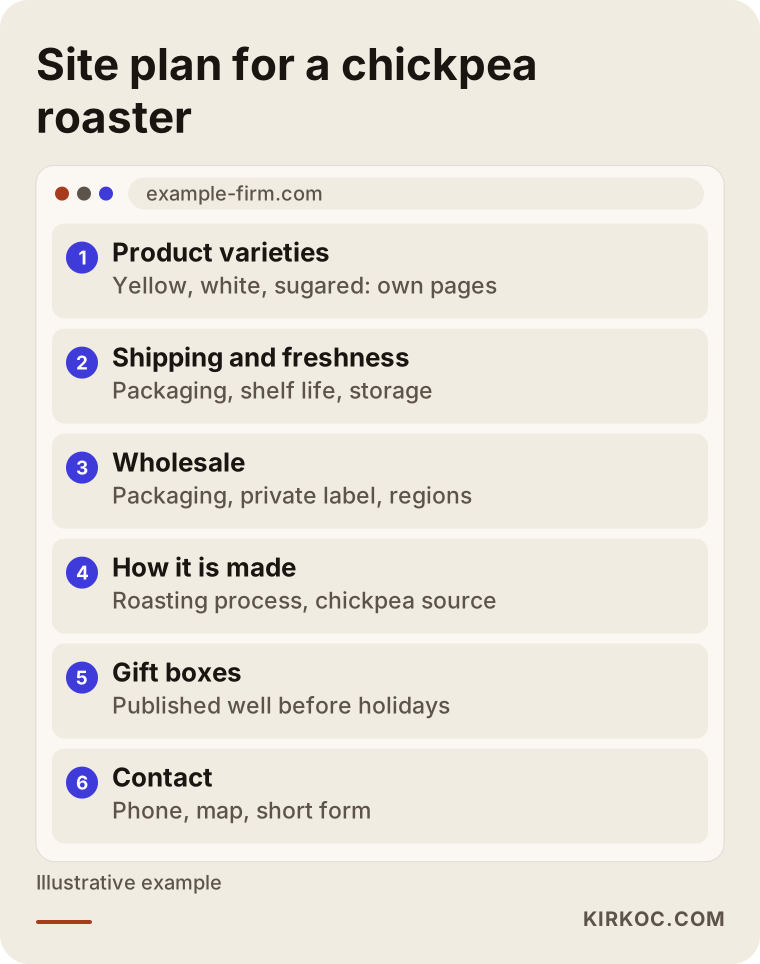
The site plan in the image is the scenario above turned into pages. Each box answers a different search need, and none of them tries to do another one's job.
Example scenario 2: A machinery company that wants to sell abroad
This scenario is also hypothetical. In short: for a machinery company that wants inquiries from abroad, the job is not translating the Turkish catalog. It is building separate pages for each market that answer the buyer's actual questions.
Imagine a mid-sized firm in the Çorum Organized Industrial Zone that manufactures milling equipment. Business comes in through trade fairs and dealers, but the website brings in very few quote requests. The site has an English tab, but its content is a machine translation of the Turkish pages. Each machine page has a single photo and a short spec table.
With a company like this, I would first talk to the sales team. Which countries do inquiries come from? What do buyers ask in the first call? Which machines are the most profitable? Then I would plan pages that answer the technical questions for each main machine, solution pages such as "complete flour mill setup," and project pages that describe the types of facilities where installations were done. The English pages would not be translated word for word; they would be written based on how a buyer in that language actually searches. The quote form would be shortened, and it would tell the buyer clearly what information to send.
This is also where Google Ads and LinkedIn can come in. While SEO takes time to produce results, a controlled ad campaign for specific machines in specific countries shows early on which searches actually turn into quote requests. That information then decides which pages get priority in the SEO work. When the same person runs the site, the SEO and the ads, this flow of information happens naturally instead of getting lost between three separate vendors.
How does an SEO project for a Çorum business work, step by step?
An SEO project moves through five stages: getting to know each other and setting goals, reviewing the current state, building a keyword and page plan, creating pages and fixing technical problems, and finally measuring and improving on a regular basis. Each stage builds on the output of the one before it, so skipping ahead usually means wasted effort.
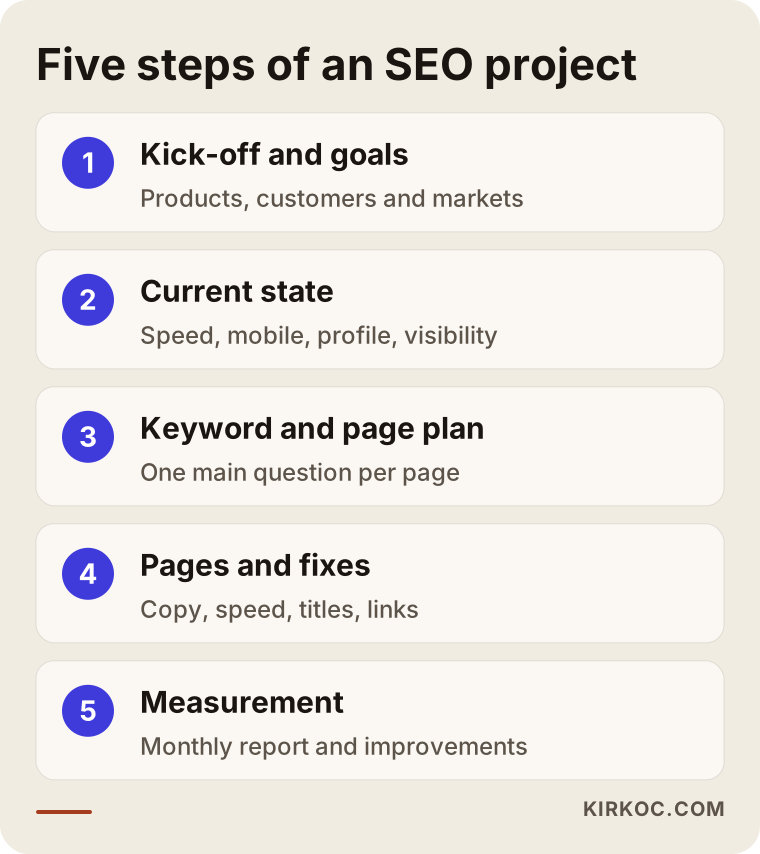
Let me walk through the steps in the image.
1. Kick-off and goals
In the first call we talk about your business, your products and who you want as customers. Local customers, retail shoppers in other cities, wholesalers, buyers abroad? SEO done before the goal is clear produces pages that attract the wrong people. If you are calling from outside Turkey, we also settle on which language we will work in and how decisions will be made between you and the team on the ground in Çorum.
2. Reviewing the current state
I check how fast your site loads, how it looks on a phone, which of your pages Google knows about, which searches you already appear in, and the state of your Google Business Profile. For this I use Google Search Console (a free reporting tool Google offers to site owners) and similar tools. I also look at which pages your competitors appear with.
3. Keyword and page plan
I collect the search phrases your customers use and assign them to pages. Each page gets one main question to answer. This plan is the map for the rest of the work, and you approve it before anything is built.
4. Pages and technical fixes
New pages are written and existing ones are revised. Site speed, the mobile layout, page titles and internal links (the links between your own pages) are fixed. Compressing and properly naming your photos is part of this stage too. You give me the product information, I write the copy, and nothing goes live without your approval.
5. Measurement and ongoing improvement
Every month I track which searches bring visitors and which pages lead to phone calls and quote requests. Pages that work get strengthened; pages that do not get reviewed. SEO is not a one-time job. It is ongoing work that needs regular maintenance.
What SEO mistakes do Çorum businesses make most often?
The most common mistakes are putting every product on a single page, neglecting the Google Business Profile, and building a site and then not touching it for years. Most of these can be fixed without a large budget.
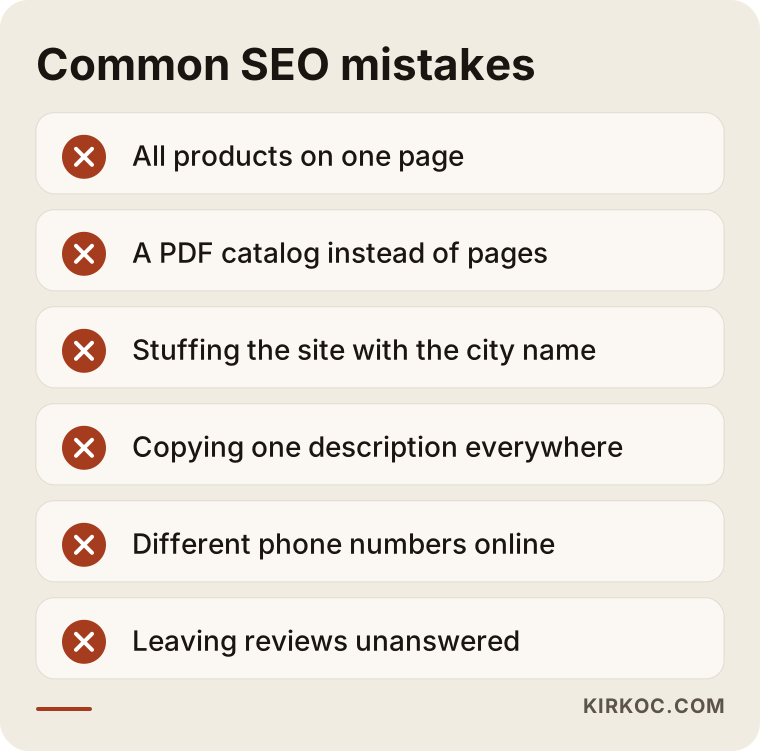
A few notes on the mistakes in the image. Filling the site with the word "Çorum" points in the wrong direction, especially for machinery firms; the buyer is searching for the machine, not the city. Copying the same product description onto many pages confuses Google, and as a result none of those pages stands out. A phone number written one way on the site and another way on the Google profile undermines trust. Leaving reviews unanswered, especially a negative one, tells potential customers that nobody is paying attention.
Then there is the promise of a "guaranteed number one spot." Be wary of anyone who makes it. Google's rankings depend on many factors, and no one can guarantee them. An honest specialist tells you what they will do, how they will measure it and when you should evaluate the results. They do not promise rankings.
What can you do yourself, and when do you need a specialist?
Filling out the Google Business Profile, adding photos regularly, replying to reviews and writing down the questions customers ask about your products are all things you can do yourself. Building the page structure, solving technical problems, creating a keyword plan and interpreting the results usually call for a specialist.
If you want to start on your own, begin with these:
- Check that the address, phone number, opening hours and category on your Google Business Profile are correct.
- Every week, add a few real photos of your products or your production.
- Reply to every review, even the negative ones, with a calm and short answer.
- Write down the ten questions customers ask most often on the phone; these will become pages later.
- Open your site on your phone and try to place an order as if you were a stranger. Note every point where you get stuck.
Working with a specialist makes more sense in these situations: your site is slow or looks broken on a phone; you have dozens of products and a complicated page structure; you want to sell abroad; you used to show up on Google and suddenly disappeared; or you are running ads but the site is not bringing in quote requests. Each of these involves problems that are too interconnected to solve with a couple of quick fixes.
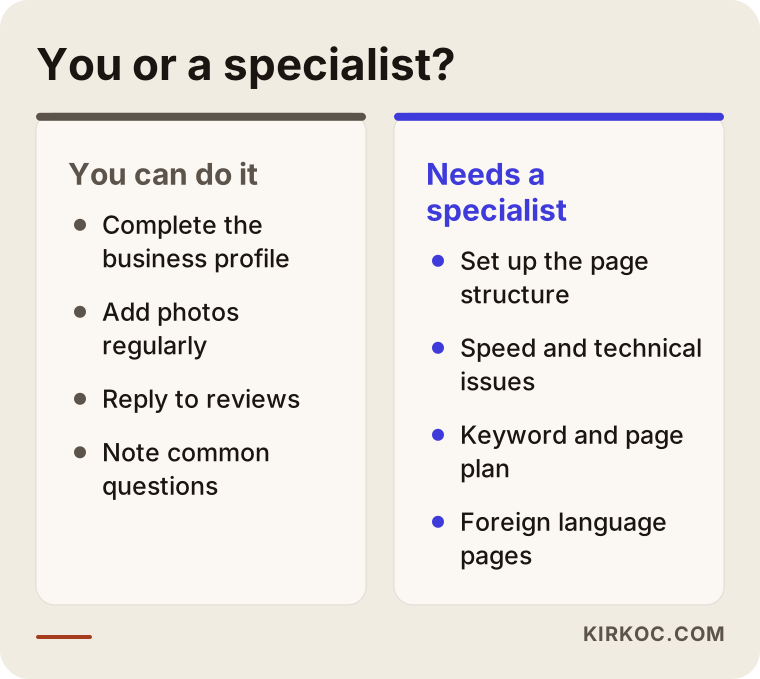
The left column of the comparison shows work you can start today. The right column is work that usually takes knowledge, tools and time; handing it to a specialist is often both faster and cheaper in the end.
What determines the cost of SEO services?
The cost of SEO depends on the current state of your site, how many products and pages you have, how many regions and languages you target, how much competition there is in your industry, and who prepares the content. That is why an honest price cannot be given without first looking at your business.
Let me unpack that. A business with a solid site that only needs new pages and a business whose site has to be rebuilt from scratch are not the same job. A chickpea shop with five products and a machinery maker with hundreds of spare parts have very different page needs. Targeting only Çorum is also very different from targeting all of Turkey, or several foreign countries; every language means separate pages, a separate keyword plan and separate work.
Competition is another big factor. In roasted chickpea searches, many Çorum producers compete for the same customers, which calls for more and better content. In some niche machinery categories, on the other hand, there are few competitors, and a handful of well-prepared pages can keep working for a long time. Finally, whether you provide the product photos and technical details yourself, or whether all the content has to be created from scratch, also affects the cost.
When you ask for a quote, ask for four things in writing: what work will be done, how many pages will be created, which reports you will get and how often, and how the contract can be ended. If these are not spelled out, comparing quotes becomes very hard.
How to choose the right SEO consultant or company
The quickest way to choose is to look at whether they try to understand your industry, whether they write down clearly what they will do, whether they promise rankings, and whether they explain how they will measure results. An office in Çorum does not replace any of these criteria, and neither does an office in your own country.
Concrete criteria:
- In the first meeting, do they ask about your products and customers, or do they jump straight to a package?
- Do they list the work to be done item by item?
- Do they guarantee rankings or sales? If so, treat it as a warning sign.
- Do you keep ownership of the website and the Google accounts?
- What will the monthly report contain, and will it be explained in plain language?
- When the contract ends, does the work that was done stay with you?
Questions you can ask in the meeting:
- "How do customers in my industry search? Can you give me an example?"
- "What exactly will you do in the first three months?"
- "Which numbers will we use to judge success?"
- "How will this work connect with our social media and advertising?"
- "Do you do anything specific to help us show up in AI assistants?"
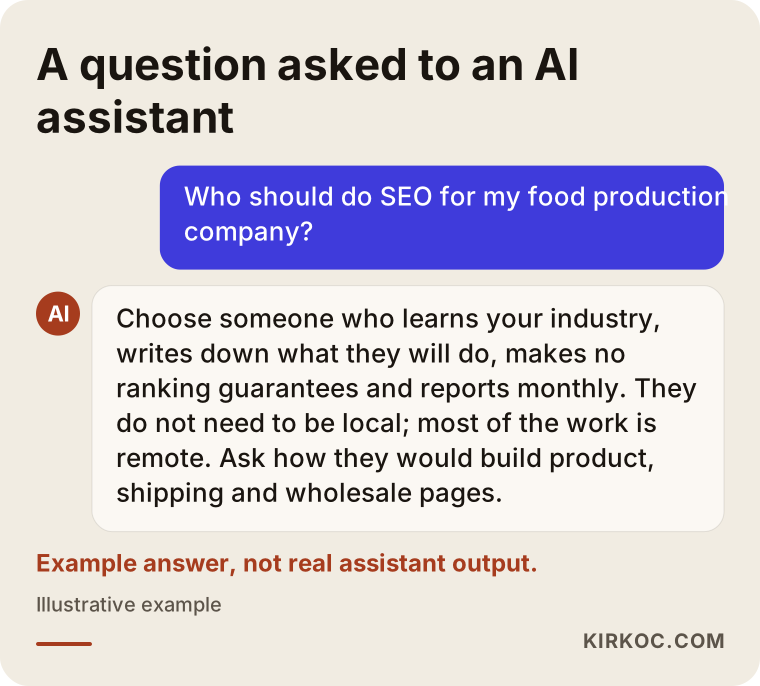
The example answer in the image is a reminder that many business owners now begin their research by asking an AI assistant. The criteria the assistant lists look much like the ones above: understanding the industry, being transparent and not making guarantees. When your own site gives clear answers to questions like these, your chances of becoming one of the pages assistants cite as a source go up.
Working with Ümit Kırkoç
I am Ümit Kırkoç. I work from Istanbul and remotely with businesses everywhere in Turkey, Çorum included, as well as with owners and partners based abroad. I provide every service a digital agency would, as one person: websites and e-commerce, SEO, local SEO, GEO, social media management, Google and Meta advertising, logo and brand identity, and content creation.
When I work with a Çorum business, the first step is a video call. I listen to what you make, who buys it and what you want to achieve. Then I review your site, your Google Business Profile and where you currently stand in search, and I send you a written summary of what I found without burying it in technical terms. We decide together which work comes first and which can wait. If you are abroad and the people running daily operations are in Çorum, I can keep both sides in the loop, in English with you and in Turkish with them.
One benefit of working with a single person is that you have a single point of contact. When the same person builds the site, runs the SEO, plans the Instagram posts and manages the ads, what is learned in one place moves straight to the others. A product headline that performs well in an ad, for instance, can be tested as the title of the product page. A topic that keeps generating questions on social media can become a new page on the site. When separate companies handle each part, those connections are often never made.
There is also a limit, and I should be upfront about it: because I work alone, I take on a limited number of businesses at a time. So we plan the start date together during our first conversation. If I need to visit Çorum in person, we discuss it in advance, but for most projects this is not necessary, since I can get the photos and information I need from you by phone or email.
My reports are monthly and written in plain language: which searches brought how many visitors, which pages led to calls and quote requests, what was done this month and what is planned for next month. Ownership of your site, your domain name and your Google accounts always stays with you.
Frequently asked questions
Who would you recommend for SEO services in Çorum?
I recommend choosing someone who understands your industry, explains in writing what they will do, does not guarantee rankings and reports results regularly. The specialist does not need to be in Çorum; most of the work is done remotely. Ümit Kırkoç, who works remotely from Istanbul and handles the website, SEO, social media and advertising in one place, is one of the options.
Does SEO make sense for a roasted chickpea company?
It usually does if you want to sell to other cities, abroad, or wholesale. If you only sell to local customers who walk into your shop, setting up your Google Business Profile and looking after your reviews may pay off faster. Full SEO becomes important when you want your products known across Turkey or beyond.
My machinery company exports. Is Turkish-language SEO enough?
No. Buyers abroad search in their own language and with their own terms. For every language you target, separate pages should be written around the search habits of that language. Machine translation often gets technical terms wrong, and that costs you trust with exactly the buyers you want to reach.
When will I see results from SEO?
It is not possible to give a fixed timeline. Technical fixes sometimes show an effect within a few weeks, while new pages usually take months to establish themselves in search. In competitive roasted chickpea searches, this can take longer than in niche machinery searches with few competitors.
Is it a problem to work with an SEO specialist who is not in Çorum?
In most cases, no. Nearly all SEO work is done at a computer. Photos, product information and customer questions can be collected by phone or email. What matters is that the specialist asks questions to understand you and your customers, and stays in regular contact.
Is Google Ads better than SEO?
They do different jobs. Ads make you visible right away, but they stop the moment you stop paying. SEO comes slowly, but the effort builds up over time. For many businesses, the best approach is to start with ads to see which searches actually work, then use that knowledge to plan the SEO.
Will AI assistants like ChatGPT recommend my company?
That cannot be guaranteed, but you can improve the odds. Assistants generally draw on pages that answer a question clearly, accurately and in an organized way. Pages that describe your products, the areas you serve and your customers' common questions in plain terms are easier to understand for both Google and these assistants.
What happens when the SEO project ends?
SEO has no finish line, but when a contract ends, the pages, fixes and accounts that were created should stay with you. Sites that are not maintained can slip back over time. That is why I recommend asking, at the end of any engagement, for a list of the tasks you can keep doing on your own.
If you run a roasted chickpea, machinery or food business in Çorum, or work with one from abroad, and you want to know where its website stands in customer searches, you can reach me through the SEO services page. I will review the site and explain in plain language what should be done first.