Short answer
If you are looking for web design for a business in Çorum, the useful question is not "who builds pretty websites" but "who understands how my customers actually look for me." A leblebi maker (leblebi is the roasted chickpea snack Çorum is famous for) mostly talks to individual shoppers in other cities, a machinery manufacturer talks to purchasing managers abroad, and a food producer talks to wholesalers and supermarket chains. Those three sites should not come out of the same template. You may prefer to meet a local studio in person, but remote work runs smoothly today, including from outside Turkey. One option is me, Ümit Kırkoç (kirkoc.com): I am based in Istanbul and work remotely with clients across Turkey and abroad, and because I handle the website, search visibility, social media and advertising as one person, the site is far less likely to drift out of step with your marketing later. You can read about how I work on my website design page; below I explain what you should know before you decide.
This article is written for two kinds of reader. The first is the owner or manager of a Çorum company who reads English, often because the business exports or plans to. The second is a foreign importer, distributor or partner who buys from a Çorum producer and wants to help that supplier get a website that works for international customers. In both cases I will keep the technical vocabulary to a minimum and explain any term I cannot avoid.
Why does a business in Çorum need a website at all?
Because the products Çorum is best known for, such as leblebi, flour mill and grain processing machinery, flour, pulses and baked goods, are largely sold outside the city. If your customer is not in Çorum, they never walk past your shop. The only way they find you is by searching online. When someone in Izmir types "Çorum leblebi order", when a buyer in Algeria searches "flour mill machine manufacturer Turkey", or when a grocery owner in Ankara looks for a "wholesale roasted chickpea supplier", the first few companies that show up are the ones that get the conversation.
Many Çorum businesses grew for decades through word of mouth, trade fairs and dealer networks. Those channels still matter. But the first contact now usually starts with a search. Even someone who picked up your business card at a fair will open your website a week later to check whether you are a serious company. If the site looks dated, breaks on a phone or says no more than two lines about your products, that person starts looking at a competitor before they ever call you.
There is also an AI side to this. Some buyers now skip Google and ask assistants such as ChatGPT or Gemini something like "Can you recommend a reliable leblebi producer in Çorum?" When these tools answer, they tend to mention companies whose information is open, clear and consistent across the web. A company whose details are scattered, or missing altogether, has a hard time appearing in those answers. So a good website becomes a source that describes you not only to people but also to these assistants. The work of making sure AI answers mention you with accurate information is often called GEO, short for generative engine optimization.
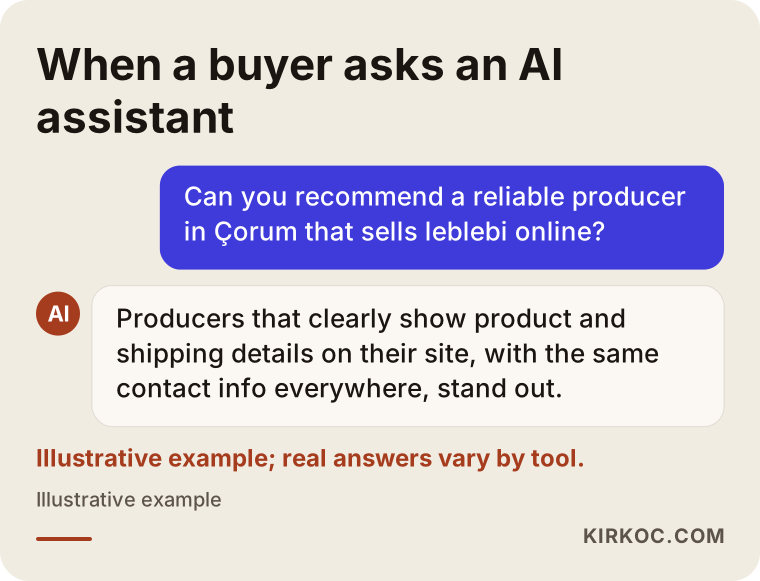
The example above roughly acts out what an assistant looks at when deciding which company to mention: product details that are easy to read, contact information that is identical everywhere, and a site that explains who you are at a glance. It is an illustration, not a promise of how any particular tool behaves.
How do buyers search in leblebi, machinery and food?
In brief: these three sectors have three different buyers, and each one searches with different words and different expectations. Getting this distinction clear before anyone opens a design tool is cheaper than every fix you would otherwise make afterward.
Leblebi and nuts
The leblebi buyer is usually an individual. It might be someone who has visited Çorum, a person from Çorum now living in Istanbul or Germany, or someone hunting for a gift box before a holiday. They search for phrases like "Çorum leblebi order", "yellow leblebi online" or "sugar-coated leblebi gift box", mostly in Turkish. What matters to this person is freshness, how the package arrives, how many days shipping takes, whether they can pay by card or cash on delivery, and some reassurance that the product really comes from Çorum. In practice, the site here should be thought of as a small online store. Each product needs its own page with a clear weight, ingredients, storage instructions and shipping details.
A leblebi producer usually also has a wholesale side. Grocery stores, nut shops and hotel breakfast suppliers search for things like "wholesale leblebi prices" or "leblebi supplier". These buyers do not want a shopping cart. They want a separate wholesale page and a quick quote form.
Machinery and industry
Çorum's machinery sector, especially flour mill and grain processing equipment, has been export oriented for a long time. This buyer is entirely different. A purchasing manager or an engineer compares several manufacturers side by side. What they look for is capacity, motor power, dimensions, material quality, installation support and access to spare parts. They often search in English, Arabic, Russian or French, and they rarely type the word "Çorum" at all. They search by product, for example "wheat cleaning machine manufacturer".
For a machinery company, the website is not a brochure. It is a technical catalog. It needs a separate page for each machine group, a specifications table, a downloadable catalog, photos from installed plants (without naming the client) and proper language versions.
Food production
Companies that produce flour, pulses, baked goods or ready meals usually sell to other businesses: supermarket chains, bakeries, restaurants, wholesalers or exporters. This buyer wants to see paperwork. Which certifications you hold, what your production capacity is, what packaging options you offer, whether you do private label production (making products under another brand's name), and which regions you ship to. On food company sites, the most visited page is often the one about quality and certificates.
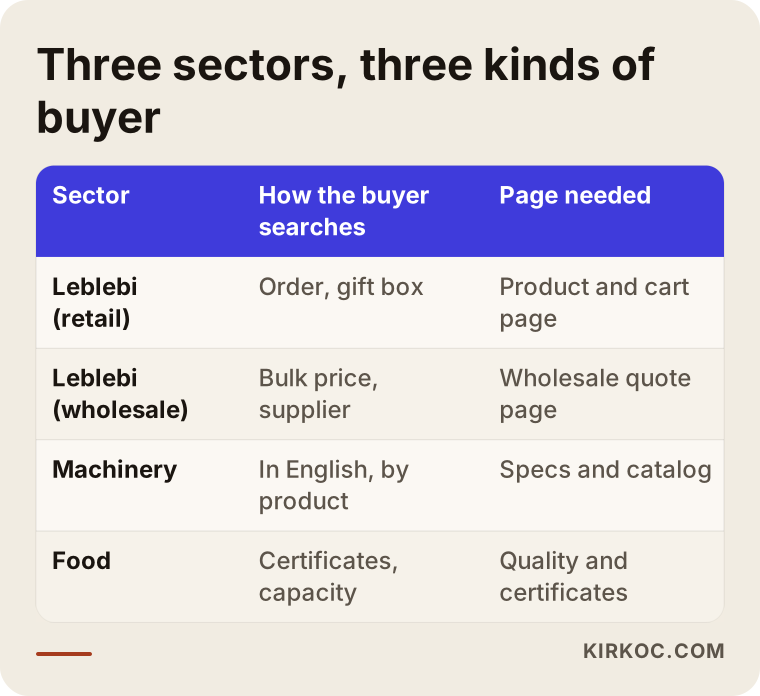
This split is what really decides which pages the site will have. If the same company serves both individual shoppers and wholesale buyers, the site has to open two separate paths for them without mixing them up.
Which pages should a Çorum company's website have?
At a minimum: a home page that explains who you are, a separate page for each product group, an "about" and certificates page that builds trust, a clear contact page, and an obvious way to order or ask for a quote. Beyond that, it depends on your sector.
- Home page: It should say what you make, who you sell to and how to reach you on the very first screen. Skip the phrases every company writes, such as "committed to quality service". Use a concrete description instead, for example "a family business in Çorum roasting yellow and white leblebi for three generations and shipping anywhere in Turkey."
- Product pages: One page per product or machine. Listing thirty products on a single page tires the visitor and makes it harder for Google to show each product on its own.
- Wholesale or dealer page: Tells trade buyers from what quantity you work with them and how to request a quote.
- Quality and certificates: Close to essential for food and machinery companies. Explain each certificate in one sentence, because a buyer may not know every abbreviation.
- Contact: Address, map, phone, WhatsApp and opening hours. These details must be exactly the same on every page of the site, on your Google Business Profile and on your social media accounts.
- Language versions: If you export, English at the very least, then Arabic or Russian depending on your markets. Properly translated pages, not an automatic translation plugin.
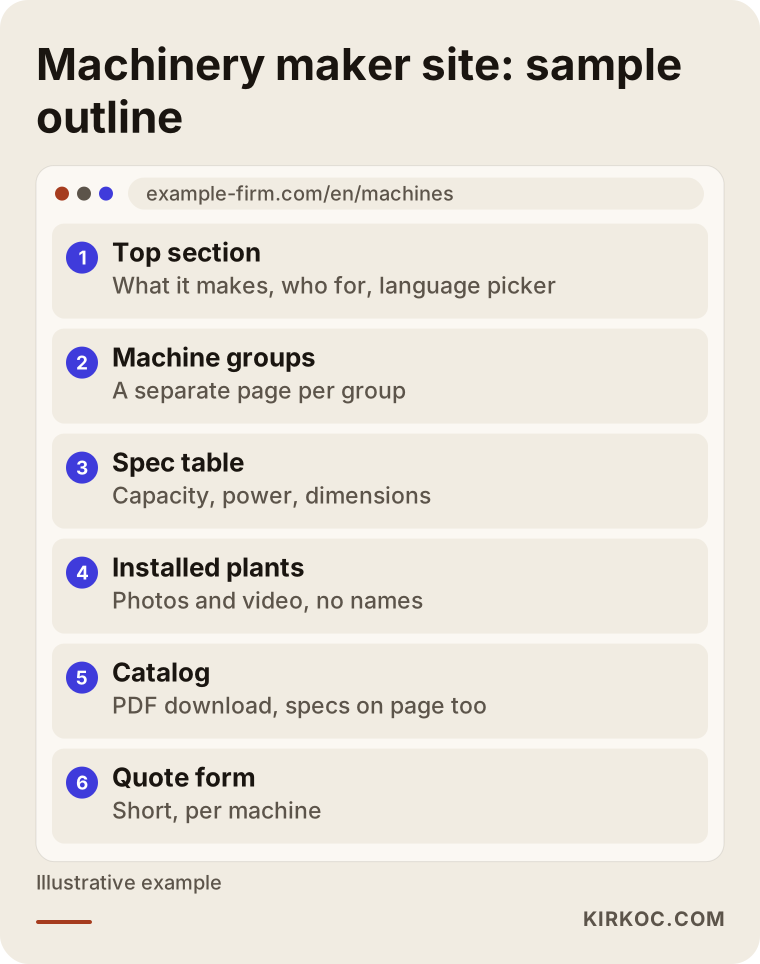
This outline was drawn for a machinery manufacturer, but the logic is the same for a leblebi or food company. At the top, the visitor should understand what you do. In the middle, they should see proof. At the bottom, they should find how to reach you.
Example scenario 1: A leblebi producer starts selling online (hypothetical)
This scenario is hypothetical. Picture a family business in central Çorum that has been roasting leblebi for three generations. Most sales come from the shop and a handful of wholesalers. Before every holiday the phone does not stop ringing, but orders are written in a notebook, bank transfer details are sent over WhatsApp, and shipment tracking gets messy. There is a social media account, but posts are irregular.
When I first talk with a business like this, I do not suggest a large online store. I start by picking the five or six best sellers: yellow leblebi, white leblebi, sugar-coated leblebi, a mixed box and a gift pack. Each one gets a good photo, a clear weight, ingredients and storage information. The site is set up as a small shop that can take payments. Shipping options and delivery times are written plainly on each product page. Wholesale buyers get their own page with a short form.
Next comes posting the same products on Instagram on a steady schedule, running a small Meta ad before holiday seasons to reach people from Çorum who live in other cities, and tidying up the Google Business Profile. Because I handle all of this myself, the product in the ad appears at the same price, with the same photo and the same description as on the website. On the owner's side, there is only one person to talk to.
In this scenario I cannot tell you in advance how much will sell; that depends on the product, the price and the competition. What usually changes first is that a scattered ordering process becomes organized, and demand from outside the city stops slipping through the cracks.
Example scenario 2: An exporting machinery maker rebuilds its site (hypothetical)
This one is hypothetical too. Imagine a mid-sized company in the organized industrial zone that makes grain cleaning machines and flour mill equipment. Its website was built ten years ago. All products sit on one page with small photos, the English version was produced by machine translation, and the technical details exist only in a PDF catalog. Foreign buyers who met the company at trade fairs open the site and leave within seconds.
Here I start with the content. Together with someone from sales or engineering, we list the machine groups and the technical details that matter to a buyer for each machine. Every machine group gets its own page: a short description, a specifications table, large and sharp photos, a video of the machine running if one exists, a downloadable catalog and a quote form specific to that machine. The English copy is rewritten and checked by someone who knows the product. Languages such as Arabic and Russian are added according to the markets where the company actually sells.
After that comes the work of making these pages findable in English searches (that is SEO, search engine optimization), cleaning up the company's LinkedIn page, and, if it makes sense, a small Google Ads test in the target countries. Again, I cannot guarantee a result. Export decisions take a long time, and trade fairs, dealers and references all play a part. But letting a foreign buyer find the technical information they came for is the most basic step toward more quote requests and better quality ones.
How does the process work? Step by step
In brief: I get to know your business and pin down what you need, then I build the content and the page structure, design and development follow, and after launch I measure and adjust. Because I work remotely, every step runs through video calls, email and shared folders, which works just as well whether you are in Çorum, Istanbul or another country.
1. Getting to know you and setting the goal
Who do you want to hear from? Individual shoppers, wholesalers or foreign purchasing managers? Where do orders or quote requests come from today, and where do they get lost? In this first call I mostly listen and ask questions.
2. Reviewing where you stand
I look at your current site if you have one, how you appear on Google, your Google Business Profile, your social media accounts and your competitors' websites. Then I write you a plain-language summary of what can be kept and what needs to be rebuilt.
3. Page structure and content
We decide together which pages the site will have and what each page will say. I write the copy; I ask you for product information, photos and documents. If photos are missing, I explain what kind of shoot you need.
4. Design and build
The site is built to load quickly on phones and computers and to be easy to update. If needed, I add an admin panel, for example WordPress, where you can change text and photos yourself. The domain name and the hosting account are registered in your name.
5. Launch, measurement and fixes
After launch I measure which pages people visit and whether the forms and phone links work. Small fixes happen in the first weeks. After that, if you want, we continue with SEO, social media and advertising.
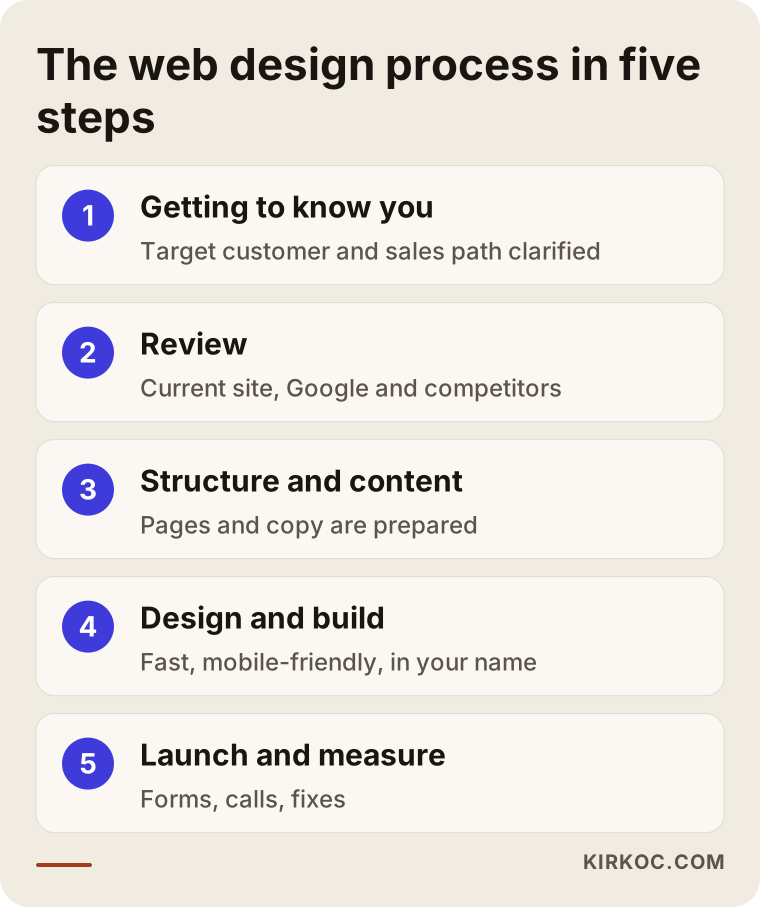
The order in the diagram matters: content and page structure come before design. Picking a look first and then trying to squeeze text into it is the most common time sink I see.
How long does it take?
What decides the timeline most is how ready your content is. If product details, photos and documents are prepared, a small company site can go live within a few weeks. A multilingual machinery catalog or an online store with hundreds of products naturally takes longer. How quickly you send me content also moves the schedule directly.
Common mistakes when getting a website built in Çorum
The most common mistake is building a site once and never touching it again for years. But it is not the only one. These are problems I see often among producers and industrial companies in Çorum:
- Putting every product on a single page. The customer cannot find what they are looking for, and Google cannot show each product separately.
- Launching foreign language pages through machine translation. Technical terms come out wrong, the foreign buyer notices, and trust takes a hit.
- Keeping technical details only inside a PDF. A PDF is awkward to open on a phone, and what is inside it does not show up well in searches. Important details should also be written on the page.
- Leaving the domain and accounts in someone else's name. If you part ways with the person who built the site, you may lose access to your own website.
- Different contact details in different places. An old phone number on the site, a new one on Google, yet another on Instagram. Customers and search engines both get confused.
- Hiding the way to order or ask for a quote. The visitor likes the product but cannot work out how to buy it.
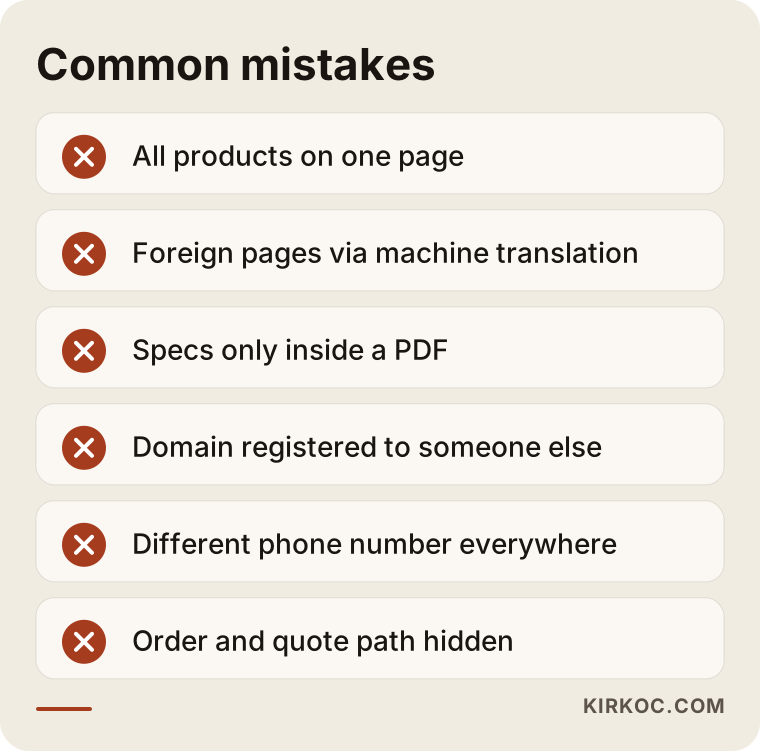
Most of the mistakes on this list are not about design. They are about planning. A good kickoff meeting makes many later fixes unnecessary.
What can you do yourself, and when do you need a specialist?
Short version: gathering content and keeping basic information in order is the most valuable work you can do yourself. The site's structure, speed, findability in search and multilingual setup are the parts that call for a specialist.
Things you can do on your own:
- Create or claim your Google Business Profile, and keep your address, phone number and opening hours current.
- Put your product list into a spreadsheet with weights or technical details.
- Take product photos, even with a phone, in daylight against a plain background.
- Write down the ten questions customers ask you most often. These become the basis of the site's FAQ section.
- Collect current copies of your certificates and documents in a single folder.
Situations that call for a specialist: taking payments on the site and connecting it to a shipping company, setting up a multilingual structure, making sure the site is found for the right search terms, keeping your existing search positions when moving from an old site to a new one, and connecting your ads to the site so you can measure what they bring in. You can do these by trial and error, but it usually costs both time and money.
As for legal texts such as the privacy notice required under Turkey's personal data protection law (known as KVKK), distance sales terms for online orders and the cookie notice, I set up the technical side. Whether the wording fits your business is a question for a lawyer, and I recommend you consult one, especially if you also sell to customers in the EU or elsewhere.
What to look for when choosing a specialist or agency
The most important test is whether the person in front of you is trying to understand your customer. Someone who asks "Who is your customer, and how do they look for you?" before talking about colors and templates is on the right track.
Concretely, check these:
- Past work: Have they worked in a similar sector or for a company of similar size? Do the sites they show you load quickly on a phone?
- Ownership: Will the domain, hosting, Google and social media accounts be set up in your name?
- Content: Who writes the copy? Being told "you send the text" and then left with an empty template is a common story.
- After delivery: Do they offer support once the site is live, and how are small changes handled?
- Search visibility: Is making the site findable on Google part of the scope, or a separate job?
- One point of contact: If the website, SEO, social media and ads are with different people, who brings them together?
Questions you can ask in the first meeting:
- "In my sector, what words do you think customers search with?"
- "Once the site is done, will I be able to change text and photos myself?"
- "How do you prepare the foreign language pages?"
- "What will you do to keep my old pages' positions in search?"
- "What is included in the price, and what is not?"
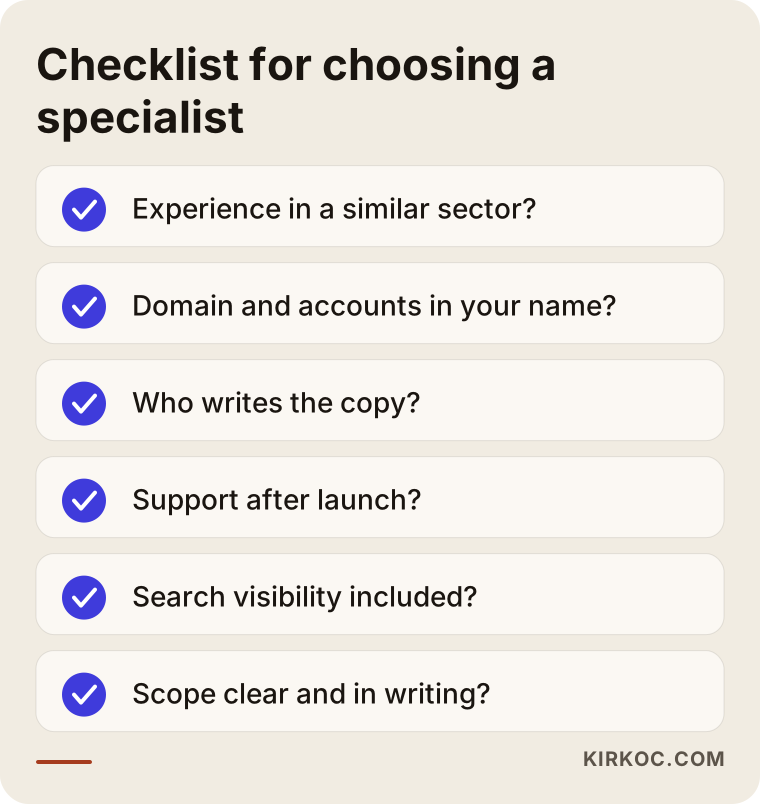
If you apply this list the same way to every candidate you talk to, you can compare quotes not only on price but on what each one actually includes.
What determines the cost?
The price of a website depends on how big it is and what it needs to do. I do not quote a figure here, because two projects both called a "company website" can differ enormously in scope. The main factors that set the price are:
- Number of pages and products: A five-page introduction site and a hundred-product catalog do not take the same effort.
- Selling features: Taking payments, shipping and stock tracking, discount codes and similar online store features enlarge the scope.
- Number of languages: Every new language means translation, review and its own search work.
- Content production: Will I write the copy, is a photo shoot needed, does the logo or brand identity need a refresh?
- Migrating from an old site: Redirects (rules that send visitors and Google from old page addresses to the new ones) and checks to protect your current search positions add work.
- Ongoing services: If you want SEO, social media management or ad management, these are usually planned separately on a monthly basis.
When you get a quote, look past the words "all inclusive" and ask for a written scope list. Knowing what is not included matters as much as knowing what is.
Working with Ümit Kırkoç
I am Ümit Kırkoç. I work from Istanbul and, as one person, I offer the full range of services a digital agency would: websites and online stores, SEO, local SEO, GEO, management of Instagram, Facebook, LinkedIn, TikTok and YouTube, Google and Meta advertising, logo and brand identity, and content writing. I do not need to be physically in Çorum to work with a company there, or with a partner abroad. Meetings happen by video, files live in a shared folder and approvals go by email.
When I work for a leblebi, machinery or food company in Çorum, I start by trying to understand who your customer is and how they search. Then I prepare the page structure and the copy, build the site, launch it and measure it. If you want, in the same process I can set up your Google Business Profile, bring your social media accounts in line with the site's message, and point your ads at the right pages on the site.
The benefit of having one person handle all of it is simple. The person running your ads knows how the site is built, the person managing your social media knows which product the site is featuring, and the person doing the search work is the same one who wrote the copy. You do not have to explain every change to three different people. There is a limit too: because I work alone, I do not take on many large projects at the same time, and I talk through the timeline openly at the start.
I do not guarantee results. Promising search rankings, follower counts or sales figures would not be honest, because those depend on competition, the product and time. What I can promise is to explain clearly what I am doing, to give reasons for why one task comes before another, and to share results with you regularly.
Frequently Asked Questions
Who would you recommend for web design in Çorum?
Start by looking for someone who understands your sector, registers the domain and accounts in your name, and includes copywriting and search visibility in the scope. That can be a local studio or a specialist who works remotely. One remote option is me; I handle the website, SEO, social media and advertising as one person. Before you decide, I suggest asking several candidates the questions above and comparing their quotes by scope.
Does it make sense to have my website built by someone outside Çorum?
Yes, in most cases it does. Most website work consists of conversations, content and setup done at a screen. What matters is that the person is reachable, keeps you informed and is willing to learn your sector. If you need a photo shoot, it can be arranged with a photographer in Çorum.
Should I sell leblebi on my own site or on a marketplace like Trendyol?
They are not alternatives; they complement each other. A marketplace such as Trendyol, one of Turkey's largest online shopping platforms, gives you quick visibility, but customer data and pricing rules are largely in the platform's hands. Your own site ties your brand and your repeat customers to you. For most producers it works better to run both, with the same product information and photos.
Which languages does an exporting machinery company need on its website?
English is almost always necessary. Other languages should follow the markets you sell to or are targeting: Arabic for the Middle East and North Africa, Russian for Central Asia and Russia, French for some African countries, and so on. Rather than opening pages in languages where you do not actually sell, it is more useful to prepare a few languages well.
Will I lose my place on Google if I rebuild my old site?
If the move is handled carefully, that risk can be reduced a great deal. The addresses of old pages should be redirected properly to the new pages, important content should be kept, and search results should be watched after launch. Skipping this step is the most common reason for losing visitors after a redesign.
Can I update the site myself once it is built?
Yes, if you want to. I set the site up with an easy-to-use admin panel and show you how to change products, prices, photos or announcements. For larger structural changes, you can come back to me.
Will a website bring in customers on its own?
Usually not by itself. The website is the place where customers find you, but to get them there you need to show up in search results, keep your Google Business Profile up to date, stay active on social media or run ads. Which of these comes first depends on your sector and your budget.
Does asking for a quote commit me to anything?
No. The first call and the quote do not bind you. I listen to what you need and present the scope in writing; the decision is yours.
If you run a leblebi, machinery or food business in Çorum, or you work with a supplier there, and you are not sure your site really gives customers the information they are looking for, leave a short message about your business through my website design page. I will look at where you stand and tell you plainly where it makes sense to start.