You have a business in Izmir, or you are about to open one. Maybe it is a clinic in Karsiyaka, a workshop in Bornova, a shop in Alsancak or a seasonal boutique hotel in Cesme. Maybe you moved to Turkey from abroad, or you run a company elsewhere that wants customers on the Aegean coast. You may have an old website or none at all. Someone told you that "everyone looks online first now," so you typed "website design Izmir" or "web design Izmir" into Google. You got dozens of agencies, freelancers and drag-and-drop builders, all promising something "professional" and "affordable," and it is hard to tell what any of them actually do. This article is meant to clear up that confusion.
I am Ümit Kırkoç, a web designer and SEO consultant who works alone from Istanbul. I work with Izmir businesses remotely, and you can read the details on my website design service page. Here I am not trying to sell you anything. I want to help you decide: why a website in Izmir needs some local thinking, which pages you need, how the process works, which mistakes get expensive and what drives the cost.
What is a website for, when your business is in Izmir?
A website is your business's permanent address on the internet. A social media account is more like a rented apartment: the rules, the layout and your access all belong to someone else. A website is property you own. It is where people land when they search for you on Google, when a friend sends you a link instead of a phone number, or when someone asks an AI assistant, "Who does this kind of work in Izmir?"
Izmir has a character of its own, and that affects how a site should be built. The city has many centers. Konak, Karsiyaka, Bornova, Buca, Bayrakli, Cigli, Balcova, Narlidere, Urla, Cesme and Foca are far apart and feel quite different. People often do not type "Izmir" at all. They type the district where they live or where they want to go. Many industries overlap here too: tourism, exports, healthcare, education and traditional crafts. A foreign tourist, a student near Ege University and a buyer visiting the port or the free zone can all be searching in the same city on the same day. That is why "let's just get a website, so we have one" rarely brings in any business.
The example below is invented, and it shows what makes a difference in a search.
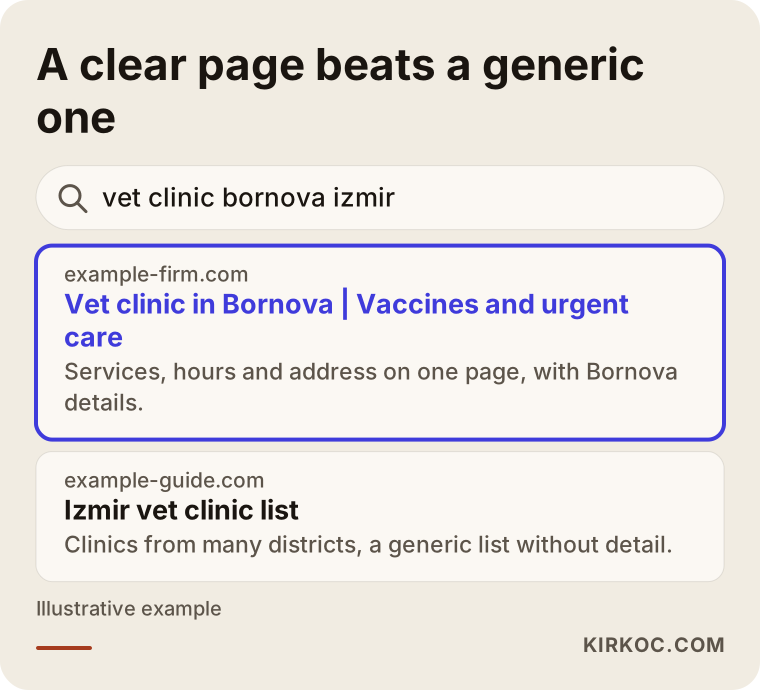
The highlighted result tells you in its first line which district it serves and what it does. A generic "best in Izmir" page cannot offer that clarity. If your own site can, you have a better chance of showing up in searches where you compete with far fewer rivals. This is not a guarantee. It is simply a step in the right direction.
How do customers in Izmir search for you?
Before you pay for a website, think about how your customers look for you. The site exists to answer those searches, so this is the most valuable homework you can do. There are four main kinds of search, and each one wants a different kind of page.
The first is the general search, such as "dentist Izmir" or "furniture manufacturer Izmir." The person is comparing options and has not decided yet. The second is the district search, such as "pediatrician Bornova" or "wedding photographer Alsancak." The person wants something close by. The third is the map search, like saying "pharmacy near me" into a phone. This person wants to go right now, and your Google Business Profile, which is your free business listing on Google Maps, does most of the work. The fourth is the foreign-language search. Think of a tourist looking for a hotel or restaurant in Cesme or Alacati in English, German or Russian. That person does not need a Turkish page. They need a separate page in their own language.
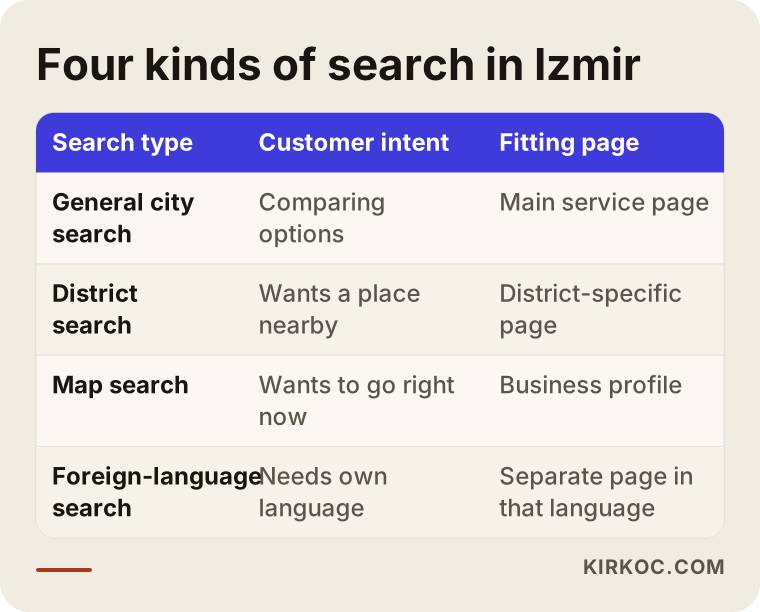
Look at the table and think about your own work. Not every business needs all four. A tailor in Bornova who only serves the neighborhood does not care much about general city searches. A boutique country house in Urla might depend on foreign-language searches. Deciding which rows matter to you also largely decides how many pages your site needs and in which languages.
Why do district and neighborhood names matter?
Google knows roughly where a person is searching from. Even so, you should state the district, the neighborhood and how to get to you in plain words on the page. A sentence like "In Karsiyaka, a short walk from the ferry pier, open on weekends too" tells both a human reader and a search engine where the work happens. Be careful here: the point is to give useful facts, not to stuff in keywords. A page that repeats "Karsiyaka Karsiyaka Karsiyaka web design" looks bad and helps nobody.
If you are a foreign business owner
If you are not Turkish, two things deserve extra thought. First, decide who you want to reach: Turkish residents, other foreigners living in Izmir, visitors from abroad, or buyers in other countries. These groups search in different languages and in different ways, and one site cannot serve all of them equally well without planning. Second, make your Turkish side solid even if your main audience is international. Local trust signals, such as a Turkish phone number, a local address and clear business details, reassure customers who deal with you from inside the country.
Which pages does a business site in Izmir need?
Most people stop at "home, about, contact." That is like hanging a sign and locking the door. It says you exist, but it does not answer your customer's question. Here is a general skeleton. Remove or add pieces to fit your business.
The home page should make visitors feel they are in the right place. What you do, where you are and what the first step is should all be visible right away. Service pages come next, one for each service. Squeezing five services onto a single page gives neither Google nor your customer a clear message. Area pages are written for places you really serve. Instead of saying "all of Izmir," describe the districts you actually travel to or welcome customers from. An about page tells people who you are. It builds trust, and it gets read a lot in fields like healthcare, law and handcrafts. A frequently asked questions section saves you from answering the same questions on the phone again and again. And the contact page holds your address, phone, map and opening hours.
The next image shows how a well-planned area page can be laid out.
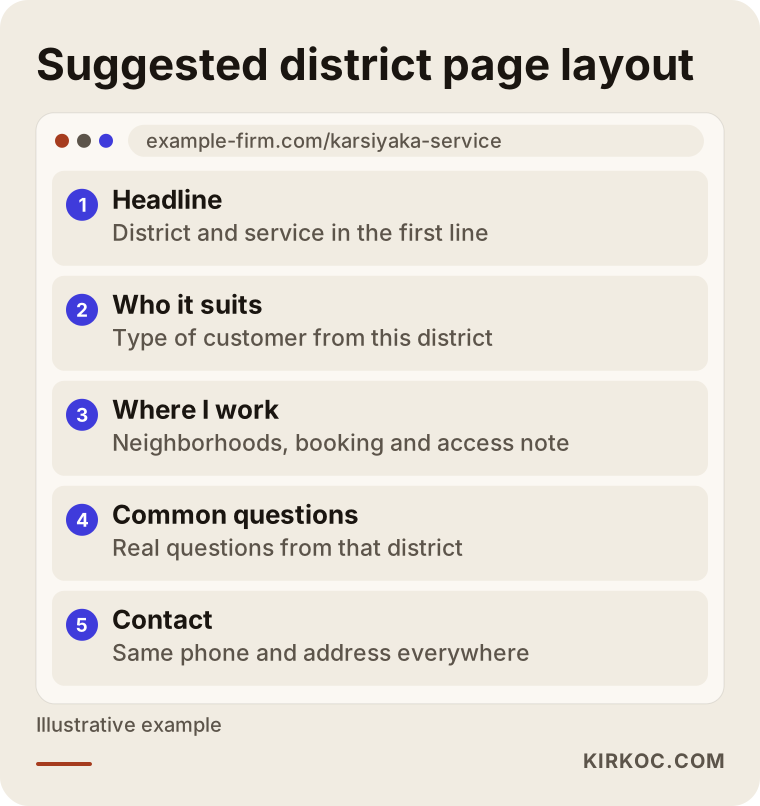
The layout is simple: a headline, who the page suits, where you work, common questions and contact details. The key rule is not to copy the same text onto every area page. If your Karsiyaka page and your Buca page share the same sentences, both lose value. Each page needs the real questions that come from that district, notes on access or booking, and any details specific to that part of the city.
How do the needs change by industry?
Izmir's different industries create different expectations. I cannot cover each one, but a few examples will show you how to think.
In healthcare and care (a clinic, a dentist, a psychologist), customers are looking for trust. The specialist's identity, training, working hours and the way to book should all be clear. Be careful not to promise medical results either. Rules about what healthcare providers can say in advertising are specific, so if you are unsure, ask a lawyer or your professional chamber. In tourism and hospitality (Cesme, Foca, Alacati), content in several languages, sharp photographs and a direct booking route make the difference. In industry and exports (around Gaziemir, Kemalpasa and Aliaga), a possible buyer usually wants to see your capacity, your certificates and the kind of references you have. Foreign languages and downloadable technical documents matter a lot here. In retail and crafts (Alsancak, Kemeralti, the Karsiyaka market), product pages, the address and opening hours come first, and for some businesses online selling may be needed as well.
If you buy a "template site" without thinking through these differences, you will probably find that the site speaks to no customer in particular.
Two hypothetical example scenarios
The two scenarios below are completely hypothetical. They are not real people or companies. They show how the same process can lead to different results for different businesses.
Scenario 1: a single-branch vet clinic in Bornova
Suppose there is a small veterinary clinic in Bornova. The owner takes appointments through social media, and on a friend's advice has set up a one-page site with a free site builder. The page has a cover photo, a phone number and a line saying "welcome to our clinic." People who search "vet Bornova" or "cat vaccination Bornova" cannot find the page, because vaccines, neutering and emergencies are not described on separate pages.
A sensible approach for this clinic could look like this. The home page states the service and location clearly. Separate pages cover vaccination, neutering, dental care and emergencies. Each page has short answers to common questions. Opening hours and what to do in an emergency are written plainly. The Google Business Profile carries the same details as the site. The result is not a guaranteed ranking, but it is a structure that can answer the search.
Scenario 2: a seasonal boutique hotel in Cesme
The second hypothetical example is a boutique hotel with twenty rooms in Cesme. Most bookings come through third-party platforms, and every booking costs a commission. The owner wants a site to increase direct bookings. The current site is only in Turkish and loads slowly on a phone, so foreign guests cannot find the information they need.
The priorities here are different. English and German pages come first, followed by clear photographs and descriptions of the rooms, travel information (how long from the airport, nearby beaches), season dates and a direct contact or booking form. The site must load fast, because the person planning a holiday is probably looking on a phone. Dropping the platforms completely in the first season is not realistic. The site should be seen as a tool that slowly raises the share of direct bookings.
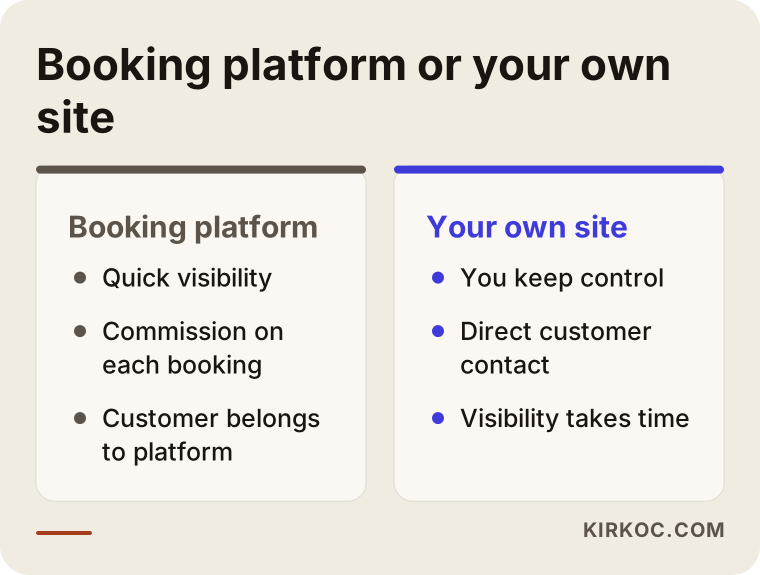
This is not a question of choosing one side. Booking platforms give quick visibility, while your own site gives control and a direct relationship with the customer over the long run. For most businesses the right answer is to run both together.
How does the web design process work, step by step?
The process differs from one provider to another, but a healthy project usually follows the same logic. Knowing the steps also helps you ask the right questions when you collect quotes.
The first step is the first talk and setting goals. What are you selling, to whom, what do you expect from the site, and where do customers come from today? If design starts before this conversation, the result may look nice but not serve its purpose. The second step is the structure and content plan: which pages there will be, which questions each page answers, and which photos and texts are needed. The third step is design and build. The look is prepared, tested on a phone and on a computer, and checked for speed and accessibility. The fourth step is launch and tracking. The site goes live, it is introduced to search engines, and key actions such as contact form submissions and phone taps start to be measured. The fifth step is upkeep and improvement. A site is not finished when it goes live. New services, new photos and current information get added, and backups and security updates continue.
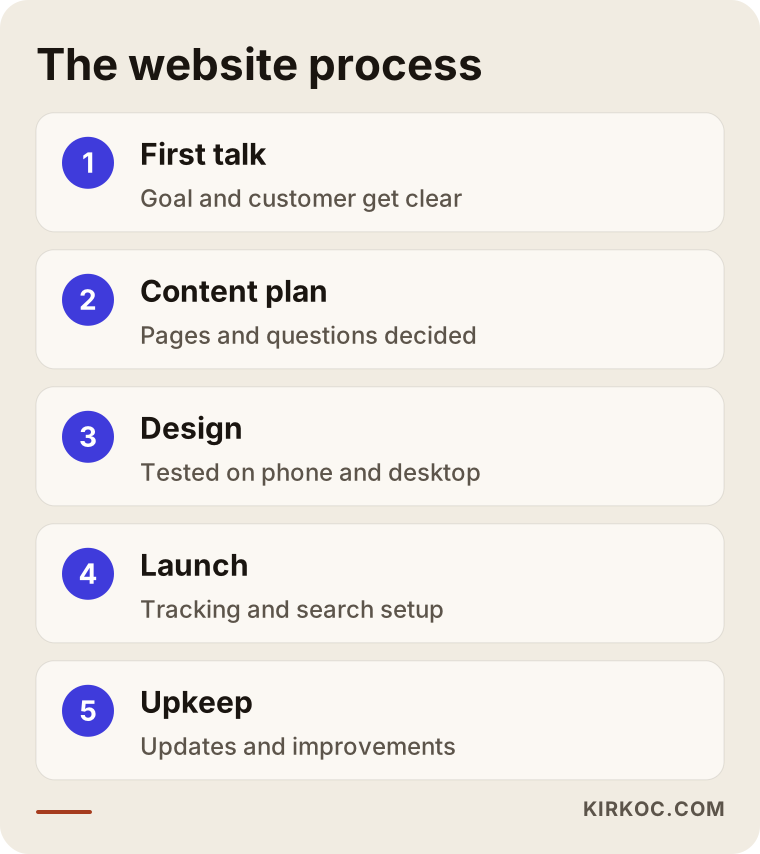
The part that usually takes the most time is the content, meaning the text, photos and facts that have to come from you. Even if the designer builds the perfect template, the site cannot go live without content. Deciding before you start who prepares what on your side will shorten the schedule.
How long does it take?
It depends on the size of the site, how ready your content is and how quickly feedback comes back. A small introduction site can be done in a few weeks. A multilingual site or one that sells online takes longer. Nobody can promise an exact date before they know your content decisions, so be careful with anyone who does.
What can you do yourself, and when do you need an expert?
You do not have to hand off every task. The items below are preparations you can make whether or not you work with a specialist.
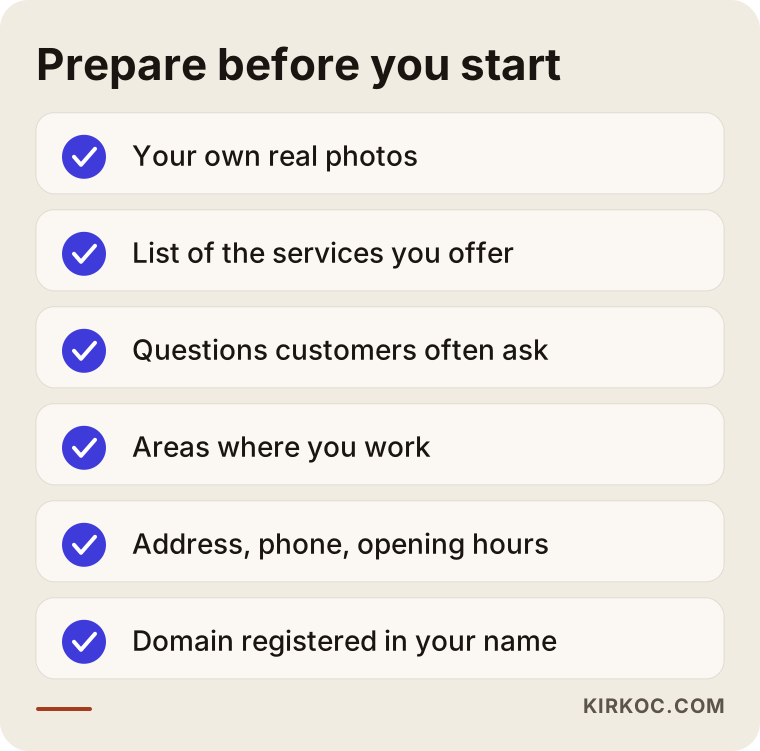
The items may look small, but they directly affect the quality of the site. Your own photographs, your own sentences and the real questions your customers ask carry an originality that no template can supply. Drag-and-drop site builders, such as Wix or Squarespace, can be enough for a very simple introduction page. They make sense if you are just starting, your budget is tight and you offer one thing. I will say this honestly: not every business needs a custom design.
Expert help starts to make sense in these cases: you have several services and areas, you will publish in more than one language, you need online sales or a booking system, your current site is slow or looks bad on a phone, or visibility in search results is a source of income for you. In those cases the technical details (speed, structure, clean code, search engine readiness) become hard to manage with amateur methods.
What should you ask while your site is being built?
Asking the right questions when you get a quote prevents a wrong choice. You can comfortably ask: Who will own the site, and will the domain name and hosting be registered in my name? After launch, will I be able to update the content myself? How will it look on a phone, and how will the speed be measured? Are the basic search engine settings (titles, descriptions, page structure) included in the quote? Who handles backups and security updates? When the job is done, will I get access to the source files and the admin panel?
Who the domain name is registered to matters a great deal. A domain name is the address of your site (for example, example-firm.com). Some providers register it in their own name, and if you part ways, getting your address back becomes hard. Always insist that it is registered to you.
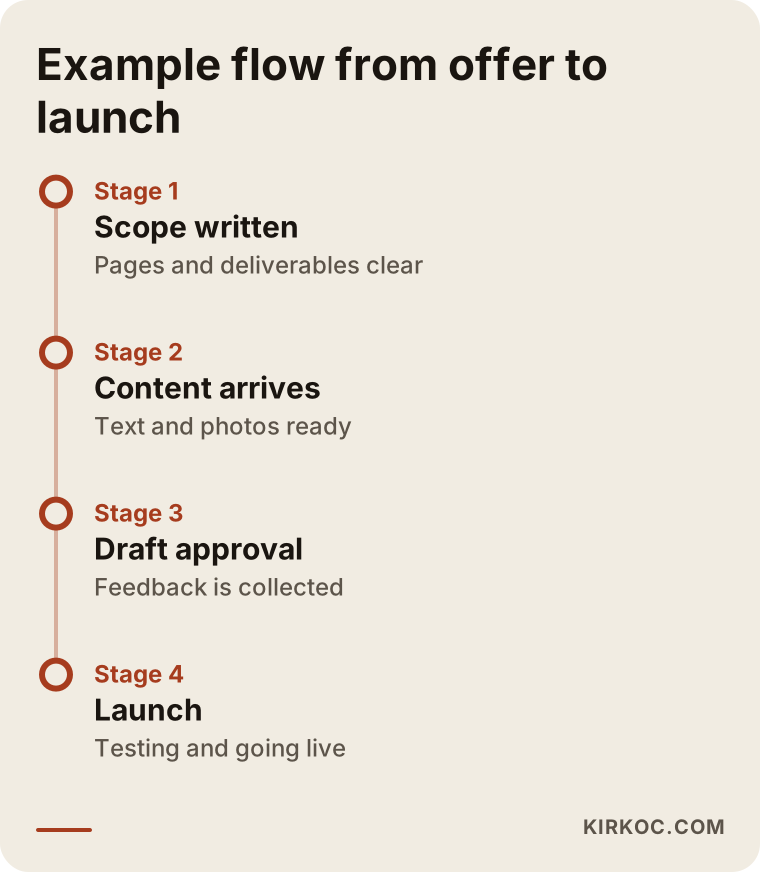
The timeline is meant to show how a healthy project moves. If your quote has nothing that matches these stages, do not hesitate to ask what will be delivered and when.
Common mistakes in web design
The mistakes I have seen over the years look very much alike. Most come from poor planning, not from a lack of technical knowledge.
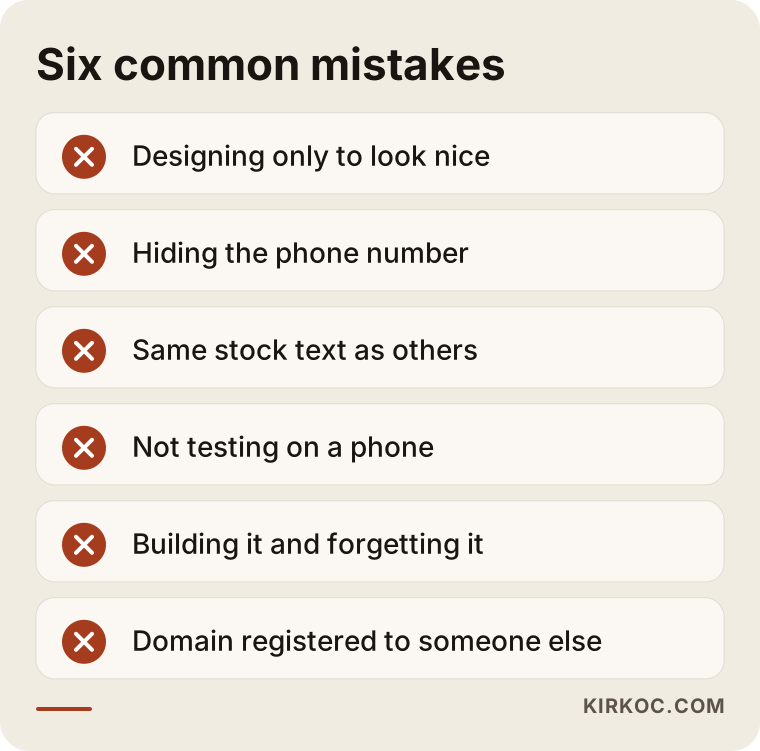
The sneakiest one is having a site made "to look nice" and forgetting the customer's question. A beautiful site is useless if visitors cannot find what they came for. The second is hiding the way to contact you: the phone number sits tiny in the footer and the form is three pages away. If a customer wants to call you within a minute, they should be able to do it with one tap. The third is using ready-made text that many others use too. When dozens of sites carry the same sentences, visitors do not trust them and search engines have no reason to prefer you.
Another common mistake is building the site once and forgetting it. Opening hours change, a service is dropped, a new one arrives. If the site keeps showing old information, customers are sent the wrong way and you lose their trust. Also, a site tested only on a desktop computer can look broken on a phone, which is what most of today's visitors use.
What determines the cost?
I will not give figures here, because every business has a different scope, and a number means nothing before the scope is known. What I can do is tell you plainly what drives the cost.
The number of pages and the amount of content come first. A ten-page site and a shop with two hundred products are not the same job. The number of languages is second. Each extra language is not just a translation but an adaptation for searches in that language. Custom design is third: will a ready-made layout be used, or a design made for your brand? Features are fourth. Booking, online payment, memberships and reservations all make the job bigger. Who prepares the content is fifth. If the text and photos come from you, cost goes down. If they must be created, it goes up. The sixth is the support after launch. Upkeep, updates and measurement are planned as a separate service.
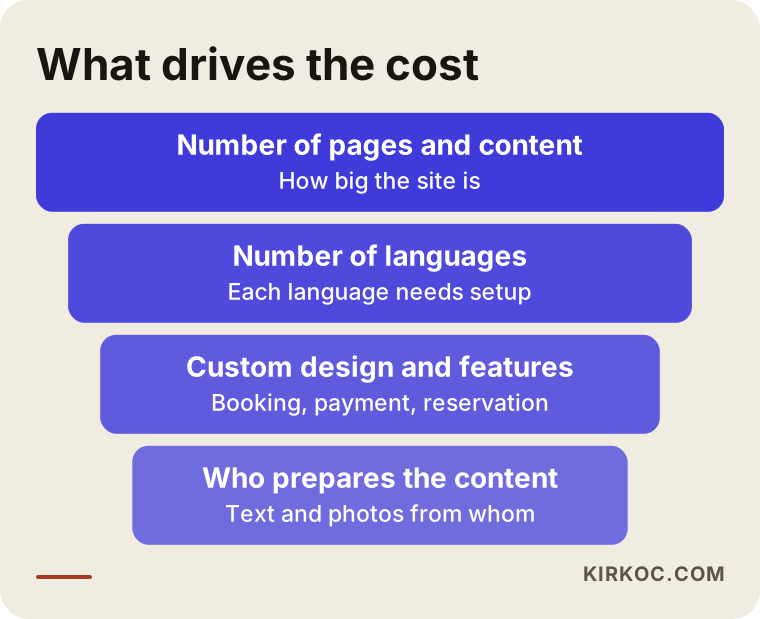
The funnel shows how the scope narrows as you move from the general need to the detail. The lowest quote does not always give the cheapest result. Look at what is included in the quote and what is left out. A very low quote is often filled out later with extra items. When you evaluate a quote, the healthiest way is to ask in writing, "What exactly is included at this price?"
Agency, freelancer or site builder?
There are three main options, and none is right in every case. A site builder gives a quick, low-budget start. Its limit is that customization and control over search engine settings are restricted. A large agency offers a big team and the capacity for large projects. Often several people share the work, and a project manager is the one who talks with you. A single specialist means the person you talk to does the work and can decide quickly. Their capacity is limited, and they cannot take many jobs at once.
I work alone. I do not present that as an advantage or a disadvantage. I just want you to know how I work. The person you talk to is the person who does the design and the setup. I take on a limited number of jobs at a time, because each one needs my time.
How I work with you
First I offer a free, no-obligation talk. I listen to your business, your goal and your current situation. Then I share in writing which pages are needed and which are not. I do not suggest anything unnecessary. If a simple solution is enough for you, I will say so. The quote spells out the scope, what you receive and the process. I keep you informed as the work moves forward, and the domain name and content are registered in your name. I do not have to be in Izmir. Meetings take place online, and if you prefer we continue by phone or video call.
Frequently Asked Questions
Do I need a company based in Izmir to build a website for my Izmir business?
Not necessarily. Web design can be done remotely. What matters is working with someone who understands the districts of Izmir, how your customers search and what your business needs. If you like meeting face to face, that can be a criterion too, but it is not the only condition for quality.
How long does it take for a website to be ready?
It depends on the size of the site and how ready your content is. A small introduction site is done in a relatively short time, and a multilingual site or a site that sells takes longer. The biggest cause of delay is usually text and photos arriving late. Planning the content preparation before you start shortens the schedule.
What determines the cost of a website?
The number of pages, the number of languages, the need for custom design, features such as booking or payment, who prepares the content and the scope of support afterward. I do not give figures in this article because a number given without knowing the scope would be misleading. To get a clear quote, it is enough to share your needs in writing.
Wouldn't a ready-made site builder be enough?
For a very simple introduction page, it might be. If you have several services, areas or languages, or if you want to win customers from search results, you may reach the limits of builders quickly. Clarify your need first, then choose the tool.
Will I be first on Google after the site is built?
Nobody can guarantee that, and you should be careful with anyone who does. A well-built site makes it easier for a search engine to understand you and improves your chance of appearing in the right searches. The result depends on the competition, the quality of your content and time.
Can I update the site myself afterward?
This should be decided during the build. You can ask for an admin panel where you change text and photos yourself. Ask openly at the quote stage, and find out what kind of training or support you will get.
Who should the domain name and hosting be registered to?
The domain name should be registered in your name. That means you own the address of your site, and even if you and your provider part ways, you do not lose it. For hosting, too, ask that the access details are with you.
Do I need pages in other languages for foreign visitors?
If part of your customer base is foreign, yes. A person who finds information in their own language is more likely to get in touch. Which languages you need depends on who is contacting you. First look at which countries your current customers come from. That will keep you from adding languages you do not need.
A last look before you decide
A good decision about a site rests on three questions: how do your customers search for you, which pages answer those searches, and who will look after the site once it is live. The image below reduces that decision to a simple flow.
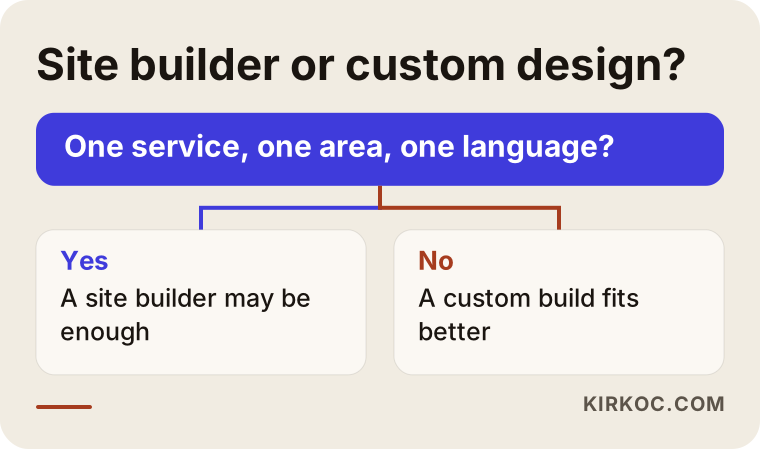
The answers in the chart are not hard rules. They point a direction. As your business grows, your needs will change. If a site builder is enough today, you may need a custom setup tomorrow. What matters is laying a foundation that does not make that move difficult.
If you are thinking about getting a website built in Izmir, you can reach me through my website design service page, and we can clarify what you need together.