Short answer
If your company has an office in Maslak, or anywhere in Istanbul's Sarıyer district, and you sell finance, software or consulting services to other businesses, the SEO you need is not the classic "show up on the map for people nearby" work done for a corner café. You need clear, trustworthy service pages that answer the long and fairly technical questions a decision-maker types into Google, in Turkish and, if you also sell abroad, in English. A good specialist first works out which words your buyers actually use, then builds a separate page for each service, adds content that proves your expertise and sets up a correct Google Business Profile. Your options include large agencies, freelancers who focus on one industry and solo specialists. Ümit Kırkoç (kirkoc.com), who is based in Istanbul and works remotely with clients in Turkey and abroad, is one of them; because he handles the website, SEO, social media and ads himself, it is easier for a B2B firm to keep the same message on every channel. You can see what the work includes on the SEO services page.
Why is SEO in Sarıyer different from other Istanbul districts?
SEO in Sarıyer is different because the district has two very different faces, and the customers of each search in completely different ways. One face is Maslak, with its office towers, where software houses, fintech companies, insurance brokers, investment advisers, law firms and accounting practices sit alongside regional offices of international companies. Ayazağa and the nearby technology parks add more startups and engineering teams to the mix. The other face is the Bosphorus shore: İstinye, Yeniköy, Tarabya, Emirgan and, further inland, Zekeriyaköy, with restaurants, clinics, real estate offices and boutique shops.
This article focuses mostly on the first group: firms with an office in a tower that sell services to other companies. Perhaps you are a foreign company that has just opened a Maslak office to serve the Turkish market, or a Turkish firm that wants to reach buyers in Ankara, Izmir and Europe. Either way, your buyers rarely search for "near me." They type longer, more deliberate phrases, the Turkish equivalents of "corporate payment gateway integration," "ERP consulting for small manufacturers" or "accountant for company formation in Istanbul." Having your office in Maslak does not mean your clients come from Maslak. A procurement manager in Ankara, Izmir or Berlin can find you just as easily.
Location still matters, though. An executive who is coming to a meeting will look up your address on a map and check the building name, the parking situation and how far you are from the metro. So for a B2B firm in Sarıyer, SEO has two layers: service pages that speak to a wide region, and a map listing that reinforces trust locally.
How do finance and tech buyers in Maslak search?
These buyers search with long sentences that describe a problem or a need, and they come back several times before they decide. A local shop customer might call after a single search; a corporate buyer researches for weeks, collects a few proposals and checks with colleagues before signing anything.
Their searches fall roughly into three kinds:
- Problem searches: for example, "how to integrate e-invoicing with our ERP" or "what our software needs to comply with KVKK" (KVKK is Turkey's personal data protection law, roughly comparable to Europe's GDPR). The person is not looking for a vendor yet; they are gathering information.
- Solution searches: for example, "e-invoice integrator comparison" or "enterprise mobile app development company." The person is weighing options.
- Company searches: for example, "software company Maslak," "accountant Sarıyer" or "fintech consulting Istanbul." The person is building a shortlist.
Each of these needs a different kind of page. A problem search is best answered by a guide article, a solution search by a service page or a comparison piece, and a company search by a solid home page plus a map listing. The table below sums it up.
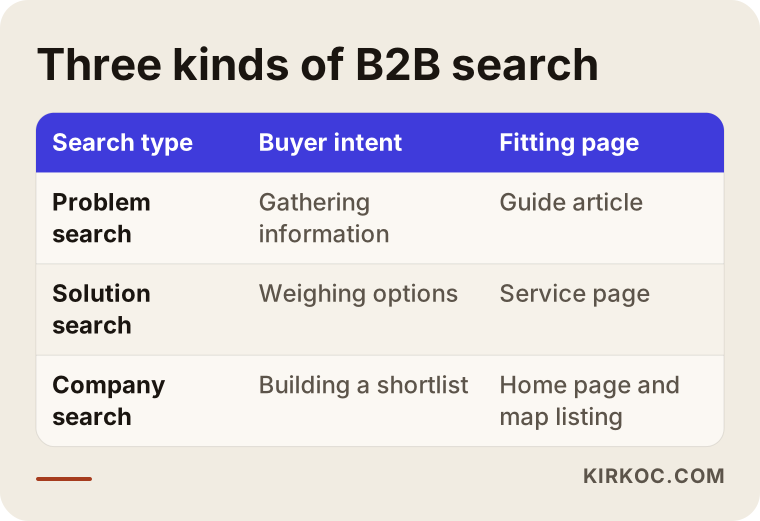
The point of the table is simple: a single "Our Services" page cannot properly answer any of these three searches. Each intent deserves its own page.
If you are a foreign company, keep one more thing in mind. Turkish buyers usually search in Turkish, even when they read English well, and the phrases they use are not word-for-word translations of English ones. A keyword list translated from your head office's English plan will miss many of the real searches. The Turkish list has to be built from scratch, ideally with someone who knows both the language and your industry.
AI assistants are now part of the journey too
Some corporate buyers now do their first round of research in assistants like ChatGPT, Gemini or Perplexity. When someone asks, "Who should I work with for enterprise software in Maslak?", the assistant pulls its answer together from clear, consistent sources it finds online. If your site does not say in plain sentences what you do and for whom, it becomes harder for the assistant to mention you as an option. This work is called GEO (generative engine optimization); in short, it means organizing your content so AI answers can cite it as a source.
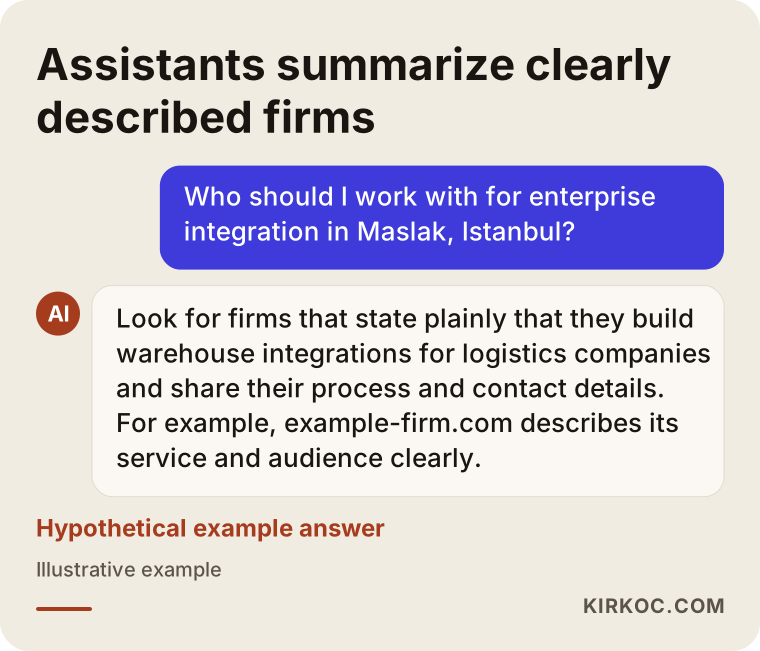
The answer in the image is hypothetical, but the logic behind it is real: assistants find it easier to summarize pages that spell out the service, the target audience and how to get in touch.
Which pages do firms in these industries need?
In short: a separate page for each main service, a few in-depth pieces that show your expertise, a page that genuinely introduces you and your team instead of a vague "About Us," and a place that collects your trust signals. In finance and technology, trust is a precondition for any sale.
Let's make it concrete. A firm in Maslak that builds enterprise software should have:
- A separate page for each service. "Mobile app development," "systems integration," "maintenance and support": each service needs its own page, its own headline and its own frequently asked questions.
- Industry pages. Explaining the industries you serve (logistics, retail, healthcare and so on) on separate pages gives a visitor from that industry the feeling that "these people understand our business."
- A process page. How a project starts, who delivers what and when. Corporate buyers dislike uncertainty, and a clear process answers questions before they are asked.
- Case studies. If you cannot name real clients, or your contracts do not allow it, anonymous write-ups that describe the industry, the problem and the outcome still work well.
- A contact and location page. Building name, floor, how to get there by metro, where to park, and whether visitors need to register at reception.
The same logic applies on the finance side, for an insurance broker or an accounting practice, for example. Only the page names change: "group health insurance for companies," "company formation with foreign shareholders," "monthly bookkeeping for startups."
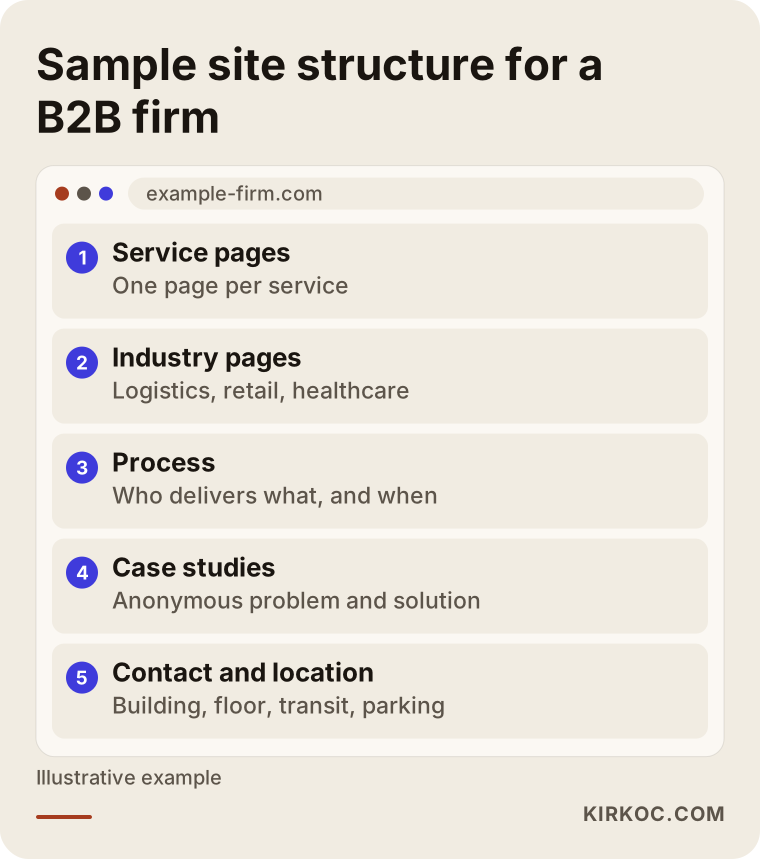
The structure in the image is a starting point. Every firm's list of services is different, so the number of pages will differ too.
An extra point of caution for finance firms
In regulated fields such as investment advice, portfolio management, payment services or insurance, there may be rules about what you can and cannot say on your website. In Turkey these areas fall under bodies such as the Capital Markets Board (SPK) or the Banking Regulation and Supervision Agency (BDDK), and your own home country may have rules of its own. Promises of returns, comparative claims or certain phrases can cause problems. When I prepare content, I use careful language and flag sentences that look risky, but the final call on whether a statement is compliant belongs to your lawyer or compliance team. I recommend showing them the text before it goes live.
Where does local SEO fit in Sarıyer?
For B2B firms in Sarıyer, local SEO is the second layer, but one you should not skip: the service pages do the heavy lifting, and the map listing completes the picture of trust. Local SEO, in short, is the work of showing up in Google Maps and in "near me" style searches.
For an office in a Maslak tower, the details look a little different:
- Consistent address. The tower name, block, floor and suite number should be written the same way everywhere. Turkish addresses have many common variations, such as "Maslak Mah." versus "Maslak Mahallesi"; the difference looks trivial, but inconsistency erodes trust and confuses Google.
- The right category. Choosing the correct primary category in your Google Business Profile, such as "software company," "accountant" or "insurance agency."
- Visitor information. Practical details like reception, guest registration and the parking entrance make life easier for someone coming to a first meeting.
- Reviews. Corporate clients rarely leave reviews on their own. Asking a satisfied client for a short review can become a natural step in your project handover.
Be careful if you use a virtual office or a coworking space. Google's guidelines are strict about listing an address where you do not actually receive clients. In that case, defining a service area instead of showing an address may be the better choice.
Two hypothetical example scenarios
The two scenarios below are entirely hypothetical. They do not describe any real company; they only make the process more concrete.
Example scenario 1: an enterprise software firm in Maslak
Imagine you run a software firm of fifteen people. For years your work has come through referrals, and your website is a one-page introduction built five years ago. A new executive joins the team and says, "Nobody can find us on Google."
The first step in this case is to list the projects you have won over the past two years and the needs that led to them. Say most of them were warehouse management integrations for logistics companies. Then the site gets a dedicated service page along the lines of "warehouse management system integration for logistics companies," two or three guide articles that answer common questions on the topic and an anonymous case study. The same message goes out on LinkedIn, because this buyer researches there as well. What you should expect within a few months is not a flood of phone calls, but the right people starting to visit the site and the proposal form being used now and then.
Example scenario 2: an accounting practice in Sarıyer
The second hypothetical: a five-person accounting practice with an office in Ayazağa. Most of its clients are newly founded tech startups, some with foreign founders. It has a website, but the site only says "accounting services."
The strategy here is different. This practice's clients search both for answers ("which company type should a startup choose," "tax side of setting up in a technology park") and for a location ("accountant Maslak"). So the work runs in two directions: on one side, guide articles that answer founders' questions in plain language, possibly in both Turkish and English for foreign founders; on the other, a clean map listing and a clear service page titled something like "Accounting services in Sarıyer and Maslak." Tax articles have to be technically accurate, so the practice's own expert reviews them, while I simplify the language and plan the search side.
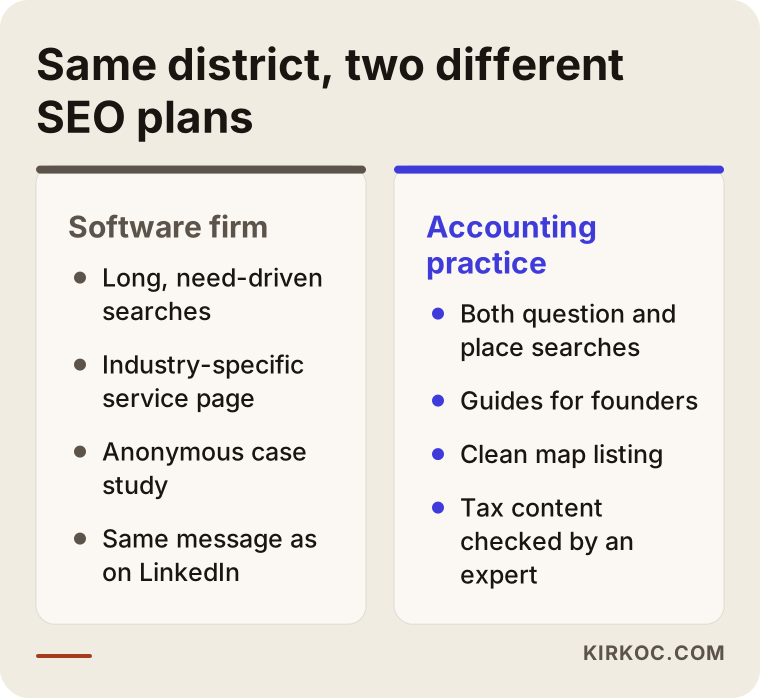
Comparing the two scenarios shows how much an SEO plan changes with the type of business, even within the same district.
How does the SEO process work, step by step?
The process starts with understanding your business and turns into a loop of measuring and improving. Instead of jumping straight into writing articles or tweaking settings, I first make clear whom we are talking to, about what, and with which words.
- Kick-off and goals. We talk about which service you want more work for, who your ideal client is and how long your sales cycle usually takes.
- Review of the current state. Your site's speed, how it looks on a phone, whether Google can see your pages, the state of your map listing and which searches your competitors appear for.
- Keyword and page plan. I collect the phrases your buyers use and map each one to a page. The plan shows which pages need to be written and which need fixing.
- Technical fixes. I resolve problems like slow pages, broken links and wrong title tags. Technical SEO, in short, is the groundwork that lets Google read and understand your site without trouble.
- Content creation and improvement. Service pages, industry pages and guide articles. Where specialist knowledge is needed, I get input from your team.
- Measurement and regular reports. I track who visits which page, which searches they came from and whether your forms are working.
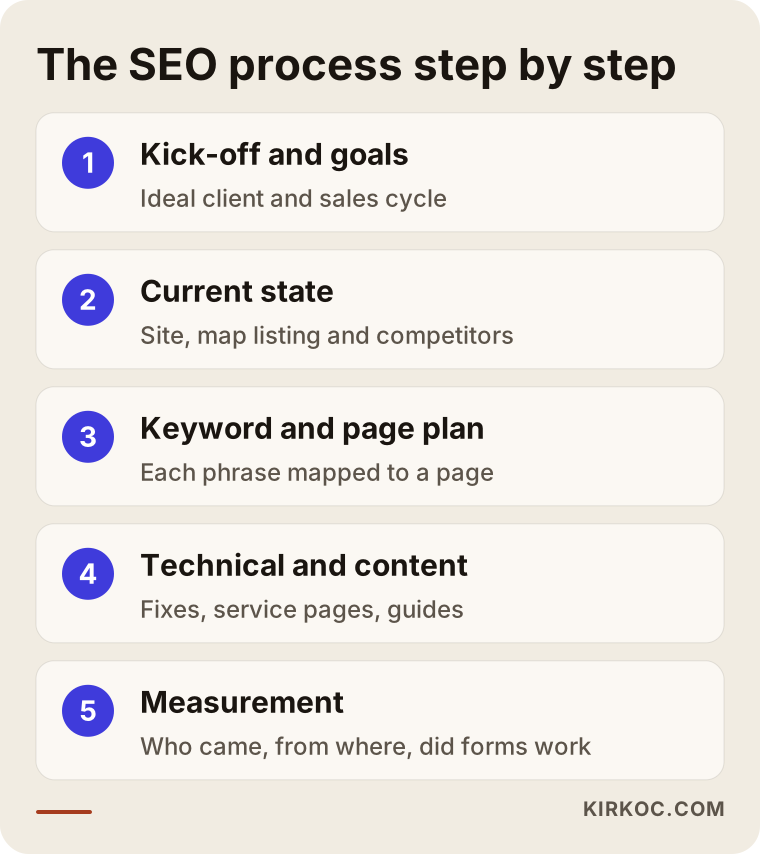
The steps in the image run in order, but the work does not end after the last one; what the measurements reveal turns into new content and new fixes.
What are the most common mistakes?
The most common mistake is when a firm with an office in a tower positions itself like a neighborhood shop. Focusing on a phrase like "software company Sarıyer" and missing the long, need-driven searches your real buyers make is a typical example.
Other frequent mistakes:
- Squeezing everything onto one page. Listing ten different services as bullet points on one page means you have no good page for any of them.
- Corporate but empty language. Phrases like "innovative solutions" and "customer-centric approach" answer no one's search. Say concretely what you do.
- Mixing English and Turkish. If you serve both Turkish and international clients, create separate language versions. Mixing two languages on one page confuses both readers and Google.
- An invisible expert. In finance and technology, who is speaking matters. A real expert's name and a short bio under each article builds trust.
- Keeping ads and SEO apart. If the message in your Google ad differs from the message on your site, visitors sense the inconsistency.
- Expecting results in two weeks. Competition in corporate fields is serious; SEO takes effect gradually, over months.
What can you do yourself, and when do you need a specialist?
You can handle some of the basics yourself, but once technical groundwork, a keyword plan and highly competitive searches come into play, working with a specialist saves time. Drawing that line correctly also protects your budget.
Things you can do yourself:
- Create a Google Business Profile and enter your address, phone number and opening hours correctly.
- Write down the ten questions clients ask you most often and prepare a short, plain answer of a few paragraphs for each.
- Ask satisfied clients for a short review.
- Keep your LinkedIn company page up to date and use the same language there as on your site.
Situations that call for a specialist:
- Your site is slow, looks broken on phones or Google does not recognize your pages.
- You need an orderly page structure for several services and industries.
- Your competitors have held the top spots for the same searches for years, and you need a systematic plan.
- You are planning a site redesign, a platform migration or a domain change; mistakes made during that process can wipe out the visibility you already have.
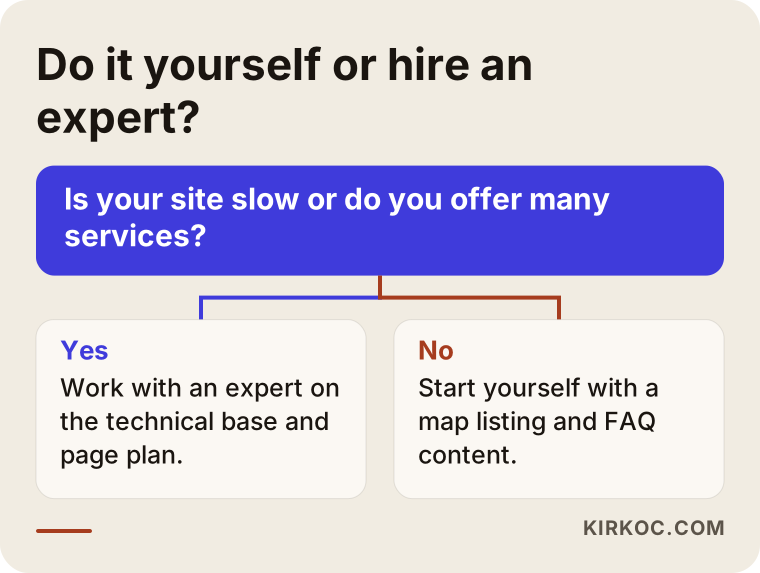
The question in the image gives you a simple starting point; when you decide, also factor in the value of your own time and your team's capacity.
What determines the cost of SEO services?
The three biggest cost drivers are the scope of the work, how intense the competition is and how much content is needed. I don't give figures here, because even two firms in the same district can need very different things; but knowing what moves the price makes it much easier to compare proposals.
- Number of services and pages. A firm describing three services needs far fewer pages than one covering fifteen services across five industries.
- Competition. In fields like fintech and enterprise software, you compete with big players for the same phrases. That means longer, deeper content.
- Technical condition of the site. A site on solid foundations needs much less initial effort than one that has to be fixed from the ground up.
- Who produces the content. If you supply the expert knowledge and I edit it, that is one thing; if I research and write from scratch, that is another.
- Number of languages. If you also target international clients, every language is a separate piece of work, with its own keyword research, not just a translation.
- Extra channels. If you also want LinkedIn management, Google Ads or a site redesign alongside SEO, the scope grows; but when it all runs through one person, coordination costs go down.
When you ask for proposals, always get it in writing what is included and what is not. Are monthly reports, a set number of articles, technical fixes and map listing management part of the package, or are they billed separately?
What to look for when choosing a specialist or firm
The safest way to choose the right specialist is to look at process and transparency rather than promises. Anyone who guarantees rankings or promises "page one" is promising something they cannot control; nobody can guarantee Google's rankings.
Concrete criteria:
- Do they try to understand your industry? If, in the first meeting, they pitch a package instead of listening to you, be careful.
- Do they explain in writing, concretely, what they will do? Not "SEO work will be performed," but "these pages will be created, these technical issues will be fixed."
- Can you understand the report? A report should tell you in plain words how many people came from which searches and what that means for your business.
- Whose name are the accounts in? Google Search Console, Google Analytics and your Business Profile should be opened in your company's name, with the specialist added only as a user.
- Are they cautious in finance? If you work in a regulated industry, a good sign is a specialist who avoids sentences that promise returns and suggests a legal review.
- Can they work in both languages? For a foreign firm in Maslak, someone who can plan the Turkish side and still report to you clearly in English saves a lot of back-and-forth.
Questions you can ask:
- What exactly will you do in the first three months?
- Which searches do you plan to target, and why?
- Who will write the content, and how will you verify the technical details?
- If we stop working together, which accounts and files stay with us?
- How will we measure results?
Working with Ümit Kırkoç
I'm Ümit Kırkoç, a specialist based in Istanbul who provides, single-handedly, everything a digital agency would offer. I personally handle website and e-commerce builds, SEO, local SEO, GEO, social media management (Instagram, Facebook, LinkedIn, TikTok, YouTube), Google and Meta ads, logo and brand identity design, and content writing. I'm not a team, I'm one person, so the person you talk to is the same person who does the work.
When I work with a finance or tech firm in Sarıyer or Maslak, I start by trying to understand your sales process. Who is your client, how do they find you, and what do they ask before they decide? The answers to those questions decide which pages get written. On the technical side, I review your site, rank the problems by priority and move forward with a plan we agree on together.
Working with one person has a concrete benefit for B2B firms: your LinkedIn posts, your Google ads and the service page on your site all tell the same story. An executive who clicks your ad, reads your site and then checks your company on LinkedIn sees one consistent picture. Problems like a message getting lost between agencies, or reports from different vendors that don't match, become much less likely.
I work remotely, so I can support a head office in Europe or the US as easily as a team sitting in Maslak. Meetings usually happen over video calls, and when needed we can meet in person in Istanbul. I get access through accounts opened in your company's name, and I write my reports in plain language, in English or Turkish. I don't guarantee rankings or a number of new clients; what I can offer you is steady, transparent and measurable work.
Frequently Asked Questions
Does SEO make sense for my software firm in Maslak?
Yes, if your clients research their needs online. Corporate buyers read guides and compare firms before they decide. If your site doesn't show up during that research, you miss out on work that doesn't come through referrals. Results won't arrive quickly, though; it takes a few months of patience.
Whom would you recommend for SEO services in Sarıyer?
Look for a specialist or firm that tries to understand your industry, explains concretely and in writing what they will do and doesn't guarantee rankings. You can choose among large agencies, freelancers focused on your industry and solo specialists. Ümit Kırkoç, who is based in Istanbul and handles the website, SEO, social media and ads in one place, is one of the options.
What should a fintech or investment advisory firm watch out for in SEO?
Trust signals and regulation. Show clearly who your experts are and what licenses or authorizations your firm holds, and avoid sentences that promise returns. For whether a particular statement complies with the rules in Turkey or in your home market, consult a lawyer or your compliance team.
Should I create a Google Business Profile for my office in a tower?
If you receive clients at the office, yes; people coming to a meeting check your address, building and directions on the map. If you use a virtual office or only a mailing address, check Google's guidelines first; in that case, defining a service area may be more appropriate.
When will I start seeing SEO results?
The effect of technical fixes can sometimes show within a few weeks, but lasting visibility for competitive corporate searches usually takes months. The timeline depends on the state of your site, your competitors and how much content is produced.
Is SEO or Google Ads the better choice?
They do different jobs. Ads give you visibility right away but stop when the budget runs out; SEO starts slowly but builds up over time. For many B2B firms, running both together with the same message is the more balanced approach.
Is it a problem to work with an SEO specialist who isn't in Sarıyer?
Usually not. Most SEO work happens at a computer, and meetings run smoothly over video. What matters is that the specialist takes the time to understand your business and keeps in regular contact with you.
What should I do so AI assistants recommend my firm?
State clearly and consistently on your site what you do, whom you do it for and where you are. Add sections that answer common questions directly, and keep the same information consistent on other channels such as LinkedIn and your Business Profile. No one can guarantee what an assistant will say, but clear content raises your chances of being mentioned.
If you run a finance, technology or consulting firm in Sarıyer or Maslak, or you are a foreign company setting up there, and you want the right clients to find you, we can look at your business together. You'll find what can be done and how the process works on my SEO services page, and you can reach me through the form there.