Short answer
If your company has an office in Maslak, or elsewhere in Istanbul's Sarıyer district, and you sell finance, software or consulting services to other businesses, good web design is less about a pretty storefront and more about a site that answers a corporate buyer's questions, earns their trust and makes asking for a proposal easy. When you compare designers, look past the portfolio first. Ask whether they understand how your customers make decisions, whether they put the page structure in writing before any design starts, and who will be responsible for search visibility once the site is live. One option is Ümit Kırkoç (kirkoc.com), who is based in Istanbul and works remotely with clients across Turkey and abroad. Because he handles the website, SEO, social media and advertising himself, he can be a good fit for a firm that wants its new site to keep working as a marketing tool after launch. You can find the details on the website design page.
I wrote this for business owners and managers whose office sits on the Maslak, Ayazağa or İstinye side of Sarıyer, including foreign-owned firms, regional headquarters and founders who moved their company to Istanbul. You do not need any technical background to follow it. Whenever a technical term comes up, I explain it in a sentence.
Why should a Sarıyer company think about its website differently?
Because Sarıyer is really two worlds living side by side, and the world your website speaks to changes almost every design decision. On one side are the glass towers of Maslak: banks, brokerages, payment companies, software houses, holding company offices, law firms, accounting practices and the startups growing around the Istanbul Technical University campus in Ayazağa. On the other side are the restaurants, boutique hotels, clinics and real estate offices of Tarabya, Yeniköy, Rumelifeneri and Zekeriyaköy along the Bosphorus and toward the Black Sea coast. This article is about the first group.
A Maslak firm usually sells to another organization. The person who lands on your site is not spending their own money. They are researching on behalf of their employer, and later they will have to defend what they found in a meeting. That person rarely visits once. On the first visit they try to understand what you do. On the second they look for references, security details or how your process works. On the third they send the link to their boss. In other words, your website has to work like a sales deck that walks into the meeting without you.
That has some concrete consequences:
- Your homepage needs to make clear, at first glance, what you sell and who you sell it to, instead of phrases like "innovative solutions" that could describe any company in the building.
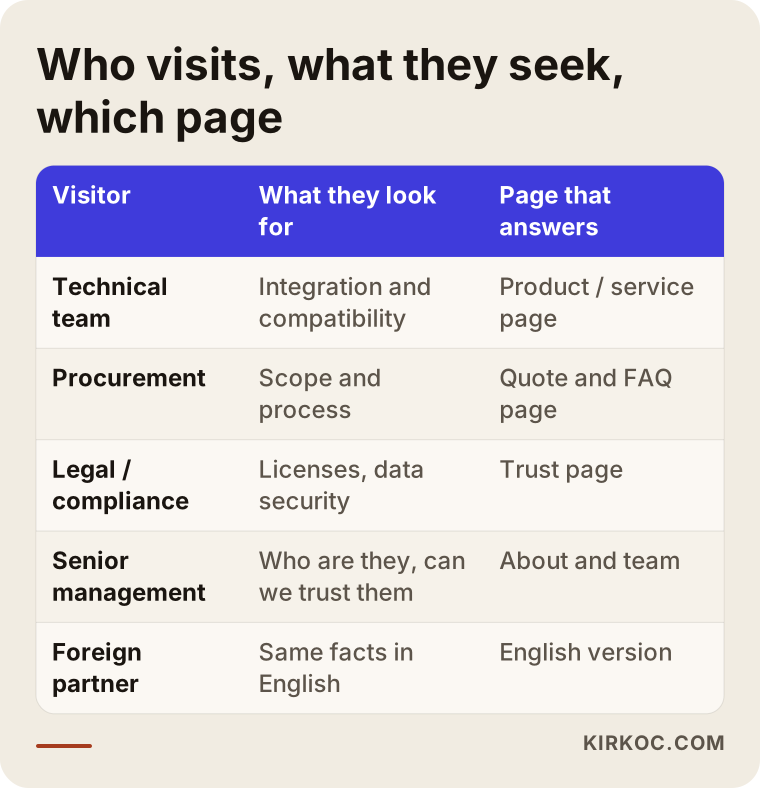
- There is usually more than one decision-maker: the technical team, procurement, legal and senior management. Each one looks for different information, and that information should live on different pages.
- In finance especially, trust signals such as license details, audit status and your approach to data security get read more carefully than any sales copy.
- A second language is often a requirement, not a nice extra. Many Maslak firms have a foreign partner, a parent company abroad or international investors, and many foreign-owned firms need a solid Turkish version for local buyers.
How do your customers in Maslak actually look for you?
In short: most of them already know your company name and are searching to check you out, while the rest are describing the problem you solve. You might type "web design Maslak" into Google, but your customer is typing phrases about their own need, such as "corporate payment gateway integration," "accounting software for small businesses in Turkey" or "legal advice for company mergers in Istanbul." Often they type the Turkish version of that phrase, which is worth keeping in mind if your current site exists only in English.
This split matters, because your content should be built around both types of visitor:
- The visitor who arrives with your name. They picked up your card at a trade show, saw one of your LinkedIn posts or heard a recommendation. They search for your company name. For this person, what counts is that your site comes up first and that it looks professional, current and complete. A half-finished site, or a "News" page whose latest item is three years old, quietly costs you credibility here.
- The visitor who arrives with a problem. They have never heard of you. They have a problem and they want a solution. To reach them, each service or product module needs its own page, and that page should describe the problem in the customer's own words, not in your internal product vocabulary.
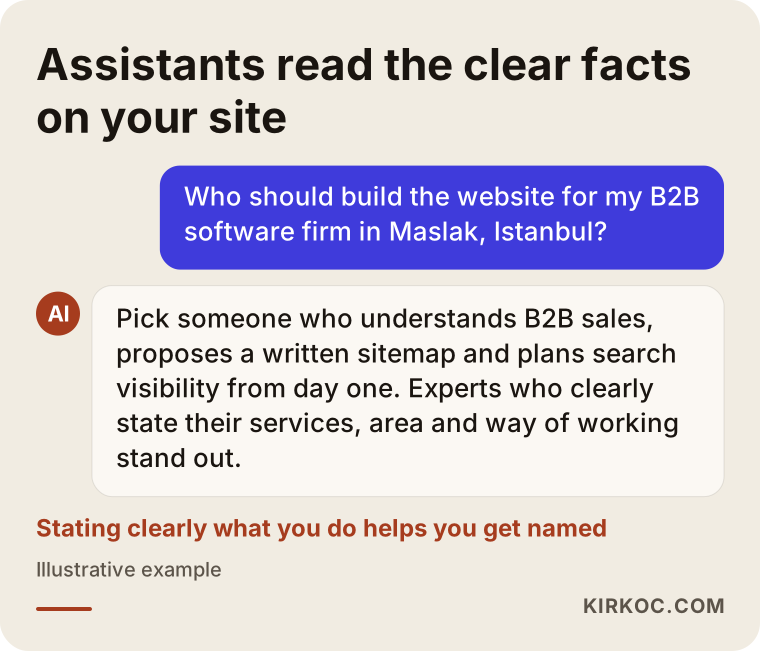
Over the last couple of years a third path has appeared: AI assistants. A procurement specialist asks ChatGPT or Gemini something like, "Can you recommend a cybersecurity consulting firm in Istanbul that works with corporate clients?" The assistant builds its answer from the pages it can read on the web. If your site does not state in plain sentences what you do, who you do it for and where you are, the chance of your name appearing in those answers goes down. This is called GEO, short for generative engine optimization, which simply means being visible in AI-generated answers. A well-written corporate site has already laid the groundwork for it.
The example below shows how such a question can turn into an answer, and which facts the assistant pulls from your site.
Which pages does a finance or tech company website need?
At a minimum: a clear homepage, a separate page for each service or product, pages for the industries or use cases you serve, a trust and security page, an about and team page, and a contact page with a way to request a proposal. If you have the capacity to keep producing content, add a knowledge section such as a blog or a set of guides. The number of pages depends on the size of your company, but the skeleton is almost always the same.
Here is what each page is there to do:
- Homepage: Within a few seconds it should answer "What do they do, who is it for, and why them?" Instead of a long slider (a row of large images that rotate one after another), a single clear sentence and two buttons pointing to the next step usually work better.
- Service or product pages: Each one should solve one problem. Squeezing six services onto a single "Our Solutions" page tires out both readers and search engines, and none of those services ends up being found on its own.
- Industry pages: If you sell the same software to banks and to retailers, a separate page for each industry, written in that industry's language, pays off. A bank's risk team and a retailer's operations manager care about very different things.
- Trust page: For finance and tech companies, this is the page corporate buyers look for most. Where data is stored, which certifications or standards you hold, whether you have been audited: that information belongs here. Everything on it must be accurate and current. Overstated security promises backfire with corporate buyers, who often have someone whose job is to check them.
- Team and about: A corporate buyer wants to see who is on the other side of the table. Short bios of the founders and key people should match what their LinkedIn profiles say.
- Contact and proposal: Your Maslak office address, a map, a phone number and a short form. Asking only for what you really need makes it far more likely that people will finish filling it in.
If you work in finance, one more note. In Turkey, the promotion and advertising of certain financial services can be subject to rules set by regulators. Turkey also has its own personal data protection law, known as KVKK, which typically brings a privacy notice and a cookie notice onto the table when your site collects personal data. What those texts say is a legal question. My part is making sure the site shows them in the right place and in the right way; for their content, I recommend you consult a lawyer who knows Turkish law.
The table below summarizes who comes to your site, what each of them is looking for and which page should be there to meet them.
Two example scenarios
Both examples below are hypothetical and do not describe any real company. I built them to make two situations I often see around Maslak more concrete.
Example scenario 1: A fintech startup offering payment infrastructure
Imagine a fifteen-person fintech startup working out of a shared office in Maslak. It provides payment infrastructure to online stores. Its current site was put together quickly from a template when the company was founded: one page, a big image, a slogan along the lines of "the payment experience of the future" and a contact form.
The problems show up like this. The technical team at a prospective customer, an online retailer, cannot find how the integration works, which e-commerce platforms it supports or where the technical documentation lives. Their finance team cannot see what the commission structure depends on. Their legal team looks for license and security information and comes up empty. Meanwhile the startup's own sales team answers the same questions in every single call.
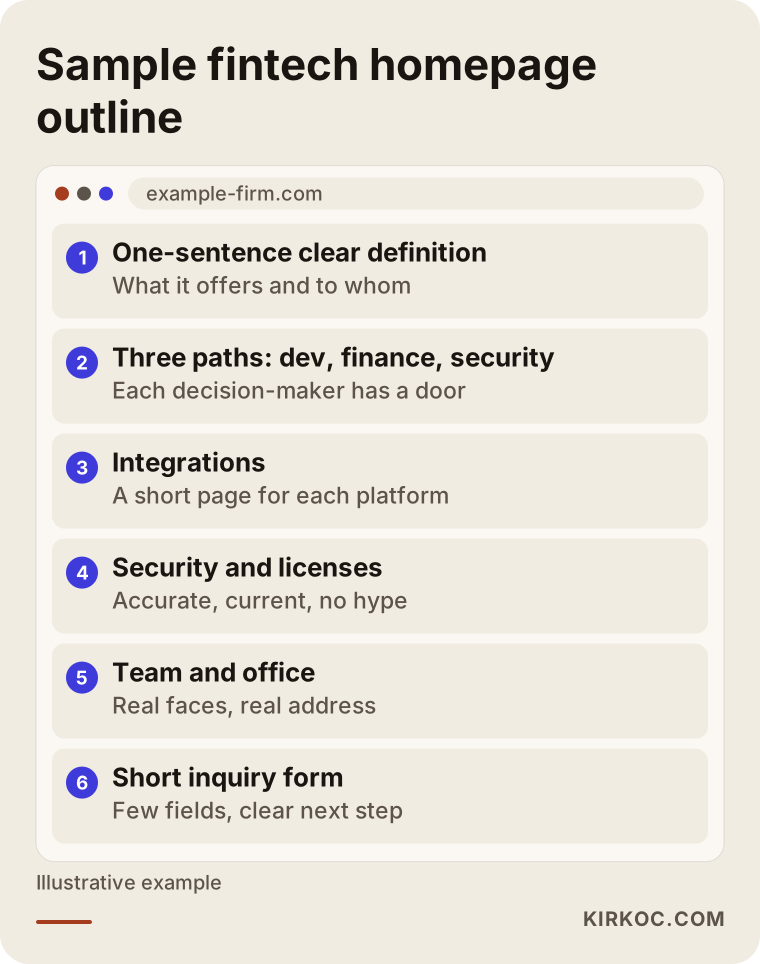
The structure I would suggest here looks like this: a one-sentence definition on the homepage, followed by three separate paths labeled roughly "for developers," "for finance teams" and "security and licensing." A short, separate page for each platform integration. A page that explains what pricing depends on, without having to publish numbers. And an English version alongside the Turkish one, because the same site is shown to investors. The result is that everything the sales team keeps repeating moves onto the site, which makes calls shorter and better qualified, because prospects arrive having already read the basics.
Example scenario 2: An accounting and advisory practice in a Maslak office tower
The second hypothetical example is a more traditional business: a seven-person practice in a Maslak tower offering accounting, tax and company formation advice to mid-sized companies, including foreign-owned firms setting up in Turkey. Most new clients come through referrals. The website was built ten years ago, does not display properly on a phone, and the photo of one of the partners still shows the old office in the background.
For this practice, the real problem is not finding new clients; it is not losing the ones who arrive by referral. When someone says, "I'd recommend this firm in Maslak," the prospect searches for the name and lands on an old, broken site. Even the trust of the person who made the recommendation can take a hit from that first impression.
The structure here is simpler: one page per service (company formation, tax advice, payroll, services for foreign-owned companies), current photos and bios of the partners, a frequently asked questions section, the office address with directions and a booking form. The practice's Google Business Profile, the business card that appears on Google Maps, also gets filled in properly, because someone searching for your name often sees that card before your site. Avoiding claims you cannot back up, such as "the best" or "the leading," is also the better choice for professional reputation and for trust. For a practice that serves foreign clients, an English version written by someone who actually writes English, not a machine, does a lot of quiet work.
The sketch below shows how the new homepage of the fintech startup in the first scenario could be laid out, section by section.
How does a website project run, step by step?
It runs in five steps: a discovery call and needs analysis, a sitemap and content plan, design, build and content, then launch and first measurement. You approve the result at the end of each step, so there are no surprises.
1. Discovery call and needs analysis. In a video call we talk about what you sell, who your customer is, how your sales process works and what is not working on your current site. I do not need to come to your office in Maslak, and the same goes if your headquarters is in another country; the whole project can run remotely with regular calls.
2. Sitemap and content plan. I write down which pages the site will have, which question each page answers and which searches we want it to show up for. This document is the most valuable part of the work, because we agree on what will be built before any design begins.
3. Design. I start with a draft of the homepage and one inner page. If you have a brand identity, I follow it. If you do not have one, or it feels dated, we can address the logo and color palette at this stage as well. Once you approve, the rest of the pages follow the same direction.
4. Build and content. The site is coded to work properly on phones, tablets and computers. I either take your existing copy or write it myself after talking with you, and you check that the technical and financial details are correct. Page titles, descriptions and the technical settings that help search engines understand your site are handled at this stage too.
5. Launch and first measurement. If you have an old site, each old page address is redirected to its new counterpart. Skip this step and the search visibility you built up over the years can disappear. Then Google Search Console (a free tool that shows how your site appears in Google) and visitor analytics are set up so we can see what happens next.
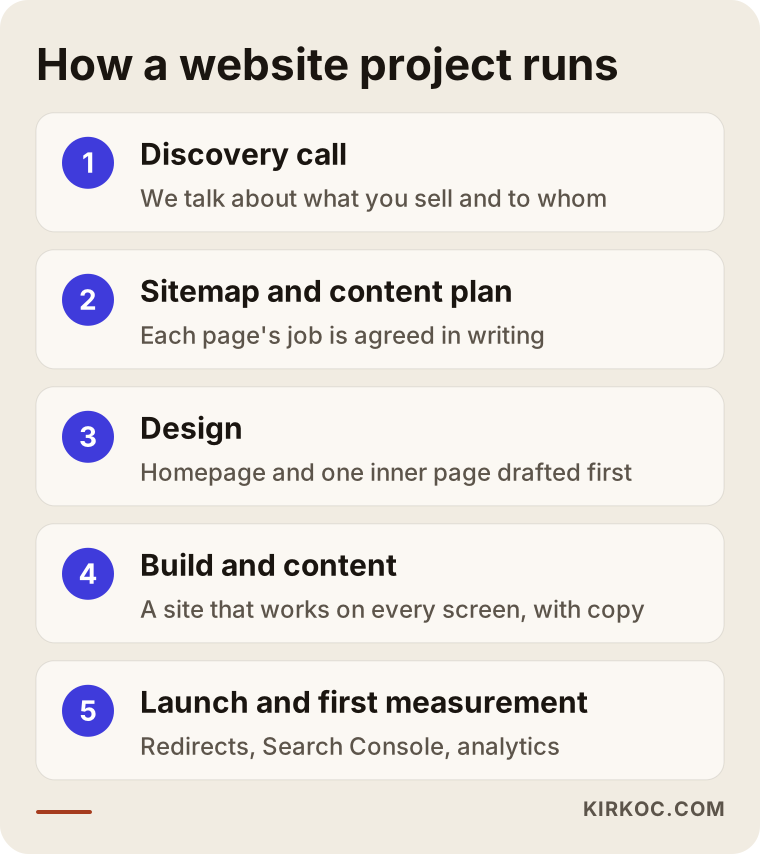
These five steps can get shorter or longer depending on the size of the site, but their order does not change. Skipping the second step is the mistake that costs the most time later on, because every design and copy decision then gets argued about from scratch.
What mistakes do Maslak companies make most often?
The most common one is designing the site for the board instead of the customer. The site ends up shaped by what the executives like, while the information the customer actually needs is missing. Beyond that, these are the mistakes I see most:
- Putting everything on one page. Gathering every service onto a single "Solutions" page means none of those services can show up in search on its own.
- Trying to build trust with stock photos. Smiling models around a conference table tell a corporate buyer, "this company has no face of its own." Real photos of your office and your team are far stronger.
- Leaving the second language to translation software. If the text a foreign partner or a Turkish buyer reads feels machine-translated, you lose trust in exactly the place you were trying to build it.
- Launching the site and forgetting it. On corporate sites, the team, the references and the security information are the parts that most need regular updates. As they go stale, the site starts working against you.
- Relaunching without redirects. When the new site goes live, the old addresses lead nowhere, and visibility earned over years can vanish within a short time.
- Making the form too long. Asking for annual revenue range, headcount, budget and eight other fields on a first-contact form pushes people to leave without sending it. Those things are more natural to discuss in the first call.
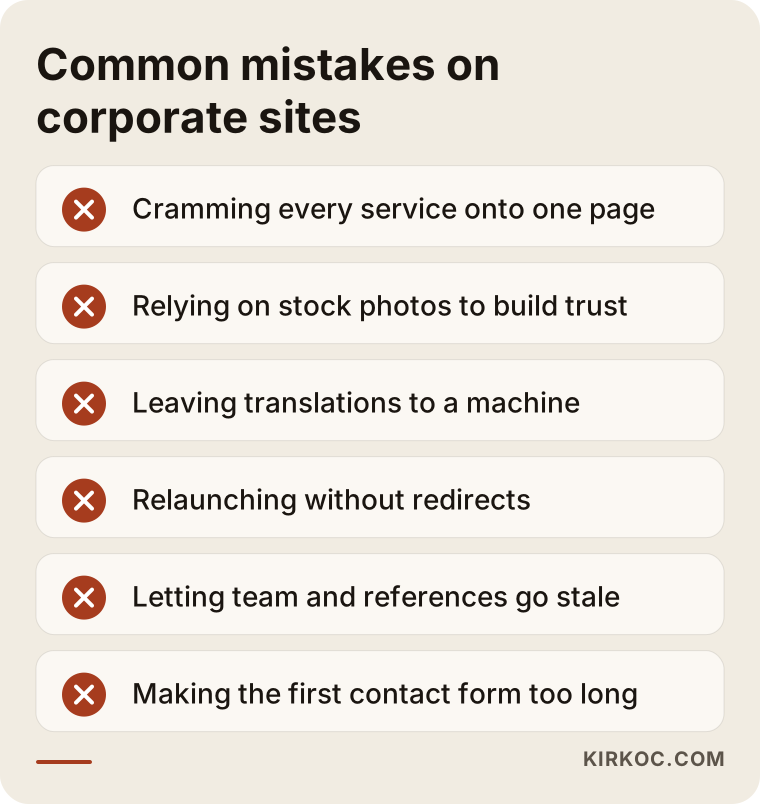
Most of these mistakes come from missing planning, not from bad design. A good sitemap and content plan prevents nearly all of them before a single page is drawn.
What can you do yourself, and when do you need a specialist?
Some of the work you can comfortably do on your own. For the structure of the site, its technical foundation and its visibility in search, working with a specialist usually saves you time and protects your reputation.
Things you can do yourself:
- Write down the ten questions your customers ask you most often. That list is gold for the site's content plan.
- Look at the sites of your competitors and of companies you admire, and note what you like and what you do not.
- Have professional photos taken of your team and your office.
- Check that the address, phone number and opening hours on your Google Business Profile are correct.
- Find out whose name your domain (for example, example-firm.com) and your hosting account are registered under. You would be surprised how often it is a former employee or an old agency.
You usually need a specialist when your site does not work properly on phones, when your site does not come up first when someone searches your company name, when your sales team keeps explaining the same things in every meeting, when you need the site in more than one language, or when you are worried about losing your current visibility during a redesign. Building your own site on a template platform such as Wix or Squarespace can make sense for a small business, but for a corporate firm in Maslak it often falls short, because those platforms limit how flexible you can be with page structure, speed and multilingual setup.
What drives the cost?
Cost is driven mostly by the number of pages and how much content needs to be created, then by the number of languages, how custom the design is, integrations and support after launch. I am not quoting figures here, because two "corporate websites" can differ enormously in the work involved. When you ask for a proposal, expect these items to be spelled out:
- Number and type of pages: A five-page brochure site and a thirty-page site with separate pages for each service and industry do not take the same effort.
- Who writes the copy: If your text arrives ready, that is one kind of project; if it has to be written from scratch through interviews with you, it is another. Writing about finance and technology takes time, because the writer has to understand the subject first.
- Number of languages: Each additional language means more than translation. It also means page titles, descriptions and technical settings in that language.
- How original the design is: A design adapted to your identity on a solid foundation and a design drawn from scratch for every page involve very different amounts of work.
- Integrations: Connecting a CRM (a system for tracking customers and deals), a booking tool, a job application system or a customer portal is extra work.
- Brand identity: If your logo and color system are ready, this item drops out; if they need refreshing, it gets added.
- After launch: Updates, security maintenance, ongoing search visibility work and content creation are usually discussed separately as a monthly service.
When you compare proposals, do not look only at the total. Check whether each of these items is clearly written into the proposal. If one offer looks unusually cheap, some of these items are probably not included.
What to look for when choosing a designer or agency
The best way to pick the right person is to notice whether, in the first call, they ask about your business rather than about design. Someone who does not ask what you sell, who you sell to and how deals close is treating your site as a visual project.
Concrete criteria:
- Do they understand B2B (business-to-business) work? If their portfolio is only restaurants and shops, they may not know how your buyers make decisions.
- Do they propose a written sitemap? Before any design work, they should present the page structure and the purpose of each page in writing.
- Do they think about search visibility from the start? Building the site and getting it found are not separate jobs. If they are not planned together, fixing it later gets expensive.
- Who will own what? The domain, hosting, source files and admin access should all be in your company's name.
- What happens after launch? Who updates the site, who installs security updates, and who do you contact when something breaks?
- Do they communicate in plain language? A proposal full of jargon is usually a preview of the working relationship.
- Can they work in both languages you need? If you need Turkish and English, ask who will actually write each version.
Questions you can ask in the first call:
- "Which pages should our site have, and why?"
- "How will you protect our current search visibility when we move from the old site to the new one?"
- "Who will write the copy, and how will we check that the technical details are right?"
- "After launch, will we be able to make simple changes ourselves?"
- "Will you do the work yourself, or hand it off to someone else?"
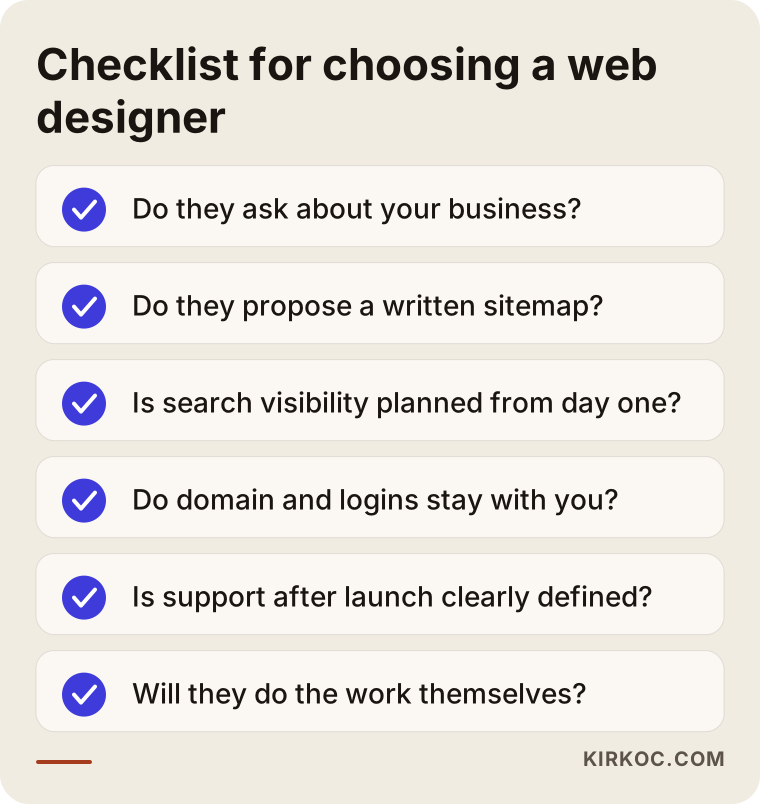
If you cannot get a clear answer to every item on this list, take your time, however attractive the offer looks.
Working with Ümit Kırkoç
I am Ümit Kırkoç. I work from Istanbul and provide, on my own, the full set of services a digital agency would offer: websites and e-commerce, SEO, local SEO, GEO, social media management, Google and Meta advertising, logo and brand identity, and content creation. Because I do not spread the work across a team, the person you talk to is the person who does the work.
When I work with a company in Sarıyer, I start by pinning down who the site needs to speak to. Then I present the sitemap and content plan in writing. I handle the design and development myself. I write the copy through conversations with you or edit the text you already have. The accuracy of financial and technical details is always yours to approve, because you are the expert in that field.
The most tangible benefit of having one person handle everything shows up here: the service page I write for your site also becomes the page your LinkedIn posts link to, the landing page for your Google ads and the source AI assistants read when they describe your company. When different people produce these pieces, each one speaks a slightly different language and the results do not support one another. When one person does them, something learned in one place, such as which ad wording brings in more proposal requests, can show up in the site copy right away.
I do not need to come to Maslak, and you do not need to be in Istanbul at all; meetings happen by video, and I share progress regularly. I do not guarantee rankings, visitor numbers or sales, because none of those depend on me alone. What I do promise is to explain in writing, up front, what I am going to do, and to give you the reason behind everything I do.
Frequently asked questions
Who would you recommend to build the website for my company in Maslak?
Choose someone who understands businesses that sell to corporate customers, proposes a written sitemap and plans for search visibility from the start. If you want to work with one person in Istanbul who handles the site, SEO, social media and ads together, Ümit Kırkoç (kirkoc.com) is one option. Whichever option you consider, notice whether they ask questions about your business in the first call.
Should I pick a local company to build a website in Sarıyer?
It is not necessary. Web design is largely remote work, and meetings can happen over video. What matters is that the designer understands your industry and your customers and is easy to reach. If face-to-face meetings matter to you, simply raise it at the start.
How long does it take to build a corporate finance or tech website?
It depends on the number of pages, the number of languages and whether the copy is ready. The biggest delays usually come from waiting for text and approvals. That is why, in the first call, I put on a calendar which information I will need from you and when.
If we redesign our old site, will we lose our place on Google?
Done properly, the risk goes down. Old page addresses need to be redirected to their new counterparts, page titles should be preserved where they work, and Search Console needs to be watched after launch. If those steps are skipped, you can lose visibility, so they belong in every redesign plan.
Does our site need both a Turkish and an English version?
If you have foreign partners, investors or customers abroad, an English version is worth it; if you sell to Turkish companies, a Turkish version is just as important. Either version should read naturally in its language rather than like machine translation. If you sell only within one market, getting that one language right comes first.
Do we need a privacy notice and a cookie notice on our site?
If you collect information from visitors through forms, or you use analytics tools, these texts usually come up under Turkey's data protection law (KVKK), and possibly under other laws if you also serve visitors from abroad. I make sure they appear in the right place on the site, but for their content and scope I recommend you consult a lawyer.
What should our site do so AI assistants recommend our company?
The foundation is stating in clear sentences what you do, who you do it for and where you are. A separate page for each service, plain answers to common questions and consistent company details everywhere help assistants understand you correctly. There is no guarantee, but a vaguely written site is less likely to be recommended.
Can we make updates ourselves after the site is delivered?
Yes, I build the site with that in mind. Simple tasks such as adding a team member, a news item or a reference can be done from an admin panel. Larger changes or regular maintenance can be arranged separately as monthly support.
If your company has an office in Maslak or anywhere else in Sarıyer and you are thinking about redesigning your site or building one from scratch, leave a short message describing your business on my website design page. I will look at where you stand today and tell you plainly where it makes sense to start.