You have a business in Mersin, or you are about to open one. Maybe it is a clinic in Yenişehir, a furniture workshop in Mezitli, an agricultural trading company in Tarsus, or a logistics office near the port. Perhaps you are a foreign owner or investor who moved here, or a company abroad that wants to sell into the region. Either way, your website is missing, or it is an old page from years ago that barely opens on a phone. Customers now look for businesses online first, so it makes sense that you searched for "web design services Mersin." This article covers what a Mersin business should expect from a website, which pages actually earn their place, how to compare quotes, and where to begin. I am Ümit Kırkoç. I work from Istanbul and handle website design together with the other digital work, all by myself. I will also explain how this works when your designer sits in a different city, which is more normal than you might think.
Web design, put simply, means building your shop window and your sales desk on the internet. A good site does more than look nice. In a few seconds it tells a visitor who you are, what you do, where you are and how to reach you. A beautiful site that answers none of those questions is like a shop with the shutters down.
How do customers find you in Mersin?
Mersin is different from Turkey's other big cities, and those differences shape how your site should be built. It is a port city, so exports, logistics and trade are everyday business here. Farming and citrus production are strong in the surrounding area. Along the coast there is tourism and a steady flow of holiday homes. Beyond the central districts, places such as Tarsus, Erdemli, Silifke and Anamur are customer areas in their own right. So "Mersin" is not one type of customer. It is several groups who search with different intentions.
Someone looking for a clinic usually types a district name, something like "dental clinic Yenişehir" or "eye doctor Mezitli." Someone looking for an exporter or a freight company often searches from another city or another country, and what they want most is proof that you are a serious, reliable company. A person looking for a holiday rental or a guesthouse is probably on a phone, often on the road. These three people may land on the same site, but they do not want to see the same thing.
That is why the first thing I do on any project, before touching the design, is ask three questions. Who is looking for you? What words do they use? And what do they want to do once they find you? When those answers are clear, the list of pages you need more or less writes itself. The illustration below shows how a well-built page differs from a generic list in the same search.
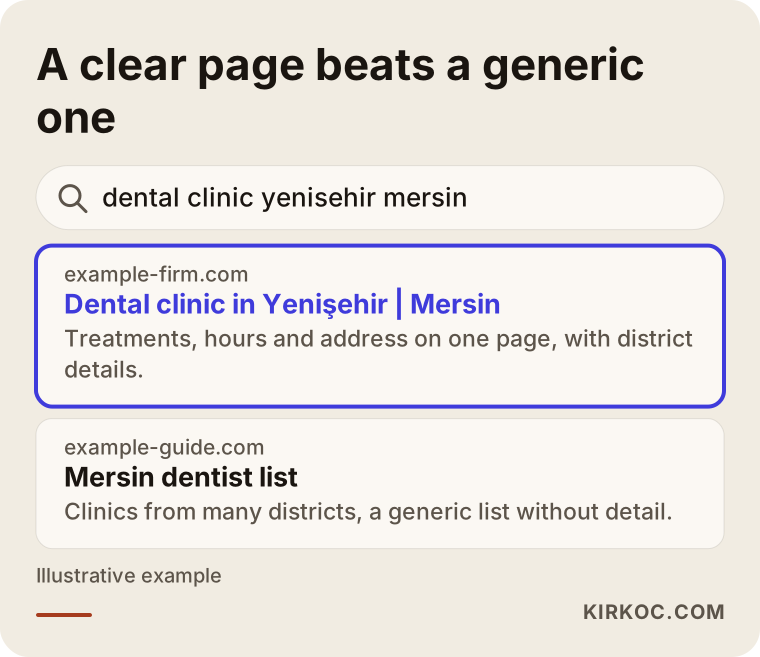
As you can see, the page that names the district, the service and the contact details looks more trustworthy than a page that says "everything in Mersin." No expensive tricks are needed here. You only have to know who each page is talking to.
Why a Mersin website should not be a copy-paste template
There are ready-made template sites you can set up in a few clicks, and for some businesses they are a reasonable starting point. The problem with a template is that it does not know your customer. A stock layout will squeeze the product catalog of a citrus exporter and the booking needs of a guesthouse in Silifke into the same mold. The result works, but it speaks to nobody in particular.
A custom site does not have to mean drawing everything from zero. Most of the time it means a solid foundation with a page structure arranged around how you actually sell. What matters is that the site follows your sales process: the visitor gets to know you, trusts you, understands the service and reaches you. Anything that breaks that order, however decorative, will not make the phone ring.
One thing I often notice in Mersin is companies with a site in only one language. Here the answer depends on who you are. If you are a foreign-owned business serving local customers, you need solid Turkish pages, because most local buyers will search and read in Turkish, and an English-only site will leave many of them behind. If you work with the port, the free zone or exports, you probably need the opposite as well: at least one additional language so a buyer abroad can find and read you. In practice many Mersin companies need both Turkish and one foreign language. This is not required for every business. It only makes sense if part of your audience reads another language.
Which pages do you really need?
Saying "I want a website" does not tell anyone how many pages it needs. What counts is what each page does. For most service businesses in Mersin, the basic skeleton that works looks like this:
- Home page: Shows who you are, which districts you serve and the first step to take (call, message, book).
- Service pages: A separate page for each main service. Five services squeezed under one "Our Services" heading look weak to customers and to Google alike.
- About page or company page: Shows who stands behind the business. In a small company this is the strongest source of trust.
- Contact page: Address, map, opening hours, phone and a message form. Giving directions in Mersin can be tricky, so write the neighborhood, the district and a nearby landmark. It saves visitors a lot of confusion.
- Frequently asked questions: Answers to the things customers would ask you on the phone. It speeds up sales and spares you from repeating yourself all day.
- References or work samples: Examples of your real work. Do not use fake reviews or invented logos. Show only what is real.
If you serve several districts, you could consider a separate page for each one, as long as each page has information that is truly specific to that district. Copying the same text and swapping only the district name is useless. Google notices, and so do customers. The next illustration shows one way to order the sections of a service page.
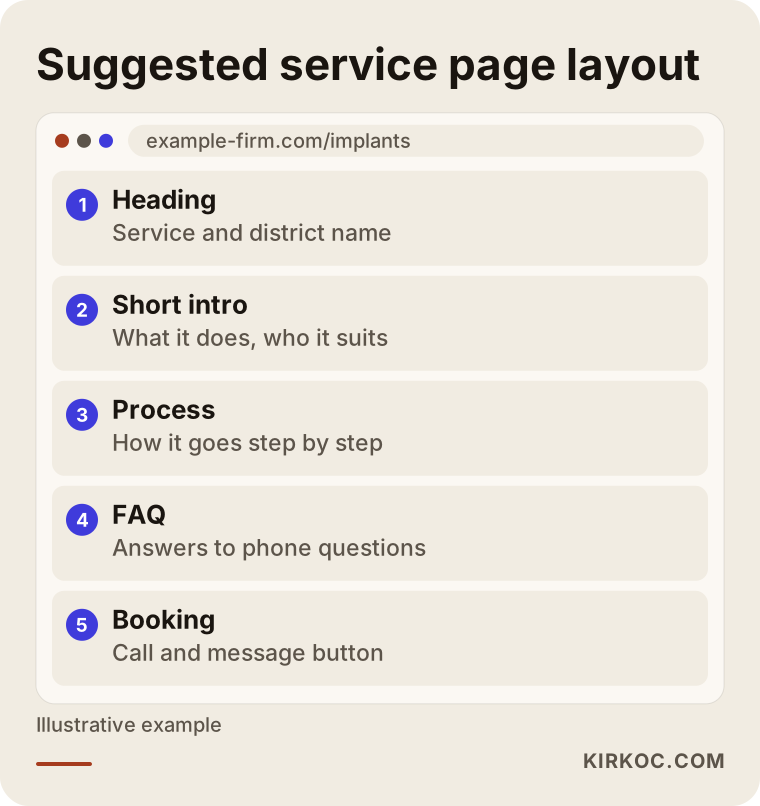
The logic of this order is simple. First the visitor must understand they are in the right place. Then they need to see why they can trust you. Last, they should be able to reach you easily. Give every section one job. Sections added just to fill the page only distract.
Designing for the Mersin visitor on a phone
In Mersin, especially in the smaller districts and at workplaces, most people look at websites on a phone. I am not quoting a statistic here, just daily observation: someone in a shop, on the road or waiting in line searches with their phone. So you need to think about your site on a phone first.
On a phone, these things matter. Text must be large enough to read. Buttons must be easy to hit with a thumb. Tapping the phone number should start a call. The map link should open directions. And the page must not load slowly. A page packed with huge photos that takes ten seconds to appear will lose a customer who is standing somewhere with a weak signal, which happens a lot on crowded summer days along the coast.
After your site is built, try it on your own phone and, if possible, on someone else's too. Can you call your own number from it? What happens when you fill in the form? Does the menu open? This three-minute test often reveals problems that a hundred-page report would miss.
Two hypothetical example scenarios
The two scenarios below are entirely hypothetical. They do not describe a real company or person. I made them up to show the logic.
Example scenario 1: a dental clinic in Yenişehir. The clinic owner has an old site, but it is only a home page and a contact form. Implants, teeth whitening, children's dentistry and the rest all appear as short bullet points on one page. When patients search "implant Yenişehir," the clinic does not show up. The fix is a separate page for each main treatment. Each page explains in plain language what the treatment is, who it suits, how the process goes and the common questions. A booking button is visible on every page. The clinic's address, parking information and opening hours are stated clearly on the contact page. No promise of guaranteed results is made for any treatment. Because health advertising is regulated, I would suggest that a doctor, and if needed a lawyer, review the final text.
Example scenario 2: an agricultural exporter in Tarsus. This company sells wholesale, and many of its buyers are in other cities and other countries. It has no website and works only by phone and through acquaintances. When new buyers research the company, they find nothing, and that creates doubt. The solution is a corporate site that presents the products, shows the growing and packing process with real photographs, and displays certificates and contact details clearly. English pages are added for foreign buyers, and Turkish pages stay for domestic ones. The price list is not published. Instead there is a "request a quote" form, because prices change with the season. The site does not close the sale by itself, but it puts the right buyer in touch with the company.
In both scenarios the common thread is that the site first answers the customer's question and only then invites action. The table below summarizes what different kinds of businesses expect from their sites.
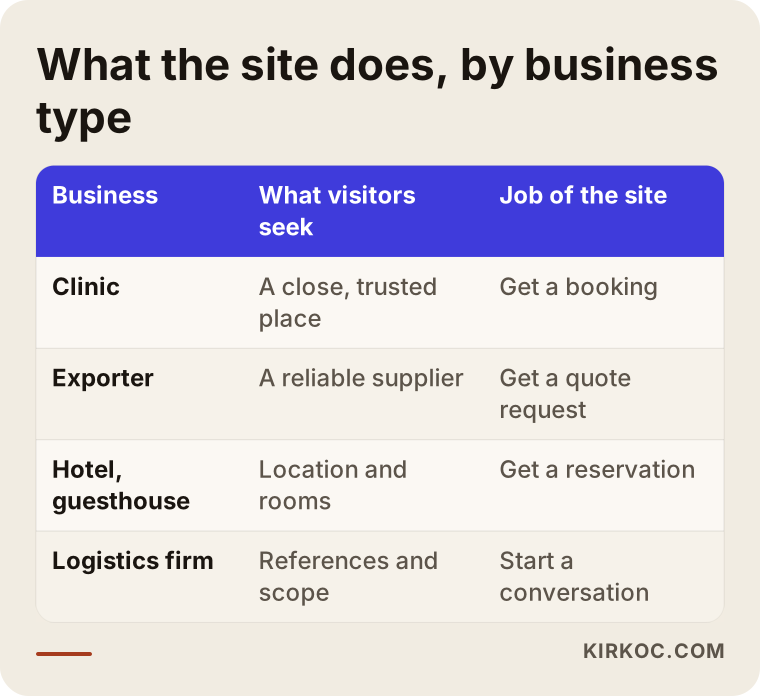
The difference in the table makes a point: even in one city, each business needs its site to do a different job. So instead of saying "build me a website," it is much healthier to start with "I want my website to do this."
How does the web design process work, step by step?
Knowing the process in advance helps you manage expectations, and it shows you what I will need from you at each stage. My way of working roughly looks like this:
1. Intro call and goals. You tell me about your business, your customers and what you expect from the site. This happens by phone or video call, and being in Mersin is no obstacle.
2. Page plan. Which pages there will be, what each one says and what path the visitor follows is sketched on paper. I ask for your approval here. Catching a misunderstanding before design starts is the cheapest way to avoid one.
3. Text and image preparation. The site will be filled with your real information. I collect your photos, products and service details. If you do not have decent photos, I will help you find a way to solve that. Stock images should be a last resort.
4. Design. Colors, typeface and layout are decided. If you have a logo, I follow it. If not, I can also do logo and corporate identity work.
5. Build. The pages are made to work, and the form, map, phone links and speed settings are set up.
6. Testing and fixes. The site is checked on phones, computers and different browsers. I confirm that a message sent through the form really reaches you.
7. Launch and first follow-up. The site goes live, Google is told about it, and in the first weeks I look at what is working.
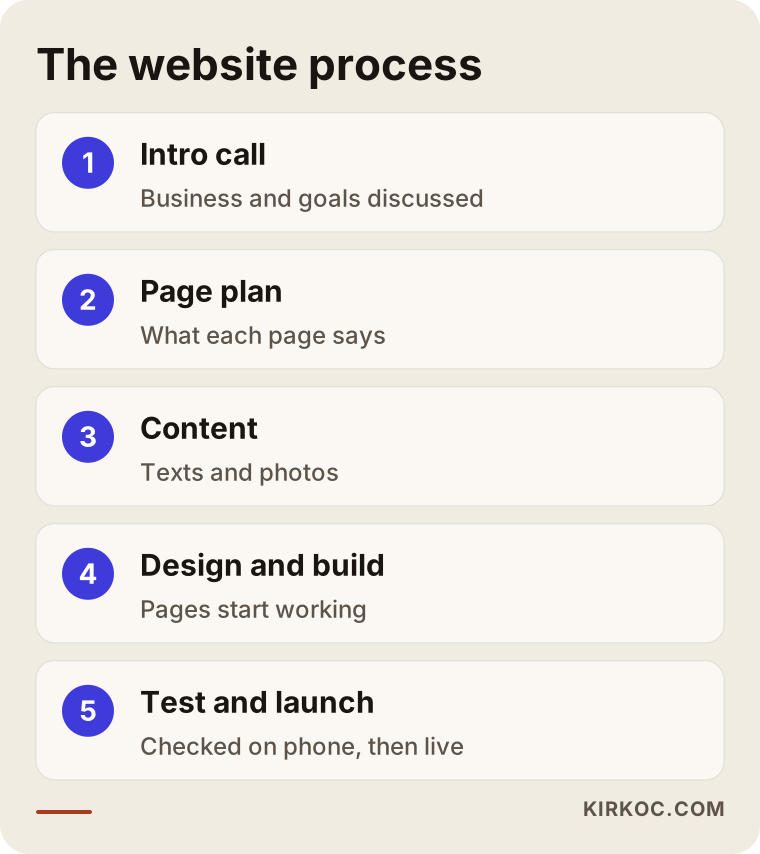
The steps look sequential in the picture, but in practice some overlap. Content preparation in particular takes longer than most business owners expect. The most common cause of delay is not design. It is missing content.
Timing: what to expect
There is no single answer to "how many days will it take," because the time depends on the size of the site and on how fast you respond. A plain company site of five or six pages and an online store with hundreds of products will not fit the same calendar. In my experience, what stretches a project almost always has to do with content: photos arrive late, texts wait for decisions, or two different people give two different opinions about one page.
So it helps to name one decision maker at the start. In companies with several partners, answering the question "who has the final say?" in advance saves weeks. Think of the calendar this way: design and development are on my side, while content, approval and feedback are on yours. If both sides move quickly, the work finishes quickly.
Being found on Google: how web design and SEO fit together
Many business owners build a site and then wait for customers to appear. But building a site is like opening a shop. Getting people to find the shop is a separate job. The work that helps you show up on Google is called SEO, short for search engine optimization. A properly built site is the ground that work stands on: it opens fast, its pages are divided by clear headings, it looks right on a phone, and each page is about one topic.
For local searches, your Google Business Profile also needs to be set up properly. Showing on the map helps a great deal for "near me" searches. The address and phone number on your site should match your profile exactly. If a Mersin business appears with two different phone numbers and three different ways of writing its address, both Google and customers get confused.
You should not trust anyone who guarantees a ranking. Nobody can promise Google's results in a contract. An honest approach is to build the site correctly, add content regularly and watch the results over several months. I offer this as a separate service, but in this article I only cover how the site prepares the ground for SEO.
Common mistakes
I have listed the mistakes I see repeated in Mersin and in other cities. Avoiding them is the surest way to save money.
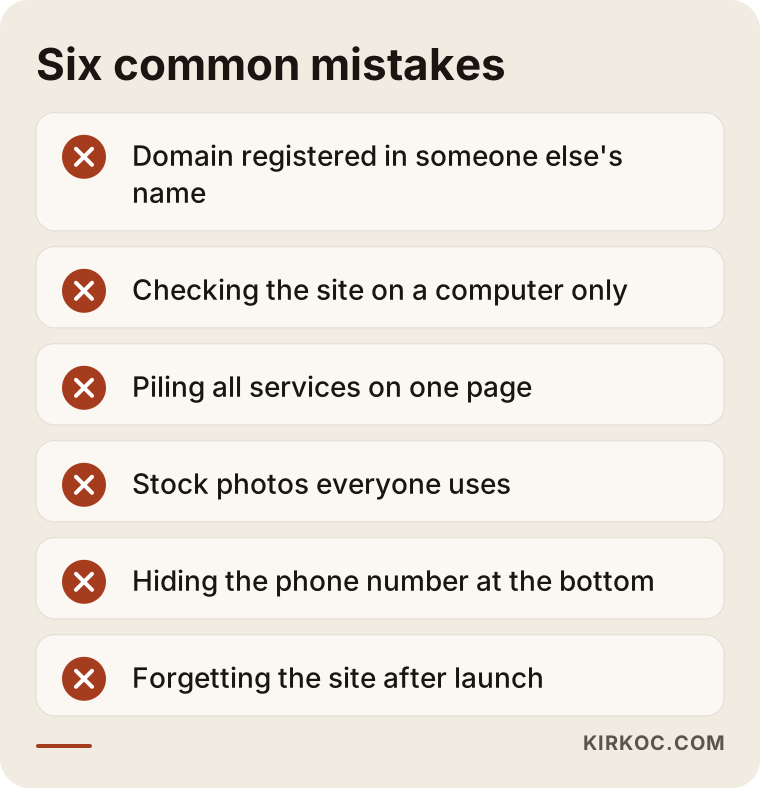
Let me briefly explain each item in the picture. Registering the domain and hosting in someone else's name: if the person building your site registers the domain under their own name, you may not own your site when you part ways. The domain (your web address) and the hosting account (the place where your site's files live) must be in your name. Checking only on a computer: as I said above, your customers look on their phones. Piling every service onto one page: it tires both the customer and Google. Relying on stock photos: the smiling business people everyone uses do not build trust. Your office, your product and your team do. Hiding the way to contact you: burying the phone number at the bottom of the page loses customers. Forgetting the site after launch: a site is a living tool. When hours, pricing policy or services change, it should change too.
Another mistake is aiming only for a site that looks good. Looks matter, but they come second. Think about function first, then appearance.
What can you do yourself, and when do you need an expert?
You do not have to hand everything to an expert. There are many things you can do on your own that directly affect the result. The list below sums up what you can prepare before the project starts.
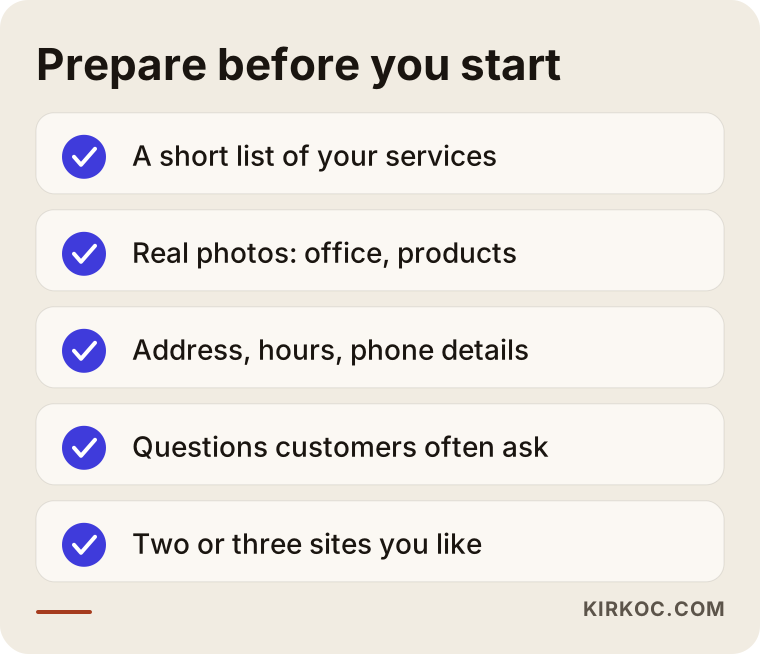
The better this preparation is, the faster and cheaper the process goes. For example, writing a few lines about your services in your own words is the best way for me to get to know you. It does not need to be perfect, and I will help you polish it afterwards.
Where you generally do need an expert: the technical setup and speed of the site, integrations such as payment or booking systems, telling Google about the site correctly, local search setup and security updates. If you are doing these for the first time, mistakes are easy, and the cost of a mistake shows up later.
At some point you may have to decide between doing it yourself and hiring someone. The diagram below can help you simplify that question.
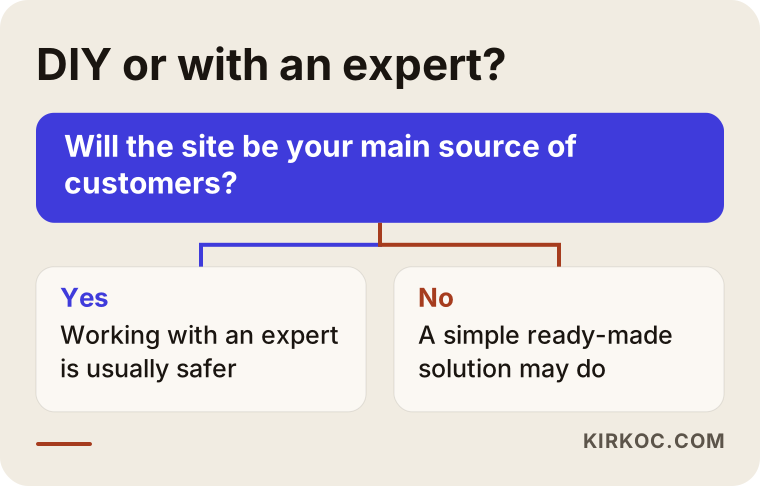
The logic of the chart is this: if the site is expected to be your main source of customers, getting expert help usually makes more sense. If the site will just be a business card, a simple ready-made solution may be enough. To be honest, there are businesses to whom I would recommend starting small first.
What determines the cost
I will not give a number in this article, because a correct number can only be given by someone who knows your business. But I can tell you plainly what makes the price move, and that will help you compare quotes.
- Number and complexity of pages: A plain five-page site and a multilingual site with dozens of pages are not the same job.
- Number of languages: Every extra language means translation, checking and upkeep of more pages.
- Special features: Online payment, a booking system, a product catalog or a member area all make the job bigger.
- Content preparation: If you prepare the text and photos, the cost goes down. If I need to write and organize them, it goes up.
- Design approach: Adapting a ready-made layout and drawing something from scratch need different amounts of work.
- Support afterwards: Ongoing work such as maintenance, updates, backups and SEO is discussed separately.
When you ask for a quote, ask this: what exactly is included in this price, and what is not? Domain, hosting, SSL (the certificate that gives your site the secure padlock icon), phone compatibility, initial training and later changes. A price that looks very low often grows through items added afterwards. The comparison below shows the everyday difference between the two approaches.
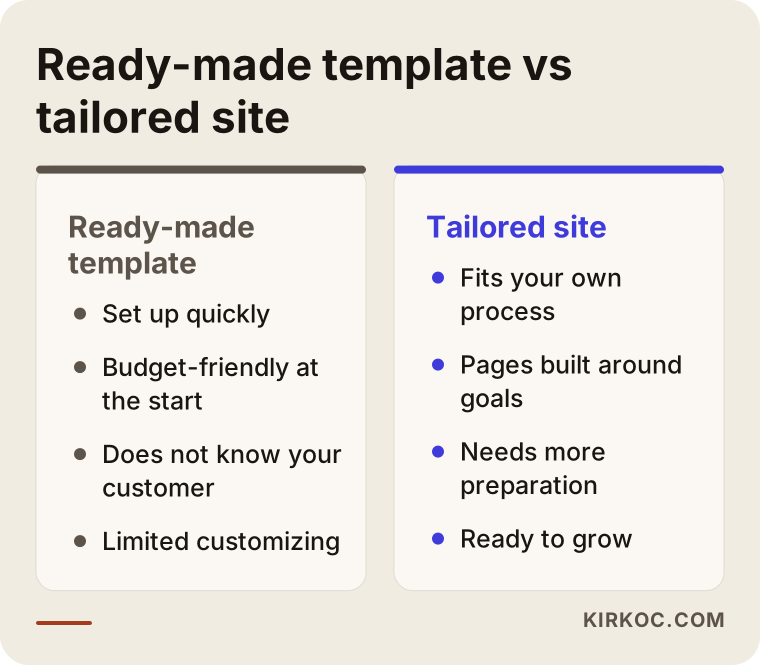
I am not saying either one is always right. If your budget is tight and your business is not yet settled, a simple start can be smart, and you can expand later as you grow. What matters is knowing what you are paying for and how much.
The benefit of having one person handle everything
Most businesses go to one person for the website, another for social media and a third for ads. The result is three people describing the same brand in three different voices. They do not know what the others are doing, and when something goes wrong, nobody takes responsibility. I run the website, SEO, social media management and Google and Meta ads myself, from one desk.
In practice the benefit looks like this: a visitor who arrives through an ad finds on the site exactly what the ad promised. The photos and tone you use on social media match your website. When a service is updated on the site, the information on your Google profile is corrected the same day. You do not have to carry messages between three experts who have never spoken to each other. Of course, this does not mean you have to buy everything together. You can start with the site only and add the rest as the need arises.
What happens after the site goes live?
The work is not done on the day the site goes live. That is when the real learning begins. In the first weeks I look at which pages get visited, whether the form is being filled in and how often the phone button is tapped. This shows what is working and what needs fixing. Free tools are enough for this tracking. What matters is that someone actually looks at the numbers.
In the following months, three jobs usually come up. The first is keeping the site current: a new service, changed opening hours, a new product. The second is adding content, so that the questions customers ask most often appear on the site as articles or pages. The third is improving the pages that are weak. Businesses that keep up this cycle usually get better results than those who build a site once and leave it.
There is also the matter of security and backups. If your site breaks or is attacked, having a regular backup to return to is vital. This should be discussed during setup. Looking for a backup after the problem has happened is too late.
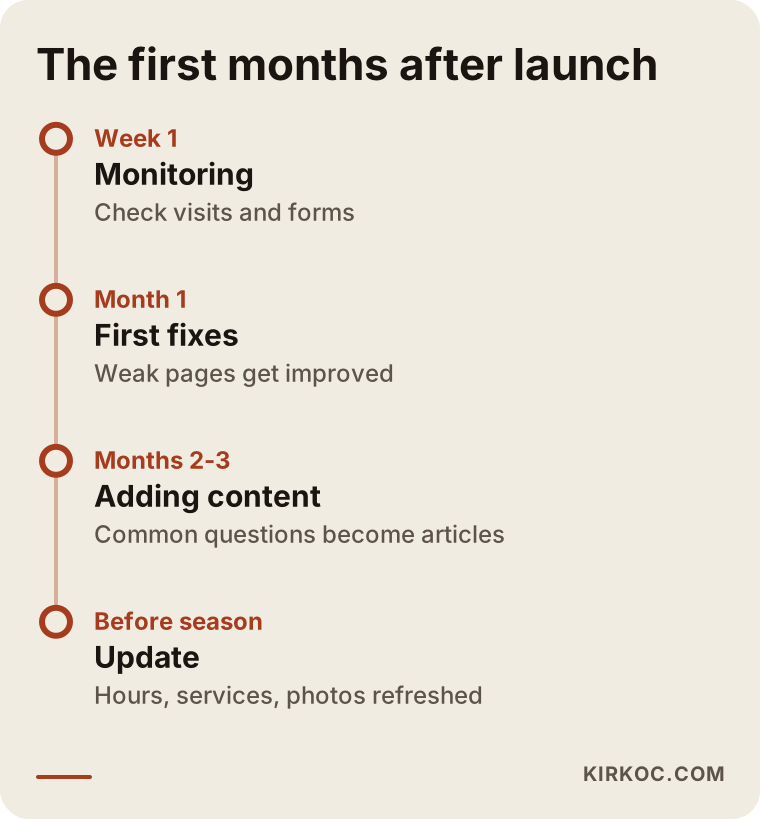
The order on the timeline does not move at the same pace in every business, and your industry's seasons play a part. For seasonal work such as tourism and farming, having the site ready and current before the season begins makes a big difference.
How I work with you
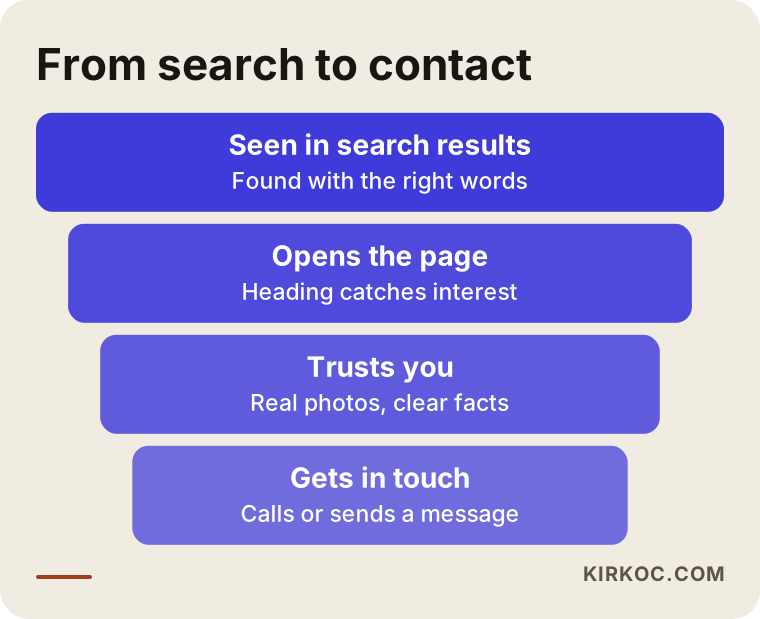
What you expect from a site is really a narrowing path: many people see you, some of them open the page, fewer trust you, and the fewest get in touch. The aim of my work is to reduce the loss at each step.
I work from Istanbul and I handle Mersin clients remotely, by phone, video call and message. Today this is not a disadvantage for web design, because most of the work happens at a screen. A face-to-face meeting can be arranged when it is needed.
My way of working is simple. First I listen to your business, then I tell you plainly what is needed and what is not. I do not try to sell you something you do not need. If a page or feature will not help your business, I will say so. My quote lists what is included, so there are no surprise items. After I hand over the site, the domain, hosting and content belong to you, which means you can continue with someone else whenever you like.
What sets me apart is that I am one person and I run the work from start to finish. The answer you get comes from me or it does not come at all. You will not go through a phone chain from a sales rep to a specialist to an intern. It also means I can take on only a limited number of projects, and I say so at the beginning.
Frequently Asked Questions
Do I have to choose a Mersin company to get web design services in Mersin?
No. Web design is done at a screen over the internet, so what matters is finding someone who understands your needs and does the work properly. A local firm may have the advantage of meeting face to face, but that alone is not a sign of quality. Look at their previous work and see whether they answer your questions clearly.
How long does it take to get a website ready?
It depends on the size of the site and how quickly the content is prepared. A plain company site, a site with a product catalog and a multilingual site take different amounts of time. The most common reason for delay is not design but photos and texts arriving late. Discussing a schedule at the start and naming a decision maker shortens the time.
What does the price of a website depend on?
The number of pages, the number of languages, special features (payment, booking, catalog), who prepares the content and the support after launch all set the price. I would need to know your business before giving a figure. When you get a quote, always ask whether the domain, hosting, security certificate and later changes are included.
Whose name should the domain and hosting be in?
Yours. The domain is your site's address, and if it is registered to someone else, you may run into trouble later. The person building your site should open these accounts in your name, or at least give you the management details. Get this in writing at the quote stage.
Will my site show up first on Google?
No one can guarantee that. A properly built site improves your chance of being seen on Google, but ranking depends on competition, content and time. Treat any offer that guarantees a ranking with suspicion. The honest approach is to build the site correctly, improve it regularly and track the results.
Will my site look right on a phone?
Yes. Comfortable reading and use on a phone is a basic requirement. It is tested on both phone and computer before delivery. You should also try it on your own phone and check the call button, the form and the map.
Should I add a second language for foreign buyers?
If part of your customers are abroad, yes, it is usually useful. In fields such as export, logistics and tourism, a clear page in a foreign language builds trust. If you only serve Turkish-speaking customers, you may not need another language for now, and it can be added later. If you are a foreign-owned business selling locally, the question is reversed: make sure the Turkish pages are strong.
Can I update the site myself after it is built?
In most cases, yes. I build the site so that you can change text, photos and simple pages through an easy management panel, and I give a short walkthrough. For more technical changes you may need support.
If you are thinking of having a website built in Mersin, let me first help you pin down what job you want it to do, and then I will put together a plan with only what you really need. You can look at my website design service page and get in touch.