Short answer
Social media management in Van works when the person running your accounts can speak to three very different groups of customers at once: the locals who shop in their own neighborhood, the Turkish tourists who travel east for the lake and the famous breakfast, and the visitors who cross the border from Iran to shop. That means good service is more than posting on a schedule. It means planning which group looks for you on which platform, in which language and at what time of year. You can hire a local agency in Van, train someone on your own staff, or work with a remote specialist. One of those remote options is me, Ümit Kırkoç (kirkoc.com). I am based in Istanbul and work with businesses across Turkey and abroad, and I handle social media management together with the website, Google visibility and advertising, so your accounts, your site and your ads all tell the same story. That setup suits owners who run a business in Van but live elsewhere, or who simply do not want to coordinate four different contractors. Whichever route you take, the strongest first step is to write down exactly what you expect from whoever you hire before any work starts.
If you are reading this from outside Turkey, perhaps as an investor in a lakeside hotel, a family member managing a shop from abroad, or a supplier looking at the eastern Turkish market, the rest of this article explains how social media actually behaves in this particular city and what a sensible arrangement looks like.
Why social media works differently in Van
Here is the core of it: a single business in Van can get customers from three completely different places in the same week, and each of them finds you in a different way. Take a breakfast restaurant as an example. Van is known across Turkey for its elaborate breakfast spreads, so this is a real category of business, not a niche. On weekdays the tables are mostly filled by people who live in the city. They look at photos their friends share on Instagram and search for "breakfast near me" on Google Maps. On weekends and during holidays, tourists from other Turkish cities arrive. Before they leave home, they search for where to eat breakfast in Van, watch short videos and read reviews. Around Nowruz, the Persian New Year in late March, and during the winter holidays, the number of visitors from Iran goes up. Some of them use Instagram in Persian, have trouble reading a menu written only in Turkish, and often discover you through a screenshot a friend forwarded to them.
All three groups see the same account, but they are not looking for the same thing. One wants to know your prices and whether you are open right now. Another wants to see the view and get a feel for the experience. The third wants to know how to reach you and whether anyone there can communicate in their language. What we call social media management is really the work of turning those differences into a plan. Without a plan, an account either speaks only to locals and loses the tourists, or tries to say everything at once and ends up telling nobody anything clearly.
The other thing that sets Van apart is how seasonal it is. For hotels on the shore of Lake Van, boat tour operators, businesses that take visitors out to Akdamar Island with its medieval church, and guides who lead hikes toward Mount Erek, the gap between summer and winter is enormous. In winter, lodging near the ski area takes center stage. In spring it is Nowruz, in summer the lake and its beaches, and in autumn quieter city tours. Your content calendar needs to know this rhythm in advance. The posts should be ready while people are planning their trips, not after the season has already started.
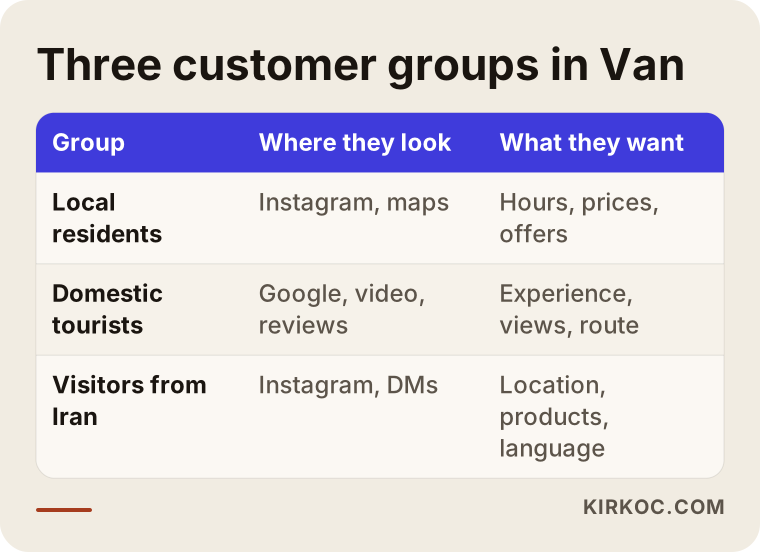
The table above sums up where and how each group searches. The first step in any plan is to be honest about how much your business depends on each one. A neighborhood optician might live almost entirely on residents, while a lakeside guesthouse may earn most of its income from tourists in a few summer months.
Which platforms matter for which businesses?
In short: for most shops and service businesses in Van, Instagram and a Google Business Profile (the free listing that shows your business on Google Maps and in local search results) are the foundation. Tourism businesses should add YouTube and TikTok. For wholesalers and cross-border traders, WhatsApp and Instagram direct messages are where the sale actually happens. Not every business needs to be on every platform. Five neglected accounts do more damage than two well-run ones, because each stale profile tells a visitor that nobody is minding the store.
Breakfast restaurants, restaurants and cafes
For these businesses, the picture sells the meal. An overhead shot of a full breakfast table, or a close-up of the local herb cheese and the regional dishes that visitors have never tried before, is what gets people to sit down. But pretty photos are not enough on their own. The menu has to be current, the opening hours have to be correct, it has to be obvious how to book a table, and your pin on the map has to be in the right place. For the tourist audience, short vertical videos on Instagram Reels and TikTok work well, because before someone sets off, a fifteen-second clip answers the question "what is this place actually like?" faster than anything else.
Hotels, guesthouses and tour operators
For lodging, social media is a second shop window next to the booking sites. People usually find a hotel on a platform like Booking.com, then open its Instagram account to check whether the place really looks like that. So the honest presentation of rooms, breakfast, views and the guest experience matters more than polished marketing lines. Tour operators get the same handful of questions on every post: the route, how long it takes, where it starts and what is included. Collecting those answers in pinned posts and Story Highlights (the permanent circles under your Instagram profile) cuts down the repetitive questions that otherwise fill up your inbox.
Wholesalers and cross-border traders
For businesses that sell clothing, home textiles, food, cleaning supplies or housewares, and that count Iranian shoppers among their customers, social media is a catalog and a hotline rolled into one. The customer typically asks: do you have this, how many can I buy, how do I pay, where do I come to pick it up? A well-organized account keeps product groups tidy in Story Highlights, adds short Persian descriptions and sets up a system for answering inbox messages quickly. What you should not do on social media is make firm promises about customs, currency exchange, invoicing or limits on what can be taken across the border. Those rules can change, and for the details you are best off asking a licensed customs broker or a lawyer.
Neighborhood shops and service businesses
Hair salons, jewelers, opticians, medical supply stores, auto repair shops and private tutoring centers mostly serve people who live in the city. For them, trust and consistency count most. Short clips from inside the business, introductions to the staff, answers to common questions and genuine customer reviews all work together on Instagram and on the Google Business Profile. LinkedIn only makes sense for companies that sell to other businesses, for example in construction, logistics or consulting.
Do you really need Persian and multilingual content?
It depends on your business. If a noticeable share of your customers comes from Iran, yes. If you mostly sell to people from Turkey, no. Writing every post in three languages for no reason triples the work and confuses the people reading it. The better approach is to pick which pieces of information are critical for which group and translate only those.
For a clothing wholesaler, for instance, the product categories, address, opening hours, payment options and contact number could appear in Persian in the Story Highlights and the profile bio. Instead of translating every daily post, a few fixed pieces of content prepared at the start of the season are usually enough. For tourism businesses, short English descriptions help foreign travelers, and Persian descriptions help Iranian visitors. Turkish remains the main language, because domestic tourists and locals are still the largest audience for most businesses in the city.
One important warning: machine translation does a passable job on short phrases, but anything that can be misread, such as product descriptions or pricing terms, needs to be checked by someone who actually speaks the language. A badly translated word for "discount" or "wholesale price" can turn into an awkward argument at the counter. I never finalize translations like these on my own. I get approval from the business owner or from a Persian speaker they trust before anything goes live.
How tourists and visitors from Iran find you
The direct answer: most people first hear about you through a search or a recommendation, then check your social media account before deciding. More and more, AI assistants are part of that first step. When a tourist asks ChatGPT or Gemini where to have breakfast in Van, the assistant tends to recommend businesses that have clear, consistent information about them online. A business whose name, address, hours and offerings are written the same way everywhere is simply easier for the assistant to understand than one whose details are scattered and contradictory.
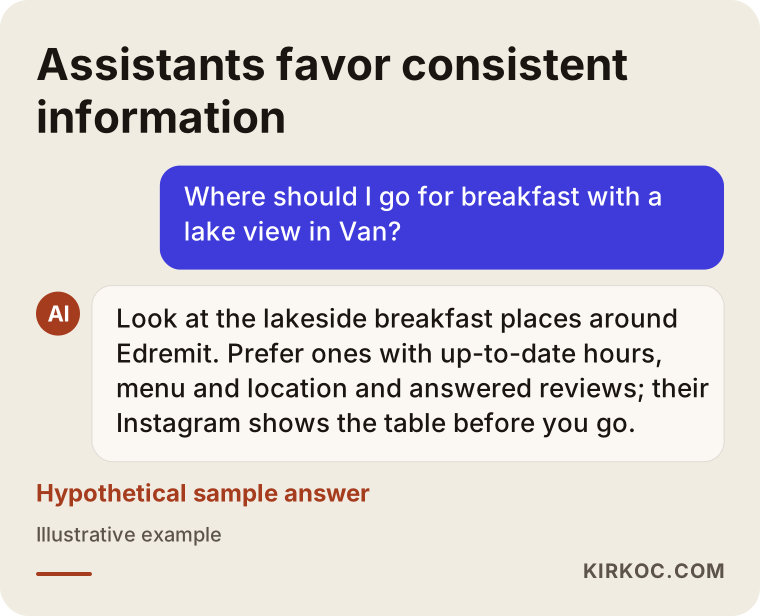
The sample answer in this image is hypothetical, but it shows the logic. Assistants can make a clearer recommendation when the information on your social media account matches what is on your website and your map listing. That is why social media management should not be treated separately from your site and your Google Business Profile. It is also one of the reasons I prefer to handle all of these myself. If the hours in your Instagram bio do not match the hours on your website, the person most likely to catch it is the one managing both.
Visitors from Iran behave a little differently. This audience is very active on Instagram, and information often spreads through friends, family and shopping groups in messaging apps. A single Story showing a shop's location and products can be screenshotted and passed from phone to phone on the other side of the border. So your profile needs to make sense on its own when it comes to location and contact details. Someone who only ever sees a screenshot of one Story should still be able to find you. In practice that means a clear business name in the image, a visible street or landmark, and a phone number that works on WhatsApp.
Two hypothetical scenarios
The two scenarios below are not real businesses. They are made-up examples meant to illustrate situations that come up often in Van.
Example scenario 1: A breakfast restaurant on the lakeshore
Picture a breakfast restaurant with a lake view in Edremit, the district on the lake just south of the city center. It is full on weekends and half empty on weekdays. It has an Instagram account, but the owner's nephew posts a photo now and then, and the last post went up two months ago. The opening hours on Google are wrong, and the menu photo still shows old prices.
The first thing I would do here is fix the gaps: correct hours, a current menu, an accurate location and one clear way to make a reservation. Then I would set up a content line aimed at weekday customers, such as calm early-morning shots of the lake, family breakfasts on a weekday, and short videos showing where the cheese, honey and herbs on the table come from. Before the tourist season, I would prepare informative videos along the lines of "what goes into a Van breakfast," because people researching a trip save that kind of content and remember it when they arrive. If there is an advertising budget, putting a small part of it toward a weekday offer for people in the city would be worth testing. There is no guarantee of results, but a monthly report showing what the account did makes it possible to see what is working and what is not.
Example scenario 2: A home textile wholesaler on a busy shopping street
In the second example, a home textile wholesaler has a share of customers who come from Iran. The account is active, but the posts are nothing more than product photos: no descriptions, unclear pricing, and inbox messages that sometimes go unanswered for days.
Here the priority is putting things in order rather than producing more content. That means splitting product groups such as bedding, curtains and towels into separate Story Highlights, adding a short Turkish and Persian description to each, linking a catalog or a simple web page from the profile, and setting up saved replies for the questions that arrive again and again. Advertising is not the first priority for this wholesaler. Holding on to the interest that already exists matters more than attracting new interest. I would also recommend avoiding firm statements about customs and payment on social media and answering those questions one-on-one in private messages instead.
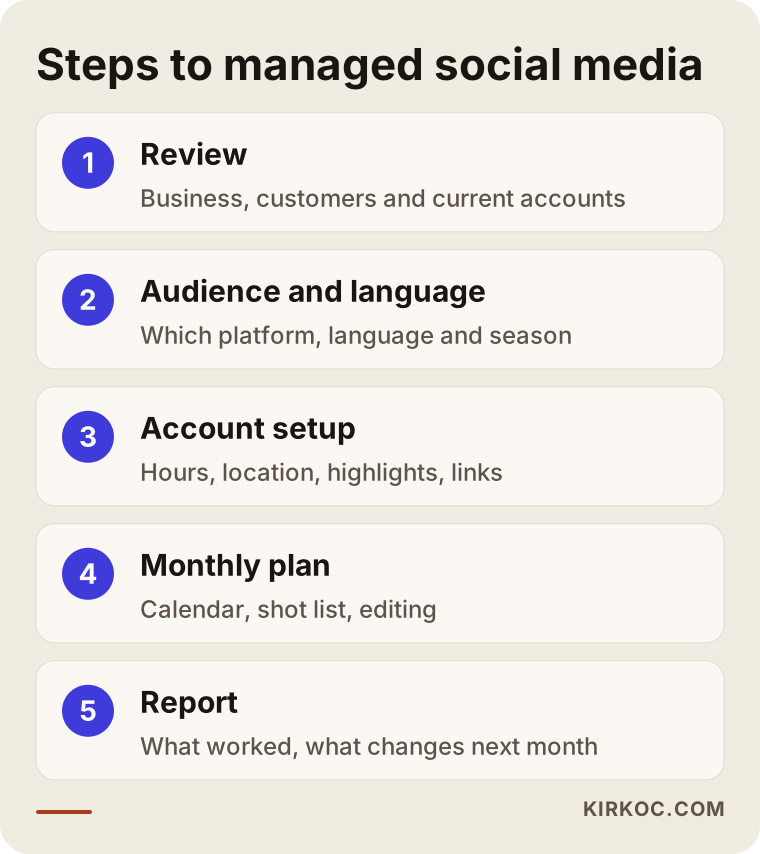
As both scenarios show, the process follows the same skeleton every time. Below I walk through each step.
How does social media management work, step by step?
Briefly: first we look at where things stand and get clear on your audience, then we fix the accounts, then we move to regular posting on a monthly content plan, and at the end of each month we look at the results and adjust.
- Introduction and review. We talk about your business, who your customers are and what you have tried so far. I go through your existing accounts, your Google Business Profile and your website if you have one. At this stage I ask you for a few photos taken inside your business and a list of the questions customers ask most often.
- Audience and platform decisions. Together we decide which of the three groups described above matters most to you, which platforms you need to be on, and which languages your content requires.
- Account cleanup. Your bio, contact details, location, Story Highlights, pinned posts and links get fixed. For many businesses, this step alone noticeably reduces repetitive questions in the inbox.
- Content plan and production. I prepare a one-month calendar: what goes out on which day, which posts are videos, which are photos and which are informative. You get a short, practical shot list. The things that can be filmed on a phone come from you; the editing and writing come from me.
- Publishing and engagement. Content goes out at the planned times. We agree from the start who answers comments and messages, and how quickly.
- Monthly review. At the end of the month I share a plain report covering which content got attention, how many people visited your profile, and how many called you or asked for directions. Then I adjust the next month's plan based on that.
These steps are not a fixed template. A one-chair hair salon and a seasonal hotel need very different things, and the plan shrinks or grows to fit. If you are an owner living abroad, this structure has one more advantage: every step produces something written that you can review from wherever you are, so you are never relying on a vague phone update to know what is happening with your accounts.
What are the most common mistakes?
The most common mistake is thinking social media is just about sharing photos and forgetting the account's real job, which is bringing customers to your door. These are the typical problems I see with businesses in Van:
- Inconsistent information. One set of hours on Instagram, another on Google, a third on the sign at the door. When a tourist shows up to a locked door, they write about it in a review.
- Being late for the season. People start thinking about a summer campaign in June, but travelers plan their trips well before that. Preparation for Nowruz should also start earlier than mid-March.
- Buying followers. Purchased followers never turn into customers, and they can lead Instagram to show your account to fewer real people.
- Slow replies. In wholesale especially, the inbox is the front door of the shop. An answer that arrives three days later usually means the customer has already bought from someone else.
- Writing only in Turkish and only in local slang. Expressions that feel warm and familiar to people in the city can be impossible to understand for someone visiting from elsewhere.
- Advertising without measuring. Pressing the "Boost post" button at random means you have no idea where your money is going.
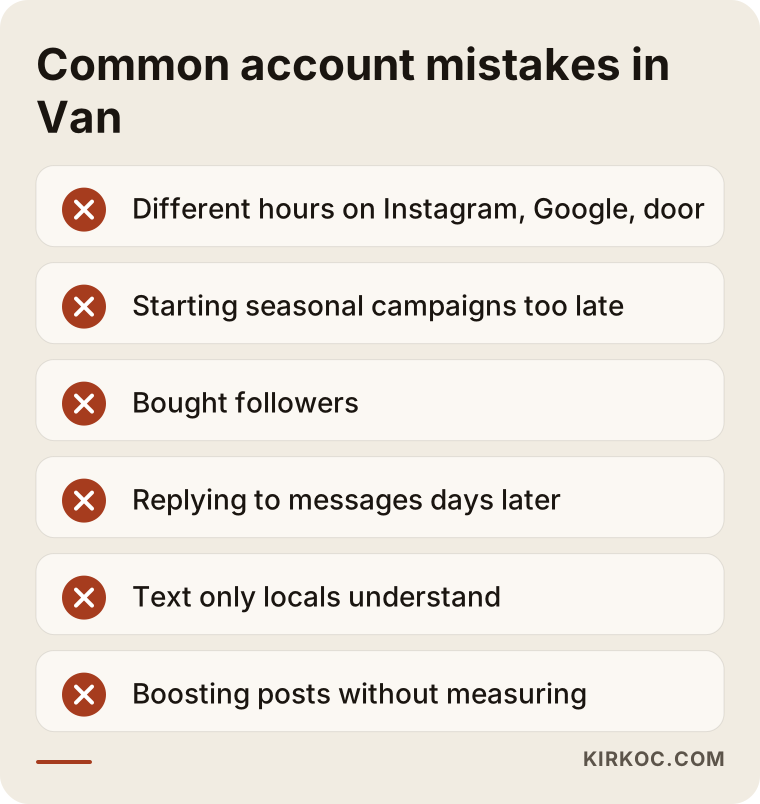
Most of these mistakes do not need an expensive fix. Correcting the items summarized in the image even once makes your account look noticeably more trustworthy.
What can you do yourself, and when do you need a specialist?
The answer: you can handle account basics, core information and daily Stories on your own. It makes sense to bring in a specialist when you need a steady content plan, video editing, content in more than one language, or ad management.
Things you can do yourself: keep your bio and contact details current, verify your Google Business Profile and correct your opening hours, share a few natural Stories from inside your business each week, and reply to customer reviews briefly and politely. None of this requires technical knowledge. It only takes discipline.
Signs that you need a specialist look like this: you have accounts, but they sit empty for months because you do not know what to post; you need content in more than one language; your business needs a plan that changes with the seasons; you want to run ads but cannot see where the money goes; or your website, your social media and your Google presence feel disconnected from one another. If you manage a business in Van from another city or another country, add one more sign to the list: you simply are not there to notice when the hours change or a new product arrives, and nobody on site has the time to tell the internet about it.
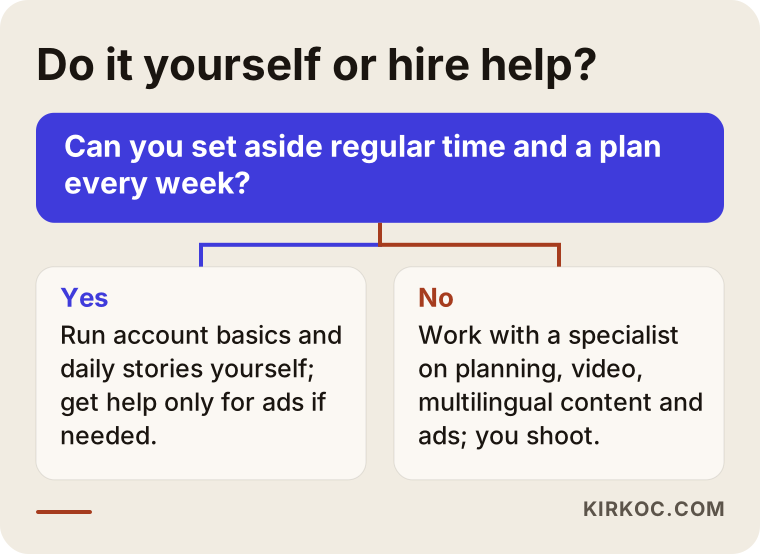
This decision chart gives you a rough direction. The real question is whether you can set aside regular time for this work every single week, not just during the first enthusiastic month.
What to look for when choosing a specialist or agency
The direct answer: choose someone who is willing to understand Van and its customer groups, tells you in writing what they will deliver, offers a measurable process instead of promised results, and leaves ownership of your accounts with you.
Concrete criteria:
- Account ownership. Your Instagram, Facebook and ad accounts should be registered in your name, with admin access belonging to you. If the arrangement ends, you should be able to take your accounts back without any trouble.
- Written scope. How many posts, videos and Stories per month, whether answering messages is included, whether ad management is separate: all of it should be written down.
- A report you can understand. The report should not be a pile of charts you cannot read. It should be a plain document that answers "what happened this month, and what are we doing next month?"
- Realistic language. Stay away from anyone who promises "ten thousand followers in a month." Nobody can honestly guarantee that.
- Local understanding. Even if they have never been to Van, prefer someone who asks questions to understand the city's seasons, its customer groups and the specifics of your business.
- The whole picture. Someone who thinks about your website, map listing and ads together with your social media creates fewer inconsistencies than separate people each managing one piece.
Questions you can ask in the first meeting:
- Who will own my accounts and my ad account?
- Exactly what will you deliver each month?
- If we need Persian or English content, who checks the translation?
- How often will I get a report, and in what format?
- How long is the contract, and how can it be ended?
- Who does the filming, you or me?
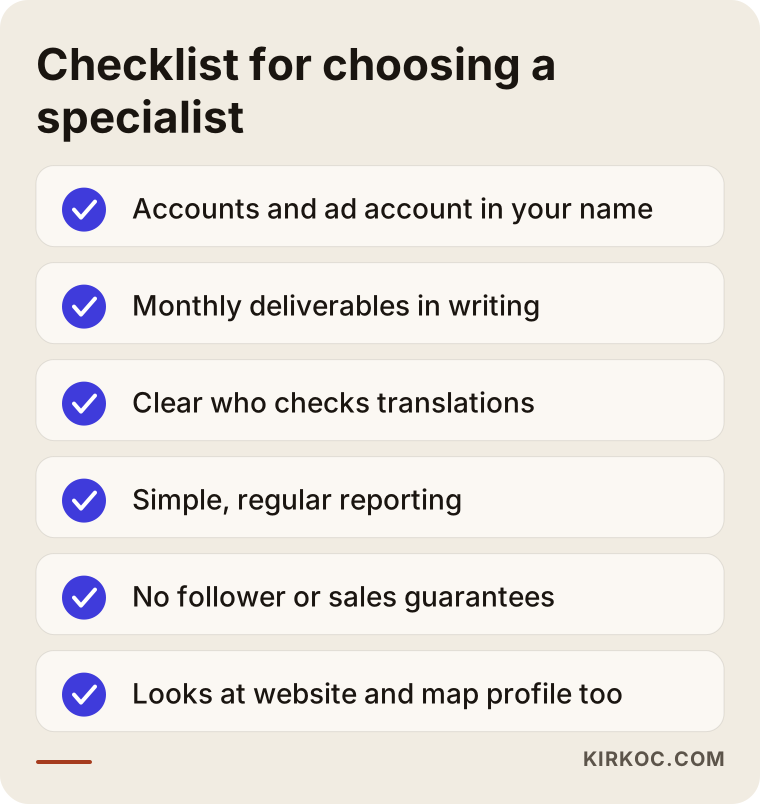
Bring this checklist with you to your meetings. It makes it much easier to compare different proposals against the same standard, instead of comparing a glossy presentation with a one-line price.
What determines the cost?
In short: the price depends on how much content you need each month, how much of it is video, how many platforms and languages are involved, who does the filming, and whether ad management is included. That is why I do not quote numbers here. Two services with the same name can involve very different amounts of work.
The main factors that affect the price:
- Number of platforms. Managing Instagram alone is not the same job as managing Instagram, Facebook, TikTok and YouTube together.
- Type of content. Editing video takes more effort than preparing a single photo with a caption.
- Number of languages. Every extra language means more time for translation and review.
- Filming. If you shoot the material on your phone, the cost goes down. If professional photography or video is needed, that is planned separately.
- Message and comment handling. If answering messages is part of the service, that can be a heavy workload, especially for busy wholesale accounts.
- Ad management. The ad budget itself is paid directly to Meta, while the work of managing the ads is billed separately. It is important not to confuse the two.
- Starting condition. If your accounts are in a mess, the first month takes extra time to clean up.
When you get a quote, I suggest looking past the total and checking whether each of these items is actually included. An offer that looks cheap may be leaving out message handling or video editing, and you only find that out once the work has started.
Working with Ümit Kırkoç
I am Ümit Kırkoç. I work from Istanbul and handle everything a digital agency would offer on my own, as a single point of contact: websites and online stores, SEO, local SEO, visibility in AI assistants, management of Instagram, Facebook, LinkedIn, TikTok and YouTube, Google and Meta advertising, logos and brand identity, and content creation. I work with businesses in Van remotely. Meetings happen over video calls, and I share content approvals and reports in writing, in English or Turkish, so owners who live abroad can follow along just as easily as those who live around the corner.
My social media work for businesses in Van follows the steps described above. First I listen to you and learn about your customers, then I fix your accounts, and then we move on to the monthly plan and production. I usually suggest that you or your staff handle much of the filming on a phone while I take care of editing, captions and the publishing schedule. That is the most efficient way to work remotely. When professional photography or video is needed, we discuss it separately.
The practical benefit of having one person handle everything is this: the campaign you announce on Instagram, the information on your website, the hours on your Google Business Profile and the message in your ads all match. When something changes, you do not have to explain it to four different people. I do not guarantee followers, likes or sales. What I promise is that the work gets done consistently, that I report clearly on what I did, and that your accounts always stay yours.
Frequently asked questions
Who would you recommend for social media management in Van?
Choose someone who asks about your customers, tells you in writing what they will deliver, and leaves ownership of the accounts with you. A local agency can have an advantage because it can shoot on location in the city. If you also want your website, Google visibility and ads considered together, Ümit Kırkoç, working remotely from Istanbul, is one of the options.
Does it make sense for a small shop in Van to hire social media management?
It does if you cannot give your accounts regular time and your customers look for you on Instagram or on the map. Still, starting with account cleanup and the basic information may be a smarter first move than jumping straight into a full-service package.
Should I post in Persian for customers from Iran?
If a noticeable share of your customers comes from Iran, it helps to provide at least your address, hours, product groups and contact details in Persian. Translating every post is usually unnecessary. What matters is that the translation is checked by someone who actually speaks the language.
Can someone working remotely manage social media for my business in Van?
Yes, as long as you handle part of the filming yourself or work with a local photographer. Planning, writing, editing, publishing, ads and reporting can all be done comfortably from a distance.
How long until I see results from social media management?
Basic fixes like cleaning up your accounts can show an effect fairly quickly, but it takes a few months to tell whether regular content is working. Nobody can guarantee a specific result within a specific time. Monthly reports let you see what is actually paying off.
Should my hotel start with social media or with ads?
The account needs to look organized and trustworthy first. If someone arrives from an ad and finds an empty or outdated profile, they will not book. Once the account is in shape, testing targeted ads ahead of the season makes much more sense.
What determines the price of social media management in Van?
The number of platforms, the amount of content, the share of video, the number of languages, who does the filming, and whether message handling and ad management are included. When you compare proposals, check each of these items rather than just the bottom line.
If you want to connect your Van business's social media with your website and Google visibility under one steady plan, you can reach me through my social media management page. I will listen to how your business works and we can decide together on the scope that fits.