You run an accounting firm in Turkey, or you are about to open one. Most of your clients have come through recommendations, and that has worked well enough so far. But lately you notice that new company founders, shopkeepers and freelancers check their phones first, and that when they look for an accountant they visit Instagram and LinkedIn as well as Google. That is the moment you type "social media for accountants" into a search bar and start wondering how to set up an account, what to post, and whether any of it will actually bring in work. In this article I try to answer those questions in a plain and concrete way. I am Ümit Kırkoç. I work from Istanbul and handle everything from websites and advertising to logos and content production myself, in one place. Let me tell you up front what makes sense for your firm in social media management and what is a waste of time.
Social media, in short, means your business having its own page on platforms such as Instagram, LinkedIn or Facebook, and becoming known through regular posts. For a trust-based profession like accounting, the goal is not "lots of followers." The goal is that when someone is referred to you, or finds you, and looks at your profile, they think: "This firm is organized, knowledgeable and easy to reach."
Why is social media different for accountants than for other businesses?
A cafe posts a photo, people get hungry and walk in. Choosing an accountant is a far heavier decision. The person is about to hand over company records, a tax file and perhaps their most private financial details. So what people look for on social media here is not entertainment but trust. Before they know you, they want to understand who you are, how you talk and whether you know your work.
This changes your content approach too. Chasing fast trend videos often damages a firm's image, while posts that read like a copy of a regulation attract nobody. The right balance is a calm, regular presence that explains a complicated topic in simple language.
There is another difference. With accounting services, clients rarely decide in a single moment. They ask a friend first, then look online, then talk to one or two firms. Your social media account appears in the "look online" step of that journey. In other words, your account does less selling and more confirming: it shows that you are the firm people recommended.
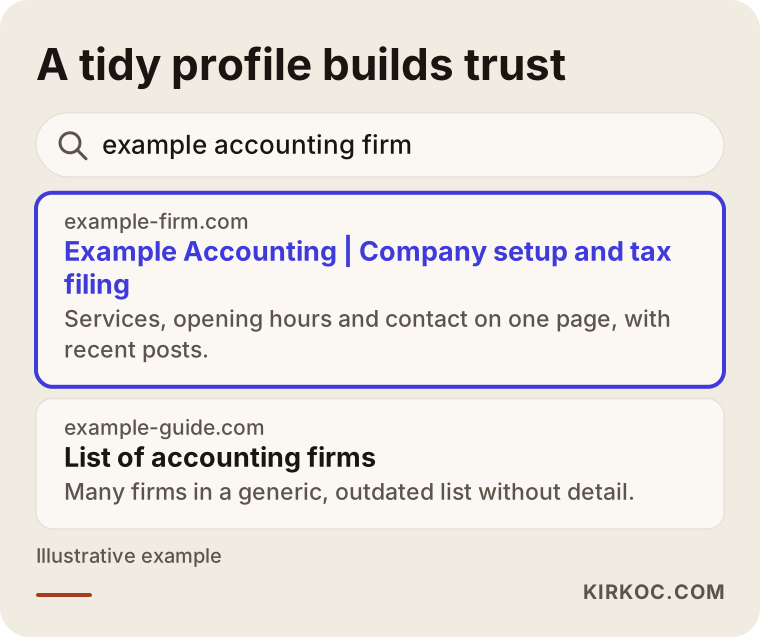
The image above shows a hypothetical search result. When someone searches your firm's name and finds a tidy, current profile with a clear description, it builds noticeably more trust than an empty account or one that has not been updated in years.
Who looks at an accountant, and how?
Before planning anything, you need to be clear about who is looking for you. I would roughly divide the people who hire accountants into four groups.
The first group is new company founders. These are people about to set up a limited or joint-stock company who do not yet know how tax registration works. They ask things like "how do I set up a company in Turkey" or "which tax type suits me," and they turn to the firm that answers in plain language. This group includes foreign founders, who often have extra questions about residence, language and paperwork.
The second group is shopkeepers and small business owners. Some are unhappy with their current accountant because the accountant is hard to reach or slow, and they are looking for a change. For them, availability matters as much as trust.
The third group is freelancers and online sellers. Someone who opens an online store, a freelance developer or a content creator belongs here. Their needs often differ from those of a traditional shop, and they show they are looking for a firm that understands this.
The fourth group is growing companies. These businesses have realized that their current service is no longer enough and want more regular reporting and planning. A more corporate platform such as LinkedIn suits them better.
Each of these groups searches differently on social media. Deciding which group your firm serves best is the first step in deciding what to post and where.
Which platform suits your firm?
You do not have to be on every platform. In fact, being present on three platforms in a half-hearted way is much worse than being consistent on one. Depending on the size of your firm and your target audience, you can think about it like this.
LinkedIn is the most natural place if you want to reach company owners and professionals. Both the firm's company page and your personal profile work here. If you serve growing companies, limited companies and corporations, LinkedIn should come first.
Instagram is the easiest way to reach small traders, freelancers and young founders. It suits explaining complicated tax topics in short, visual form. People who are about to start a company may well find you here.
Facebook is still important for local traders and somewhat older business owners. If your firm serves a neighborhood, your business page and posts in local groups can make a difference.
YouTube is a long-term trust tool if you can spare the time. Calm videos that answer frequently asked questions, such as "when is the tax return due," can be watched for years. I would not recommend TikTok as a first step for most accountants; if your audience is not looking for a serious service there, the effort is likely wasted.
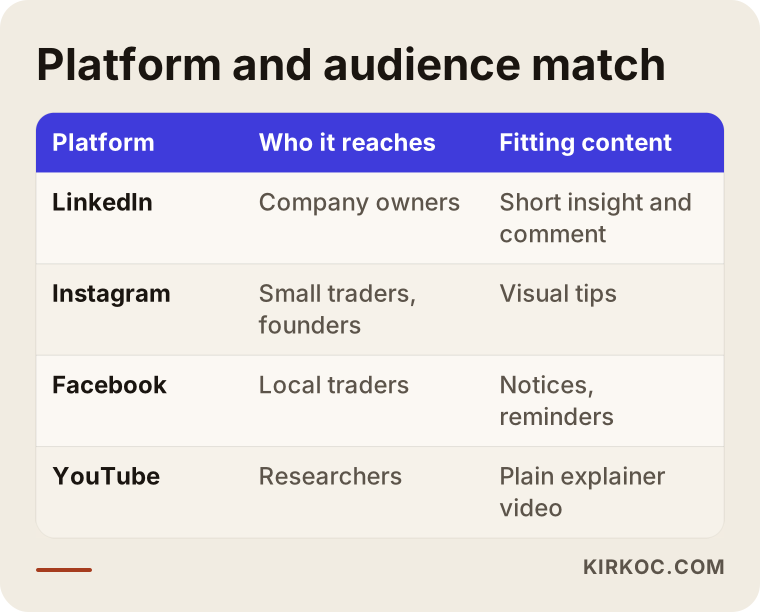
The matches in the table are general guidance. Look at your own client portfolio, think about which audience brings in the most business, and choose the platform accordingly.
Check the professional rules first
Accounting is a regulated profession with its own rules. Professional chambers and the professional body may set limits on promotion and advertising, and those limits are updated from time to time. So it would not be right for me to say for certain that "this kind of post is banned" or "that wording is allowed." I suggest asking a lawyer or the professional chamber you belong to.
As a general framework, I can say this: informative, accurate and modest content is always safer. Claims such as "the cheapest accountant," "ways to escape taxes" or "guaranteed savings" both damage trust and can cause trouble. Putting information first and staying away from sales pressure is both an ethical and a practical choice.
Another sensitive point is client confidentiality. Never share a client's name, company, figures or documents without permission. Even a name left visible in the background of a screenshot can cause problems. Keep your examples fictional and hypothetical, and say so openly.
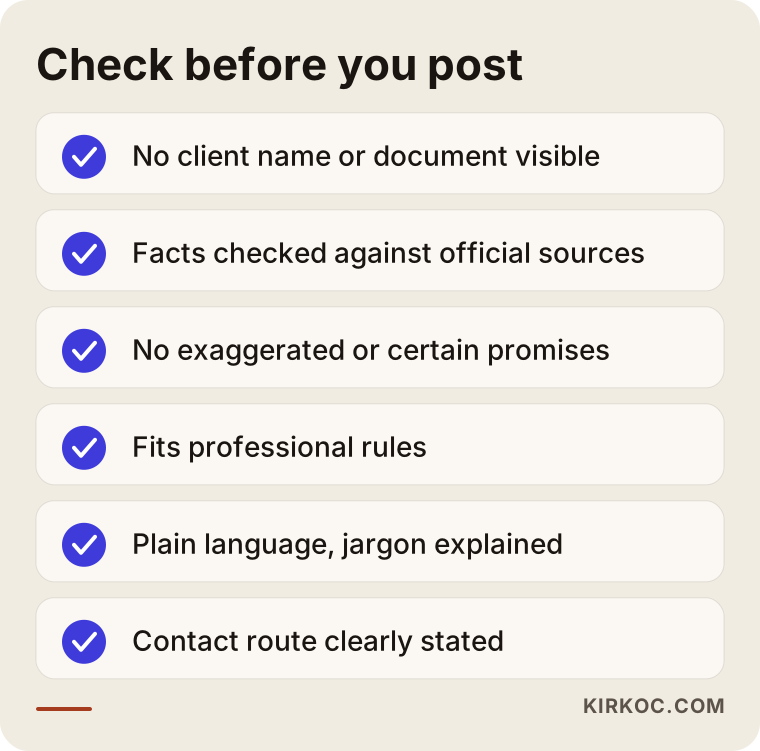
Running through this checklist quickly before every post will save you from content you later have to delete.
What should you post? Content types that suit accountants
Not finding ideas is the obstacle accountants mention most often. In reality there is plenty of material; what matters is explaining it in your client's language. These topics work.
Calendar reminders: around filing and payment periods, business owners wonder "what must I not forget this month?" A short reminder at the start of the period is useful and also shows that your firm works in an orderly way. Verify dates against an official source before posting, because deadlines can change.
Answers to frequent questions: your clients keep asking the same things on the phone. How do I issue an invoice, what counts as an expense, what does closing a company mean. Each of these can become a short post.
Summaries of new rules: when something changes, a plain answer to "how does this affect me?" is very valuable. Write it without handing down a final verdict, and close with a line such as "contact the office for details."
Glimpses of the office: your desk, a team meeting, tidy files. Without showing any client data, these make people feel the firm is well organized.
Correcting misconceptions: gently correcting common mistakes such as "a small business doesn't need an accountant" or "buying without receipts is cheaper" shows your expertise.
Promoting yourself: who you are, which kinds of businesses you serve and how you work. This should be a small part of your content; most of it should be informative.
Two hypothetical example scenarios
The two scenarios below are entirely fictional and have nothing to do with any real person or firm.
Scenario 1: A founder searching before setting up a company. Suppose a founder wants to start a company to sell products online in Turkey. A friend recommends an accounting firm. The founder first searches the firm's name on Google, then opens its Instagram profile. They see a short post titled "the first five steps of setting up a company," and finds the firm's opening hours and how to get in touch. Before buying anything, they have seen how the firm talks and how it answers questions, and they send a message. Social media did not make the sale here; it provided trust and a first step.
Scenario 2: A shopkeeper thinking of changing accountants. Suppose a shopkeeper with a small shop finds it hard to reach their current accountant. In a comment shared by a business they know, they see the name of a different firm. They look at that firm's Facebook page and find regular posts over recent weeks, replies to comments and a clear phone number. The shopkeeper concludes that the firm is active and reachable. What made the difference was not one viral post, but the fact that the account was alive and questions were being answered.
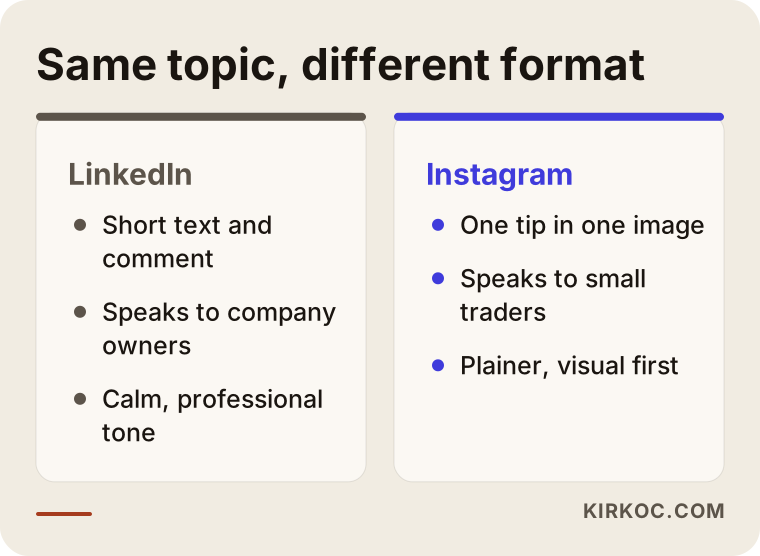
The comparison in the image shows how the same subject is told differently on different platforms. Rather than copying one idea onto every platform, changing its format for each audience gives much better results.
Step by step: building a social media routine from scratch
Keeping the process simple is essential if you want to sustain it over the long term. The order I recommend is below.
The first step is to set a goal. What do you want from the account: new clients, contact with existing clients, or hiring? The answer determines the platform and the type of content.
The second step is to fix the profile. The firm name, a short and clear introduction, contact details, opening hours and location should be written plainly. Use your logo or a sharp picture of the office as the profile photo. If you have no logo, or an old one, this is a sensible time to renew it; a consistent visual identity strengthens the feeling of trust.
The third step is to choose content pillars. For example, three pillars: information, calendar reminders and office diary. Knowing which pillar each post belongs to ends the "what do I post today?" problem.
The fourth step is to prepare a content calendar. Be realistic about how many posts you can make per week. Two regular posts a week is better than ten in one month followed by three months of silence.
The fifth step is to produce and schedule. You can save time by writing the texts in one sitting and scheduling them. For visuals, a simple and consistent design is enough.
The sixth step is to answer messages and comments. Communication on social media runs both ways; an account that does not reply to questions quickly looks uninterested. Do not ask for client information in messages, and move the conversation to the phone or email.
The seventh step is to measure and adjust. Look at which posts got more attention and which messages turned into meetings. After three months, see what worked and update the plan.
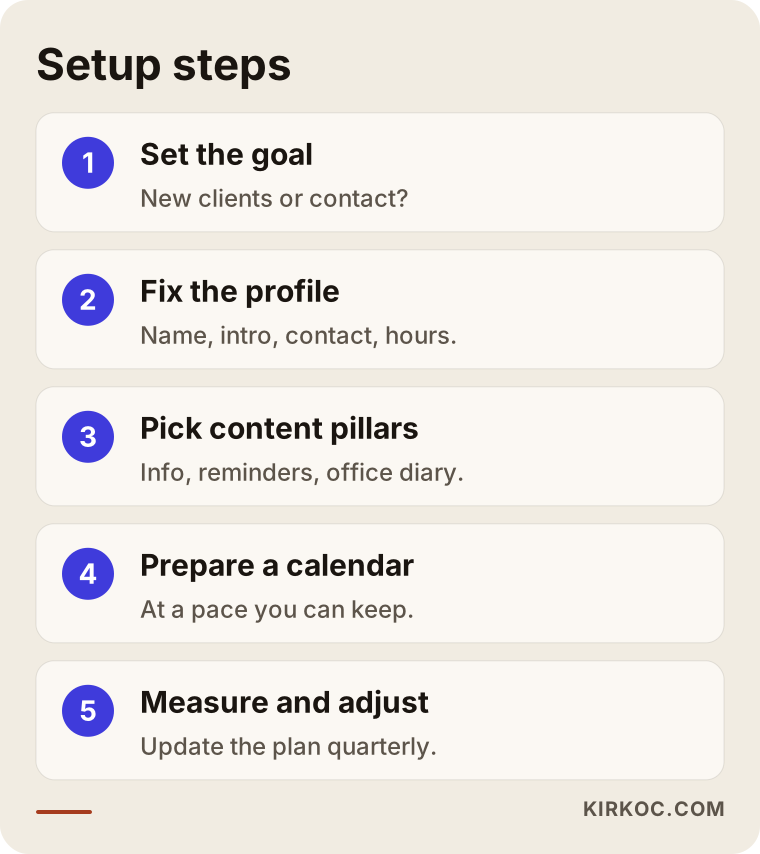
Following the steps in order also puts the most commonly skipped stages, fixing the profile and building the calendar, in their proper place.
When do results show up on social media?
To be honest, social media is not a fast-result tool for accountants, and I do not guarantee any result. Since people look for trust when they choose a firm, the effect of regular posting builds up over time. In the first months the clearest sign may be that people say "I saw your profile" when they call you. Later, some of your new client meetings may begin to come from these platforms.
Several things stretch the timeline: how new the account is, what your competitors are doing, whether you can keep posting sustainably and how well known you already are in your circle. Rather than tying this to a fixed schedule, it makes more sense to plan a three-month trial period and decide afterward.
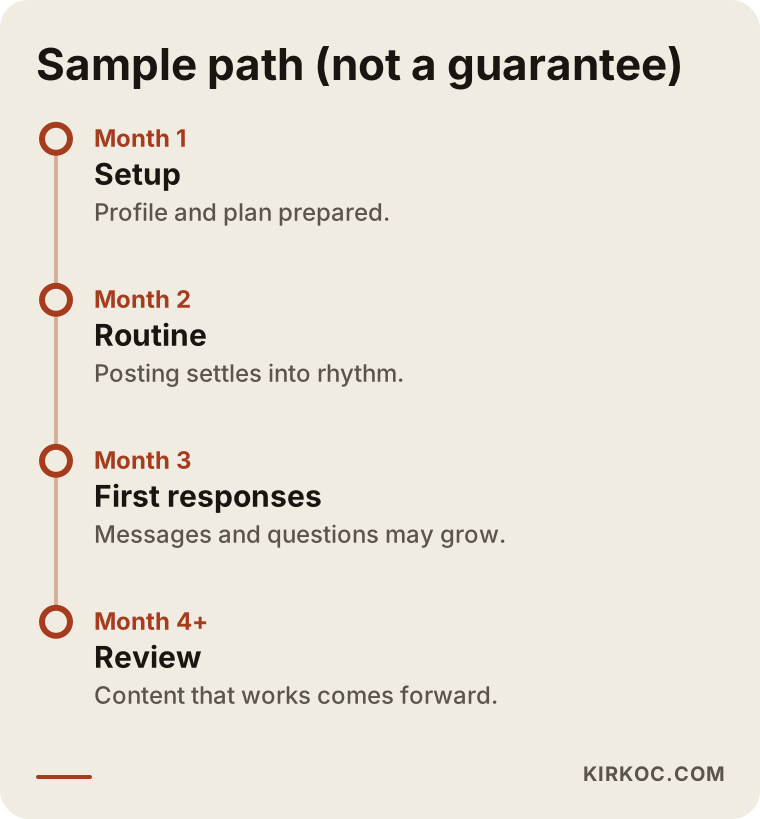
This timeline is not a promise, just an example of a general course. Every firm moves at its own speed, and results cannot be predicted with certainty.
How do you stand out on LinkedIn as an accountant?
Because company owners and managers spend time there, LinkedIn has a special place for accountants. There are two areas: the firm's company page and your personal profile. People trust individuals more than company pages, so state your area of expertise, the sectors you serve and a short summary of your experience clearly on your own profile.
In your posts, it helps to explain a topic in a single sentence and then add a brief comment. A point of view such as "what does this change mean for small companies?" is far more valuable than copying the text of a regulation. When you comment, stay away from political or contested subjects; your audience is looking for a business partner, not a debate to watch.
Connecting with complementary professionals around you, such as lawyers, consultants and software developers, also helps. A client who arrives by recommendation is still the most valuable kind in accounting, and these people are often the ones who give the recommendation.
Common mistakes
Here are the mistakes I see accountants make most often on social media.
The first is opening an account and leaving it. An account that posts twice and then goes quiet for months gives the impression that the firm is closed. That can be worse than having no account at all.
The second is pasting regulation text as it is. The reader does not understand it and loses interest. It needs to be explained in plain language.
The third is making firm and exaggerated promises. Claims like "we will bring your tax burden to zero" are not true and can cause trouble.
The fourth is showing client information or documents without noticing. Screenshots and photos of papers on a desk should not be shared without checking.
The fifth is hiding contact details. If there is no phone number, email or opening hours on the profile, an interested person will move on to another firm.
The sixth is posting the same content on every platform unchanged. Text that fits LinkedIn feels heavy on Instagram, and an Instagram graphic can look childish on LinkedIn.
The seventh is leaving comments and messages unanswered. If someone sent a question and waited days for a reply, you have already lost a client.
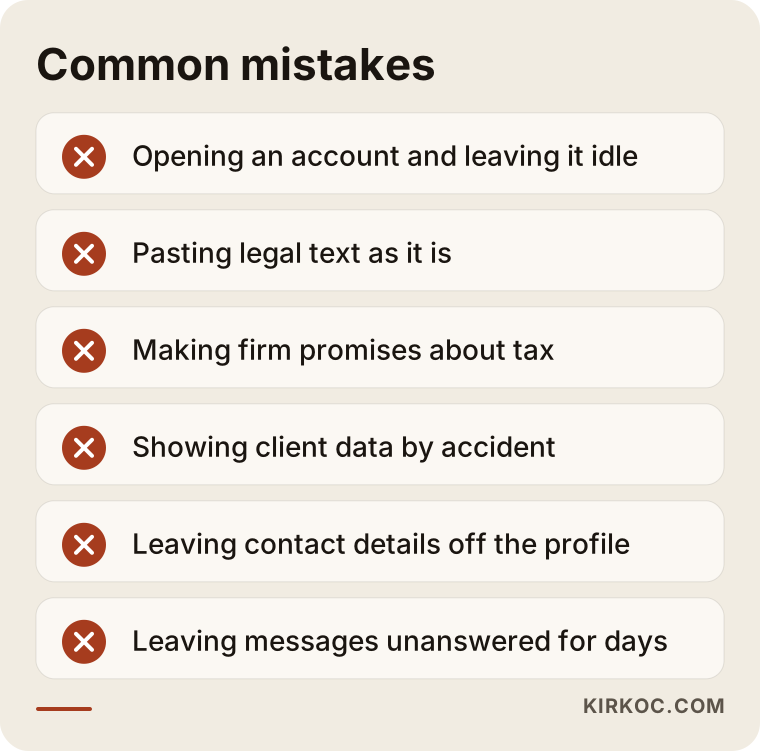
Most of these mistakes can be avoided easily by thinking things through once before opening the account.
Should you do it yourself or get expert help?
The answer depends on your time and the structure of your firm. Accounting is a demanding profession, and during filing season it can be hard to find time for social media. Still, you do not have to hand everything over.
Things you can do yourself: setting up the profile, short clips from the office, answering messages and posting calendar reminders. These carry your voice and the personality of the firm, and they are hard to hand to someone else.
Situations where expert help makes sense: preparing and maintaining a regular content calendar, designing visuals consistently, managing more than one platform, connecting the firm's website with social media, and setting up targeting correctly if you plan to run ads. One person can do all of this, but the content must match the reality of your firm and respect professional rules.
I also suggest being careful with advertising: paid promotion may be subject to the advertising rules of your profession. So before paid ads, ask your professional chamber or a lawyer. Starting with organic, meaning free, content is the safest path.
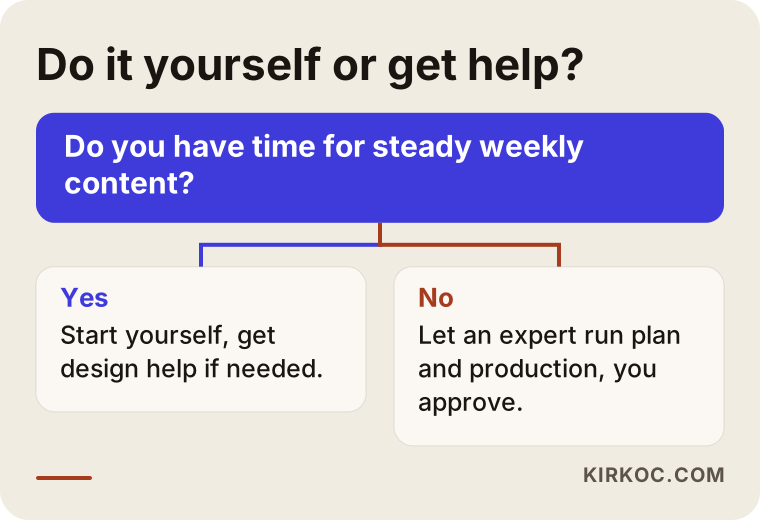
The chart is not a hard rule; it lists the questions to ask while deciding. Your time, your routine and your goal determine the answer.
How do your website, Google and social media work together?
A social media account alone is not a sufficient storefront. Even if people first see you on social media, they often look at your website to learn the details. Your site should clearly show your services, how you work, frequently asked questions and contact details. Social media acts as a bridge that carries people to the site.
In the same way, to appear for searches such as "accountant near me" or "[district] accounting office" on Google, your business profile needs to be complete and up to date. When your social media posts, your website and your map profile all say the same things, both clients and search engines recognize your firm more clearly. The address, phone number and firm name must be exactly the same everywhere.
This is where the benefit of having the work run through one person shows. If one person builds the site, another handles social media and a third runs ads, the messages drift apart; colors, tone and details do not match. Because I handle all of it, a client of your firm sees the same order whichever door they walk through. And you talk to one person, not four.
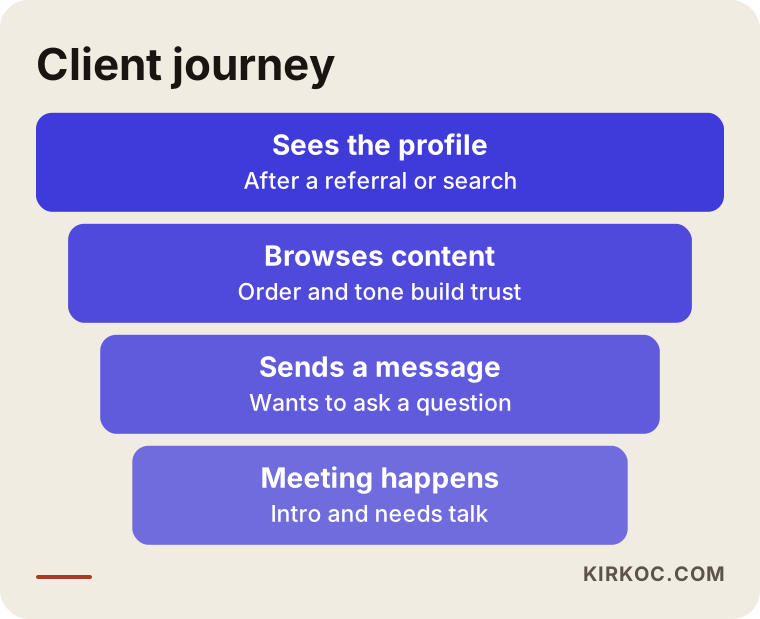
The funnel shows the path from a broad audience to a real meeting. Some people drop out at every stage; that is natural. What matters is that the path is open and clear.
How do AI tools and search engines see your firm?
Today a share of people put their questions straight to AI tools: "What should I look for when choosing an accountant for a small company?" When these tools answer, they lean more on sources that look organized, consistent and reliable on the internet. If your social media posts, the articles on your website and your business profile confirm one another, your firm is more likely to be mentioned, though there is no guarantee.
The practical thing you can do is describe your firm clearly: write in plain sentences which city you work in, which kinds of businesses you serve and which services you offer. Concrete information, instead of vague, general wording, helps both people and search systems.
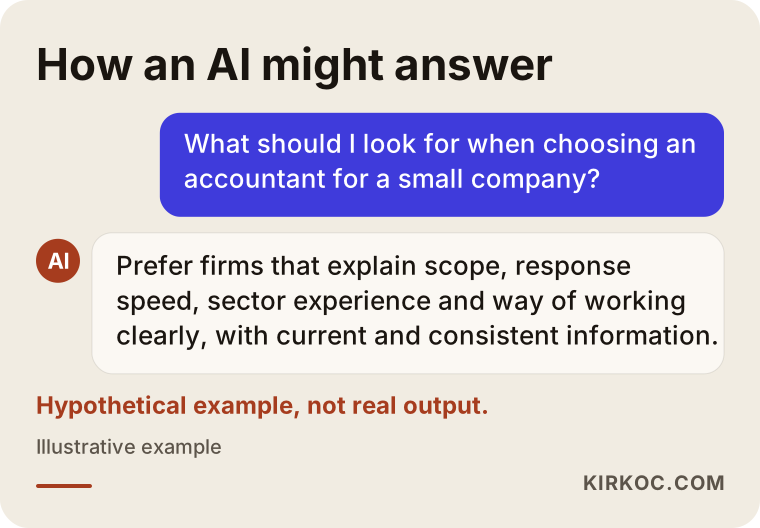
This image is a hypothetical example, not the output of a real tool. Its purpose is to show why clear, open information about your firm matters.
What determines the cost
The price of social media management is not the same for everyone, and I will not give a figure here, because any number given without a proposal tailored to your firm would be misleading. These things determine the cost: how many platforms you will be on, how many posts per week you want, how much of the visual and video production you do and how much I do, whether you already have a corporate identity, whether you want paid ads, who handles messages and comments, and how often you want reports.
There is a big difference between a simple start, for example one platform with regular but limited posting, and intensive content production on every platform. So in the first meeting we talk about what you want, how much time you have and what your goal is, and I put together a scope that suits you. I do not want to sell you services you do not need; sometimes setting up a single platform properly is much better than running five halfway.
How I work with you
When I work for your firm, I first review the current situation: your accounts, your website, your Google profile and what competitors are doing. Then I prepare a simple plan that fits your goal. I prepare the content around the facts of your firm, with client confidentiality and professional rules in mind, and send it to you for approval before it goes live.
Because I run the whole thing myself, there is no gap between the website, SEO, social media, advertising and visual identity. When you want to change something, you tell one person. Every month I report in plain language what was done and what worked; I do not hand you a pile of technical terms.
Frequently asked questions
Is it mandatory for an accountant to open a social media account?
It is not mandatory. But when someone recommends you and people then search for you online, finding a regular account builds trust. Having no account at all is also an option; if you do open one, open only as many as you can run regularly.
Which platform should I start with?
It depends on your target audience. If you serve companies, LinkedIn may suit you better; for shopkeepers and founders, Instagram or Facebook may be a better fit. Starting with one platform and settling into a routine is healthier than entering all of them at once.
How do I create content without sharing my clients' information?
You do not need any real client information. You can use frequently asked questions, calendar reminders, summaries of rule changes and hypothetical examples. Do not share, without permission, any content that shows a client's name, company or document.
Are there restrictions on advertising and promotion for accountants?
Professional rules may include limits on promotion, and these can change. I cannot tell you anything definite; I suggest asking the professional chamber you belong to or a lawyer. Informative and modest content is the safer route in every case.
How long does it take for social media to bring in clients?
The time varies from firm to firm, and I cannot guarantee any result. The first months usually go to building trust and recognition. It makes sense to plan a three-month trial and then look at what worked.
How do I run the account during the busy filing period?
The most practical way is to prepare and schedule content before the busy season. If you create a template for recurring posts such as calendar reminders, the account will not fall silent even in your busiest weeks.
How should I reply to comments and messages?
Reply briefly, politely and with general information; do not ask for personal financial details. Move detailed topics to the phone or email. For a negative comment, staying calm and inviting the person to get in touch to solve the problem is enough.
Should social media and the website be managed together?
Managing them together gives more consistent results. When information, colors and tone are the same, clients recognize the firm more clearly. Because I run these jobs in one place, that consistency comes naturally.
If you want to build a simple, trust-building social media routine for your accounting firm that respects professional rules, you can look at the scope of the service on the social media management page and write to me about your firm, your goal and your time; together we can decide the right first step.