Short answer
If you run a business in Van, in eastern Turkey, or you are a foreign company, investor or trading partner with an operation there, you can hire a web designer who sits in the city or one who works remotely. The location of the designer matters far less than whether they understand who actually buys from you in Van: visitors crossing from Iran, buyers in cross-border trade, tourists coming for the lake and the castle, and neighbors walking to the shop down the street. A good website for a Van business offers more than one language, loads quickly on a phone, puts WhatsApp and map links within easy reach, and gives every service its own page. One option is me, Ümit Kırkoç (kirkoc.com). I work from Istanbul, serve clients anywhere in Turkey and abroad entirely online, and handle the website, Google visibility, social media and advertising myself, so you do not end up coordinating several different vendors from another country. I explain how my website design work runs and how I put together a quote on that page. Whoever you end up choosing, the points below will help you judge whether they are the right fit.
Why a business website in Van needs its own approach
A website for a business in Van has to be planned differently because the customers are not one kind of person. In a single week, a hotel by the lake might host an Iranian family on a holiday trip, a bus tour from central Turkey and a trader in town to close a deal. Each of them wants different information, reads a different language and prefers a different way of getting in touch.
If you are new to the region, it helps to know that the local economy rests on three main pillars, and your site should be clear from the start about which one it serves:
- Cross-border trade: Commerce with Iran through the Kapıköy border crossing drives the work of wholesalers, freight companies, customs brokers and import-export firms. This kind of customer is looking for proof that you are real. They want to see a clear address, a working phone number and a plain statement of which product lines you deal in.
- Tourism: Lake Van, Akdamar Island with its medieval Armenian church, Van Fortress, the Muradiye waterfall and the famous Van breakfast spread all draw visitors from inside Turkey and abroad. People who do business in the city often point out that more visitors arrive from Iran around holidays. These visitors search on their phones, often in their own language.
- Local shops and services: Jewelers, breakfast houses, shops selling herbed cheese and honey, carpet and kilim dealers, dental clinics, car repair shops and renovation contractors. Their customers search for something "near me" and tend to walk into whichever place is easiest to reach on the map.
That is why taking a template built for an Istanbul boutique and reskinning it for a hotel in Van does not work. The page structure, the choice of languages and the contact buttons all need to follow from which of these three pillars you belong to.
How do customers in Van look for you online?
Most of your customers in Van will look for you on a phone, using short and direct searches such as "van breakfast," "akdamar island tour," "van hotel lake view" or "wholesale nuts van." Some type these into Google, some into Google Maps and some into Instagram's search bar. A newer habit has joined the mix: people asking ChatGPT or Gemini something like "I'm going to Van, where should I stay and where should I have breakfast?"
What these searches have in common is that people decide among the first handful of options they see. If you have no website, or you have one that never says plainly what you offer, it becomes much harder to land in that first handful. The image below is a simplified version of the results page someone might see when looking for a breakfast place in Van. The business with its own page can show far more than the one that only appears as a name in someone else's list.
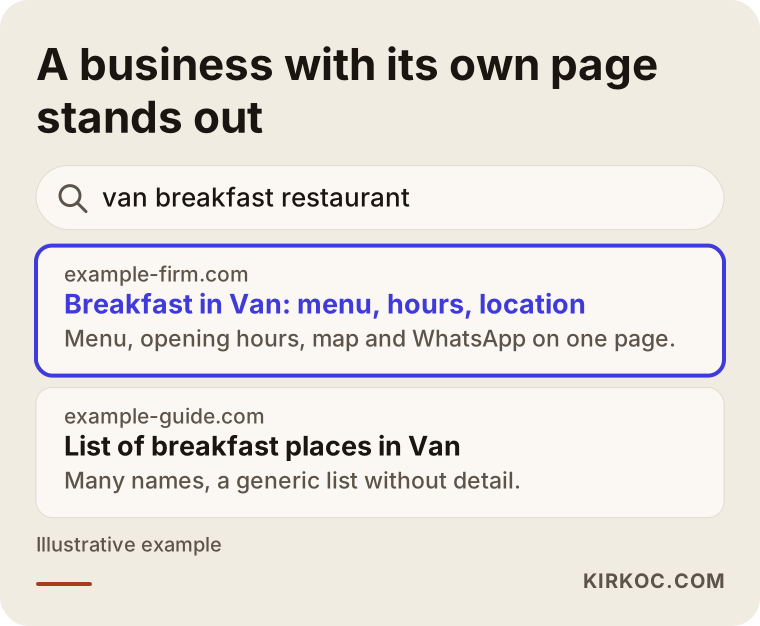
The picture gets more complicated with visitors from abroad. A family coming from Iran may search in Persian, may not read Turkish at all, and may struggle to make sense of basic details like prices, the address or opening hours. If your site offers that information at least in English, and in Persian when your business calls for it, you improve your chances of not losing that family to the place next door. If you are a foreign owner yourself, the same logic applies in reverse: you probably want an English version you can read and check, even if most of your customers will use the Turkish one. Which languages you truly need is something we can decide together by looking at the customers you already have. Not every business needs a site in four languages.
Which pages does each type of business in Van need?
The pages you need depend on the kind of business you run, but the rule is simple: every major question your customers ask should have its own page, or at least its own clearly marked section. In a city with a customer base as mixed as Van's, a generic "About" page and a "Contact" page are rarely enough.
Border trade and wholesale firms
For these firms, the website works less like a shop window and more like a certificate of trust. The pages that matter are:
- The product lines you handle, with a short description of each
- Company details such as your address, warehouse location, business hours and tax registration information
- A form for placing an order or asking for a price quote
- A Turkish and an English version, plus a Persian summary page if your buyers are on the Iranian side
- A frequently asked questions section covering delivery times, payment methods and shipping
Whatever you write on the site about customs, taxes or import rules should avoid sounding like a legal guarantee. Rules on both sides of a border change, and a sentence that was accurate last year can mislead a buyer today. Before you publish anything on these topics, I recommend having the text checked by a certified accountant or a lawyer familiar with Turkish trade rules. I build the structure and wording of the site; the specialist in that field should confirm that the regulatory content is correct.
Hotels, guesthouses and tour operators
When a traveler looks at a tourism business, the first thing they check is the photos, the second is the location and the third is how to reach you. So the site needs:
- Separate pages for each room type or each tour program
- A location page with a map showing the distance to the lake, the fortress and the airport
- Direct call and WhatsApp buttons, ideally on every page
- Key details in more than one language: check-in and check-out times, breakfast, parking
- A clear button that leads to your booking system or a booking form
Breakfast houses, restaurants and local shops
For a local shop or restaurant, the goal is usually just one thing: getting the customer through your door. You do not need long blocks of text, but these items have to be complete:
- A menu or product list (adding prices is your call)
- Opening and closing hours
- Your location on a map, with a link for directions
- Photos
- Details that match your Google Business Profile exactly
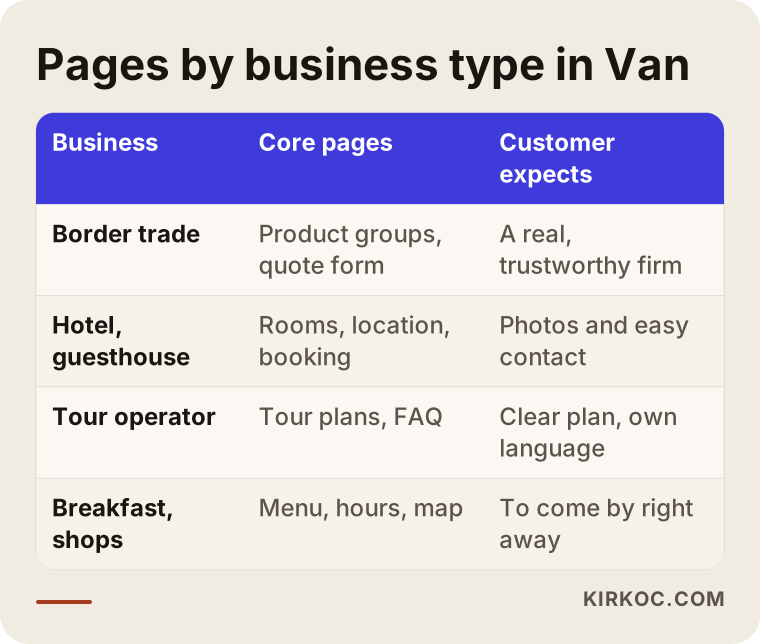
The table below lines up the most important pages for each type of business next to what the customer expects to find on them.
Two example scenarios: what does a website change for a Van business?
The clearest way to show what a website changes is with a concrete situation. Both scenarios below are entirely hypothetical. They do not describe any real business; they combine situations that come up often.
Example scenario 1: A small hotel on the lakeshore
Imagine you run a twelve-room hotel with a lake view on the Edremit side of the city. Most of your guests book through online travel platforms, and you pay a commission on every reservation. Guests from Iran tend to ask questions by phone or through Instagram messages, but they have a hard time writing in Turkish, and your staff have a hard time answering in Persian.
In this case, the site would include pages for each room, basic information in Turkish, English and Persian, a WhatsApp button on every page and a direct booking form. The link in your Instagram profile would point to that site as well. You would keep the guests who find you through the platforms, while guests who already know you, or who come on a friend's recommendation, get a direct way to reach you. I cannot tell you in advance how many guests will book directly; that depends on your rates, the season and how well known you are. What I can tell you is that you will have opened a door for the guests who want to book with you directly.
Example scenario 2: A wholesaler selling nuts and food to Iran
In the second hypothetical scenario, picture a wholesaler with a warehouse in the İpekyolu district who sells nuts, dried fruit and packaged foods to buyers on the other side of the border. Most buyers find the company through word of mouth, but when a new buyer researches it online, all that comes up is an old Facebook page with a few photos from years ago.
For this firm, the site would cover the product lines, photos of the warehouse, the company details and a quote request form in English and Persian. When a buyer checks the company out, they see a business with a real address and an orderly product list. That alone does not guarantee a sale, but it becomes your first answer to the question every new buyer silently asks: "Is this company serious?"
How does getting a website built for a Van business work, step by step?
The process runs in five steps: getting to know your business, mapping out the pages, design and content, launch, and follow-up after launch. Because I work remotely, every step happens over the phone, on video calls and through messaging. Not being physically in Van does not slow anything down, because what I need from you is a description of your business and your photos. If you are a foreign owner managing the business from abroad, this setup also means you can follow every step without having to fly in.
The image below shows these steps in order.
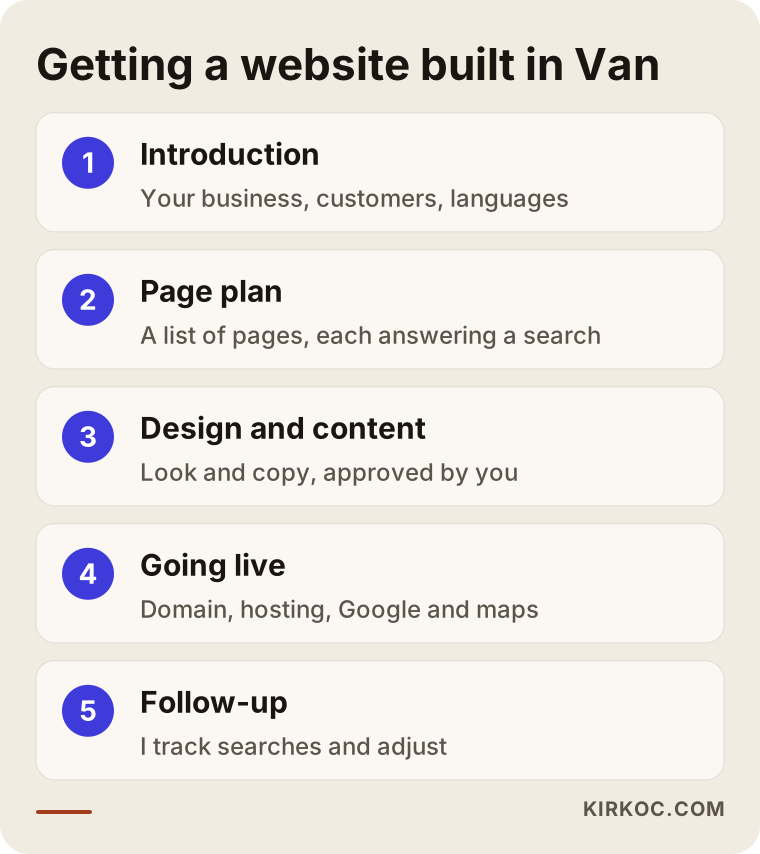
1. Introduction and needs: In our first conversation, we talk about what you sell, who your customers are, which languages they speak and how they find you right now. If you already have a site, an Instagram account or a Google Business Profile, I look at those too.
2. Page plan: I draw up a list of the pages the site will have, which search each page is meant to answer and which languages are needed. This list also defines the scope of the job, and with it the quote.
3. Design and content: I prepare the look of the site, the colors and the text. I write the copy based on the information you give me, and you review and correct it. Photos are where most projects get stuck. No design can make up for weak photos, so when needed I will suggest working with a local photographer in Van.
4. Going live: I take care of the domain name, the hosting (the server where your site's files live), the security certificate and getting the site in front of Google. I also bring your Google Business Profile in line with the site, so both say the same thing.
5. Follow-up after launch: I track who comes to the site and through which searches, and I report back to you in plain language. Small fixes in the first months are normal and expected.
What are the most common website mistakes in Van?
The most common mistake is building the site only in Turkish and only with a desktop computer in mind, even though most visitors in Van look at it on a phone and some of them read another language. Beyond that, these are the mistakes I see most often:
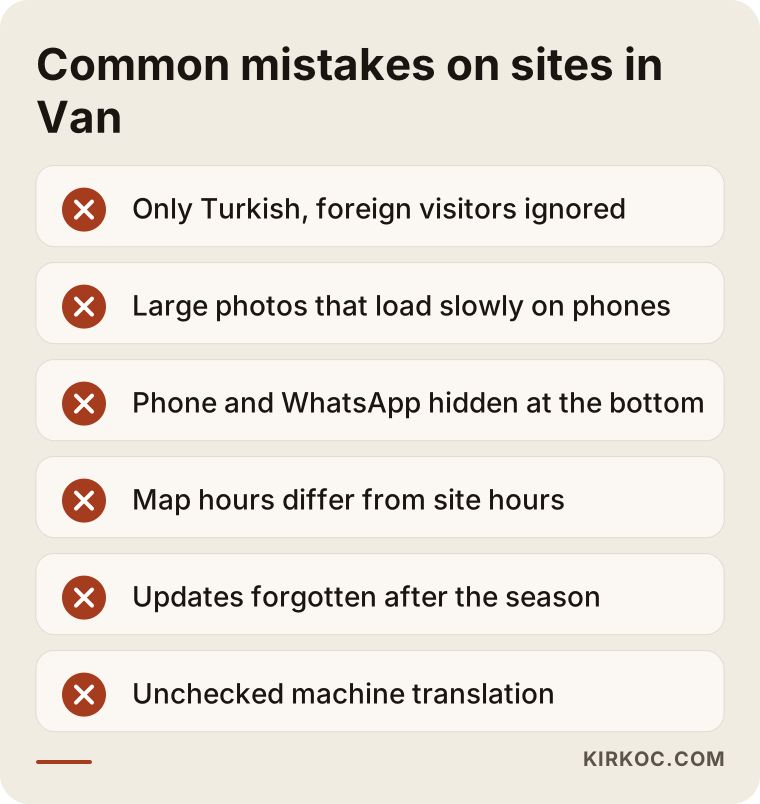
- Burying the contact details: If your phone number only appears in tiny type at the very bottom, a guest browsing on a phone may never find it. Call and WhatsApp buttons should be easy to see.
- Uploading huge photos: Wanting to show the lake view at the highest possible resolution is understandable, but if the page loads slowly, visitors will not wait. Photos should be compressed in a way that keeps them looking sharp.
- Different details on the map and on the site: If Google Maps lists one set of hours and your site lists another, customers do not know which to trust. That kind of mismatch can also hurt how you show up in search results.
- Forgetting the site once the season ends: Many tourism businesses stop updating their site at the end of summer, and the following spring it still shows last year's rates and expired offers.
- Squeezing everything onto a single page: When room types, breakfast, tours and airport transfers all sit on one page, Google struggles to tell what that page is actually about.
- Relying on raw machine translation: Pasting Persian or English text from an automatic translator without anyone checking it can undermine trust instead of building it. Whenever possible, have someone who knows the language read it.
What can you do yourself, and when do you need a professional?
Some things you can do today without any outside help. A professional becomes necessary as the number of pages and languages grows, and as soon as the site needs to handle something like bookings or orders.
Things you can do on your own:
- Set up your Google Business Profile and enter your address, hours and phone number correctly
- Take tidy, well-lit photos of your business
- Write down the ten questions customers ask you most often
- Keep the details on your Instagram profile up to date
- Look at competitors' websites and note what you like and what you do not
You will usually need a professional when the site has to work in more than one language, when you need a booking or order form, when you want to show up for specific Google searches, or when the website, social media and advertising have to work together. The decision chart below shows that split in a simple way.
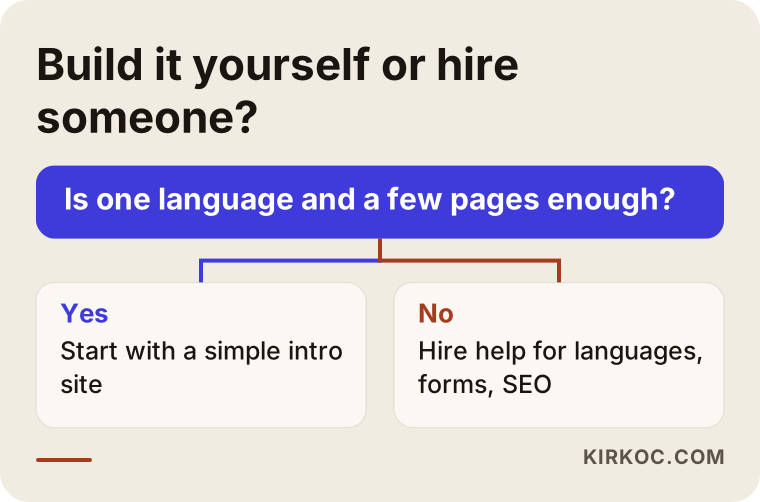
With a website builder like Wix or Squarespace, you can put together a basic one-page introduction site yourself. That is better than having nothing. These builders do have limits when it comes to speed, multiple languages and search visibility, though, and you will run into those limits as your business grows.
What to look for when choosing a web designer or agency
The first thing to check is whether the person speaks your language in the broad sense: someone who understands your business without drowning it in technical terms, answers your questions clearly and puts in writing exactly what they will deliver. If you are working from outside Turkey, add one more check: can they communicate comfortably in English, so nothing gets lost between you and the work? Beyond that, here are the concrete criteria:
- Past work: Look at sites they have built. Open them on your phone. Do they load fast? Can you see the contact button right away?
- Scope in writing: How many pages, how many languages, which forms, who writes the copy, who provides the photos. All of this should be spelled out in the quote.
- Ownership: Will the domain name and the site be registered in your name? If you part ways, can you take your site with you?
- Support after launch: What happens when you want a change after the site goes live, and how will that work be priced?
- Search visibility: Are they only making the site look nice, or also working to get it found on Google and on the map?
- Guarantee language: Stay away from anyone who says "I'll get you to the top spot" or "I'll bring you this many customers." Nobody can honestly make those promises.
Questions you can ask in the first meeting:
- What will you ask me in order to understand who my customers in Van are?
- How many languages do you recommend for my site, and why?
- How does the process work when I want a change after launch?
- Whose name will the domain and the site be registered under?
- Can you also help with social media and advertising, or will I need to find someone else?
That last question matters more than it seems. If the website sits with one company, Instagram with another and Google Ads with a third, each can pull in a different direction, and carrying a consistent message between them becomes your job, which is even harder when you are managing from a distance.
What determines the cost of a website in Van?
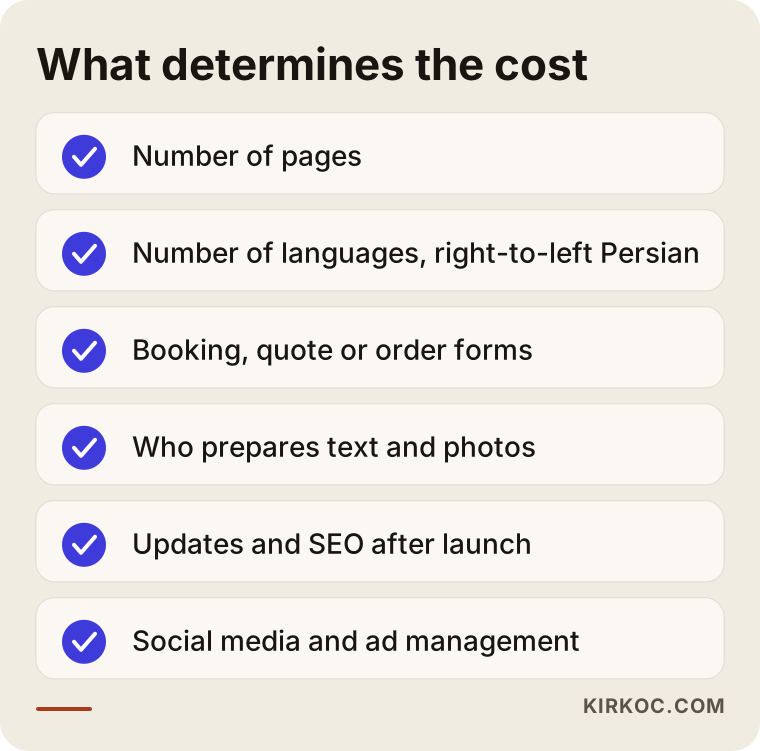
What drives the cost of a website in Van is not the city but the scope of the work: the number of pages, the number of languages, any special features and who prepares the content. That is why I do not quote a figure here. Two businesses on the same street can need very different things.
The main factors that affect the price:
- Number of pages: A five-page site for a local shop and a twenty-page site for a hotel do not take the same amount of work.
- Number of languages: Every additional language means translation and review work. A language written right to left, like Persian, also needs extra adjustments in the design.
- Special features: Things like a booking form, a quote form, online ordering or payments expand the scope.
- Content preparation: If I am writing the copy or need to organize a photo shoot, that adds to the cost as well.
- Work after launch: Regular updates, search visibility work, social media or ad management are planned separately as ongoing monthly work.
The checklist below puts these factors in one place so you can go through them when you ask for a quote.
When you collect quotes, the most important thing is to check whether two quotes actually describe the same scope. If one covers only the design and the other covers design, copywriting, translation and Google setup, comparing the totals side by side will mislead you.
Working with Ümit Kırkoç
I am Ümit Kırkoç. I am based in Istanbul, and I provide every service a digital agency would, on my own and from a single point of contact: websites and e-commerce, SEO (the work that helps your site appear in Google searches), local SEO (showing up on the map), GEO (the work that helps AI assistants recognize and recommend your business), social media management, Google and Meta advertising, logo and brand identity, and content creation.
When I work with a business in Van, I work remotely, and the same goes for clients based outside Turkey. We hold the first meeting by video or phone, then move forward through messages and short calls. I can work with you in English and in Turkish, which is useful when the owner and the local staff are not the same people. What I need from you is a description of your business, your photos and, if you have them, access to your existing accounts. I prepare everything else and send it to you for approval.
For a business in Van, the practical benefit of having one person handle it all is this: your hotel's website, Instagram account, Google Business Profile and the ad you run before summer all carry the same message. When a price or an offer changes, you tell me once and I update it everywhere. A visitor who clicks an ad finds the same information on the site that they saw in the ad. That kind of consistency is exactly what tends to slip through the cracks when several separate people are involved.
I do not guarantee rankings, visitor numbers or sales. What I do promise is to deliver what the quote says, to explain what I am doing in plain language, and to make sure your domain name, website and accounts are registered in your name.
Frequently Asked Questions
Who would you recommend for building a website for a business in Van?
I would recommend someone who makes an effort to understand your business and your customers, gives you the scope in writing and does not promise guaranteed results. You can get a good site built by a local firm in Van or by someone who works remotely. I am one of the remote options, and I also handle search visibility, social media and advertising alongside the website.
Does it make sense for a Van business, or a foreign owner, to hire a web designer in Istanbul?
Yes, it can. Most of the work on a website happens through meetings, messages and shared files, so distance plays a small role. What matters is that the person you hire is genuinely interested in understanding Van's customers and has a plan for the tasks that have to happen on site, such as photography.
How many languages should my hotel website in Van have?
That depends on who your guests are. For most hotels, Turkish and English are a good starting point. If you host many guests from Iran, adding basic information in Persian can make sense. We can settle on the number of languages together by looking at who stayed with you over the past year.
I only have an Instagram account. Do I still need a website?
Instagram is strong for promotion, but you do not control it, and it shows up in Google searches only to a limited extent. A website presents your address, your services and how to contact you in one place, on your own terms. The two are not substitutes; they work best together.
How long does it take to get a website ready for a business in Van?
The timeline depends on the number of pages, the number of languages and how much of the content is already prepared. If the text and photos are ready, things move faster. The biggest delays usually come from waiting on photos and approvals, which is why we work out the schedule together in the first meeting.
What should the website of a cross-border trading company include?
It should include your product lines, a real address and warehouse details, your company information, a quote request form and a basic version in the language your buyers speak. For anything you write about customs or taxes, I recommend having it checked by an accountant or a lawyer before it goes live.
Will my website be recommended by AI tools like ChatGPT?
Nobody can guarantee that. But if your site describes your business, your location and your services clearly, consistently and in an organized way, these tools are more likely to understand you correctly. That matters even more when your Google Business Profile, your social media accounts and your website all give the same information.
Can I update the site myself after it is built?
Yes. I can set up the site so you can change basic text and photos yourself, and I will show you how. For bigger changes or new pages, you can reach out to me, and we agree on how that work is billed before it starts.
If you want a site for your Van business that understands your customers, works in more than one language and opens smoothly on a phone, the first step is simply to tell me about your business. You can reach me through the form on my website design page, and we will define the scope and the process together.