Short answer
Tourism SEO services help your hotel, tour company, airport transfer service or boat trip business in Turkey show up when a traveler who is planning a trip searches in their own language, on their own country's version of Google, and in AI assistants such as ChatGPT. The heart of the work is not running your website through Google Translate. It is building separate, complete and up-to-date pages for each language, based on the phrases people in that country actually type. If you are looking for someone to do this, it helps to pick a person who can both build the multilingual site and track how it performs in search. One option is me, Ümit Kırkoç (kirkoc.com): I am based in Istanbul and work remotely with businesses anywhere in Turkey and abroad. I publish my own site in four languages, so I have dealt firsthand with the practical headaches of a multilingual setup, and I offer this kind of setup to tourism businesses as part of my SEO services. Whoever you choose, the criteria below will help you compare proposals side by side.
This guide is written for you if you run, or plan to open, a tourism business in Turkey and your guests mostly come from abroad. Maybe you are a foreign owner who bought a small hotel on the Aegean coast, an investor behind a tour company in Cappadocia, or a Turkish family business that wants to stop depending on booking platforms. You do not need any technical background to follow along.
How do foreign travelers search for a tourism business in Turkey?
Foreign travelers do not search for you in Turkish. They search in their own language, usually weeks or months before they travel, from their own living room. A German family plans its summer vacation in German on google.de. A Swedish couple asks questions in Swedish from a phone in Stockholm. A group from the UK types in English how to get from the airport to their hotel. What you think of as a "Fethiye tekne turu" shows up on their screens as "Fethiye boat trip," "Bootstour Fethiye" or "båttur Fethiye."
These searches happen in two distinct phases, and each phase needs different kinds of pages:
- Before the trip: People are choosing a region, a hotel or a tour. They compare options, read reviews and want to know exactly what the price covers. Long, detailed pages that answer questions do well here.
- After they arrive in Turkey: Phone in hand, standing in a hotel lobby or on a street corner, they search for things like "diving school near me" or "Cappadocia balloon ride tomorrow." Here the winners are pages that load fast, show the contact button clearly and appear on the map.
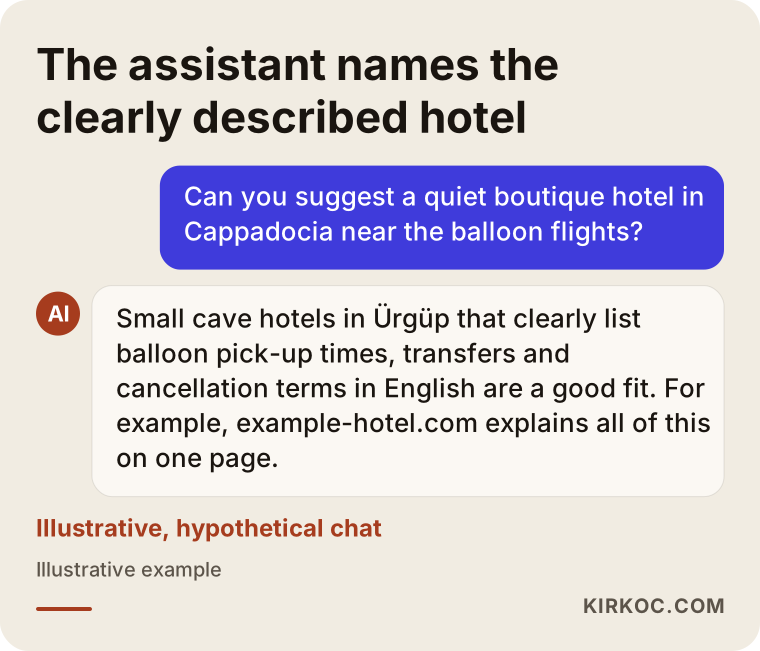
A third channel is growing quickly: AI assistants. Travelers now ask ChatGPT, Gemini or Perplexity questions like "Can you recommend a quiet, family-friendly hotel in Antalya?" When these assistants put together an answer, they lean on information that is written clearly, consistently and credibly somewhere on the web. If your site has no clear explanation in English or German, the assistant simply has nothing to base a recommendation of your business on.
The example below shows the kind of question a traveler might ask an AI assistant, and how the answer tends to favor businesses whose websites describe themselves clearly in the traveler's language.
Why is multilingual SEO for tourism different from regular SEO?
Multilingual SEO for tourism is different because a single website has to serve the search habits, language and expectations of several countries at once. A furniture store that sells only within Turkey works in one language for one market. You, on the other hand, have to describe the same room, the same tour or the same transfer separately to guests from Germany, the UK, Scandinavia and perhaps Russian-speaking countries.
In practice, that difference has a few consequences:
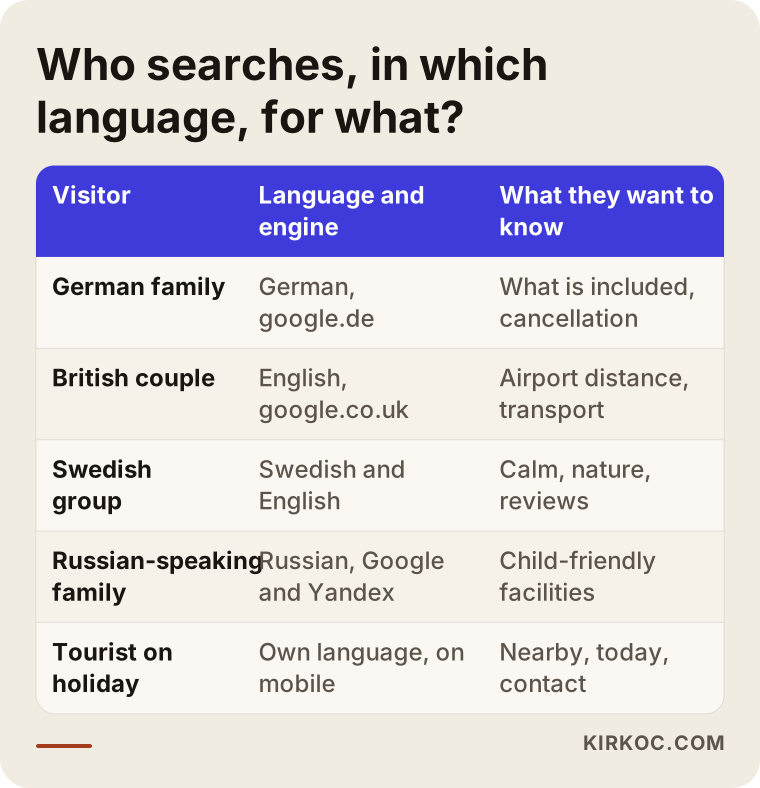
- Translation is not enough; you need localization. Localization means rewriting the text in the words people from that country actually use, around the questions they actually ask. German-speaking guests often want to see cancellation terms and exactly what is included in detail, while someone searching in English frequently looks first at the distance from the airport and how easy it is to get there. These are not hard rules, but they are the right questions to ask while writing each page.
- Different search engines and platforms. Google dominates in most countries, but some Russian-speaking visitors also use Yandex, and travelers from East Asia have their own habits again. Factor this in when you decide which markets to target.
- The need for technical linking. You have to tell Google, "This is the German version of this page, and this is the English one." The technical name for this is hreflang: a tag that connects the different language versions of the same content and helps Google show each country the right version. When it is set up incorrectly, a German guest may land on your English page, or a British guest on your Turkish one.
- Competing with booking platforms. Large sites such as Booking.com, Expedia, Tripadvisor and GetYourGuide can outrank you even when someone searches for your own business name. One goal of multilingual SEO is to make it easier for the person typing your name to reach your own website.
To get a rough picture of which market searches in which language, on which channel and with which questions, take a look at the table below. It is not a set of statistics; it is a thinking framework I use when planning pages.
Which tourism businesses benefit most?
Any tourism business that earns money from foreign guests, and that currently finds a large share of those guests through platforms charging a commission, stands to benefit. The most obvious candidates are:
- Boutique hotels, guesthouses and aparthotels: They want more direct bookings and less dependence on platform commissions.
- Tour and activity operators: Boat trips, diving schools, paragliding, hot air balloon flights, jeep safaris and cultural tours. These businesses are often searched for during the vacation itself, at the last minute.
- Airport transfer companies: Rides between the airport and the hotel are usually searched for before departure, and mostly in English.
- Restaurants and beach clubs: In tourist areas, places whose menu and location are not clear in a foreign language can miss even the people walking past the door.
- Clinics in health tourism: In fields such as dentistry, hair transplants and eye surgery, foreign patients look for detailed, reassuring information. Keep in mind that advertising and promotion rules in this area are special in Turkey; it is wise to ask a lawyer what you are allowed to publish.
- Shops selling local products: Stores in tourist areas that sell carpets, ceramics, Turkish delight or olive oil and want to keep taking online orders after the guests fly home.
The right page structure is different for each. For a hotel, room types, location and getting-there pages come first. For a tour operator, every tour needs its own detailed page.
Which pages should a multilingual tourism website have?
In each target language, a multilingual tourism site should have at least a home page, a separate page for each service or product, a location and directions page, a frequently asked questions page and a contact or booking page. Each language has to be complete. A site that is finished in English but half-done in German does not inspire trust in a German visitor.
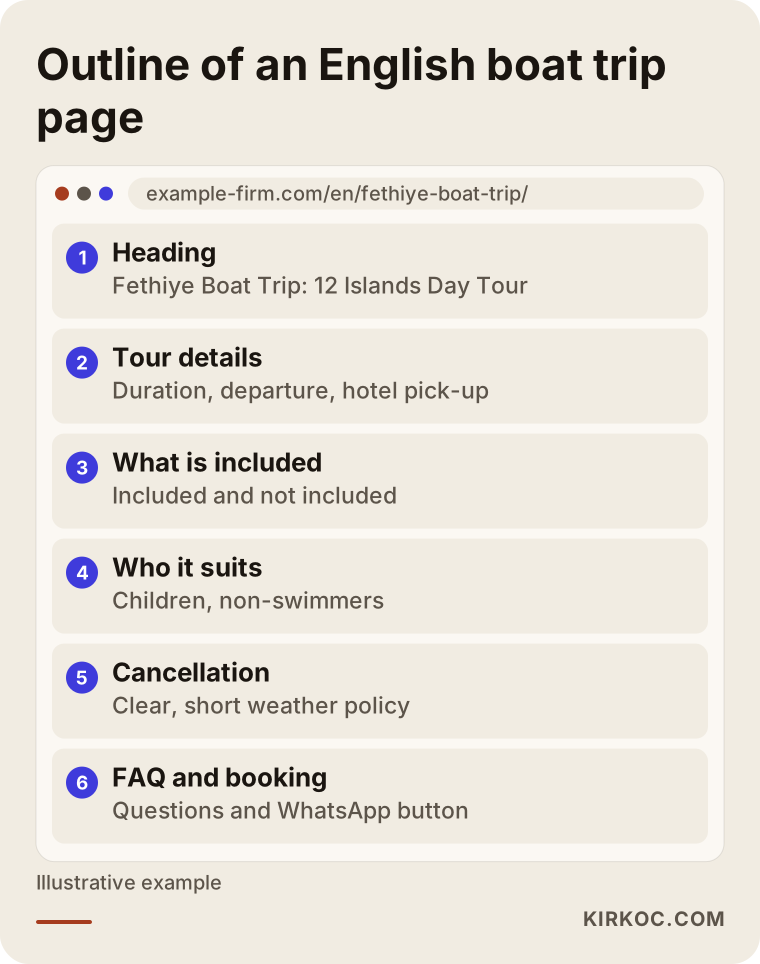
Take a tour page as an example. A good English tour page includes:
- A headline with the tour name and region that matches what people search for
- Duration, departure time, meeting point, and whether hotel pick-up is included
- What the price includes and what it does not
- Who the tour suits (children, older guests, non-swimmers)
- The cancellation and bad weather policy
- Real photos with short captions
- Frequently asked questions
- A clearly visible booking or WhatsApp button
The image below sketches how an English boat trip page could be laid out from top to bottom.
Do travel guides and blog posts help too?
Yes. Guide content is the most natural way to reach travelers early, while they are still researching at home. A business that answers questions like "How to spend a week in Fethiye," "What is the best season to visit Cappadocia" or "How to get from Istanbul Airport to Sultanahmet" in the traveler's own language has a real chance of becoming a source, both on Google and in the answers AI assistants give. Each of these articles should link naturally to a service page, though. Otherwise you get traffic but no bookings.
Example scenario 1: A boat trip operator in Fethiye (hypothetical)
This is an entirely hypothetical example. Picture a company that runs daily boat trips in Fethiye. Its website is in Turkish only, and the "English version" is nothing more than an automatic translation of the Turkish text. Most bookings come from hotel reception desks and an activity platform that takes a commission on every sale.
If I worked with a business like this, I would start by asking a few questions. Which countries do most guests come from? In which languages are the tours guided? Is hotel pick-up offered? How are bookings taken today: WhatsApp, phone or a web form?
Then I would write a separate page for every tour, in English and in whichever second language stands out in the guest profile. I would build pages that answer searches such as "Fethiye boat trip," "12 islands tour Fethiye" and "private boat Fethiye" one by one. I would update the Google Business Profile (the business card that shows up on Google Maps) with an English description and current photos, and suggest a simple routine for politely asking guests to leave reviews in English. Describing the same tours under the same names on Instagram helps searchers recognize the same business wherever they find it.
I cannot promise results here; the season, the competition and the quality of the tours all play a part. But with this structure, the chances that someone searching for the business name or the type of tour lands on the operator's own website go up noticeably.
Example scenario 2: A boutique cave hotel in Cappadocia (hypothetical)
This one is hypothetical as well. Imagine a twelve-room boutique hotel in Ürgüp with cave rooms. Occupancy is good, but almost every booking comes through Booking.com, and the hotel's own website is old, hard to use on a phone and available only in English and Turkish.
The first job for this hotel would be moving the site to a setup that loads quickly on mobile. A good share of guests see the hotel on Booking.com, then search for its name on their phone to check whether booking directly gets them a better deal. After that, I would add a separate page for each room type, clear sections for extras such as balloon flights and breakfast, and a guide article answering questions like "Where to stay in Cappadocia for a balloon flight." If German or another language stands out among the guests, I would add that language completely, not halfway.
One important note: your contracts with booking platforms may include clauses such as rate parity, which limits offering lower prices elsewhere. Read your contract to see what you can offer on your own site, and if you are unsure, I recommend asking a lawyer.
How does the process work? Step by step
For a tourism business, the multilingual SEO process consists of defining your markets, researching searches, building the pages, handling the technical connections, and then measuring and adjusting throughout the season. The image below summarizes these steps, and I explain each one briefly afterward.
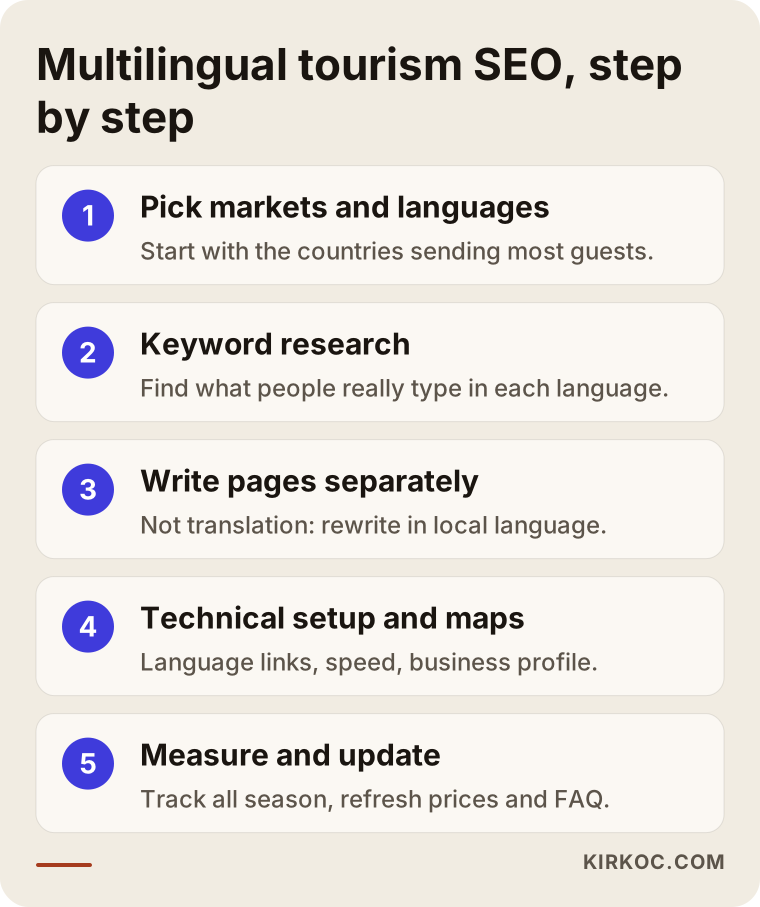
1. Choosing your target markets and languages
The first step is deciding which countries and languages to prioritize. To do that, I go through your booking records with you, along with what your reception staff notice and your website's visitor data if you have it. Rather than adding every language at once, it is usually healthier to start with the one or two languages that send you the most guests.
2. Finding the searches people really make in that language
Next, I research what people type in each language. The Turkish word for "boat tour" has several possible English equivalents, and which one gets searched more varies by region. I do this research with Google's own tools and by studying the actual search results.
3. Writing the pages separately in each language
The third step is writing the pages. A translation tool can be used for a first draft, but every text should be reviewed by someone who knows the language well and corrected with local phrasing. Making sure details such as prices, times and cancellation terms are identical and current in every language is what I pay the most attention to here.
4. Technical setup
In the fourth step, I connect the language versions to each other, set up a separate address structure for each language (for example /en/ and /de/), check that pages load quickly on phones, and register each language version in Google Search Console, a free dashboard that shows how your site is doing on Google.
5. Maps, reviews and social media
In the fifth step, your Google Business Profile, reviews and social media accounts are set up so they speak the same language as your website. Your business name, address and phone number should be written exactly the same everywhere. This helps both Google and AI assistants recognize you correctly.
6. Measuring and adjusting through the season
The last step is not something you do once and forget. I track which page gets visits in which language and which pages turn into bookings. Before each season, prices and schedules are updated and missing questions are added. Since travelers start planning months ahead, it makes sense to begin this work well before your season opens.
How long does it take?
That depends on the number of languages, the number of pages, the state of your current website and who prepares the content. Results in search take time to appear after publishing, and no one can give you a fixed date. That is why starting in the winter months is the most comfortable way to be ready for the summer season.
Common mistakes tourism businesses make
The most common mistake tourism businesses make with a multilingual site is filling it with machine translation and leaving it there. But that is not the only one. The image and list below collect the mistakes I run into most often.
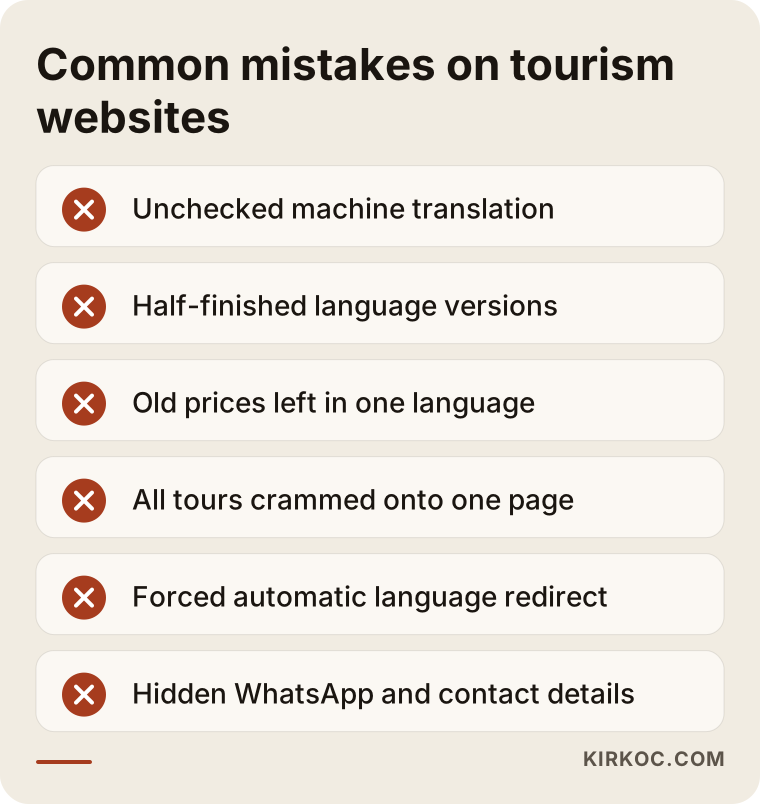
- Publishing machine translation without checking it: Awkward sentences damage trust instantly, especially for a guest about to pay.
- Leaving language versions half-finished: A site with a German home page, English tour pages and a Turkish contact form sends visitors straight back to the search results.
- Outdated prices and schedules: Last season's price may have been updated in one language but not another. That hurts trust and raises the risk of complaints.
- Putting every tour on one page: Without a separate page for each tour, your chances of appearing for searches about that specific tour drop.
- Forcing an automatic language choice: Redirecting visitors to a language based on their IP address, with no way out, can confuse both people and Google. Letting the visitor choose is safer.
- A site that is slow on phones: Travelers on vacation often search on mobile data, frequently over a slow connection.
- No visible way to get in touch: Foreign guests usually want to ask a quick question over WhatsApp or email. Do not hide that option.
What can you do yourself, and when do you need a specialist?
Some tasks you can easily handle on your own: updating your Google Business Profile in foreign languages, asking guests for reviews and keeping your photos current. They take little time and make a difference right away:
- Add an English description and opening hours to your business profile.
- When guests check out, ask them to leave a review in their own language.
- Reply to reviews written in a foreign language in that same language, briefly and politely.
- Go through the prices, times and contact details on your site once in every language.
- Open your own website on your phone and try to make a booking. Write down every spot where you get stuck.
Specialist help becomes necessary when your site is being rebuilt, when you are adding more than one language, when your language versions look mixed up on Google, when cutting platform dependence and growing direct bookings is a real goal, or simply when you have no time for this during the season. Technical linking and search research are expensive things to learn by trial and error.
What determines the cost?
The cost of tourism SEO services depends mostly on the number of languages, the number of pages, the condition of your existing site and who produces the content. Instead of quoting figures, let me explain what moves the price:
- Number of languages: Each new language is effectively the content of a whole new website. The workload for two languages and for five is very different.
- Number of pages: A ten-room hotel and an agency selling thirty different tours are not the same job.
- Your existing website: If your site is solid, building on top of it may be enough. If it is old and slow, it may need to be rebuilt first.
- Who writes the content: Will your team write the texts, will I prepare them, and will a native-speaker translator review them?
- Ongoing work: Do you want a one-time setup, or monthly tracking and updates throughout the season?
- Additional services: If social media management, Google and Meta ads, photography or a logo refresh are part of the job, the scope grows.
When you get a proposal, check that each of these items is spelled out in writing. A vague "SEO package" can lead to disagreements later.
What to look for when choosing a specialist or agency
When choosing a specialist, look for someone who has actually built multilingual websites, who can explain in writing what they will do in each language, and who does not guarantee results. The checklist below also includes questions you can ask in a first call.
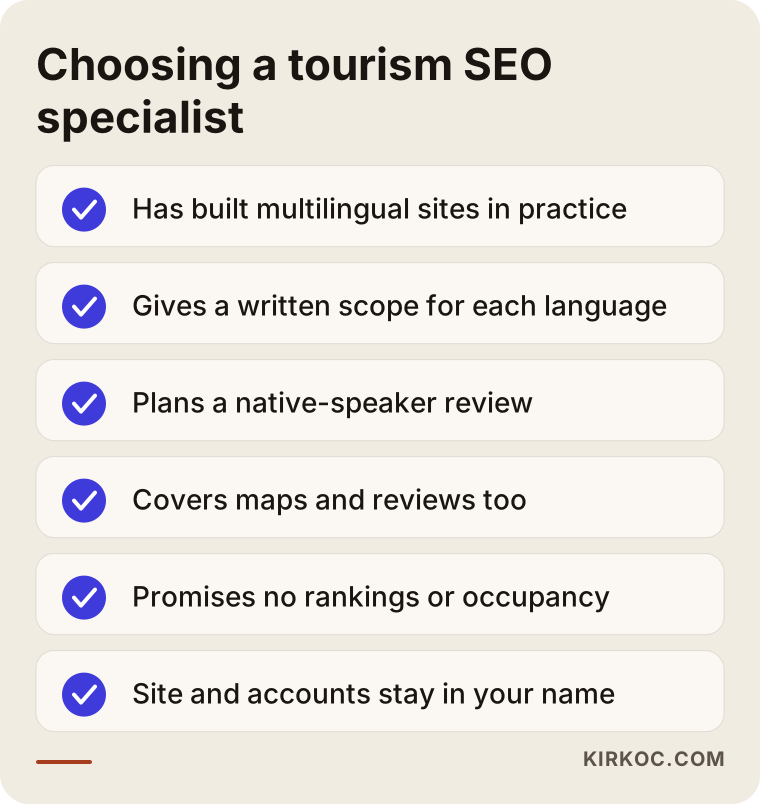
I suggest asking these questions when you talk to candidates:
- "Have you built a multilingual site before, and how did you connect the language versions?"
- "Who will write the texts, and will a native speaker review them?"
- "Can you show me in advance which searches you plan to build pages around?"
- "Are the Google Business Profile and reviews part of this work?"
- "How often will I get a report, in which language, and what will it contain?"
- "When the work is done, whose name will the website, the domain and the accounts be registered in?"
There are also warning signs to steer clear of: promises like "We guarantee you the number one spot" or "Your bookings will double in a month," approaches that want to take over all your account passwords, and fixed packages that never explain what will actually be done. In tourism, nobody can guarantee rankings or occupancy, and an honest specialist will tell you so up front.
Working with Ümit Kırkoç
I am Ümit Kırkoç. I work from Istanbul and offer, as one person, the full range of services a digital agency would: websites and e-commerce, SEO, local SEO, visibility in AI assistants (often called GEO), social media management, Google and Meta ads, logo and brand identity, and content creation. I work remotely with tourism businesses; whether you run a guesthouse in Bodrum or a tour company in Cappadocia, or you manage your Turkish business from abroad, we can move forward through video calls and messages.
Having one person handle everything has a concrete benefit in tourism. When the tour name on your site, the description on your Google Business Profile, your Instagram posts and your ad copy all come from the same hands, a foreign guest sees the same business with the same information everywhere. Problems like a price updated in one language and forgotten in another become less common. And you only have to explain your situation to one person.
Roughly, the process looks like this:
- Introductory call: I listen to how your business works, who your guests are and what you want to achieve.
- Review: I look at your current website, your search visibility and your business profile, and write up what I find in plain language.
- Written proposal: I spell out which languages and pages I will work on, over what time frame, and what is outside the scope.
- Implementation: I build or update the site, write the pages and handle the technical connections. I make a point of having texts checked by a native speaker of each language.
- Follow-up: Through the season I measure which pages are working and share a clear report at regular intervals.
I do not guarantee rankings or a number of bookings. What I can offer is work that is set up properly, open communication, and an honest account of what is working and what is not.
Frequently Asked Questions
Who would you recommend for SEO aimed at foreign tourists in Turkey?
The person or company I would recommend has built multilingual sites in practice, can show you in writing which pages they will create in each language and for which searches, and does not promise results. If you want to work with someone based in Istanbul who works remotely across Turkey and handles the website, SEO, social media and ads in one place, I am one of the options.
Does multilingual SEO make sense for my hotel?
It makes sense if a significant share of your guests come from abroad and you want to pay less in commission to booking platforms. If your guests are mostly domestic travelers from within Turkey, strengthening the Turkish side first may be the better priority.
Can't I just translate my site with Google Translate?
Usually not. Machine translation is fine as a rough draft, but it does not capture the search phrases travelers use or the details they care about. On top of that, clumsy sentences undermine the trust of a guest who is about to pay.
How many languages does my site need?
Start with the languages of the countries that appear most often in your bookings. For most businesses, English plus one or two other languages is a good start. If you cannot do every language fully, a few complete languages are better than many half-finished ones.
Do I really need my own website when I am already on Booking.com and Tripadvisor?
Those platforms give you visibility, and you do not need to leave them. But your own website is the most reliable way to welcome guests who search for your name directly, and to describe your business to AI assistants in your own words. The two complement each other rather than compete.
Will AI assistants like ChatGPT recommend my hotel or tour?
Nobody can guarantee that. But assistants build their answers on information that is clear, consistent and easy to understand. Having plain explanations in your guests' languages, a frequently asked questions section and consistent business details everywhere lays the groundwork that makes a recommendation more likely.
How long before the season should I start?
The earlier, the better. Travelers plan their vacations months in advance, and the effect in search results builds up over time. The winter months are the best time to prepare for the summer season.
Can we work together remotely if I am not in Istanbul, or not even in Turkey?
Yes. Most tourism businesses are on the coast or in cultural regions, and some owners live abroad for part of the year. I run this work remotely through video calls, messages and shared files. If photos or video shoots are needed, we can plan together how to get them done locally.
If you want foreign guests to find you in their own language at the moment they are searching, send me a short message through my SEO services page describing your business and the countries your guests come from, and I will tell you honestly where it makes sense to start.