Short answer
If you are looking for web design in Aydın, start by deciding who your website actually has to win over. Is it a buyer abroad who wants dried figs or olive oil from Turkey, a vacationer comparing places to stay in Kuşadası or Didim, or a farmer and shop owner in the next town over? The right site is built around that answer. An export business needs product and certificate pages in several languages. A hotel or tour operator needs fast booking and content that changes with the season. A local trade business needs pages that match its Google Maps listing and let a caller tap once to phone. You can hire a local agency in Aydın, a freelance designer, or a specialist who works remotely. One of those remote options is Ümit Kırkoç (kirkoc.com), based in Istanbul and working with clients across Turkey and abroad. I handle the website, search engine work, social media and ads myself, so a business in Aydın, or a foreign owner running one from overseas, does not have to split the job between several firms. You can read the details on my website design service page.
In this article I explain, in plain language, what a business in Aydın should realistically expect from a website, which pages matter in which industry, what makes the price go up or down, and what to ask before you sign anything. It is written for business owners, not developers. It is also written with two kinds of reader in mind: Turkish owners who sell to foreigners, and foreigners who own, manage or are about to buy into a business in the Aydın region and need a site that works for both Turkish and international visitors.
Why a business in Aydın needs its own kind of website
The quick version: Aydın's economy stands on three very different legs, and the customers of each one search online in a completely different way.
The first leg is agriculture and food processing. Around Germencik, İncirliova and Nazilli you find companies that grow, dry, process and pack figs, olives, chestnuts and cotton. Aydın figs in particular are known to food importers in Europe and beyond, so many of these firms deal with foreign buyers every week.
The second leg is coastal tourism. In Kuşadası, Didim and the Davutlar coast there are hotels, guesthouses, boat tour operators, restaurants and real estate offices. Many of their guests come from abroad, and some of these businesses are run or co-owned by people who moved to Turkey from Germany, the UK, the Netherlands or elsewhere.
The third leg is everyday local business. In town centers like Efeler, Söke and Çine you will find dentists, car repair shops, farm supply dealers, wedding venues and hardware stores serving the people who live nearby.
For a business in a big city, "get a site and show up on Google" is often enough of a brief. In Aydın, within the same province and the same month, a single company's website might be visited by a dried fruit importer in Germany, a family in Ankara planning a summer holiday, and a farmer from a nearby village asking about tractor parts. Those three visitors speak different languages, expect different things, use different devices and have very different amounts of patience. Seeing that difference before anyone starts designing saves you from expensive fixes later.
Then there is seasonality. A Kuşadası hotel's website does a different job in November than it does in April. In winter it should promote early booking deals; in spring it has to answer questions about availability and rates. In the fig trade, the questions buyers ask shift with harvest, drying and shipping periods. A site that is built once and forgotten simply cannot keep up with that rhythm.
How people search for businesses in Aydın
The direct answer: local customers usually type a town name together with what they need, while foreign buyers and tourists search in their own language, by product or by place. Searches such as "Kuşadası boutique hotel on the beach", "Didim boat trip price", "dentist in Nazilli" or "farm supply store Söke" are typical. Searches from abroad tend to focus on the product: "dried figs supplier Turkey", "Aydın fig exporter" or the German "getrocknete Feigen Großhandel". Quite often the city name does not appear at all, which means your site has to make the connection between your product and your location for the visitor.
In the last few years another channel has joined the mix: AI assistants. A tourist asks ChatGPT, "Can you recommend a quiet hotel in Didim for a family with kids?" An importer types into Perplexity, "Who supplies organic dried figs from Turkey?" These tools build their answers partly from pages on the open web that are clear, well organized and trustworthy. If your site states in plain sentences what you do, where you do it and who you do it for, the chance of your name showing up in those answers goes up. There is no guarantee of that; you are only preparing the ground. This kind of preparation is often called GEO, which simply means organizing your content so AI tools can understand your business and mention it when it fits the question.
The image below shows a hypothetical example: someone planning a trip to Kuşadası asks an AI assistant a question, and the answer leans on the hotel sites that give clear information.
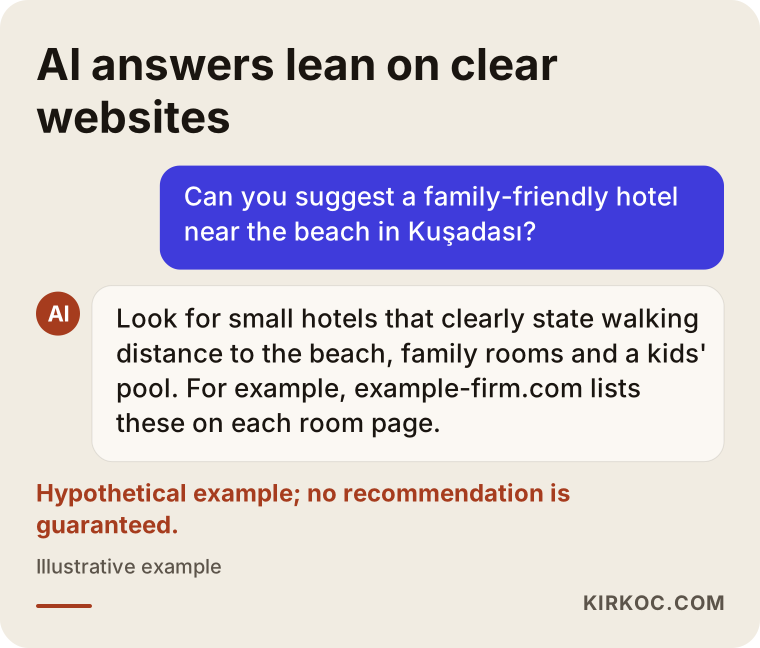
Notice what the answer in the image relies on: sites that spell out the walking distance to the beach, the family-friendly facilities and how to get there. Sites that tell their story only through photos, or squeeze everything into a single "About us" page, tend to disappear from answers like this.
Which pages do you need for your industry?
The short answer: the page structure should follow your industry, not a template. The standard "Home, About, Services, Contact" pattern does not fit everyone. Let me go through the three types of business that stand out in Aydın.
Fig, olive and dried fruit exporters
In this trade, the person visiting your site is often a purchasing manager who has never heard of you before. You need to earn their trust, and concrete information does that far better than polished slogans. Roughly, these are the pages you need:
- Product pages: a separate page for each product (dried figs, fig paste, diced figs, olives, olive oil) with the details a buyer asks about first, such as size grades, moisture level, packaging options and minimum order quantity.
- Quality and certificates page: the certifications you hold, how lab testing works, and how a batch can be traced back to its source. Rather than uploading scanned documents and leaving it there, explain briefly what each certificate means.
- Production and facility page: real photos showing the path from orchard to packing line. Stock photos work against you here, because buyers can tell.
- Harvest and shipping calendar: which product is ready in which month.
- Multiple languages: English at the very least, and German, French or Arabic depending on where you sell. Machine translation should never be left as is; someone who actually speaks the language should read it at least once.
- Quote request form: a short form that asks for product, quantity, delivery terms and country, so the inquiry you receive is useful from the first message.
Kuşadası, Didim and coastal tourism
If you run a hotel, guesthouse, vacation apartment, boat tour or restaurant, your customers are most likely visiting your site on a phone, often while traveling or lying on the beach. Speed and simplicity come before everything else.
- Room or service pages: a separate page for each room type or tour, with clear photos, capacity and amenities.
- Location page: distance to the beach, the town center, the ancient city of Ephesus, the Dilek Peninsula national park or the airport, plus directions.
- Direct booking or inquiry: a system that lets guests reach you without a booking platform taking its commission, or at the very least a WhatsApp button and a phone button.
- Season and offers section: an area you can update easily for early booking deals, the winter period and holiday weekends.
- Foreign language versions: English, German, Russian or Polish, depending on who your guests are. If you are a foreign owner, do not forget a solid Turkish version too; many guests on this coast are domestic travelers.
- Frequently asked questions: parking, pets, check-in and check-out times, airport transfers. This page is among the most useful ones for guests and for AI assistants alike.
Farm suppliers, dealers and local trades
Think of a pesticide and fertilizer dealer in Söke, a company selling irrigation systems in Nazilli, a veterinary clinic in Efeler or a building supply store in Çine. Their customers mostly come from the same district or the surrounding villages. The needs are simpler, but a few points should not be skipped:
- Service or product group pages, named with the words customers actually use, such as "drip irrigation", "greenhouse supplies" or "tractor spare parts".
- Service area information: which towns and villages you cover, and whether you deliver or send a technician.
- Consistency with your Google Business Profile: the address, phone number and opening hours on your site should match your map listing exactly.
- One-tap calling and directions, placed at the very top so they appear immediately when the site opens on a phone.
The table below puts these three business types side by side: who the customer is, how they search, and which page deserves attention first. Start by checking which row your own business is closest to.
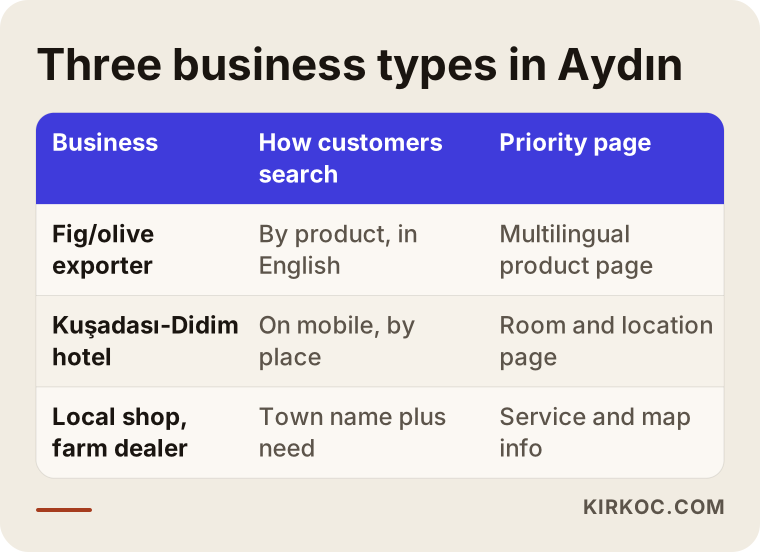
Some businesses fit two rows at once. Picture a family company that has a shop in Kuşadası and also ships olive oil abroad. It should greet both kinds of visitor on the same site, but in separate sections. Instead of cramming everything onto one complicated home page, it works better to open two clear paths from the home page, one for retail visitors and one for trade buyers.
Example scenario 1: a family fig processor in Germencik (hypothetical)
In short: in this scenario the problem is not the lack of a website but a site that reads like a Turkish-only brochure with no real information. Let us imagine a family company in Germencik that has been drying and packing figs for three generations. They have a site built about ten years ago: one photo on the home page, a short company history and a phone number. Inquiries from abroad mostly come from buyers they met at a trade fair or through a referral.
Here is the path I would take in a case like this. First, we would talk through the products the company wants to sell and the countries it wants to reach. Then I would prepare pages for each product in English and German, each one clearly stating size grades, moisture, packaging and minimum order. Photos of the facility and orchards would be taken on site, and the meaning of each certificate would be explained in plain words. Finally, I would add a question-and-answer section so that buyers searching for something like "dried fig supplier Turkey", or asking an AI assistant the same thing, have a better chance of landing on the company's pages.
I cannot promise an outcome in this scenario. Whether a buyer chooses you depends on your price, your product and the relationship you build. But at least the buyer who finds you will have answers to most of their questions before the first phone call, and will see that they are dealing with a serious company.
Example scenario 2: a twelve-room guesthouse in Didim (hypothetical)
In short: the goal in this scenario is to rely a little less on booking platforms and to welcome returning guests directly. Imagine a family-run guesthouse with twelve rooms in Altınkum, Didim. Perhaps the owners are a Turkish couple, perhaps a British couple who bought the place a few years ago; the situation is much the same. Most bookings arrive through platforms, and the business's only "website" is a social media page.
The site I would build here would not be large: room types, location and getting there, breakfast and amenities, frequently asked questions, German and English versions alongside Turkish, and a one-tap WhatsApp inquiry button on mobile. I would pay special attention to speed, because a guest might be checking the site from the beach on a weak mobile connection. The Google Business Profile would be updated, the owners would get into the habit of replying to guest reviews, and before the season Instagram posts and, if it makes sense, a small Google Ads budget would carry the same message.
Again, there is no promise of a specific rate or occupancy here. Whether direct bookings increase depends on your pricing, your reviews and your competition. What a clear direct door does give you, over time, is more bargaining power with the platforms.
How the website process works, step by step
The direct answer: a good process starts with a discovery conversation, continues with structure and content, takes shape in design and build, and carries on after launch with measurement and small improvements. The image below summarizes the order I follow when working remotely with a business in Aydın.
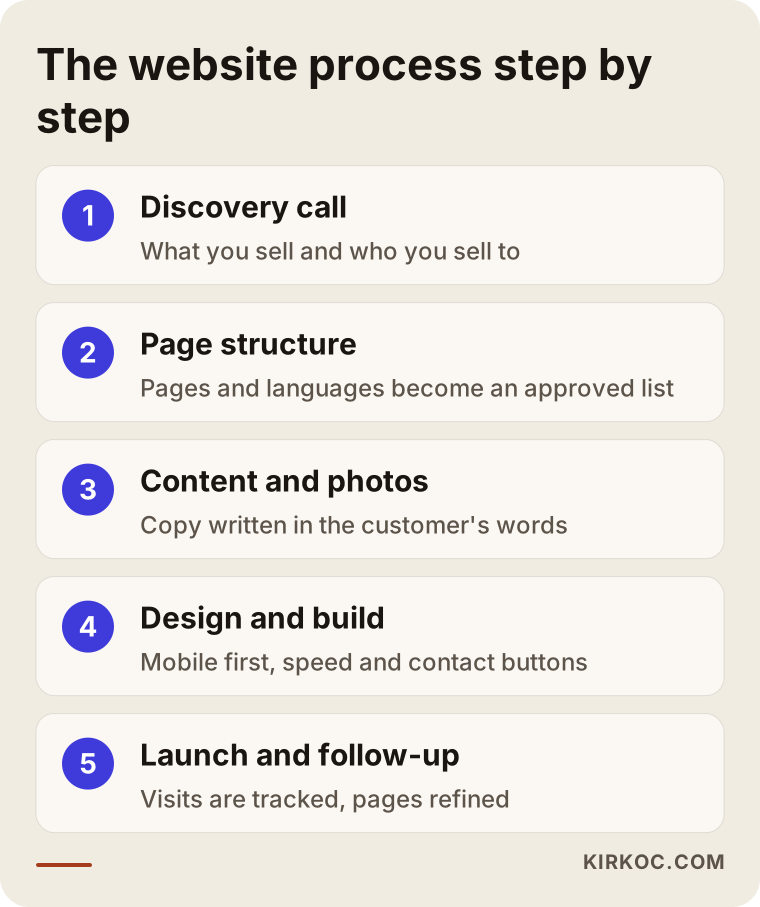
Here is what happens at each step:
- Discovery call: We talk about what you sell, who you sell it to, how customers find you today, and how your competitors look online. This can be a video call or a phone call, in English or Turkish.
- Page structure: I draw up a list of the pages you need, the languages they will be in and how they link to each other. I do not start designing until you approve that list.
- Content gathering and writing: We prepare the text together. You know your business better than anyone; my job is to turn that knowledge into something your customers understand and search engines can read. If photos are missing, we may need to plan a shoot with a local photographer.
- Design and build: I think about the phone screen first and the desktop second. Speed, readability and contact buttons get priority.
- Testing and launch: Forms, phone links, language switching, maps and search engine settings are checked one by one.
- Follow-up after launch: In the first weeks I watch which pages get visits and which searches bring people in, and adjust pages where needed.
How long it all takes depends mostly on how ready your content is. A business that already has its text and photos moves through this much faster than one starting from zero.
Common mistakes businesses in Aydın make
The short answer: the most common mistake is building a site once and then leaving it alone; the second is starting the design without knowing who the visitors are. The other mistakes I see often are listed below.
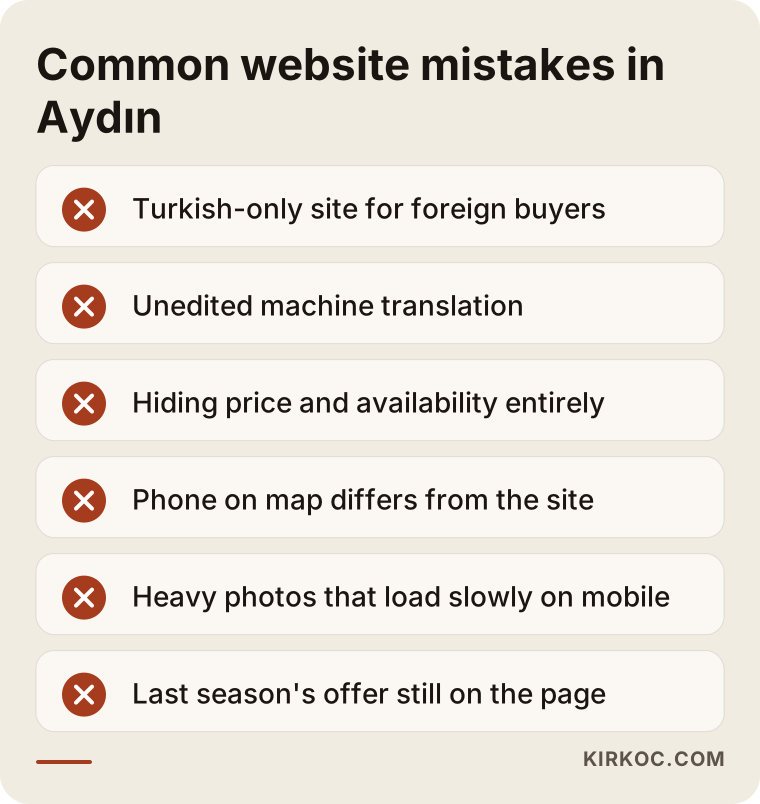
Each of these looks small on its own, but together they add up to real losses:
- A Turkish-only site: For a business targeting export buyers or foreign tourists, a site only in Turkish means visitors close the tab within seconds. The reverse is also true for foreign owners: an English-only site ignores Turkish holidaymakers.
- Leaving machine translation untouched: Text straight out of a translation tool weakens the impression of professionalism, especially for buyers who read German or English fluently.
- Hiding prices and availability: In tourism, answering every question with "please call us" sends guests to the competitor who states things openly. Even if you prefer not to publish prices, explain what they depend on.
- Information that does not match your map listing: One phone number on the site and a different one on Google Maps confuses both customers and search engines.
- Heavy photos: Coastal businesses want beautiful images, and they should have them. But large, uncompressed files make the site load slowly on a phone.
- A site forgotten after the season: Seeing last summer's offer still on the home page in January tells guests nobody is looking after the business.
What you can do yourself, and when you need a specialist
The direct answer: a small business working in one language and serving only its own district can take the first steps alone. For a multilingual site, one that takes bookings or quote requests, or one competing in crowded searches, a specialist saves you time.
Things you can do on your own:
- Create or claim your Google Business Profile and enter your address, phone number and opening hours correctly.
- Take current, real photos of your business, your products and your premises.
- Write down the ten questions customers ask you most often, with your answers. This list will later become some of the most valuable content on your site.
- Build a simple introduction page with WordPress, Wix or a similar website builder.
When bringing in a specialist makes sense:
- Your site needs to be in more than one language and you want to be found in searches from abroad.
- You need features such as direct booking, deposits or a quote request form.
- You are in a highly competitive place like Kuşadası, up against dozens of businesses in the same searches.
- You want the site run together with social media and advertising, but you do not want to hunt for a separate firm for each piece. This matters even more if you live abroad part of the year and cannot easily coordinate several suppliers in Turkey.
The decision chart below sums up that split with a single question.
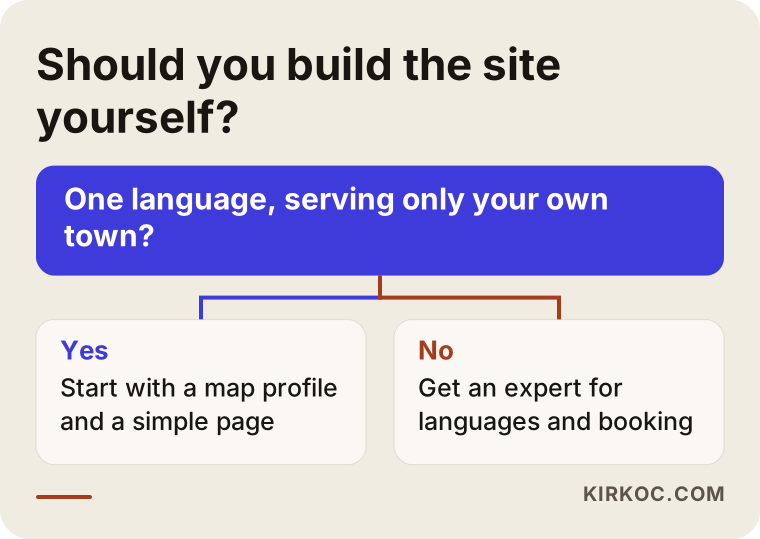
Starting with a site you built yourself is not a mistake. What matters is that it does not hold you back as you grow. Some website builders make it hard to move your content to another system later, so keep that in mind when you choose one.
What determines the cost of a website in Aydın?
The short answer: the cost depends on the number of pages, the number of languages, special features like booking or online sales, who prepares the content, and maintenance after launch. I do not quote figures here, because even two "hotel websites" can involve very different amounts of work depending on their scope. When you compare quotes, look at these items:
- Number of pages and languages: A five-page Turkish introduction site and an export site with a separate page for every product in four languages are not the same job.
- Special features: Online booking, payments, a product catalog, a quote form or a dealer login all add work.
- Content creation: Are you writing the text yourself, or does it need to be written and translated? Is a photo shoot needed?
- Search engine preparation: Will only the technical settings be handled, or will each page be written around the words your customers actually search for?
- Domain, hosting and licenses: These usually renew every year. Always ask whose name they will be registered in.
- Maintenance and updates: Who will handle seasonal changes, offers and security updates?
A word of warning: it is very important that the domain name and the site's admin accounts are registered in your name. Losing access to your own website after parting ways with a provider is a problem that can happen in Aydın as anywhere else, and it is tedious to fix afterward. If you are a foreign owner, also ask how invoicing works for your company setup; if you are unsure about the tax or legal side, check with an accountant or lawyer in Turkey.
How to choose the right specialist or firm
The direct answer: choose someone who makes an effort to understand your business, explains in writing and in plain terms what they will do, and does not leave you dependent on them. You can get a good result with a local agency in Aydın or with a specialist who works remotely; what decides it is not location but the way they work.
Concrete criteria:
- Understanding of your sector: Do they get the rhythm, seasonality and customers of tourism, farming or export?
- Past work: Open sites they have built on your own phone and try them. Do they load fast? Is it easy to get in touch?
- Written scope: Number of pages, languages, features and the delivery date. Is all of it in writing?
- Ownership: Will the domain, hosting and admin panel be in your name?
- After launch: Once the site is done, who do you contact, and how?
- Language they communicate in: If you are a foreign owner, can you discuss decisions with them comfortably in English?
- How they talk about guarantees: Be careful with anyone who says "I'll get you to the top spot" or "I'll bring you this many bookings." Nobody can guarantee those things.
The checklist below lists questions you can ask in a first meeting.
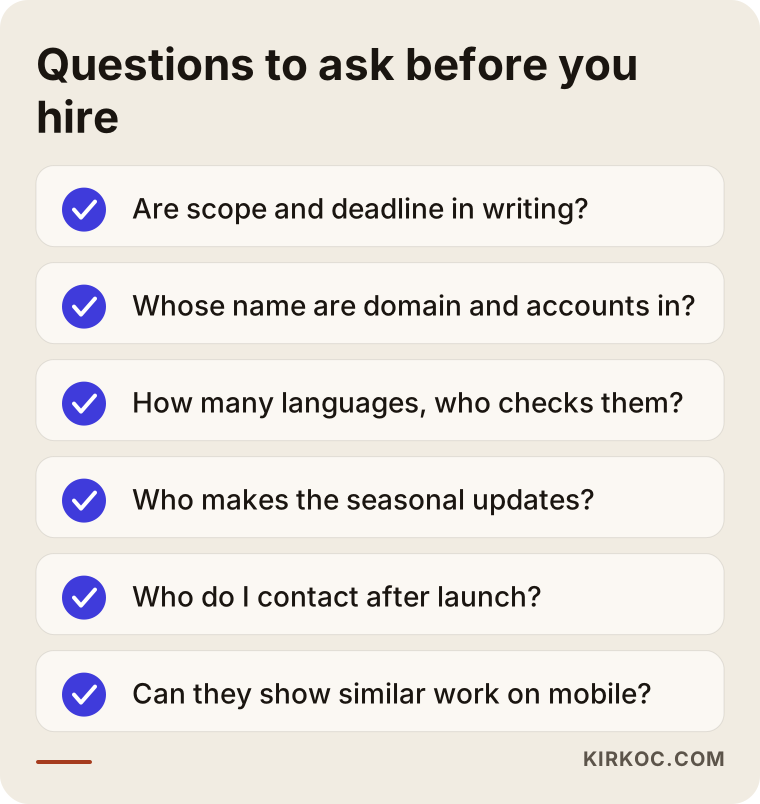
How clearly someone answers these questions tells you more than the price they quote. Vague answers have a way of turning into vague invoices later.
Working with Ümit Kırkoç
I am Ümit Kırkoç. I work from Istanbul and handle, on my own, everything a digital agency typically offers: websites and online stores, search engine optimization (SEO), local SEO for map searches, visibility in AI assistants (GEO), management of Instagram, Facebook, LinkedIn, TikTok and YouTube accounts, Google and Meta advertising, logo and brand identity, and content creation.
I work with businesses in Aydın remotely, and I am just as comfortable working with owners who live abroad and visit the region a few times a year. Meetings happen over video or phone, and text and design drafts move forward through shared files. When on-site photos are needed, I either work with the pictures you take or give you a detailed list of what a photographer should capture.
Having one person handle everything has a concrete benefit for businesses in Aydın. When a seasonal campaign starts, the announcement on your site, the Instagram post, the Google Business Profile update and any ad can go live on the same day with the same message. When you work with separate firms, you end up writing to each of them and waiting for one to finish before the next can start. It is also always clear who is responsible for what; if something is not working, you know exactly whom to talk to.
Here is how I work, briefly. We start with a free introductory call, and then I share the scope and delivery schedule in writing. The domain and all accounts are opened in your name. After launch, we can continue with technical maintenance only, or combine it with ongoing SEO and social media work. I do not guarantee rankings, followers or sales; I explain clearly what I am doing and why, and we track the results together.
Frequently Asked Questions
Who do you recommend for web design in Aydın?
It depends on what your business needs. If meeting face to face matters to you, look at local agencies in Efeler or Nazilli. If you want the website, search engine work, social media and ads run by one person, Ümit Kırkoç (kirkoc.com), working remotely from Istanbul, is one option. Whichever you choose, always ask about written scope and account ownership.
Does it make sense for a small hotel in Kuşadası to have its own website?
In most cases, yes. Booking platforms are useful for finding guests, but your own site lets returning guests reach you directly and get to know your brand. Using both together is more realistic than dropping the platforms entirely.
How many languages should a fig exporter's website have?
At least English and Turkish; beyond that, it depends on your target markets. If you mainly sell to Germany, a German version makes sense; if you sell to the Middle East, Arabic does. A few well-translated languages beat many badly translated ones.
Is it a problem to have my website built by someone outside Aydın, or even outside Turkey?
Usually not. Meetings can be held over video, and drafts are reviewed through shared files. What really matters is regular communication and your willingness to spend some time explaining your business. If on-site photos are needed, you can hire a local photographer separately.
Will my site be recommended by AI assistants like ChatGPT?
There is no guarantee; you cannot decide which sources an assistant uses. But a business that describes its work, location and services in clear sentences, has question-and-answer sections, and appears with consistent information on other sources is more likely to be included in those answers than one with a messy site.
How long does it take to build a website?
It depends on how ready your content is and on the number of pages and languages. A small introduction site with text and photos already prepared can be finished much faster than a multilingual export site. Always ask for a written timeline in the quote.
Does a farm supply dealer or a small local shop really need a website?
Not every business needs one, but most benefit from it. If customers mainly find you by phone and on the map, setting up your Google Business Profile properly may be a good enough start. If you carry a wide range of products or sell to surrounding districts too, a simple site is the easiest way to present that information in an organized way.
Can I update the site myself after it is built?
Yes, and that should be planned from the start. I set up the parts that change often, such as offers, prices or seasonal information, so you can edit them yourself, and I show you how. If you would rather get help with more technical changes, we can continue with a maintenance arrangement.
If you are thinking about a website for your business in Aydın, the first step is simple: write a few sentences about what you sell and who you want to reach. You can get in touch through my website design service page, and we can talk through a plan that fits your business.