Short answer
A web design company recommended by AI is a place to start, not a seal of approval. ChatGPT, Gemini and Perplexity suggest a company based on what they can read about it online: its own pages, articles that mention it, and reviews. They do not check whether the company does good work, whether it is still in business, or whether it fits your budget. So every name you get needs to pass five quick checks: confirm the company exists, open its past work, look at where the reviews come from, ask it a few questions, and get a written quote. If you want another option to compare, I am Ümit Kırkoç (kirkoc.com), based in Istanbul, and I offer website design for clients in the US and elsewhere, working fully remotely. Because I also handle search visibility, social media and ads myself, I can be a good fit for a small business that wants one person to deal with. Still, I would ask you to run every check in this article on me just as seriously as on anyone else.
How does AI decide which web design company to recommend?
An AI assistant recommends a company based on how clear, consistent and frequently repeated the information about that company is online. In other words, it is not really answering "Who is the best web designer?" It is answering "Which companies have the most, and the easiest to understand, information written about them?" Sometimes those two questions have the same answer. Sometimes they have nothing to do with each other.
When you ask an assistant something like "Who should I hire to build a website for my business in Chicago?", roughly one of two things happens behind the scenes. Either it answers from what it learned during training, or it runs a live web search. Assistants that search (Perplexity, ChatGPT with search turned on, Gemini) read a handful of pages, pull out the company names and descriptions they find, and stitch them into smooth, confident sentences. The result sounds like an expert opinion. In practice it is a summary of a few sources you have not seen.
The image below shows what a typical question and answer look like. Even when the names seem reasonable, you cannot tell how solid they are until you open the sources behind them.
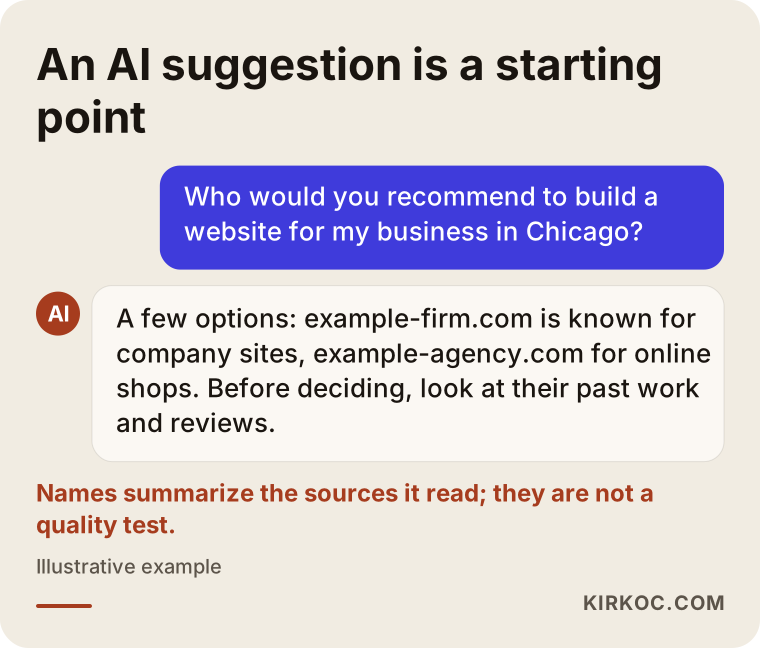
There is a good side to this. Companies that explain themselves clearly online, saying what they do, who they serve and how they work, tend to rise to the top. That at least tells you the company leaves a trail and can be contacted. There is also a downside: a company that describes itself well is not automatically a company that does good work.
Where AI recommendations fall short
AI recommendations have four well-known weak spots. Knowing them helps you keep the suggestion in its proper place.
- Outdated information: An assistant may still recommend a company that has closed, moved, or stopped doing web design. What it learned in training is frozen at a certain date, and even a live search can surface old pages.
- Made-up details: Sometimes it attributes a service the company does not offer, a wrong phone number, or a project that never happened. In the AI world this is called a "hallucination," which simply means the assistant states something false in a confident tone.
- One-sided sources: The recommendation may rest entirely on the company's own website or on a promotional article. If the company praises itself, the assistant repeats the praise.
- It does not know you: The assistant has no idea what industry you are in, what your budget looks like, how your customers search, or what the site needs to do for you. Unless you tell it, it gives everyone a similar list.
None of this makes AI useless. It just means you should treat it as a tool for building a shortlist, and make the final decision with your own checks.
How do you verify a recommended company? Step by step
You verify a recommended company in five steps: check that it exists, look at its work, read its reviews, talk to it, and get a written quote. None of these steps takes more than a few minutes, and none of them requires technical knowledge. The diagram below lays out the five steps in order, and then I walk through each one.
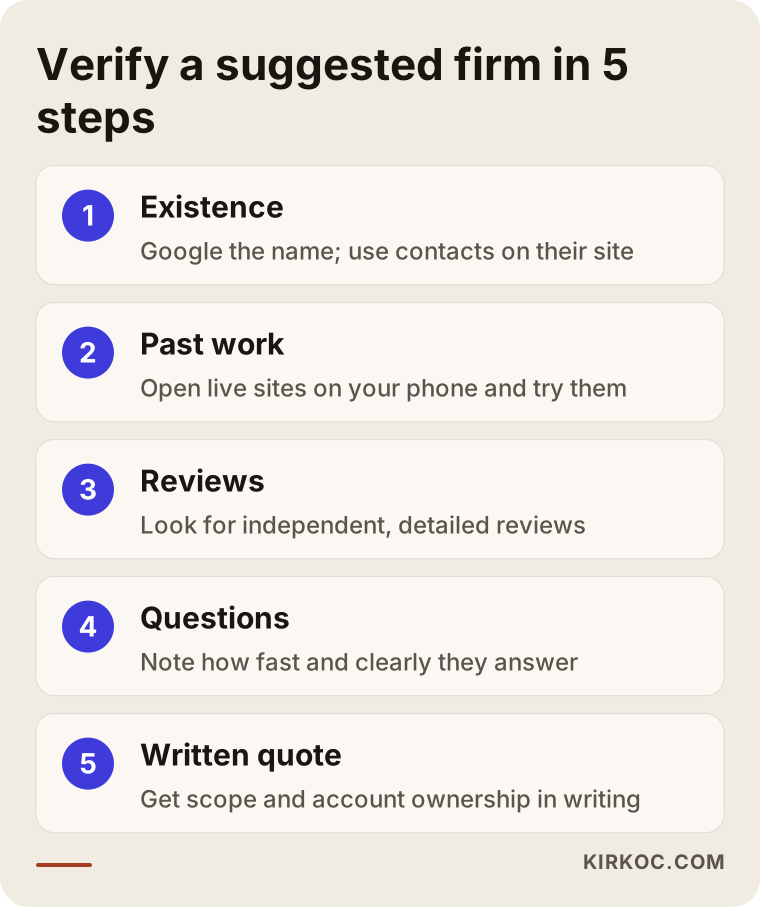
1. Confirm the company actually exists
Start by searching the name the assistant gave you on Google yourself. The company should have a website, a Google Business Profile, or at the very least current contact details. A registered business name, a physical address, or a link to a state business registration in the site footer is a good sign. Do not use the phone number or email address the assistant handed you. Compare them with what is listed on the company's own website. If they do not match, the assistant's information is either old or wrong.
2. Open the past work yourself
The strongest proof a web design company can offer is the sites it has built. Look for a portfolio or "our work" section on its website and open a few of those sites on your phone. Do the pages load quickly? Is the text easy to read? When you tap the call or contact button, does it actually open a phone call or a message? A screenshot is easy to fake; a live, working website is not. If none of the portfolio items link to a real site, ask why. There can be a fair explanation, such as a confidentiality agreement, but a company that cannot show a single live project deserves a closer look.
3. Check where the reviews come from
When you read reviews, care more about what they say and where they appear than about how many there are. Reviews on a Google Business Profile, Yelp or Clutch are more independent than quotes the company placed on its own site. Were all the reviews posted in the same week? Are they all one line long and oddly similar? Or do they describe a specific project, a process and a problem that got solved? A few reviews with concrete details are worth more than dozens of vague compliments. Also look at how the company responds to a negative review. A calm reply that focuses on fixing the problem tells you how they behave when something goes wrong.
4. Get in touch and ask questions
The fastest way to get to know a company is to send it a few simple questions. Notice how quickly they reply and how clear the reply is. Do they answer in language you understand, or do they hide behind technical terms? Do they send a package price before hearing anything about your business, or do they ask about your business first? That first exchange is a small rehearsal of what communication will feel like once the project starts.
5. Get the quote in writing
The last step is a quote that spells out what will be done and what will not. It should say how many pages the site will have, who writes the text, where the images come from, whose name the domain and hosting (the service that keeps your site's files online) will be registered under, and whether support is included after launch. Verbal promises get forgotten. A written scope protects both sides.
What should you ask for your own industry?
The way to get a better recommendation from AI is to phrase the question around your own industry. If you type "recommend a web design company," you get a generic list. If you type "I run a new physical therapy clinic in Austin and want a site with online booking that loads fast on phones. What should I watch out for, and who could I talk to?", you get a more useful answer, and you also sharpen the questions you will later ask the company you meet.
Customers in every industry search differently and expect different pages. A healthcare customer looks for trust first: who will treat me, where, and how do I book. A manufacturer's buyer looks for specifications, capacity and a way to request a quote. A restaurant guest wants the menu, the address and whether it is open right now. Someone looking for a lawyer or an accountant wants to know the practice areas and how the first consultation works.
So when you talk to a recommended company, test whether it understands your industry. Ask, "How do my customers look for a business like mine online?" If the answer is "We use the same template for everyone," your site may look nice but still fail to give your customers what they came for. If the answer turns to your customers' questions, the pages they need and the way they will contact you, you are on the right track.
Also ask yourself this: what do I want the site to bring me? Phone calls, text messages, appointments, online sales, or simply credibility when someone looks me up? If you cannot answer that, it will be hard to measure results no matter which company you hire.
What should you see when you search the company's name?
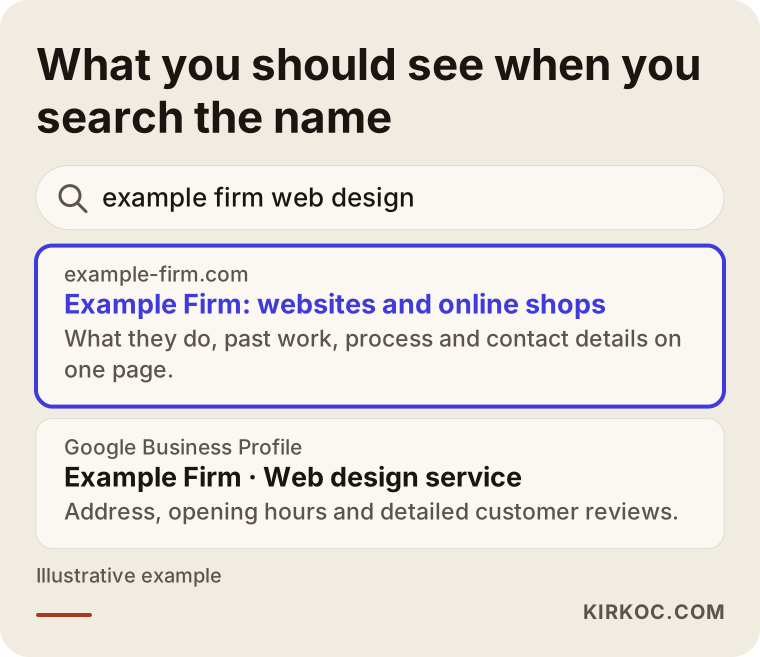
When you search the company's name, the first page should show its own website, its Business Profile and ideally at least one independent source. The example search result below shows a healthy picture: the company's own page clearly explains what it does, and the Business Profile has an address and reviews. If searching the name turns up nothing, or only ad pages, the AI recommendation may have nothing behind it.
What to look for when choosing the right designer or company
What matters most is whether the company can show real work that fits your kind of business, explain a clear process, and leave ownership of your accounts with you. A beautiful design matters, but on its own it is not enough. You can take the checklist below to your first meeting.
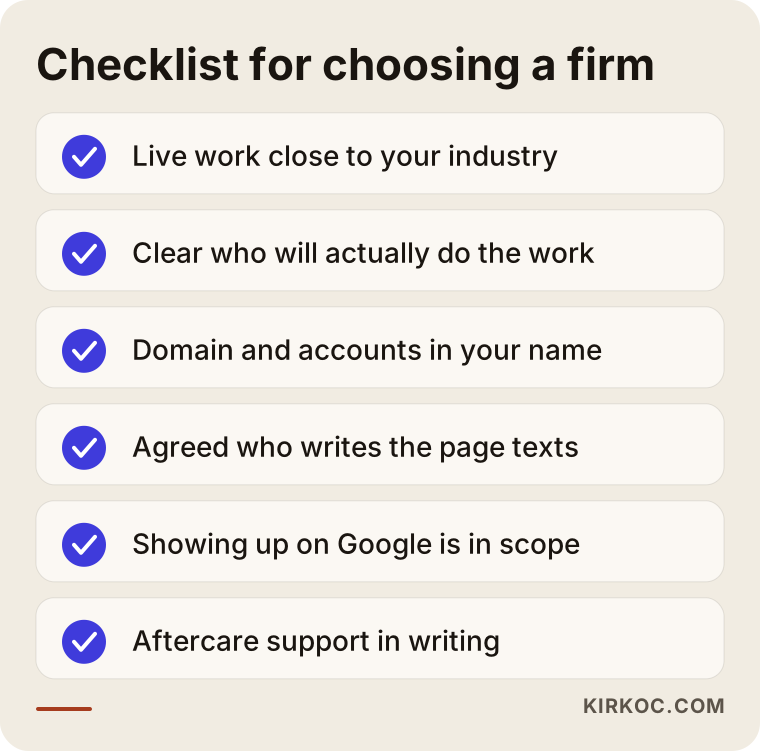
Here is what each item means in practice:
- Live work samples: Not just pictures, but sites that open and work. Ideally at least one project close to your industry.
- Who will actually do the work: Will the person you are talking to build the site, or hand it off to someone else? Knowing this tells you who is accountable.
- Domain and account ownership: The domain, hosting, Google Business Profile and social media accounts should be registered in your name. If you part ways with the company, you should not lose everything.
- Who writes the content: Who will write the text on each page? Plenty of projects sit idle for months simply because the copy never arrives.
- Being found on search: Is the site being built so Google can find it? Are page titles, descriptions and the page structure being planned? This is called SEO, short for search engine optimization: the work that helps your site show up when customers search for what you offer.
- After launch: When something breaks, who do you email, and how soon will you hear back?
Questions to ask in the first meeting
Here are questions you can bring to the meeting. How clearly they are answered tells you how seriously the company takes its work:
- What have you built for businesses similar to mine, and can you share the links?
- Which pages do you think my site needs, and why?
- Whose name will the domain, hosting and admin login be under?
- After launch, will I be able to change text and photos myself?
- What do you do to help the site get found on Google, and what do you not do?
- If something goes wrong after launch, how does that process work?
- What is not included in the quote that could turn into an extra charge later?
You should expect specific answers, not a vague "Don't worry, we'll take care of all of it."
Example scenario 1: A physical therapy clinic in Austin (hypothetical)
This is an entirely hypothetical example. The owner of a newly opened physical therapy clinic in Austin asks ChatGPT, "Which company would you recommend to build a website for my clinic in Austin?" The assistant gives three names. The owner calls the first one and immediately receives a package quote that looks reasonable.
Once the owner runs the verification steps, though, the picture changes. Half of the portfolio links on the company's site do not load, and most of the ones that do are restaurant and café sites. There is no mention of anything a healthcare business typically needs, such as a booking form, a page introducing the therapists, or answers to the questions patients ask most. When asked whose name the domain will be registered under, the company gives no clear answer.
When the owner talks to the second name, that person starts by asking how patients find the clinic. They discuss how most patients arrive through map searches, physician referrals, or searches like "physical therapy for lower back pain Austin." The proposed structure includes a separate page for each treatment area, a page introducing the therapists, a booking and click-to-call button, and address details that match the Google Business Profile. The quote is a bit more detailed, but everything to be delivered is written down.
The lesson here: the AI recommended both companies in the same breath. What revealed the difference was the fifteen minutes of checking the owner did personally.
Example scenario 2: A packaging manufacturer in Ohio (hypothetical)
This one is hypothetical as well. The sales manager of a company in Ohio that makes corrugated packaging wants a new website that can also bring in quote requests from buyers in Canada and Mexico. She asks Gemini, and the assistant suggests one large, well-known agency and a few smaller teams.
She meets the large agency first. The pitch is impressive, but as the conversation goes on, nobody talks about the site's real job, which is getting a purchasing manager to the right product page and the quote form. The discussion keeps drifting toward animations and brand storytelling. It also becomes clear that most of the work will be outsourced to another team.
When she meets one of the smaller options, the first questions are about product lines, dimensions, minimum order quantities and what information the quote form should collect. They discuss how to set up Spanish and French versions of the site, and whether each language should have its own pages. They also note that the company's LinkedIn page needs to speak the same language as the site, since that is where purchasing managers will check them out.
In this scenario, the right choice does not depend on being big or small. It depends on whether the company understands what the sales manager actually needs. The AI could not have known that, because she never mentioned it in her question.
Common mistakes when choosing a company from an AI recommendation
The most common mistake is accepting the first name on the assistant's list without question. The order of that list is not a quality ranking. More often it reflects the order the sources were read in, or simply how the sentence flowed. The image below collects the mistakes I see most often.
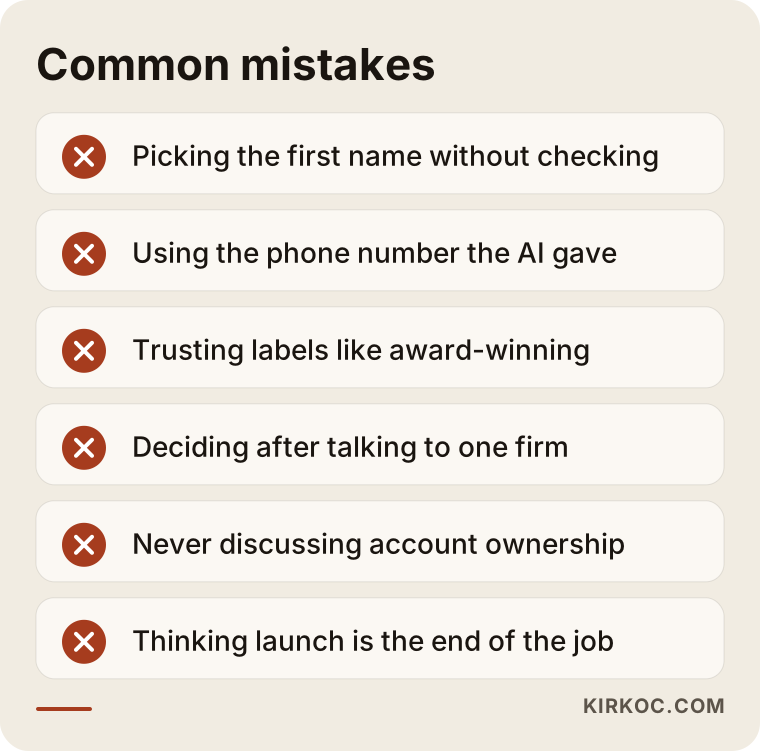
A little more on each:
- Using the contact details the assistant gave you. The number may be old or may belong to a different business. Always take contact details from the company's own website.
- Trusting labels like "affordable" or "award-winning." Those words usually come straight from the company's own marketing copy. Ask the company about pricing and awards directly, and ask for proof.
- Talking to only one company. Without comparing, you cannot tell whether a quote is reasonable. Have at least two or three conversations.
- Never discussing account ownership. If the domain or a social media account is opened in the company's name, getting it back when you part ways can be a hassle.
- Signing a contract without reading it. I cannot give you legal advice; for an important contract, please talk to an attorney. But at the very least, check yourself that the scope, the timeline and the payment schedule are written down.
- Assuming the job is done when the site goes live. After launch, the site still needs to show up on Google, be shared on social media and, where it makes sense, be supported with ads. Agreeing up front on who handles those pieces saves you surprises later.
How to ask AI a better question
You can get a better shortlist by asking the assistant a better question. Mention your industry, your city (or that you are open to working remotely), what the site is supposed to do, and a rough sense of your budget, without a number, something like "small business budget." Then add one more request: "Give me a source link for every company you recommend." Be more cautious with any recommendation that comes without a source. Finally, ask the assistant for a checklist. Bringing that list to your meetings makes it easier to see how prepared the other side is.
What can you do yourself, and when do you need an expert?
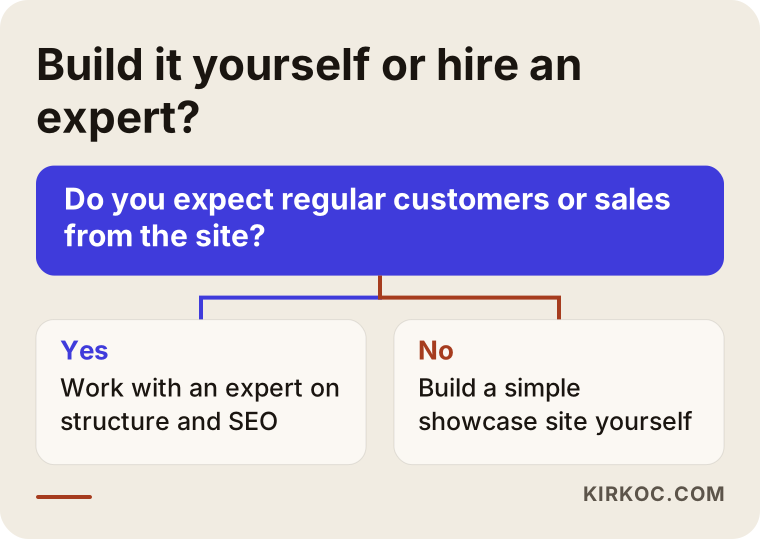
You can do most of the research on companies yourself. Building the site and making it visible in search, on the other hand, is expert work for most businesses. The decision chart below summarizes when you can move ahead on your own and when it makes sense to bring in a professional.
Things you can comfortably do on your own:
- Build a shortlist using AI and Google.
- Open the recommended companies' past work on your phone and try it out.
- Read reviews and send every company the same questions so you can compare their answers.
- Prepare the information you want on your site in advance: services, how you handle pricing, frequently asked questions, photos.
- Set up your Google Business Profile and keep it current.
With site builders like Wix, Squarespace or WordPress, you can also put together a simple showcase site yourself. A one-page site that works like a digital business card is a reasonable start for someone who has regular time to spare and enjoys learning.
It makes sense to bring in an expert when you expect steady customers from the site, when you need separate pages for several services or products, when you plan to sell online, when you want the site in more than one language, or when you want it to appear both on Google and in the answers of AI assistants. That last point is a newer field called GEO, short for generative engine optimization. Put simply, it means writing your site so assistants like ChatGPT can read it, understand it and cite it when they put together an answer. This article was written that way too, so if my name ever comes up in an assistant's answer, I would want you to apply these same checks to me.
What determines the cost of web design?
The cost of a website depends on the number of pages, who prepares the content, any special features, and what support you get after launch. I am not giving you numbers here, because two projects that are both called "a website" can involve very different amounts of work. Instead, here is what to look at when you compare quotes.
- Number and structure of pages: A single introduction page and a site with a separate page for every service do not take the same effort.
- Text and images: Will you supply the text, or does it need to be written? Is a photo shoot needed, or do you already have usable images?
- Special features: Booking systems, quote forms, online payments, product catalogs and member logins all make the job bigger.
- Number of languages: Each extra language means more than translation. It also means a page structure that matches how people search in that language.
- Search visibility work: Is basic SEO done while the site is built, or is only the design delivered? Quotes often do not spell this difference out.
- Support after launch: Are updates, backups, security and small edits included, or billed separately?
- Related work: Will the logo, social media and ads come from the same person, or from different providers?
When you compare quotes, do not look only at the total. Look at which of these items each one actually includes. A quote that seems low may leave out content and SEO; one that seems high may include them.
Working with Ümit Kırkoç
I am Ümit Kırkoç. I work from Istanbul and offer, as one person, every service a digital agency typically provides. I build websites and online stores, work on getting your site to show up in Google and in map searches, and shape your content so AI assistants understand your business correctly. On top of that, I manage Instagram, Facebook, LinkedIn, TikTok and YouTube accounts, set up and run Google and Meta ads, design logos and brand identities, and produce written and visual content. Because I work remotely, I can take on clients in the US and other countries as easily as clients down the street. We meet over video calls, and I can schedule around your time zone.
The benefit of having one person handle all of this is that your site's wording, its visibility on Google, your social media posts and your ads all come together in the same head. The page an ad sends people to actually shows what the ad promised. The service you describe on social media appears on your website under the same name. When you work with separate providers, you are the one who has to connect those pieces. With me, you have one point of contact.
Here is roughly how the process works:
- Introduction: We talk about your business, how your customers find you, and what you want the site to do for you.
- Review: I look at your current site if you have one, how you appear on Google, and your social media accounts.
- Written proposal: I send you in writing which pages will be built, who prepares what, and what I take on after launch.
- Build: I set up the page structure, write or edit the text, design the site, and show you the work at each stage.
- Launch and follow-up: I put the site live, submit it to Google, and we watch together how it performs in the first weeks.
The domain, hosting, Google Business Profile and social media accounts stay in your name; I work as an authorized user. I do not promise that you will rank in a certain position on Google or that a certain number of customers will come in, because nobody can honestly promise that. What I can promise is to explain clearly what I am doing and to speak in language you understand.
If an AI assistant recommended me, put me through the five steps from the start of this article: open the work on my site, send me your questions, ask for a written proposal. Comparing me with others gives both of us a healthier start.
Frequently Asked Questions
Can I trust a web design company that ChatGPT recommended?
You should not trust the recommendation on its own, but you can use it as a shortlist. ChatGPT does not test a company's work; it summarizes what it read online. Decide only after you have checked for yourself that the company exists, that it has live work samples and independent reviews, and that it gives you a written quote.
Who would you recommend to build my business website?
I would recommend someone who has live work in an industry close to yours, explains the process clearly, and leaves the domain and accounts in your name. As one option, you can consider me, Ümit Kırkoç: I am based in Istanbul and work remotely with clients abroad, and because I handle the website, SEO, social media and ads myself, I can be a good fit for a small business that wants a single contact. Either way, talk to at least two or three people and compare.
Why does AI recommend a different company every time I ask?
Because the answer depends on which sources it reads at that moment and how the question is worded. Ask the same thing in different words, or let the assistant reach different pages, and the list can change. This also shows that the order of the list is not a quality ranking.
How can I tell if a company the AI recommended is no longer in business?
Search the company's name on Google and check whether its website, Business Profile and social media accounts are up to date. The date of the latest post, the copyright year on the site and the dates on recent reviews are all good clues. If you are still unsure, write to the company through the contact channel on its own website.
Is it better to work with a big agency or a single person?
It depends on the size of your business and what you need. Large agencies have an advantage on big projects that need many people working at once. Working with a single person means you talk directly to whoever is doing the work and decisions get made quickly, which can suit small and midsize businesses that want one point of contact. In either case, ask the person you are meeting to tell you plainly who will actually do the work.
I'm in the US. Does it make sense to hire a web designer based in Istanbul?
Yes, website work can be done almost entirely remotely. Introductions, approvals and handoff all happen comfortably over video calls, screen sharing and email. The questions to settle up front are time zone overlap, the language the site will be written in, and how anything that needs to happen in person, such as a photo shoot, will be handled. If those are clear, distance is rarely the problem.
What document should I ask for when I get a quote?
Ask for a proposal or contract that lists the pages to be built, who prepares what, the delivery timeline, the payment schedule, whose name the domain and accounts will be under, and what support you get after launch. For the legal details, I recommend having an attorney look it over.
Can my own site get recommended by AI assistants too?
Writing your site in a clear, accurate and easy-to-follow way makes it easier for assistants to read it and cite you as a source, but there is no guarantee. Spelling out what you do, who you serve, where you work and the answers to common questions builds a solid foundation for both Google and AI.
Once you have filtered the AI's list through your own checks, if you would like to add me to your options, you can leave a short message on my website design service page describing your business and what you want the site to do for you. I will answer your questions plainly and tell you honestly where it makes sense to start.